

In This Article
How HR tech startups use AI-driven content to shorten sales cycles, build trust across stakeholders, and generate leads.
Updated:
Trusted by 1,000+ teams
Startups use Averi to build
content engines that rank.
Content marketing is essential for HR tech startups navigating long sales cycles and complex buyer dynamics. With purchasing decisions involving 6–10 stakeholders and an average sales cycle of 134 days, startups need to deliver tailored content that builds trust and addresses specific concerns. Here's why it matters and how to make it work:
Key Stats:
Buyers review 5–7 pieces of content before engaging sales.
Content marketing costs 62% less than traditional advertising and generates 3x more leads.
Regular blogging can boost conversions by 320%.
Core Strategy:
Map content to the buyer journey: Awareness, Discovery, Evaluation, Decision.
Address stakeholder-specific concerns (e.g., ROI for CFOs, usability for managers).
Use tools like AI to streamline workflows and optimize content for search engines and AI platforms.
Execution Tips:
Focus 40% on educational content, 30% on conversion pages, 20% on thought leadership, and 10% on product features.
Build topic clusters (e.g., pillar pages with supporting articles) to establish authority and improve search visibility.
Use AI tools to automate research, creation, and updates, cutting production time from 20 hours to 2 hours per piece.
Performance Metrics:
Prioritize demo requests, leads, and content-assisted conversions over vanity metrics like page views.
Regularly update content to maintain relevance and improve rankings.
With the HR tech market projected to grow from $42.38 billion in 2025 to $83 billion by 2033, startups that implement a consistent, data-driven B2B marketing strategy will position themselves for long-term growth and customer retention.
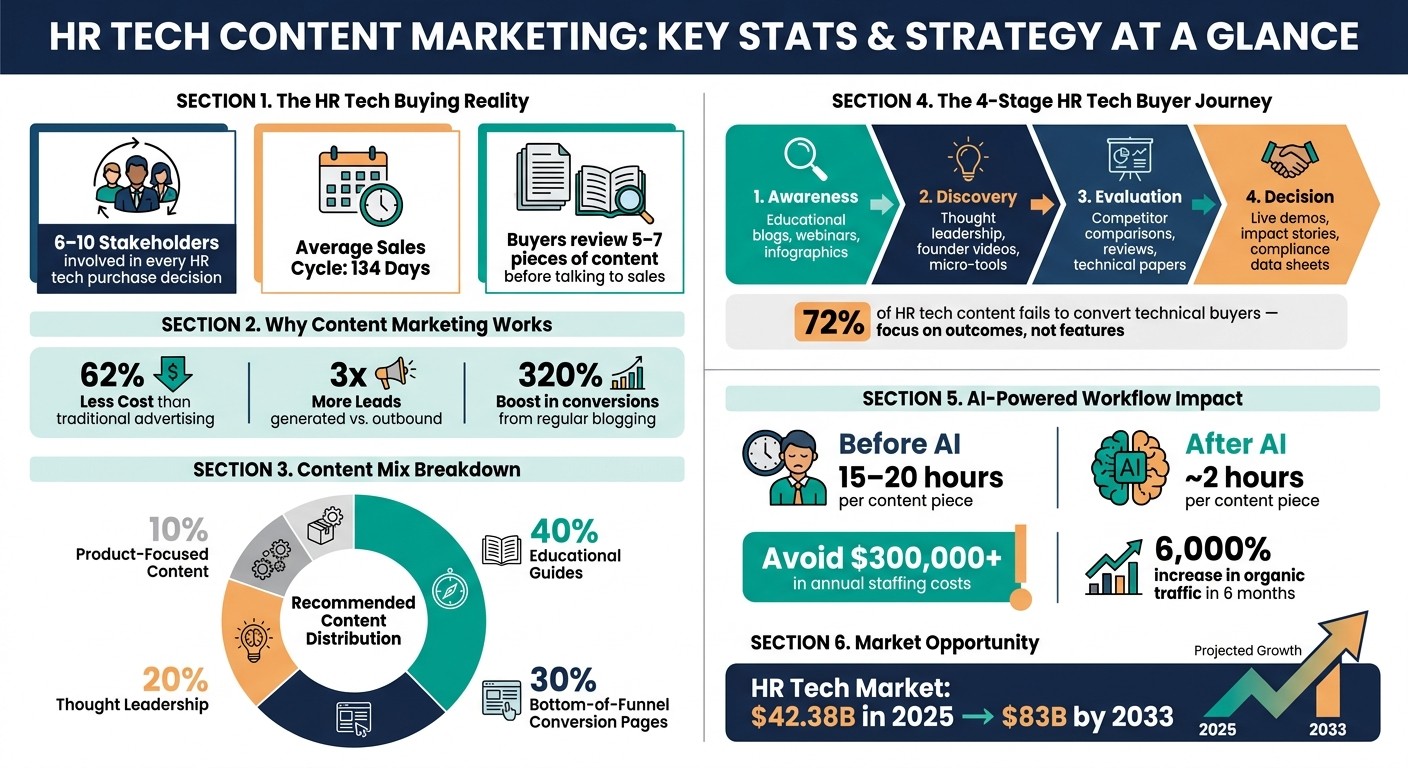
HR Tech Content Marketing: Key Stats & Strategy at a Glance
Know Your HR Tech Audience and Buyer Journey
How to Define Your Ideal Customer Profile (ICP)
Understanding your audience is the cornerstone of creating content that builds trust and fuels growth. HR tech decisions are rarely made by one person - they involve a mix of stakeholders across HR, IT, Finance, and Legal [1].
Here’s a breakdown of the key players and their concerns:
Stakeholder | Key Concern | Primary Question |
|---|---|---|
Strategic HR Leadership | Business alignment & ROI | How will this advance our business strategy? |
HR Operations | Implementation & integration | How will this affect our current processes? |
IT | Security & compatibility | Is this solution secure and compatible with our tech stack? |
Finance | Total cost of ownership | What is the total cost, and when do we break even? |
Line Managers | Usability & time savings | Will this make my job easier or harder? |
Legal/Compliance | Risk & data protection | Does this create new regulatory risks? |
Once you’ve identified these stakeholders, tools like Gong or Fathom can help you analyze sales calls, uncovering recurring objections and questions [4]. Pair this with reviews from platforms like G2 and Capterra to capture the exact language prospects use. This feedback effectively turns your buyers’ words into a ready-made content brief.
To pinpoint where your audience spends time, platforms like LinkedIn Sales Navigator and SparkToro can reveal the communities, influencers, and publications they follow [4]. This insight not only shapes the content you create but also guides where to distribute it.
As industry experts point out, HR tech buyers aren’t overwhelmed by choices; they’re overwhelmed by a lack of time, trust, and proof [1]. By understanding their concerns and behaviors, you can better navigate the stages of their decision-making process. With your ICP in place, the next step is mapping their journey to deliver the right content at the right time.
Mapping the HR Tech Buyer Journey
Once your ideal customer is defined, the next move is to align your content strategy with the buyer journey. In HR tech, this journey typically unfolds in four stages: Awareness, Discovery, Evaluation, and Decision. Given the average sales cycle of 3 to 4 months [9], buyers engage with content throughout - and with 89% of B2B buyers using generative AI tools to assist their purchasing decisions [10], structuring your content for AI citations is now just as vital as traditional SEO.
Here’s a snapshot of what buyers need at each stage and the content formats that resonate:
Journey Stage | Buyer Goal | Recommended Content |
|---|---|---|
Awareness | Identify the problem | Educational blogs, webinars, infographics |
Discovery | Explore solution types | Thought leadership, founder-led videos, micro-tools |
Evaluation | Compare specific vendors | Competitor comparisons, third-party reviews, technical papers |
Decision | Validate ROI & security | Live demos, impact stories, compliance data sheets |
An important note: 72% of HR tech marketing content fails to convert technical buyers because it focuses too much on features rather than outcomes [2]. For instance, a line manager doesn’t care about “automated workflow triggers” - they want to know how a solution will save time or improve results. Translating technical capabilities into business-focused benefits can significantly increase your content’s effectiveness.
"Buyers engage with three to five pieces of content before they ever speak to sales. That's where trust is built, or lost." - Kirsten Robinette, Marketing Strategist, WorkTech Advisory [4]
And don’t stop once the deal closes. Post-purchase content - like onboarding guides, feature updates, and community forums - plays a critical role in reducing churn [9]. By aligning your content with every stage of the buyer journey, you ensure your marketing remains impactful from start to finish. With the HR tech market expected to reach $83 billion by 2033 [1], retaining customers is just as crucial as acquiring new ones.
How to Build an HR Tech Content and SEO Strategy That Works
How to Build a Scalable Content Marketing Plan
Once you've mapped out your buyer journey, the next step is crafting a content strategy that aligns with both your business objectives and the needs of your audience.
Choosing Content Pillars for HR Tech
With your buyer personas and their journey in hand, it's time to decide on the core themes your content will cover. For HR tech startups, a balanced strategy works best, distributing efforts across the funnel:
40% educational guides
30% bottom-of-funnel conversion pages
20% thought leadership
10% product-focused content[8]
This mix builds awareness while also targeting buyers ready to make decisions. To stand out, focus on data-backed authority by publishing resources like benchmarks and trend reports tailored to the unique challenges faced by legal, finance, and HR teams [12].
Using a topic cluster model is another effective approach. For instance, create a comprehensive pillar page (think 3,000+ words, such as The Complete Guide to HR Automation for Mid-Size Companies) and support it with 5–8 detailed subtopic articles. This not only establishes authority with search engines but also provides valuable depth for buyers at every stage [8].
"Content marketing should be a means to connect with people and bring in new clients. Don't become a full-time blogger in the process of growing your brand!" - Amanda Cross, Thought Leadership Writer [12]
Maximize your efforts by developing one major asset - like an eBook or benchmark report - and repurposing it into smaller pieces, such as blog posts, LinkedIn updates, or infographics. A single piece of research can fuel your content for an entire quarter, saving time and resources [11].
Once your content pillars are defined, the next step is to align these themes with your business and buyer cycles using a well-structured content calendar.
Building a Content Calendar Around Business Goals
A content plan disconnected from business objectives is far less effective.
"The problem isn't content marketing. The problem is how most B2B SaaS companies do content marketing: sporadically, without a system, targeting the wrong keywords, and measuring the wrong metrics." - Zach Chmael, CMO, Averi [8]
Map out your content 90 days in advance, syncing it with the US business calendar. Tools like Averi can help you track trends and refine your strategy on the go. HR professionals follow predictable cycles - Q4 is prime for ROI calculators, vendor comparison guides, and compliance checklists as HR leaders finalize budgets and evaluate new tools for the next year. Mid-year (Q2–Q3) tends to focus more on performance management and retention-related content.
For startups in early stages, targeting bottom-of-funnel keywords like "best HR automation tool" or "[competitor] alternatives" can deliver quick pipeline results within 90 days. Once you've gained traction, shift to broader educational topics to grow your long-term presence [7].
A sample 90-day plan might look like this:
Month 1: Publish four comparison articles.
Month 2: Develop a topic cluster with six to eight pieces.
Month 3: Refresh high-performing content and launch a new pillar page [8].
AI-powered tools like Averi can streamline this process, keeping your calendar up-to-date and integrated into your overall workflow. Traditional topic research often takes 3–5 hours weekly, but an AI content engine can monitor competitors, identify keyword gaps, and suggest ready-to-approve topics tailored to your ideal customer profile (ICP) [8]. Publishing consistently - on a weekly basis - drives conversions [3], making a regular schedule achievable even for smaller teams.
How to Run a Content Workflow Using AI Tools
A content calendar only works if you can consistently execute it. For lean HR tech startups, the challenge isn’t coming up with ideas - it’s finding the time to turn those ideas into published content. The traditional process (research, write, optimize, format, publish) can eat up 15–20+ hours a week. AI tools can cut this down to about 2 hours by automating the repetitive parts.
Step-by-Step Content Creation Workflow
Start by giving AI tools the right foundation. Input your Ideal Customer Profile (ICP), brand voice, competitive landscape, and core messaging. Averi refers to this setup as the "Brand Core." Once established, it informs every draft automatically, saving you from having to re-explain your positioning every time [3].
Here’s how it works: approve a topic, let the AI draft using your Brand Core, review and refine the draft, and then publish directly through CMS integrations. Tools like WordPress, Webflow, or Framer make publishing a breeze, cutting a 30-minute formatting task down to just 2 minutes [3]. Each published piece is saved in a content library, which helps improve future drafts.
"We built Averi around the exact workflow we've used to scale our web traffic over 6000% in the last 6 months." - Zach Chmael, CMO, Averi [3]
Between September 2025 and March 2026, Averi’s team used this method - automating research, drafting, and publishing - to achieve 2.91 million monthly organic search impressions with just one marketer [3].
Once your content is published, automation ensures it stays relevant and continues to perform.
Using Automation to Keep Content Improving Over Time
Publishing regularly is only part of the job; keeping content performing well is just as important. A smart tactic is to identify posts ranking on page two of search results and use AI to update them with fresh data or better keywords. This approach is faster than creating new content and often leads to quicker ranking improvements [7].
Automation also eliminates the inefficiency of switching between tools like keyword platforms, docs, CMS systems, and analytics dashboards. By centralizing approvals, edits, and performance tracking, you streamline your workflow. For instance, Averi doesn’t just analyze data - it provides actionable insights. It can flag a post ranking at #8 and recommend specific changes to push it to page one, or alert you when a competitor publishes on a topic relevant to your ICP [3]. This type of feedback transforms a content calendar into a growth engine.
How to Measure and Improve Content Performance
After implementing the steps for workflow automation, it's crucial to measure how well your content supports the buyer's journey. Unfortunately, many HR tech startups focus on metrics like page views and social shares, which don't reveal whether the content is actually driving conversions. The metrics that matter most are those directly tied to pipeline impact: demo requests, gated content leads, cost per lead (CPL), and content-assisted conversions - where a blog post or guide played a role in the buyer's decision-making process, even if it wasn’t the final touchpoint [14].
Key Metrics for HR Tech Content
In addition to lead generation, two metrics stand out for building long-term visibility: Domain Rating (DR) and organic traffic. A study by Journey Engine of 860 HR tech websites revealed that 64% of sites with a DR between 0 and 14 received no organic traffic [15]. On the other hand, websites with a DR above 57 attracted anywhere from 7,600 to over 34,000 monthly sessions. These figures offer a clear benchmark for setting realistic goals.
Here’s a breakdown of key metrics and their purposes:
Metric Category | Key KPIs | Purpose |
|---|---|---|
Lead Generation | Demo requests, gated content leads, CPL | Tracks direct contribution to the pipeline |
SEO/Authority | Domain Rating, organic traffic, SERP rank | Measures visibility over time |
Engagement | Time-on-page, scroll depth | Assesses how relevant content is to HR buyers |
Efficiency | CAC, content decay rate, assisted conversions | Evaluates ROI and long-term sustainability |
When it comes to engagement, metrics like time-on-page and scroll depth are critical. For example, HR professionals engaging with a 2,000-word thought leadership piece need to finish it for the content to have a meaningful impact. If scroll depth is low, it indicates the content isn't resonating, even if traffic numbers appear strong [13][14].
Once these metrics are clearly defined, the next step is to use AI tools to turn insights into actionable improvements.
Using AI to Act on Content Performance Data
Tracking data is only useful if it leads to change. AI tools can shift from being simple writing assistants to becoming engines for growth. For instance, Averi can analyze content performance in real time, flagging underperforming posts and suggesting specific optimizations to improve search rankings. If a competitor publishes content targeting your ideal customer profile, Averi can identify opportunities to create a counter-strategy, ensuring you stay competitive [7].
Another metric to consider adding to your dashboard is the Marketing Efficiency Ratio (MER), which is calculated by dividing total revenue by total marketing spend. Rather than attributing success to a single blog post in a lengthy sales cycle, MER offers a broader view of your content system’s overall health. When combined with content-attributed signups, it provides a more accurate and actionable picture of performance [8].
Conclusion: How Consistent Content Builds Long-Term Growth
A steady, AI-driven content strategy isn't about quick wins; it's about building momentum that pays off over time. Unlike paid ads that stop delivering the moment your budget ends, a well-structured content system continues to generate traffic, leads, and authority long after publication. Research shows that consistent blogging drives ongoing lead generation, and the benefits only grow the longer you stick with it [3].
Take Averi's content engine as an example: by maintaining a regular publishing schedule and optimizing for search engines, they achieved a staggering 6,000% increase in organic traffic within six months. Their impressions skyrocketed from 5,800 in May 2025 to 2.91 million by March 2026 [3]. This kind of growth isn’t the result of one standout post - it’s the outcome of a repeatable, disciplined system.
Leveraging AI-powered workflows makes this process manageable, even for small teams. By cutting content production time from 15–20 hours to just 2 hours, a two-person startup can match the output of a much larger team while avoiding costs that could exceed $300,000 annually [5][6]. Notably, human-edited AI content generates 5.44 times more traffic than content created solely by AI [5].
By focusing on bottom-of-funnel topics, keeping a backlog of ideas, and refreshing top-performing posts, you can build a scalable and sustainable content engine. Use performance data to refine your approach - double down on what works and eliminate what doesn’t.
In the competitive HR tech space, buyers are more research-driven than ever, relying on both Google and AI tools to make decisions. Startups that consistently show up in these spaces gain a significant edge. A structured, AI-supported content strategy isn’t just a marketing tool - it’s a long-term advantage that can set a lean HR tech startup apart. Implement these tactics to turn your content efforts into a lasting source of growth and differentiation.
FAQs
What content should I create first to shorten a long HR tech sales cycle?
To get ahead early in the buyer's decision-making process, focus on thought leadership content such as blogs, detailed guides, or comparison pages. These should be tailored to address the questions and challenges potential customers face at this stage. Prioritize research-driven, SEO-friendly articles that not only improve visibility but also establish your startup as a trusted authority. Incorporate elements like industry trends, case studies, and actionable how-to guides to provide real value. This approach positions your brand as a go-to resource, building trust and helping to streamline the sales journey.
How can I create content that appeals to HR, IT, Finance, and Legal at the same time?
To effectively connect with HR, IT, Finance, and Legal teams at the same time, it's key to focus on the priorities they all share - like compliance, efficiency, and cost management. Formats such as whitepapers or case studies work well here, as they can clearly demonstrate the cross-departmental advantages of your HR tech solution. Keep the language straightforward and avoid unnecessary jargon to ensure accessibility.
When crafting your message, align it with universal objectives, such as boosting productivity and reducing risks. At the same time, make an effort to address the specific challenges each group faces, ensuring the content speaks to their individual concerns while highlighting the collective benefits. This balanced approach helps your solution resonate across all departments.
What are the 3 best metrics to show content is driving demos and pipeline?
To measure how effectively your content is driving demos and building pipeline, focus on these three key metrics:
Number of leads generated: This shows how well your content attracts potential customers and brings them into your sales funnel.
Conversions from content engagement: Track how often engaged users take the next step, such as signing up for a demo or downloading additional resources.
Quality of qualified leads: Evaluate whether the leads generated align with your target audience and are likely to convert into paying customers.
These metrics provide a clear picture of how your content contributes to lead generation and conversion efforts.
Related Blog Posts

Zach Chmael
CMO, Averi
"We built Averi around the exact workflow we've used to scale our web traffic over 6000% in the last 6 months."
Your content should be working harder.
Averi's content engine builds Google entity authority, drives AI citations, and scales your visibility so you can get more customers.