

In This Article
GEO strategy lets Series A startups win new markets fast by optimizing content for AI citations, localized research, and automated publishing.
Updated:
Trusted by 1,000+ teams
Startups use Averi to build
content engines that rank.
Scaling a Series A startup requires precision, especially when expanding into new markets. Geographic Expansion Optimization (GEO) is a data-driven method that helps startups identify high-potential regions, create localized content, and leverage automation to grow quickly without overextending resources.
Key Takeaways:
Market Selection: Use AI tools to identify regions with the best ROI potential by analyzing search trends, competition, and customer profiles.
Content Strategy: Focus on localized, AI-optimized content to target both search engines and AI platforms like ChatGPT or Perplexity.
Automation: Tools like Averi can reduce manual work by 70%, enabling lean teams to scale efficiently.
Metrics to Track: Monitor AI citation rates, market share in AI responses, and conversion rates to refine your strategy.
By integrating GEO principles, startups can achieve 2x-3x growth in 12 months, meeting board expectations while avoiding common pitfalls like wasted budgets and low traction. The shift to AI-driven discovery makes this approach essential for staying competitive. This requires building brands that AI can't ignore to maintain long-term visibility.
Global Expansion Strategy for 2026: Where to Grow, How to Scale, and What to Watch
Step 1: Finding High-Potential Markets
Identify target markets where limited resources can achieve the greatest impact.
Market Research Essentials
Traditional market research can cost anywhere from $15,000 to $50,000 and take 4 to 12 weeks to complete [4]. For Series A startups, this timeline and expense are often impractical. Fortunately, AI-powered tools like Averi dramatically reduce both time and cost by analyzing hundreds of data sources - ranging from competitor content to social media sentiment and regulatory updates - in just minutes [4]. This approach aligns perfectly with a GEO strategy, allowing for faster insights and smarter market targeting.
Start by identifying gaps in topical authority. Focus on niches that dominant brands may have overlooked [2]. For example, if you're marketing a project management tool, you might notice that while Asana dominates "project management for enterprise", there’s minimal content addressing "project management for remote design teams."
Key metrics to evaluate include:
Search volume for "problem-aware" and "solution-aware" queries
Competitive content density
Average Contract Value (ACV) alignment
Markets with an ACV under $5,000 are better suited for scalable Product-Led Growth (PLG) models and SEO-driven strategies. On the other hand, markets with ACVs exceeding $100,000 justify resource-intensive, sales-led approaches [3]. Misaligning your go-to-market strategy with the ACV profile can quickly drain your resources.
It’s also worth noting that 89% of B2B buyers now use generative AI tools during their purchasing decisions [3]. This means your research should account for both traditional search engines like Google and AI-driven discovery channels such as ChatGPT and Perplexity. Content optimized for traditional search but not AI extraction risks missing a significant portion of your audience.
Once you’ve identified clear market gaps, the next step is to refine your focus by building data-backed customer profiles.
Developing Ideal Customer Profiles (ICPs)
After identifying promising markets, create data-driven Ideal Customer Profiles (ICPs) tailored to each region. Focus on revenue-related metrics like contract values, renewals, and churn rates to estimate the true market potential [6].
A useful tool for this process is the MMF-PMF Matrix (Message-Market Fit vs. Product-Market Fit). Use leading indicators such as win rates and sales velocity (MMF) alongside lagging indicators like lifetime value and net revenue retention (PMF) to plot customer segments [6]. Segments that perform well on both dimensions can be classified as "Ideal", while those with strong acquisition but weak retention may be "Acceptable" for short-term gains. Segments that underperform in both areas should be avoided [6].
This data-driven segmentation can significantly improve your results:
Boost marketing conversions by 30–50%
Shorten sales cycles by 20–35%
Increase customer lifetime value by 15–25% [6]
For startups leveraging tools like Averi, much of this analysis can be automated. By uploading your customer data and brand documents, Averi identifies patterns in your top-performing accounts and suggests ICPs. You can then review and refine these suggestions, cutting down analysis time considerably [5].
Once ICPs are finalized, the next step is to rank these markets using measurable criteria.
Prioritizing Markets Effectively
With potential markets identified and ICPs in place, you’ll need a framework to rank them. A practical method involves evaluating three key factors: market opportunity size, competitive intensity, and execution feasibility.
Start by calculating your Total Addressable Market (TAM), Serviceable Available Market (SAM), and current market penetration to uncover whitespace opportunities - markets with high demand and low competition [6]. Tools like scoring matrices or clustering algorithms can help you weigh these factors based on your specific constraints, including ACV-channel alignment. For example, PLG models work best for low ACVs, while sales-led strategies are better suited for high ACVs [3].
Here’s how this might look for a Series A SaaS company with $2.5 million in ARR and a small marketing team:
UK: Large market but high competition makes it tough to break in.
Germany: Moderate opportunity with less competition but requires localization efforts.
Australia: Smaller market, but low competition and fewer barriers make it easier to establish authority.
Given limited resources, Australia might rank highest due to its clear path to success.
Finally, focus on building depth before breadth. Instead of spreading resources thin across a wide range of topics, concentrate on 2–3 core topic pillars to establish domain authority quickly [2]. This approach not only signals expertise to search engines but also boosts visibility in AI-powered discovery systems, increasing the likelihood of being recognized when potential buyers search for relevant solutions.
Step 2: Building a GEO-Optimized Content Strategy
After pinpointing your target markets, the next move is crafting content that enhances visibility across both search engines and AI platforms using the GEO framework. This dual approach is essential, as 89% of B2B buyers now rely on AI tools during their purchasing process [7], and visitors referred by AI convert at a rate 4.4 times higher than those from traditional organic traffic [8].
Creating Market-Specific Content
Expanding into new regions successfully requires tailoring your content to reflect local preferences, regional challenges, and cultural expectations. This means adjusting examples, units of measurement, currency formats, and even the tone to align with each audience.
For instance, content aimed at European audiences should focus on GDPR compliance and use local currencies, while U.S.-specific content would incorporate imperial measurements and dollar formatting. Cultural sensitivity is equally important - understanding whether a market prefers direct communication, as seen in the U.S., or a more nuanced approach, like in Japan, can make a big difference [9][13].
Start by studying cultural dimensions using tools like Hofstede Insights [9][13]. Combine this with tools like Ahrefs to map out region-specific search terms. For example, in the U.S. Southwest, a relevant query might be "Series A funding in Texas", while in Germany, it could be "Series A venture capital in Berlin" [11][12]. Research shows that tailoring content to match local buyer intent can boost conversion rates by two to three times [11][12].
Develop content clusters around high-intent, location-specific topics. If you’re expanding into Australia, consider creating comparison pages such as "Your Product vs. Australian Competitor" or case studies highlighting Australian businesses. This signals relevance to both search engines and AI platforms, which prioritize sources that align with the geographic context of user queries.
To streamline this process, AI tools can be a game-changer.
Using AI for Content Creation
Creating content for multiple markets can be time-consuming, but AI tools like Averi simplify the process by automating market research, generating localized content drafts, and applying GEO optimization techniques - all within one workflow.
Averi begins by analyzing your website to understand your product’s positioning and brand voice. Once you provide your ideal customer profiles (ICPs) and target regions, the system generates tailored content for each market. It automatically adjusts for regional differences, such as currency formats, units of measurement, spelling variations (e.g., "optimize" in U.S. English vs. "optimise" in UK English), and localized keywords. This automation reduces the manual workload by roughly 70% [9][12].
The workflow combines AI efficiency with human oversight: AI handles research and structure (about 60% of the work), while human input refines the tone, adds unique insights, and ensures cultural accuracy (the remaining 40%) [7]. For example, a fintech startup used AI to produce 50 localized landing pages for European markets in just one week, resulting in a 40% increase in traffic [10][11]. Similarly, a healthtech company automated a blog series on regional compliance, reducing production costs by 60% while maintaining a cohesive brand voice [10][11].
Iteration is crucial. Review AI drafts for cultural and contextual accuracy, provide feedback, and allow the system to improve. Over time, saved drafts in your content library enhance future outputs by building a deeper understanding of your brand.
With localized content in hand, the next step is optimizing it for AI-driven search engines.
Optimizing Content for AI Search Engines
While traditional SEO focuses on ranking for keywords, GEO aims to establish your content as the trusted source AI platforms cite when delivering answers. As Zach Chmael, CMO of Averi, explains:
"Traditional SEO asks: 'How do I rank for this keyword?' GEO asks: 'How do I become the authoritative source AI confidently cites when synthesizing answers?'" [7]
To achieve this, your content needs structured formats, clear signals of expertise, and up-to-date information. Research indicates that content formatted with concise question-and-answer sections is 40% more likely to be cited by AI tools [8], and pages updated within two months see a 28% increase in AI citations compared to older content [8].
Incorporate 40–60 word answer blocks directly following question-based headings. For example:
How does GEO differ from SEO?
GEO focuses on making content authoritative for AI-generated answers, while SEO emphasizes keyword rankings and backlinks. GEO prioritizes structured formats, consistent entity signals, and data-rich content that AI can easily reference.
Use proper HTML hierarchy (H1 → H2 → H3) to help AI models understand topic transitions [8]. Apply specific schema markups, such as FAQPage for Q&A sections, HowTo for step-by-step guides, and Organization with knowsAbout arrays to highlight expertise [8]. Adding FAQ sections with localized questions like "What are the best Series A funding options in California?" can attract both traditional search traffic and AI citations [9][11].
Concrete data with clear attribution enhances credibility, lifting impression scores by an average of 28% [8]. Signals of freshness, such as "Last Updated: April 15, 2026", and phrases like "As of April 2026", indicate relevance to AI crawlers [8]. Finally, ensure consistency in your company’s information across platforms like LinkedIn, G2, and Crunchbase, as AI systems prioritize brands with corroborated data [8].
Step 3: Implementing and Automating GEO Workflows
It’s time to move from planning to action. For Series A startups, the challenge lies in executing consistently without exhausting resources. This is where automation becomes a game changer, tackling repetitive tasks while maintaining high-quality output. The next step is to utilize structured data to ensure your content is easily understood and referenced by AI engines.
Adding Structured Data
Structured data helps AI engines interpret and cite your content accurately. By implementing schemas such as Organization, Product, and FAQPage, you can significantly increase your visibility in AI-driven responses - by as much as 30% to 40% [14][15][19]. Tools like AthenaHQ (starting at $49/month) and Profound (Lite plans at $499/month) make this process more accessible.
Start with Organization schema on your homepage. This schema provides AI crawlers with essential information about your company - who you are, what you do, and where to find credible details. Next, add Product schema to product pages, including details like pricing, availability, and customer reviews. For blog posts or guides, incorporate FAQPage schema to structure Q&A sections effectively.
For startups competing against larger, well-established companies, this added visibility can make a significant difference. Once your structured data is in place, the focus shifts to automating the content publishing process for consistent output.
Automating Content Publishing
With structured data ready, the next step is to eliminate manual publishing tasks by directly integrating your CMS. Tasks like reformatting and fixing links can consume hours each week. A direct CMS integration removes these bottlenecks entirely.
Averi simplifies this process by connecting directly to platforms like Webflow and WordPress. It allows you to push finished content from draft to live with no manual intervention [1][2]. The workflow begins with AI-powered research and drafting, moves through collaborative editing (where your team can refine tone and leave comments), and ends with one-click publishing.
"We built Averi around the exact workflow we've used to scale our web traffic over 6000% in the last 6 months." - Zach Chmael, CMO, Averi [3]
This streamlined automation can triple your monthly content output without increasing your team size [1]. For a Series A startup, this means producing enterprise-level content at a fraction of the cost - 60% to 80% less than hiring full-time writers [1][3].
Tracking and Improving Performance
Publishing is just the beginning; tracking performance completes the cycle. Automation not only speeds up production but also provides critical insights into how your content performs. While traditional SEO metrics like rankings and traffic remain relevant, GEO introduces new benchmarks: AI citation count, market share in AI responses (how often your brand appears compared to competitors), and sentiment analysis (whether AI portrays your brand positively or negatively) [17][18].
Start by identifying your "Golden Prompt" universe - 30 to 100 prompts that mirror how your target audience searches [17][18]. Tools like Profound and Otterly AI (starting at $29/month) help track how often your brand appears in responses to these prompts across platforms like ChatGPT, Gemini, and Perplexity [14][16]. Pay close attention to citation frequency and quality: if your brand is mentioned often but without clickable links, it could indicate that your content lacks the authority or structure AI engines need to treat it as a primary source [17][18].
Use first-touch and last-touch attribution to pinpoint which content pieces engage leads initially and which drive conversions [1]. For example, if a blog post on "Series A funding strategies" frequently serves as a first touch, consider expanding on similar topics. If a comparison page consistently drives conversions, prioritize creating more head-to-head content.
Performance tracking is the final piece of the puzzle. By analyzing data, you can determine what content to create next, which pieces need updates, and where to focus your efforts. As Mahi Kothari, Senior Content Strategist at Quattr, explains:
"Measurement in isolation is noise. Measurement tied to execution is leverage." [17]
30-Day GEO Implementation Plan
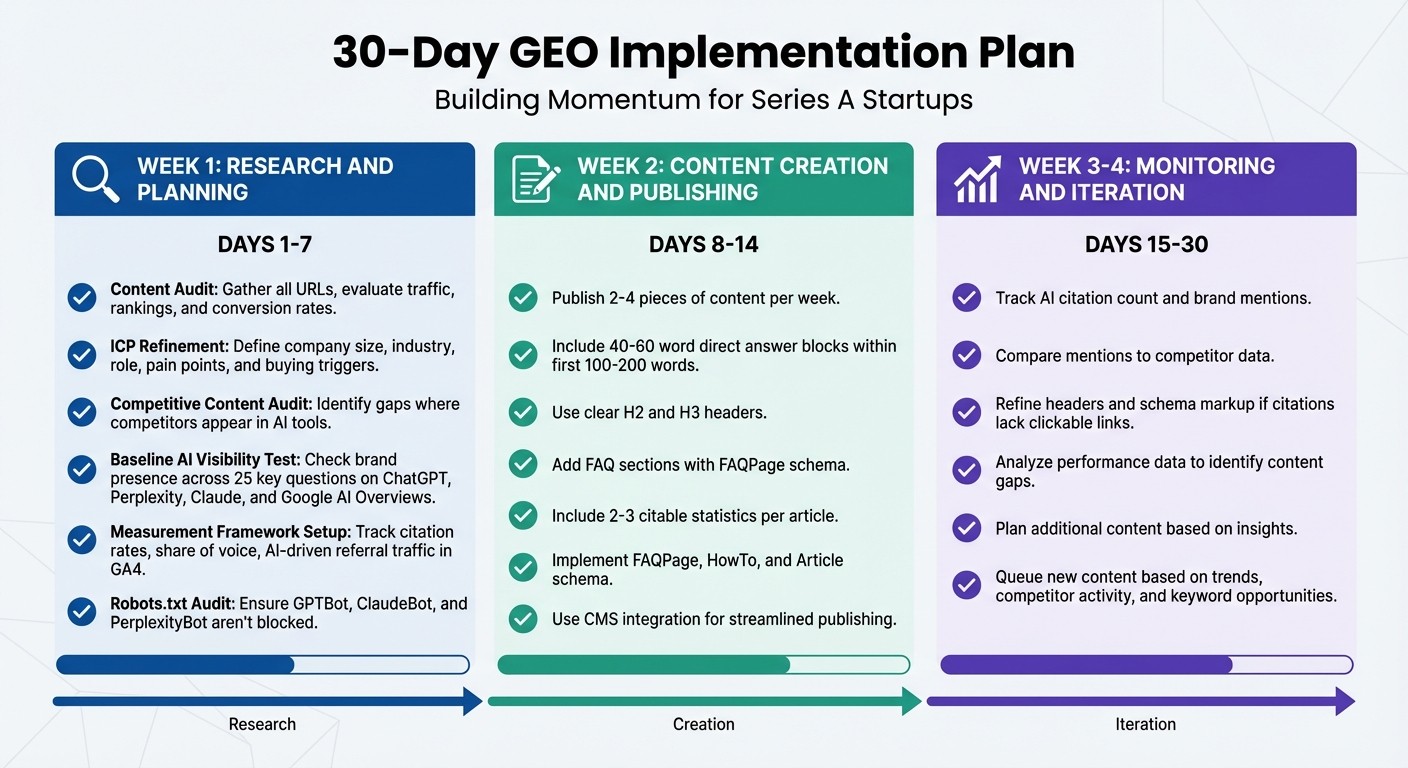
30-Day GEO Implementation Plan for Series A Startups
This 30-day plan is designed to drive immediate action for implementing the GEO strategy. The focus here is on building momentum rather than achieving perfection. For Series A startups, speed is critical during this initial sprint.
Week 1: Research and Planning
Kick things off by conducting a content audit. Gather every URL on your site and evaluate monthly traffic, keyword rankings, and conversion rates. Decide which pieces of content to keep, update, or remove [1][2]. Prioritize high-performing content that aligns with your goals.
Next, refine your Ideal Customer Profile (ICP). Be as specific as possible - define details like company size, industry, role, pain points, and buying triggers. For instance, if targeting Series A SaaS companies, clarify whether you're focusing on 20-person teams with $3 million in ARR or 50-person teams with $10 million. Pair this with a competitive content audit to identify gaps where competitors are mentioned in AI tools but your brand isn’t [2][3][20].
Run a baseline AI visibility test by checking your brand’s presence in responses to 25 key industry questions on platforms like ChatGPT, Perplexity, Claude, and Google AI Overviews [8]. Record these results to establish your starting point.
Finally, set up a measurement framework. Track metrics like citation rates (how often AI tools reference your content), share of voice, and AI-driven referral traffic [8]. Use GA4 to create segments for domains like chat.openai.com, perplexity.ai, and claude.ai to monitor traffic from these sources [8]. Don’t forget to audit your robots.txt file to ensure AI crawlers like GPTBot, ClaudeBot, and PerplexityBot aren’t being blocked [8].
With this groundwork complete, you’ll be ready to ramp up content production in Week 2.
Week 2: Content Creation and Publishing
Switch gears to content production mode. Aim to publish 2–4 pieces of content per week [3]. Use AI-assisted tools to draft initial versions of articles, aligning them with your keyword strategy and brand voice [1][22]. Structure your content for easy extraction by AI tools: include a 40–60 word direct answer to the core question within the first 100–200 words, use clear H2 and H3 headers, and add FAQ sections with FAQPage schema [21][3].
Ensure your content is packed with factual details. Include at least 2–3 citable statistics or original frameworks per article [21]. For example, instead of writing, "AI search is growing", provide a concrete statistic like, "Traffic to U.S. retail websites from generative AI sources increased by 1,200% between July 2024 and February 2025" [8].
Before publishing, verify your schema and metadata. Implement FAQPage, HowTo, and Article schema to make your content easier for AI to extract and cite [21]. Use your CMS integration to streamline publishing and maintain consistency [22].
Once the content is live, shift your focus to performance monitoring and strategy refinement in the following weeks.
Week 3-4: Monitoring and Iteration
After publishing, begin tracking performance metrics. Monitor your AI citation count and how often your brand is mentioned in AI-generated responses. Compare this to competitor mentions to measure progress.
If citations lack clickable links, refine headers and schema markup to improve link integration. Analyze performance data to identify content gaps and plan additional pieces on related topics. Use these insights to guide your next content cycle - decide what to expand on, update, or create anew.
Weeks 3-4 are all about fine-tuning. Queue up new content based on emerging trends, competitor activity, and keyword opportunities. Increased publishing not only grows your content library but also helps the system better understand and recommend your brand.
GEO vs. SEO: What's the Difference?
How GEO and SEO Differ
SEO, or Search Engine Optimization, focuses on ranking for specific keywords to attract clicks from search engines like Google. This involves optimizing content for keyword relevance, building backlinks, and targeting top spots in search results.
GEO, or Generative Engine Optimization, takes a different approach. It aims to position your content as the authoritative source cited by AI models like ChatGPT, Perplexity, and Claude. As Zach Chmael, CMO at Averi, explains, GEO is about being the trusted source for AI-generated answers.
The structural demands of these strategies also set them apart. Traditional SEO prioritizes broad keyword strategies and long-form content designed for search engine crawlers. In contrast, GEO requires highly "extractable" content - think concise 40–60 word answer blocks, clear headings, and structured data. AI platforms rely on a retrieval-synthesis-citation process, which makes formats like tables and lists far more effective than simply cramming in keywords.
User behavior also shifts significantly. With SEO, users search, click on a link, and engage with the content on a website. GEO flips this model. Users receive a synthesized answer directly from an AI system - often without clicking through. Research shows that 93% of AI-driven searches end without a click [7], and zero-click searches have risen from 56% to 69% since Google introduced AI Overviews [7].
This shift from focusing on keyword rankings to earning authoritative citations is why GEO offers unique advantages for startups.
Why GEO Works for Series A Startups
For early-stage companies, GEO offers a way to compete without the long wait required to build Domain Authority through SEO. Startups can become "citation-worthy" and bypass the resource-heavy demands of traditional SEO [7].
The conversion potential is impressive. Visitors arriving via AI search convert at rates 4.4 times higher than those from traditional organic traffic because AI pre-qualifies them with tailored recommendations [3]. Additionally, 89% of B2B buyers now use generative AI tools during their decision-making process [3], and half of B2B software buyers start their search with AI chatbots rather than traditional search engines [7]. By 2027, AI-driven search channels are expected to generate economic value comparable to traditional search [3].
For startups working with content budgets between $15,000 and $40,000 per month [2][1], GEO compresses the customer journey into a single interaction, making it an efficient and effective strategy.
"Your content IS your sales team when you can't afford a sales team" [3]
Zach Chmael, CMO, Averi
GEO vs. SEO Tools Comparison
Here's a quick look at how GEO and SEO stack up:
Feature | Traditional SEO | Generative Engine Optimization (GEO) |
|---|---|---|
Primary Goal | Rank for keywords and drive clicks | Be cited as the authoritative source in AI answers |
Core Metric | Clicks, CTR, and keyword position | Citation frequency and brand share of voice |
Content Focus | Keyword density and backlink profile | Extractable facts, direct answers, and original data |
User Behavior | Search → Click → Read | Ask → Receive synthesized answer |
Startup Advantage | Hard to compete with high-DA incumbents | Citation-worthy content can bypass DA limitations |
Conversion Rate | Standard organic conversion rates | 4.4× higher conversion than traditional organic [3] |
Speed to Result | Slower; requires indexing and ranking | Faster; immediate AI citations [23] |
This comparison underscores why startups should consider a GEO-first strategy while maintaining strong SEO fundamentals.
Averi simplifies GEO by automating the creation of structured data, FAQ schemas, and citation-ready content. Starting at $99 per month [24], Averi can triple your content production without increasing your team size. It handles the technical aspects - like generating concise answer blocks, applying structured hierarchies, and integrating schema markup - allowing you to focus on strategy and content approval.
Although GEO and SEO differ, they work best together. A solid technical SEO foundation remains vital because AI bots still rely on organic search to locate content. Many AI platforms use Retrieval Augmented Generation (RAG) to enhance their knowledge with real-time data from search rankings. For Series A startups, the ideal approach is "GEO-First, SEO-Strong": prioritize creating citation-ready content while maintaining robust technical SEO. This strategy enables startups to enter key markets more effectively and scale faster.
Conclusion
Shape your GEO strategy by blending traditional SEO techniques with content tailored for AI-driven platforms. Start with focused content clusters, anchored by a central pillar page and supported by related posts. Each post should include a concise 40–60 word summary and clear, structured headings. This method lays a solid foundation for reaching high-intent buyers.
Prioritize bottom-funnel assets like comparison pages and case studies to attract high-intent buyers as your strategy gains traction. Being referenced in AI-generated answers can have a direct impact on your pipeline and overall success.
Refinement is key to long-term success. Regularly update high-performing content while phasing out underperformers. Monitor keyword rankings and use multi-touch attribution to guide your adjustments. Aiming for 15–25% month-over-month growth in organic traffic [3] can serve as a strong benchmark. By continuously improving your approach, your content evolves into a scalable asset aligned with your growth.
Tools like Averi can simplify the entire process, enabling you to triple your content output without increasing team size. By automating workflows from strategy to publishing, Averi empowers small teams to produce more while transforming content into an asset that builds authority over 12–24 months. This comprehensive GEO strategy helps maximize resources and drives steady growth in new markets.
Related Blog Posts

Zach Chmael
CMO, Averi
"We built Averi around the exact workflow we've used to scale our web traffic over 6000% in the last 6 months."
Your content should be working harder.
Averi's content engine builds Google entity authority, drives AI citations, and scales your visibility so you can get more customers.