

In This Article
Compare costs, speed, control, and output of SEO agencies vs AI content engines to decide whether to hire experts, automate content, or use a hybrid approach.
Updated:
Trusted by 1,000+ teams
Startups use Averi to build
content engines that rank.
When deciding how to grow your website's traffic, you have two main options: hiring an SEO agency or using an AI content engine. Each has distinct strengths and weaknesses, and the choice depends on your budget, goals, and how much control you want over the process. Here's a quick breakdown:
SEO Agencies: Offer expert guidance and handle everything for you but are expensive (up to $300,000+ annually) and slower (6–16 weeks for results). They excel in technical SEO and creative campaigns but often lack transparency and speed.
AI Content Engines: Cost significantly less ($3,000–$15,000 yearly), work faster (hours or days), and allow you to control the process. However, they require human oversight to ensure quality and alignment with your brand.
Key Takeaway: If you need tailored strategies and can afford higher costs, agencies are the way to go. For faster, scalable content production at a lower cost, AI tools are ideal. Many businesses combine both for the best results.
Quick Comparison
Factor | SEO Agency | AI Content Engine |
|---|---|---|
Speed | Slow (6–16 weeks) | Fast (hours or days) |
Cost | $36,000–$300,000+ annually | $3,000–$15,000 annually |
Control | Limited | High |
Output | 8–12 pieces per month | 20–50+ pieces per month |
Best For | Complex strategies, large budgets | Fast production, small teams |
For most, a hybrid approach - agencies for strategy and AI for execution - delivers the best balance of cost, speed, and quality.
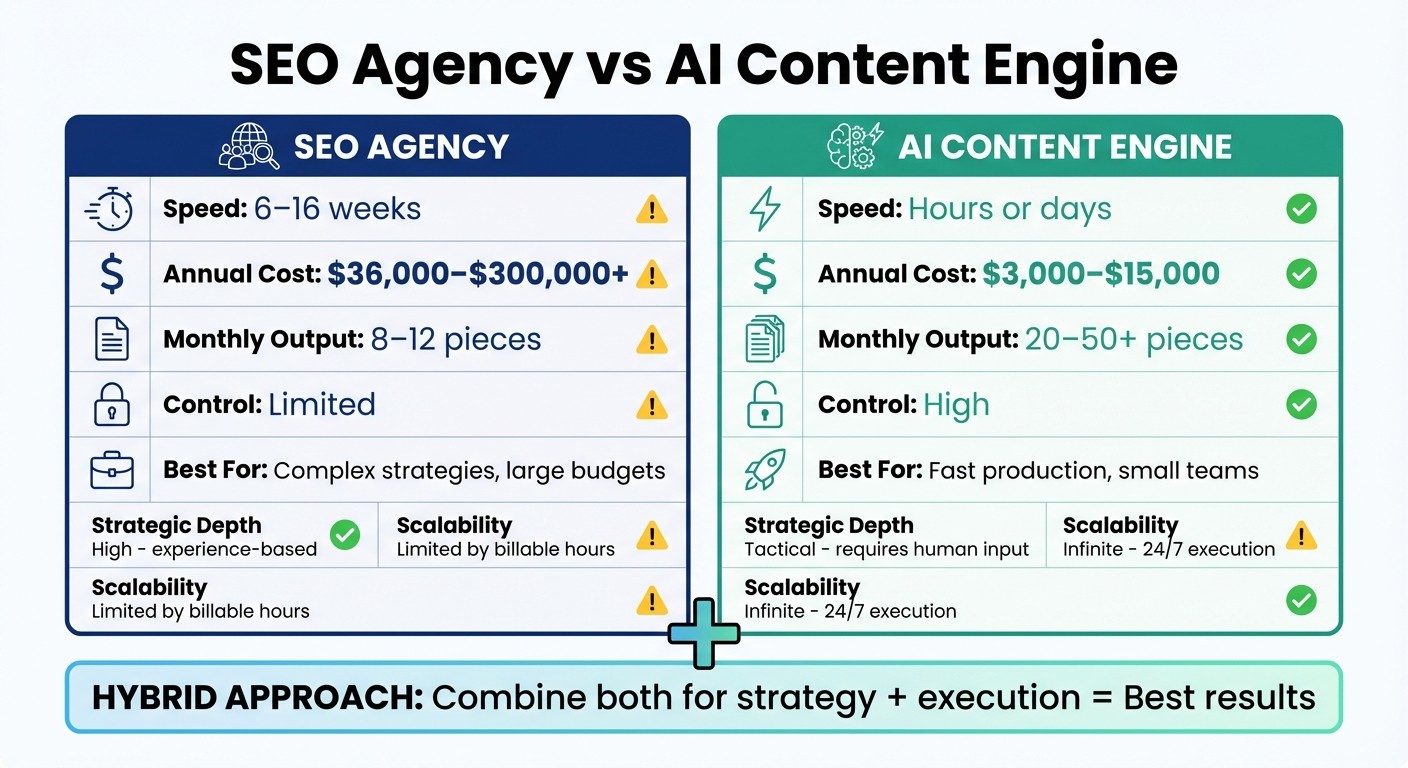
SEO Agency vs AI Content Engine: Cost, Speed, and Output Comparison
How Each Option Works
SEO Agencies: Human-Managed Execution
SEO agencies rely on custom strategies built through hands-on research and expert analysis. Their process typically starts with in-depth site audits, competitive analysis, and keyword research, which can take several weeks. Once the strategy is finalized, they manage tasks like content creation, link-building campaigns, and technical optimizations, all handled by specialized team members.
The workflow is structured but often slow, with multiple steps and handoffs. For instance, a single blog post might pass through strategists, writers, editors, and SEO specialists, each adding their input. These revision cycles can stretch timelines significantly. Agencies are particularly skilled at tackling technical SEO issues, such as improving site architecture, earning high-quality backlinks, and addressing algorithm updates that demand advanced expertise.
However, this approach comes with limitations. Agencies often manage multiple clients simultaneously, meaning your projects compete for their attention. Transparency is another challenge - you generally have limited real-time visibility into their processes. While this model suits businesses looking for strategic insight and can accommodate longer timelines, it struggles to deliver the speed and immediacy that some companies require. AI content engines, on the other hand, address these gaps by automating much of the execution process.
AI Content Engines: Automated Workflows and Speed
AI content engines, such as Averi, take a streamlined approach by automating the entire content lifecycle. The system begins by analyzing your website to create a "Brand Core" in just 10 minutes [2]. This ensures that every piece of content aligns with your brand identity without requiring detailed manual input.
Unlike traditional agency workflows, AI engines operate continuously rather than in isolated campaigns. They handle market research, monitor competitor activity, identify keyword opportunities, and generate content ideas automatically. Once you approve a topic, the engine drafts, optimizes for both Google and AI citations, and publishes content within hours or days.
"The bottleneck is execution, not strategy. Every startup founder knows what content they should be creating... they just can't do it." - Zach Chmael, Head of Marketing, Averi [2]
A key advantage is the human-in-the-loop model, which blends AI efficiency with human oversight. You can review AI-generated drafts, refine tone and messaging, and approve the final versions, ensuring quality and brand consistency. This hybrid system enables a single person to achieve the output of an entire team, producing 20–50 or more pieces of content monthly with human review [2]. Additionally, AI engines optimize for Generative Engine Optimization (GEO) by structuring content with FAQ sections and authoritative sources, increasing the chances of being cited by AI search tools [2]. In contrast, these tasks require manual effort in traditional agency workflows.
The Truth About AI, SEO, and Why Agencies Are Struggling
Cost Comparison and Total Ownership
When it comes to pricing, SEO agencies charge between $2,500 and $12,000 per month, while specialized firms can demand anywhere from $8,000 to $25,500 monthly. Annually, this translates to a hefty $36,000 to $306,000 before factoring in any additional expenses [1].
By contrast, AI content platforms operate on a much different pricing model. For instance, Averi offers plans starting at $45 per month for its Plus tier, scaling up to $285 monthly for Pro levels [1][2]. Even when you include extra marketing tools - adding between $3,000 and $15,000 annually - the total yearly cost typically falls between $10,000 and $15,000. This not only represents a clear cost reduction but also provides flexibility with month-to-month commitments, avoiding the long-term contracts often required by agencies.
Traditional setups also come with hidden costs. One major factor is the "coordination tax" - the time and effort spent managing feedback loops, attending meetings, and juggling multiple vendors. If this coordination requires more than 15 hours per week, it can significantly inflate the actual cost of working with an agency.
Startup Budgets: Fixed Costs vs. Variable Fees
The impact of these cost structures varies between startups and larger enterprises.
For startups, traditional agency fees can exceed $500,000 annually. On the other hand, an AI-driven model can deliver comparable results for closer to $100,000 per year [1]. Breaking down a traditional setup designed for $500,000 in output, you might see $392,000 allocated to full-time employees, $60,000–$150,000 to agencies and programs, and over $50,000 to software tools [1]. A substantial portion of this budget goes toward organizational overhead rather than direct marketing results.
AI content engines flip this model on its head. Startups can allocate approximately $15,000 to AI platforms and tools, alongside $40,000–$50,000 for fractional leadership, to create a marketing system comparable to a $500,000 traditional setup - all for around $100,000 annually [1]. In this scenario, AI takes care of repetitive tasks like research, drafting, and optimization, while fractional experts focus on strategy. This approach reduces coordination overhead and ensures predictable, lower monthly costs.
Enterprise Budgets: Premium Services and Custom Work
While startups thrive on AI’s efficiency, enterprises often require more tailored solutions that justify larger investments.
Enterprise-grade SEO agencies provide premium services such as dedicated account management and custom campaigns, which can push annual costs well beyond $500,000 when retainers, project fees, and internal management resources are included [1].
Some enterprises opt to build in-house AI workflows by hiring content engineers, who come with fully loaded annual costs of $120,000–$175,000 [2]. As Parker Gawne, Founder of Syntora, explains:
"Building AI in-house requires hiring a full-time engineer, which takes months and costs over $150,000 per year. Hiring a done-for-you agency delivers a production system in weeks for a fixed project fee." [3]
For companies seeking both strategic depth and fast execution, a hybrid model often provides the best solution. This setup keeps strategy in-house while leveraging AI engines for scalable content production, offering a balance of efficiency and cost-effectiveness [4].
Pros and Cons: SEO Agency vs. AI Content Engine
When weighing the options between SEO agencies and AI content engines, it’s important to consider their strengths and limitations. Each approach caters to different needs, and the right choice often depends on your business goals, budget, and timeline.
SEO agencies bring strategic insight and creativity to the table, but they are often costly and slower to deliver. On the other hand, AI content engines excel in speed and affordability, though they require human oversight to ensure the content aligns with your brand and maintains quality standards.
AI platforms can dramatically outpace agencies when it comes to content production. While an agency might produce 8–12 pieces of content per month per person, AI tools can generate 20–50+ pieces monthly - as long as there’s a human review process in place [2]. Zach Chmael, CMO at Averi, highlights this efficiency:
"The bottleneck is execution, not strategy... A content engine does what a content engineer does - without the salary, the recruiting timeline, or the single point of failure risk." [2]
However, quality remains a key differentiator. Agencies shine in crafting creative campaigns and delivering nuanced storytelling, but their execution quality can vary depending on the team. AI engines, while consistent in output, often need human input to add strategic depth and an authentic brand voice. Ultimately, neither approach is universally better; the choice depends on your priorities.
Side-by-Side Comparison
Here’s a breakdown of how the two stack up:
Factor | SEO Agency | AI Content Engine |
|---|---|---|
Speed to Market | Slow (6–16 week cycles) | Fast (hours or days) |
Annual Cost | High ($36,000–$300,000+) | Low ($3,000–$15,000 for tools) |
Strategic Depth | High (experience-based) | Tactical (requires human input) |
Control | Limited ("black box" processes) | High (total workflow ownership) |
Scalability | Limited by billable hours | Infinite (24/7 execution) |
Quality | High creative, variable execution | Consistent baseline, needs human refinement |
Output Velocity | 8–12 pieces per month per person [2] | 20–50+ pieces per month with review [2] |
For many businesses, a hybrid approach offers the best of both worlds. As noted by Single Grain:
"Hybrid is often the sweet spot: keep the 'why' (strategy, brand voice) in-house and outsource the 'how' at scale (technical SEO, content engines)." [4]
This balance allows companies to maintain strategic oversight while leveraging the efficiency and scalability of AI tools.
Which Option Fits Your Business
Deciding between an SEO agency, an AI content engine, or a combination of both depends on your team size, budget, and marketing goals. Smaller teams often lean toward the speed and scalability of AI tools, while larger organizations may find greater value in the expertise of an agency. Let’s break down when each option might be the best fit.
Choose an SEO Agency If...
An SEO agency is ideal when you need customized strategies and human oversight, particularly for creative and strategic tasks. Agencies excel in areas like managing backlink campaigns and outreach, which require a mix of creativity and ethical decision-making. If your focus is on achieving top search rankings or creating flagship content that reflects your brand’s depth, nuance, and E-E-A-T (Experience, Expertise, Authoritativeness, Trustworthiness) signals, agencies provide the expertise that AI tools might not fully replicate.
Larger brands often rely on agencies for competitive niches where trust signals and manual effort are critical. However, this level of expertise comes at a price - agency retainers average around $5,500 per month, and results typically take days or weeks to materialize [6].
Choose an AI Content Engine If...
For startups or small teams, AI content engines are a practical choice when speed and scalability are priorities. Tools like Averi are particularly useful for teams looking to enhance visibility across both traditional search engines and the newer AI-driven platforms, all while keeping coordination efforts minimal.
AI engines are especially appealing to businesses operating on tight budgets. They offer lower, flexible costs and quick returns on investment without the high fixed fees of agency retainers. For example, one case study highlighted a 100-Day Growth Framework that led to a 920% increase in AI-driven traffic and a ninefold boost in conversions for brands generating over $250M in revenue [5]. Additionally, the adoption of AI tools among small and medium businesses has soared - from 31% in 2023 to 73% today [6].
Using Both: The Hybrid Model
If you’re looking to balance strategic depth with operational efficiency, a hybrid model might be the way to go. This approach combines the strategic expertise of an agency with the speed and scale of AI tools. Agencies handle the "why" - defining your brand voice, strategic goals, and content architecture - while AI takes care of the "how" by managing tasks like publishing, monitoring, and optimization.
In fact, AI can handle about 85% of the work typically performed by agencies, often at 80–90% lower costs for small to medium-sized businesses [6]. Tasks such as audits, keyword research, and initial content drafts can be automated, using a structured AI content creation framework, leaving humans to focus on high-level strategy and creative assets. By blending the strengths of both methods, businesses can achieve faster results without compromising on quality or strategic oversight.
Conclusion
Choosing between an SEO agency and an AI content engine isn’t about finding a universal solution - it’s about selecting the right tool for your unique needs. Agencies excel in delivering strategic insight and human creativity, making them invaluable in competitive niches where trust and tailored campaigns are essential. On the other hand, AI content engines offer unmatched speed, scalability, and affordability, making them a smart choice for startups or small teams working within tight budgets. These differences are further emphasized by the clear gap in costs.
While agencies often come with higher fees, AI platforms can achieve comparable outcomes at a fraction of the price [8]. However, cost is just one of several factors to weigh. As Andrew Holland, Director of SEO at JBH, explains:
"The winners in this new landscape won't necessarily be the agencies with the best technical capabilities - AI platforms will largely commoditize those. Instead, success will likely come to those who can build the strongest brands and most efficient operations" [8].
This shift reflects the broader evolution of search. Traditional SEO once revolved around ranking links for specific keywords, but modern AI tools like ChatGPT and Google AI Overviews prioritize becoming a trusted "source of truth" in their answers [7]. To succeed, businesses must now balance traditional search strategies with the growing importance of AI citations.
For many, a hybrid approach strikes the perfect balance. Agencies can focus on the strategic "why" behind your content, while AI tools handle the "how" of execution. This mix can automate up to 80% of repetitive tasks at approximately 75% lower costs for small- to medium-sized businesses, giving human experts the bandwidth to tackle high-level decisions that require nuance and judgment.
Ultimately, your choice depends on three key factors: your budget, your team’s ability to manage content workflows, and whether your business requires strategic guidance or fast execution. Neither option is inherently better - they’re designed to serve different purposes at different stages of growth. By aligning your choice with your business’s specific needs, whether prioritizing human insight or AI-driven efficiency, you can ensure your marketing strategy supports your long-term goals.
FAQs
How do I know if I’m ready for an SEO agency?
If you're aiming to boost visibility, attract more customers, and compete effectively with bigger brands - especially when internal marketing resources are limited - it might be time to consider hiring an SEO agency. On the other hand, if your focus is on navigating the shift toward AI-driven search, it could be more practical to first develop in-house expertise or experiment with AI-powered content tools before engaging with an agency.
What human review is still needed with an AI content engine?
Human involvement plays a crucial role in ensuring the quality and effectiveness of content generated by AI. While AI tools excel at tasks such as gathering information and drafting, it’s the human touch that refines the tone, verifies facts, and ensures the content aligns with the brand’s voice and standards. This oversight helps maintain emotional connection, consistency, and relevance, ensuring the content not only meets strategic objectives but also resonates with the intended audience.
Can I combine an agency with AI without duplicating work?
By combining AI tools with human oversight in a structured workflow, duplication can be minimized effectively. AI takes on repetitive tasks such as research and drafting, while humans concentrate on strategy, quality assurance, and refining creative elements. For example, Averi demonstrates how this balance ensures efficiency by automating routine processes and utilizing human expertise for strategic decision-making. This method creates a streamlined and scalable content system without unnecessary overlap.
Related Blog Posts

Zach Chmael
CMO, Averi
"We built Averi around the exact workflow we've used to scale our web traffic over 6000% in the last 6 months."
Your content should be working harder.
Averi's content engine builds Google entity authority, drives AI citations, and scales your visibility so you can get more customers.