

In This Article
Editorial framework for nonprofits: set goals, define audiences, audit content, use AI to speed workflows, and track metrics to increase impact.
Updated:
Trusted by 1,000+ teams
Startups use Averi to build
content engines that rank.
Nonprofits can grow their impact by adopting an editorial-led approach to content creation. This method focuses on structured content planning, storytelling, and leveraging existing resources to maximize reach and engagement. Here's what you need to know:
Set clear goals: Define measurable objectives, such as increasing website traffic or donation conversions.
Know your audience: Develop detailed personas and tailor content to their needs.
Audit existing content: Identify gaps, update underperforming pieces, and build a content calendar.
Use AI tools: Automate tasks like research, SEO, and publishing to save time.
Track performance: Monitor metrics like traffic, engagement, and conversions to refine your strategy.
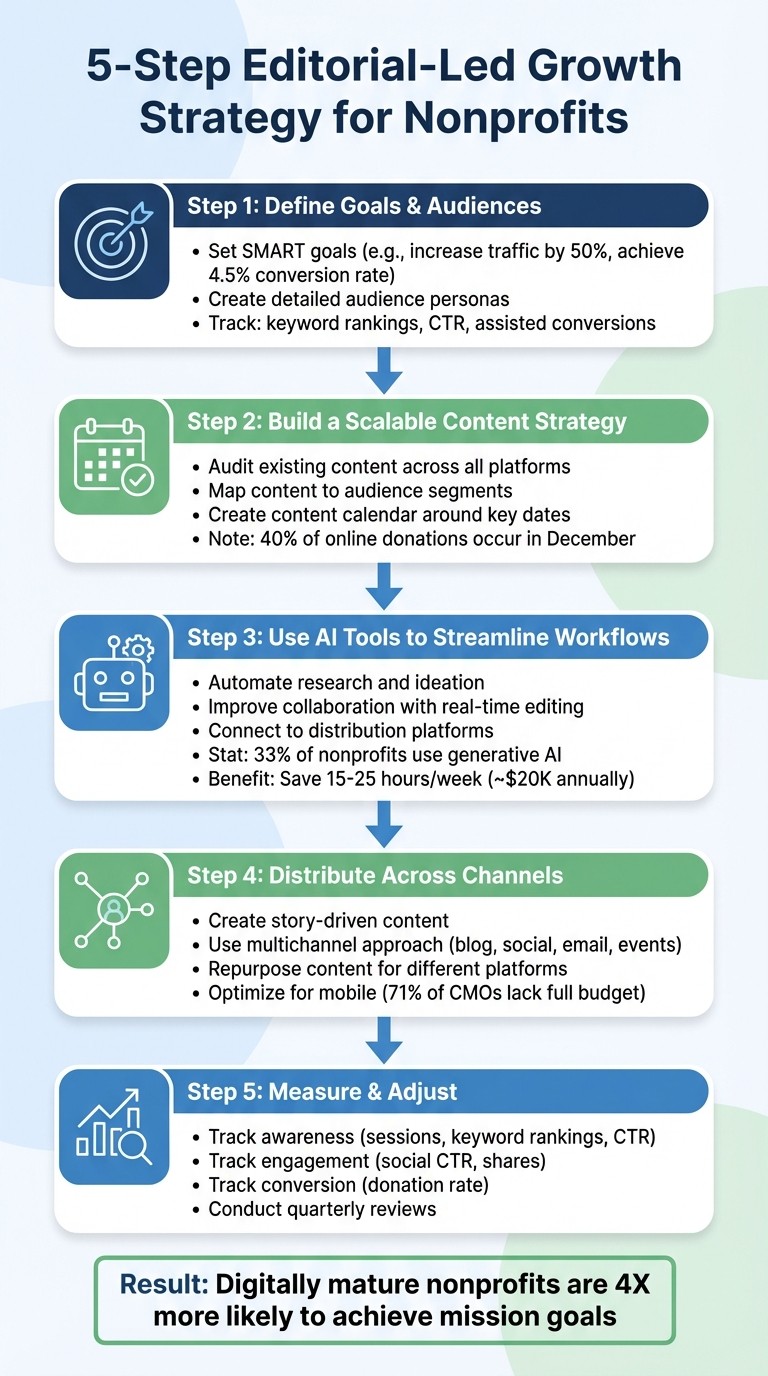
5-Step Editorial-Led Growth Strategy for Nonprofits
Content Marketing Strategy for Nonprofits - GaryVee Content Model
Step 1: Define Your Editorial Goals and Target Audiences
Before diving into content creation, it's crucial to establish clear objectives and know exactly who you're trying to reach. Nonprofits, in particular, can't afford to rely on guesswork when resources are often tight and impact is paramount.
Set Measurable Goals
Start by setting goals that operate on two levels: your broader mission impact and specific, trackable KPIs. For example, a nonprofit might aim to increase website traffic by 50% while achieving a 4.5% donation conversion rate - goals that align with the SMART framework[5]. Everything you create should have a clear purpose that supports your organization’s mission. Stick to topics that directly contribute to these objectives[4].
To measure success, track metrics like the number of keywords ranking in the top 10, the average click-through rates (CTR) to donation pages, and social media-driven CTRs. Tools like Google Analytics' "Assisted Conversion" reports can provide valuable insights into how blog posts and other content contribute to eventual donations[5].
When these goals are tied to well-defined audience segments, your content is more likely to resonate and drive meaningful results. Once your objectives are in place, the next step is to identify exactly who will benefit from your message.
Identify and Segment Your Audience
General terms like "donors" or "local community" aren’t specific enough when defining your audience[1]. Instead, develop detailed audience personas through ongoing research. Vanessa Chase Lockshin, Founder of The Storytelling Nonprofit, emphasizes the importance of this process:
"The antidote to having a broadly defined audience is to identify your target audience and to get to know them through on-going research." [1]
A Content Matrix can help you map your audience segments against your organization’s values, ensuring tailored messaging for each group[5]. For instance, community members may respond best to uplifting impact stories, while major stakeholders might prioritize data-driven reports and ROI metrics[5].
Additionally, use surveys, polls, and other feedback tools to gather direct insights from your audience. Reviewing your existing content can also reveal which posts resonate most with specific segments. These insights will allow you to refine your audience profiles and create content that truly connects[1].
Step 2: Build a Content Strategy That Scales
Once you’ve defined your goals and identified your audience, the next step is creating a content strategy that not only delivers results but also avoids overwhelming your team. This means taking stock of what you already have, finding areas that need attention, and developing a practical plan for consistent content creation.
Audit Your Existing Content
Before diving into new content, take a close look at what you’ve already produced. This audit should include your website, social media platforms, search engine rankings, and email campaigns. Dig into the data to see which pieces are performing well, which are outdated, and which are falling short.
Map your existing content to your audience segments to uncover gaps. For example, you might find that while you have plenty of stories aimed at donors, you’re missing resources for the communities your organization serves. This kind of visual mapping can help you identify which groups are underserved.
Don’t forget to check the technical side of things. Pages like donation forms need optimized SEO elements - meta descriptions, alt tags, and strategic keyword usage - to ensure they rank well in search engines. A shared content calendar can also help you visualize your current pipeline and spot opportunities for improvement. To streamline your evaluation process, consider using a scoring system to rank content based on clear qualitative and quantitative criteria. Keeping a centralized library of your best-performing assets - like impactful stories, graphics, and templates - can save time and energy when creating new materials.
Use the insights from your audit to form the backbone of a focused content calendar.
Create a Content Calendar
Turn the findings from your audit into a detailed content calendar. A structured calendar helps transform scattered ideas into an organized publishing system. Start by plotting out major annual events - like Giving Tuesday, your annual appeal, and other key dates. Then, break these down into smaller, actionable pieces of content. Keep in mind that nearly 40% of one-time online donations occur in December[6], so plan for a heavier content schedule during this period.
Every piece of content should reflect your organization’s mission in action. As Ed Harris, Digital Communications Professional at Blue Hills Digital, emphasizes:
"Content governance is the key to taming the chaos of content ideas, content creators, formats, and channels."[2]
To keep things running smoothly, establish clear workflows that outline who is responsible for creating, editing, and approving content. This helps avoid bottlenecks and ensures quality, even with a small team.
Focus on quality over quantity. It’s better to post consistently on a few high-performing platforms than to spread yourself too thin across every channel. Weekly themes, like "Mission Monday" or "Teach Tuesday", can keep your content diverse and make the creative process easier. Invest in evergreen topics - such as educational guides, impact stories, and how-to articles - that remain relevant over time.
Content Type | Production Time | Recommended Planning Lead Time |
|---|---|---|
Blog Posts | 2–4 hours | 1–2 weeks |
Social Media Updates | 15–30 minutes | 1 week |
Newsletters | 4–8 hours | 2–3 weeks |
Videos | 1–3 days | 4–6 weeks |
Annual Reports | 2–4 weeks | 2–3 months |
While planning is crucial, leave room for flexibility. Be ready to adjust your schedule during unexpected events, such as natural disasters or global crises, to ensure your content remains relevant and sensitive. Incorporate internal deadlines, like board meetings and fiscal year-end dates, into your calendar to help your team manage workloads during busy periods. Tools like Trello, Asana (which offers nonprofits a 50% discount), or Google Sheets can help keep everyone on track and allow team members to brainstorm ideas collaboratively.
Step 3: Use AI Tools to Streamline Content Workflows
AI tools can do more than speed up content creation - they can help maintain consistent quality while supporting your editorial strategy. Once your content calendar is set, the next hurdle is execution, especially when your team is juggling multiple responsibilities. By automating repetitive tasks, AI frees up your team to focus on strategy and storytelling. The trick is selecting tools that complement your workflow and using them to enhance human decision-making, not replace it.
Automate Content Research and Ideation
Deciding what to write about can be one of the most time-consuming tasks for nonprofit teams. AI tools simplify this process by analyzing your existing content to identify gaps and suggest topics that resonate with your audience. For example, platforms like Averi AI feature tools like a "Command Bar" that predicts your next steps, offering suggestions such as FAQ schema or blog post ideas based on current trends in your field. Instead of lengthy brainstorming sessions, you can review AI-generated ideas that align with your mission.
AI can also keep an eye on what your peers and competitors are publishing, helping you find opportunities to join relevant conversations or present a fresh perspective. By automating the research phase, your team can focus on crafting impactful stories that connect with your audience. This sets the stage for a more collaborative and refined content creation process.
Improve Collaboration and Quality Control
AI isn't just about generating content - it can also improve how your team collaborates. Many AI tools support real-time editing, allowing multiple team members to review drafts, leave comments, and make changes without running into version control issues. Some platforms even offer "persistent brand memory", which learns your organization’s tone, language preferences, and style guidelines to ensure every piece of content stays consistent.
That said, human oversight remains essential. Establish a clear process where a human editor reviews AI-generated drafts for accuracy, tone, and alignment with your organization’s values. Tools like Grammarly and Hemingway can catch grammar and style issues, while project management platforms like Asana (which offers nonprofits a 50% discount) help keep track of responsibilities for each stage of the workflow.
A hybrid approach works best: use AI for initial drafts and technical tasks like SEO optimization, but always rely on a human to finalize the content. This ensures your organization’s voice shines through. Once collaboration and quality checks are in place, the next step is distributing your polished content efficiently.
Connect with Distribution Platforms
After finalizing your content, AI tools can handle the technical aspects of publishing. Many AI-powered platforms can post directly to content management systems like WordPress, Webflow, or Squarespace, reducing manual errors and saving time - especially during busy periods like fundraising campaigns.
AI can also help repurpose content for different channels. For instance, a detailed annual report can be transformed into an email series, social media snippets, or web summaries tailored to various audiences. Tools like Buffer and Hootsuite use predictive analytics to schedule posts at times that maximize engagement. Recent data shows that 33% of nonprofit communicators already use generative AI for content marketing [9], with early adopters reporting time savings of 15–25 hours per week - equivalent to over $20,000 in annual savings [7].
If your current platforms don’t have AI capabilities, consider starting with a pilot project. Automate one specific task, such as donor thank-you emails or a social media calendar, and measure the results over 30 to 60 days. Use these insights to decide how to expand AI integration across your nonprofit marketing strategy.
Step 4: Distribute and Optimize Content Across Channels
Once you’ve laid the groundwork with a solid content strategy, the next step is making sure your message reaches the right people in the right places. Effective distribution is what turns great content into meaningful results. Each platform has its own style and audience, so tailoring your approach while keeping the message consistent is key.
Create Story-Driven Content
"Storytelling is the cornerstone of all nonprofit marketing. It's what keeps supporters interested in your cause."
The best content combines emotional storytelling with hard data to make a strong case for support. Instead of treating each piece of content as a one-off, think of your stories as adaptable building blocks. These can be reshaped to fit different audiences and platforms without losing their core essence.
For instance, a story about someone who benefited from your program can emphasize measurable results when shared on LinkedIn to appeal to corporate donors. On Instagram, that same story might focus on the personal journey to connect with individual supporters. The narrative stays consistent, but the angle shifts to suit the platform and audience. This strategic storytelling method has helped professionals like Vanessa Chase Lockshin generate over $10 million for nonprofits [1].
Refining your stories to resonate deeply with your audience is the next step.
Use a Multichannel Approach
Once you’ve crafted compelling narratives, the real work begins: distributing them effectively. A multichannel strategy ensures you meet your audience where they already spend their time. Think of your blog as the central hub, offering in-depth content optimized for search engines with clear calls to action. Social media platforms are perfect for sharing emotionally engaging stories and building a sense of community. Email campaigns provide a direct line to stakeholders, especially during key moments like Giving Tuesday, while events can create buzz around major campaigns.
Efficiency is crucial, especially for teams with limited resources. Use AI content repurposing techniques to maximize reach while maintaining your brand’s voice. For example, a detailed annual report can be transformed into an email series, bite-sized posts for social media, and a concise web summary. Tools like Buffer, which offers nonprofits a 50% discount, can help schedule posts at optimal times using predictive analytics. Considering that 71% of CMOs report lacking the budget to fully implement their content strategies [3], finding ways to stretch your resources is essential.
Set a consistent distribution schedule that outlines how often and where content will be shared. Since most social media engagement happens on mobile devices, make sure all content is mobile-friendly. Optimize metadata so that when your blog posts are shared on platforms like Facebook or X (formerly Twitter), they display eye-catching previews and descriptions. Use tools like Google Analytics' "Assisted Conversion" reports to track how different content pieces contribute to your overall goals, such as donations or event sign-ups.
Step 5: Measure Performance and Adjust for Growth
Once your content is up and running, the next step is to measure its performance and use the data to fine-tune your strategy. Crafting content is just the starting line - real progress comes from analyzing the results and making smart adjustments. Nonprofits should distinguish between overarching goals, like boosting annual donations, and specific website metrics that reflect how well the content is performing[5].
Track Key Metrics
To get a clear picture, focus on three main areas: awareness, engagement, and conversion.
For awareness, monitor total site sessions, how many keywords rank in the top 10, and the click-through rate (CTR) from search results.
For engagement, pay attention to the CTR from social media to donation pages and how often your content is shared.
For conversion, calculate the percentage of visitors who turn into donors. Use tools like Google Analytics' Assisted Conversion reports to track which articles play a role in generating donations, even if they weren’t the final step in the process[5].
"Setting SMART goals for your content marketing strategy allows you to track your progress successfully with numerical data." - GiveWP[5]
Set specific and measurable targets, such as increasing site sessions by 50% while maintaining a 4.5% conversion rate, or doubling the number of keywords ranking in the top 10. These benchmarks provide a foundation for making strategic updates.
Refine Your Strategy
Use the performance data to make thoughtful changes to your approach. Regularly audit your content to pinpoint high-performing posts that could use an update, topics your audience is searching for but can’t find on your site, and outdated content that might be dragging down your SEO[4]. A content scoring system can help you prioritize updates and projects that best align with your nonprofit’s mission[3].
Create visual performance reports, like graphs in Google Sheets, to compare individual pieces of content against category averages[5]. Plan quarterly reviews to evaluate content health, SEO trends, and overall performance. These check-ins allow you to recalibrate your strategy based on what’s working and what isn’t[4]. This cycle of analysis and refinement keeps your content aligned with your nonprofit’s goals. If you’re using AI tools to assist with content creation, ensure a human expert verifies all claims and data to maintain trust and credibility[10].
Conclusion: Build an Editorial Engine for Long-Term Impact
Developing an editorial-driven growth strategy creates a reliable system that ties your nonprofit's mission to tangible results. Begin by setting clear objectives that align with your strategic plan, and pinpoint the key audiences you need to reach. Focus on publishing content that directly supports your mission and its progress [4].
"Every nonprofit has its own mission, and that means that what each organization creates for content will vary... All of your content should be tied to your mission and work to move it forward." - Liz Smith, Content Writer, Media Cause [4]
This advice highlights the importance of having a well-organized process that blends content creation with strategic oversight.
Incorporate AI tools for tasks like research, brainstorming, and drafting, but ensure human oversight remains central. When paired with a mission-centered content strategy, AI can significantly enhance your efforts. Nonprofits identified as "digitally mature" are four times more likely to achieve their mission goals. Additionally, using AI can free up 15–20 hours per week by automating administrative work [8][11]. That extra time can be redirected to activities like refining your messaging, engaging donors, or broadening your audience.
By combining clear objectives, AI-driven efficiency, and consistent performance tracking, your editorial process can transform into a self-sustaining system. Keep an eye on key performance indicators such as website traffic, keyword rankings, click-through rates, and conversion rates. These metrics will guide ongoing adjustments to optimize your strategy.
The outcome? A scalable editorial engine. Every piece of content you publish strengthens your brand, boosts SEO, and builds a valuable resource library that attracts supporters and inspires donations. With a focused strategy, effective tools, and a commitment to continuous improvement, your nonprofit can create a growth channel that magnifies its impact.
FAQs
How can nonprofits use AI tools to streamline content creation?
AI tools are revolutionizing how nonprofits handle content creation, turning what used to be a time-intensive process into a streamlined, repeatable system. By using affordable platforms like Averi AI alongside clear editorial guidelines and human review, nonprofits can quickly produce donor emails, social media updates, event announcements, and even content calendars. The results speak for themselves - many organizations report saving 15–25 hours per week, translating to around $20,000 annually in staff-related costs.
Beyond saving time and money, AI helps nonprofits maintain a consistent brand voice while scaling their outreach efforts without the need to expand their teams. Automated drafts, once polished by human editors, ensure high-quality content, freeing up staff to focus on relationship-building and strategic initiatives. With only 26% of nonprofits currently using AI effectively, adopting these tools provides a powerful opportunity to amplify impact without stretching budgets.
What are the best ways to segment nonprofit audiences effectively?
To effectively segment nonprofit audiences, the first step is to create well-defined audience personas. Focus on key groups such as donors, volunteers, beneficiaries, or community partners, and take the time to understand their demographics, motivations, and preferred ways of communicating. This approach ensures your messaging resonates with their specific interests and needs.
Next, apply data-driven methods to organize your supporters into meaningful groups. For instance, donors can be segmented based on their giving habits - like monthly versus one-time contributions - or by their engagement levels, such as how often they attend events or interact with emails. Leveraging AI-powered tools can reveal these patterns, making it much easier to craft personalized outreach strategies.
Finally, make sure to tailor your content strategy to match each segment’s journey. Develop targeted materials, such as impact stories for major donors or volunteer spotlights for community members, and share them through the channels they use most, whether that’s email, social media, or text messages. Setting clear, measurable goals - like aiming to boost donor retention by 10% within the next quarter - can help you track progress and fine-tune your efforts as you go.
How can nonprofits measure the success of editorial-led growth strategies?
To evaluate the effectiveness of editorial-driven growth, focus on transforming storytelling into measurable, mission-oriented outcomes. A four-part framework can guide this process:
Activity: Keep track of the volume of content you produce, whether it’s blog posts, emails, or social media updates. This ensures your workflow remains manageable over time.
Reach: Measure how far your content travels by analyzing metrics like email deliveries, page views, and social media impressions.
Engagement: Look at how your audience interacts with your content. Metrics like clicks, shares, sign-ups, and comments can reveal how well your message connects.
Impact: Evaluate the tangible results tied to your mission. This could include donor retention rates, acquiring new donors, volunteer registrations, or program achievements.
Pair these metrics with regular reviews to identify what’s working and where adjustments are needed. Leveraging tools such as AI can streamline this process, helping your team save time, cut costs, and focus on driving meaningful progress.
Related Blog Posts

Zach Chmael
CMO, Averi
"We built Averi around the exact workflow we've used to scale our web traffic over 6000% in the last 6 months."
Your content should be working harder.
Averi's content engine builds Google entity authority, drives AI citations, and scales your visibility so you can get more customers.