

In This Article
Step-by-step process to build and use data-driven donor and volunteer personas with CRM data, surveys, segmentation, and AI tools.
Updated:
Trusted by 1,000+ teams
Startups use Averi to build
content engines that rank.
Nonprofits often struggle to connect with diverse audiences like donors, volunteers, and supporters. Persona development simplifies this by creating detailed profiles of these groups, helping organizations understand their motivations, behaviors, and preferences. This leads to better outreach, smarter use of resources, and stronger engagement. Here's a quick summary of the process:
What are Personas? Fictional profiles based on real data that represent audience segments. They include demographics, values, motivations, and communication preferences.
Why Use Personas? They align teams, improve campaign focus, and maximize limited budgets. For example, 71% of organizations exceeding revenue goals use documented personas.
How to Create Personas:
Collect Data: Use CRM systems, surveys, and interviews to gather insights.
Segment Audiences: Group individuals by behaviors, motivations, and preferences.
Create Profiles: Build detailed personas with names, goals, and communication habits.
Use AI Tools: Speed up analysis, refine personas, and simulate interactions.
Apply Personas: Tailor campaigns, map donor journeys, and integrate personas into team workflows.
Personas are not static - they should evolve with audience behavior. Regular updates ensure accuracy and keep campaigns effective. Tools like Averi AI can streamline this process, saving time and improving results. By focusing on personas, nonprofits can build meaningful relationships and achieve their mission more efficiently.
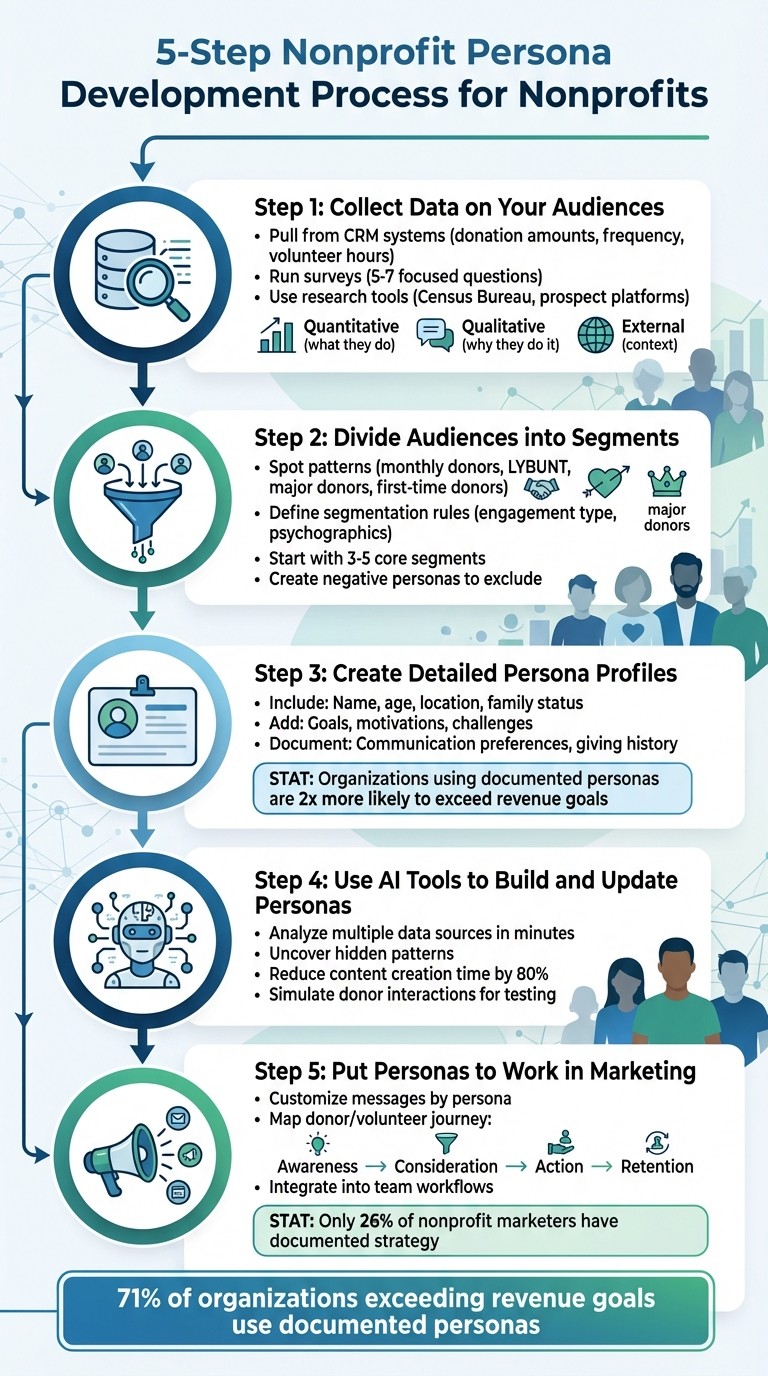
5-Step Nonprofit Persona Development Process
How to Create Donor Personas for Nonprofits (8 Steps to Better Fundraising)
Step 1: Collect Data on Your Audiences
Creating effective personas starts with gathering detailed and relevant data. The more precise your information, the better you can tailor your outreach efforts. Begin by consolidating existing audience data, then use direct feedback from stakeholders to deepen your understanding.
Pull from Your Existing Data
Your CRM or donor database is a goldmine of information, offering insights into donation amounts, giving frequency, preferred donation channels, volunteer hours, event participation, and email engagement. Look for patterns based on demographics like age, location, and occupation, as well as engagement types - such as recurring donors versus one-time contributors or email subscribers versus social media followers. Website analytics can highlight which pages attract the most visitors and where users tend to drop off. Similarly, email marketing tools can reveal which subject lines and content resonate most with your audience. This behavioral data provides a strong foundation for understanding what’s already working before you dig deeper.
Run Surveys and Interviews
While numbers provide trends, direct conversations uncover the "why" behind those trends. Keep surveys concise with 5–7 focused questions that explore reasons for supporting your cause and any barriers they face. For example, ask questions like, "What almost prevented you from donating?" or "What would make volunteering easier for you?" To add depth, conduct three to five interviews for each persona type, including not just active supporters but also lapsed donors or volunteers who’ve disengaged. Offering small incentives, such as gift cards, can encourage participation. Be upfront that these conversations are for research purposes, not fundraising. This qualitative data complements the numbers, giving you a fuller picture of your audience.
Add Depth with Research Tools
To enrich your insights, use prospect research platforms that provide external data, such as household income, education levels, career industries, and even political affiliations [5]. Tools like Meta Audience Insights can add context about lifestyle and demographics, while AI platforms such as Averi AI analyze interviews and CRM data to uncover patterns you might overlook. Cross-check your internal data with external benchmarks - such as Census Bureau or Bureau of Labor Statistics data - to ensure your findings are balanced and free from bias.
Here’s a quick summary of the data sources:
Data Type | Source Examples | Insight Gained |
|---|---|---|
Quantitative | Google Analytics, CRM, Email Metrics | What they do: demographics, click rates, donation frequency |
Qualitative | Interviews, Focus Groups, Support Tickets | Why they do it: motivations, fears, personal values |
External | Census Bureau, Prospect Research Platforms | Context: how your audience compares to the general population |
Step 2: Divide Your Audiences into Segments
Now that you’ve gathered your data, it’s time to organize it into clear audience segments. This step transforms raw insights into targeted strategies by grouping individuals based on shared behaviors, motivations, and characteristics - not just surface-level demographics. Effective segmentation ensures your outreach efforts resonate with the right people.
Spot Patterns and Define Segmentation Rules
Start by analyzing your CRM data to identify recurring patterns. Break your audience into groups like monthly donors, LYBUNT (Last Year But Unfortunately Not This) supporters, major donors, and first-time donors. You can also segment by engagement type - for example, volunteers who donate, event attendees, social media followers, or petition signers. Define rules to classify these groups. For instance, categorize anyone who has donated two or more times in the past three years as "Retained", while those who only gave once and didn’t return could fall into "Re-engagement Needed."
Go beyond donation history and consider psychographics, which delve into motivations and values. For instance, some donors might be moved by emotional storytelling, while others respond better to data-driven impact reports. Segmenting by communication preferences is also key - older donors may favor direct mail, while younger audiences might prefer social media or SMS [6]. Reviewing inquiries and social media comments can help you identify common frustrations or preferences within your audience.
Additionally, pinpoint negative personas - groups unlikely to convert or too costly to engage. Excluding these audiences helps conserve resources and keeps your focus on high-value supporters. Start with three to five core segments to keep things manageable, and expand as you refine your strategy [1][4]. Visual summaries of these segments can help clarify priorities and guide your team.
Compare Segments for Strategic Insights
A side-by-side comparison of your audience segments can make their differences - and corresponding resource needs - more apparent. Use a comparison table to outline key metrics like average donation size, communication preferences, and engagement frequency. This approach allows you to align outreach strategies with each segment’s unique profile. For example, major donors may require personalized calls and invitations to exclusive events, while monthly donors might respond better to automated updates highlighting collective impact.
Segment Type | Average Donation | Frequency | Preferred Channel | Primary Motivation |
|---|---|---|---|---|
Monthly Donors | $20–$100 | Monthly/Automated | Email, Automated SMS | Sustained impact, convenience |
Major Donors | $1,000+ | Annual or Multi-year | Personal calls, In-person events | Legacy, high-level influence |
Event Attendees | Variable | Event-based | Social media, Email | Community, shared experience |
LYBUNTs | Variable | Lapsed (Annual) | Direct mail, Personal outreach | Past connection, specific appeals |
Volunteers | N/A (Time-based) | Frequent (Weekly/Monthly) | SMS, Email | Hands-on contribution, social connection |
This framework ensures your segments are actionable (capable of driving results), scalable (broad enough to justify the effort), and aligned with your goals [7]. To validate your findings, compare them with external benchmarks like Census Bureau data or industry reports. This step helps correct for any selection bias and ensures your segments reflect the broader community [3]. These well-defined groups will serve as the foundation for refining AI-driven personas in the next stages.
Step 3: Create Detailed Persona Profiles
With your audience segments in place, the next step is to turn that data into detailed persona profiles. These profiles serve as a bridge between raw data and actionable strategies, helping guide decisions on everything from email campaigns to event planning. A well-crafted persona should feel like a real individual your team can picture and understand.
Persona Template Components
Each persona should include a visual element and a relatable name, like "Volunteer Val" or "Major Donor Mike", to make them feel more tangible. Add key background details such as age, location, family status, education level, and daily routines. This "day-in-the-life" context helps illuminate when and how they might engage with your nonprofit.
Outline their goals, motivations, and challenges to better align your outreach efforts. For instance, a college student might be looking for community service opportunities to fulfill a sorority requirement, while a retiree could be seeking meaningful ways to contribute to their community. Include identifiers like attending a local university or having a history of monthly donations.
Don’t forget to document their communication preferences - whether they prefer email, social media, direct mail, or face-to-face events. Include giving history details, such as average donation size, frequency of contributions, and whether their donations are one-time or recurring. Research shows that organizations using documented personas are twice as likely to exceed revenue goals, with engagement rates improving by 10% to 20% after implementation [1].
With these components in place, the next focus should be on keeping your personas updated to reflect changes in audience behavior.
How to Keep Personas Accurate
Personas aren’t static; they need regular updates to remain effective. Periodically review and refine their details to ensure they stay relevant. Compare your internal data with external sources, such as Census Bureau statistics, to eliminate any potential bias. Conduct interviews with 3–5 representatives from each persona group to uncover new motivations or challenges they may be facing. These updates are vital for maintaining accuracy [1].
Update personas whenever you launch new programs, explore new markets, or notice shifts in audience trends. Insights from these updates can be invaluable for keeping your strategies aligned with real-world behaviors. Additionally, maintain "negative personas" to identify groups that are unlikely to engage or are too resource-intensive to target. This ensures your efforts remain focused on the right audiences. Regularly refreshing your profiles will help you avoid outdated assumptions and stay aligned with evolving audience needs.
Step 4: Use AI Tools to Build and Update Personas
AI tools bring speed and precision to the process of creating and refining nonprofit personas, ensuring they stay accurate and relevant over time.
Instead of spending weeks sifting through data manually, nonprofits can leverage AI to analyze vast datasets in a matter of minutes. This efficiency allows teams to shift their focus from data-crunching to strategic outreach and meaningful engagement. AI tools uncover patterns that might otherwise go unnoticed, helping nonprofits better understand their audience and optimize their efforts.
How AI Enhances Persona Development
AI can process data from multiple sources - such as donor databases, email engagement stats, social media activity, and website behavior - to uncover actionable insights. For example, it can pinpoint the most effective communication channels for different demographics, distinguish what drives recurring donors versus one-time contributors, or reveal how volunteer participation varies by region. These insights not only fine-tune outreach strategies but also streamline workflows, reducing content creation time by as much as 80%. This gives staff more time to focus on building relationships and advancing the organization’s mission.
Another application involves training generative AI tools with persona data to simulate donor interactions. For instance, your team could ask the AI, “How might Major Donor Mike respond to this appeal for a capital campaign?” Using Mike’s preferences, motivations, and giving history, the AI provides tailored feedback, helping refine messaging before it reaches actual donors [2].
Example: Using Averi AI to Refine Personas
Take the example of a nonprofit dedicated to youth education. By using Averi AI, the organization can streamline its persona-building process. After uploading donor information, volunteer records, and campaign performance data, the AI identifies distinct audience segments. It might reveal, for instance, that retired educators engage differently than corporate sponsors or that parents of current students prefer communication channels like text messages over alumni, who respond better to email.
Once the AI organizes this data into detailed persona profiles - including demographics, giving habits, and content preferences - the nonprofit can use it to guide outreach. Through Averi’s workflow, the team can track how specific campaigns perform for each persona, with the system recommending adjustments in real time. For example, if “Volunteer Val” responds more to Instagram stories than email newsletters, Averi flags this insight and suggests reallocating resources to Instagram. The role-playing feature also allows the team to test messaging by having the AI respond in the voice of a particular persona, helping refine language and tone before launching a campaign. This continuous feedback loop ensures the personas stay relevant without the need for quarterly manual updates.
Up next, see how these dynamically updated personas can seamlessly integrate into your marketing strategies.
Step 5: Put Personas to Work in Your Marketing
Once your personas are polished with AI insights, the next step is weaving them into your marketing efforts. Crafting personas is only the starting point - real impact comes when you use them to shape every campaign. Nonprofits that align their strategies with these profiles move beyond guesswork, delivering messages that resonate deeply with donors, volunteers, and advocates. This approach not only amplifies their reach but also ensures resources are used wisely.
Customize Messages and Campaigns by Persona
Not everyone interacts with your organization the same way. For instance, a retired teacher scrolling through Facebook will engage differently than a corporate sponsor browsing LinkedIn. It starts with matching your communication channels to the preferences of each persona. Younger volunteers might respond best to Instagram’s visual storytelling, while older donors may lean toward Facebook or even direct mail [6].
Take one compelling story and adapt it across formats tailored to each persona. For example:
Turn it into an email for engaged donors.
Create Instagram quote cards for younger supporters.
Write a detailed blog post for researchers.
Develop a direct mail campaign for major donors [6].
The message remains consistent, but the delivery is customized to fit the audience. You can even use AI tools to simulate how each persona might react to different tones or calls-to-action [2].
Map the Donor and Volunteer Journey
Every persona follows a journey, from discovering your organization to becoming a loyal advocate. Mapping this journey lets you deliver the right content at the right time. Here's how it might look:
Awareness stage: Share educational blogs, social media stories, or infographics.
Consideration stage: Send welcome emails, link to impact-focused landing pages, or host webinars.
Action stage: Simplify donation forms and showcase testimonials.
Retention stage: Offer personalized thank-you messages and celebrate milestones [4].
Currently, only 26% of nonprofit marketers have a documented strategy [4]. This means many organizations are running disconnected campaigns rather than guiding supporters through a cohesive journey. By mapping out touchpoints for each persona, you’re not just asking for donations - you’re building long-term relationships.
Add Personas to Your Team's Operations
To make personas a core part of your strategy, integrate them across your team’s workflow. Start with an internal kickoff meeting where team members from development, programs, and operations review the personas together [6]. This collaboration fosters buy-in and can reveal overlooked insights.
Create shared resources, like persona-specific templates stored in platforms such as Notion or Google Drive. This ensures everyone - whether they’re program officers or volunteer coordinators - has quick access to tailored content [6].
Additionally, map each persona’s journey through the Awareness, Consideration, and Action stages so your team knows what content to deploy and when [4]. Regularly review KPIs to adjust campaigns based on donor behavior, keeping personas aligned with actual outcomes. Embedding personas into your operations ensures they’re not just theoretical tools but active drivers of your strategy.
Conclusion: What to Remember About Nonprofit Personas
Nonprofits now have a clear path to harnessing the power of dynamic, data-informed personas. This isn't just a marketing exercise - it's about turning raw data into a vivid understanding of the people who support your mission. The process involves gathering data, segmenting it meaningfully, creating detailed profiles, leveraging AI for updates, and consistently applying these insights across your campaigns.
Despite the proven benefits, many nonprofits still lack a formal approach to building personas [4]. Without this, organizations often rely on guesswork instead of informed strategies.
AI tools like Averi AI have revolutionized this process, cutting down the time it takes to create personas from weeks to just hours. By synthesizing CRM data, website insights, and interview notes, these tools produce unified profiles and even generate tailored content for each audience segment in seconds. They also monitor shifts in donor behavior, ensuring your personas stay relevant.
Personas should be treated as living documents, constantly evolving. As Funraise warns:
"If you create static supporter profiles, your strategies will remain static as well, and your revenue will likely drift downward" [8]
Quarterly reviews help keep your data fresh and aligned with changing audience needs. When integrated into campaign planning, content creation, and donor outreach, these dynamic personas go beyond being just profiles - they become strategic tools for building lasting relationships and driving sustainable growth.
FAQs
How many personas do we actually need?
When determining how many personas your nonprofit needs, it’s all about balancing your audience segments and organizational goals. Generally, 3 to 5 well-crafted personas - like donors, volunteers, or supporters - work well to represent your primary groups. The key is to build detailed profiles for these core segments, allowing you to tailor your messaging effectively without overwhelming your strategy. This keeps your outreach both impactful and manageable.
What if our CRM data is incomplete or messy?
If your CRM data is disorganized or incomplete, AI tools such as Averi can step in to build detailed donor personas. These tools analyze existing data, interviews, and other inputs to assist with audience segmentation and profile creation, even when data quality is less than ideal. Moreover, professional services highlighted in related resources can help refine and clean your data, ensuring it's easier to extract meaningful insights.
How do we keep personas updated without extra staff time?
Using AI tools can streamline data collection and analysis, making the process faster and more efficient. For instance, platforms like CauseWriter.ai or Lightful's AI-powered persona creator allow you to generate and refine personas with minimal effort. Additionally, predictive analytics tools such as DonorSearch AI can monitor shifts in supporter behavior automatically, ensuring profiles stay up-to-date without requiring manual updates. These technologies not only save time but also help maintain personas that are both relevant and practical.
Related Blog Posts

Zach Chmael
CMO, Averi
"We built Averi around the exact workflow we've used to scale our web traffic over 6000% in the last 6 months."
Your content should be working harder.
Averi's content engine builds Google entity authority, drives AI citations, and scales your visibility so you can get more customers.