

In This Article
Personas transform real estate outreach—build 3–5 data-driven profiles using CRM, AI, and JTBD to target high-value clients and close deals faster.
Updated:
Trusted by 1,000+ teams
Startups use Averi to build
content engines that rank.
Want to attract the right clients and close deals faster? Persona development helps real estate professionals understand their clients on a deeper level, tailoring marketing and sales strategies to their specific needs. By creating profiles based on client behaviors, motivations, and challenges, you can focus on high-value leads and deliver personalized experiences.
Key Takeaways:
Why personas matter: Personalization boosts profitability by up to 80%, and understanding client motivations helps you stand out in a competitive market.
Where to start: Use CRM data, transaction histories, and tools like PropStream or Google Analytics to gather insights on your audience.
How to segment: Group clients into 3–5 key personas, such as first-time buyers, luxury clients, or investors, focusing on their goals and pain points.
AI tools: Speed up persona creation, test strategies, and keep profiles updated with real-time data.
This guide explains how to build effective personas, use them in marketing and sales, and refine them over time to stay ahead in the real estate market.
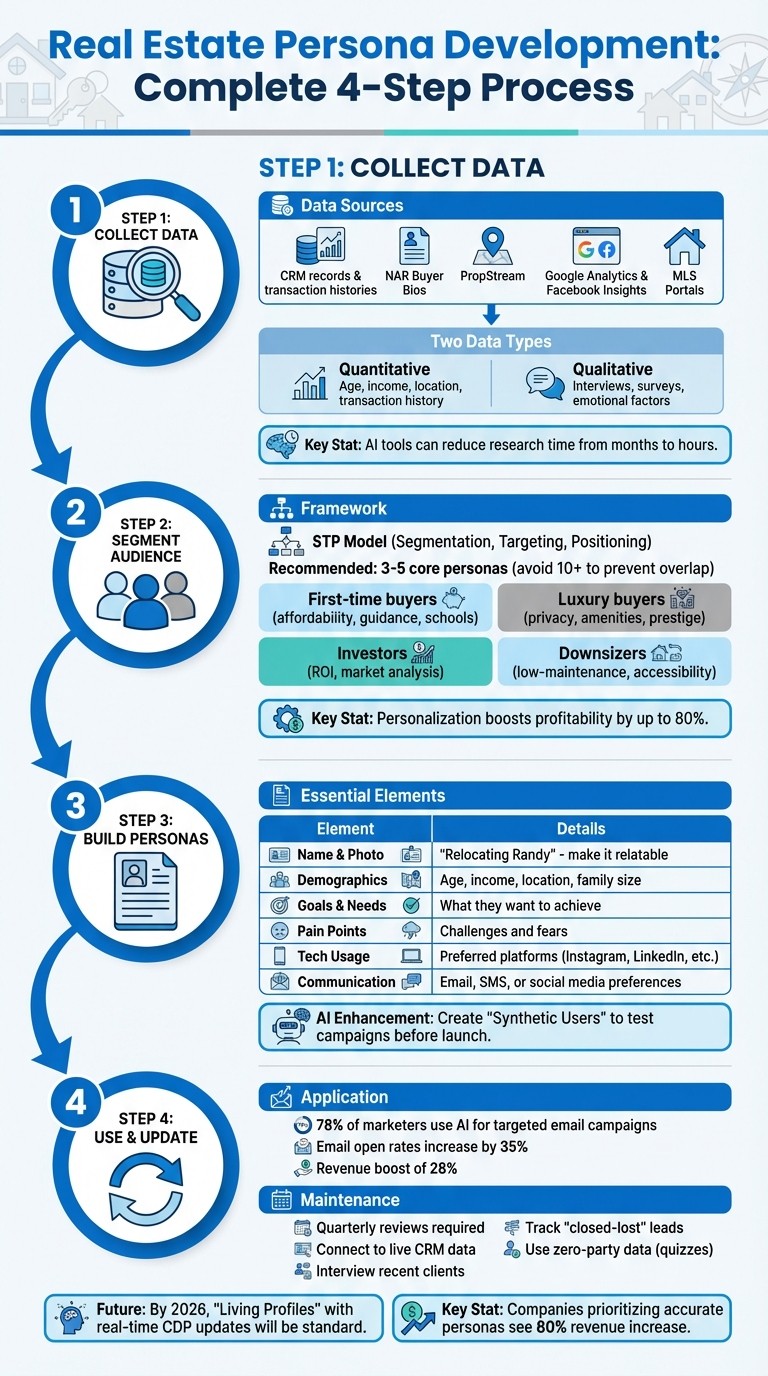
Real Estate Persona Development Process: 4-Step Framework
Collecting Data for Real Estate Personas
Where to Find Client Data
Start with your CRM records, transaction histories, and insights from your last 5–10 clients - whether they converted or not. This internal data highlights which client types bring in the most revenue and which ones drain time without results [2][5].
Expand your view by tapping into resources like the National Association of Realtors (NAR) Buyer Bios for detailed buyer profiles, local MLS Portals for consumer stats, and economist blogs to track emerging housing trends [1][8]. For hyper-local insights, tools like PropStream provide data on neighborhood demographics, including education levels, income ranges, household structures, and employment figures [5]. Additionally, digital tools like Google Analytics and Facebook Insights help you understand how leads engage online, revealing which listings spark the most interest [1][2]. These platforms uncover behavioral patterns that go beyond static demographic data.
With these resources in hand, you’ll have a strong mix of internal metrics and external insights to start building well-rounded personas.
Numbers vs. Stories: Two Types of Data
Effective personas require a blend of numbers and narratives. Quantitative data - like age, income, location, and transaction history - gives you a broad view of client patterns. Meanwhile, qualitative data, gathered through interviews, surveys, or casual conversations, reveals the emotional factors driving their decisions [10][13].
"The biggest mistake in buyer persona creation is relying on internal assumptions instead of external data. You are not your customer." - Neeraj, Digital Marketing Expert, Wildnet Marketing Agency [3]
For example, in December 2024, Yahoo News transformed qualitative interview insights into quantitative survey questions using a modified k-nearest neighbors algorithm. This approach identified five unique personas, leading to a homepage redesign that reduced bounce rates by 90% and boosted Daily Active Users by 51% [11]. While quantitative data tells you who your clients are, qualitative data explains why they make certain choices [10][12].
Using AI to Analyze Your Data
AI tools can turn months of research into hours by analyzing data from sales calls, support tickets, and reviews [3]. These tools often uncover patterns you might miss, like a segment’s focus on compliance over ROI [3].
AI also allows you to create "Synthetic Users" based on your personas. For instance, you can test ad copy or email subject lines on an AI-generated avatar of "The First-Time Buyer" before committing to a campaign [3]. This pre-launch testing refines your messaging, saving time and money.
Dynamic AI-powered personas take it a step further by staying updated with real-time CRM and analytics data. If your lead sources shift - say, from Zillow to Instagram - your personas adapt automatically. This ensures your marketing stays aligned with evolving client behaviors. These AI-driven insights will play a key role in the upcoming segmentation and persona-building process.
Dividing Your Audience into Segments
How to Group Your Clients
Segmenting your audience starts with understanding their demographics - such as age, income, education, marital status, and household makeup - and their digital behavior [5][7][6]. But in today’s landscape, behavioral signals are even more telling. Pay attention to how your clients interact online: their preferred content formats, the devices they use, and how they engage with platforms like Instagram or email newsletters [7][3].
Using the JTBD (Jobs to Be Done) framework can take your segmentation to the next level. Instead of sorting clients into broad categories like "Millennial Buyer", focus on their specific goals. For instance, "The Efficiency Seeker" might be someone who values automating the closing process to save time [3]. This approach shifts the focus from who your clients are to what they aim to achieve, leading to more impactful marketing strategies.
By employing these strategies, you’ll naturally uncover distinct client types.
Common Client Types in Real Estate
For real estate, it’s best to concentrate on three to five key segments. Examples include:
First-time buyers: They often prioritize affordability, guidance, and proximity to good schools [6].
Luxury buyers: Privacy, high-end amenities, and prestigious locations are their main concerns [6].
Investors: Their focus lies on market analysis, property performance, and ROI [6].
Downsizers: They typically seek low-maintenance homes with community amenities and accessibility features [6].
You can refine these categories even further, targeting niches like "Downtown/Skyrise Buyers", "Single Women", or "LGBTQ Groups" [1]. However, it’s crucial to avoid over-segmenting. Stick to 3–5 core segments - creating more than 10 personas can lead to overlap, which dilutes your marketing efforts [4][2][3].
Once you’ve defined your client types, focus on those that deliver the greatest value.
Identifying Your Most Profitable Segments
Not every segment warrants equal attention. The STP (Segmentation, Targeting, and Positioning) model can help you determine which groups offer the best returns [4]. Evaluate potential segments based on factors like size, accessibility, deal value, and distinctiveness [4].
Personalization plays a big role here. According to 90% of top marketers, tailoring experiences significantly boosts profitability [4]. Additionally, companies prioritizing customer experience can see revenue growth of up to 80% [4]. Dive into your CRM data to identify segments that close deals faster, generate higher commissions, or bring in more referrals. These insights should guide your persona development, ensuring your efforts align with where the real opportunities lie - not just where you assume they are.
Building Your Real Estate Personas
Persona Templates and Examples
Once you've analyzed your segmented data and insights, use persona templates to create a clear framework for targeted real estate marketing.
A complete persona begins with a relatable name like "Relocating Randy" or "Starter Home Samantha", paired with a representative photo and essential demographics: age, income, location, and family size [15][2]. Add psychographic details like motivations, values, daily habits, and preferred media platforms [3][2]. Include real estate-specific traits, such as preferred property types (condo, single-family home), neighborhood priorities (school districts, commute times), and budget ranges [6][16].
Define key pain points too. These could include financial challenges, fear of making a poor decision, or stress about tight timelines [15][2]. Document how they prefer to communicate - whether through SMS, email, or even TikTok home tours versus LinkedIn articles [1].
For example, Danny Noland, a 61-year-old VP of Sales in Phoenix, Arizona, earns $150,000 annually. As a new empty-nester, he wants to sell his large family home at the best price and downsize to a low-maintenance condo. With his hectic schedule, Danny seeks an agent who can handle every detail of both transactions [9]. This level of detail transforms a broad "downsizer" category into a precise target.
With these foundational personas, AI tools can take the process to the next level by refining and enhancing profiles with speed and accuracy.
Using AI to Build Personas Faster
AI tools can quickly transform CRM data, survey results, and call transcripts into detailed persona documents [3]. Platforms like Averi AI's Brand Core act as a centralized hub for compiling customer research and creating ideal profiles, ensuring your personas are grounded in reliable, consistent data.
Modern AI doesn't just speed up persona creation - it makes them dynamic. Instead of static PDFs, AI-powered "living profiles" connect to customer data platforms (CDPs) and update automatically as customer behaviors evolve. You can also generate synthetic users - AI-based avatars modeled on your personas - to test ad copy or pricing strategies before launching campaigns. This allows you to fine-tune your approach while minimizing wasted resources [3].
To bring this concept to life, let’s look at a detailed example.
Example: A Complete Real Estate Persona
Meet Young Professional Stephanie: a 29-year-old MBA graduate in finance, married with an infant, and earning $140,000 annually [7]. She currently rents a two-bedroom apartment near a city park but is looking to move to the suburbs for more space and access to better schools. Her main priority is balancing work-life stress while securing a stable future for her family.
Stephanie is an iPhone and MacBook user, frequently checks Instagram, and values brands that align with meaningful social causes [7]. Her challenges include navigating the mortgage process for the first time and juggling a demanding career with family life. She prefers detailed information via email but likes quick updates through text. On weekends, she researches neighborhoods, reading content like "Top 10 Family-Friendly Suburbs Near [City]" and first-time buyer guides.
Personas like Stephanie's allow you to create highly targeted messaging. For instance, you could provide her with a mortgage pre-approval guide tailored to busy professionals, transforming generic outreach into personalized, impactful marketing.
Using and Updating Your Personas
Applying Personas to Marketing Campaigns
Once you’ve developed detailed personas, the next step is to integrate them into your marketing strategy. Each channel should reflect the preferences and behaviors of your target audience. For instance, visual content resonates with younger audiences on TikTok and Instagram, while professionals on LinkedIn and Facebook may prefer more in-depth, analytical posts [1]. A helpful approach is to structure your content creation with a clear framework: "As a [persona], I need a [content type] about [topic] so I can [value statement]" [7]. For example, "As a First-Time Buyer, I need a mortgage pre-approval guide about navigating lender requirements so I can feel confident making an offer."
AI tools can take personalization to the next level. Currently, 78% of marketers use AI to craft targeted email campaigns, which can increase open rates by up to 35% and boost revenue by 28% [14]. By setting up automated workflows in your CRM, you can launch multi-channel campaigns tailored to specific persona groups. For instance, you might send detailed market analysis to investors before introducing them to relevant property listings [1]. This approach ensures your marketing and sales efforts work in harmony, creating a seamless experience for your clients.
Teaching Your Sales Team to Use Personas
Aligning your sales team with these insights is just as important as refining your marketing channels. Train your agents to identify and respond to specific persona types during client interactions. Using tailored scripts and the Jobs-To-Be-Done (JTBD) framework helps them address unique client needs effectively. For example, an "Efficiency Seeker" might prioritize an agent who can handle every aspect of buying and selling. Incorporating real-time behavioral data into these conversations not only enhances marketing campaigns but also strengthens sales interactions. When agents align their value propositions with client expectations, they can close deals faster and build lasting relationships.
Keeping Your Personas Current
Personas are only as effective as they are accurate, which means they need to evolve alongside your clients’ behaviors. By 2026, "Living Profiles" - dynamic profiles updated in real time through CRM and customer data platforms (CDPs) - will be the norm [3]. These profiles go beyond static demographics like age and location, incorporating digital body language and behavioral intent.
To ensure your personas stay relevant, conduct quarterly reviews and leverage real-time updates from your CRM and CDPs [3]. Interview recent clients to capture new insights, and connect with "closed-lost" leads to understand where your assumptions may have fallen short [6]. Website analytics, such as heatmaps, can help verify whether actual user behavior aligns with your persona predictions [4]. With the decline of third-party cookies, zero-party data - information willingly shared by clients through tools like interactive quizzes - has become essential. For example, quizzes like "What's your home-buying style?" can provide direct insights into client preferences [3]. Businesses that prioritize accurate and updated personas see an 80% increase in revenue [4].
Next Steps
What to Remember
Building effective personas is an evolving process that enhances how you connect with clients. Start by analyzing data from your last 5–10 successful deals to identify shared buyer characteristics [2]. Then, apply the Segmentation, Targeting, and Positioning (STP) model to study your market before creating profiles [4]. Aim to keep your personas concise - 3–5 core profiles are ideal. Having more than 10 can lead to overlapping segments, which weakens your targeting efforts [4][2].
Looking ahead to 2026, customer personas will become dynamic, pulling real-time data from live sources [3]. To stay ahead, integrate your personas with live CRM data and conduct quarterly reviews. This approach has been linked to revenue increases of up to 80% [3][4].
Start Creating Your Personas
Once you’ve set the groundwork, it’s time to create your personas. Turn your data into relatable profiles by giving each persona a descriptive name like "Relocating Randy" or "First-Time Amy." Adding a photo can also help make these profiles more engaging and memorable for your team [7][2]. Use the following framework to structure each persona:
Persona Element | Contents | Purpose |
|---|---|---|
Name & Keyword | A descriptive title (e.g., "Empty-Nester Peter") | Helps your team easily recall and relate to each segment [7][4] |
Bio Basics | Age, income, location, education | |
Goals & Needs | What they aim to achieve (e.g., more space) | |
Pain Points | Challenges or fears (e.g., rising interest rates) | |
Tech Usage | Preferred platforms (e.g., Instagram, LinkedIn) |
To implement this framework efficiently, take advantage of specialized tools. For instance, PropertyPulse.Ai can help you categorize contacts by persona and automate follow-ups [1]. Meanwhile, PropStream provides demographic data like income levels and household composition for your specific market [5]. Additionally, the National Association of Realtors offers "Buyer Bios", which are research-based profiles to assist with segmentation [8].
How to Create Real Estate Customer Personas
FAQs
How do I validate personas before spending money on ads?
To build accurate and actionable customer personas, start by analyzing real data from your existing customers. Dive into details like demographics, motivations, and purchasing habits. Leverage AI tools alongside zero-party data - information customers voluntarily provide - to create profiles that are both precise and adaptable. Once your personas are established, test them with small-scale campaigns or surveys to see if your messaging connects. This method fine-tunes your targeting efforts and helps reduce unnecessary ad spending.
What CRM fields should I track to build better personas?
To refine personas in real estate, it's essential to track CRM fields that cover demographics, behaviors, and motivations. Key data points include age, gender, income, location, marital status, family size, buying motivations like lifestyle preferences, common objections, and specific homeownership goals. Additionally, pay close attention to zero-party data - the details clients willingly share, such as their aspirations and desired home features. Combining this with behavioral signals allows you to craft dynamic, data-rich profiles that enhance the precision of your marketing efforts.
How do I keep personas updated as the market changes?
To keep personas relevant, think of them as living profiles that adapt based on real-world data and behavioral patterns. Continuously collect zero-party data - information customers voluntarily provide - and leverage AI tools to incorporate fresh insights. Stay attuned to market trends, customer feedback, and engagement metrics, refining these profiles to align with shifting preferences and needs. This ensures your targeting remains precise and your results stay effective.
Related Blog Posts

Zach Chmael
CMO, Averi
"We built Averi around the exact workflow we've used to scale our web traffic over 6000% in the last 6 months."
Your content should be working harder.
Averi's content engine builds Google entity authority, drives AI citations, and scales your visibility so you can get more customers.