

In This Article
Practical guide to building compliant content strategies that build trust, generate leads, and scale with AI for financial firms.
Updated:
Trusted by 1,000+ teams
Startups use Averi to build
content engines that rank.
In the financial industry, trust is non-negotiable. Content marketing helps financial firms build trust by focusing on education, transparency, and expertise - key factors that resonate with clients navigating complex financial decisions. Here’s why it works:
76% of consumers trust financial brands more when they provide educational content.
Teams with structured content strategies generate 312% more leads than those without.
A 2025 campaign by a financial advisor saw a 42% boost in organic traffic and 7.3% lead-to-consultation conversion rate using targeted blogs and tools.
Content tailored to your audience’s needs at each stage of their journey - full-funnel marketing stages—awareness, consideration, decision, and retention - can simplify financial topics, address objections, and drive measurable results. By integrating compliance early and leveraging AI content marketing tools, firms can streamline production, maintain quality, and reduce costs.
This guide walks you through creating an effective, compliant content strategy that builds trust, generates leads, and enhances client relationships.
Content Marketing for Financial Services
Define Your Goals and Target Audience
When crafting a content strategy in financial services, defining your goals and understanding your target audience aren't just good practices - they're mandatory. Your objectives guide the metrics you track, while your audience determines how to craft messages that comply with strict financial regulations. This dual focus ensures your content not only educates but also aligns with industry standards.
Set Measurable Goals
Clarity on your objectives allows you to pinpoint measurable outcomes. Whether your aim is boosting brand awareness, generating leads, building trust, or retaining customers, tie these goals to specific metrics like conversion rates, engagement levels, or meeting bookings.
For instance, if lead generation is your primary goal, track how many content downloads lead to consultations. If trust-building is the priority, monitor engagement with tools like retirement calculators or tax guides. Consider this: financial services ad spending surged by 17.5% in the first half of 2025, outpacing all other industries [5].
To make your case for content marketing, align your goals with key performance indicators (KPIs) such as website traffic or email open rates. Vanguard, for example, found in 2025 that content marketing delivered three times more qualified leads than paid ads and cost 62% less per acquisition [7]. These kinds of results are hard for executives to ignore.
Identify Your Audience Segments
Generic messaging doesn’t work in financial services. Instead, tailor your content to specific audience segments, such as first-time investors or business owners navigating complex financial decisions. With 73% of affluent investors researching financial topics online before making major decisions [7], your content must resonate with their unique needs.
Use first-party data - like webinar participation, content downloads, and sales team feedback - to build detailed personas. Segment your audience based on life stage (early career, pre-retirement), professional role (CFO, compliance officer), or wealth level (retail investor, high-net-worth individual). Personalized financial content sees engagement grow by 121%, compared to just 18% for non-personalized content [6].
For B2B fintech, address the needs of "the buying committee." This means creating content that appeals to finance leaders (focused on ROI), IT teams (concerned about API quality), legal teams (ensuring compliance), and operations staff (interested in workflow integration) [4]. Each stakeholder has different priorities, and your messaging must reflect that.
Prioritize Compliance and Transparency
In financial services, marketing content must meet rigorous regulatory standards. Agencies like the SEC, FINRA, and CFPB enforce these rules, and failure to comply can result in hefty fines. In 2024, for instance, FINRA imposed fines totaling over $59.8 million, with roughly 20% tied to marketing violations [3]. Missteps like exaggerating returns or misrepresenting FDIC insurance can damage both your finances and your reputation.
"A retailer can use demographic data to make campaigns more efficient without much risk. But when a financial institution uses that same data, regulators expect every campaign to meet fair lending standards." - Marci Kawski, Partner, Husch Blackwell [10]
To stay compliant, implement a tiered review process. General educational content, like market trends or financial literacy tips, might require minimal legal oversight. However, product-specific claims, performance data, or content aimed at accredited investors demand thorough compliance checks [4]. Build these reviews into your content calendar from the start.
Also, be cautious of disparate impact. AI-driven targeting can inadvertently exclude protected groups if it relies on factors like credit scores or homeownership, which often correlate with demographic data [10]. Document every campaign decision, maintain thorough approval records, and ensure your team understands UDAAP (Unfair, Deceptive, or Abusive Acts or Practices) regulations [8] [9].
Map Content to the Buyer's Journey
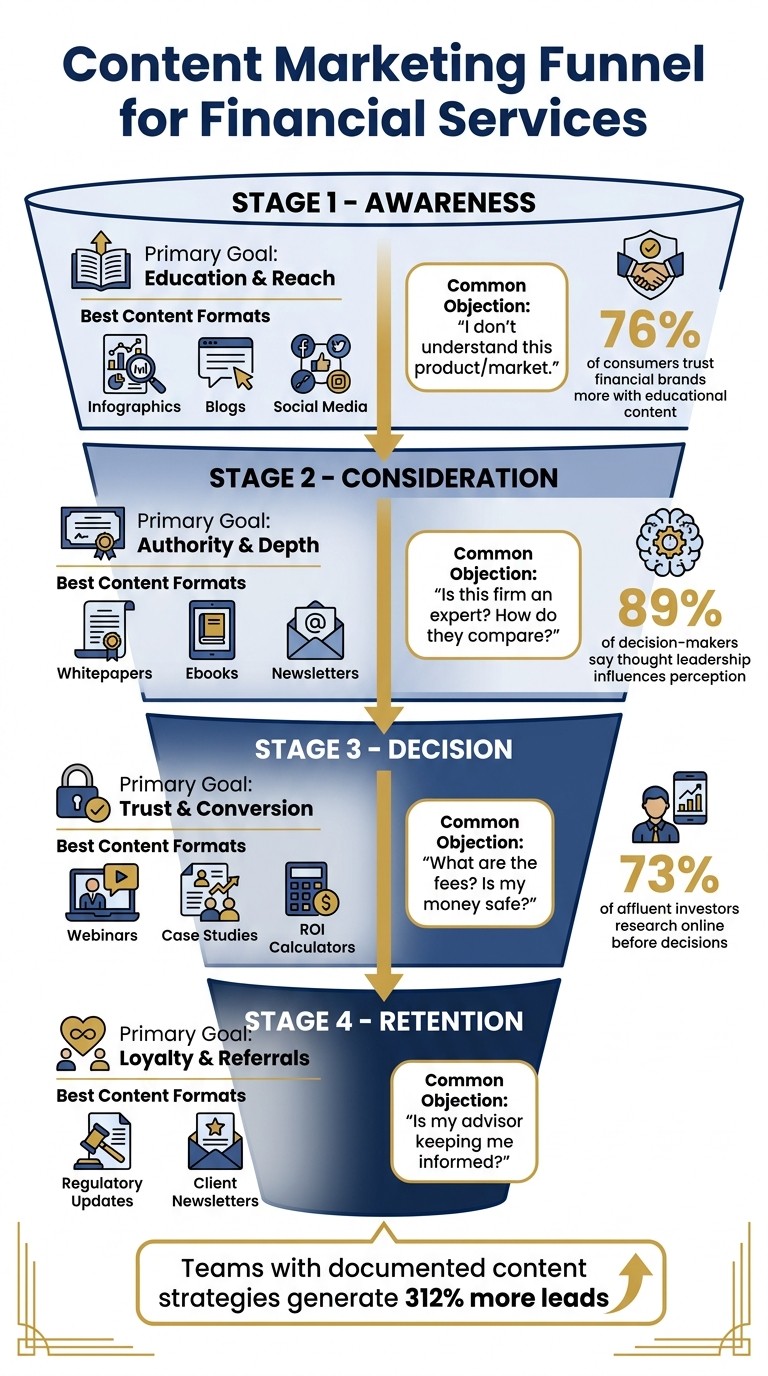
Content Marketing Funnel Stages for Financial Services
Once you've set clear goals and identified your target audience, the next step is tailoring your content to align with each phase of the buyer's journey. Financial buyers don’t wake up ready to sign contracts - they go through distinct stages, from recognizing a problem to evaluating solutions and, finally, making a purchase. Your content needs to match each phase with the right messaging, format, and level of detail.
Understand the Financial Buyer Journey
The buyer's journey in financial services typically unfolds in four stages: awareness (identifying a problem), consideration (exploring solutions), decision (validating the purchase), and retention (ensuring continued value). Trust is the backbone of every phase. With 73% of affluent investors researching financial topics online before making decisions [7], your content must establish expertise long before they contact you.
While B2C financial decisions, like opening a checking account, can happen in minutes, B2B financial sales cycles are much longer. For example, products like corporate loans or treasury management can span six to 12 months and often involve committees of decision-makers, including CFOs, CTOs, and legal teams [11]. Each stakeholder comes with unique concerns: CFOs focus on ROI and risks, IT teams look at API integration, and legal teams prioritize compliance. Your content must address these varied perspectives.
Match Content to Each Funnel Stage
Each stage of the funnel requires a distinct approach to content. During the awareness stage, the goal is to educate and clarify. Blog posts, infographics, social media updates, and financial literacy resources can help simplify complex ideas. 76% of consumers say educational content from financial institutions increases their trust in the brand [3].
In the consideration stage, buyers are comparing solutions and assessing expertise. Whitepapers, ebooks, email newsletters, and third-party analyst reports are effective tools for building credibility. Notably, 89% of decision-makers report that thought leadership content positively influences their perception of a company [1]. At the decision stage, buyers seek reassurance and concrete details. Webinars, case studies, ROI calculators, and comparison guides help close the gap between interest and commitment. Finally, the retention stage focuses on maintaining relationships. Client-only newsletters, regulatory updates, and advanced educational content can keep existing customers engaged and loyal.
Funnel Stage | Primary Goal | Best Content Formats | Common Objections Addressed |
|---|---|---|---|
Awareness | Education & Reach | Infographics, Blogs, Social Media | "I don’t understand this product/market." |
Consideration | Authority & Depth | Whitepapers, Ebooks, Newsletters | "Is this firm an expert? How do they compare?" |
Decision | Trust & Conversion | Webinars, Case Studies, ROI Calculators | "What are the fees? Is my money safe?" |
Retention | Loyalty & Referrals | Regulatory Updates, Client Newsletters | "Is my advisor keeping me informed?" |
Teams with documented content strategies generate 312% more leads than those without, according to a 2024 Morgan Stanley analysis [2]. Addressing common objections through your content not only builds trust but also helps drive conversions.
Address Common Buyer Objections
Financial buyers often hesitate because of predictable concerns: unclear fees, investment risks, regulatory issues, and lack of transparency. Content that directly tackles these objections is essential at every stage. For instance, during the awareness stage, address questions like, "I don’t understand this market." In the consideration stage, focus on, "How does this firm compare?" And at the decision stage, answer concerns like, "What are the fees? Is my money safe?"
"Content marketing focuses on offering information that helps to solve customer problems... to motivate customers to reach out to you." - NYTLicensing [1]
For decision-stage tools like ROI calculators or case studies, ensure all claims are backed by documented results and include clear disclaimers to avoid misleading prospects [4]. Transparent, fact-based content not only builds trust but also speeds up the decision-making process.
Create Compliant, High-Value Content
Producing financial services content requires a careful balance between educating your audience and meeting regulatory standards. With an efficient workflow, you can create content that builds trust, engages readers, and navigates compliance without slowing down your publishing schedule.
Focus on Educational Content
Educational content is a cornerstone of trust in financial services. Instead of simply promoting products, aim to address the real questions your audience has.
Take, for instance, a Bay Area-based RIA that launched a 10-part blog series in early 2025 titled "Investing for High Earners Under 40." This campaign led to a 42% boost in organic traffic, 386 new leads, and a 7.3% conversion rate from those leads to consultations [3].
Formats that directly answer specific questions - like calculators, FAQs, comparison guides, and case studies - are especially effective. If privacy rules prevent naming customers, use anonymized examples, such as "A top-50 mortgage lender", to illustrate your points. Including author bios with professional credentials (e.g., CFP, CPA, CFA) also reinforces expertise, lending credibility and authority to your content.
Build Compliance Reviews Into Your Workflow
While educational content fosters trust, a streamlined compliance process ensures it reaches your audience without unnecessary delays. Many compliance bottlenecks arise from a lack of clear processes [12]. Address this by integrating compliance early and creating a tiered review system that prioritizes resources effectively.
Content can be categorized into three tiers:
Tier 1: High-risk content like product claims, performance data, or testimonials. This requires thorough legal and compliance review.
Tier 2: Medium-risk content such as industry trends or educational blogs, needing a lighter review by marketing and subject matter experts.
Tier 3: Low-risk content like team news or company culture updates, requiring only marketing approval.
Content Tier | Review Level | Examples |
|---|---|---|
Tier 1 | Full Compliance/Legal | Product pages, performance claims, testimonials |
Tier 2 | Light Legal/Marketing | Industry trends, educational blogs, event recaps |
Tier 3 | Marketing Only | Company culture, team news, general updates |
To maintain a steady publishing rhythm, schedule specific compliance review windows - such as five business days for Tier 1 content. AI tools can also speed up this process by scanning drafts for risky language, missing disclaimers, or misleading statements in real-time. These tools can work up to 30 times faster than manual reviews [13], freeing human reviewers to focus on more nuanced risks.
Use Storytelling to Simplify Complex Topics
Even with compliance and structure in place, storytelling can make financial topics more relatable. Complex ideas don’t have to be dry or overly technical. Instead of using jargon like "EBITDA margin compression", opt for plain language, such as "Profit per dollar of sales is shrinking." Replace "OPEX optimization" with "Making daily operations more efficient."
"Storytelling is what sets great FP&A professionals apart - it transforms raw data into meaningful insights that drive business decisions." - UHY [14]
Frameworks like the "Three Whats" can help make complex information digestible:
What happened (the event)
So What (why it matters to your audience)
Now What (actions they can take) [16]
For example, instead of leading with "Revenues are down", start with the business event that caused the decline, explain the financial impact, and outline actionable steps.
The Rule of Three is another useful tool for simplifying analysis. Breaking information into three key drivers or options makes it easier for audiences to understand and remember [15]. For presentations or webinars, follow the 10-20-30 Rule: no more than 10 slides, 20 minutes of content to allow for discussion, and a 30-point font to minimize clutter [16]. These techniques ensure your content is both clear and engaging while meeting the precision required by regulators.
Use Technology to Scale Content Production
Scaling your content production doesn't have to drain your team's energy. Financial services firms with well-documented content strategies consistently generate more leads than those without clear frameworks. However, manual production can quickly become a bottleneck. AI-powered tools provide a way to expand your content output while maintaining the quality and compliance standards your audience relies on.
Automate Workflows with AI Tools
Once your compliance process is streamlined, you can focus on efficiency by integrating AI into your workflows. Modern AI platforms simplify the entire content lifecycle, from strategy development to publishing. For instance, tools like Averi AI use "Strategy Maps" to pinpoint high-value topics based on your Ideal Customer Profiles (ICPs) and competitive positioning. This approach ensures every piece supports your authority in the field, eliminating random or unfocused publishing efforts [4]. Instead of starting from scratch, AI engines can create first drafts that align with your brand's voice and messaging, optimized for both traditional SEO and newer AI-driven discovery platforms like Perplexity and ChatGPT [4].
For video content, platforms such as SageContent can significantly streamline production. These tools leverage AI for scripting and editing, reducing production time by as much as 90% [18]. They also incorporate compliance into the workflow through automated checkpoints, audit trails, and downloadable video histories for regulatory reviews [18]. By adopting AI-driven content operations, firms can cut operational costs by up to 24% while still meeting the precision required in regulated industries [19].
Track Content Performance Metrics
Creating content is just the start - understanding its impact is equally important. In financial services, the focus is on lead quality rather than sheer traffic volume. Key metrics to monitor include the average assets of prospects generated, conversion rates from content engagement to discovery meetings, and the time it takes for prospects to become clients [2][7]. A full-funnel tracking approach is essential, breaking metrics into stages such as awareness (e.g., organic search visibility), evaluation (e.g., dwell time or guide downloads), and decision (e.g., consultation requests or assets under management acquired) [3][7].
Unlike paid advertising, content marketing generates returns that grow over time. Content published months earlier can continue to deliver leads, making it essential to track long-term performance. By 2025, content marketing for financial firms is expected to deliver three times as many qualified leads as paid advertising while costing 62% less per acquisition [7]. Tools like Google Search Console and CRM integrations can help connect specific blog posts or whitepapers to key actions such as demo requests or new account openings [4].
Refine Your Strategy Using Data
Data should be the driving force behind your future content efforts. AI-powered tools like Ahrefs can audit your site to identify gaps, outdated content, and underperforming topics, enabling you to focus on areas with the highest potential impact [17]. Instead of guessing what will resonate, use engagement metrics to track how prospects move through your funnel - from educational content to mid-funnel tools like retirement calculators [2].
For 85% of financial institutions, the complexity of content workflows is a major barrier to scaling personalized customer experiences [19]. AI can help by scanning sitemaps to ensure new content ideas complement rather than compete with existing resources [17]. Monitoring E-E-A-T (Experience, Expertise, Authoritativeness, Trustworthiness) signals, such as search rankings for high-intent keywords like "fee-only financial advisor near me", can also provide insights into how your content is perceived [3]. By integrating AI into your operations, you can scale production while maintaining trust and compliance, positioning your firm as a leader in customer engagement and regulatory excellence [19].
Conclusion
In financial services, content marketing isn’t about producing more - it’s about being smarter with what you create. Success comes from earning trust through clear expertise, weaving compliance into the process from the start, and leveraging technology to scale without compromising quality. Research shows that advisor teams with well-documented content strategies generate a staggering 312% more leads than those without such frameworks [2].
The journey begins with truly understanding your audience and tailoring content to their specific needs at each stage of their decision-making process. Educational material that solves real-world challenges - like strategies for minimizing taxes or addressing retirement planning gaps - consistently outperforms generic promotional pieces. In fact, targeted educational content produces four times more qualified leads than broad, general articles [7].
Compliance doesn’t have to slow things down. By adopting a tiered review system, firms can streamline the process: general educational pieces can move quickly, while content involving regulatory claims undergoes a more thorough review. Tools like Averi AI can further speed things up by generating structured drafts for compliance teams to refine instead of starting from scratch, significantly reducing review times [4].
Technology plays a pivotal role in scaling these efforts. AI-driven platforms can pinpoint high-value topics, ensure a consistent brand voice, and optimize content for both traditional search engines and AI-based tools like ChatGPT and Perplexity. The numbers back this up: content marketing delivers three times more qualified leads than paid advertising, all while reducing acquisition costs by 62% [7].
Firms that view content as a core business strategy - not just a marketing task - position themselves to build trust, increase visibility, and achieve sustained growth in today’s digital-first financial world.
FAQs
How do I start a compliant content strategy in financial services?
To establish a content strategy that meets compliance standards in financial services, begin by prioritizing regulatory guidelines and fostering trust. Focus on producing content that is accurate, evidence-based, and aligned with industry regulations to demonstrate your commitment to compliance.
Develop a structured plan with defined workflows that incorporate multiple review stages and quality checks. This ensures compliance is maintained at every step - from creation to editing and publishing. By being transparent and adhering to established compliance frameworks, you'll build trust and position your brand effectively in this highly regulated sector.
What content should I create for each stage of the buyer’s journey?
To create content that resonates with buyers at every stage of their journey, it's crucial to address their evolving needs:
Awareness Stage: Focus on providing educational materials such as blogs, whitepapers, or articles that discuss industry challenges and trends. This helps establish trust and positions you as a helpful resource.
Consideration Stage: Offer content that aids in decision-making, like product comparisons, case studies, or how-to guides. These resources demonstrate how your solutions can address their specific problems.
Decision Stage: Emphasize what sets you apart by showcasing product demos, customer testimonials, and clear, compelling calls-to-action. These elements can help encourage buyers to make a commitment.
Which metrics prove content marketing ROI for financial firms?
For financial firms, evaluating the return on investment (ROI) of content marketing hinges on several key metrics. These include customer lifetime value, product adoption rates, engagement quality, churn rate, pipeline influence, and revenue contribution. Each of these metrics ties content performance directly to measurable business outcomes, such as increases in assets under management (AUM) and successful lead conversions. Tools like content scoring and advanced analytics play a critical role in assessing the real impact of content efforts on these outcomes.
Related Blog Posts

Zach Chmael
CMO, Averi
"We built Averi around the exact workflow we've used to scale our web traffic over 6000% in the last 6 months."
Your content should be working harder.
Averi's content engine builds Google entity authority, drives AI citations, and scales your visibility so you can get more customers.