

In This Article
Practical steps to track donor metrics, set up GA4 and CRMs, use AI tools, and improve fundraising with data.
Updated:
Trusted by 1,000+ teams
Startups use Averi to build
content engines that rank.
Marketing analytics helps nonprofits make smarter decisions by showing what works and what doesn’t. With limited budgets and small teams, nonprofits can’t afford to guess. Analytics pinpoints strategies that increase donations, retain donors, and improve campaign performance.
Key takeaways:
Data matters: Only 26% of nonprofit marketers document their strategy, making analytics essential for clarity.
Track the right metrics: Focus on donor retention, conversion rates, and fundraising ROI - not just vanity metrics like impressions.
Use tools effectively: Google Analytics 4, CRM systems, and AI tools like Averi streamline tracking, donor management, and content creation.
Leverage data types: Descriptive, predictive, and prescriptive analytics help nonprofits analyze trends, forecast outcomes, and make data-driven decisions.
Start small with free tools like Google Ad Grants and HubSpot CRM. Define clear goals and use analytics to focus resources where they’ll have the most impact.
Maximizing Nonprofit Impact with Google Analytics : A Step by Step Guide
Which Metrics to Track for Nonprofit Campaigns
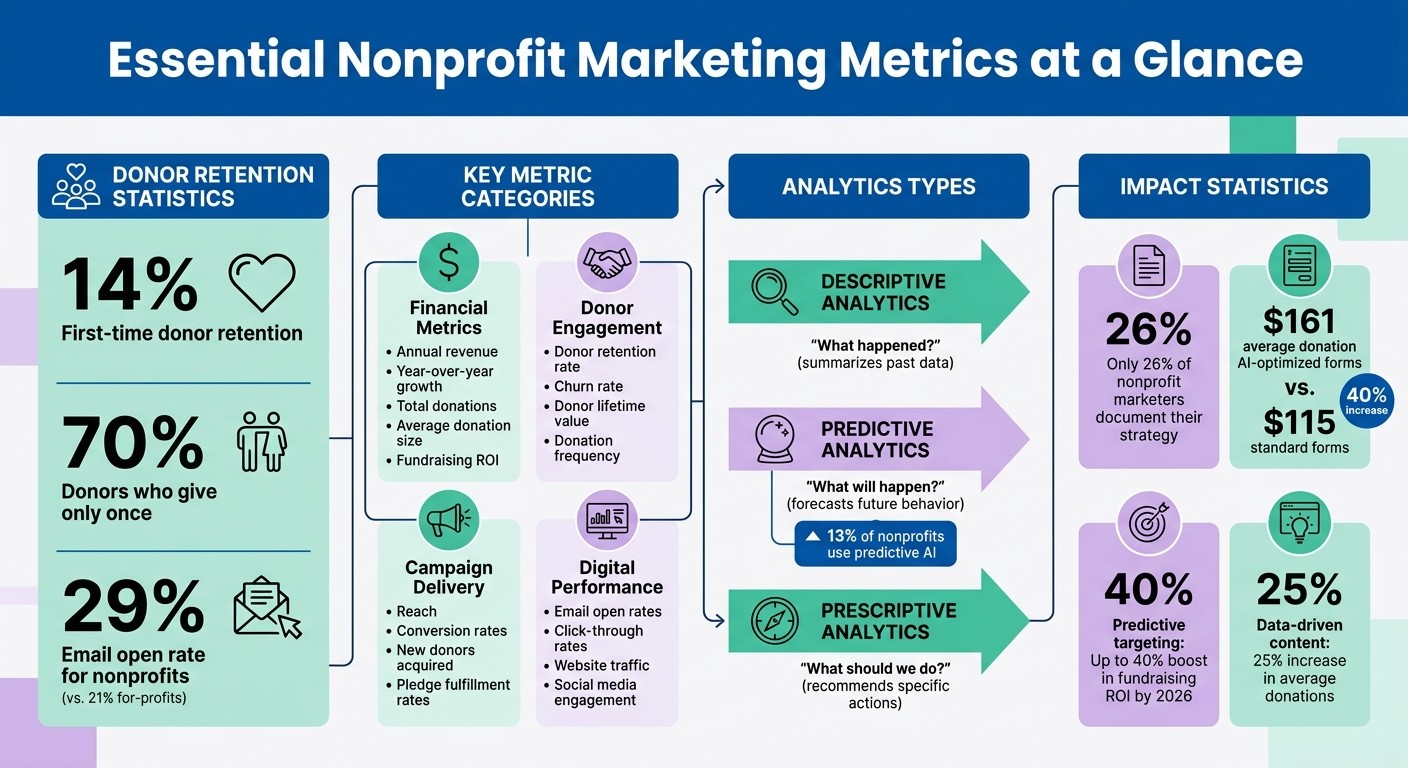
Key Nonprofit Marketing Analytics Metrics and Statistics
Core Metrics Every Nonprofit Should Monitor
Tracking the right metrics transforms vague outcomes into actionable insights. Start with financial metrics: annual revenue, year-over-year growth, total donations, average donation size, and fundraising ROI (calculated as annual funds raised divided by annual investments) [4][5]. These numbers reveal if your campaigns are generating consistent income.
Next, dive into donor engagement metrics. Donor retention rate - the percentage of donors who contribute in consecutive periods - is a key indicator of success [2]. Other important metrics include churn rate, donor lifetime value, and donation frequency. For example, first-time donor retention averages just 14%, and 70% of donors only give once [8].
Campaign delivery metrics evaluate how well your message reaches and resonates with your audience. Key indicators include reach, conversion rates, new donors acquired, and pledge fulfillment rates [4][6]. For digital campaigns, track metrics like email open rates (nonprofits average 29%, compared to 21% for for-profits) [3], click-through rates, website traffic, and social media engagement.
It's also crucial to differentiate between leading and lagging metrics. Leading indicators, such as website traffic, can signal future trends, while lagging indicators, like annual revenue, reflect past results [4]. Additionally, relative measures (e.g., a 5% conversion rate) often provide more context than absolute numbers (e.g., 500 visitors) [6].
"Most of us in nonprofit leadership have neither the time nor the resources to meander down a random path towards hopeful success." - Joe Domaleski, Marketing Data Science [6]
These foundational metrics pave the way for deeper analytics, which can help nonprofits strategize resource allocation and amplify their impact.
3 Types of Analytics: Descriptive, Predictive, and Prescriptive
Once you've established core metrics, analytics can help you interpret the data and guide your decision-making. Shifting from simply reporting results to proactively influencing outcomes can be transformative.
Descriptive analytics focuses on summarizing past data to identify trends. Metrics like total website traffic, monthly donations, or email open rates fall into this category, answering the question, “What happened?” [5][6][7].
Predictive analytics leverages historical data to forecast future behavior. For instance, AI tools can rank donors based on their likelihood to give again, upgrade their contributions, or stop donating altogether [5]. Currently, 13% of nonprofits use predictive AI to identify potential major donors [3]. This type of analysis answers the question, “What will happen?”
Prescriptive analytics takes it a step further by recommending specific actions based on the data [6]. For example, it can suggest the best timing for a campaign launch or how to allocate advertising budgets for maximum impact.
A fourth category, diagnostic analytics, digs into past performance to uncover the reasons behind specific outcomes - such as investigating a sudden drop in email open rates [5][6]. Together, these types of analytics offer a well-rounded view of your campaign performance and provide actionable insights to improve future strategies.
How to Set Up Marketing Analytics Tools
Setting Up Google Analytics for Nonprofits
Google Analytics 4 (GA4) is a free tool designed to monitor performance across your website, donation pages, and campaigns. To get started, create an account at analytics.google.com and install the tracking code on your site using a plugin or by adding it directly to your website's code.
Once installed, set up conversion and event tracking to measure key actions. For example, configure "Destination Goals" to track when users reach the "thank you" page after completing a donation. Additionally, use "Event Tracking" to monitor activities like button clicks, video plays, or ad interactions. This allows you to see how many visitors click your "Donate Now" button compared to those who complete the donation process [9].
To identify which marketing channels bring in the most donors, use UTM parameters. Tag links in your emails, social media posts, and paid ads to let GA4 categorize traffic by source - such as Organic, Direct, Referral, Social, or Paid [9]. This helps you determine whether your Instagram posts or email campaigns drive more donations.
If your nonprofit qualifies as a 501(c)(3), consider applying for Google Ad Grants, which provides $10,000 per month in free search advertising credits [9][3]. By combining these ads with GA4 tracking, you can measure their effectiveness in converting visitors into donors and refine your keyword strategy.
Finally, integrate your CRM system to centralize donor data and enable personalized outreach.
Connecting Your CRM System for Donor Data
A CRM system serves as the hub for all your supporter information, including contact details, donation history, and engagement preferences [10]. Popular tools like HubSpot (starting at $18/month with a strong free tier for nonprofits) or Bloomerang can sync directly with your website and email platforms, updating donor records in real time [3].
Before migrating data, review and clean your database. Remove duplicates, update outdated information, and standardize data entry formats (e.g., phone numbers as (555) 123-4567, dates as MM/DD/YYYY). Importing messy data will only cause headaches later [11].
With the integration in place, you can automate tasks that would otherwise take hours. For instance, when a donor gives through your website, the CRM can automatically send a thank-you email, schedule a follow-up, and tag them for future campaigns based on their donation level [10]. You can also segment donors by giving frequency, lifetime value, or prior engagement to tailor your outreach and improve retention rates.
Always back up your database before starting any integration or data cleanup process to avoid losing important information if something goes wrong [11]. Many CRM platforms offer step-by-step guides for connecting tools like Mailchimp, which is free for up to 500 contacts and offers a 15% discount for nonprofits on paid plans [3].
With analytics and a CRM in place, you can take your campaigns to the next level by automating content creation with AI tools.
Using Averi AI to Automate Content and Campaign Work
Averi AI combines strategy, content creation, SEO, and analytics into one streamlined system, making it possible for small nonprofits to operate like a full-scale marketing team [2][1]. The platform begins by analyzing your website to understand your mission, tone, and goals, then generates a tailored content marketing plan.
Averi continuously monitors your sector, identifying trends, keywords, and content opportunities. It queues up ready-to-publish ideas for blog posts, social media updates, email campaigns, and donor outreach materials [1]. All you have to do is approve the content. Nonprofits using Averi have been able to publish 8–12 optimized pieces of content per month without hiring additional staff [2].
The platform also repurposes content automatically. For example, it can turn an annual impact report into multiple social media posts, email sequences, and blog articles, saving time while maintaining consistent messaging [1]. From SEO optimization to direct publishing in platforms like Webflow, WordPress, or Framer, Averi handles the technical work so you can focus on your mission.
"We accomplished more in two weeks with Averi than we did in three months with our previous agency. The combination of AI speed and expert execution is exactly what we needed." - Sarah Chen, Founder, TechScale [2]
Averi's analytics go beyond basic reporting by recommending actionable steps. It highlights trending topics, suggests ways to improve content rankings, and identifies what to create next based on performance data [2]. This creates a feedback loop where each campaign becomes smarter, helping you maximize donor engagement and impact with every effort.
How to Improve Campaigns Using Analytics Data
Adjusting Campaign Strategies Based on Data
Analytics can be a game-changer for refining donor outreach. Start by segmenting donors based on their giving history, demographics, and interests. For example, approach one-time donors with emotional storytelling, while recurring donors might respond better to detailed reports showing the impact of their contributions [12].
Use analytics to identify which channels - email, social media, direct mail, or search ads - deliver the best results [2]. If social media posts generate strong engagement but fewer conversions compared to email campaigns, consider shifting resources to where they’re most effective. A full-funnel approach can help you fine-tune your strategies [2].
Email data is particularly valuable. Schedule appeals during peak engagement times and run A/B tests on subject lines to find the most compelling messaging.
Take inspiration from a national charity hospital that partnered with DiveTeam. By implementing a unified data warehouse and cross-channel reporting, they reduced reporting time from a week to a single day and improved their cost-per-action by 34% [8].
Once you’ve refined your outreach, turn your attention to optimizing your website and donation pages.
Making Your Website and Donation Pages More Effective
Your website analytics can reveal exactly where donors are dropping off. For example, if your donation pages have a bounce rate over 50%, it could point to issues like slow load times, confusing navigation, or overly long forms [12].
A/B testing can help you refine layouts, calls-to-action (CTAs), and form lengths. For instance, testing CTAs like "Change a life today" versus "Donate now" can identify which resonates more. Data shows that AI-optimized forms lead to an average donation of $161, compared to $115 for standard forms - a 40% increase [3]. Simplify forms by reducing unnecessary fields and adding trust signals to build confidence.
Keep an eye on time-on-page metrics. If visitors spend less than 30 seconds on an impact page, it may signal poor engagement. Enhance these pages with visuals, pull quotes, and clear subheadings to make them more compelling [12].
Geographic data can also guide your strategy. If certain regions show higher engagement, consider creating localized campaigns or hosting events in those areas. For instance, a campaign spotlighting local volunteers can help foster a stronger sense of community.
These strategies are even more impactful when paired with consistent data analysis and real-world application.
Case Study: How One Nonprofit Used Data to Increase Donations
Diagnostic analytics can uncover the root causes of underperformance. For example, low email open rates or high bounce rates on donation pages might explain why a campaign isn’t meeting expectations [13].
Establish a monthly review process to focus on relative performance metrics like conversion and click-through rates rather than just absolute numbers [8] [13]. A campaign with 500 visitors and a 5% conversion rate (25 donations) is more effective than one with 1,000 visitors and a 2% conversion rate (20 donations).
Predictive targeting is another powerful tool, with the potential to boost fundraising ROI by up to 40% by 2026. Additionally, data-driven content can increase average donations by 25% compared to static campaigns [3]. By continuously testing and optimizing, nonprofits can create a feedback loop that leads to smarter, more effective campaigns. These data-driven strategies allow organizations to maximize their impact and refine their approach over time.
Best Practices for Measuring and Improving Results
Building a System for Continuous Campaign Analysis
To effectively measure and refine your campaigns, start by centralizing all donor data. Use your CRM as the single, reliable source of truth, and integrate tools like Google Tag Manager to track every interaction along the donor journey [5]. Nonprofits often rely on more than 15 disconnected marketing tools [8], which can create significant gaps in understanding. By connecting your email platform, donation system, and CRM into a unified dashboard, you can perform real-time analysis without missing critical insights.
Commit to a monthly review schedule to evaluate key metrics like conversion rates, email engagement, and channel ROI [2]. Establish SMART goals - Specific, Measurable, Attainable, Relevant, and Timely - for each campaign to provide clear benchmarks. Without these, you're left guessing, and only 26% of nonprofit marketers currently operate with a documented strategy [2].
"For the first time, we can answer questions about marketing performance with confidence. We went from guessing at attribution to having a clear picture of what drives engagement."
– Chief Marketing Officer, Charity Hospital [8]
Once your data is centralized, the next step is ensuring its quality and reliability.
Keeping Your Data Clean and Reliable
Reliable data is the foundation of meaningful analysis. As Kaleb Nyquist, a Data-Driven Strategist, explains:
"Poorly managed data makes it nearly impossible to perform any meaningful analysis. As the saying goes: 'garbage in, garbage out.'" [14]
To avoid errors, standardize how your team inputs information. Create strict protocols for tagging donor names, campaign sources, dates, and donation amounts [5]. Replace manual color-coded spreadsheets with standardized data fields like "Status: Complete" or "Status: Pending", which are easier for systems to process [14]. Automate data flow by connecting your fundraising software directly to your CRM, reducing the risk of manual entry mistakes.
Regular audits are essential for maintaining data integrity. Conduct these quarterly to verify accuracy and ensure your insights remain actionable [5]. Clean data is critical, especially when only 14% of first-time donors become recurring supporters [8]. Missing key patterns in messy data could mean losing valuable opportunities for engagement.
Scaling Success Across Campaigns
Once your analytics system is in place and your data is accurate, focus on applying successful strategies across multiple campaigns. Monitor performance by channel to identify which platforms drive the most engagement and conversions [1]. If one channel consistently outshines others, consider reallocating resources to amplify its impact.
Repurpose high-performing content across multiple formats, such as email, social media, blogs, and direct mail [1]. Organize effective themes - such as donor spotlights, impact stories, and behind-the-scenes updates - into content libraries for future use [1]. This approach reinforces a cycle of learning and improvement, ensuring your campaigns continue to evolve based on proven results.
Use data insights to eliminate underperforming channels. If a particular channel consistently falls short, redirect your efforts elsewhere [2]. Nonprofits using DonorPerfect's segmentation features alongside Constant Contact report 19% higher open rates and a 180% increase in click-through rates [15]. By systematically applying these insights, you can enhance your marketing operations and achieve better results across the board.
Conclusion and Next Steps
How Data Helps Nonprofits Make a Bigger Difference
By using detailed tracking strategies and integrating the right tools, data has become a game-changer for nonprofits. It takes the guesswork out of decision-making, helping organizations focus their limited resources where they matter most. Instead of trying every marketing channel and hoping for results, analytics pinpoint the tactics that drive real outcomes - like donations, volunteer sign-ups, and lasting supporter relationships. For nonprofits, where every dollar counts, cutting wasteful spending on underperforming efforts means more funds can go directly toward fulfilling their mission.
The numbers speak for themselves: AI-powered tools like optimized forms and personalized content are already delivering better results. Predictive targeting, for example, is expected to significantly improve fundraising returns by 2026 [3]. These advancements let nonprofits reach more people without overextending their resources.
With these insights in mind, here’s how to take the first steps toward building an analytics-driven approach.
Getting Started with Marketing Analytics
Start small by taking advantage of free tools designed for nonprofits:
Google Ad Grants: Eligible 501(c)(3) organizations can receive $10,000 per month in search advertising credits.
HubSpot's free CRM: A great way to centralize and manage donor data efficiently.
Canva's nonprofit tier: Perfect for creating eye-catching visual content [3].
These tools provide a strong foundation for tracking performance and gathering meaningful data.
Before launching any campaign, define SMART goals - clear and measurable targets like "increase monthly donations by 20%." Focus on metrics that matter, such as email open rates and conversion rates, rather than less useful vanity statistics [1][2]. Use A/B testing to experiment with one variable at a time and see what drives better results [2][16].
For nonprofits aiming to scale their efforts without hiring more staff, platforms like Averi can automate content creation and campaign analysis. This allows smaller teams to manage comprehensive strategies with ease [1][2]. Keep this in mind:
"Strategy without measurement is just guessing." [1]
The sooner you start tracking and analyzing, the sooner you’ll discover what’s truly effective - and what’s not worth your time.
FAQs
What should we track first if we’re new to analytics?
To gauge the success of your campaign, begin by monitoring key performance indicators (KPIs) such as reach, engagement, and web traffic. These metrics provide a clear picture of how well your message is connecting with your audience. Beyond that, pay close attention to donor behavior and how they interact with your content. These initial insights will serve as a roadmap for refining your approach and improving future campaigns.
How do I measure donations correctly in GA4?
To track donations in GA4, start by setting up event tracking specifically for donation conversions. Identify actions related to donations, such as clicking a "Donate" button, and configure these as events. Next, define the donation confirmation page as a conversion event to ensure completed donations are properly recorded.
Take advantage of enhanced measurement features in GA4, which can automatically track visits to donation pages and completion actions. Regularly check your GA4 reports to verify that all donation-related actions are captured correctly. Additionally, review your tags and triggers to ensure they are functioning as intended for accurate data collection.
How can I connect GA4 and our CRM without breaking our data?
To link GA4 with your CRM while maintaining precise data handling, leverage Google Tag Manager (GTM) to streamline the data flow and prevent duplicate tracking. Pay close attention when setting up GTM triggers and tags to avoid overlapping events. For added privacy and better attribution, consider using anonymized data when loading it into GA4. Make it a habit to regularly validate and review your data flows to keep the integration accurate and dependable.
Related Blog Posts

Zach Chmael
CMO, Averi
"We built Averi around the exact workflow we've used to scale our web traffic over 6000% in the last 6 months."
Your content should be working harder.
Averi's content engine builds Google entity authority, drives AI citations, and scales your visibility so you can get more customers.