

In This Article
A practical 5-step guide to using LLMs to audit your content, map competitor coverage, prioritize high-impact gaps, and automate execution.
Updated:
Trusted by 1,000+ teams
Startups use Averi to build
content engines that rank.
Large Language Models (LLMs) like ChatGPT, Google Gemini, and Microsoft Copilot simplify competitor content analysis by processing thousands of pages in minutes. They identify gaps in your strategy by categorizing competitor content, mapping user intent, and uncovering missed audience needs. This allows you to create targeted, high-performing content that attracts traffic and addresses overlooked topics.
Key insights:
Efficiency: AI-powered audits take 45 minutes vs. 12 hours manually.
Traffic Impact: Compounding posts (10% of content) drive 38% of traffic.
AI Search: URLs cited in AI Overviews retain 68% of click volume despite a 25% drop in organic clicks.
LLMs also help prioritize high-value gaps, automate tagging, and create actionable content strategies, saving time and resources while improving results.
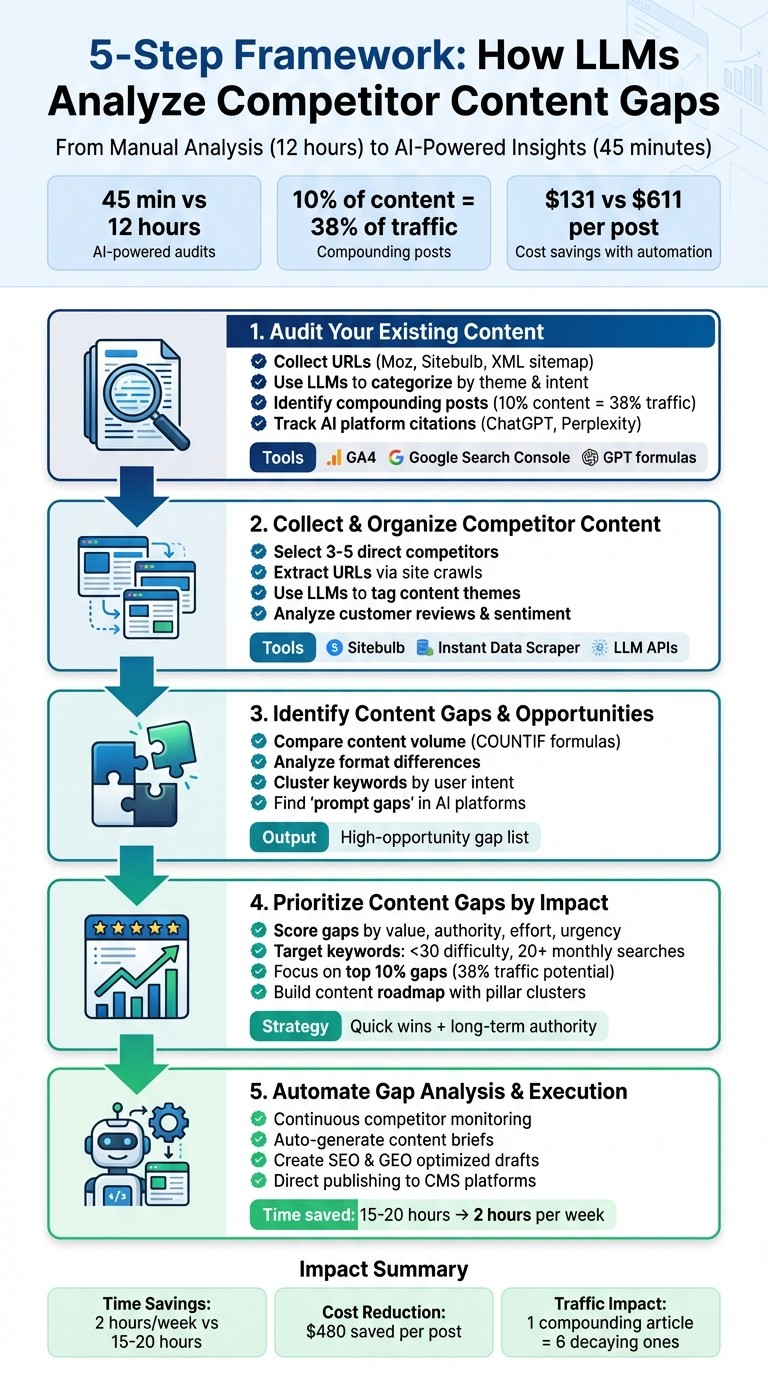
5-Step LLM-Powered Competitor Content Gap Analysis Framework
How to Create a Content Gap Analysis using ChatGPT (Free Custom GPT)
Step 1: Audit Your Existing Content
Before diving into competitor analysis, take a close look at your own content inventory. Many startups operate without a clear understanding of what they’ve published - often ending up with a chaotic mix of blog posts, landing pages, and product documentation, lacking any clear strategy or insights into performance.
Organize and Categorize Your Content with LLMs
Start by collecting every URL from your website using tools like Moz Site Crawl, Sitebulb, or your XML sitemap. Export this data into a Google Sheet. From there, leverage a large language model (LLM) to categorize each piece of content by theme, topic, and intent.
Here’s a helpful formula you can use in Google Sheets:
=GPT("Based on the string provided, assign it to one of these themes: 'Product Features', 'Customer Pain Points', 'How-To Guides'...", A2) [1].
This method significantly reduces the time spent on manual tagging. However, it’s essential to double-check the LLM’s tags, especially when URLs or slugs are unclear [1].
For a more automated and advanced approach, platforms like Averi can streamline this process. Averi scrapes your entire website to understand your brand’s positioning, products, and brand voice. It then creates a dynamic Brand Core library that evolves with every new piece of content [5]. This doesn’t just help with a one-time audit - it builds a continuously improving knowledge base for future content creation.
Once your URLs are categorized, combine them with performance data to pinpoint the content that delivers the most impact.
Analyze Your Content’s Performance
After tagging your content, overlay it with key performance metrics to determine what’s driving results. Use tools like GA4 and Google Search Console (GSC) to gather data on organic sessions, rankings, impressions, and click-through rates [3][5].
Additionally, track traffic sourced from AI platforms by setting up a GA4 "Session source" filter. Use this regex to isolate visits from AI tools:
(chat\.openai\.com|openai\.com|perplexity\.ai|claude\.ai|bard\.google\.com|poe\.com|copilot\.microsoft\.com|brave\.com) [3].
This will reveal which pieces of your content are being cited by AI platforms like ChatGPT, Perplexity, and others - an increasingly important metric for shaping your content strategy.
Finally, identify your compounding posts - those that experience steady growth in traffic 3–6 months after publication. These articles, though they make up just 10% of your blog content, account for 38% of total traffic [4]. A single compounding article can outperform six decaying ones [4]. Tag these separately, as they serve as a model for creating future high-performing content.
Step 2: Collect and Organize Competitor Content
After completing your internal content audit, it’s time to turn your attention outward and analyze what your competitors are doing. Gathering competitor content used to involve painstaking hours of manual research, but modern tools powered by LLM optimization have cut this process down significantly, allowing you to gain insights in just a few hours.
Select Competitors and Map Their Content Strategy
Begin by identifying 3–5 direct competitors whose content strategies you want to examine. Tools like Moz Site Crawl or Sitebulb can help you extract all URLs from their sitemap or even crawl their entire site. Export this data into a Google Sheet to create a foundational list of URLs and their metadata.
To get an overview of each competitor’s approach, leverage an LLM for a quick analysis. For example, input their homepage or key pages into tools like Microsoft Copilot or Google Gemini with a prompt such as:
"Analyze this website and identify its target audience, unique selling points, and main content themes."
This step gives you a high-level understanding of their positioning and strategy.
You can also dig deeper into customer sentiment by scraping reviews from platforms like Trustpilot using tools such as Instant Data Scraper. Feed this data into an LLM to uncover recurring customer pain points or the benefits most frequently mentioned. Additionally, LLMs can help you identify relevant subreddits where your competitors’ audiences are active. By analyzing these communities, you can discover common questions and discussion trends that might inform your own strategy.
Use LLMs to Tag Competitor Content
Once you’ve gathered your competitor URLs, the next step is to categorize them by themes and formats, much like you did in your internal audit. Use Google Sheets in combination with the OpenAI API to automate this process. A custom =GPT() formula can quickly tag each URL based on its content, title, or H1 tag.
For example:
=GPT("Based on the string provided, assign it to one of these themes: 'Product Guides', 'Case Studies', 'Industry News', 'How-To Guides', 'Other'. Output only the theme name.", A2)
This method allows you to sort and categorize thousands of URLs in minutes. Include an "Other" category for any outliers, and manually review any inconsistencies to ensure accuracy.
Once the content is categorized, you can use simple spreadsheet formulas like COUNTIF to compare the volume of articles in specific categories across competitors. This analysis helps you identify where competitors are heavily investing their efforts and where potential gaps may exist. For example, you might find they’re producing a lot of "How-To Guides" but neglecting "Case Studies", giving you an opportunity to focus on the underrepresented category.
"We build an LLM matrix that contains prompts prioritized by features and solutions highly important to our clients. And we then analyze LLM visibility gaps for these prompts." - Ajdin Perco, Director of Content, Organic Growth Marketing [3]
For those seeking a fully automated solution, platforms like Averi can continuously monitor competitor content, identify gaps, and suggest content strategies in real time. Instead of manually updating spreadsheets every quarter, Averi tracks competitor rankings and provides actionable recommendations as they emerge.
Step 3: Identify Content Gaps and Opportunities
Compare Your Content Against Competitor Data
Start by analyzing how your content measures up to competitors using tools like COUNTIF formulas. For instance, if a competitor has 47 "Product Guides" and you only have 12, this highlights a clear opportunity to expand your content library [1]. However, it's not just about numbers - quality and format play an equally important role.
Take a closer look at the type of content competitors are creating. Are they offering in-depth guides with interactive tools like calculators or checklists while you're sticking to short blog posts? By leveraging large language models (LLMs), you can analyze the structure and intent of competitor content. For example, input a set of competitor URLs into an LLM with a prompt like: "Review these articles and identify the primary format used (e.g., how-to guides, comparison tables, checklists, or video transcripts)." This approach can uncover gaps in formats or styles that might better engage your audience [2].
Another critical area to examine is intent. Competitors might focus on transactional topics like "best tools for X", while you’re emphasizing informational content such as "what is X." LLMs can help cluster keywords by user intent - whether informational, transactional, or navigational - giving you insights into where your content strategy might not align with user needs. Combining these quantitative and qualitative findings helps pinpoint the most impactful opportunities.
Use LLMs to Find High-Opportunity Gaps
Once you've identified content gaps, the next step is to prioritize which ones are worth pursuing. Not all gaps are created equal - some topics might have minimal search volume, lack relevance to your audience, or involve highly competitive keywords. This is where LLMs shine by identifying patterns and helping with prioritization.
Feed your dataset into an LLM to uncover keyword clusters that align with your audience, have significant search demand, and fit your site's authority. For instance, you could prompt: "From this data, identify content themes where competitors have more coverage and suggest keyword clusters that align with our target audience and show moderate to high search interest." This process often reveals overlooked opportunities, such as niche "how-to" queries that competitors dominate.
For teams focusing on AI-driven visibility, this step can extend beyond traditional SEO practices. LLMs can also identify "prompt gaps" - specific questions users ask on platforms like ChatGPT, Perplexity, or Google's AI Overviews where competitors are cited, but your brand is absent [3]. Tools like Averi streamline this process by continuously monitoring competitor content, clustering gaps by intent, and recommending topics to prioritize. This eliminates the need for manual spreadsheet reviews, saving time and ensuring your strategy stays ahead of the curve.
Step 4: Prioritize Content Gaps by Impact
Once you've identified high-opportunity gaps, the next step is to rank them by their potential impact. This ensures your content strategy focuses on areas that deliver the most value.
Filter Gaps by Search Volume and Relevance
Zero in on the top 10% of gaps that account for 38% of your traffic[4]. Each gap should be scored based on its potential value, how well it aligns with your authority, the effort required to address it, and its urgency[2].
Leverage a large language model (LLM) to prioritize gaps with transactional search intent - those that help guide users through the sales funnel rather than just drawing in casual visitors[1]. If your site is newer and lacks domain authority, target keywords with a difficulty score under 30 and a minimum monthly search volume of 20. This approach uncovers opportunities where competitors may rank, but competition remains manageable[3].
Pair search volume data with LLM-driven analysis of customer reviews to identify gaps tied to real audience pain points. Ajdin Perco, Director of Content, Automation/AI, and Ops at Organic Growth Marketing, shares:
"We build an LLM matrix that contains prompts prioritized by features and solutions highly important to our clients. And we then analyze LLM visibility gaps for these prompts." [3]
These carefully prioritized gaps will form the foundation of your upcoming content initiatives.
### Build a Content Machine
With your priority gaps in hand, the next step is to craft a content roadmap designed to maximize impact and engage users effectively. Before creating new content, check if existing pages can be optimized by running a site:yourdomain.com search[6].
Your roadmap should balance quick wins with efforts to build long-term authority. Start with "infrastructure" content - persistent, non-seasonal topics like the common questions customers ask during sales calls (e.g., how-to guides, product comparisons, or best practices). These pieces often become compounding assets that generate traffic months or even years after publication[4].
Organize related gaps into pillar clusters to establish deeper topical authority[4]. For each gap, create an AI-driven content brief outlining sections, target keywords, and production timelines.
The most efficient roadmaps create growth loops, where data from published content informs future topics automatically. Tools like Averi can streamline this process by monitoring competitor activity, tracking keyword performance, and queuing up high-priority topics based on real-time market shifts. This eliminates tedious spreadsheet tracking, allowing your team to focus on execution rather than endless research.
Step 5: Automate Gap Analysis and Execution with Averi
Identifying content gaps is just the beginning - automating the analysis and execution can dramatically speed up your competitive strategy. The traditional approach to gap analysis is time-consuming, with the average blog post taking nearly 4 hours to create, from research to tagging. For busy founders, this is simply not feasible[5].
How Averi Simplifies Competitor Content Analysis
Averi transforms the process by automating competitor content analysis. It starts by scraping your website to understand your product details, positioning, and brand voice. Then, it compares this data against competitor content to identify gaps. Beyond just spotting gaps, Averi continuously tracks competitor rankings, industry trends, and keyword performance to uncover high-potential topics tailored to your target audience.
The platform organizes these insights into a categorized content queue, including formats like how-to guides, comparisons, listicles, and editorials. Each suggestion comes fully loaded with a title, target keywords, and a content overview. By dedicating just 15 minutes a week to reviewing and approving new topics, you can bypass the hassle of manual keyword research, spreadsheets, and guesswork.
What sets Averi apart is its actionable analytics. Instead of overwhelming you with raw numbers, it provides clear recommendations, such as "This piece is ranking #8 - here’s how to push it to page 1", or "Your competitor just published on X - here’s a counter-strategy." This creates a feedback loop that continuously refines your content strategy, ensuring it remains sharp and effective.
From Content Gaps to Published Pieces with Averi
Once you've prioritized your content gaps, Averi takes over to turn insights into ready-to-publish content. After you approve a topic, the platform conducts thorough research with verified, hyperlinked sources, integrates your brand’s context, and generates drafts optimized for SEO and GEO targeting. This ensures your content not only ranks well on Google but is also recognized by AI-driven search engines.
Each draft comes equipped with FAQ sections, internal linking suggestions, and meta descriptions. You can refine the draft in a collaborative editing tool, leaving comments or requesting revisions. Once finalized, the content is published directly to platforms like Webflow, Framer, or WordPress, saving you from the tedious task of manual formatting. Every published piece is stored in a growing Library for future reference.
This streamlined approach cuts production time to just 2 hours per piece each week, costing around $131 - significantly less than the traditional average of $611 per post[5]. As Zach Chmael, Head of Marketing at Averi, aptly puts it:
"The path to faster growth is often slower content production... do less, more intentionally, and watch it outperform the chaos." [4]
Conclusion: Turn Content Gaps Into Competitive Advantages
Spotting content gaps is just the starting point - what truly matters is how you act on them. The five-step framework shared here - auditing content, analyzing competitors, pinpointing valuable gaps, prioritizing efforts, and automating execution - provides a clear path forward. Consider this: compounding posts account for only 10% of blog content but drive 38% of total traffic [4]. Yet, many teams squander resources on content that fizzles out instead of delivering long-term results.
Switching from manual analysis to automated workflows reshapes the economics of content creation. Traditionally, creating a single post costs an average of $611 and demands 15-20 hours of founder time weekly. Tools like Averi slash that cost to $131 per post and reduce time to just 2 hours per week - that’s a $480 savings per piece while maintaining consistent output [5]. Zach Chmael, Head of Marketing at Averi, highlights the impact:
"One compounding article does the work of six decaying ones. Which means 90% of the content most teams are producing is, economically speaking, a waste of resources" [4].
These savings let you redirect resources toward creating content that reinforces your authority over time.
The real edge, however, isn’t just about cutting costs - it’s about establishing topical authority that both search engines and AI systems recognize. When AI tools like ChatGPT, Perplexity, and Google’s AI Overviews decide which brands to cite, they favor those with authoritative, well-connected content ecosystems. By addressing gaps strategically, you can build these clusters of expertise. Ajdin Perco, Director of Content at Organic Growth Marketing, suggests using an "LLM matrix" to monitor how your brand appears in AI-driven prompts tied to your strengths [3].
The takeaway? Focus on quality over quantity. Publishing one well-researched, gap-filling article each week can outperform a high volume of thin, low-impact content. Automation allows you to concentrate on refining your brand voice and approving strategic moves. With every new post, your content library strengthens, rankings improve, and AI recommendations become more favorable. This approach doesn’t just fill gaps - it transforms them into enduring advantages.
FAQs
What data is needed for an LLM content gap audit?
To conduct an effective LLM content gap audit, start by collecting data on the keywords your competitors rank for, their top-performing content, and trending topics in your industry. Pay close attention to areas where your site falls short - whether in search terms, content themes, or overall coverage compared to competitors. This process will help you pinpoint opportunities to refine and strengthen your content strategy.
How can I measure traffic from AI tools in GA4?
To keep an eye on traffic coming from AI tools in Google Analytics 4 (GA4), attach UTM tags or tracking parameters to your AI-generated links. Once set up, you can track these in GA4's traffic reports to identify the sources and assess performance. This approach lets you measure how AI-driven content influences your website traffic, giving you insights to fine-tune your strategy.
How should I prioritize which content gaps to publish first?
To make a real impact, pinpoint content gaps where search volume is high but competition is low. These opportunities can help you rank faster and attract more traffic. Focus on topics that resonate with your audience's interests while aligning with your business objectives. Prioritize publishing content that balances relevance and potential to deliver measurable results.
Related Blog Posts

Zach Chmael
CMO, Averi
"We built Averi around the exact workflow we've used to scale our web traffic over 6000% in the last 6 months."
Your content should be working harder.
Averi's content engine builds Google entity authority, drives AI citations, and scales your visibility so you can get more customers.