

In This Article
Organize content workflows for fractional teams with a five-phase system, AI automation, and collaboration practices to boost consistency and speed.
Updated:
Trusted by 1,000+ teams
Startups use Averi to build
content engines that rank.
Fractional teams - part-time specialists working across multiple clients - are a cost-efficient solution for businesses, especially startups, to access expert talent without full-time commitments. However, managing these teams presents challenges like fragmented workflows, inconsistent messaging, and time inefficiencies. This guide offers actionable steps to streamline workflows, improve coordination, and ensure high-quality content production without losing your brand's creative soul. Key takeaways include:
Workflow Phases: From strategy to analytics, a five-phase system ensures smooth collaboration and consistent output.
AI Tools: Platforms like Averi reduce manual work by automating planning, drafting, and publishing, saving time and cutting costs.
Collaboration Practices: Regular check-ins, shared guidelines, and tools like Slack and Asana enhance team coordination.
Cost Comparison: Averi minimizes oversight time and costs compared to freelancers or standalone AI tools.
What Fractional Teams Need in Content Marketing
What Are Fractional Teams?
Fractional teams are made up of part-time specialists - such as strategists, copywriters, designers, and SEO experts - who collaborate on content marketing projects without the need for full-time commitments. Unlike traditional agencies that often churn out one-size-fits-all solutions or in-house teams stretched across multiple tasks, fractional teams provide tailored, scalable support that seamlessly integrates into your operations [3][4]. For example, a strategist might craft messaging guidelines, a copywriter develops the content, and a designer creates visuals - all contributing their niche expertise to deliver high-quality results across multiple clients [3].
This approach enables businesses to tap into senior-level talent without the hefty price tag.
Jina Wye, Managing Director at HITE Digital, puts it this way: "Startups are drawn to fractional marketing leaders because they get senior-level expertise without committing to the cost of a full-time hire" [5].
For lean organizations, this model offers access to specialized skills - such as a fractional content strategist who can design repeatable distribution frameworks - without the financial burden of full-time employment. However, while the flexibility is appealing, it comes with its own set of challenges that can impact brand consistency.
Common Challenges for Fractional Teams
Despite their advantages, fractional teams face unique hurdles. Decentralized setups can lead to coordination issues, such as a copywriter's draft not aligning with a designer's visuals or messaging drifting off-brand due to infrequent collaboration [3][4]. Since team members often balance multiple clients, maintaining a consistent brand voice across blogs, social media, and email campaigns can become a struggle [3][4].
This fragmented workflow can result in disjointed strategies and delays, ultimately weakening engagement. Inconsistent execution, a common pitfall for fractional teams, can undermine the effectiveness of content marketing efforts. To counter these challenges, teams need structured workflows: clear briefs, shared style guides, dedicated communication channels, and collaborative editing tools. These elements help ensure that even dispersed specialists can work in harmony, creating a cohesive and impactful content strategy.
The Do’s and Don’ts of Managing Fractional Talent
The 5 Phases of an Optimized Content Workflow
For fractional teams, managing content production can often feel like juggling too many moving parts. A streamlined workflow is key to ensuring quality while reducing inefficiencies. The five phases outlined here create a system where strategists, writers, and designers can work simultaneously, avoiding bottlenecks. Each phase builds on the previous one, aligning strategy with execution.
Phase 1: Strategy and Planning
Everything starts with a solid strategy. AI platforms like Averi simplify the process by analyzing your website to understand your business, products, positioning, and brand voice. From there, the platform identifies ideal customer profiles, highlights gaps in competitor content, and finalizes a marketing plan - all in about 10 minutes. This shared foundation ensures that every team member works from the same playbook, keeping messaging consistent across all content.
Phase 2: Content Queue Management
Say goodbye to scrambling for ideas on Monday mornings. AI tools continuously monitor your market, tracking trends, competitor activity, and keyword opportunities. They generate a queue of content ideas - complete with suggested titles, keywords, and outlines - organized by type, like how-to guides, comparisons, or listicles. A quick 15-minute review each week keeps everyone focused on execution rather than brainstorming.
Phase 3: AI-Driven Content Execution
AI takes on the heavy lifting of first drafts, gathering in-depth research with hyperlinked sources and applying your brand’s unique context. These drafts come fully structured for SEO, with features like FAQ sections and summaries. Fractional experts then step in, spending 20–30 minutes refining the draft by adding insights, professional expertise, and brand voice. This approach doesn’t just save time - it saves money too. Recent data shows that AI-assisted production reduces costs by $480 per blog post, with an average cost of $131 compared to $611 for traditional methods[1]. This allows writers to focus on crafting content that resonates on a deeper level.
Phase 4: Publishing and Content Storage
With direct integrations to platforms like WordPress, Webflow, and Framer, publishing becomes a one-click process - no formatting headaches required. Each piece of content is stored in a central library, building a repository of institutional knowledge. For fractional teams, this library is a game-changer. It preserves your brand’s history and voice, making it easier for AI to improve over time and ensuring consistency even as team members come and go.
Phase 5: Analytics and Continuous Improvement
Actionable analytics take the guesswork out of content performance. Instead of overwhelming dashboards, you get clear, actionable suggestions like, "This post is ranking #8 - here’s how to move it to page 1", or, "Add this low-competition, high-relevance keyword to your queue." This guidance allows fractional teams to focus on execution rather than data analysis. Over time, as your content library grows, the system becomes smarter, helping your posts rank higher and perform better. According to research, just 10% of blog posts - those with compounding effects - account for 38% of total traffic[2]. This phase ensures that every piece of content contributes to long-term growth.
Tools and Practices for Fractional Team Collaboration
Tools for Workflow Optimization
For fractional teams, having the right tools in place can make all the difference in reducing coordination challenges and keeping workflows smooth.
Averi is a game-changer for automating repetitive tasks like strategy planning, queuing, drafting, editing, and publishing. By cutting manual work by up to 80%, it allows team members to focus on approvals and fine-tuning content.
Asana acts as the central hub for project management. It helps teams maintain a visual content calendar, assign tasks with clear dependencies, and track key performance indicators (KPIs). This ensures all team members have a shared understanding of project goals and progress.
Slack simplifies communication by replacing long email threads with real-time messaging. Create dedicated channels for different content phases, integrate Asana for automatic updates, and use threaded discussions to keep feedback organized. Slack’s bots can also streamline quick approvals, making it easier for teams to stay aligned across time zones.
These tools create a framework for efficient operations, but structured communication practices are equally important to ensure everyone stays on the same page.
Communication and Alignment Practices
Short, regular check-ins help fractional teams stay connected and aligned. Schedule 15–30 minute weekly stand-ups through Zoom or Slack to review progress, address challenges, and set priorities. These sessions should cover key wins, upcoming tasks, and updates on industry trends, helping to maintain a unified brand voice.
Every two weeks, conduct content reviews using shared screens in tools like Google Docs or Averi’s editing interface. These sessions allow teams to analyze drafts and performance data, enabling quicker adjustments to strategies. Use shared calendars in Google Calendar or Asana to coordinate publishing schedules, review sessions, and stand-ups, minimizing missed deadlines and ensuring smooth cross-time-zone collaboration.
To onboard new team members and maintain consistency, store brand guidelines, standard operating procedures (SOPs), and content templates in platforms like Notion or Google Drive. This documentation ensures everyone works from the same playbook, no matter when they join the team.
Averi vs. Other Approaches: A Comparison
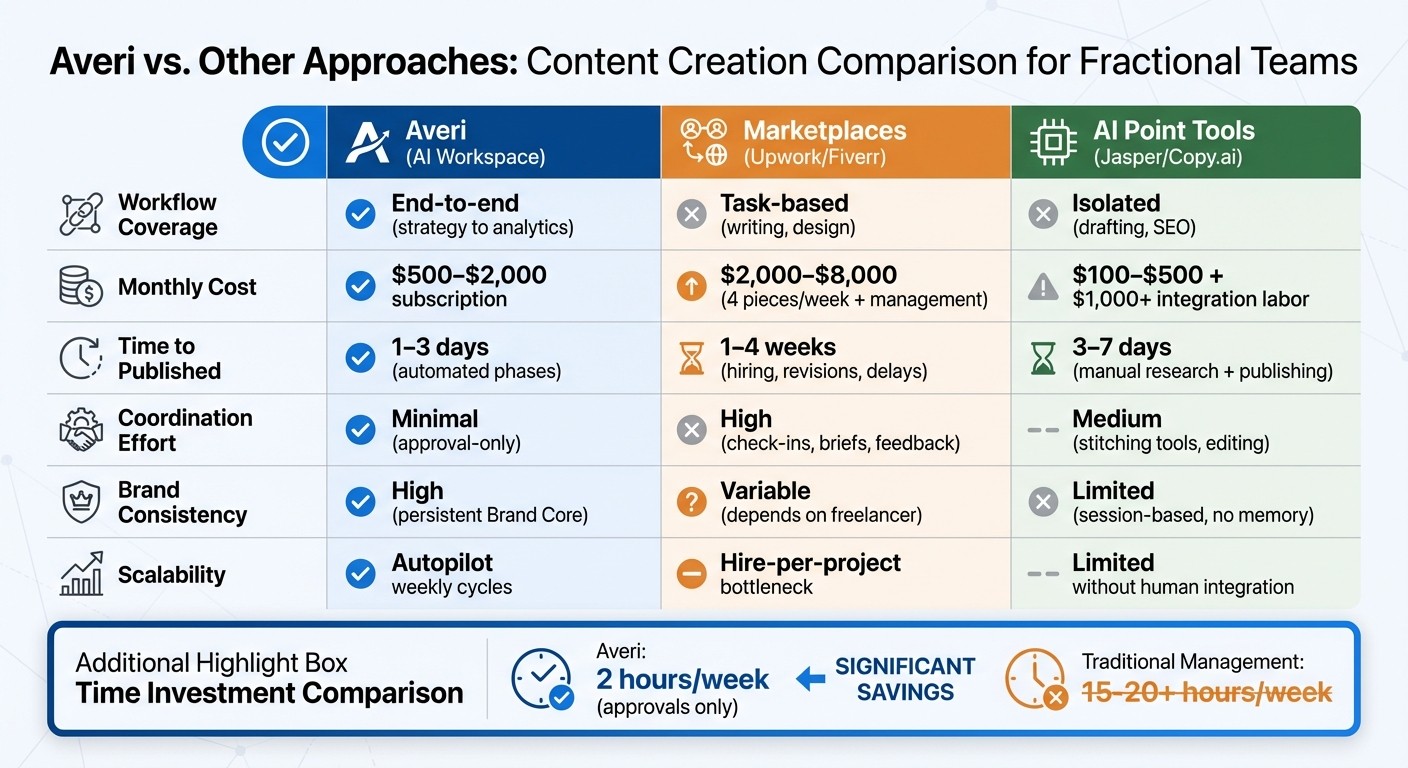
Content Creation Approaches: Averi vs Freelance Marketplaces vs AI Point Tools Comparison
When it comes to managing content creation efficiently, fractional teams often face a choice between three main options: end-to-end AI workspaces like Averi, freelance marketplaces such as Upwork and Fiverr, and AI point tools like Jasper or Copy.ai. Each approach has its strengths and weaknesses, and the choice often depends on how much time, coordination, and strategic alignment a team can manage.
Freelance marketplaces offer access to specialized talent with project-based pricing, typically ranging from $500 to $2,000 per article. However, these platforms require significant oversight. Managing a team of 5–10 freelancers can become a logistical challenge, involving frequent back-and-forth on briefs, revisions, and ensuring brand consistency. On the other hand, AI point tools can churn out drafts quickly but often lack the ability to integrate seamlessly with broader strategies, publishing workflows, or analytics. Teams using these tools often spend 8–10 hours per week manually managing prompts, editing, and piecing together workflows from various tools.
Averi takes a different approach by automating the entire content lifecycle - from strategy to analytics. This reduces the time investment to just 2 hours per week for approvals and refinements, compared to the 15–20+ hours typically required to manage freelancers. Its Brand Core and Library ensure that every piece builds on previous work, refining the brand’s voice and context over time - something that neither marketplaces nor point tools can achieve consistently.
Comparison Table: Averi vs. Marketplaces vs. AI Point Tools
Here’s a breakdown of how Averi stacks up against other options in terms of workflow, cost, and efficiency:
Factor | Averi (AI Workspace) | Marketplaces (Upwork/Fiverr) | AI Point Tools (Jasper/Copy.ai) |
|---|---|---|---|
Workflow Coverage | End-to-end (strategy to analytics) | Task-based (writing, design) | Isolated (drafting, SEO) |
Monthly Cost | $500–$2,000 subscription | $2,000–$8,000 (4 pieces/week + management) | $100–$500 + $1,000+ integration labor |
Time to Published | 1–3 days (automated phases) | 1–4 weeks (hiring, revisions, delays) | 3–7 days (manual research + publishing) |
Coordination Effort | Minimal (approval-only) | High (check-ins, briefs, feedback) | Medium (stitching tools, editing) |
Brand Consistency | High (persistent Brand Core) | Variable (depends on freelancer) | Limited (session-based, no memory) |
Scalability | Autopilot weekly cycles | Hire-per-project bottleneck | Limited without human integration |
Pros and Cons of Averi for Fractional Teams
Pros:
End-to-end automation: Averi eliminates the fragmented handoffs that come with freelance marketplaces, drastically reducing coordination time.
Zach Chmael, Head of Marketing at Averi, explains: "You don't need more time for content. You need a system that creates content without requiring your time."
Compounding results: Averi’s Library stores every published piece, allowing it to refine future outputs with richer brand context and performance insights. Its analytics go beyond basic metrics, offering actionable recommendations to align execution with strategy.
Minimal time investment: With just a 10-minute setup and minimal weekly oversight, Averi is ideal for fractional teams that lack the capacity to manage freelancers or integrate multiple tools manually.
Cons:
Subscription cost: Starting at $500 per month, the subscription may seem expensive compared to pay-per-gig models. However, for teams producing 4+ pieces weekly, the overall cost is often lower when factoring in reduced coordination time and more consistent quality.
Learning curve: Initial setup and getting accustomed to Averi’s collaborative editing tools may require some effort upfront. That said, it’s still simpler than onboarding and managing multiple freelancers.
Less flexibility for one-off tasks: Averi is designed for ongoing content production rather than ad-hoc projects. For one-time needs like a single landing page or blog post, platforms like Fiverr may be more practical, though they lack scalability for long-term operations.
Conclusion: Building Scalable Workflows for Fractional Teams
Fractional teams thrive when workflows are designed to seamlessly align specialists, allowing them to maintain high-quality output. By automating tasks like research, drafting, and publishing, experts can dedicate their energy to strategic thinking and creative problem-solving. This approach transforms content creation from a frustrating bottleneck into a resource that grows in value over time.
The real power of fractional teams lies in their ability to scale efficiently when supported by well-structured systems. For example, integrating strategic budget insights with an AI content creation framework can dramatically speed up operations. Tools such as Averi simplify this process by automating key steps - from setting up strategy to analyzing performance - reducing the need for constant oversight to just 2 hours per week. This is a stark contrast to the 15-20+ hours typically required to manage freelancers, as fractional teams focus on approving outputs rather than micromanaging every detail.
Sustainable success comes from creating growth loops that continually refine both brand voice and strategy. Each piece of published content contributes valuable data back into the system, improving recommendations, sharpening the brand’s messaging, and identifying promising topics. Over time, even a small portion of these posts can generate substantial traffic, especially when fractional teams operate within systems built for continuous iteration rather than isolated efforts. This iterative model ensures that every step reinforces scalable practices, paving the way for long-term growth.
FAQs
How can I maintain brand voice with fractional contributors?
Maintaining a consistent brand voice, even with fractional contributors, is entirely doable with the right tools and strategies. Start by establishing a clear brand voice framework that outlines your tone, style, messaging pillars, and preferred language. This serves as a guiding document for anyone creating content for your brand.
AI-powered tools, like Averi, can be a game-changer here. These platforms help draft and refine content to align seamlessly with your brand’s voice, reducing the risk of inconsistencies. Additionally, fostering collaboration during the review process - such as leaving comments or tagging team members - ensures every piece of content reflects your brand before it goes live.
What should each phase of a content workflow include?
Each step in a content workflow needs to be clearly outlined to keep things running smoothly and maintain high quality. The main phases include:
Strategy setup: This involves defining your brand identity, understanding your audience, setting clear goals, and leveraging tools to automate research and planning.
Queue building: Focus on generating ideas automatically by tapping into trends and relevant keywords.
Content execution: Use AI tools to draft and optimize content, while ensuring a human touch for refinement and polish.
Publication: Simplify the process of publishing across platforms to save time and effort.
Analytics: Monitor performance metrics and extract useful insights to guide future strategies.
Each phase works together to create a seamless and effective content creation process.
How much time should a fractional team spend managing content weekly?
Fractional teams generally dedicate between 2 to 5 hours per week to managing content. Simpler workflows may only need around 2 hours, focusing on basic oversight tasks. On the other hand, more involved processes, such as providing strategic direction and handling approvals, can take up to 5 hours weekly. The actual time required often hinges on the level of automation and the efficiency of the tools implemented to streamline the workflow.
Related Blog Posts

Zach Chmael
CMO, Averi
"We built Averi around the exact workflow we've used to scale our web traffic over 6000% in the last 6 months."
Your content should be working harder.
Averi's content engine builds Google entity authority, drives AI citations, and scales your visibility so you can get more customers.