The 6 Functions of an AI Content Engineer (And What Each One Actually Does)

Zach Chmael

Head of Marketing

6 minutes

In This Article

Breaking down all 6 functions an AI content engineer performs: Brand Core, Strategy Map, Queue, Drafting, SEO + GEO Scoring, Publishing + Analytics.

Updated

Trusted by 1,000+ teams

★★★★★ 4.9/5

Startups use Averi to build
content engines that rank.

TL;DR

  • 🎯 Six functions define the role: Brand Core, Strategy Map, Content Queue, AI Drafting, SEO + GEO Scoring, CMS Publishing with Analytics Feedback

  • 🏗️ A human content engineer builds these over 4–6 months. An AI content engineer ships all six on day one

  • 🧪 Each function has an operational test. If your tool fails the test, it's running one function, not the role

  • ⏱️ Function 1 (Brand Core) is the prerequisite. Five of the other six functions degrade without it loaded. Brand voice is the input layer, not the output layer

  • 🔄 The six functions are a closed loop. Output from Function 6 (analytics) feeds Function 2 (strategy), which refreshes Function 3 (queue), which directs Function 4 (drafting). Tools that skip the loop run one function in isolation

  • 💰 Single-function tools cost the same as full engines. Jasper at $59/mo handles drafting; Surfer SEO at $89/mo handles part of scoring; the stack runs $250+ and still requires a human content engineer to operate

Zach Chmael

CMO, Averi

"We built Averi around the exact workflow we've used to scale our web traffic over 6000% in the last 6 months."

Your content should be working harder.

Averi's content engine builds Google entity authority, drives AI citations, and scales your visibility so you can get more customers.

The 6 Functions of an AI Content Engineer (And What Each One Actually Does)

The role gets discussed in abstractions.

"Content engineering platform." "AI-driven workflows." "Systems thinking for marketing."

Most teams evaluating an AI content engineer come out of the vendor demo unable to answer the basic operational question… what does it actually do, function by function, on day one?

The role decomposes into six functions.

Each one has a corresponding job a human content engineer would do, a software-delivered version that runs the same job at 1-to-2 orders of magnitude lower cost, and an operational test you can use to evaluate whether the version you're running actually performs the function or just claims to.

The pillar piece on the AI content engineer covers the strategic case. The category definition lives in What Is an AI Content Engineer. This piece is the operational anatomy.
How To Read This Breakdown

Each function is documented in the same shape: what the function is, what the human content engineer version of the work looks like in practice, what changes when the function is delivered as software, the operational test for whether your current tool actually runs the function, and one or two concrete examples of the function's output.

The order is not arbitrary.

Function 1 (Brand Core) is the prerequisite for everything that follows.

Function 2 (Strategy Map) consumes Brand Core to produce direction.

Function 3 (Content Queue) translates Strategy into work units.

Function 4 (Drafting) executes the units.

Function 5 (Scoring) verifies the units.

Function 6 (Publishing + Analytics) ships the units and feeds the loop back to Function 2.

Tools that run any single function in isolation produce worse output than the function would produce inside the loop, because the upstream context is missing.

Function 1: Brand Core

What it is

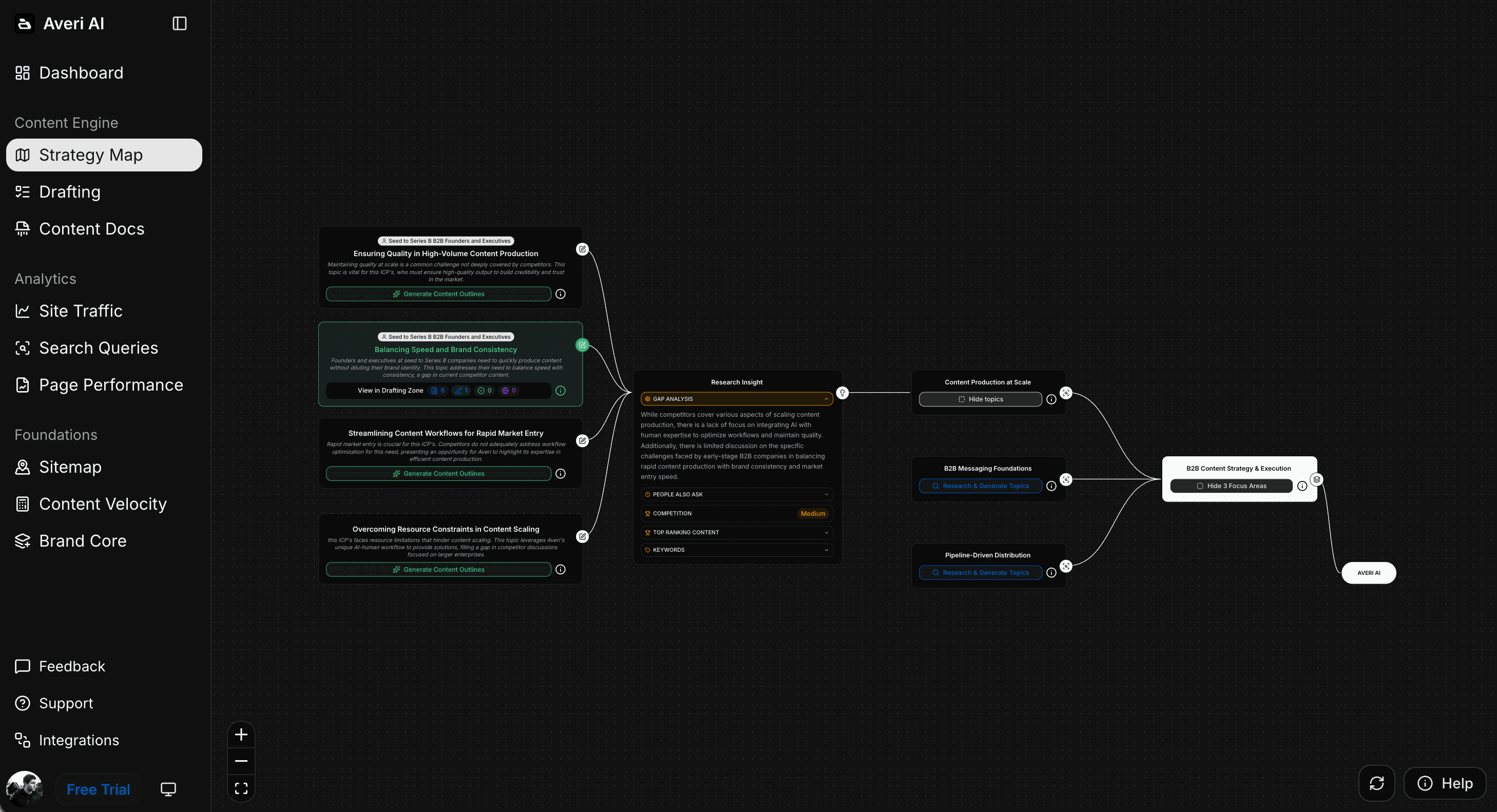
A stored, machine-readable model of the brand. Voice rules, tone calibrations, ICP segments with persona detail, competitor positioning, banned terms, preferred messaging anchors, case study library, sourcing preferences, editorial standards. Brand Core is the context layer every other function consumes.

What the human content engineer version looks like

A content engineer at a Series-B company typically spends weeks 1–8 of their tenure building this. The process includes founder and exec interviews to capture voice, customer research to define ICPs, competitor audits to map positioning, and editorial documentation to formalize rules. The output is usually a 30–60 page brand brief stored in Notion or Google Drive, referenced manually whenever a new piece gets drafted.

What the AI version does

Generates Brand Core in the first 30–60 minutes of onboarding from website analysis, public positioning, ICP signals, and a short interactive survey. The output is structured (not narrative) so the AI can load it as context for every subsequent draft. Brand Core is updated continuously as new content publishes, new positioning emerges, and customer feedback flows in. Brand voice ends up loaded at the input layer, not retrofit at the output layer, which is the operational difference between an AI content engineer and a writing tool with a "tone setting."

The operational test

Does the first draft sound like the brand without rewriting? Generate a draft on any topic and read the first 200 words. If you spend more time rewriting than reviewing, Brand Core isn't loaded properly. The fix is upstream (more brand context), not downstream (a humanizer pass).

Concrete examples

  • Voice guidelines: 1–2 page document covering sentence rhythm, formality calibration, conjunction preferences, the words your brand uses vs. the words it doesn't

  • ICP one-pagers: 3–5 persona profiles with roles, company stages, pain points, jargon they use, jargon they don't, decision triggers, objections

  • Banned words list: terms the brand never uses, with substitutes

  • Competitor map: 5–10 competitors with positioning, voice differentiation, ICP overlap
Function 2: Strategy Map

What it is

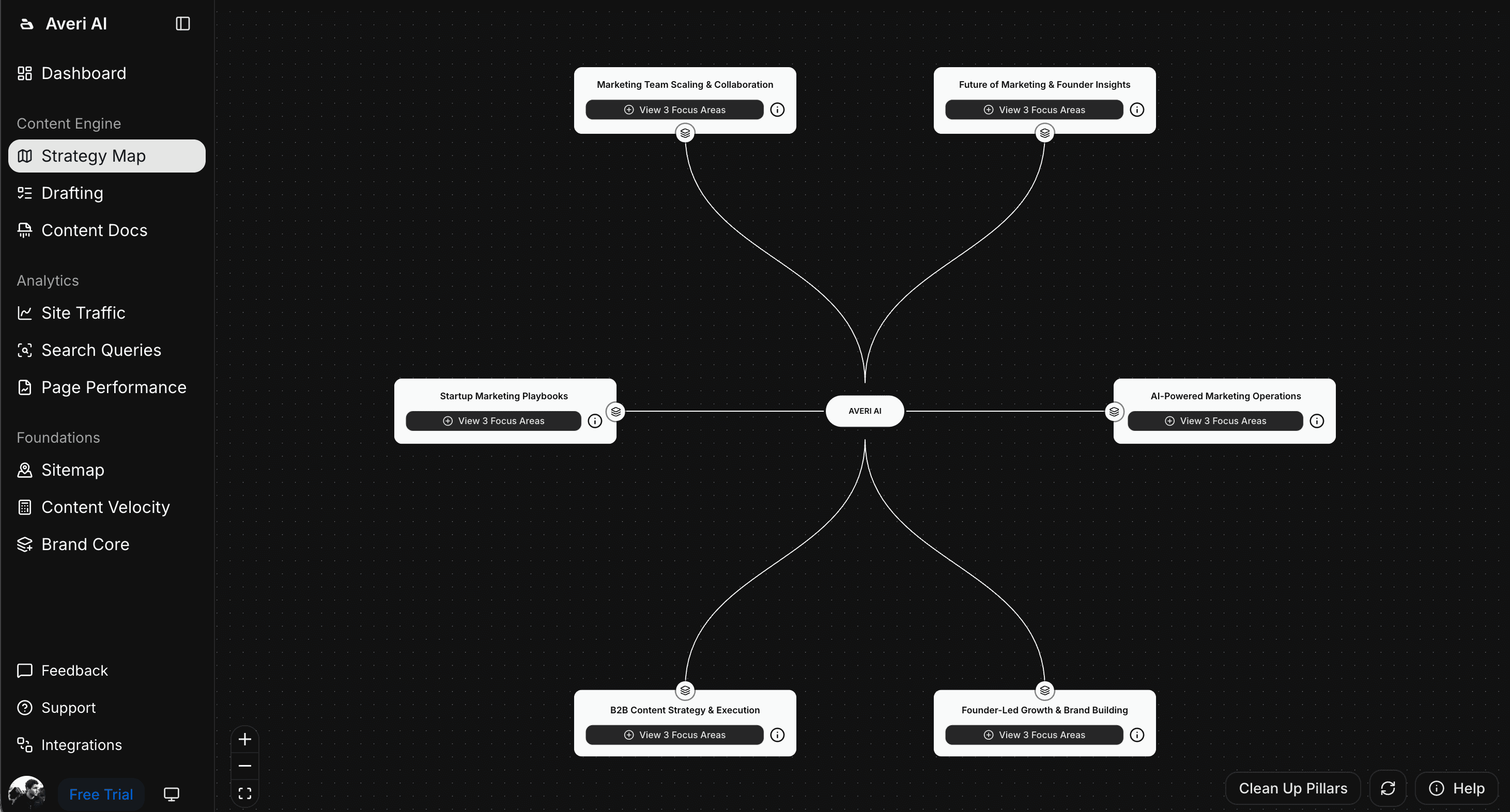
A 90-day content plan mapped to ICP segments, funnel stages, topic clusters, and AI citation opportunities. The strategy answers: what should we publish in the next quarter, in what order, mapped to which business outcomes, to compound the most authority on our core topics.

What the human content engineer version looks like

Weeks 8–14 of tenure. The work combines Ahrefs or Semrush keyword exports, competitive gap analysis, ICP intent research, AI Overview opportunity scoring, and editorial calendar pacing. The output is typically a quarterly content roadmap with topic clusters mapped to ICPs and funnel stages. Most teams refresh this every 6–12 weeks.

What the AI version does

Generates the Strategy Map in the same onboarding session as Brand Core, then refreshes continuously rather than quarterly. Inputs include Brand Core (for ICP and positioning), connected analytics (Google Search Console, GA4), competitor crawl data, AI search citation patterns, and ongoing AI Overview presence scoring. Output is a living plan that updates as new data flows in. Platform-specific GEO informs the citation opportunity portion, because ChatGPT, Perplexity, and Google AI Overviews each reward different content structures.

The operational test

Do the recommended topics map to actual questions your buyers are asking, in their words? Pull five briefs from the strategy and search each topic in Google + ChatGPT. If the queries don't show AI Overviews or feature snippets, the Strategy Map is generating phantom opportunities rather than real ones.

Concrete examples

  • Topic cluster diagram: 5–10 cluster pillars with 8–12 supporting pieces each, mapped to ICPs

  • Funnel-stage breakdown: TOFU education, MOFU comparison, BOFU decision support, post-purchase enablement

  • Keyword-to-piece matrix: each piece tagged with target keyword, search volume estimate, difficulty rating, AI citation opportunity score

  • Editorial pacing calendar: weekly cadence with topic rotation across clusters

Function 3: Content Queue

What it is

A prioritized, briefed pipeline of pieces ready to draft. Each item in the queue has a specific keyword target, primary angle, internal link plan, source list, and SEO + GEO score forecast before drafting starts.

What the human content engineer version looks like

Notion or Airtable database, refreshed weekly. The engineer reviews analytics, adjusts priorities, drafts briefs, hands them to writers (internal or contracted), tracks progress. Brief depth varies — most teams write 200–400 word briefs that the writer fills in. Queue management is administrative work that consumes 8–12 hours weekly at scale.

What the AI version does

Generates fully fleshed-out briefs from the Strategy Map and refreshes the queue continuously without weekly admin work. Each brief includes target keyword with traffic and difficulty estimates, primary angle and 2–3 alternate framings, recommended internal links from existing content library, supporting research and sources, forecasted SEO + GEO scores, recommended length, and AI Overview opportunity if applicable. Queue prioritization shifts automatically as analytics feed back from Function 6.

The operational test

Can you click a queue item and draft it without doing a separate research session first? If the brief requires you to gather sources, find supporting stats, or research the angle before drafting, the queue is incomplete. A real queue function ships briefs that hand off directly to drafting.

Concrete examples

  • Briefs with 8–12 source links per piece, organized by argument

  • Forecasted scores so you know which pieces are worth drafting first

  • Internal link plans that map to your existing library

  • Priority ordering by combined SEO opportunity + GEO citation potential
Function 4: AI Drafting

What it is

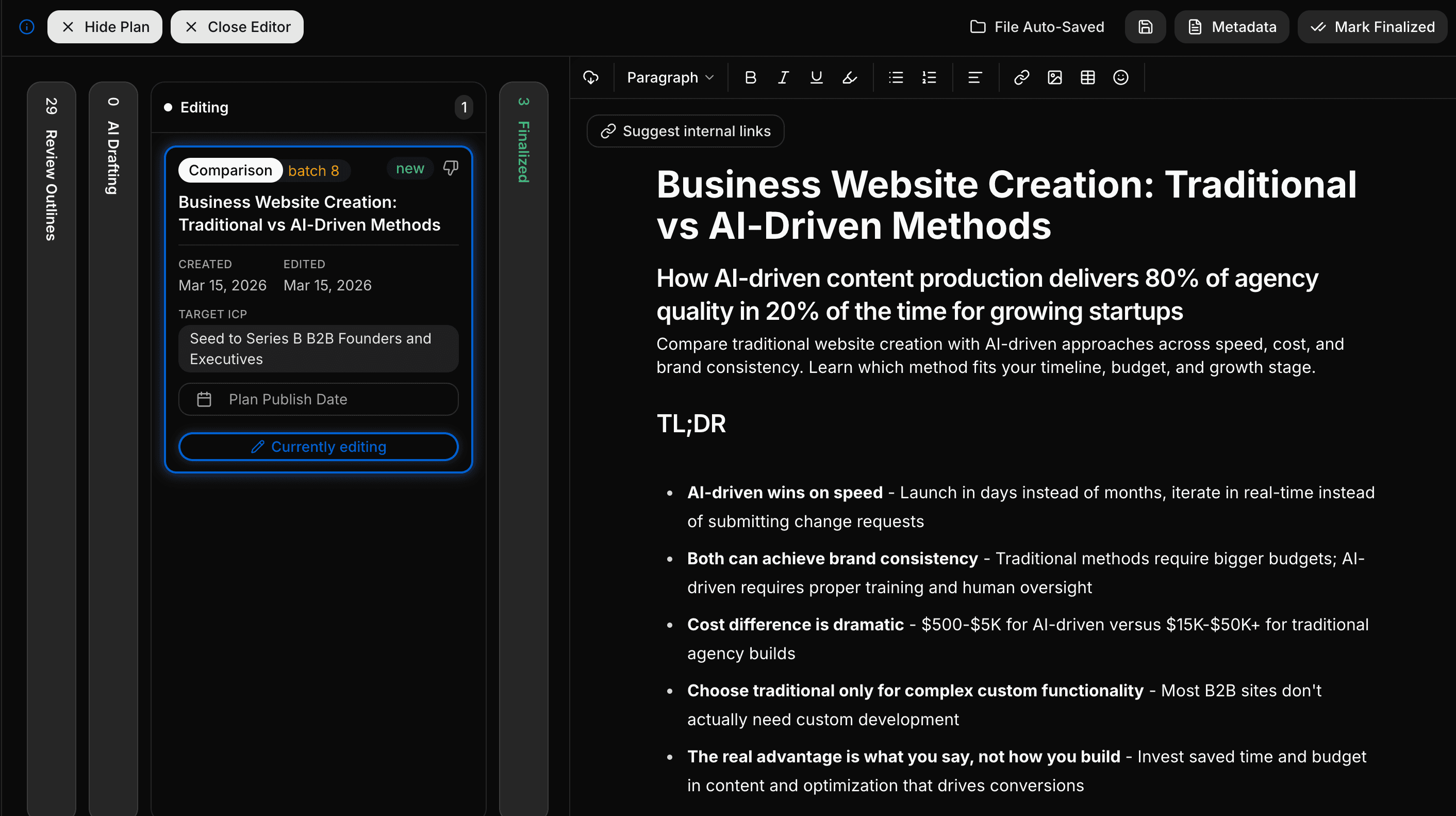
Generates first drafts that read in the brand's voice from the opening sentence, structured for both reader extraction and AI engine citation, with first-person experience markers and source-cited fact density baked in.

What the human content engineer version looks like

Weeks 14–18 of tenure, then ongoing. The engineer wires Jasper, Claude, or custom GPT pipelines with brand kits, voice calibration prompts, tone instructions, and source libraries. Each new piece requires manual prompt construction. Output quality varies by piece because the context isn't standardized across runs. Most teams spend 2–4 weeks tuning prompts before output stabilizes.

What the AI version does

Drafts with Brand Core loaded from session one. Voice, ICP fit, banned terms, source preferences, fact density requirements, and structural standards (direct-answer H2s, 7-question FAQ, first-person markers) are applied automatically. The first draft is editorially reviewable, not a starting point that requires rewriting. The draft also incorporates the latest Google AI optimization guidance — non-commodity content with first-person experience markers as the foundation.

The operational test

Does the draft pass the swap test? Replace your brand name with a competitor's. Is the piece still recognizable as your voice? If yes, Brand Core isn't loaded sufficiently into drafting — the AI is producing generic output with your logo on it. If no, the draft passed the test and is ready for editorial review.

Concrete examples

  • Direct-answer H2s phrased as buyer questions (not topic labels)

  • 120–180 word section length between headings

  • First-person experience markers in every major section

  • 7-question FAQ with self-contained 40–60 word answers

  • 15+ hyperlinked stats per long-form piece, 15+ internal links

Function 5: SEO + GEO Scoring

What it is

Dual-layer scoring that grades every draft against traditional SEO criteria (keyword integration, structural completeness, schema, internal linking, technical SEO factors) and generative engine optimization criteria (direct-answer formatting, fact density, first-person markers, citation worthiness, multimodal completeness).

What the human content engineer version looks like

Stitched from Surfer SEO ($89/month) for SEO scoring, ContentKing or Semrush ($199–$499/month) for technical audit, and manual GEO heuristics for AI optimization. Each tool runs in isolation and produces its own score. The engineer manually consolidates outputs into a single readiness call. The GEO half is mostly judgment-based because no mature standalone GEO scoring tool exists yet.

What the AI version does

Dual-layer score generated at draft time, with specific recommendations for each gap. SEO score covers traditional ranking factors. GEO score covers AI search visibility factors documented across our citation worthiness guide and the schema markup implementation guide. Recommendations are actionable inside the same editor, not exported as a PDF the writer ignores.

The operational test. Do pieces published at 80+ score actually rank and get cited? Track 30 pieces published over 90 days. If the score threshold doesn't correlate with downstream ranking and citation lift, the scoring system is measuring the wrong things. The score is only as valuable as its predictive validity.

Concrete examples

  • SEO score components: keyword integration density, H2/H3 structure, schema completeness, internal link count, image alt text quality, meta title and description, word count fit for query intent

  • GEO score components: direct-answer formatting completeness, fact density (stat per 100 words), first-person experience marker presence, FAQ self-containment, citation potential by platform (ChatGPT, Perplexity, Google AI Overviews), multimodal completeness if pillar piece

  • Score-to-action mapping: every score gap gets a specific recommendation, not a generic "improve quality" note
Function 6: CMS Publishing + Analytics Feedback

What it is

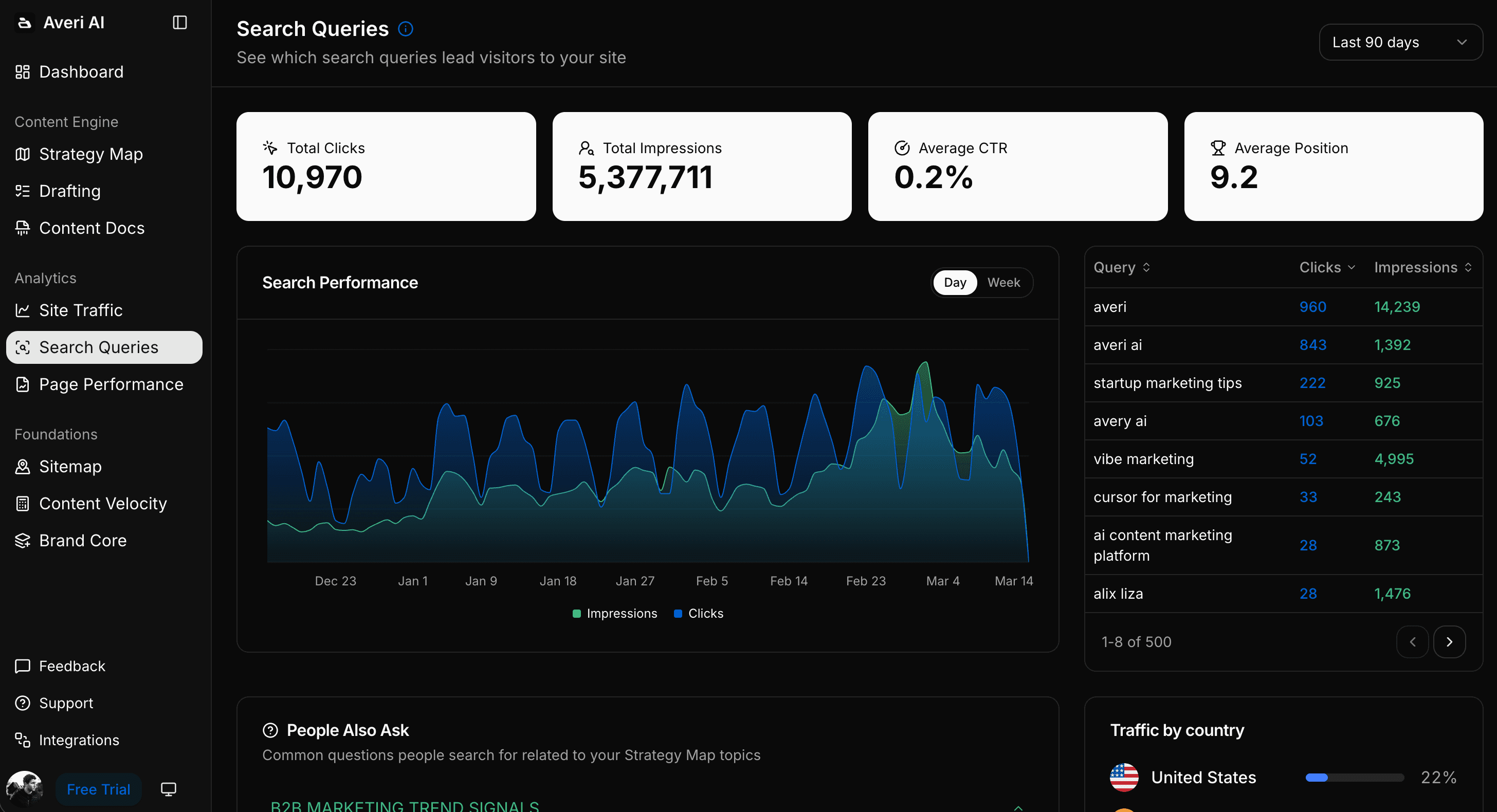
Direct publishing to your CMS with schema applied, plus analytics ingestion that feeds performance data back into Strategy Map and Content Queue.

What the human content engineer version looks like

Weeks 18–22 of tenure, then ongoing. The engineer wires Zapier or Make automations between the draft layer and the CMS, configures schema templates per content type, sets up Google Search Console and GA4 connectors, builds dashboards in Looker or Mode, and maintains the integrations as APIs change. Schema implementation is manual per content type. Most teams spend 2–6 weeks debugging publish workflows before they're reliable.

What the AI version does

Publishes directly to Webflow, Framer, or WordPress with the appropriate schema stack applied automatically (Article, FAQPage, ItemList, Person, Organization, with VideoObject and ImageObject for pillar pieces). Analytics ingestion from Search Console and GA4 happens natively. Performance data feeds back into the Strategy Map, which refreshes the Content Queue. The full loop runs without human intervention except for publish approval. Zero-click search optimization gets handled at the publish layer, with citation-friendly structure preserved on publish.

The operational test

Does new content ship within 24–48 hours of editorial approval, including schema, images, and meta? And does performance data show up in your queue priority within 7 days of publish? If publish takes longer or analytics don't flow back into queue prioritization, the function is partially broken.

Concrete examples

  • Direct publish to Webflow CMS Collection, Framer CMS, or WordPress posts with custom fields populated

  • Full schema stack applied at publish: Article, FAQPage, ItemList, Organization, Person, plus VideoObject and ImageObject for pillar pieces with multimodal components

  • Analytics signals: clicks, impressions, average position, CTR by query, branded search lift, AI citation frequency where measurable

  • Queue refresh logic: pieces driving below-forecast traffic get deprioritized; topics showing AI Overview growth get prioritized

How The 6 Functions Connect

The functions form a closed loop.

Brand Core feeds the Strategy Map.

The Strategy Map directs the Content Queue.

The Queue feeds Drafting.

Drafting produces output that goes through Scoring.

Scoring confirms readiness for Publishing.

Publishing routes content to CMS plus pulls Analytics.

Analytics feeds back into the Strategy Map and the Queue.

The loop closes and runs continuously.

This is the operational shape that distinguishes a content engine from a content tool.

A tool runs one function. An engine runs all six in a connected loop where each function's output is the next function's input. Tools that run one function in isolation degrade because the upstream context is missing. A writing tool without Brand Core context produces generic drafts. A scoring tool without Strategy context can't tell whether the score is being applied to the right piece. A publishing tool without analytics feedback ships content that doesn't compound.

Most teams running fragmented tool stacks (Jasper + Surfer + Notion + Zapier + Webflow + Looker) burn 30–40% of their content marketing time on tool management rather than execution. The fragmentation is what makes a content engineer hire necessary at scale — someone has to wire the loop.

The AI content engineer is the loop, pre-wired.

What's Missing From Tools That Run Only One Function

The category claim from the pillar piece is that an AI content engineer is the role itself, not a tool the role would use. The six-function breakdown clarifies what that means in practice.

Single-function writing tools (Jasper, Copy.ai, Writesonic) handle Function 4 only. The other five functions remain manual or absent. Output quality is capped by the absence of Brand Core, Strategy, Queue context, Scoring, and Publishing integration.

Single-function SEO tools (Surfer SEO, MarketMuse, Frase) handle the SEO half of Function 5. They don't run Brand Core, Strategy, Queue, Drafting, GEO scoring, or Publishing. They are inputs to the role, not the role.

Workflow automators (AirOps, Zapier, Make) provide infrastructure for connecting tools that run individual functions. They require a content engineer to operate them. The infrastructure is what the engineer uses, not the engineer themselves.

Content marketplaces (Contently, Skyword) source the labor that would otherwise perform some of these functions manually. They don't run any of the six functions as software.

The operational test for whether a vendor is an AI content engineer: can you sign up, complete onboarding in under an hour, and have a published piece live on your CMS by end of week without hiring a content engineer to operate the platform?

If yes, the vendor performs the role end-to-end. If no, the vendor performs a slice of one function and requires the role to be staffed elsewhere.

Watch all six functions run in 60 minutes

Brand Core, Strategy Map, Content Queue, AI Drafting, dual-layer Scoring, and direct CMS Publishing — all live on day one. $99/month for the Solo plan. 14-day free trial. No credit card.

Start free →


Related Resources

The AI Content Engineer Cluster

Function-Specific Deep Dives

Category Context

Implementation

Publishing note for Indy: this piece needs ItemList schema applied at publish, with each of the six function H2s as a separate list item.

FAQs

What are the six functions of an AI content engineer?

The six functions are Brand Core (stored brand context), Strategy Map (90-day content plan), Content Queue (briefed pipeline), AI Drafting (first drafts in brand voice), SEO + GEO Scoring (dual-layer quality check), and CMS Publishing with Analytics Feedback (direct publish plus performance loop). The functions run as a closed loop where each function's output feeds the next. An AI content engineer runs all six. A tool runs one or two.

Why is Brand Core listed first?

Brand Core is the prerequisite for the other five functions. Without stored brand context loaded into the AI, drafts come out generic, strategy recommends topics that don't fit the brand, scoring grades against generic standards rather than brand-specific ones, and publishing surfaces content that doesn't recognizably belong to your company. Brand voice has to be loaded at the input layer, not retrofit at the output layer.

Can I run only some of the six functions and skip the rest?

You can, but the output quality degrades. Each function depends on upstream context from the functions before it and feeds downstream signal to the functions after it. Running Function 4 (drafting) without Functions 1, 2, and 3 (Brand Core, Strategy, Queue) produces drafts that are technically grammatical but generic, unaligned to business priorities, and disconnected from a compounding plan. The closed loop is what makes the engine an engine.

How long does it take to set up the six functions?

A human content engineer typically takes 18–22 weeks to build all six functions to operational maturity. Weeks 1–8 build Brand Core. Weeks 8–14 build Strategy Map. Weeks 14–18 build Queue and Drafting workflows. Weeks 18–22 wire Scoring and Publishing with analytics. An AI content engineer ships all six on day one — the six-month build state is the product, not a roadmap to it.

What's the difference between Function 5 (Scoring) and Function 6 (Publishing analytics)?

Function 5 scores drafts before publish to verify quality. Function 6 measures published content's performance after it's live to inform future strategy. Scoring is a quality gate; analytics is a learning loop. Both matter. Tools that handle only one of the two leave half the feedback signal on the table.

Do I need a content engineer to operate an AI content engineer?

No. The operational test from this piece is whether a founder of a 5-person company can sign up, complete onboarding in under an hour, and have a published piece live on their CMS by end of week, without hiring a separate content engineer. If a platform requires a content engineer to operate it, it's a tool the engineer would use, not the engineer themselves. The whole pillar argument hinges on this distinction.

Which function is hardest to automate well?

Function 4 (Drafting) is the function vendors most commonly claim to handle well but actually run poorly because they skip Function 1 (Brand Core) as a prerequisite. AI drafting without stored brand context produces generic output that requires heavy editing. The fix is upstream — load Brand Core before drafting — not downstream with a humanizer pass. Function 1 is the prerequisite that determines whether Function 4 actually works.


Continue Reading

The latest handpicked blog articles

Experience The AI Content Engine

Already have an account?

Join 30,000+ Founders, Marketers & Builders

Don't Feed the Algorithm

“Top 3 tech + AI newsletters in the country. Always sharp, always actionable.”

"Genuinely my favorite newsletter in tech. No fluff, no cheesy ads, just great content."

“Clear, practical, and on-point. Helps me keep up without drowning in noise.”

User-Generated Content & Authenticity in the Age of AI

Zach Chmael

Head of Marketing

6 minutes

In This Article

Breaking down all 6 functions an AI content engineer performs: Brand Core, Strategy Map, Queue, Drafting, SEO + GEO Scoring, Publishing + Analytics.

Don’t Feed the Algorithm

The algorithm never sleeps, but you don’t have to feed it — Join our weekly newsletter for real insights on AI, human creativity & marketing execution.

TL;DR

  • 🎯 Six functions define the role: Brand Core, Strategy Map, Content Queue, AI Drafting, SEO + GEO Scoring, CMS Publishing with Analytics Feedback

  • 🏗️ A human content engineer builds these over 4–6 months. An AI content engineer ships all six on day one

  • 🧪 Each function has an operational test. If your tool fails the test, it's running one function, not the role

  • ⏱️ Function 1 (Brand Core) is the prerequisite. Five of the other six functions degrade without it loaded. Brand voice is the input layer, not the output layer

  • 🔄 The six functions are a closed loop. Output from Function 6 (analytics) feeds Function 2 (strategy), which refreshes Function 3 (queue), which directs Function 4 (drafting). Tools that skip the loop run one function in isolation

  • 💰 Single-function tools cost the same as full engines. Jasper at $59/mo handles drafting; Surfer SEO at $89/mo handles part of scoring; the stack runs $250+ and still requires a human content engineer to operate

"We built Averi around the exact workflow we've used to scale our web traffic over 6000% in the last 6 months."

founder-image
founder-image
Your content should be working harder.

Averi's content engine builds Google entity authority, drives AI citations, and scales your visibility so you can get more customers.

The 6 Functions of an AI Content Engineer (And What Each One Actually Does)

The role gets discussed in abstractions.

"Content engineering platform." "AI-driven workflows." "Systems thinking for marketing."

Most teams evaluating an AI content engineer come out of the vendor demo unable to answer the basic operational question… what does it actually do, function by function, on day one?

The role decomposes into six functions.

Each one has a corresponding job a human content engineer would do, a software-delivered version that runs the same job at 1-to-2 orders of magnitude lower cost, and an operational test you can use to evaluate whether the version you're running actually performs the function or just claims to.

The pillar piece on the AI content engineer covers the strategic case. The category definition lives in What Is an AI Content Engineer. This piece is the operational anatomy.

How To Read This Breakdown

Each function is documented in the same shape: what the function is, what the human content engineer version of the work looks like in practice, what changes when the function is delivered as software, the operational test for whether your current tool actually runs the function, and one or two concrete examples of the function's output.

The order is not arbitrary.

Function 1 (Brand Core) is the prerequisite for everything that follows.

Function 2 (Strategy Map) consumes Brand Core to produce direction.

Function 3 (Content Queue) translates Strategy into work units.

Function 4 (Drafting) executes the units.

Function 5 (Scoring) verifies the units.

Function 6 (Publishing + Analytics) ships the units and feeds the loop back to Function 2.

Tools that run any single function in isolation produce worse output than the function would produce inside the loop, because the upstream context is missing.

Function 1: Brand Core

What it is

A stored, machine-readable model of the brand. Voice rules, tone calibrations, ICP segments with persona detail, competitor positioning, banned terms, preferred messaging anchors, case study library, sourcing preferences, editorial standards. Brand Core is the context layer every other function consumes.

What the human content engineer version looks like

A content engineer at a Series-B company typically spends weeks 1–8 of their tenure building this. The process includes founder and exec interviews to capture voice, customer research to define ICPs, competitor audits to map positioning, and editorial documentation to formalize rules. The output is usually a 30–60 page brand brief stored in Notion or Google Drive, referenced manually whenever a new piece gets drafted.

What the AI version does

Generates Brand Core in the first 30–60 minutes of onboarding from website analysis, public positioning, ICP signals, and a short interactive survey. The output is structured (not narrative) so the AI can load it as context for every subsequent draft. Brand Core is updated continuously as new content publishes, new positioning emerges, and customer feedback flows in. Brand voice ends up loaded at the input layer, not retrofit at the output layer, which is the operational difference between an AI content engineer and a writing tool with a "tone setting."

The operational test

Does the first draft sound like the brand without rewriting? Generate a draft on any topic and read the first 200 words. If you spend more time rewriting than reviewing, Brand Core isn't loaded properly. The fix is upstream (more brand context), not downstream (a humanizer pass).

Concrete examples

  • Voice guidelines: 1–2 page document covering sentence rhythm, formality calibration, conjunction preferences, the words your brand uses vs. the words it doesn't

  • ICP one-pagers: 3–5 persona profiles with roles, company stages, pain points, jargon they use, jargon they don't, decision triggers, objections

  • Banned words list: terms the brand never uses, with substitutes

  • Competitor map: 5–10 competitors with positioning, voice differentiation, ICP overlap

Function 2: Strategy Map

What it is

A 90-day content plan mapped to ICP segments, funnel stages, topic clusters, and AI citation opportunities. The strategy answers: what should we publish in the next quarter, in what order, mapped to which business outcomes, to compound the most authority on our core topics.

What the human content engineer version looks like

Weeks 8–14 of tenure. The work combines Ahrefs or Semrush keyword exports, competitive gap analysis, ICP intent research, AI Overview opportunity scoring, and editorial calendar pacing. The output is typically a quarterly content roadmap with topic clusters mapped to ICPs and funnel stages. Most teams refresh this every 6–12 weeks.

What the AI version does

Generates the Strategy Map in the same onboarding session as Brand Core, then refreshes continuously rather than quarterly. Inputs include Brand Core (for ICP and positioning), connected analytics (Google Search Console, GA4), competitor crawl data, AI search citation patterns, and ongoing AI Overview presence scoring. Output is a living plan that updates as new data flows in. Platform-specific GEO informs the citation opportunity portion, because ChatGPT, Perplexity, and Google AI Overviews each reward different content structures.

The operational test

Do the recommended topics map to actual questions your buyers are asking, in their words? Pull five briefs from the strategy and search each topic in Google + ChatGPT. If the queries don't show AI Overviews or feature snippets, the Strategy Map is generating phantom opportunities rather than real ones.

Concrete examples

  • Topic cluster diagram: 5–10 cluster pillars with 8–12 supporting pieces each, mapped to ICPs

  • Funnel-stage breakdown: TOFU education, MOFU comparison, BOFU decision support, post-purchase enablement

  • Keyword-to-piece matrix: each piece tagged with target keyword, search volume estimate, difficulty rating, AI citation opportunity score

  • Editorial pacing calendar: weekly cadence with topic rotation across clusters

Function 3: Content Queue

What it is

A prioritized, briefed pipeline of pieces ready to draft. Each item in the queue has a specific keyword target, primary angle, internal link plan, source list, and SEO + GEO score forecast before drafting starts.

What the human content engineer version looks like

Notion or Airtable database, refreshed weekly. The engineer reviews analytics, adjusts priorities, drafts briefs, hands them to writers (internal or contracted), tracks progress. Brief depth varies — most teams write 200–400 word briefs that the writer fills in. Queue management is administrative work that consumes 8–12 hours weekly at scale.

What the AI version does

Generates fully fleshed-out briefs from the Strategy Map and refreshes the queue continuously without weekly admin work. Each brief includes target keyword with traffic and difficulty estimates, primary angle and 2–3 alternate framings, recommended internal links from existing content library, supporting research and sources, forecasted SEO + GEO scores, recommended length, and AI Overview opportunity if applicable. Queue prioritization shifts automatically as analytics feed back from Function 6.

The operational test

Can you click a queue item and draft it without doing a separate research session first? If the brief requires you to gather sources, find supporting stats, or research the angle before drafting, the queue is incomplete. A real queue function ships briefs that hand off directly to drafting.

Concrete examples

  • Briefs with 8–12 source links per piece, organized by argument

  • Forecasted scores so you know which pieces are worth drafting first

  • Internal link plans that map to your existing library

  • Priority ordering by combined SEO opportunity + GEO citation potential

Function 4: AI Drafting

What it is

Generates first drafts that read in the brand's voice from the opening sentence, structured for both reader extraction and AI engine citation, with first-person experience markers and source-cited fact density baked in.

What the human content engineer version looks like

Weeks 14–18 of tenure, then ongoing. The engineer wires Jasper, Claude, or custom GPT pipelines with brand kits, voice calibration prompts, tone instructions, and source libraries. Each new piece requires manual prompt construction. Output quality varies by piece because the context isn't standardized across runs. Most teams spend 2–4 weeks tuning prompts before output stabilizes.

What the AI version does

Drafts with Brand Core loaded from session one. Voice, ICP fit, banned terms, source preferences, fact density requirements, and structural standards (direct-answer H2s, 7-question FAQ, first-person markers) are applied automatically. The first draft is editorially reviewable, not a starting point that requires rewriting. The draft also incorporates the latest Google AI optimization guidance — non-commodity content with first-person experience markers as the foundation.

The operational test

Does the draft pass the swap test? Replace your brand name with a competitor's. Is the piece still recognizable as your voice? If yes, Brand Core isn't loaded sufficiently into drafting — the AI is producing generic output with your logo on it. If no, the draft passed the test and is ready for editorial review.

Concrete examples

  • Direct-answer H2s phrased as buyer questions (not topic labels)

  • 120–180 word section length between headings

  • First-person experience markers in every major section

  • 7-question FAQ with self-contained 40–60 word answers

  • 15+ hyperlinked stats per long-form piece, 15+ internal links

Function 5: SEO + GEO Scoring

What it is

Dual-layer scoring that grades every draft against traditional SEO criteria (keyword integration, structural completeness, schema, internal linking, technical SEO factors) and generative engine optimization criteria (direct-answer formatting, fact density, first-person markers, citation worthiness, multimodal completeness).

What the human content engineer version looks like

Stitched from Surfer SEO ($89/month) for SEO scoring, ContentKing or Semrush ($199–$499/month) for technical audit, and manual GEO heuristics for AI optimization. Each tool runs in isolation and produces its own score. The engineer manually consolidates outputs into a single readiness call. The GEO half is mostly judgment-based because no mature standalone GEO scoring tool exists yet.

What the AI version does

Dual-layer score generated at draft time, with specific recommendations for each gap. SEO score covers traditional ranking factors. GEO score covers AI search visibility factors documented across our citation worthiness guide and the schema markup implementation guide. Recommendations are actionable inside the same editor, not exported as a PDF the writer ignores.

The operational test. Do pieces published at 80+ score actually rank and get cited? Track 30 pieces published over 90 days. If the score threshold doesn't correlate with downstream ranking and citation lift, the scoring system is measuring the wrong things. The score is only as valuable as its predictive validity.

Concrete examples

  • SEO score components: keyword integration density, H2/H3 structure, schema completeness, internal link count, image alt text quality, meta title and description, word count fit for query intent

  • GEO score components: direct-answer formatting completeness, fact density (stat per 100 words), first-person experience marker presence, FAQ self-containment, citation potential by platform (ChatGPT, Perplexity, Google AI Overviews), multimodal completeness if pillar piece

  • Score-to-action mapping: every score gap gets a specific recommendation, not a generic "improve quality" note

Function 6: CMS Publishing + Analytics Feedback

What it is

Direct publishing to your CMS with schema applied, plus analytics ingestion that feeds performance data back into Strategy Map and Content Queue.

What the human content engineer version looks like

Weeks 18–22 of tenure, then ongoing. The engineer wires Zapier or Make automations between the draft layer and the CMS, configures schema templates per content type, sets up Google Search Console and GA4 connectors, builds dashboards in Looker or Mode, and maintains the integrations as APIs change. Schema implementation is manual per content type. Most teams spend 2–6 weeks debugging publish workflows before they're reliable.

What the AI version does

Publishes directly to Webflow, Framer, or WordPress with the appropriate schema stack applied automatically (Article, FAQPage, ItemList, Person, Organization, with VideoObject and ImageObject for pillar pieces). Analytics ingestion from Search Console and GA4 happens natively. Performance data feeds back into the Strategy Map, which refreshes the Content Queue. The full loop runs without human intervention except for publish approval. Zero-click search optimization gets handled at the publish layer, with citation-friendly structure preserved on publish.

The operational test

Does new content ship within 24–48 hours of editorial approval, including schema, images, and meta? And does performance data show up in your queue priority within 7 days of publish? If publish takes longer or analytics don't flow back into queue prioritization, the function is partially broken.

Concrete examples

  • Direct publish to Webflow CMS Collection, Framer CMS, or WordPress posts with custom fields populated

  • Full schema stack applied at publish: Article, FAQPage, ItemList, Organization, Person, plus VideoObject and ImageObject for pillar pieces with multimodal components

  • Analytics signals: clicks, impressions, average position, CTR by query, branded search lift, AI citation frequency where measurable

  • Queue refresh logic: pieces driving below-forecast traffic get deprioritized; topics showing AI Overview growth get prioritized

How The 6 Functions Connect

The functions form a closed loop.

Brand Core feeds the Strategy Map.

The Strategy Map directs the Content Queue.

The Queue feeds Drafting.

Drafting produces output that goes through Scoring.

Scoring confirms readiness for Publishing.

Publishing routes content to CMS plus pulls Analytics.

Analytics feeds back into the Strategy Map and the Queue.

The loop closes and runs continuously.

This is the operational shape that distinguishes a content engine from a content tool.

A tool runs one function. An engine runs all six in a connected loop where each function's output is the next function's input. Tools that run one function in isolation degrade because the upstream context is missing. A writing tool without Brand Core context produces generic drafts. A scoring tool without Strategy context can't tell whether the score is being applied to the right piece. A publishing tool without analytics feedback ships content that doesn't compound.

Most teams running fragmented tool stacks (Jasper + Surfer + Notion + Zapier + Webflow + Looker) burn 30–40% of their content marketing time on tool management rather than execution. The fragmentation is what makes a content engineer hire necessary at scale — someone has to wire the loop.

The AI content engineer is the loop, pre-wired.

What's Missing From Tools That Run Only One Function

The category claim from the pillar piece is that an AI content engineer is the role itself, not a tool the role would use. The six-function breakdown clarifies what that means in practice.

Single-function writing tools (Jasper, Copy.ai, Writesonic) handle Function 4 only. The other five functions remain manual or absent. Output quality is capped by the absence of Brand Core, Strategy, Queue context, Scoring, and Publishing integration.

Single-function SEO tools (Surfer SEO, MarketMuse, Frase) handle the SEO half of Function 5. They don't run Brand Core, Strategy, Queue, Drafting, GEO scoring, or Publishing. They are inputs to the role, not the role.

Workflow automators (AirOps, Zapier, Make) provide infrastructure for connecting tools that run individual functions. They require a content engineer to operate them. The infrastructure is what the engineer uses, not the engineer themselves.

Content marketplaces (Contently, Skyword) source the labor that would otherwise perform some of these functions manually. They don't run any of the six functions as software.

The operational test for whether a vendor is an AI content engineer: can you sign up, complete onboarding in under an hour, and have a published piece live on your CMS by end of week without hiring a content engineer to operate the platform?

If yes, the vendor performs the role end-to-end. If no, the vendor performs a slice of one function and requires the role to be staffed elsewhere.

Watch all six functions run in 60 minutes

Brand Core, Strategy Map, Content Queue, AI Drafting, dual-layer Scoring, and direct CMS Publishing — all live on day one. $99/month for the Solo plan. 14-day free trial. No credit card.

Start free →


Related Resources

The AI Content Engineer Cluster

Function-Specific Deep Dives

Category Context

Implementation

Publishing note for Indy: this piece needs ItemList schema applied at publish, with each of the six function H2s as a separate list item.

Continue Reading

The latest handpicked blog articles

Join 30,000+ Founders, Marketers & Builders

Don't Feed the Algorithm

“Top 3 tech + AI newsletters in the country. Always sharp, always actionable.”

"Genuinely my favorite newsletter in tech. No fluff, no cheesy ads, just great content."

“Clear, practical, and on-point. Helps me keep up without drowning in noise.”

User-Generated Content & Authenticity in the Age of AI

Zach Chmael

Head of Marketing

6 minutes

In This Article

Breaking down all 6 functions an AI content engineer performs: Brand Core, Strategy Map, Queue, Drafting, SEO + GEO Scoring, Publishing + Analytics.

Don’t Feed the Algorithm

The algorithm never sleeps, but you don’t have to feed it — Join our weekly newsletter for real insights on AI, human creativity & marketing execution.

Trusted by 1,000+ teams

★★★★★ 4.9/5

Startups use Averi to build
content engines that rank.

The 6 Functions of an AI Content Engineer (And What Each One Actually Does)

The role gets discussed in abstractions.

"Content engineering platform." "AI-driven workflows." "Systems thinking for marketing."

Most teams evaluating an AI content engineer come out of the vendor demo unable to answer the basic operational question… what does it actually do, function by function, on day one?

The role decomposes into six functions.

Each one has a corresponding job a human content engineer would do, a software-delivered version that runs the same job at 1-to-2 orders of magnitude lower cost, and an operational test you can use to evaluate whether the version you're running actually performs the function or just claims to.

The pillar piece on the AI content engineer covers the strategic case. The category definition lives in What Is an AI Content Engineer. This piece is the operational anatomy.

How To Read This Breakdown

Each function is documented in the same shape: what the function is, what the human content engineer version of the work looks like in practice, what changes when the function is delivered as software, the operational test for whether your current tool actually runs the function, and one or two concrete examples of the function's output.

The order is not arbitrary.

Function 1 (Brand Core) is the prerequisite for everything that follows.

Function 2 (Strategy Map) consumes Brand Core to produce direction.

Function 3 (Content Queue) translates Strategy into work units.

Function 4 (Drafting) executes the units.

Function 5 (Scoring) verifies the units.

Function 6 (Publishing + Analytics) ships the units and feeds the loop back to Function 2.

Tools that run any single function in isolation produce worse output than the function would produce inside the loop, because the upstream context is missing.

Function 1: Brand Core

What it is

A stored, machine-readable model of the brand. Voice rules, tone calibrations, ICP segments with persona detail, competitor positioning, banned terms, preferred messaging anchors, case study library, sourcing preferences, editorial standards. Brand Core is the context layer every other function consumes.

What the human content engineer version looks like

A content engineer at a Series-B company typically spends weeks 1–8 of their tenure building this. The process includes founder and exec interviews to capture voice, customer research to define ICPs, competitor audits to map positioning, and editorial documentation to formalize rules. The output is usually a 30–60 page brand brief stored in Notion or Google Drive, referenced manually whenever a new piece gets drafted.

What the AI version does

Generates Brand Core in the first 30–60 minutes of onboarding from website analysis, public positioning, ICP signals, and a short interactive survey. The output is structured (not narrative) so the AI can load it as context for every subsequent draft. Brand Core is updated continuously as new content publishes, new positioning emerges, and customer feedback flows in. Brand voice ends up loaded at the input layer, not retrofit at the output layer, which is the operational difference between an AI content engineer and a writing tool with a "tone setting."

The operational test

Does the first draft sound like the brand without rewriting? Generate a draft on any topic and read the first 200 words. If you spend more time rewriting than reviewing, Brand Core isn't loaded properly. The fix is upstream (more brand context), not downstream (a humanizer pass).

Concrete examples

  • Voice guidelines: 1–2 page document covering sentence rhythm, formality calibration, conjunction preferences, the words your brand uses vs. the words it doesn't

  • ICP one-pagers: 3–5 persona profiles with roles, company stages, pain points, jargon they use, jargon they don't, decision triggers, objections

  • Banned words list: terms the brand never uses, with substitutes

  • Competitor map: 5–10 competitors with positioning, voice differentiation, ICP overlap

Function 2: Strategy Map

What it is

A 90-day content plan mapped to ICP segments, funnel stages, topic clusters, and AI citation opportunities. The strategy answers: what should we publish in the next quarter, in what order, mapped to which business outcomes, to compound the most authority on our core topics.

What the human content engineer version looks like

Weeks 8–14 of tenure. The work combines Ahrefs or Semrush keyword exports, competitive gap analysis, ICP intent research, AI Overview opportunity scoring, and editorial calendar pacing. The output is typically a quarterly content roadmap with topic clusters mapped to ICPs and funnel stages. Most teams refresh this every 6–12 weeks.

What the AI version does

Generates the Strategy Map in the same onboarding session as Brand Core, then refreshes continuously rather than quarterly. Inputs include Brand Core (for ICP and positioning), connected analytics (Google Search Console, GA4), competitor crawl data, AI search citation patterns, and ongoing AI Overview presence scoring. Output is a living plan that updates as new data flows in. Platform-specific GEO informs the citation opportunity portion, because ChatGPT, Perplexity, and Google AI Overviews each reward different content structures.

The operational test

Do the recommended topics map to actual questions your buyers are asking, in their words? Pull five briefs from the strategy and search each topic in Google + ChatGPT. If the queries don't show AI Overviews or feature snippets, the Strategy Map is generating phantom opportunities rather than real ones.

Concrete examples

  • Topic cluster diagram: 5–10 cluster pillars with 8–12 supporting pieces each, mapped to ICPs

  • Funnel-stage breakdown: TOFU education, MOFU comparison, BOFU decision support, post-purchase enablement

  • Keyword-to-piece matrix: each piece tagged with target keyword, search volume estimate, difficulty rating, AI citation opportunity score

  • Editorial pacing calendar: weekly cadence with topic rotation across clusters

Function 3: Content Queue

What it is

A prioritized, briefed pipeline of pieces ready to draft. Each item in the queue has a specific keyword target, primary angle, internal link plan, source list, and SEO + GEO score forecast before drafting starts.

What the human content engineer version looks like

Notion or Airtable database, refreshed weekly. The engineer reviews analytics, adjusts priorities, drafts briefs, hands them to writers (internal or contracted), tracks progress. Brief depth varies — most teams write 200–400 word briefs that the writer fills in. Queue management is administrative work that consumes 8–12 hours weekly at scale.

What the AI version does

Generates fully fleshed-out briefs from the Strategy Map and refreshes the queue continuously without weekly admin work. Each brief includes target keyword with traffic and difficulty estimates, primary angle and 2–3 alternate framings, recommended internal links from existing content library, supporting research and sources, forecasted SEO + GEO scores, recommended length, and AI Overview opportunity if applicable. Queue prioritization shifts automatically as analytics feed back from Function 6.

The operational test

Can you click a queue item and draft it without doing a separate research session first? If the brief requires you to gather sources, find supporting stats, or research the angle before drafting, the queue is incomplete. A real queue function ships briefs that hand off directly to drafting.

Concrete examples

  • Briefs with 8–12 source links per piece, organized by argument

  • Forecasted scores so you know which pieces are worth drafting first

  • Internal link plans that map to your existing library

  • Priority ordering by combined SEO opportunity + GEO citation potential

Function 4: AI Drafting

What it is

Generates first drafts that read in the brand's voice from the opening sentence, structured for both reader extraction and AI engine citation, with first-person experience markers and source-cited fact density baked in.

What the human content engineer version looks like

Weeks 14–18 of tenure, then ongoing. The engineer wires Jasper, Claude, or custom GPT pipelines with brand kits, voice calibration prompts, tone instructions, and source libraries. Each new piece requires manual prompt construction. Output quality varies by piece because the context isn't standardized across runs. Most teams spend 2–4 weeks tuning prompts before output stabilizes.

What the AI version does

Drafts with Brand Core loaded from session one. Voice, ICP fit, banned terms, source preferences, fact density requirements, and structural standards (direct-answer H2s, 7-question FAQ, first-person markers) are applied automatically. The first draft is editorially reviewable, not a starting point that requires rewriting. The draft also incorporates the latest Google AI optimization guidance — non-commodity content with first-person experience markers as the foundation.

The operational test

Does the draft pass the swap test? Replace your brand name with a competitor's. Is the piece still recognizable as your voice? If yes, Brand Core isn't loaded sufficiently into drafting — the AI is producing generic output with your logo on it. If no, the draft passed the test and is ready for editorial review.

Concrete examples

  • Direct-answer H2s phrased as buyer questions (not topic labels)

  • 120–180 word section length between headings

  • First-person experience markers in every major section

  • 7-question FAQ with self-contained 40–60 word answers

  • 15+ hyperlinked stats per long-form piece, 15+ internal links

Function 5: SEO + GEO Scoring

What it is

Dual-layer scoring that grades every draft against traditional SEO criteria (keyword integration, structural completeness, schema, internal linking, technical SEO factors) and generative engine optimization criteria (direct-answer formatting, fact density, first-person markers, citation worthiness, multimodal completeness).

What the human content engineer version looks like

Stitched from Surfer SEO ($89/month) for SEO scoring, ContentKing or Semrush ($199–$499/month) for technical audit, and manual GEO heuristics for AI optimization. Each tool runs in isolation and produces its own score. The engineer manually consolidates outputs into a single readiness call. The GEO half is mostly judgment-based because no mature standalone GEO scoring tool exists yet.

What the AI version does

Dual-layer score generated at draft time, with specific recommendations for each gap. SEO score covers traditional ranking factors. GEO score covers AI search visibility factors documented across our citation worthiness guide and the schema markup implementation guide. Recommendations are actionable inside the same editor, not exported as a PDF the writer ignores.

The operational test. Do pieces published at 80+ score actually rank and get cited? Track 30 pieces published over 90 days. If the score threshold doesn't correlate with downstream ranking and citation lift, the scoring system is measuring the wrong things. The score is only as valuable as its predictive validity.

Concrete examples

  • SEO score components: keyword integration density, H2/H3 structure, schema completeness, internal link count, image alt text quality, meta title and description, word count fit for query intent

  • GEO score components: direct-answer formatting completeness, fact density (stat per 100 words), first-person experience marker presence, FAQ self-containment, citation potential by platform (ChatGPT, Perplexity, Google AI Overviews), multimodal completeness if pillar piece

  • Score-to-action mapping: every score gap gets a specific recommendation, not a generic "improve quality" note

Function 6: CMS Publishing + Analytics Feedback

What it is

Direct publishing to your CMS with schema applied, plus analytics ingestion that feeds performance data back into Strategy Map and Content Queue.

What the human content engineer version looks like

Weeks 18–22 of tenure, then ongoing. The engineer wires Zapier or Make automations between the draft layer and the CMS, configures schema templates per content type, sets up Google Search Console and GA4 connectors, builds dashboards in Looker or Mode, and maintains the integrations as APIs change. Schema implementation is manual per content type. Most teams spend 2–6 weeks debugging publish workflows before they're reliable.

What the AI version does

Publishes directly to Webflow, Framer, or WordPress with the appropriate schema stack applied automatically (Article, FAQPage, ItemList, Person, Organization, with VideoObject and ImageObject for pillar pieces). Analytics ingestion from Search Console and GA4 happens natively. Performance data feeds back into the Strategy Map, which refreshes the Content Queue. The full loop runs without human intervention except for publish approval. Zero-click search optimization gets handled at the publish layer, with citation-friendly structure preserved on publish.

The operational test

Does new content ship within 24–48 hours of editorial approval, including schema, images, and meta? And does performance data show up in your queue priority within 7 days of publish? If publish takes longer or analytics don't flow back into queue prioritization, the function is partially broken.

Concrete examples

  • Direct publish to Webflow CMS Collection, Framer CMS, or WordPress posts with custom fields populated

  • Full schema stack applied at publish: Article, FAQPage, ItemList, Organization, Person, plus VideoObject and ImageObject for pillar pieces with multimodal components

  • Analytics signals: clicks, impressions, average position, CTR by query, branded search lift, AI citation frequency where measurable

  • Queue refresh logic: pieces driving below-forecast traffic get deprioritized; topics showing AI Overview growth get prioritized

How The 6 Functions Connect

The functions form a closed loop.

Brand Core feeds the Strategy Map.

The Strategy Map directs the Content Queue.

The Queue feeds Drafting.

Drafting produces output that goes through Scoring.

Scoring confirms readiness for Publishing.

Publishing routes content to CMS plus pulls Analytics.

Analytics feeds back into the Strategy Map and the Queue.

The loop closes and runs continuously.

This is the operational shape that distinguishes a content engine from a content tool.

A tool runs one function. An engine runs all six in a connected loop where each function's output is the next function's input. Tools that run one function in isolation degrade because the upstream context is missing. A writing tool without Brand Core context produces generic drafts. A scoring tool without Strategy context can't tell whether the score is being applied to the right piece. A publishing tool without analytics feedback ships content that doesn't compound.

Most teams running fragmented tool stacks (Jasper + Surfer + Notion + Zapier + Webflow + Looker) burn 30–40% of their content marketing time on tool management rather than execution. The fragmentation is what makes a content engineer hire necessary at scale — someone has to wire the loop.

The AI content engineer is the loop, pre-wired.

What's Missing From Tools That Run Only One Function

The category claim from the pillar piece is that an AI content engineer is the role itself, not a tool the role would use. The six-function breakdown clarifies what that means in practice.

Single-function writing tools (Jasper, Copy.ai, Writesonic) handle Function 4 only. The other five functions remain manual or absent. Output quality is capped by the absence of Brand Core, Strategy, Queue context, Scoring, and Publishing integration.

Single-function SEO tools (Surfer SEO, MarketMuse, Frase) handle the SEO half of Function 5. They don't run Brand Core, Strategy, Queue, Drafting, GEO scoring, or Publishing. They are inputs to the role, not the role.

Workflow automators (AirOps, Zapier, Make) provide infrastructure for connecting tools that run individual functions. They require a content engineer to operate them. The infrastructure is what the engineer uses, not the engineer themselves.

Content marketplaces (Contently, Skyword) source the labor that would otherwise perform some of these functions manually. They don't run any of the six functions as software.

The operational test for whether a vendor is an AI content engineer: can you sign up, complete onboarding in under an hour, and have a published piece live on your CMS by end of week without hiring a content engineer to operate the platform?

If yes, the vendor performs the role end-to-end. If no, the vendor performs a slice of one function and requires the role to be staffed elsewhere.

Watch all six functions run in 60 minutes

Brand Core, Strategy Map, Content Queue, AI Drafting, dual-layer Scoring, and direct CMS Publishing — all live on day one. $99/month for the Solo plan. 14-day free trial. No credit card.

Start free →


Related Resources

The AI Content Engineer Cluster

Function-Specific Deep Dives

Category Context

Implementation

Publishing note for Indy: this piece needs ItemList schema applied at publish, with each of the six function H2s as a separate list item.

"We built Averi around the exact workflow we've used to scale our web traffic over 6000% in the last 6 months."

founder-image
founder-image
Your content should be working harder.

Averi's content engine builds Google entity authority, drives AI citations, and scales your visibility so you can get more customers.

FAQs

Function 4 (Drafting) is the function vendors most commonly claim to handle well but actually run poorly because they skip Function 1 (Brand Core) as a prerequisite. AI drafting without stored brand context produces generic output that requires heavy editing. The fix is upstream — load Brand Core before drafting — not downstream with a humanizer pass. Function 1 is the prerequisite that determines whether Function 4 actually works.

Which function is hardest to automate well?

No. The operational test from this piece is whether a founder of a 5-person company can sign up, complete onboarding in under an hour, and have a published piece live on their CMS by end of week, without hiring a separate content engineer. If a platform requires a content engineer to operate it, it's a tool the engineer would use, not the engineer themselves. The whole pillar argument hinges on this distinction.

Do I need a content engineer to operate an AI content engineer?

Function 5 scores drafts before publish to verify quality. Function 6 measures published content's performance after it's live to inform future strategy. Scoring is a quality gate; analytics is a learning loop. Both matter. Tools that handle only one of the two leave half the feedback signal on the table.

What's the difference between Function 5 (Scoring) and Function 6 (Publishing analytics)?

A human content engineer typically takes 18–22 weeks to build all six functions to operational maturity. Weeks 1–8 build Brand Core. Weeks 8–14 build Strategy Map. Weeks 14–18 build Queue and Drafting workflows. Weeks 18–22 wire Scoring and Publishing with analytics. An AI content engineer ships all six on day one — the six-month build state is the product, not a roadmap to it.

How long does it take to set up the six functions?

You can, but the output quality degrades. Each function depends on upstream context from the functions before it and feeds downstream signal to the functions after it. Running Function 4 (drafting) without Functions 1, 2, and 3 (Brand Core, Strategy, Queue) produces drafts that are technically grammatical but generic, unaligned to business priorities, and disconnected from a compounding plan. The closed loop is what makes the engine an engine.

Can I run only some of the six functions and skip the rest?

Brand Core is the prerequisite for the other five functions. Without stored brand context loaded into the AI, drafts come out generic, strategy recommends topics that don't fit the brand, scoring grades against generic standards rather than brand-specific ones, and publishing surfaces content that doesn't recognizably belong to your company. Brand voice has to be loaded at the input layer, not retrofit at the output layer.

Why is Brand Core listed first?

The six functions are Brand Core (stored brand context), Strategy Map (90-day content plan), Content Queue (briefed pipeline), AI Drafting (first drafts in brand voice), SEO + GEO Scoring (dual-layer quality check), and CMS Publishing with Analytics Feedback (direct publish plus performance loop). The functions run as a closed loop where each function's output feeds the next. An AI content engineer runs all six. A tool runs one or two.

What are the six functions of an AI content engineer?

FAQs

How long does it take to see SEO results for B2B SaaS?

Expect 7 months to break-even on average, with meaningful traffic improvements typically appearing within 3-6 months. Link building results appear within 1-6 months. The key is consistency—companies that stop and start lose ground to those who execute continuously.

Is AI-generated content actually good for SEO?

62% of marketers report higher SERP rankings for AI-generated content—but only when properly edited and enhanced with human expertise. Pure AI content without human refinement often lacks the originality and depth that both readers and algorithms prefer.

Is AI-generated content actually good for SEO?

62% of marketers report higher SERP rankings for AI-generated content—but only when properly edited and enhanced with human expertise. Pure AI content without human refinement often lacks the originality and depth that both readers and algorithms prefer.

Is AI-generated content actually good for SEO?

62% of marketers report higher SERP rankings for AI-generated content—but only when properly edited and enhanced with human expertise. Pure AI content without human refinement often lacks the originality and depth that both readers and algorithms prefer.

Is AI-generated content actually good for SEO?

62% of marketers report higher SERP rankings for AI-generated content—but only when properly edited and enhanced with human expertise. Pure AI content without human refinement often lacks the originality and depth that both readers and algorithms prefer.

Is AI-generated content actually good for SEO?

62% of marketers report higher SERP rankings for AI-generated content—but only when properly edited and enhanced with human expertise. Pure AI content without human refinement often lacks the originality and depth that both readers and algorithms prefer.

Is AI-generated content actually good for SEO?

62% of marketers report higher SERP rankings for AI-generated content—but only when properly edited and enhanced with human expertise. Pure AI content without human refinement often lacks the originality and depth that both readers and algorithms prefer.

Is AI-generated content actually good for SEO?

62% of marketers report higher SERP rankings for AI-generated content—but only when properly edited and enhanced with human expertise. Pure AI content without human refinement often lacks the originality and depth that both readers and algorithms prefer.

TL;DR

  • 🎯 Six functions define the role: Brand Core, Strategy Map, Content Queue, AI Drafting, SEO + GEO Scoring, CMS Publishing with Analytics Feedback

  • 🏗️ A human content engineer builds these over 4–6 months. An AI content engineer ships all six on day one

  • 🧪 Each function has an operational test. If your tool fails the test, it's running one function, not the role

  • ⏱️ Function 1 (Brand Core) is the prerequisite. Five of the other six functions degrade without it loaded. Brand voice is the input layer, not the output layer

  • 🔄 The six functions are a closed loop. Output from Function 6 (analytics) feeds Function 2 (strategy), which refreshes Function 3 (queue), which directs Function 4 (drafting). Tools that skip the loop run one function in isolation

  • 💰 Single-function tools cost the same as full engines. Jasper at $59/mo handles drafting; Surfer SEO at $89/mo handles part of scoring; the stack runs $250+ and still requires a human content engineer to operate

Continue Reading

The latest handpicked blog articles

Join 30,000+ Founders, Marketers & Builders

Don't Feed the Algorithm

“Top 3 tech + AI newsletters in the country. Always sharp, always actionable.”

"Genuinely my favorite newsletter in tech. No fluff, no cheesy ads, just great content."

“Clear, practical, and on-point. Helps me keep up without drowning in noise.”

Maybe later