AI Content Engineer vs Human Content Engineer: When Each One Wins

Zach Chmael

Head of Marketing

6 minutes

In This Article

Honest comparison: AI content engineer vs human content engineer. When each wins, the triggers for switching, and how most teams end up running both.

Updated

Trusted by 1,000+ teams

★★★★★ 4.9/5

Startups use Averi to build
content engines that rank.

TL;DR

  • 🤝 Both options are legitimate. A human content engineer is the right hire at Series B+ with 15+ person teams. An AI content engineer is the right purchase at pre-seed through early Series A. Neither is inherently superior

  • 📊 Eight dimensions determine the fit: cost, time to first piece, content volume, customizability, ICP alignment, scalability ceiling, editorial judgment, multi-brand complexity

  • 💰 The cost spread is real: $1,188–$4,788 annual (AI) vs. ~$201,000 annual fully loaded (human). The differential matters most at sub-$10M ARR; matters less past Series B

  • 🎯 Three operational triggers signal upgrade time: production exceeding 25 pieces monthly, multi-brand or multi-region complexity emerging, content driving 25%+ of pipeline. When all three fire simultaneously, hire the human

  • 🚫 The most expensive mistake: hiring on Series A funding rather than on operational triggers. Series A is permission to hire, not a signal you need to. Six months and $100K typically wasted

  • 🔄 The endgame is usually both. At Series B and beyond, the AI content engineer becomes the substrate the human content engineer manages. Hybrid is the steady state, not a transition phase

Zach Chmael

CMO, Averi

"We built Averi around the exact workflow we've used to scale our web traffic over 6000% in the last 6 months."

Your content should be working harder.

Averi's content engine builds Google entity authority, drives AI citations, and scales your visibility so you can get more customers.

AI Content Engineer vs Human Content Engineer: When Each One Wins

Both options are real and both options work.

The question is not which one is better in the abstract. The question is which one fits your company at this stage on this date.

A human content engineer is the right hire at the right time.

An AI content engineer is the right purchase at a different right time.

Most companies that scale will eventually run both — the AI content engineer as the substrate, the human content engineer as the strategist sitting on top of it.

The decision framework in this piece is operational, not philosophical. There are eight dimensions that matter for the choice, three concrete triggers that signal when to switch or add the human hire, and one common mistake that costs most companies six months and $100,000 in loaded compensation.

Read the pillar piece for the strategic case for AI content engineers at seed stage. Read the role definition for the formal what-it-is.

Read this piece when you're making the actual decision.

The Honest Comparison Frame

Most "AI vs human" content marketing comparisons are written by one side trying to discredit the other.

AI vendors argue the human is unnecessary; recruiting agencies and content engineer evangelists argue the AI can't replace expertise.

Both framings are wrong because both assume the choice is binary at a single point in time.

The actual choice is sequenced. At pre-seed through Series A, the AI content engineer is the structurally correct choice — the math, time-to-first-piece, and operational complexity all favor software. At Series B and beyond, the human content engineer is the structurally correct addition (not replacement) — the volume, multi-brand complexity, and editorial sophistication all favor a dedicated human owning the role. Between those stages, the right call depends on the operational triggers below, not on opinions about AI capability.

The framing that helps most: an AI content engineer at seed stage is what makes the eventual human content engineer hire successful. The software builds the infrastructure, captures the brand context, ships the first hundred pieces, generates the analytics, and creates the data the human content engineer will use to direct their first-year roadmap.

Companies that try to skip the AI content engineer stage and hire the human directly typically spend six months reconstructing what the software would have built in 60 minutes.

The 8-Dimension Comparison Table

Dimension

AI Content Engineer

Human Content Engineer

Cost (Year 1, fully loaded)

$1,188 (Solo) — $4,788 (Agency)

~$201,000 (base $161K + benefits, taxes, equipment, tool stack)

Time to first published piece

<5 days from signup

4–16 weeks from hire date

Time to operational 6-function build

Day 1 (onboarding completes the build)

18–22 weeks of tenure

Content production volume capacity

4–24 pieces monthly (throttled by editorial review time)

25–60+ pieces monthly (throttled by hours in the workday)

Brand context capture

30–60 minutes via onboarding flow

6–8 weeks of interviews and documentation review

Customizability for edge cases

Packaged workflow — opinionated, fast

Highly configurable — slow, expensive, infinitely customizable

Editorial judgment

None on the platform itself; the human reviewer adds it

Built into the role

Multi-brand / multi-region governance

One brand at a time per instance; multi-brand requires separate instances

Single owner can govern multiple brands and regions

Best fit stage

Pre-seed to early Series A

Series B and later (or as add-on at any stage with budget)

What it gives up

Configurability and editorial sophistication

Speed, cost efficiency, day-one operational state

What it does well

Ships the 6-month build state instantly; runs the systems continuously

Adds judgment, opinion, and complexity governance no software can replicate

Failure mode if mismatched to stage

Bumping against tier limits at scale (manageable; expand or upgrade)

Six months reconstructing what software does (expensive; usually fatal to the hire)

The dimensions are not equally weighted at every stage.

At seed stage, the first three rows (cost, time-to-piece, time-to-build) dominate.

At Series B, the bottom three rows (editorial judgment, multi-brand, configurability) start to dominate.

The point of the table is not to find the "winner" — it's to help you match the dimensions that matter most for your company today against the option that delivers them.

When The Human Content Engineer Wins

The case for hiring a human content engineer is honest and worth taking seriously. Five scenarios where the hire is clearly correct:

Scenario 1: You've outgrown the AI content engine's ceiling. Publishing 25+ pieces monthly across multiple formats (long-form, video transcripts, gated assets, sales enablement, partner content, localized variants). The AI content engineer at Agency tier handles this volume technically, but the editorial review burden exceeds 20 hours per week of a single person's time. A dedicated human content engineer becomes necessary to manage the pipeline, not because the software can't, but because the volume justifies dedicated ownership.

Scenario 2: You operate multiple brands or regions. Two or more brands, three or more language markets, or a complex segmented voice strategy across product lines creates governance work that benefits from a dedicated owner. At that complexity, the human content engineer becomes the conductor of multiple AI content engine instances rather than a substitute for one.

Scenario 3: Content drives 25%+ of pipeline. When content is your single largest growth channel, further investment has predictable ROI. The math finally works on a $200K hire because they're building on top of an established channel, not trying to discover whether one exists. The hire becomes a force multiplier on a proven engine.

Scenario 4: Editorial sophistication exceeds what the founder or marketer provides. When your category demands deep technical expertise (regulated industries, scientific research, enterprise compliance), the editorial layer above the AI content engine needs to be staffed by someone with that expertise. A part-time founder can't be the editorial reviewer for a piece on FedRAMP compliance, or a deep technical breakdown of distributed systems. The human content engineer fills that gap.

Scenario 5: You're past Series B with budget calibrated to enterprise content operations. Annual content marketing budgets above $500,000, dedicated content teams of 4+ people, and the operational infrastructure to support a senior content engineer hire. At this stage the cost ratio becomes a rounding error and the strategic value of dedicated human ownership compounds.

In each scenario, the human content engineer is not replacing the AI content engineer. They're sitting on top of it. The hire works because the substrate (Brand Core, Strategy Map, Queue, Drafting, Scoring, Publishing) is already built and operational. The human adds the layer that doesn't compress into software: editorial judgment, contrarian POV, expert relationships, multi-brand governance.

When The AI Content Engineer Wins

The case for the AI content engineer is equally honest. Five scenarios where the software is clearly the right call:

Scenario 1: You're pre-seed or seed stage with a 1–5 person team. The founder still touches content. The content marketing budget is $99–$5,000 monthly. ARR is $0–$5M. The math doesn't work for a $200K hire — that's six months of runway equivalent. The AI content engineer ships the same six-month build state on day one for less than 1% of the loaded cost.

Scenario 2: You need content live in the next two weeks. You can't wait 4–16 weeks for a human hire to ramp. Maybe you're going to market in a new category, responding to a competitor move, or preparing for fundraise outreach. The AI content engineer publishes the first piece in <5 days. The human content engineer's first piece typically lands in week 12 of their tenure.

Scenario 3: Your content needs are mostly mid-funnel education and BOFU comparison content. Long-form articles, FAQ pages, landing page copy, comparison guides. The kind of content that follows a repeatable structure (direct-answer H2s, 7-question FAQ, comparison tables, first-person experience markers). This is exactly what the AI content engineer is built to produce well. Editorial sophistication beyond the structure isn't required.

Scenario 4: You have a founder or fractional marketer who can be the editorial reviewer. The AI content engineer handles the systems work. The editorial layer above it requires 5–15 hours weekly of someone with brand context and decision authority. A founder or fractional marketer fills this role at a fraction of a dedicated content engineer's cost. The founder's guide to content marketing in 5 hours a week covers the operational rhythm.

Scenario 5: You're optimizing for total content marketing budget under $10,000 monthly. Including platform cost, freelance writer time, design, distribution, and tooling. At this budget level, allocating $200K annually to a single hire consumes the entire allocation and leaves nothing for distribution, design, or paid amplification. The AI content engine fits inside the budget and preserves resources for the rest of the marketing mix.

These five scenarios cover roughly 80% of B2B SaaS companies between pre-seed and early Series A. The AI content engineer is not a compromise for these companies — it's the structurally correct choice for the stage.

See how much you could save with Averi for Content

The Operational Triggers For Switching (Or Adding)

The trigger framework determines when to move from AI content engineer alone to AI content engineer + human content engineer hire. Three triggers, each with a specific operational threshold:

Trigger 1: Production capacity ceiling. You're publishing 25+ pieces monthly across multiple formats and the editorial review burden exceeds 20 hours weekly of a single person's time. The AI content engineer is still functioning — it's not broken — but the volume justifies dedicated human ownership of the pipeline.

Trigger 2: Multi-brand or multi-region complexity. You're operating two or more brands, three or more language markets, or a segmented voice strategy across multiple product lines. Each adds governance complexity that benefits from dedicated human attention. One AI content engine instance can run multiple brands technically, but the editorial governance across brands needs an owner.

Trigger 3: Pipeline contribution exceeds 25%. Content is your single largest growth channel and is driving more than 25% of pipeline. Further investment has predictable ROI because the channel is proven. The $200K hire becomes a force multiplier on a working engine rather than a bet on whether the channel will work.

When all three trigger simultaneously, run the hire.

When two trigger, evaluate hiring a fractional content engineer or content marketing director (10–20 hours weekly) before committing to a full-time hire.

When one triggers in isolation, stay on the AI content engineer and revisit in 6 months.

Most teams won't hit all three triggers for 18–36 months after they start using an AI content engineer.

By that time, you have the data, the engine, and the brand foundation that makes a $200K hire dramatically more likely to succeed.

The Hybrid Reality At Series B+

The framing that helps most: the steady state at Series B and beyond is not "AI content engineer or human content engineer." It's both. The hybrid configuration:

  • AI content engineer handles the systems: Brand Core maintenance across multiple brands, Strategy Map generation, Content Queue management, AI drafting for the long-tail volume, dual-layer scoring on every piece, CMS publishing with schema applied, analytics ingestion and feedback into the Strategy Map

  • Human content engineer owns the strategic layer: editorial judgment on what the company believes, opinion-driven pieces and pillar content authored or co-authored, expert interviews and partnership content, multi-brand governance, complex stakeholder content (board updates, investor reports, partnership announcements), and calibration of the AI content engineer's outputs against evolving brand strategy

At this configuration, the human content engineer's salary is justified by the multiplier effect on the AI content engine's output, not by replacing it.

The AI version produces 40–80 pieces monthly across multiple brands. The human version is responsible for the 5–10 pieces per quarter that require editorial sophistication beyond what the engine produces, plus oversight of the rest.

This is the model running at AirOps, Webflow, Klaviyo, and most other post-Series-B B2B SaaS companies that have dedicated content engineers. The platforms they use (or build internally) handle the systems. The humans they hire handle the judgment. Neither replaces the other; both are necessary at scale.

Common Mistakes Founders Make On This Decision

Four patterns that cost companies time and money:

Mistake 1: Hiring on Series A funding rather than on operational triggers. Series A is permission to hire, not a signal that you need to. Most teams that hire a content engineer on Series A funding (and not on the three triggers above) end up paying $100K+ in loaded compensation for someone reconstructing what software would have built in 60 minutes. The fix: defer the hire until at least two of the three triggers fire, regardless of how much budget the raise unlocks.

Mistake 2: Treating AI content engineer as a temporary stopgap. The framing that the AI content engineer is something you "use until you can afford the real thing" misreads the role. The AI content engineer is the substrate. The human content engineer sits on top of it at scale. Companies that treat the AI version as temporary skip building the foundation that makes the human hire successful later.

Mistake 3: Hiring a content engineer to figure out content strategy. The job of a content engineer at hire time is to run the systems that produce content against an existing strategy, not to discover what your content strategy should be. Companies that hire before they know what to publish typically pay the engineer to run discovery work that the AI content engine would have done in onboarding. The AI version generates Strategy Map output as a starting point; the human hire becomes the validator and refiner of that strategy, not the originator.

Mistake 4: Confusing the AI content engineer with an AI writing tool. Jasper, Copy.ai, and Writesonic are AI writing tools that handle one function. They require a human content engineer to operate them. An AI content engineer is the role itself, packaged as software. Comparing "AI content engineer vs human content engineer" against the wrong substitute (a single-function writing tool) makes the human hire look more necessary than it actually is. The honest comparison uses the AI content engineer as the AI side of the equation.
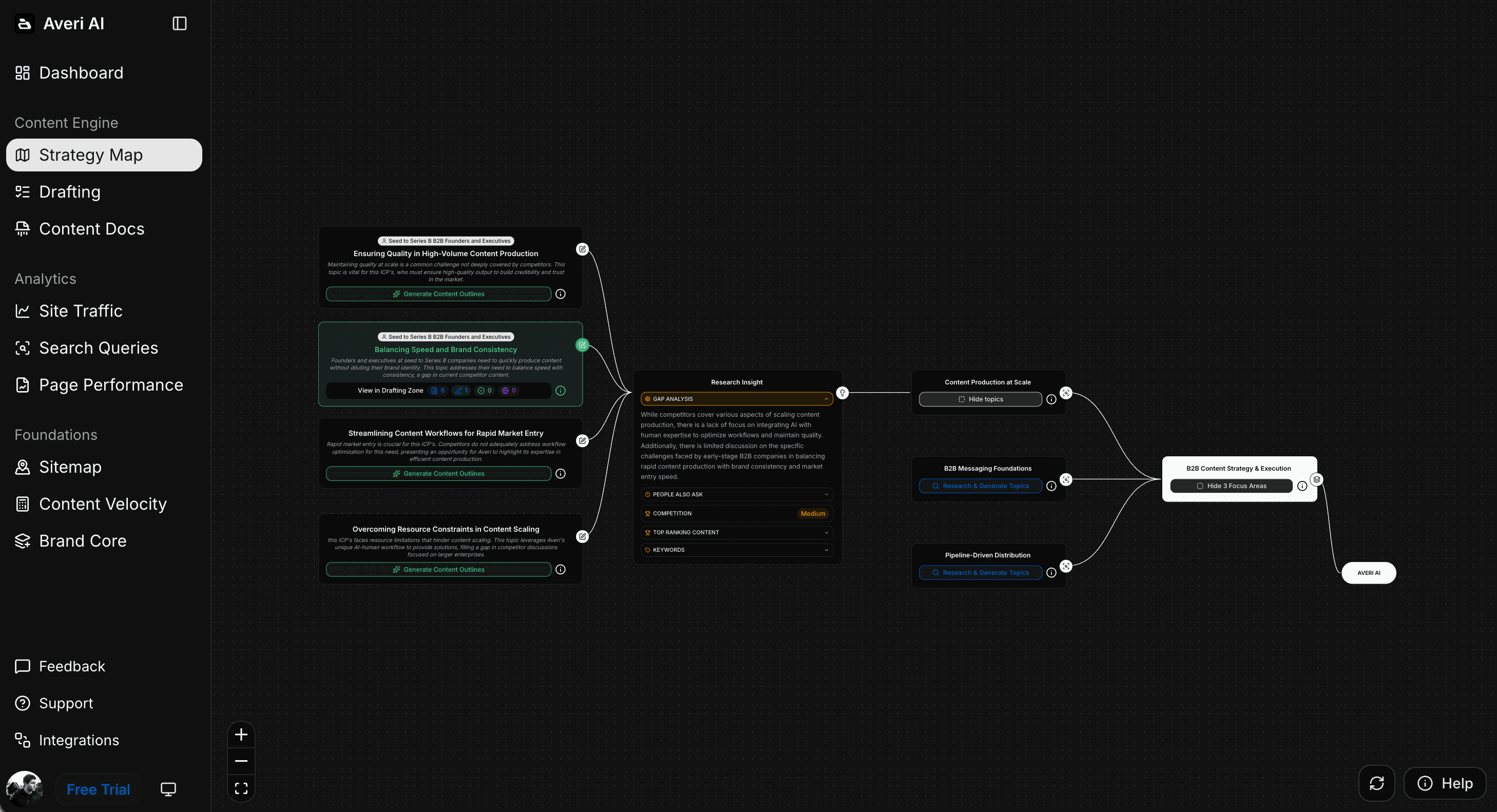
The 60-Day Trial Framework

If you're trying to decide between the two options right now, the lowest-cost path is a 60-day test of the AI content engineer first, with explicit go/no-go criteria for whether to hire the human content engineer after.

Day 1–14: Setup and first ship. Sign up for the AI content engineer (Solo or Team tier, $99–$199/month). Complete onboarding to generate Brand Core, Strategy Map, and Content Queue. Ship the first 3 pieces. The 14-day free trial covers this period — no commitment beyond editorial review time.

Day 15–30: Production rhythm. Move to paid tier. Ship 4–8 pieces in this window. Confirm the rhythm fits your editorial review bandwidth. Track score performance and identify any tier limits you bump against.

Day 31–45: Analytics and feedback. First analytics signals start appearing. Search Console indexing, AI Overview presence checks, initial citation patterns. Identify whether the engine is producing pieces that map to actual buyer questions and ranking outcomes.

Day 46–60: Decision. By day 60, you have shipped 12–16 pieces and have 30+ days of analytics data. Re-evaluate against the three operational triggers. If none have fired, stay on the AI content engineer for another 6 months and revisit. If one has fired, expand the editorial review bandwidth (fractional marketer or part-time hire). If two or more have fired, run a content engineer hire process — knowing the engine, the data, and the brand foundation are already in place.

This is the cheapest possible way to make the AI-vs-human decision.

Total spend over 60 days: $198–$398 for the AI content engineer plus editorial review time.

Information generated: enough to either commit to the software path or to direct a successful human hire. The seed-stage content marketing playbook covers the operational rhythm in detail.

Run the 60-day trial before you run the hire process

Sign up for the AI content engineer, ship 12–16 pieces, get 30+ days of analytics, then make the AI-vs-human call with real data rather than vendor pitches.

$99/month for the Solo plan. 14-day free trial. No credit card.

Start free →


Related Resources

The AI Content Engineer Cluster

Content Engineer Context

Buy-vs-Hire Economics

Operational Setup

FAQs

When should I hire a human content engineer vs use an AI content engineer?

Use an AI content engineer at pre-seed through early Series A (typically $0–$5M ARR, 1–10 person teams, content budgets under $5K monthly). Hire a human content engineer when three operational triggers fire simultaneously: publishing 25+ pieces monthly across multiple formats, operating multiple brands or regions, and content driving 25%+ of pipeline. ARR alone is not a sufficient trigger — Series A funding is permission to hire, not a signal that you need to.

Is a human content engineer worth 168x more than an AI content engineer?

At the right stage, yes. At the wrong stage, no. A human content engineer fully loaded costs ~$201,000 in Year 1 vs. $1,188 for an AI content engineer (Solo tier). At Series B+ with 25+ pieces monthly and 25%+ pipeline from content, the human's editorial judgment, multi-brand governance, and strategic ownership justify the cost differential. At pre-seed to early Series A, the AI version delivers the same six-month build state at less than 1% of the cost. The math depends on stage.

Can the AI content engineer really replace what a human content engineer would do in the first six months?

For the six functions (Brand Core, Strategy Map, Content Queue, AI Drafting, SEO + GEO Scoring, CMS Publishing + Analytics), yes — the AI content engineer ships the operational build state on day one that a human content engineer typically constructs over 18–22 weeks of tenure. What it does not replace is the editorial judgment layer that sits on top of those systems: contrarian POV, expert relationships, multi-brand governance, complex stakeholder content. That layer remains human at every stage.

Do most companies use AI content engineer, human content engineer, or both?

At pre-seed to Series A, most companies that are running content operations well use only an AI content engineer with a founder or fractional marketer as editorial reviewer. At Series B and beyond, most companies that have scaled content use both — the AI content engineer runs the systems, the human content engineer owns the strategic layer. The hybrid is the steady state at scale, not a transition phase. Most enterprise teams already operate this way, even if the AI version is built in-house rather than purchased.

What's the biggest mistake startups make on this decision?

Hiring a content engineer on Series A funding rather than on operational triggers. Series A unlocks budget; it does not signal that the work demands a dedicated human hire. Most teams that hire prematurely spend six months and ~$100,000 of loaded compensation having the new hire reconstruct what an AI content engineer would have built in 60 minutes of onboarding. The fix: defer the hire until at least two of the three operational triggers fire (volume, multi-brand complexity, pipeline contribution), regardless of how much the raise unlocks.

How do I know if my AI content engineer is reaching its ceiling?

Three signals: editorial review time exceeds 20 hours weekly of a single person's time, content production is consistently bumping against tier limits and quota overages, or multi-brand and multi-region complexity is creating governance work that no one owns. If two or three of these signals fire, you're at the ceiling and the hybrid configuration (AI + human content engineer) becomes the structurally correct next step.

Should I just hire a fractional content engineer instead of either option?

A fractional content engineer (10–20 hours weekly, typically $4,000–$8,000 monthly) is a reasonable middle option when one of the three operational triggers has fired but not all three. The fractional hire layers on top of an AI content engineer rather than replacing it — the AI version still handles the systems work, the fractional hire adds editorial sophistication and strategic ownership. Build a killer marketing team without full-time hires covers the fractional model in detail.


Continue Reading

The latest handpicked blog articles

Experience The AI Content Engine

Already have an account?

Join 30,000+ Founders, Marketers & Builders

Don't Feed the Algorithm

“Top 3 tech + AI newsletters in the country. Always sharp, always actionable.”

"Genuinely my favorite newsletter in tech. No fluff, no cheesy ads, just great content."

“Clear, practical, and on-point. Helps me keep up without drowning in noise.”

User-Generated Content & Authenticity in the Age of AI

Zach Chmael

Head of Marketing

6 minutes

In This Article

Honest comparison: AI content engineer vs human content engineer. When each wins, the triggers for switching, and how most teams end up running both.

Don’t Feed the Algorithm

The algorithm never sleeps, but you don’t have to feed it — Join our weekly newsletter for real insights on AI, human creativity & marketing execution.

TL;DR

  • 🤝 Both options are legitimate. A human content engineer is the right hire at Series B+ with 15+ person teams. An AI content engineer is the right purchase at pre-seed through early Series A. Neither is inherently superior

  • 📊 Eight dimensions determine the fit: cost, time to first piece, content volume, customizability, ICP alignment, scalability ceiling, editorial judgment, multi-brand complexity

  • 💰 The cost spread is real: $1,188–$4,788 annual (AI) vs. ~$201,000 annual fully loaded (human). The differential matters most at sub-$10M ARR; matters less past Series B

  • 🎯 Three operational triggers signal upgrade time: production exceeding 25 pieces monthly, multi-brand or multi-region complexity emerging, content driving 25%+ of pipeline. When all three fire simultaneously, hire the human

  • 🚫 The most expensive mistake: hiring on Series A funding rather than on operational triggers. Series A is permission to hire, not a signal you need to. Six months and $100K typically wasted

  • 🔄 The endgame is usually both. At Series B and beyond, the AI content engineer becomes the substrate the human content engineer manages. Hybrid is the steady state, not a transition phase

"We built Averi around the exact workflow we've used to scale our web traffic over 6000% in the last 6 months."

founder-image
founder-image
Your content should be working harder.

Averi's content engine builds Google entity authority, drives AI citations, and scales your visibility so you can get more customers.

AI Content Engineer vs Human Content Engineer: When Each One Wins

Both options are real and both options work.

The question is not which one is better in the abstract. The question is which one fits your company at this stage on this date.

A human content engineer is the right hire at the right time.

An AI content engineer is the right purchase at a different right time.

Most companies that scale will eventually run both — the AI content engineer as the substrate, the human content engineer as the strategist sitting on top of it.

The decision framework in this piece is operational, not philosophical. There are eight dimensions that matter for the choice, three concrete triggers that signal when to switch or add the human hire, and one common mistake that costs most companies six months and $100,000 in loaded compensation.

Read the pillar piece for the strategic case for AI content engineers at seed stage. Read the role definition for the formal what-it-is.

Read this piece when you're making the actual decision.

The Honest Comparison Frame

Most "AI vs human" content marketing comparisons are written by one side trying to discredit the other.

AI vendors argue the human is unnecessary; recruiting agencies and content engineer evangelists argue the AI can't replace expertise.

Both framings are wrong because both assume the choice is binary at a single point in time.

The actual choice is sequenced. At pre-seed through Series A, the AI content engineer is the structurally correct choice — the math, time-to-first-piece, and operational complexity all favor software. At Series B and beyond, the human content engineer is the structurally correct addition (not replacement) — the volume, multi-brand complexity, and editorial sophistication all favor a dedicated human owning the role. Between those stages, the right call depends on the operational triggers below, not on opinions about AI capability.

The framing that helps most: an AI content engineer at seed stage is what makes the eventual human content engineer hire successful. The software builds the infrastructure, captures the brand context, ships the first hundred pieces, generates the analytics, and creates the data the human content engineer will use to direct their first-year roadmap.

Companies that try to skip the AI content engineer stage and hire the human directly typically spend six months reconstructing what the software would have built in 60 minutes.

The 8-Dimension Comparison Table

Dimension

AI Content Engineer

Human Content Engineer

Cost (Year 1, fully loaded)

$1,188 (Solo) — $4,788 (Agency)

~$201,000 (base $161K + benefits, taxes, equipment, tool stack)

Time to first published piece

<5 days from signup

4–16 weeks from hire date

Time to operational 6-function build

Day 1 (onboarding completes the build)

18–22 weeks of tenure

Content production volume capacity

4–24 pieces monthly (throttled by editorial review time)

25–60+ pieces monthly (throttled by hours in the workday)

Brand context capture

30–60 minutes via onboarding flow

6–8 weeks of interviews and documentation review

Customizability for edge cases

Packaged workflow — opinionated, fast

Highly configurable — slow, expensive, infinitely customizable

Editorial judgment

None on the platform itself; the human reviewer adds it

Built into the role

Multi-brand / multi-region governance

One brand at a time per instance; multi-brand requires separate instances

Single owner can govern multiple brands and regions

Best fit stage

Pre-seed to early Series A

Series B and later (or as add-on at any stage with budget)

What it gives up

Configurability and editorial sophistication

Speed, cost efficiency, day-one operational state

What it does well

Ships the 6-month build state instantly; runs the systems continuously

Adds judgment, opinion, and complexity governance no software can replicate

Failure mode if mismatched to stage

Bumping against tier limits at scale (manageable; expand or upgrade)

Six months reconstructing what software does (expensive; usually fatal to the hire)

The dimensions are not equally weighted at every stage.

At seed stage, the first three rows (cost, time-to-piece, time-to-build) dominate.

At Series B, the bottom three rows (editorial judgment, multi-brand, configurability) start to dominate.

The point of the table is not to find the "winner" — it's to help you match the dimensions that matter most for your company today against the option that delivers them.

When The Human Content Engineer Wins

The case for hiring a human content engineer is honest and worth taking seriously. Five scenarios where the hire is clearly correct:

Scenario 1: You've outgrown the AI content engine's ceiling. Publishing 25+ pieces monthly across multiple formats (long-form, video transcripts, gated assets, sales enablement, partner content, localized variants). The AI content engineer at Agency tier handles this volume technically, but the editorial review burden exceeds 20 hours per week of a single person's time. A dedicated human content engineer becomes necessary to manage the pipeline, not because the software can't, but because the volume justifies dedicated ownership.

Scenario 2: You operate multiple brands or regions. Two or more brands, three or more language markets, or a complex segmented voice strategy across product lines creates governance work that benefits from a dedicated owner. At that complexity, the human content engineer becomes the conductor of multiple AI content engine instances rather than a substitute for one.

Scenario 3: Content drives 25%+ of pipeline. When content is your single largest growth channel, further investment has predictable ROI. The math finally works on a $200K hire because they're building on top of an established channel, not trying to discover whether one exists. The hire becomes a force multiplier on a proven engine.

Scenario 4: Editorial sophistication exceeds what the founder or marketer provides. When your category demands deep technical expertise (regulated industries, scientific research, enterprise compliance), the editorial layer above the AI content engine needs to be staffed by someone with that expertise. A part-time founder can't be the editorial reviewer for a piece on FedRAMP compliance, or a deep technical breakdown of distributed systems. The human content engineer fills that gap.

Scenario 5: You're past Series B with budget calibrated to enterprise content operations. Annual content marketing budgets above $500,000, dedicated content teams of 4+ people, and the operational infrastructure to support a senior content engineer hire. At this stage the cost ratio becomes a rounding error and the strategic value of dedicated human ownership compounds.

In each scenario, the human content engineer is not replacing the AI content engineer. They're sitting on top of it. The hire works because the substrate (Brand Core, Strategy Map, Queue, Drafting, Scoring, Publishing) is already built and operational. The human adds the layer that doesn't compress into software: editorial judgment, contrarian POV, expert relationships, multi-brand governance.

When The AI Content Engineer Wins

The case for the AI content engineer is equally honest. Five scenarios where the software is clearly the right call:

Scenario 1: You're pre-seed or seed stage with a 1–5 person team. The founder still touches content. The content marketing budget is $99–$5,000 monthly. ARR is $0–$5M. The math doesn't work for a $200K hire — that's six months of runway equivalent. The AI content engineer ships the same six-month build state on day one for less than 1% of the loaded cost.

Scenario 2: You need content live in the next two weeks. You can't wait 4–16 weeks for a human hire to ramp. Maybe you're going to market in a new category, responding to a competitor move, or preparing for fundraise outreach. The AI content engineer publishes the first piece in <5 days. The human content engineer's first piece typically lands in week 12 of their tenure.

Scenario 3: Your content needs are mostly mid-funnel education and BOFU comparison content. Long-form articles, FAQ pages, landing page copy, comparison guides. The kind of content that follows a repeatable structure (direct-answer H2s, 7-question FAQ, comparison tables, first-person experience markers). This is exactly what the AI content engineer is built to produce well. Editorial sophistication beyond the structure isn't required.

Scenario 4: You have a founder or fractional marketer who can be the editorial reviewer. The AI content engineer handles the systems work. The editorial layer above it requires 5–15 hours weekly of someone with brand context and decision authority. A founder or fractional marketer fills this role at a fraction of a dedicated content engineer's cost. The founder's guide to content marketing in 5 hours a week covers the operational rhythm.

Scenario 5: You're optimizing for total content marketing budget under $10,000 monthly. Including platform cost, freelance writer time, design, distribution, and tooling. At this budget level, allocating $200K annually to a single hire consumes the entire allocation and leaves nothing for distribution, design, or paid amplification. The AI content engine fits inside the budget and preserves resources for the rest of the marketing mix.

These five scenarios cover roughly 80% of B2B SaaS companies between pre-seed and early Series A. The AI content engineer is not a compromise for these companies — it's the structurally correct choice for the stage.

See how much you could save with Averi for Content

The Operational Triggers For Switching (Or Adding)

The trigger framework determines when to move from AI content engineer alone to AI content engineer + human content engineer hire. Three triggers, each with a specific operational threshold:

Trigger 1: Production capacity ceiling. You're publishing 25+ pieces monthly across multiple formats and the editorial review burden exceeds 20 hours weekly of a single person's time. The AI content engineer is still functioning — it's not broken — but the volume justifies dedicated human ownership of the pipeline.

Trigger 2: Multi-brand or multi-region complexity. You're operating two or more brands, three or more language markets, or a segmented voice strategy across multiple product lines. Each adds governance complexity that benefits from dedicated human attention. One AI content engine instance can run multiple brands technically, but the editorial governance across brands needs an owner.

Trigger 3: Pipeline contribution exceeds 25%. Content is your single largest growth channel and is driving more than 25% of pipeline. Further investment has predictable ROI because the channel is proven. The $200K hire becomes a force multiplier on a working engine rather than a bet on whether the channel will work.

When all three trigger simultaneously, run the hire.

When two trigger, evaluate hiring a fractional content engineer or content marketing director (10–20 hours weekly) before committing to a full-time hire.

When one triggers in isolation, stay on the AI content engineer and revisit in 6 months.

Most teams won't hit all three triggers for 18–36 months after they start using an AI content engineer.

By that time, you have the data, the engine, and the brand foundation that makes a $200K hire dramatically more likely to succeed.

The Hybrid Reality At Series B+

The framing that helps most: the steady state at Series B and beyond is not "AI content engineer or human content engineer." It's both. The hybrid configuration:

  • AI content engineer handles the systems: Brand Core maintenance across multiple brands, Strategy Map generation, Content Queue management, AI drafting for the long-tail volume, dual-layer scoring on every piece, CMS publishing with schema applied, analytics ingestion and feedback into the Strategy Map

  • Human content engineer owns the strategic layer: editorial judgment on what the company believes, opinion-driven pieces and pillar content authored or co-authored, expert interviews and partnership content, multi-brand governance, complex stakeholder content (board updates, investor reports, partnership announcements), and calibration of the AI content engineer's outputs against evolving brand strategy

At this configuration, the human content engineer's salary is justified by the multiplier effect on the AI content engine's output, not by replacing it.

The AI version produces 40–80 pieces monthly across multiple brands. The human version is responsible for the 5–10 pieces per quarter that require editorial sophistication beyond what the engine produces, plus oversight of the rest.

This is the model running at AirOps, Webflow, Klaviyo, and most other post-Series-B B2B SaaS companies that have dedicated content engineers. The platforms they use (or build internally) handle the systems. The humans they hire handle the judgment. Neither replaces the other; both are necessary at scale.

Common Mistakes Founders Make On This Decision

Four patterns that cost companies time and money:

Mistake 1: Hiring on Series A funding rather than on operational triggers. Series A is permission to hire, not a signal that you need to. Most teams that hire a content engineer on Series A funding (and not on the three triggers above) end up paying $100K+ in loaded compensation for someone reconstructing what software would have built in 60 minutes. The fix: defer the hire until at least two of the three triggers fire, regardless of how much budget the raise unlocks.

Mistake 2: Treating AI content engineer as a temporary stopgap. The framing that the AI content engineer is something you "use until you can afford the real thing" misreads the role. The AI content engineer is the substrate. The human content engineer sits on top of it at scale. Companies that treat the AI version as temporary skip building the foundation that makes the human hire successful later.

Mistake 3: Hiring a content engineer to figure out content strategy. The job of a content engineer at hire time is to run the systems that produce content against an existing strategy, not to discover what your content strategy should be. Companies that hire before they know what to publish typically pay the engineer to run discovery work that the AI content engine would have done in onboarding. The AI version generates Strategy Map output as a starting point; the human hire becomes the validator and refiner of that strategy, not the originator.

Mistake 4: Confusing the AI content engineer with an AI writing tool. Jasper, Copy.ai, and Writesonic are AI writing tools that handle one function. They require a human content engineer to operate them. An AI content engineer is the role itself, packaged as software. Comparing "AI content engineer vs human content engineer" against the wrong substitute (a single-function writing tool) makes the human hire look more necessary than it actually is. The honest comparison uses the AI content engineer as the AI side of the equation.

The 60-Day Trial Framework

If you're trying to decide between the two options right now, the lowest-cost path is a 60-day test of the AI content engineer first, with explicit go/no-go criteria for whether to hire the human content engineer after.

Day 1–14: Setup and first ship. Sign up for the AI content engineer (Solo or Team tier, $99–$199/month). Complete onboarding to generate Brand Core, Strategy Map, and Content Queue. Ship the first 3 pieces. The 14-day free trial covers this period — no commitment beyond editorial review time.

Day 15–30: Production rhythm. Move to paid tier. Ship 4–8 pieces in this window. Confirm the rhythm fits your editorial review bandwidth. Track score performance and identify any tier limits you bump against.

Day 31–45: Analytics and feedback. First analytics signals start appearing. Search Console indexing, AI Overview presence checks, initial citation patterns. Identify whether the engine is producing pieces that map to actual buyer questions and ranking outcomes.

Day 46–60: Decision. By day 60, you have shipped 12–16 pieces and have 30+ days of analytics data. Re-evaluate against the three operational triggers. If none have fired, stay on the AI content engineer for another 6 months and revisit. If one has fired, expand the editorial review bandwidth (fractional marketer or part-time hire). If two or more have fired, run a content engineer hire process — knowing the engine, the data, and the brand foundation are already in place.

This is the cheapest possible way to make the AI-vs-human decision.

Total spend over 60 days: $198–$398 for the AI content engineer plus editorial review time.

Information generated: enough to either commit to the software path or to direct a successful human hire. The seed-stage content marketing playbook covers the operational rhythm in detail.

Run the 60-day trial before you run the hire process

Sign up for the AI content engineer, ship 12–16 pieces, get 30+ days of analytics, then make the AI-vs-human call with real data rather than vendor pitches.

$99/month for the Solo plan. 14-day free trial. No credit card.

Start free →


Related Resources

The AI Content Engineer Cluster

Content Engineer Context

Buy-vs-Hire Economics

Operational Setup

Continue Reading

The latest handpicked blog articles

Join 30,000+ Founders, Marketers & Builders

Don't Feed the Algorithm

“Top 3 tech + AI newsletters in the country. Always sharp, always actionable.”

"Genuinely my favorite newsletter in tech. No fluff, no cheesy ads, just great content."

“Clear, practical, and on-point. Helps me keep up without drowning in noise.”

User-Generated Content & Authenticity in the Age of AI

Zach Chmael

Head of Marketing

6 minutes

In This Article

Honest comparison: AI content engineer vs human content engineer. When each wins, the triggers for switching, and how most teams end up running both.

Don’t Feed the Algorithm

The algorithm never sleeps, but you don’t have to feed it — Join our weekly newsletter for real insights on AI, human creativity & marketing execution.

Trusted by 1,000+ teams

★★★★★ 4.9/5

Startups use Averi to build
content engines that rank.

AI Content Engineer vs Human Content Engineer: When Each One Wins

Both options are real and both options work.

The question is not which one is better in the abstract. The question is which one fits your company at this stage on this date.

A human content engineer is the right hire at the right time.

An AI content engineer is the right purchase at a different right time.

Most companies that scale will eventually run both — the AI content engineer as the substrate, the human content engineer as the strategist sitting on top of it.

The decision framework in this piece is operational, not philosophical. There are eight dimensions that matter for the choice, three concrete triggers that signal when to switch or add the human hire, and one common mistake that costs most companies six months and $100,000 in loaded compensation.

Read the pillar piece for the strategic case for AI content engineers at seed stage. Read the role definition for the formal what-it-is.

Read this piece when you're making the actual decision.

The Honest Comparison Frame

Most "AI vs human" content marketing comparisons are written by one side trying to discredit the other.

AI vendors argue the human is unnecessary; recruiting agencies and content engineer evangelists argue the AI can't replace expertise.

Both framings are wrong because both assume the choice is binary at a single point in time.

The actual choice is sequenced. At pre-seed through Series A, the AI content engineer is the structurally correct choice — the math, time-to-first-piece, and operational complexity all favor software. At Series B and beyond, the human content engineer is the structurally correct addition (not replacement) — the volume, multi-brand complexity, and editorial sophistication all favor a dedicated human owning the role. Between those stages, the right call depends on the operational triggers below, not on opinions about AI capability.

The framing that helps most: an AI content engineer at seed stage is what makes the eventual human content engineer hire successful. The software builds the infrastructure, captures the brand context, ships the first hundred pieces, generates the analytics, and creates the data the human content engineer will use to direct their first-year roadmap.

Companies that try to skip the AI content engineer stage and hire the human directly typically spend six months reconstructing what the software would have built in 60 minutes.

The 8-Dimension Comparison Table

Dimension

AI Content Engineer

Human Content Engineer

Cost (Year 1, fully loaded)

$1,188 (Solo) — $4,788 (Agency)

~$201,000 (base $161K + benefits, taxes, equipment, tool stack)

Time to first published piece

<5 days from signup

4–16 weeks from hire date

Time to operational 6-function build

Day 1 (onboarding completes the build)

18–22 weeks of tenure

Content production volume capacity

4–24 pieces monthly (throttled by editorial review time)

25–60+ pieces monthly (throttled by hours in the workday)

Brand context capture

30–60 minutes via onboarding flow

6–8 weeks of interviews and documentation review

Customizability for edge cases

Packaged workflow — opinionated, fast

Highly configurable — slow, expensive, infinitely customizable

Editorial judgment

None on the platform itself; the human reviewer adds it

Built into the role

Multi-brand / multi-region governance

One brand at a time per instance; multi-brand requires separate instances

Single owner can govern multiple brands and regions

Best fit stage

Pre-seed to early Series A

Series B and later (or as add-on at any stage with budget)

What it gives up

Configurability and editorial sophistication

Speed, cost efficiency, day-one operational state

What it does well

Ships the 6-month build state instantly; runs the systems continuously

Adds judgment, opinion, and complexity governance no software can replicate

Failure mode if mismatched to stage

Bumping against tier limits at scale (manageable; expand or upgrade)

Six months reconstructing what software does (expensive; usually fatal to the hire)

The dimensions are not equally weighted at every stage.

At seed stage, the first three rows (cost, time-to-piece, time-to-build) dominate.

At Series B, the bottom three rows (editorial judgment, multi-brand, configurability) start to dominate.

The point of the table is not to find the "winner" — it's to help you match the dimensions that matter most for your company today against the option that delivers them.

When The Human Content Engineer Wins

The case for hiring a human content engineer is honest and worth taking seriously. Five scenarios where the hire is clearly correct:

Scenario 1: You've outgrown the AI content engine's ceiling. Publishing 25+ pieces monthly across multiple formats (long-form, video transcripts, gated assets, sales enablement, partner content, localized variants). The AI content engineer at Agency tier handles this volume technically, but the editorial review burden exceeds 20 hours per week of a single person's time. A dedicated human content engineer becomes necessary to manage the pipeline, not because the software can't, but because the volume justifies dedicated ownership.

Scenario 2: You operate multiple brands or regions. Two or more brands, three or more language markets, or a complex segmented voice strategy across product lines creates governance work that benefits from a dedicated owner. At that complexity, the human content engineer becomes the conductor of multiple AI content engine instances rather than a substitute for one.

Scenario 3: Content drives 25%+ of pipeline. When content is your single largest growth channel, further investment has predictable ROI. The math finally works on a $200K hire because they're building on top of an established channel, not trying to discover whether one exists. The hire becomes a force multiplier on a proven engine.

Scenario 4: Editorial sophistication exceeds what the founder or marketer provides. When your category demands deep technical expertise (regulated industries, scientific research, enterprise compliance), the editorial layer above the AI content engine needs to be staffed by someone with that expertise. A part-time founder can't be the editorial reviewer for a piece on FedRAMP compliance, or a deep technical breakdown of distributed systems. The human content engineer fills that gap.

Scenario 5: You're past Series B with budget calibrated to enterprise content operations. Annual content marketing budgets above $500,000, dedicated content teams of 4+ people, and the operational infrastructure to support a senior content engineer hire. At this stage the cost ratio becomes a rounding error and the strategic value of dedicated human ownership compounds.

In each scenario, the human content engineer is not replacing the AI content engineer. They're sitting on top of it. The hire works because the substrate (Brand Core, Strategy Map, Queue, Drafting, Scoring, Publishing) is already built and operational. The human adds the layer that doesn't compress into software: editorial judgment, contrarian POV, expert relationships, multi-brand governance.

When The AI Content Engineer Wins

The case for the AI content engineer is equally honest. Five scenarios where the software is clearly the right call:

Scenario 1: You're pre-seed or seed stage with a 1–5 person team. The founder still touches content. The content marketing budget is $99–$5,000 monthly. ARR is $0–$5M. The math doesn't work for a $200K hire — that's six months of runway equivalent. The AI content engineer ships the same six-month build state on day one for less than 1% of the loaded cost.

Scenario 2: You need content live in the next two weeks. You can't wait 4–16 weeks for a human hire to ramp. Maybe you're going to market in a new category, responding to a competitor move, or preparing for fundraise outreach. The AI content engineer publishes the first piece in <5 days. The human content engineer's first piece typically lands in week 12 of their tenure.

Scenario 3: Your content needs are mostly mid-funnel education and BOFU comparison content. Long-form articles, FAQ pages, landing page copy, comparison guides. The kind of content that follows a repeatable structure (direct-answer H2s, 7-question FAQ, comparison tables, first-person experience markers). This is exactly what the AI content engineer is built to produce well. Editorial sophistication beyond the structure isn't required.

Scenario 4: You have a founder or fractional marketer who can be the editorial reviewer. The AI content engineer handles the systems work. The editorial layer above it requires 5–15 hours weekly of someone with brand context and decision authority. A founder or fractional marketer fills this role at a fraction of a dedicated content engineer's cost. The founder's guide to content marketing in 5 hours a week covers the operational rhythm.

Scenario 5: You're optimizing for total content marketing budget under $10,000 monthly. Including platform cost, freelance writer time, design, distribution, and tooling. At this budget level, allocating $200K annually to a single hire consumes the entire allocation and leaves nothing for distribution, design, or paid amplification. The AI content engine fits inside the budget and preserves resources for the rest of the marketing mix.

These five scenarios cover roughly 80% of B2B SaaS companies between pre-seed and early Series A. The AI content engineer is not a compromise for these companies — it's the structurally correct choice for the stage.

See how much you could save with Averi for Content

The Operational Triggers For Switching (Or Adding)

The trigger framework determines when to move from AI content engineer alone to AI content engineer + human content engineer hire. Three triggers, each with a specific operational threshold:

Trigger 1: Production capacity ceiling. You're publishing 25+ pieces monthly across multiple formats and the editorial review burden exceeds 20 hours weekly of a single person's time. The AI content engineer is still functioning — it's not broken — but the volume justifies dedicated human ownership of the pipeline.

Trigger 2: Multi-brand or multi-region complexity. You're operating two or more brands, three or more language markets, or a segmented voice strategy across multiple product lines. Each adds governance complexity that benefits from dedicated human attention. One AI content engine instance can run multiple brands technically, but the editorial governance across brands needs an owner.

Trigger 3: Pipeline contribution exceeds 25%. Content is your single largest growth channel and is driving more than 25% of pipeline. Further investment has predictable ROI because the channel is proven. The $200K hire becomes a force multiplier on a working engine rather than a bet on whether the channel will work.

When all three trigger simultaneously, run the hire.

When two trigger, evaluate hiring a fractional content engineer or content marketing director (10–20 hours weekly) before committing to a full-time hire.

When one triggers in isolation, stay on the AI content engineer and revisit in 6 months.

Most teams won't hit all three triggers for 18–36 months after they start using an AI content engineer.

By that time, you have the data, the engine, and the brand foundation that makes a $200K hire dramatically more likely to succeed.

The Hybrid Reality At Series B+

The framing that helps most: the steady state at Series B and beyond is not "AI content engineer or human content engineer." It's both. The hybrid configuration:

  • AI content engineer handles the systems: Brand Core maintenance across multiple brands, Strategy Map generation, Content Queue management, AI drafting for the long-tail volume, dual-layer scoring on every piece, CMS publishing with schema applied, analytics ingestion and feedback into the Strategy Map

  • Human content engineer owns the strategic layer: editorial judgment on what the company believes, opinion-driven pieces and pillar content authored or co-authored, expert interviews and partnership content, multi-brand governance, complex stakeholder content (board updates, investor reports, partnership announcements), and calibration of the AI content engineer's outputs against evolving brand strategy

At this configuration, the human content engineer's salary is justified by the multiplier effect on the AI content engine's output, not by replacing it.

The AI version produces 40–80 pieces monthly across multiple brands. The human version is responsible for the 5–10 pieces per quarter that require editorial sophistication beyond what the engine produces, plus oversight of the rest.

This is the model running at AirOps, Webflow, Klaviyo, and most other post-Series-B B2B SaaS companies that have dedicated content engineers. The platforms they use (or build internally) handle the systems. The humans they hire handle the judgment. Neither replaces the other; both are necessary at scale.

Common Mistakes Founders Make On This Decision

Four patterns that cost companies time and money:

Mistake 1: Hiring on Series A funding rather than on operational triggers. Series A is permission to hire, not a signal that you need to. Most teams that hire a content engineer on Series A funding (and not on the three triggers above) end up paying $100K+ in loaded compensation for someone reconstructing what software would have built in 60 minutes. The fix: defer the hire until at least two of the three triggers fire, regardless of how much budget the raise unlocks.

Mistake 2: Treating AI content engineer as a temporary stopgap. The framing that the AI content engineer is something you "use until you can afford the real thing" misreads the role. The AI content engineer is the substrate. The human content engineer sits on top of it at scale. Companies that treat the AI version as temporary skip building the foundation that makes the human hire successful later.

Mistake 3: Hiring a content engineer to figure out content strategy. The job of a content engineer at hire time is to run the systems that produce content against an existing strategy, not to discover what your content strategy should be. Companies that hire before they know what to publish typically pay the engineer to run discovery work that the AI content engine would have done in onboarding. The AI version generates Strategy Map output as a starting point; the human hire becomes the validator and refiner of that strategy, not the originator.

Mistake 4: Confusing the AI content engineer with an AI writing tool. Jasper, Copy.ai, and Writesonic are AI writing tools that handle one function. They require a human content engineer to operate them. An AI content engineer is the role itself, packaged as software. Comparing "AI content engineer vs human content engineer" against the wrong substitute (a single-function writing tool) makes the human hire look more necessary than it actually is. The honest comparison uses the AI content engineer as the AI side of the equation.

The 60-Day Trial Framework

If you're trying to decide between the two options right now, the lowest-cost path is a 60-day test of the AI content engineer first, with explicit go/no-go criteria for whether to hire the human content engineer after.

Day 1–14: Setup and first ship. Sign up for the AI content engineer (Solo or Team tier, $99–$199/month). Complete onboarding to generate Brand Core, Strategy Map, and Content Queue. Ship the first 3 pieces. The 14-day free trial covers this period — no commitment beyond editorial review time.

Day 15–30: Production rhythm. Move to paid tier. Ship 4–8 pieces in this window. Confirm the rhythm fits your editorial review bandwidth. Track score performance and identify any tier limits you bump against.

Day 31–45: Analytics and feedback. First analytics signals start appearing. Search Console indexing, AI Overview presence checks, initial citation patterns. Identify whether the engine is producing pieces that map to actual buyer questions and ranking outcomes.

Day 46–60: Decision. By day 60, you have shipped 12–16 pieces and have 30+ days of analytics data. Re-evaluate against the three operational triggers. If none have fired, stay on the AI content engineer for another 6 months and revisit. If one has fired, expand the editorial review bandwidth (fractional marketer or part-time hire). If two or more have fired, run a content engineer hire process — knowing the engine, the data, and the brand foundation are already in place.

This is the cheapest possible way to make the AI-vs-human decision.

Total spend over 60 days: $198–$398 for the AI content engineer plus editorial review time.

Information generated: enough to either commit to the software path or to direct a successful human hire. The seed-stage content marketing playbook covers the operational rhythm in detail.

Run the 60-day trial before you run the hire process

Sign up for the AI content engineer, ship 12–16 pieces, get 30+ days of analytics, then make the AI-vs-human call with real data rather than vendor pitches.

$99/month for the Solo plan. 14-day free trial. No credit card.

Start free →


Related Resources

The AI Content Engineer Cluster

Content Engineer Context

Buy-vs-Hire Economics

Operational Setup

"We built Averi around the exact workflow we've used to scale our web traffic over 6000% in the last 6 months."

founder-image
founder-image
Your content should be working harder.

Averi's content engine builds Google entity authority, drives AI citations, and scales your visibility so you can get more customers.

FAQs

A fractional content engineer (10–20 hours weekly, typically $4,000–$8,000 monthly) is a reasonable middle option when one of the three operational triggers has fired but not all three. The fractional hire layers on top of an AI content engineer rather than replacing it — the AI version still handles the systems work, the fractional hire adds editorial sophistication and strategic ownership. Build a killer marketing team without full-time hires covers the fractional model in detail.

Should I just hire a fractional content engineer instead of either option?

Three signals: editorial review time exceeds 20 hours weekly of a single person's time, content production is consistently bumping against tier limits and quota overages, or multi-brand and multi-region complexity is creating governance work that no one owns. If two or three of these signals fire, you're at the ceiling and the hybrid configuration (AI + human content engineer) becomes the structurally correct next step.

How do I know if my AI content engineer is reaching its ceiling?

Hiring a content engineer on Series A funding rather than on operational triggers. Series A unlocks budget; it does not signal that the work demands a dedicated human hire. Most teams that hire prematurely spend six months and ~$100,000 of loaded compensation having the new hire reconstruct what an AI content engineer would have built in 60 minutes of onboarding. The fix: defer the hire until at least two of the three operational triggers fire (volume, multi-brand complexity, pipeline contribution), regardless of how much the raise unlocks.

What's the biggest mistake startups make on this decision?

At pre-seed to Series A, most companies that are running content operations well use only an AI content engineer with a founder or fractional marketer as editorial reviewer. At Series B and beyond, most companies that have scaled content use both — the AI content engineer runs the systems, the human content engineer owns the strategic layer. The hybrid is the steady state at scale, not a transition phase. Most enterprise teams already operate this way, even if the AI version is built in-house rather than purchased.

Do most companies use AI content engineer, human content engineer, or both?

For the six functions (Brand Core, Strategy Map, Content Queue, AI Drafting, SEO + GEO Scoring, CMS Publishing + Analytics), yes — the AI content engineer ships the operational build state on day one that a human content engineer typically constructs over 18–22 weeks of tenure. What it does not replace is the editorial judgment layer that sits on top of those systems: contrarian POV, expert relationships, multi-brand governance, complex stakeholder content. That layer remains human at every stage.

Can the AI content engineer really replace what a human content engineer would do in the first six months?

At the right stage, yes. At the wrong stage, no. A human content engineer fully loaded costs ~$201,000 in Year 1 vs. $1,188 for an AI content engineer (Solo tier). At Series B+ with 25+ pieces monthly and 25%+ pipeline from content, the human's editorial judgment, multi-brand governance, and strategic ownership justify the cost differential. At pre-seed to early Series A, the AI version delivers the same six-month build state at less than 1% of the cost. The math depends on stage.

Is a human content engineer worth 168x more than an AI content engineer?

Use an AI content engineer at pre-seed through early Series A (typically $0–$5M ARR, 1–10 person teams, content budgets under $5K monthly). Hire a human content engineer when three operational triggers fire simultaneously: publishing 25+ pieces monthly across multiple formats, operating multiple brands or regions, and content driving 25%+ of pipeline. ARR alone is not a sufficient trigger — Series A funding is permission to hire, not a signal that you need to.

When should I hire a human content engineer vs use an AI content engineer?

FAQs

How long does it take to see SEO results for B2B SaaS?

Expect 7 months to break-even on average, with meaningful traffic improvements typically appearing within 3-6 months. Link building results appear within 1-6 months. The key is consistency—companies that stop and start lose ground to those who execute continuously.

Is AI-generated content actually good for SEO?

62% of marketers report higher SERP rankings for AI-generated content—but only when properly edited and enhanced with human expertise. Pure AI content without human refinement often lacks the originality and depth that both readers and algorithms prefer.

Is AI-generated content actually good for SEO?

62% of marketers report higher SERP rankings for AI-generated content—but only when properly edited and enhanced with human expertise. Pure AI content without human refinement often lacks the originality and depth that both readers and algorithms prefer.

Is AI-generated content actually good for SEO?

62% of marketers report higher SERP rankings for AI-generated content—but only when properly edited and enhanced with human expertise. Pure AI content without human refinement often lacks the originality and depth that both readers and algorithms prefer.

Is AI-generated content actually good for SEO?

62% of marketers report higher SERP rankings for AI-generated content—but only when properly edited and enhanced with human expertise. Pure AI content without human refinement often lacks the originality and depth that both readers and algorithms prefer.

Is AI-generated content actually good for SEO?

62% of marketers report higher SERP rankings for AI-generated content—but only when properly edited and enhanced with human expertise. Pure AI content without human refinement often lacks the originality and depth that both readers and algorithms prefer.

Is AI-generated content actually good for SEO?

62% of marketers report higher SERP rankings for AI-generated content—but only when properly edited and enhanced with human expertise. Pure AI content without human refinement often lacks the originality and depth that both readers and algorithms prefer.

Is AI-generated content actually good for SEO?

62% of marketers report higher SERP rankings for AI-generated content—but only when properly edited and enhanced with human expertise. Pure AI content without human refinement often lacks the originality and depth that both readers and algorithms prefer.

TL;DR

  • 🤝 Both options are legitimate. A human content engineer is the right hire at Series B+ with 15+ person teams. An AI content engineer is the right purchase at pre-seed through early Series A. Neither is inherently superior

  • 📊 Eight dimensions determine the fit: cost, time to first piece, content volume, customizability, ICP alignment, scalability ceiling, editorial judgment, multi-brand complexity

  • 💰 The cost spread is real: $1,188–$4,788 annual (AI) vs. ~$201,000 annual fully loaded (human). The differential matters most at sub-$10M ARR; matters less past Series B

  • 🎯 Three operational triggers signal upgrade time: production exceeding 25 pieces monthly, multi-brand or multi-region complexity emerging, content driving 25%+ of pipeline. When all three fire simultaneously, hire the human

  • 🚫 The most expensive mistake: hiring on Series A funding rather than on operational triggers. Series A is permission to hire, not a signal you need to. Six months and $100K typically wasted

  • 🔄 The endgame is usually both. At Series B and beyond, the AI content engineer becomes the substrate the human content engineer manages. Hybrid is the steady state, not a transition phase

Continue Reading

The latest handpicked blog articles

Join 30,000+ Founders, Marketers & Builders

Don't Feed the Algorithm

“Top 3 tech + AI newsletters in the country. Always sharp, always actionable.”

"Genuinely my favorite newsletter in tech. No fluff, no cheesy ads, just great content."

“Clear, practical, and on-point. Helps me keep up without drowning in noise.”

Maybe later