What Is an AI Content Engineer? The 2026 Role Defined

Zach Chmael

Head of Marketing

5 minutes

In This Article

An AI content engineer is software that performs the six functions of a human content engineer — instantly, at less than 1% of the cost.

Updated

Trusted by 1,000+ teams

★★★★★ 4.9/5

Startups use Averi to build
content engines that rank.

TL;DR

  • 📖 Definition: An AI content engineer is software that performs the same six functions a human content engineer would, packaged as a platform you sign up for rather than a person you hire

  • 🔧 Six functions: Brand Core, Strategy Map, Content Queue, AI Drafting, SEO + GEO Scoring, CMS Publishing with Analytics

  • 💰 Cost: $99–$399/month, vs. ~$201,000 fully loaded Year 1 for the human version

  • 🚫 What it is not: Not a writing tool (Jasper, Copy.ai), not an SEO optimizer (Surfer, MarketMuse), not a workflow automator (AirOps requires a content engineer to operate it), not a content marketplace (Contently). The distinguishing test: does it perform the role end-to-end, or does it help someone in the role?

  • 🎯 Who uses one: Pre-seed through Series A B2B SaaS startups (1–14 person teams). Series B+ companies typically run an AI content engineer underneath a human content engineer who manages it

  • ⏱️ Time to operational: <60 minutes (vs. 4–6 weeks for a human hire to ramp)

Zach Chmael

CMO, Averi

"We built Averi around the exact workflow we've used to scale our web traffic over 6000% in the last 6 months."

Your content should be working harder.

Averi's content engine builds Google entity authority, drives AI citations, and scales your visibility so you can get more customers.

What Is an AI Content Engineer? The 2026 Role Defined

An AI content engineer is a software platform that performs the same six functions a human content engineer is responsible for — Brand Core maintenance, Strategy Map generation, Content Queue management, AI drafting with brand voice loaded, SEO and GEO scoring, and CMS publishing with analytics feedback — without requiring you to hire a human into the role.

It is not just a tool that helps a content engineer do their job. It is the role itself, instantiated as software, designed to ship the same six-month build state on day one.

This is the formal definition. The rest of this piece walks through where the term came from, what an AI content engineer specifically does, what it is not, and who should use one. The deeper case for why the role exists as software first lives in the pillar piece. The function-by-function breakdown lives in the 6 Functions of an AI Content Engineer guide. The decision framework for choosing between an AI content engineer and a human one lives in the comparison piece.
The Formal Definition

An AI content engineer is a software platform that performs end-to-end content production for a business. It captures and maintains brand context, generates content strategy and queues, drafts pieces in brand voice, scores them against SEO and AI search optimization criteria, publishes them to a CMS, and feeds analytics back into the strategy and queue. It does this continuously, without human operation of the system itself.

The phrase has three components worth defining individually:

AI — The system uses large language models, retrieval-augmented generation, and structured prompt engineering to perform tasks that previously required human judgment. The AI is not generic; it is calibrated against a stored Brand Core that captures voice, positioning, ICP segments, and editorial rules specific to the business.

Content — The output is written and structured marketing content. Long-form articles, FAQ blocks, landing page copy, schema markup, email sequences, social posts. Not media production, not video editing, not paid ad creative — those are adjacent disciplines with different tooling.

Engineer — The system performs the work of a content engineer, which is a defined role at companies including Wiz, Vanta, Carta, Webflow, and Klaviyo. The role manages the systems that produce content rather than producing every piece manually. An AI content engineer takes the same systems-management orientation and runs it as software instead of as a human.

The term sits inside a broader category called content engineering, which describes the practice. An AI content engineer is one of two ways to practice content engineering. A human content engineer is the other.

The 2026 Origin Of The Role

The human content engineer role emerged at enterprise stage in 2024 and 2025, primarily at post-Series-B B2B SaaS companies that had outgrown traditional content marketing structures. Ahrefs documented the role's emergence; AirOps coined the "10x Content Engineer" framing in early 2025; Jasper formalized the position in their April 29, 2026 piece naming it "the most in-demand role in marketing."

By early 2026, the six functions of the role had been documented well enough across job descriptions and case studies that the work itself became decomposable. Brand context, strategy generation, queue management, drafting, scoring, and publishing analytics were no longer crafts requiring tacit human knowledge. They had become systems, and systems are what software runs better than humans.

The AI content engineer emerged as the software-delivered version of that role.

The pattern is familiar from other operational categories. Bookkeeping became QuickBooks before most small businesses hired bookkeepers. Media planning became Google Ads Manager before most small companies hired media planners. Customer support routing became Zendesk before most companies hired support ops leads. In each case, an enterprise role got decomposed into systems, the systems became software, and the role became a hiring decision again only at scales the software couldn't reach.

Content engineering is currently in that transition. The role exists as a real hire at enterprise stage. It exists as software at sub-Series-A stage. The two coexist, and most companies will eventually run both — the AI content engineer as the substrate, the human content engineer as the strategist on top.

What An AI Content Engineer Does

The six functions, listed briefly. The full function breakdown walks through each in detail.

Function 1: Brand Core. Captures and maintains brand voice, positioning, ICP segments, competitor map, banned terms, preferred messaging anchors, case study library. Loaded into the AI as context before any draft generation.

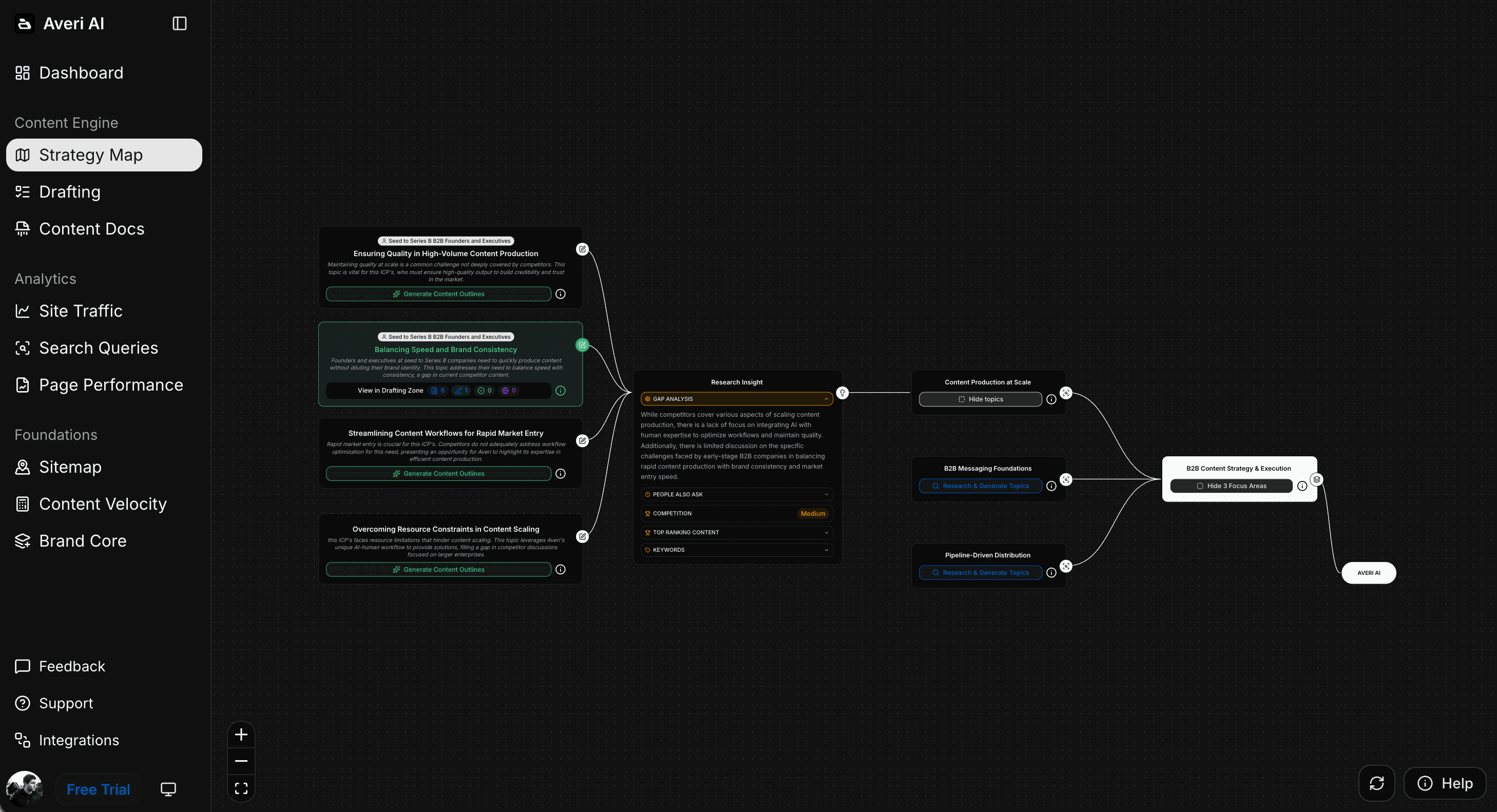
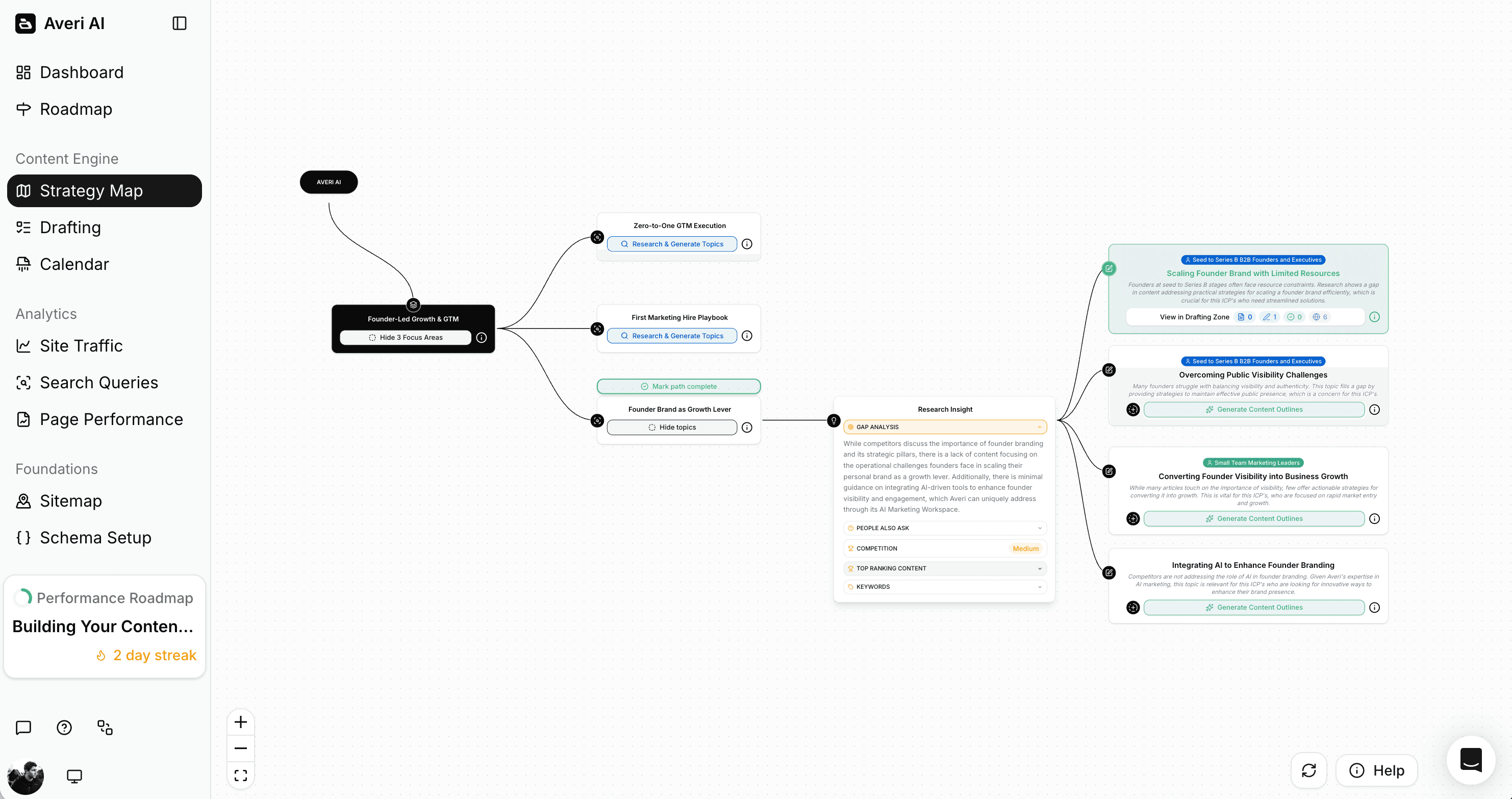
Function 2: Strategy Map. Generates a 90-day content strategy from the Brand Core, mapped to ICP segments, funnel stages, topic clusters, and AI citation opportunities.

Function 3: Content Queue. Translates the Strategy Map into a working pipeline of specific briefed pieces, refreshed continuously from analytics signals and editorial pacing.

Function 4: AI Drafting. Generates first drafts with Brand Core loaded, so the draft already reads in the brand's voice without separate "humanization" passes required.

Function 5: SEO + GEO Scoring. Scores every draft against both traditional SEO (keywords, structure, schema) and generative engine optimization (direct-answer formatting, fact density, first-person experience markers, citation worthiness).

Function 6: CMS Publishing With Analytics. Ships directly to Webflow, Framer, or WordPress with schema applied, then pulls performance data back into the Strategy Map and Content Queue.

The defining characteristic of an AI content engineer, vs. a tool that performs one of these functions, is that all six run continuously inside a single workflow.

Hand-stitching six tools requires a human content engineer to operate them. Running all six in one engine is what removes the need for that operator at seed stage.

What An AI Content Engineer Is Not

The distinction matters because every adjacent category gets called an AI content engineer in marketing material, and most of them aren't.

The distinguishing test: does the system perform the role end-to-end, or does it help someone in the role do their job?

Not a writing tool. Jasper, Copy.ai, and Writesonic are AI writing tools. They handle Function 4 (drafting) well. They do not handle Brand Core, Strategy Map, Queue, Scoring, or Publishing. A writing tool requires a human content engineer to operate it; an AI content engineer is the operator.

Not an SEO content optimizer. Surfer SEO, MarketMuse, Frase, and Clearscope are SEO content optimizers. They handle part of Function 5 (the SEO half of scoring). They do not handle Brand Core, Strategy, Queue, Drafting, GEO scoring, or Publishing. They are inputs to the role, not the role.

Not a workflow automator. AirOps is the closest competitor to an AI content engineer in market — they have built powerful infrastructure for content production. But AirOps explicitly markets itself as a "content engineering platform" that requires a content engineer to operate it. Their workflow builder is the tool the content engineer uses. The AirOps Workflow Builder is to a content engineer what Photoshop is to a graphic designer: powerful, configurable, and useless without the human in the role.

Not a humanizer. Tools like Undetectable.ai and StealthGPT reword AI output to sound less AI-generated. They handle a slice of post-draft cleanup. They do not handle any of the six core functions of the role. Humanizer tools fix surface vocabulary patterns without changing the underlying production system.

Not a content marketplace. Contently, Skyword, and ClearVoice connect businesses with freelance writers. They are sourcing platforms. They do not perform any of the engineer's functions; they sell the labor a content team would otherwise hire directly. Useful for some use cases, but a different category entirely.

Not a publishing tool. Webflow, Framer, WordPress, and Ghost are CMS platforms. They handle the publishing destination of Function 6. They do not produce, score, or strategize content. An AI content engineer publishes to a CMS; it is not the CMS.

If a vendor claims to be an AI content engineer, the operational test is straightforward: can the founder of a 5-person company sign up, complete onboarding in under an hour, and have a published piece live on their CMS by end of week, without hiring a content engineer to operate the platform?

If yes, it's an AI content engineer. If no, it's just a tool a content engineer would use.
Who Uses An AI Content Engineer

The stage-specific profile, since the role-as-software has different fit at different company stages.

Pre-seed startups ($0–$1M ARR). The AI content engineer is often the entire content marketing function. The founder is the editorial reviewer. Five hours per week of editorial time produces 2–4 published pieces per month. The Founder's Guide to Content Marketing in 5 Hours a Week covers the operational rhythm.

Seed-stage startups ($1–$5M ARR). Typically the founder plus a part-time or full-time marketer, with the AI content engineer running the production pipeline. The marketer becomes the editorial owner; the founder contributes POV pieces and stays involved in voice calibration. Publishing volume is 4–8 pieces monthly.

Early Series A startups ($3–$10M ARR). A dedicated marketer (often a marketing manager or fractional CMO) owns content, with the AI content engineer handling the systems work. Publishing volume scales to 8–15 pieces monthly. The team starts evaluating whether an upgrade to a human content engineer makes sense.

Series B and later ($10M+ ARR). The AI content engineer typically sits underneath a human content engineer who manages it, calibrates the systems, and adds the editorial judgment the software doesn't make. Publishing volume scales to 25+ pieces monthly across multiple formats. This is the stage the eventual upgrade decision lives at.

Across all stages, the common factor is that the AI content engineer handles the systems work — what would otherwise consume the first six months of a human content engineer's tenure — so the human time available goes to the editorial layer rather than the infrastructure layer.

How An AI Content Engineer Differs From A Human Content Engineer

The full comparison lives in the dedicated piece. The condensed version:

Dimension

AI Content Engineer

Human Content Engineer

Cost (Year 1)

$1,188 – $4,788

~$201,000 fully loaded

Time to first published piece

<5 days

4–16 weeks

Best fit

Pre-seed through Series A

Series B and later

Operational mode

Software runs the systems; humans run the strategy

Human runs the systems and the strategy

Scaling characteristic

Continuous output, throttled by review time

Continuous output, throttled by hours in the workday

Configurability for edge cases

Packaged workflow, opinionated

Highly configurable, infrastructure-flexible

Failure mode if mismatched to stage

Bumping against tier limits at scale (good problem)

Six months reconstructing what software does (bad problem)

The dimensions matter because they convert the choice from a values question ("am I anti-AI or anti-hire?") to a stage question ("what is the right form factor for this work at this company on this date?").
Examples Of AI Content Engineer Outputs

Five concrete artifacts an AI content engineer produces, with what each one looks like in practice.

Brand Core document. A structured profile of brand voice, ICP segments, banned terms, positioning, competitors, preferred sources, and editorial rules. Generated during onboarding from website analysis and confirmed by the user. Loaded into every subsequent draft. The first version exists within 30 minutes of signup.

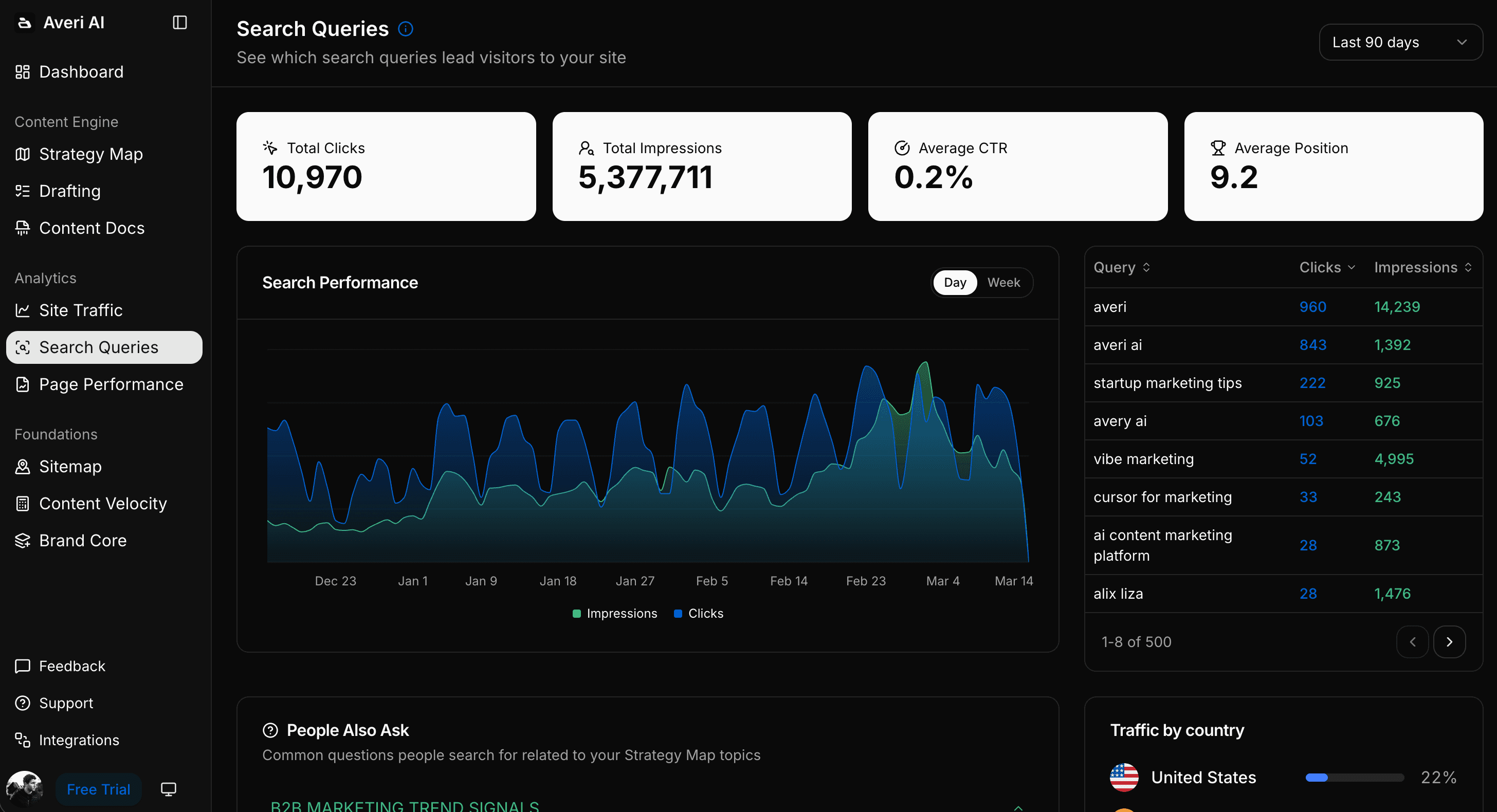
Strategy Map. A 90-day content plan mapped to ICP segments, funnel stages, and topic clusters. Includes target keywords with traffic and difficulty estimates, content type recommendations (pillar, supporting, BOFU, comparison), and AI citation opportunity scoring. Refreshed quarterly.

Content Queue. A prioritized pipeline of specific briefed pieces, each with target keyword, primary angle, internal link plan, supporting research, and forecasted SEO + GEO scores. Refreshes continuously as analytics flow in and priorities shift.

Drafted piece with brand voice loaded. A first draft that reads in the brand's voice from the opening sentence — direct-answer H2s, fact-dense first 30%, first-person experience marker hooks, 7-question FAQ self-contained for AI extraction. The draft is ready for editorial review, not ready to publish without one.

Score report per piece. A dual-layer score showing SEO completeness (keyword integration, internal linking, schema, technical SEO factors) and GEO completeness (direct-answer formatting, fact density, first-person markers, citation worthiness, schema for rich-results eligibility). Score thresholds (typically 80+) determine publish readiness. The scoring system breakdown lives here.

These five outputs replace what a human content engineer would build over the first six months of their tenure.

The pillar piece walks through why this six-month build state matters — it's the operational reason the AI version is the structurally correct choice at sub-Series-A stage.

Meet your AI content engineer in 60 minutes

Brand Core, Strategy Map, first published piece — all live on day one. Solo plan starts at $99/month. 14-day free trial, no credit card.

Start free →


Related Resources

The AI Content Engineer Cluster

Related Definitions

Operational Setup

Buy-vs-Hire Context

Meet your AI content engineer in 60 minutes. Brand Core, Strategy Map, first published piece — all live on day one. Solo plan starts at $99/month. 14-day free trial, no credit card. Start free →

FAQs

What does an AI content engineer do?

An AI content engineer performs six functions end-to-end: maintains a Brand Core capturing voice and positioning, generates a 90-day Strategy Map, manages a continuously refreshed Content Queue, drafts pieces with brand voice loaded from session one, scores every draft against SEO and GEO criteria, and publishes directly to a CMS with analytics feedback. It runs all six functions in one workflow, which is what removes the need for a human content engineer to operate the platform.

Is an AI content engineer the same as an AI writing tool?

No. AI writing tools (Jasper, Copy.ai, Writesonic) handle drafting only — one of the six functions a content engineer is responsible for. They do not maintain Brand Core, generate Strategy Maps, manage queues, score for SEO + GEO, or publish to a CMS. A writing tool requires a human content engineer to operate it. An AI content engineer is the operator.

How is an AI content engineer different from a content engineering platform like AirOps?

AirOps is a content engineering platform that requires a content engineer to operate it — they explicitly market themselves to teams hiring or training a "10x Content Engineer." Their visual workflow builder is the tool the content engineer uses. An AI content engineer is the role itself instantiated as software, with the workflow packaged so a founder or marketer can operate it without a separate technical hire.

How much does an AI content engineer cost?

AI content engineer platforms typically cost $99–$399 per month, depending on tier and team size. Averi Solo is $99/month, Team is $199/month, Agency is $399/month. The equivalent human content engineer hire runs approximately $201,000 fully loaded in Year 1 (including base salary, benefits, taxes, equipment, and supporting tool stack). The cost differential is 42x at the Agency tier and 168x at the Solo tier.

Can an AI content engineer really replace a human?

At sub-Series-A stage, yes — the software performs the same six functions a human content engineer would build during their first six months on the job. At Series B and beyond, the AI content engineer typically sits underneath a human content engineer who manages it, calibrates the systems, and adds editorial judgment the software doesn't make. The right framing is "AI content engineer first, human content engineer later when the company outgrows it" rather than "AI vs. human as competing options."

What is the difference between an AI content engineer and a content engine?

A content engine is the system. An AI content engineer is the role that operates the system. The content engine is what gets built. The AI content engineer is what builds it. In Averi specifically, the software is both — it operates as the AI content engineer that runs the content engine for you, which is the same as a human content engineer building and running a content engine, just packaged as software.

What stage of startup should use an AI content engineer?

Pre-seed through early Series A is the cleanest fit. Pre-seed startups often use an AI content engineer as their entire content marketing function. Seed-stage startups typically pair it with a part-time or full-time marketer who serves as editorial owner. Series A startups scale review time as content volume grows. By Series B, an AI content engineer typically runs underneath a human content engineer rather than instead of one.


Continue Reading

The latest handpicked blog articles

Experience The AI Content Engine

Already have an account?

Join 30,000+ Founders, Marketers & Builders

Don't Feed the Algorithm

“Top 3 tech + AI newsletters in the country. Always sharp, always actionable.”

"Genuinely my favorite newsletter in tech. No fluff, no cheesy ads, just great content."

“Clear, practical, and on-point. Helps me keep up without drowning in noise.”

User-Generated Content & Authenticity in the Age of AI

Zach Chmael

Head of Marketing

5 minutes

In This Article

An AI content engineer is software that performs the six functions of a human content engineer — instantly, at less than 1% of the cost.

Don’t Feed the Algorithm

The algorithm never sleeps, but you don’t have to feed it — Join our weekly newsletter for real insights on AI, human creativity & marketing execution.

TL;DR

  • 📖 Definition: An AI content engineer is software that performs the same six functions a human content engineer would, packaged as a platform you sign up for rather than a person you hire

  • 🔧 Six functions: Brand Core, Strategy Map, Content Queue, AI Drafting, SEO + GEO Scoring, CMS Publishing with Analytics

  • 💰 Cost: $99–$399/month, vs. ~$201,000 fully loaded Year 1 for the human version

  • 🚫 What it is not: Not a writing tool (Jasper, Copy.ai), not an SEO optimizer (Surfer, MarketMuse), not a workflow automator (AirOps requires a content engineer to operate it), not a content marketplace (Contently). The distinguishing test: does it perform the role end-to-end, or does it help someone in the role?

  • 🎯 Who uses one: Pre-seed through Series A B2B SaaS startups (1–14 person teams). Series B+ companies typically run an AI content engineer underneath a human content engineer who manages it

  • ⏱️ Time to operational: <60 minutes (vs. 4–6 weeks for a human hire to ramp)

"We built Averi around the exact workflow we've used to scale our web traffic over 6000% in the last 6 months."

founder-image
founder-image
Your content should be working harder.

Averi's content engine builds Google entity authority, drives AI citations, and scales your visibility so you can get more customers.

What Is an AI Content Engineer? The 2026 Role Defined

An AI content engineer is a software platform that performs the same six functions a human content engineer is responsible for — Brand Core maintenance, Strategy Map generation, Content Queue management, AI drafting with brand voice loaded, SEO and GEO scoring, and CMS publishing with analytics feedback — without requiring you to hire a human into the role.

It is not just a tool that helps a content engineer do their job. It is the role itself, instantiated as software, designed to ship the same six-month build state on day one.

This is the formal definition. The rest of this piece walks through where the term came from, what an AI content engineer specifically does, what it is not, and who should use one. The deeper case for why the role exists as software first lives in the pillar piece. The function-by-function breakdown lives in the 6 Functions of an AI Content Engineer guide. The decision framework for choosing between an AI content engineer and a human one lives in the comparison piece.

The Formal Definition

An AI content engineer is a software platform that performs end-to-end content production for a business. It captures and maintains brand context, generates content strategy and queues, drafts pieces in brand voice, scores them against SEO and AI search optimization criteria, publishes them to a CMS, and feeds analytics back into the strategy and queue. It does this continuously, without human operation of the system itself.

The phrase has three components worth defining individually:

AI — The system uses large language models, retrieval-augmented generation, and structured prompt engineering to perform tasks that previously required human judgment. The AI is not generic; it is calibrated against a stored Brand Core that captures voice, positioning, ICP segments, and editorial rules specific to the business.

Content — The output is written and structured marketing content. Long-form articles, FAQ blocks, landing page copy, schema markup, email sequences, social posts. Not media production, not video editing, not paid ad creative — those are adjacent disciplines with different tooling.

Engineer — The system performs the work of a content engineer, which is a defined role at companies including Wiz, Vanta, Carta, Webflow, and Klaviyo. The role manages the systems that produce content rather than producing every piece manually. An AI content engineer takes the same systems-management orientation and runs it as software instead of as a human.

The term sits inside a broader category called content engineering, which describes the practice. An AI content engineer is one of two ways to practice content engineering. A human content engineer is the other.

The 2026 Origin Of The Role

The human content engineer role emerged at enterprise stage in 2024 and 2025, primarily at post-Series-B B2B SaaS companies that had outgrown traditional content marketing structures. Ahrefs documented the role's emergence; AirOps coined the "10x Content Engineer" framing in early 2025; Jasper formalized the position in their April 29, 2026 piece naming it "the most in-demand role in marketing."

By early 2026, the six functions of the role had been documented well enough across job descriptions and case studies that the work itself became decomposable. Brand context, strategy generation, queue management, drafting, scoring, and publishing analytics were no longer crafts requiring tacit human knowledge. They had become systems, and systems are what software runs better than humans.

The AI content engineer emerged as the software-delivered version of that role.

The pattern is familiar from other operational categories. Bookkeeping became QuickBooks before most small businesses hired bookkeepers. Media planning became Google Ads Manager before most small companies hired media planners. Customer support routing became Zendesk before most companies hired support ops leads. In each case, an enterprise role got decomposed into systems, the systems became software, and the role became a hiring decision again only at scales the software couldn't reach.

Content engineering is currently in that transition. The role exists as a real hire at enterprise stage. It exists as software at sub-Series-A stage. The two coexist, and most companies will eventually run both — the AI content engineer as the substrate, the human content engineer as the strategist on top.

What An AI Content Engineer Does

The six functions, listed briefly. The full function breakdown walks through each in detail.

Function 1: Brand Core. Captures and maintains brand voice, positioning, ICP segments, competitor map, banned terms, preferred messaging anchors, case study library. Loaded into the AI as context before any draft generation.

Function 2: Strategy Map. Generates a 90-day content strategy from the Brand Core, mapped to ICP segments, funnel stages, topic clusters, and AI citation opportunities.

Function 3: Content Queue. Translates the Strategy Map into a working pipeline of specific briefed pieces, refreshed continuously from analytics signals and editorial pacing.

Function 4: AI Drafting. Generates first drafts with Brand Core loaded, so the draft already reads in the brand's voice without separate "humanization" passes required.

Function 5: SEO + GEO Scoring. Scores every draft against both traditional SEO (keywords, structure, schema) and generative engine optimization (direct-answer formatting, fact density, first-person experience markers, citation worthiness).

Function 6: CMS Publishing With Analytics. Ships directly to Webflow, Framer, or WordPress with schema applied, then pulls performance data back into the Strategy Map and Content Queue.

The defining characteristic of an AI content engineer, vs. a tool that performs one of these functions, is that all six run continuously inside a single workflow.

Hand-stitching six tools requires a human content engineer to operate them. Running all six in one engine is what removes the need for that operator at seed stage.

What An AI Content Engineer Is Not

The distinction matters because every adjacent category gets called an AI content engineer in marketing material, and most of them aren't.

The distinguishing test: does the system perform the role end-to-end, or does it help someone in the role do their job?

Not a writing tool. Jasper, Copy.ai, and Writesonic are AI writing tools. They handle Function 4 (drafting) well. They do not handle Brand Core, Strategy Map, Queue, Scoring, or Publishing. A writing tool requires a human content engineer to operate it; an AI content engineer is the operator.

Not an SEO content optimizer. Surfer SEO, MarketMuse, Frase, and Clearscope are SEO content optimizers. They handle part of Function 5 (the SEO half of scoring). They do not handle Brand Core, Strategy, Queue, Drafting, GEO scoring, or Publishing. They are inputs to the role, not the role.

Not a workflow automator. AirOps is the closest competitor to an AI content engineer in market — they have built powerful infrastructure for content production. But AirOps explicitly markets itself as a "content engineering platform" that requires a content engineer to operate it. Their workflow builder is the tool the content engineer uses. The AirOps Workflow Builder is to a content engineer what Photoshop is to a graphic designer: powerful, configurable, and useless without the human in the role.

Not a humanizer. Tools like Undetectable.ai and StealthGPT reword AI output to sound less AI-generated. They handle a slice of post-draft cleanup. They do not handle any of the six core functions of the role. Humanizer tools fix surface vocabulary patterns without changing the underlying production system.

Not a content marketplace. Contently, Skyword, and ClearVoice connect businesses with freelance writers. They are sourcing platforms. They do not perform any of the engineer's functions; they sell the labor a content team would otherwise hire directly. Useful for some use cases, but a different category entirely.

Not a publishing tool. Webflow, Framer, WordPress, and Ghost are CMS platforms. They handle the publishing destination of Function 6. They do not produce, score, or strategize content. An AI content engineer publishes to a CMS; it is not the CMS.

If a vendor claims to be an AI content engineer, the operational test is straightforward: can the founder of a 5-person company sign up, complete onboarding in under an hour, and have a published piece live on their CMS by end of week, without hiring a content engineer to operate the platform?

If yes, it's an AI content engineer. If no, it's just a tool a content engineer would use.

Who Uses An AI Content Engineer

The stage-specific profile, since the role-as-software has different fit at different company stages.

Pre-seed startups ($0–$1M ARR). The AI content engineer is often the entire content marketing function. The founder is the editorial reviewer. Five hours per week of editorial time produces 2–4 published pieces per month. The Founder's Guide to Content Marketing in 5 Hours a Week covers the operational rhythm.

Seed-stage startups ($1–$5M ARR). Typically the founder plus a part-time or full-time marketer, with the AI content engineer running the production pipeline. The marketer becomes the editorial owner; the founder contributes POV pieces and stays involved in voice calibration. Publishing volume is 4–8 pieces monthly.

Early Series A startups ($3–$10M ARR). A dedicated marketer (often a marketing manager or fractional CMO) owns content, with the AI content engineer handling the systems work. Publishing volume scales to 8–15 pieces monthly. The team starts evaluating whether an upgrade to a human content engineer makes sense.

Series B and later ($10M+ ARR). The AI content engineer typically sits underneath a human content engineer who manages it, calibrates the systems, and adds the editorial judgment the software doesn't make. Publishing volume scales to 25+ pieces monthly across multiple formats. This is the stage the eventual upgrade decision lives at.

Across all stages, the common factor is that the AI content engineer handles the systems work — what would otherwise consume the first six months of a human content engineer's tenure — so the human time available goes to the editorial layer rather than the infrastructure layer.

How An AI Content Engineer Differs From A Human Content Engineer

The full comparison lives in the dedicated piece. The condensed version:

Dimension

AI Content Engineer

Human Content Engineer

Cost (Year 1)

$1,188 – $4,788

~$201,000 fully loaded

Time to first published piece

<5 days

4–16 weeks

Best fit

Pre-seed through Series A

Series B and later

Operational mode

Software runs the systems; humans run the strategy

Human runs the systems and the strategy

Scaling characteristic

Continuous output, throttled by review time

Continuous output, throttled by hours in the workday

Configurability for edge cases

Packaged workflow, opinionated

Highly configurable, infrastructure-flexible

Failure mode if mismatched to stage

Bumping against tier limits at scale (good problem)

Six months reconstructing what software does (bad problem)

The dimensions matter because they convert the choice from a values question ("am I anti-AI or anti-hire?") to a stage question ("what is the right form factor for this work at this company on this date?").

Examples Of AI Content Engineer Outputs

Five concrete artifacts an AI content engineer produces, with what each one looks like in practice.

Brand Core document. A structured profile of brand voice, ICP segments, banned terms, positioning, competitors, preferred sources, and editorial rules. Generated during onboarding from website analysis and confirmed by the user. Loaded into every subsequent draft. The first version exists within 30 minutes of signup.

Strategy Map. A 90-day content plan mapped to ICP segments, funnel stages, and topic clusters. Includes target keywords with traffic and difficulty estimates, content type recommendations (pillar, supporting, BOFU, comparison), and AI citation opportunity scoring. Refreshed quarterly.

Content Queue. A prioritized pipeline of specific briefed pieces, each with target keyword, primary angle, internal link plan, supporting research, and forecasted SEO + GEO scores. Refreshes continuously as analytics flow in and priorities shift.

Drafted piece with brand voice loaded. A first draft that reads in the brand's voice from the opening sentence — direct-answer H2s, fact-dense first 30%, first-person experience marker hooks, 7-question FAQ self-contained for AI extraction. The draft is ready for editorial review, not ready to publish without one.

Score report per piece. A dual-layer score showing SEO completeness (keyword integration, internal linking, schema, technical SEO factors) and GEO completeness (direct-answer formatting, fact density, first-person markers, citation worthiness, schema for rich-results eligibility). Score thresholds (typically 80+) determine publish readiness. The scoring system breakdown lives here.

These five outputs replace what a human content engineer would build over the first six months of their tenure.

The pillar piece walks through why this six-month build state matters — it's the operational reason the AI version is the structurally correct choice at sub-Series-A stage.

Meet your AI content engineer in 60 minutes

Brand Core, Strategy Map, first published piece — all live on day one. Solo plan starts at $99/month. 14-day free trial, no credit card.

Start free →


Related Resources

The AI Content Engineer Cluster

Related Definitions

Operational Setup

Buy-vs-Hire Context

Meet your AI content engineer in 60 minutes. Brand Core, Strategy Map, first published piece — all live on day one. Solo plan starts at $99/month. 14-day free trial, no credit card. Start free →

Continue Reading

The latest handpicked blog articles

Join 30,000+ Founders, Marketers & Builders

Don't Feed the Algorithm

“Top 3 tech + AI newsletters in the country. Always sharp, always actionable.”

"Genuinely my favorite newsletter in tech. No fluff, no cheesy ads, just great content."

“Clear, practical, and on-point. Helps me keep up without drowning in noise.”

User-Generated Content & Authenticity in the Age of AI

Zach Chmael

Head of Marketing

5 minutes

In This Article

An AI content engineer is software that performs the six functions of a human content engineer — instantly, at less than 1% of the cost.

Don’t Feed the Algorithm

The algorithm never sleeps, but you don’t have to feed it — Join our weekly newsletter for real insights on AI, human creativity & marketing execution.

Trusted by 1,000+ teams

★★★★★ 4.9/5

Startups use Averi to build
content engines that rank.

What Is an AI Content Engineer? The 2026 Role Defined

An AI content engineer is a software platform that performs the same six functions a human content engineer is responsible for — Brand Core maintenance, Strategy Map generation, Content Queue management, AI drafting with brand voice loaded, SEO and GEO scoring, and CMS publishing with analytics feedback — without requiring you to hire a human into the role.

It is not just a tool that helps a content engineer do their job. It is the role itself, instantiated as software, designed to ship the same six-month build state on day one.

This is the formal definition. The rest of this piece walks through where the term came from, what an AI content engineer specifically does, what it is not, and who should use one. The deeper case for why the role exists as software first lives in the pillar piece. The function-by-function breakdown lives in the 6 Functions of an AI Content Engineer guide. The decision framework for choosing between an AI content engineer and a human one lives in the comparison piece.

The Formal Definition

An AI content engineer is a software platform that performs end-to-end content production for a business. It captures and maintains brand context, generates content strategy and queues, drafts pieces in brand voice, scores them against SEO and AI search optimization criteria, publishes them to a CMS, and feeds analytics back into the strategy and queue. It does this continuously, without human operation of the system itself.

The phrase has three components worth defining individually:

AI — The system uses large language models, retrieval-augmented generation, and structured prompt engineering to perform tasks that previously required human judgment. The AI is not generic; it is calibrated against a stored Brand Core that captures voice, positioning, ICP segments, and editorial rules specific to the business.

Content — The output is written and structured marketing content. Long-form articles, FAQ blocks, landing page copy, schema markup, email sequences, social posts. Not media production, not video editing, not paid ad creative — those are adjacent disciplines with different tooling.

Engineer — The system performs the work of a content engineer, which is a defined role at companies including Wiz, Vanta, Carta, Webflow, and Klaviyo. The role manages the systems that produce content rather than producing every piece manually. An AI content engineer takes the same systems-management orientation and runs it as software instead of as a human.

The term sits inside a broader category called content engineering, which describes the practice. An AI content engineer is one of two ways to practice content engineering. A human content engineer is the other.

The 2026 Origin Of The Role

The human content engineer role emerged at enterprise stage in 2024 and 2025, primarily at post-Series-B B2B SaaS companies that had outgrown traditional content marketing structures. Ahrefs documented the role's emergence; AirOps coined the "10x Content Engineer" framing in early 2025; Jasper formalized the position in their April 29, 2026 piece naming it "the most in-demand role in marketing."

By early 2026, the six functions of the role had been documented well enough across job descriptions and case studies that the work itself became decomposable. Brand context, strategy generation, queue management, drafting, scoring, and publishing analytics were no longer crafts requiring tacit human knowledge. They had become systems, and systems are what software runs better than humans.

The AI content engineer emerged as the software-delivered version of that role.

The pattern is familiar from other operational categories. Bookkeeping became QuickBooks before most small businesses hired bookkeepers. Media planning became Google Ads Manager before most small companies hired media planners. Customer support routing became Zendesk before most companies hired support ops leads. In each case, an enterprise role got decomposed into systems, the systems became software, and the role became a hiring decision again only at scales the software couldn't reach.

Content engineering is currently in that transition. The role exists as a real hire at enterprise stage. It exists as software at sub-Series-A stage. The two coexist, and most companies will eventually run both — the AI content engineer as the substrate, the human content engineer as the strategist on top.

What An AI Content Engineer Does

The six functions, listed briefly. The full function breakdown walks through each in detail.

Function 1: Brand Core. Captures and maintains brand voice, positioning, ICP segments, competitor map, banned terms, preferred messaging anchors, case study library. Loaded into the AI as context before any draft generation.

Function 2: Strategy Map. Generates a 90-day content strategy from the Brand Core, mapped to ICP segments, funnel stages, topic clusters, and AI citation opportunities.

Function 3: Content Queue. Translates the Strategy Map into a working pipeline of specific briefed pieces, refreshed continuously from analytics signals and editorial pacing.

Function 4: AI Drafting. Generates first drafts with Brand Core loaded, so the draft already reads in the brand's voice without separate "humanization" passes required.

Function 5: SEO + GEO Scoring. Scores every draft against both traditional SEO (keywords, structure, schema) and generative engine optimization (direct-answer formatting, fact density, first-person experience markers, citation worthiness).

Function 6: CMS Publishing With Analytics. Ships directly to Webflow, Framer, or WordPress with schema applied, then pulls performance data back into the Strategy Map and Content Queue.

The defining characteristic of an AI content engineer, vs. a tool that performs one of these functions, is that all six run continuously inside a single workflow.

Hand-stitching six tools requires a human content engineer to operate them. Running all six in one engine is what removes the need for that operator at seed stage.

What An AI Content Engineer Is Not

The distinction matters because every adjacent category gets called an AI content engineer in marketing material, and most of them aren't.

The distinguishing test: does the system perform the role end-to-end, or does it help someone in the role do their job?

Not a writing tool. Jasper, Copy.ai, and Writesonic are AI writing tools. They handle Function 4 (drafting) well. They do not handle Brand Core, Strategy Map, Queue, Scoring, or Publishing. A writing tool requires a human content engineer to operate it; an AI content engineer is the operator.

Not an SEO content optimizer. Surfer SEO, MarketMuse, Frase, and Clearscope are SEO content optimizers. They handle part of Function 5 (the SEO half of scoring). They do not handle Brand Core, Strategy, Queue, Drafting, GEO scoring, or Publishing. They are inputs to the role, not the role.

Not a workflow automator. AirOps is the closest competitor to an AI content engineer in market — they have built powerful infrastructure for content production. But AirOps explicitly markets itself as a "content engineering platform" that requires a content engineer to operate it. Their workflow builder is the tool the content engineer uses. The AirOps Workflow Builder is to a content engineer what Photoshop is to a graphic designer: powerful, configurable, and useless without the human in the role.

Not a humanizer. Tools like Undetectable.ai and StealthGPT reword AI output to sound less AI-generated. They handle a slice of post-draft cleanup. They do not handle any of the six core functions of the role. Humanizer tools fix surface vocabulary patterns without changing the underlying production system.

Not a content marketplace. Contently, Skyword, and ClearVoice connect businesses with freelance writers. They are sourcing platforms. They do not perform any of the engineer's functions; they sell the labor a content team would otherwise hire directly. Useful for some use cases, but a different category entirely.

Not a publishing tool. Webflow, Framer, WordPress, and Ghost are CMS platforms. They handle the publishing destination of Function 6. They do not produce, score, or strategize content. An AI content engineer publishes to a CMS; it is not the CMS.

If a vendor claims to be an AI content engineer, the operational test is straightforward: can the founder of a 5-person company sign up, complete onboarding in under an hour, and have a published piece live on their CMS by end of week, without hiring a content engineer to operate the platform?

If yes, it's an AI content engineer. If no, it's just a tool a content engineer would use.

Who Uses An AI Content Engineer

The stage-specific profile, since the role-as-software has different fit at different company stages.

Pre-seed startups ($0–$1M ARR). The AI content engineer is often the entire content marketing function. The founder is the editorial reviewer. Five hours per week of editorial time produces 2–4 published pieces per month. The Founder's Guide to Content Marketing in 5 Hours a Week covers the operational rhythm.

Seed-stage startups ($1–$5M ARR). Typically the founder plus a part-time or full-time marketer, with the AI content engineer running the production pipeline. The marketer becomes the editorial owner; the founder contributes POV pieces and stays involved in voice calibration. Publishing volume is 4–8 pieces monthly.

Early Series A startups ($3–$10M ARR). A dedicated marketer (often a marketing manager or fractional CMO) owns content, with the AI content engineer handling the systems work. Publishing volume scales to 8–15 pieces monthly. The team starts evaluating whether an upgrade to a human content engineer makes sense.

Series B and later ($10M+ ARR). The AI content engineer typically sits underneath a human content engineer who manages it, calibrates the systems, and adds the editorial judgment the software doesn't make. Publishing volume scales to 25+ pieces monthly across multiple formats. This is the stage the eventual upgrade decision lives at.

Across all stages, the common factor is that the AI content engineer handles the systems work — what would otherwise consume the first six months of a human content engineer's tenure — so the human time available goes to the editorial layer rather than the infrastructure layer.

How An AI Content Engineer Differs From A Human Content Engineer

The full comparison lives in the dedicated piece. The condensed version:

Dimension

AI Content Engineer

Human Content Engineer

Cost (Year 1)

$1,188 – $4,788

~$201,000 fully loaded

Time to first published piece

<5 days

4–16 weeks

Best fit

Pre-seed through Series A

Series B and later

Operational mode

Software runs the systems; humans run the strategy

Human runs the systems and the strategy

Scaling characteristic

Continuous output, throttled by review time

Continuous output, throttled by hours in the workday

Configurability for edge cases

Packaged workflow, opinionated

Highly configurable, infrastructure-flexible

Failure mode if mismatched to stage

Bumping against tier limits at scale (good problem)

Six months reconstructing what software does (bad problem)

The dimensions matter because they convert the choice from a values question ("am I anti-AI or anti-hire?") to a stage question ("what is the right form factor for this work at this company on this date?").

Examples Of AI Content Engineer Outputs

Five concrete artifacts an AI content engineer produces, with what each one looks like in practice.

Brand Core document. A structured profile of brand voice, ICP segments, banned terms, positioning, competitors, preferred sources, and editorial rules. Generated during onboarding from website analysis and confirmed by the user. Loaded into every subsequent draft. The first version exists within 30 minutes of signup.

Strategy Map. A 90-day content plan mapped to ICP segments, funnel stages, and topic clusters. Includes target keywords with traffic and difficulty estimates, content type recommendations (pillar, supporting, BOFU, comparison), and AI citation opportunity scoring. Refreshed quarterly.

Content Queue. A prioritized pipeline of specific briefed pieces, each with target keyword, primary angle, internal link plan, supporting research, and forecasted SEO + GEO scores. Refreshes continuously as analytics flow in and priorities shift.

Drafted piece with brand voice loaded. A first draft that reads in the brand's voice from the opening sentence — direct-answer H2s, fact-dense first 30%, first-person experience marker hooks, 7-question FAQ self-contained for AI extraction. The draft is ready for editorial review, not ready to publish without one.

Score report per piece. A dual-layer score showing SEO completeness (keyword integration, internal linking, schema, technical SEO factors) and GEO completeness (direct-answer formatting, fact density, first-person markers, citation worthiness, schema for rich-results eligibility). Score thresholds (typically 80+) determine publish readiness. The scoring system breakdown lives here.

These five outputs replace what a human content engineer would build over the first six months of their tenure.

The pillar piece walks through why this six-month build state matters — it's the operational reason the AI version is the structurally correct choice at sub-Series-A stage.

Meet your AI content engineer in 60 minutes

Brand Core, Strategy Map, first published piece — all live on day one. Solo plan starts at $99/month. 14-day free trial, no credit card.

Start free →


Related Resources

The AI Content Engineer Cluster

Related Definitions

Operational Setup

Buy-vs-Hire Context

Meet your AI content engineer in 60 minutes. Brand Core, Strategy Map, first published piece — all live on day one. Solo plan starts at $99/month. 14-day free trial, no credit card. Start free →

"We built Averi around the exact workflow we've used to scale our web traffic over 6000% in the last 6 months."

founder-image
founder-image
Your content should be working harder.

Averi's content engine builds Google entity authority, drives AI citations, and scales your visibility so you can get more customers.

FAQs

Pre-seed through early Series A is the cleanest fit. Pre-seed startups often use an AI content engineer as their entire content marketing function. Seed-stage startups typically pair it with a part-time or full-time marketer who serves as editorial owner. Series A startups scale review time as content volume grows. By Series B, an AI content engineer typically runs underneath a human content engineer rather than instead of one.

What stage of startup should use an AI content engineer?

A content engine is the system. An AI content engineer is the role that operates the system. The content engine is what gets built. The AI content engineer is what builds it. In Averi specifically, the software is both — it operates as the AI content engineer that runs the content engine for you, which is the same as a human content engineer building and running a content engine, just packaged as software.

What is the difference between an AI content engineer and a content engine?

At sub-Series-A stage, yes — the software performs the same six functions a human content engineer would build during their first six months on the job. At Series B and beyond, the AI content engineer typically sits underneath a human content engineer who manages it, calibrates the systems, and adds editorial judgment the software doesn't make. The right framing is "AI content engineer first, human content engineer later when the company outgrows it" rather than "AI vs. human as competing options."

Can an AI content engineer really replace a human?

AI content engineer platforms typically cost $99–$399 per month, depending on tier and team size. Averi Solo is $99/month, Team is $199/month, Agency is $399/month. The equivalent human content engineer hire runs approximately $201,000 fully loaded in Year 1 (including base salary, benefits, taxes, equipment, and supporting tool stack). The cost differential is 42x at the Agency tier and 168x at the Solo tier.

How much does an AI content engineer cost?

AirOps is a content engineering platform that requires a content engineer to operate it — they explicitly market themselves to teams hiring or training a "10x Content Engineer." Their visual workflow builder is the tool the content engineer uses. An AI content engineer is the role itself instantiated as software, with the workflow packaged so a founder or marketer can operate it without a separate technical hire.

How is an AI content engineer different from a content engineering platform like AirOps?

No. AI writing tools (Jasper, Copy.ai, Writesonic) handle drafting only — one of the six functions a content engineer is responsible for. They do not maintain Brand Core, generate Strategy Maps, manage queues, score for SEO + GEO, or publish to a CMS. A writing tool requires a human content engineer to operate it. An AI content engineer is the operator.

Is an AI content engineer the same as an AI writing tool?

An AI content engineer performs six functions end-to-end: maintains a Brand Core capturing voice and positioning, generates a 90-day Strategy Map, manages a continuously refreshed Content Queue, drafts pieces with brand voice loaded from session one, scores every draft against SEO and GEO criteria, and publishes directly to a CMS with analytics feedback. It runs all six functions in one workflow, which is what removes the need for a human content engineer to operate the platform.

What does an AI content engineer do?

FAQs

How long does it take to see SEO results for B2B SaaS?

Expect 7 months to break-even on average, with meaningful traffic improvements typically appearing within 3-6 months. Link building results appear within 1-6 months. The key is consistency—companies that stop and start lose ground to those who execute continuously.

Is AI-generated content actually good for SEO?

62% of marketers report higher SERP rankings for AI-generated content—but only when properly edited and enhanced with human expertise. Pure AI content without human refinement often lacks the originality and depth that both readers and algorithms prefer.

Is AI-generated content actually good for SEO?

62% of marketers report higher SERP rankings for AI-generated content—but only when properly edited and enhanced with human expertise. Pure AI content without human refinement often lacks the originality and depth that both readers and algorithms prefer.

Is AI-generated content actually good for SEO?

62% of marketers report higher SERP rankings for AI-generated content—but only when properly edited and enhanced with human expertise. Pure AI content without human refinement often lacks the originality and depth that both readers and algorithms prefer.

Is AI-generated content actually good for SEO?

62% of marketers report higher SERP rankings for AI-generated content—but only when properly edited and enhanced with human expertise. Pure AI content without human refinement often lacks the originality and depth that both readers and algorithms prefer.

Is AI-generated content actually good for SEO?

62% of marketers report higher SERP rankings for AI-generated content—but only when properly edited and enhanced with human expertise. Pure AI content without human refinement often lacks the originality and depth that both readers and algorithms prefer.

Is AI-generated content actually good for SEO?

62% of marketers report higher SERP rankings for AI-generated content—but only when properly edited and enhanced with human expertise. Pure AI content without human refinement often lacks the originality and depth that both readers and algorithms prefer.

Is AI-generated content actually good for SEO?

62% of marketers report higher SERP rankings for AI-generated content—but only when properly edited and enhanced with human expertise. Pure AI content without human refinement often lacks the originality and depth that both readers and algorithms prefer.

TL;DR

  • 📖 Definition: An AI content engineer is software that performs the same six functions a human content engineer would, packaged as a platform you sign up for rather than a person you hire

  • 🔧 Six functions: Brand Core, Strategy Map, Content Queue, AI Drafting, SEO + GEO Scoring, CMS Publishing with Analytics

  • 💰 Cost: $99–$399/month, vs. ~$201,000 fully loaded Year 1 for the human version

  • 🚫 What it is not: Not a writing tool (Jasper, Copy.ai), not an SEO optimizer (Surfer, MarketMuse), not a workflow automator (AirOps requires a content engineer to operate it), not a content marketplace (Contently). The distinguishing test: does it perform the role end-to-end, or does it help someone in the role?

  • 🎯 Who uses one: Pre-seed through Series A B2B SaaS startups (1–14 person teams). Series B+ companies typically run an AI content engineer underneath a human content engineer who manages it

  • ⏱️ Time to operational: <60 minutes (vs. 4–6 weeks for a human hire to ramp)

Continue Reading

The latest handpicked blog articles

Join 30,000+ Founders, Marketers & Builders

Don't Feed the Algorithm

“Top 3 tech + AI newsletters in the country. Always sharp, always actionable.”

"Genuinely my favorite newsletter in tech. No fluff, no cheesy ads, just great content."

“Clear, practical, and on-point. Helps me keep up without drowning in noise.”

Maybe later