beehiiv + SEO: How to Grow Your Newsletter With Organic Search Traffic

Zach Chmael
Head of Marketing
6 minutes

In This Article
There's one subscriber acquisition channel most beehiiv creators haven't touched. It doesn't have a ceiling. It compounds instead of plateauing. And once it starts working, it keeps working whether you're actively promoting or not. That channel is organic search.
Updated
Trusted by 1,000+ teams
Startups use Averi to build
content engines that rank.
TL;DR
📉 Referral programs, Boosts, and social media all have growth ceilings. Referrals cost $0.17/sub but plateau as your list grows. Paid channels stop when spend stops.
🔍 Organic search drives 53% of all website traffic and is the only newsletter growth channel that compounds over time
📈 SEO delivers 748% ROI with a 7–9 month break-even. Compound blog posts generate 38% of traffic from 10% of posts
⚙️ beehiiv has built-in SEO tools (meta tags, URL slugs, sitemaps, breadcrumbs). For serious growth, pair with an external blog on your own domain.
🎯 Target keywords in 3 tiers: direct subscriber intent, topic-aligned informational, and broad authority builders
🤖 Structure every post for Google + AI citations: question-based headers, 40–60 word answer blocks, hyperlinked stats, and FAQ sections
📊 Measure new subscribers from organic (primary), not just traffic or rankings. Only 29% of marketers measure content ROI effectively
🔧 Averi runs the SEO engine so newsletter creators can focus on writing

Zach Chmael
CMO, Averi
"We built Averi around the exact workflow we've used to scale our web traffic over 6000% in the last 6 months."
Your content should be working harder.
Averi's content engine builds Google entity authority, drives AI citations, and scales your visibility so you can get more customers.
beehiiv + SEO: How to Grow Your Newsletter With Organic Search Traffic
You've done everything right. Referral program is live. Boosts are running. You're active in the beehiiv Recommendation Network. Cross-promotions lined up with aligned newsletters. Social media posts every day.
Your subscriber count grew fast at first. Now it's not.
This is the plateau. Every newsletter creator hits it. The growth channels that took you from 0 to 5,000 subscribers start flattening somewhere between 5,000 and 25,000.
Referral programs boost growth by about 17%, which is meaningful at 500 subscribers and barely noticeable at 15,000. Boosts and recommendations cost money or require reciprocity. Social media algorithms change every quarter. Each of these channels has a ceiling, and at some point you're pressing against all of them at once.
There's one subscriber acquisition channel most beehiiv creators haven't touched.
It doesn't have a ceiling. It compounds instead of plateauing. And once it starts working, it keeps working whether you're actively promoting or not.
That channel is organic search.
SEO delivers 748% ROI for B2B companies with a break-even period of 7–9 months. Organic search drives 53% of all website traffic. Businesses with blogs generate 67% more leads than those without. And unlike every other growth channel you're currently running, the cost per subscriber drops over time instead of rising.
This is the guide to using SEO to break through the beehiiv growth plateau.
See what your Content ROI could be this year
Why Your Current Growth Channels Have a Ceiling
Every newsletter growth channel beehiiv offers works. That's not the problem. The problem is that each one has inherent constraints that get tighter the larger you grow.
Referral Programs
Referrals cost an average of $0.17 per subscriber and convert at about 32%. Excellent unit economics.
But referral programs are bounded by your existing subscriber base. You can only get referrals from people who already subscribe. As your list grows, you need proportionally more referrals to maintain the same growth rate. The denominator keeps getting bigger. The numerator doesn't scale linearly.
Most newsletter operators see referral program effectiveness peak between months 3–6 after launch, then gradually decline.
Your most enthusiastic subscribers refer early. The rest don't refer at all.
Boosts and Recommendations
beehiiv's Recommendation Network includes 30,000+ active publishers and has generated millions of new subscribers. Newsletters that participate grow 2.75x faster. The channel works.
But as The Pour Over noted in beehiiv's State of Newsletters report: their highest quality growth channels were referrals and other newsletters, but they're harder to scale.
Boosts are paid acquisition. You're buying subscribers from other newsletters.
The math is straightforward: spend stops, growth stops. And as more newsletters compete for the same Boost inventory, costs rise over time. Customer acquisition costs have surged 222% over eight years across digital channels. Boosts aren't immune to that trend.
Social Media
Social media is rented land. You don't control the algorithm, the reach, or the rules. When platforms change policies, newsletter traffic drops overnight.
The beehiiv State of Newsletters report highlighted this repeatedly: X/Twitter policy changes, TikTok disruptions, feed algorithm shifts. Building your growth strategy on platforms you don't own is fine as a supplement. It's dangerous as a foundation.
The Common Thread
Every one of these channels is linear. You put in effort or money, you get results. You stop, the results stop. Growth is directly proportional to ongoing input. The moment you take a week off, your growth rate drops to zero.
Organic search doesn't work this way.
Compound blog posts generate 38% of all blog traffic from just 10% of total posts. Content you publish in April drives subscribers in November without any additional effort. SEO is the only newsletter growth channel where past work makes future work more effective.
How SEO Actually Grows a beehiiv Newsletter
The mechanics are simple. The execution is where most creators stall.
The Loop
You publish a blog post optimized for a keyword your target audience searches
Google indexes and ranks that post over the following weeks/months
Searchers find your post, read it, and see your beehiiv subscribe form
A percentage subscribe. They're now in your newsletter audience
Your newsletter nurtures them. Some become paid subscribers, ad revenue, or customers
Meanwhile, the blog post keeps ranking and driving new subscribers every day
That loop runs for every blog post you publish. The average page in Google's top 10 is over 2 years old. A post you write today can drive subscribers for years. Stack 20, 40, 60 posts, and you have an acquisition engine that produces subscribers at scale without ongoing spend.
The Math
Say you publish one optimized blog post per week. After 3–6 months, each post averages 300 organic visits per month. With a 3% conversion rate to newsletter signup, each post delivers 9 new subscribers per month.
After 6 months, you have 24 posts live. That's 216 new subscribers per month from organic search alone. Zero ad spend. Zero daily social posting. Zero Boost budget.
After 12 months, 48 posts. Your older content has climbed to higher positions, now averaging 500 visits per month. Your newer posts are ramping up. Total: 500–1,000 new subscribers per month from SEO. That's the compounding effect in action.
Averi grew its own web traffic 6,000% in 10 months using this exact model.
The subscribers keep coming whether you're writing your newsletter, on vacation, or sleeping.
See how much you could save by using Averi for your content
SEO for beehiiv: The Technical Setup
Before you write a word of content, your technical foundation needs to be solid. beehiiv has built-in SEO features.
You should use them. You should also know their limits.
What beehiiv Gives You Out of the Box
beehiiv's platform includes SEO-first architecture with customizable meta titles, meta descriptions, URL slugs, breadcrumbs, and auto-updating sitemaps. You can connect Google Search Console directly to monitor performance.
One creator indexed 20 newsletter pages and generated 9,000 impressions and 82 clicks within three months. That's from content they were already writing. The only change was flipping the indexing switch.
Here's what to configure immediately:
Enable search indexing in your beehiiv website settings. This tells Google it's allowed to crawl and rank your content.
Customize your URL slugs. beehiiv lets you edit URL slugs in the post editor. Use keyword-rich, descriptive URLs. yourdomain.beehiiv.com/best-ai-newsletters-2026 performs better than yourdomain.beehiiv.com/post-12345.
Write unique meta titles and descriptions for every post. This is the text Google shows in search results. Include your target keyword. Keep titles under 60 characters. Keep descriptions under 155 characters. Make them compelling enough to click.
Enable breadcrumbs. They improve crawlability and strengthen your internal link architecture.
Connect Google Search Console. Submit your sitemap (found at yourdomain.beehiiv.com/sitemap.xml). Monitor which queries drive impressions. Track average positions. This data tells you what's working and what to double down on.
When to Go Beyond beehiiv's Built-In SEO
beehiiv's SEO tools cover the fundamentals. For creators serious about making organic search a primary growth channel, an external blog on your own domain (WordPress, Webflow, Framer) gives you more control.
The advantages of your own domain:
Full control over site speed optimization (40–53% of users leave slow sites)
Custom schema markup for FAQ, HowTo, and Article structured data
Advanced internal linking architecture across hundreds of pages
Ability to build topic clusters with full control over page hierarchy
Independent domain authority that accumulates over time
Direct CMS publishing through platforms like Averi that handle the SEO optimization automatically
If you go this route, disable indexing on your beehiiv website to prevent duplicate content issues. Google penalizes sites that publish the same content on multiple domains.
The SEO Content Strategy for Newsletter Growth
Generic SEO advice won't work here. You're not trying to rank for vanity keywords. You're trying to rank for keywords that convert searchers into beehiiv subscribers. That's a narrower, more valuable goal.
Target Keywords With Subscriber Intent
Not all traffic converts.
"What is a newsletter" might get 10,000 searches per month, but someone asking that question isn't ready to subscribe to yours.
"Best AI newsletters to subscribe to" has subscriber intent baked right in.
Sort your keyword targets into three tiers:
Tier 1: Direct subscriber intent. Keywords like "best [niche] newsletters," "top [topic] email lists," "[competitor newsletter] alternatives." These people are actively looking for newsletters. Conversion rates to email signup are the highest here.
Tier 2: Topic-aligned informational intent. Keywords your target audience searches when they need answers your newsletter provides. If you run a marketing newsletter, that's "how to improve email open rates" or "content marketing strategy for startups." These people aren't searching for a newsletter, but they're the right audience.
Tier 3: Broad topical authority. Keywords that build your credibility on the subject your newsletter covers. These drive traffic and authority but convert at lower rates. Still worth publishing because they make your Tier 1 and Tier 2 content rank higher.
Structure Content for Both Google and AI Citations
In 2026, SEO means optimizing for two surfaces simultaneously. Google still matters. But LLM visitors convert 4.4x better than traditional organic visitors, and AI-referred sessions grew 527% year-over-year. Getting cited by ChatGPT and Perplexity is now a legitimate subscriber acquisition channel.
The content that ranks on Google and the content that gets cited by AI overlap almost completely. Here's the structure that works for both:
Clear H2 headers phrased as questions. Google uses these for Featured Snippets. AI systems use them to identify answerable questions.
40–60 word direct answers immediately after each header. These standalone answer blocks are what Google pulls into AI Overviews and what LLMs cite. Pages with FAQ sections earn 4.3x more Featured Snippets.
Hyperlinked statistics from authoritative sources. Both Google's E-E-A-T framework and AI citation systems reward content that backs claims with credible data. Aim for 15–25 hyperlinked stats per long-form article.
FAQ sections at the end of every post. Seven questions minimum. Each answer self-contained. This is the highest-value real estate for GEO optimization.
Internal links throughout. Internal linking upgrades drive ranking improvements within 2–8 weeks. Every post should link to 3–5 other posts on your blog.
The Content Calendar That Compounds
Consistency is the mechanism. Companies publishing weekly see up to 200% more organic traffic than sporadic publishers. Here's a quarterly plan:
Month 1: Publish 4 posts. Two targeting Tier 2 keywords (topic-aligned informational), one targeting a Tier 1 keyword (direct subscriber intent), one targeting a Tier 3 keyword (broad authority). Connect Google Search Console. Start tracking.
Month 2: Publish 4 more posts. Review Search Console data from Month 1 posts. Identify which keywords are gaining impressions. Begin building internal links between your growing library.
Month 3: Publish 4 more posts. Refresh Month 1 content based on ranking data (add sections, update stats, improve answer blocks). Updating existing content can boost organic traffic by 106%. By now you should have 12 posts forming 2–3 topic clusters.
Month 4+: The compounding starts. Your domain authority is building. Older posts climb in rankings. Newer posts rank faster because of the authority your existing content has built. Each post adds another drip of daily subscribers to your beehiiv newsletter.
Converting Organic Traffic to beehiiv Subscribers
Getting organic traffic is half the equation. Converting that traffic into newsletter subscribers is where most creators lose the plot.
The Subscribe Form Strategy
Don't put one subscribe form at the bottom of the page and call it done. 70% of consumers prefer learning about companies through articles rather than ads. They found your article because they wanted information. Give them the information. Then give them a reason to get more.
Place beehiiv subscribe forms in three positions:
After the introduction (lines 3–5 of visible content). At this point the reader has confirmed the article is relevant. A CTA here catches the "I'm interested but won't read the whole thing" segment.
Mid-article contextual callout. Between two major sections, insert a callout that references the newsletter specifically: "I break down tools like these every Tuesday morning. Subscribe and get the analysis before anyone else." Contextual CTAs outperform generic "subscribe" buttons because they sell the value, not the action.
End of article. For readers who consumed the full piece. This audience is the most engaged and most likely to convert. Make the end-of-article CTA different from the others. Reference what they just read: "If this breakdown was useful, you'll get one like it in your inbox every week."
Match the CTA to the Content
A blog post about "best AI writing tools in 2026" should have a CTA that says: "I test and review new AI tools every week in my newsletter. Subscribe for the write-ups that don't make it to the blog."
A blog post about "email marketing best practices" should say: "This is the kind of tactical breakdown I send every Wednesday. 5-minute read. No fluff."
Specificity converts. "Subscribe to my newsletter" doesn't.
The person reading your blog post has a specific interest. Your CTA should mirror that interest exactly.
The Post-Subscribe Experience
What happens after someone subscribes through your blog is as important as the conversion itself. Set up a beehiiv automation sequence that delivers your 3 best-performing newsletter editions immediately. This does two things:
It proves your newsletter is worth opening (reducing early churn)
It drives the new subscriber back to your blog through links in those editions
Newsletter-driven returning traffic converts with lead rates 15–35% higher than first-time visits. Subscribers you acquire through SEO who then engage with your newsletter who then return to your blog are your most valuable audience segment. Build the sequence that creates them.
Measuring SEO Performance for Newsletter Growth
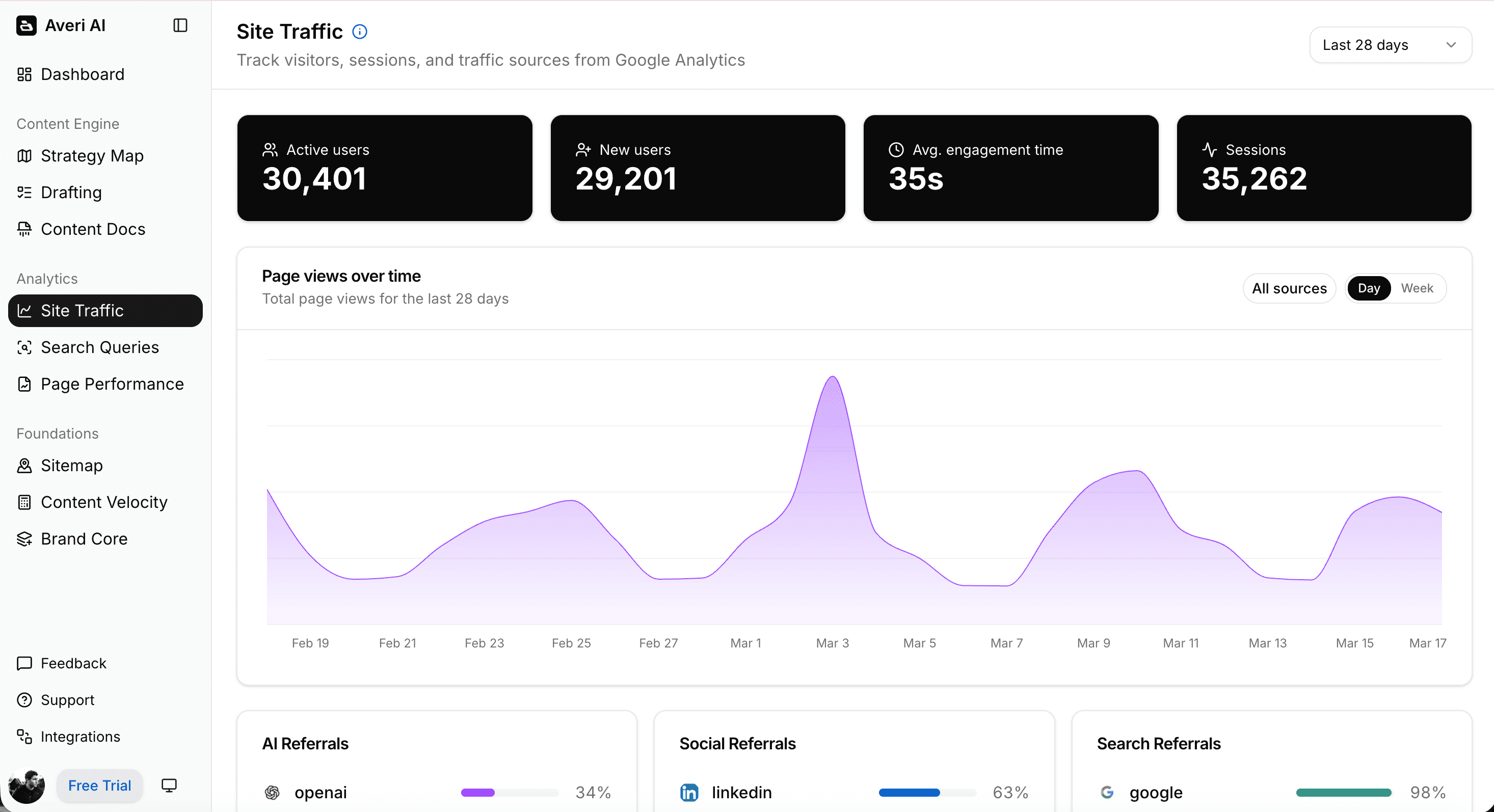
Most SEO metrics are vanity metrics for newsletter operators. Rankings, impressions, and organic traffic all matter, but only as leading indicators of the metric that actually counts: new subscribers from organic search.
The Metrics That Matter
New email subscribers from organic search (primary). Track this by adding UTM parameters to your blog CTAs or by comparing subscriber growth rate against organic traffic trends. If you're using beehiiv forms embedded on an external blog, the analytics should show where subscriptions originate.
Organic traffic growth (leading indicator). Rising organic traffic means your content is ranking. If traffic grows but subscriber conversions don't, the problem is your CTA strategy, not your SEO strategy.
Keyword rankings in target tiers. Track your Tier 1, 2, and 3 keywords separately. Tier 1 keyword improvements have the most direct impact on subscriber growth.
Content refresh impact. When you update an existing post, track the change in organic traffic and subscriber conversions for that specific page. Content refreshes lower the cost per incremental lead by 20–50% versus new publishing. This tells you when refreshing old content outperforms creating new content.
Subscriber quality from organic. Compare open rates and click rates of subscribers acquired through organic search versus other channels. If organic subscribers engage at comparable or higher rates, you have confirmation that SEO is delivering quality, not just volume.
The Dashboard
You need three tools talking to each other:
Google Search Console for keyword data, impressions, and click-through rates
Google Analytics (or Fathom, if privacy-first) for on-site behavior and conversion tracking
beehiiv analytics for subscriber engagement, open rates, and revenue attribution
Only 29% of marketers effectively measure content marketing ROI. The ones who do have a permanent advantage, because they know exactly which content to create more of and which to stop investing in.
The Acceleration Option
Everything above works. It also takes significant time to execute manually, especially if you're already producing a weekly newsletter.
Between keyword research, content strategy, writing 1,500–2,500 word blog posts, optimizing for SEO and GEO, managing technical setup, and tracking analytics, you're looking at 15–20 hours per week on top of your newsletter production.
That's where a content engine changes the math.
Averi handles the entire SEO workflow for newsletter creators: keyword research, content queue generation, AI-assisted drafting with human editing, dual SEO + GEO optimization, CMS publishing, and performance analytics.
The time commitment drops to about 2 hours per week of reviewing and approving content.
You keep writing your newsletter. Averi builds the SEO engine that feeds it.
The subscribers compound while you do the work only you can do.
Beehiiv Resources
How to Repurpose Your beehiiv Newsletter Into Blog Content That Ranks on Google
The Content Marketing Stack for beehiiv Creators: What You Actually Need Beyond Email
Why Your beehiiv Subscriber Growth Stalled (And How Content Marketing Restarts It)
beehiiv Has Monetization. You Need Discovery. Here's How to Build Both.
Related Resources
SEO for Startups: How to Rank Higher Without a Big Budget in 2026
AI-Powered SEO for B2B SaaS: Getting to Page 1 Without an Agency
Beyond Google: How to Get Your Startup Cited by ChatGPT, Perplexity, and AI Search
Google AI Overviews Optimization: How to Get Featured in 2026
Schema Markup for AI Citations: The Technical Implementation Guide
Content Marketing on a Startup Budget: High-ROI Tactics for Lean Teams
Content Velocity for Startups: How Much Content to Publish (And How Fast)
Programmatic SEO for B2B SaaS Startups: The Complete 2026 Playbook
FAQs
How do I set up SEO on my beehiiv newsletter?
Enable search engine indexing in your beehiiv website settings, then customize meta titles, meta descriptions, and URL slugs for each post. Connect Google Search Console and submit your sitemap at yourdomain.beehiiv.com/sitemap.xml to track which keywords drive impressions and clicks. Enable breadcrumbs for better crawlability. beehiiv's SEO-first architecture includes auto-updating sitemaps and customizable domains. One creator saw 9,000 impressions from just 20 indexed pages within three months of enabling these features.
Does beehiiv have built-in SEO features?
Yes. beehiiv provides customizable meta titles and descriptions, editable URL slugs, auto-updating sitemaps, breadcrumb navigation, and Google Search Console integration. The platform was designed with SEO at its core and includes a website builder with web publishing capabilities. These features cover the fundamentals for getting your newsletter content indexed and ranked. For more advanced SEO control over page structure, schema markup, and internal linking, creators often pair beehiiv with an external blog on their own domain.
How long does it take for SEO to grow a beehiiv newsletter?
Expect 3–6 months before posts reach stable rankings in Google, and 6–12 months before organic search becomes a meaningful subscriber acquisition channel. New blog content commonly takes 3–6 months to stabilize in competitive niches. The payoff is worth the wait: unlike referral programs or Boosts that plateau, SEO compounds. After 12 months of consistent publishing, organic search can deliver 500–1,000+ new subscribers monthly without ongoing ad spend. The average top-10 page is over 2 years old, meaning posts you write now are long-term assets.
What keywords should I target to grow my beehiiv newsletter with SEO?
Focus on three tiers. Tier 1 targets direct subscriber intent: "best [niche] newsletters," "top [topic] email lists," and "[competitor newsletter] alternatives." Tier 2 targets topic-aligned informational queries your audience searches, like "how to improve email open rates" if you run a marketing newsletter. Tier 3 builds broad topical authority. Use tools like Ahrefs or SEMrush to find keywords with 200+ monthly search volume and difficulty below 40 for newer domains. Your beehiiv analytics reveal which topics resonate most, which makes excellent keyword research starting points.
Should I use beehiiv's web publishing or a separate blog for SEO?
Both work, but they serve different growth ceilings. beehiiv's built-in web publishing is ideal for creators who want to start capturing organic traffic without additional infrastructure. Enable indexing, optimize your meta tags, and your existing newsletter content becomes searchable. An external blog on your own domain gives you full control over site speed, schema markup, topic cluster architecture, and advanced internal linking strategies. If organic search is meant to become a primary growth channel, your own domain builds independent authority that compounds faster.
How do I convert organic search traffic into beehiiv subscribers?
Place subscribe forms in three positions: after the introduction, at a natural mid-article break, and at the end. Make each CTA specific to the content. "Subscribe to my newsletter" converts worse than "I break down tools like these every Tuesday. Get the analysis first." Set up an automated beehiiv welcome sequence that delivers your 3 best-performing editions immediately after signup. Newsletter-driven returning traffic converts 15–35% higher than first-time visits, so the post-subscribe experience matters as much as the conversion itself. Track subscriber quality by comparing open rates of organic-acquired subs against other channels.
How does Averi help beehiiv creators with SEO?
Averi is the AI content engine that handles the SEO workflow newsletter creators don't have time to run manually: keyword research, content strategy, topic clustering, AI-assisted drafting, dual SEO and GEO optimization, direct CMS publishing, and performance analytics. Instead of 15–20 hours weekly on content marketing, Averi compresses the workflow to about 2 hours of review and approval. Your newsletter stays in your hands. The SEO engine that feeds it runs through Averi.