Why Your beehiiv Subscriber Growth Stalled (And How Content Marketing Restarts It)

Zach Chmael

Head of Marketing

6 minutes

In This Article

Here's why every growth channel you're using has a ceiling, and why content marketing is the only channel that breaks through it.

Updated

Trusted by 1,000+ teams

★★★★★ 4.9/5

Startups use Averi to build
content engines that rank.

TL;DR

📉 Growth plateaus happen because referrals, recommendations, social, and Boosts all have built-in ceilings: linear input, linear output, diminishing returns over time

📊 55% of newsletter creators believe revenue will become harder by 2030. The window to add compounding channels is narrowing.

🔄 Content marketing compounds instead of plateauing. 38% of blog traffic comes from 10% of posts. Past work makes future work more effective.

📈 The growth math: 48 blog posts over 12 months can drive 300–500+ organic subscribers/month with zero ad spend

🔍 Organic search drives 53% of all web traffic. SEO delivers 748% ROI. Most beehiiv creators haven't touched this channel.

⚡ 5-step restart: audit existing topics → build a blog → publish consistently → connect the flywheel → measure separately

🔧 Averi runs the content engine in ~2 hours/week so you can focus on writing the newsletter

Zach Chmael

CMO, Averi

"We built Averi around the exact workflow we've used to scale our web traffic over 6000% in the last 6 months."

Your content should be working harder.

Averi's content engine builds Google entity authority, drives AI citations, and scales your visibility so you can get more customers.

Why Your beehiiv Subscriber Growth Stalled (And How Content Marketing Restarts It)

The chart looked great for a while. You launched on beehiiv. Turned on the referral program. Got into the Recommendation Network. Posted on LinkedIn and Twitter every day. Ran some Boosts.

Subscribers climbed fast. Maybe you hit 2,000 in the first few months. Maybe 5,000. Maybe 10,000.

Then the line went flat.

You're still doing everything that worked before. Posting the same amount. Running the same growth tactics. But the subscriber count barely moves. Some weeks it goes backward (unsubscribes outpacing new signups). You're working harder for less return, and nothing you tweak seems to fix it.

This is the growth plateau.

It's not a beehiiv problem. It's a channel saturation problem. And 55% of newsletter creators believe earning newsletter revenue will become significantly harder by 2030, which means the window to fix it is narrowing.

Here's why every growth channel you're using has a ceiling, and why content marketing is the only channel that breaks through it.

The Anatomy of a Newsletter Growth Plateau

Growth plateaus don't happen because you got worse at marketing. They happen because the channels you relied on have diminishing returns baked into their mechanics.

Understanding why each channel stalls is the first step toward fixing the problem.

Your Referral Program Peaked

Referral programs boost newsletter growth by about 35% and cost an average of $0.17 per subscriber. Those numbers are real, and they probably matched your experience for the first few months.

Here's the math problem.

Referrals come from existing subscribers. If you have 1,000 subscribers and 5% refer someone, that's 50 new subscribers. At 5,000 subscribers, the same 5% gives you 250.

Sounds like it scales. It doesn't, because the 5% doesn't hold.

Your most enthusiastic subscribers refer early. They share with friends in the first week. By month three, your active referral pool has shrunk to a fraction of your list.

The remaining subscribers aren't anti-referral. They're just not wired to actively promote things they read. The referral rate decays over time, even as the denominator grows.

The result: a channel that delivered 200 subscribers per month in Month 2 delivers 40 per month by Month 8.

beehiiv's referral tools are some of the best in the industry. The channel still has a natural ceiling tied to your existing audience size and engagement decay.

Recommendations Saturated Your Niche

beehiiv's Recommendation Network has 30,000+ active publishers and generates millions of new subscribers. Participating newsletters grow 2.75x faster. That's a powerful channel when you first enter the network.

The saturation problem is niche-specific.

If you write about AI productivity, there are a finite number of AI newsletters in the Recommendation Network whose audiences overlap with yours.

Once you've been recommended by the top 20 aligned newsletters, the next 20 are less aligned. The subscribers they send you are less qualified. Open rates on recommendation-sourced subscribers tend to be lower. Some unsubscribe quickly because the fit wasn't strong.

The Pour Over described this exact dynamic in beehiiv's State of Newsletters report: their highest quality growth channels were referrals and other newsletters, but they're harder to scale.

Social Media Hit Diminishing Returns

52% of newsletter creators use LinkedIn and 50% use Facebook as primary distribution channels. Social media is the default growth tactic for newsletter creators. And it works, until it doesn't.

Social algorithms reward novelty.

Your first posts about your newsletter get high reach because they're new content from your account on a new topic. Over time, the algorithm learns that your audience engaged with that type of post, and it shows similar content more often.

Sounds good.

The problem is that reach eventually normalizes. The people in your network who were going to subscribe from social have already subscribed. You're now posting to the same people who've already decided.

Platform risk compounds this.

When X/Twitter changed its algorithm in 2025, newsletter traffic from the platform dropped for thousands of creators. beehiiv's State of Newsletters report noted that building on rented platforms means you can lose access overnight. One policy change can erase months of social-driven growth.

Boosts Cost More Over Time

Boosts are paid subscriber acquisition. You pay other newsletters to recommend yours. The unit economics start strong. But as more newsletters compete for the same Boost inventory, costs rise. Customer acquisition costs across digital channels have surged 222% over eight years. Boosts aren't immune.

More importantly, Boosts are linear. Spend money, get subscribers. Stop spending, stop getting subscribers. There's no compounding effect. The subscribers you acquired through Boosts last month don't help you acquire subscribers this month (unless they refer, which loops back to the referral ceiling).

The Common Pattern

Every channel you're using shares one characteristic: the output is proportional to the ongoing input. More effort or more money produces more subscribers. Less produces less. Zero produces zero. Growth is a function of continuous activity.

That's not a bad trait in a growth channel. It's a limiting one.

It means you can never take your foot off the gas. It means your growth rate has a ceiling determined by how much effort or money you can sustain. And it means that if every beehiiv creator in your niche is running the same playbook, the channels get more crowded and less effective for everyone.
Why Content Marketing Doesn't Plateau

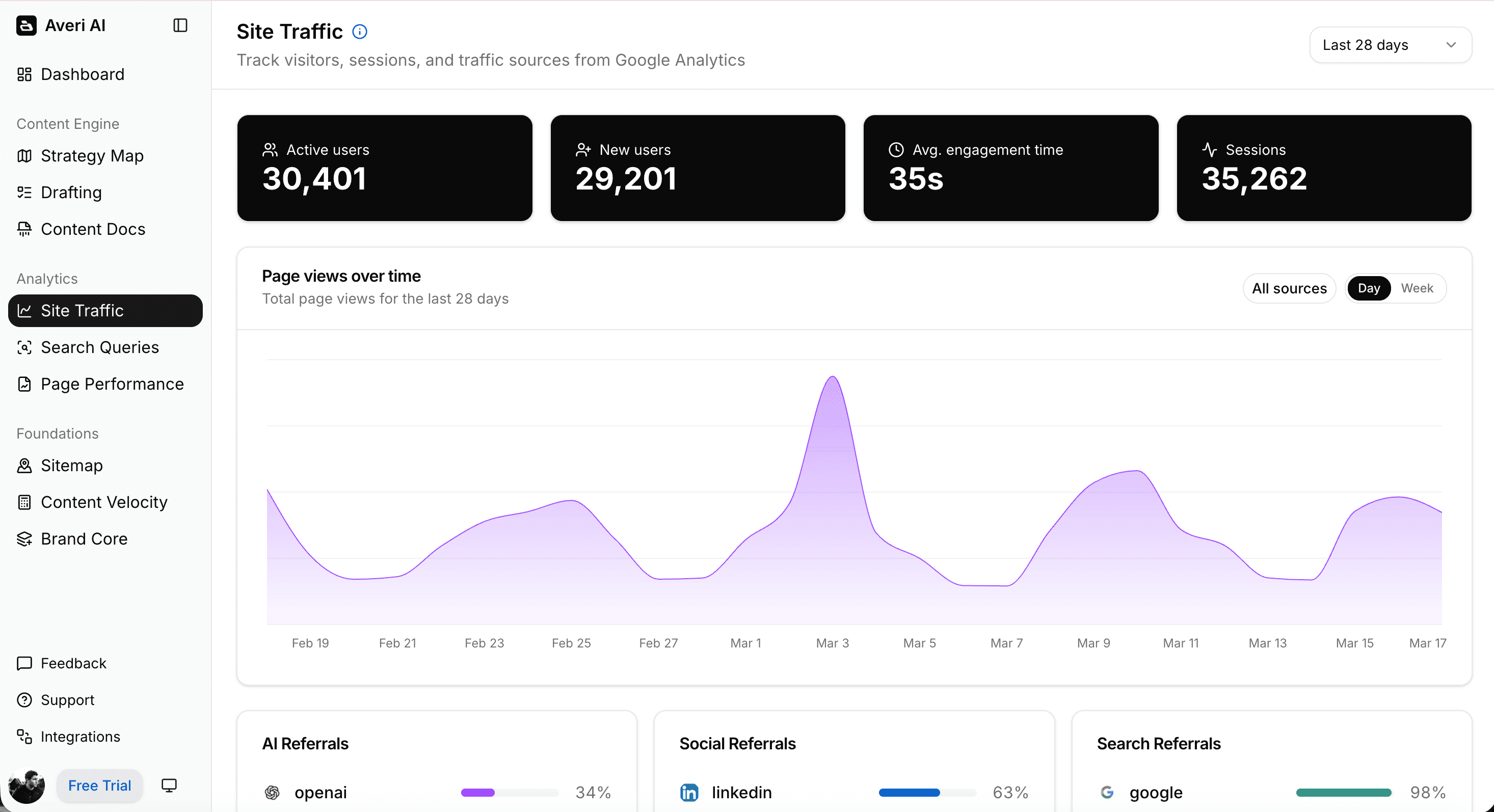
Content marketing works on a different curve. Instead of linear returns on continuous effort, it produces compounding returns on past effort.

The work you do in April produces results in April and also in May, June, October, and the following April.

Compound blog posts generate 38% of all blog traffic despite making up just 10% of total posts.

That's the compounding effect in action. A small percentage of your content library drives a disproportionate share of results because those articles keep ranking and driving traffic long after you published them.

Here's how that changes the growth math:

Month 1: You publish 4 blog posts. Google hasn't ranked them yet. Organic subscribers from content marketing: roughly zero.

Month 3: Your earliest posts start appearing in search results. Positions 15–30. Trickle of traffic. Maybe 5–10 organic subscribers.

Month 6: Older posts have climbed to positions 5–12. Newer posts are entering the rankings. Monthly organic subscribers: 50–100. Your referral program is still doing its thing. Social is still doing its thing. Content marketing is additive.

Month 9: Your content library is 36 posts. The best ones are on page 1. Posts over 1,890 words earn 77% more backlinks, which boost your domain authority, which helps every other post rank higher. Monthly organic subscribers: 150–300.

Month 12: 48 posts. Compounding is visible in the data. Traffic grows even during weeks you don't publish. Monthly organic subscribers: 300–500+. This channel is now your largest and most reliable growth source. And you haven't spent a dollar on ads to make it happen.

Averi grew organic traffic 6,000% in 10 months using this exact model.

That's not an anomaly. It's what compounding content does when you stick with it.

The key difference: content marketing doesn't plateau because each new piece of content adds permanent capacity to the system.

Your 48th blog post benefits from the domain authority your first 47 posts built. It ranks faster. It drives traffic sooner. The curve steepens over time instead of flattening.

The Channel You Haven't Tried

Organic search drives 53% of all website traffic. SEO delivers 748% ROI for B2B companies. Businesses with blogs generate 67% more leads per month. Content marketing generates $3 for every $1 invested, compared to $1.80 for paid advertising.

These stats aren't new.

They get cited in every content marketing article on the internet. And yet the average beehiiv creator has no organic search strategy. The HubSpot State of Newsletters report found that 42% rank direct word-of-mouth recommendations as their most effective growth strategy. Only a fraction cited organic search.

This is the opportunity.

The biggest growth channel in digital marketing is functionally untapped by most newsletter creators. They're all fighting over the same referral, recommendation, and social channels while organic search sits open.

See what your Content ROI could be this year

How to Restart Growth With Content Marketing

You don't need to abandon what's working. Referrals, recommendations, social, and Boosts still contribute. Content marketing adds a new curve on top of the existing ones.

Step 1: Audit Your Existing Content

You've written hundreds of newsletter editions. Some of those topics have search demand. Run your best-performing topics through a keyword research tool (Ahrefs, SEMrush, or Google's Keyword Planner). Look for keywords with 200+ monthly search volume and difficulty scores your domain can compete for.

Identify 10–15 topics that overlap between "what my audience cares about" and "what people search for on Google."

Those topics are your content marketing starting points.

Step 2: Build a Blog on Your Own Domain

beehiiv's web publishing works for basic indexing. But companies with active blogs have 434% more indexed pages and 97% more inbound links. A dedicated blog on your own domain (WordPress, Webflow, Framer) builds authority under your brand and gives you full control over the technical SEO elements that determine rankings.

Embed beehiiv subscribe forms on every blog page. Connect Google Search Console. Submit your sitemap. The infrastructure takes an afternoon to set up. The returns last for years.

Step 3: Publish Consistently

Companies publishing weekly see up to 200% more organic traffic than sporadic publishers. The specific cadence matters less than the consistency. One article per week is ideal. Two per month is viable. One exceptional piece per month works if you can't do more.

Every blog post should:

Step 4: Connect the Flywheel

Your blog drives organic traffic. Some of those visitors subscribe to your beehiiv newsletter. Your newsletter engagement data tells you which topics resonate most. You create more blog content around those topics. The flywheel spins.

Newsletter-driven returning traffic converts with lead rates 15–35% higher than first-time visits.

Subscribers who discovered you through search, engaged with your newsletter, and returned to your blog are your most valuable audience segment.

Content marketing creates that segment. beehiiv's growth tools can't.

Step 5: Measure What Matters

Track organic subscribers separately from other channels. Compare:

  • Organic subscriber growth rate vs. referral/recommendation/social growth rate

  • Open rates and click rates of organic-acquired subscribers vs. other sources

  • Cost per subscriber across channels (organic trends toward zero over time)

Only 29% of marketers effectively measure content marketing ROI. Be in the 29%. The data will confirm that content marketing is your highest-ROI growth channel within 6–9 months.

The Acceleration Path

Building a content marketing engine manually alongside a newsletter production schedule is doable. It's also time-intensive.

The average blog post takes 4 hours and 10 minutes to write. On top of 2–3 newsletter editions per week, that's a significant workload.

Averi compresses the content marketing workflow into about 2 hours of review and approval per week.

The platform handles keyword research, content strategy, AI-assisted drafting, SEO + GEO optimization, CMS publishing, and analytics. You provide the editorial judgment. Averi does the production work.

Your newsletter stays in your hands. The content engine that feeds it runs through Averi. The growth curve that stalled restarts with a channel that doesn't plateau.

See how much you could save with Averi for content marketing


Beehiiv Resources

Related Resources

FAQs

Why did my beehiiv newsletter stop growing?

Most newsletter growth plateaus result from channel saturation, not poor content quality. Referral programs peak as your most engaged subscribers exhaust their networks. Recommendations saturate within your niche as aligned newsletters run out. Social media reach normalizes once your existing network has already decided whether to subscribe. Boosts scale linearly with spend but stop when spend stops. Each channel has built-in ceiling mechanics. The fix isn't optimizing harder within those channels. It's adding a new channel with a different growth curve. Content marketing compounds instead of plateauing because each new piece of content adds permanent subscriber acquisition capacity.

How does content marketing grow a beehiiv newsletter?

Content marketing drives newsletter growth by creating blog content that ranks in search engines and converts organic visitors into subscribers. You publish keyword-optimized articles on a blog with embedded beehiiv subscribe forms. Organic search drives 53% of all website traffic, reaching people who care about your topic but haven't found your newsletter through social or referrals. Unlike those channels, organic traffic compounds: a blog post published in April can drive subscribers in October and beyond. After 12 months of consistent publishing, content marketing typically becomes a newsletter's largest and most cost-effective growth channel.

How long does it take for content marketing to impact newsletter growth?

Expect 3–6 months before blog content reaches stable search rankings, and 6–12 months before organic search becomes a meaningful subscriber acquisition channel. The compounding curve steepens after month 6 as domain authority builds and older posts climb to higher positions. New blog content typically takes 3–6 months to reach stable rankings, with the payback window spanning 6–18 months. Content marketing rewards patience that referral programs and social media don't require, but it delivers returns those channels can't match long-term. SEO delivers 748% ROI because the investment keeps paying back.

Can I grow my beehiiv newsletter without paid ads?

Yes. Content marketing costs 62% less than traditional marketing while generating 3x more leads. A blog optimized for organic search drives subscribers without ongoing ad spend. The initial investment is time (creating and publishing content), but the cost per subscriber trends toward zero as your content library compounds. Combine organic search with beehiiv's free growth tools (referral program, Recommendation Network) and you have multiple subscriber acquisition channels running without paid advertising. Businesses that blog generate 67% more leads than those that don't. The blog is the missing free growth channel.

What type of content grows a newsletter fastest?

The highest-converting content for newsletter subscriber acquisition targets keywords with subscriber intent: "best [niche] newsletters," "top [topic] email lists," and comparison posts in your topic area. Beyond those, detailed how-to guides and data-backed analyses in your niche attract the right audience and demonstrate the kind of insight your newsletter delivers weekly. Content over 3,000 words earns 3x more traffic and 3.5x more backlinks than shorter posts. Every piece should include beehiiv subscribe CTAs with specific value propositions tied to the content topic, not generic "subscribe" buttons.

Should I stop using beehiiv's growth tools and switch to content marketing?

No. Content marketing adds a new growth curve on top of your existing channels. Keep your referral program running. Stay in the Recommendation Network. Continue posting on social. These channels still contribute incremental subscribers. Content marketing adds a channel that doesn't compete with the others for the same audience. Referrals reach your subscribers' networks. Recommendations reach other newsletters' audiences. Social reaches your followers. Organic search reaches everyone else. It's additive. The total growth rate is the sum of all channels.

How does Averi help restart beehiiv newsletter growth?

Averi is the AI content engine that builds the organic search channel most beehiiv creators haven't activated. It handles keyword research, content strategy, AI-assisted drafting, dual SEO + GEO optimization, CMS publishing, and analytics in one workflow. Instead of spending 15–20 hours weekly building content marketing infrastructure from scratch, Averi compresses it to about 2 hours of review and approval. Your beehiiv newsletter keeps running. Averi builds the compounding growth channel that feeds it new subscribers every day.


Continue Reading

The latest handpicked blog articles

Experience The AI Content Engine

Already have an account?

Join 30,000+ Founders, Marketers & Builders

Don't Feed the Algorithm

“Top 3 tech + AI newsletters in the country. Always sharp, always actionable.”

"Genuinely my favorite newsletter in tech. No fluff, no cheesy ads, just great content."

“Clear, practical, and on-point. Helps me keep up without drowning in noise.”

User-Generated Content & Authenticity in the Age of AI

Zach Chmael

Head of Marketing

6 minutes

In This Article

Here's why every growth channel you're using has a ceiling, and why content marketing is the only channel that breaks through it.

Don’t Feed the Algorithm

The algorithm never sleeps, but you don’t have to feed it — Join our weekly newsletter for real insights on AI, human creativity & marketing execution.

TL;DR

📉 Growth plateaus happen because referrals, recommendations, social, and Boosts all have built-in ceilings: linear input, linear output, diminishing returns over time

📊 55% of newsletter creators believe revenue will become harder by 2030. The window to add compounding channels is narrowing.

🔄 Content marketing compounds instead of plateauing. 38% of blog traffic comes from 10% of posts. Past work makes future work more effective.

📈 The growth math: 48 blog posts over 12 months can drive 300–500+ organic subscribers/month with zero ad spend

🔍 Organic search drives 53% of all web traffic. SEO delivers 748% ROI. Most beehiiv creators haven't touched this channel.

⚡ 5-step restart: audit existing topics → build a blog → publish consistently → connect the flywheel → measure separately

🔧 Averi runs the content engine in ~2 hours/week so you can focus on writing the newsletter

"We built Averi around the exact workflow we've used to scale our web traffic over 6000% in the last 6 months."

founder-image
founder-image
Your content should be working harder.

Averi's content engine builds Google entity authority, drives AI citations, and scales your visibility so you can get more customers.

Why Your beehiiv Subscriber Growth Stalled (And How Content Marketing Restarts It)

The chart looked great for a while. You launched on beehiiv. Turned on the referral program. Got into the Recommendation Network. Posted on LinkedIn and Twitter every day. Ran some Boosts.

Subscribers climbed fast. Maybe you hit 2,000 in the first few months. Maybe 5,000. Maybe 10,000.

Then the line went flat.

You're still doing everything that worked before. Posting the same amount. Running the same growth tactics. But the subscriber count barely moves. Some weeks it goes backward (unsubscribes outpacing new signups). You're working harder for less return, and nothing you tweak seems to fix it.

This is the growth plateau.

It's not a beehiiv problem. It's a channel saturation problem. And 55% of newsletter creators believe earning newsletter revenue will become significantly harder by 2030, which means the window to fix it is narrowing.

Here's why every growth channel you're using has a ceiling, and why content marketing is the only channel that breaks through it.

The Anatomy of a Newsletter Growth Plateau

Growth plateaus don't happen because you got worse at marketing. They happen because the channels you relied on have diminishing returns baked into their mechanics.

Understanding why each channel stalls is the first step toward fixing the problem.

Your Referral Program Peaked

Referral programs boost newsletter growth by about 35% and cost an average of $0.17 per subscriber. Those numbers are real, and they probably matched your experience for the first few months.

Here's the math problem.

Referrals come from existing subscribers. If you have 1,000 subscribers and 5% refer someone, that's 50 new subscribers. At 5,000 subscribers, the same 5% gives you 250.

Sounds like it scales. It doesn't, because the 5% doesn't hold.

Your most enthusiastic subscribers refer early. They share with friends in the first week. By month three, your active referral pool has shrunk to a fraction of your list.

The remaining subscribers aren't anti-referral. They're just not wired to actively promote things they read. The referral rate decays over time, even as the denominator grows.

The result: a channel that delivered 200 subscribers per month in Month 2 delivers 40 per month by Month 8.

beehiiv's referral tools are some of the best in the industry. The channel still has a natural ceiling tied to your existing audience size and engagement decay.

Recommendations Saturated Your Niche

beehiiv's Recommendation Network has 30,000+ active publishers and generates millions of new subscribers. Participating newsletters grow 2.75x faster. That's a powerful channel when you first enter the network.

The saturation problem is niche-specific.

If you write about AI productivity, there are a finite number of AI newsletters in the Recommendation Network whose audiences overlap with yours.

Once you've been recommended by the top 20 aligned newsletters, the next 20 are less aligned. The subscribers they send you are less qualified. Open rates on recommendation-sourced subscribers tend to be lower. Some unsubscribe quickly because the fit wasn't strong.

The Pour Over described this exact dynamic in beehiiv's State of Newsletters report: their highest quality growth channels were referrals and other newsletters, but they're harder to scale.

Social Media Hit Diminishing Returns

52% of newsletter creators use LinkedIn and 50% use Facebook as primary distribution channels. Social media is the default growth tactic for newsletter creators. And it works, until it doesn't.

Social algorithms reward novelty.

Your first posts about your newsletter get high reach because they're new content from your account on a new topic. Over time, the algorithm learns that your audience engaged with that type of post, and it shows similar content more often.

Sounds good.

The problem is that reach eventually normalizes. The people in your network who were going to subscribe from social have already subscribed. You're now posting to the same people who've already decided.

Platform risk compounds this.

When X/Twitter changed its algorithm in 2025, newsletter traffic from the platform dropped for thousands of creators. beehiiv's State of Newsletters report noted that building on rented platforms means you can lose access overnight. One policy change can erase months of social-driven growth.

Boosts Cost More Over Time

Boosts are paid subscriber acquisition. You pay other newsletters to recommend yours. The unit economics start strong. But as more newsletters compete for the same Boost inventory, costs rise. Customer acquisition costs across digital channels have surged 222% over eight years. Boosts aren't immune.

More importantly, Boosts are linear. Spend money, get subscribers. Stop spending, stop getting subscribers. There's no compounding effect. The subscribers you acquired through Boosts last month don't help you acquire subscribers this month (unless they refer, which loops back to the referral ceiling).

The Common Pattern

Every channel you're using shares one characteristic: the output is proportional to the ongoing input. More effort or more money produces more subscribers. Less produces less. Zero produces zero. Growth is a function of continuous activity.

That's not a bad trait in a growth channel. It's a limiting one.

It means you can never take your foot off the gas. It means your growth rate has a ceiling determined by how much effort or money you can sustain. And it means that if every beehiiv creator in your niche is running the same playbook, the channels get more crowded and less effective for everyone.

Why Content Marketing Doesn't Plateau

Content marketing works on a different curve. Instead of linear returns on continuous effort, it produces compounding returns on past effort.

The work you do in April produces results in April and also in May, June, October, and the following April.

Compound blog posts generate 38% of all blog traffic despite making up just 10% of total posts.

That's the compounding effect in action. A small percentage of your content library drives a disproportionate share of results because those articles keep ranking and driving traffic long after you published them.

Here's how that changes the growth math:

Month 1: You publish 4 blog posts. Google hasn't ranked them yet. Organic subscribers from content marketing: roughly zero.

Month 3: Your earliest posts start appearing in search results. Positions 15–30. Trickle of traffic. Maybe 5–10 organic subscribers.

Month 6: Older posts have climbed to positions 5–12. Newer posts are entering the rankings. Monthly organic subscribers: 50–100. Your referral program is still doing its thing. Social is still doing its thing. Content marketing is additive.

Month 9: Your content library is 36 posts. The best ones are on page 1. Posts over 1,890 words earn 77% more backlinks, which boost your domain authority, which helps every other post rank higher. Monthly organic subscribers: 150–300.

Month 12: 48 posts. Compounding is visible in the data. Traffic grows even during weeks you don't publish. Monthly organic subscribers: 300–500+. This channel is now your largest and most reliable growth source. And you haven't spent a dollar on ads to make it happen.

Averi grew organic traffic 6,000% in 10 months using this exact model.

That's not an anomaly. It's what compounding content does when you stick with it.

The key difference: content marketing doesn't plateau because each new piece of content adds permanent capacity to the system.

Your 48th blog post benefits from the domain authority your first 47 posts built. It ranks faster. It drives traffic sooner. The curve steepens over time instead of flattening.

The Channel You Haven't Tried

Organic search drives 53% of all website traffic. SEO delivers 748% ROI for B2B companies. Businesses with blogs generate 67% more leads per month. Content marketing generates $3 for every $1 invested, compared to $1.80 for paid advertising.

These stats aren't new.

They get cited in every content marketing article on the internet. And yet the average beehiiv creator has no organic search strategy. The HubSpot State of Newsletters report found that 42% rank direct word-of-mouth recommendations as their most effective growth strategy. Only a fraction cited organic search.

This is the opportunity.

The biggest growth channel in digital marketing is functionally untapped by most newsletter creators. They're all fighting over the same referral, recommendation, and social channels while organic search sits open.

See what your Content ROI could be this year

How to Restart Growth With Content Marketing

You don't need to abandon what's working. Referrals, recommendations, social, and Boosts still contribute. Content marketing adds a new curve on top of the existing ones.

Step 1: Audit Your Existing Content

You've written hundreds of newsletter editions. Some of those topics have search demand. Run your best-performing topics through a keyword research tool (Ahrefs, SEMrush, or Google's Keyword Planner). Look for keywords with 200+ monthly search volume and difficulty scores your domain can compete for.

Identify 10–15 topics that overlap between "what my audience cares about" and "what people search for on Google."

Those topics are your content marketing starting points.

Step 2: Build a Blog on Your Own Domain

beehiiv's web publishing works for basic indexing. But companies with active blogs have 434% more indexed pages and 97% more inbound links. A dedicated blog on your own domain (WordPress, Webflow, Framer) builds authority under your brand and gives you full control over the technical SEO elements that determine rankings.

Embed beehiiv subscribe forms on every blog page. Connect Google Search Console. Submit your sitemap. The infrastructure takes an afternoon to set up. The returns last for years.

Step 3: Publish Consistently

Companies publishing weekly see up to 200% more organic traffic than sporadic publishers. The specific cadence matters less than the consistency. One article per week is ideal. Two per month is viable. One exceptional piece per month works if you can't do more.

Every blog post should:

Step 4: Connect the Flywheel

Your blog drives organic traffic. Some of those visitors subscribe to your beehiiv newsletter. Your newsletter engagement data tells you which topics resonate most. You create more blog content around those topics. The flywheel spins.

Newsletter-driven returning traffic converts with lead rates 15–35% higher than first-time visits.

Subscribers who discovered you through search, engaged with your newsletter, and returned to your blog are your most valuable audience segment.

Content marketing creates that segment. beehiiv's growth tools can't.

Step 5: Measure What Matters

Track organic subscribers separately from other channels. Compare:

  • Organic subscriber growth rate vs. referral/recommendation/social growth rate

  • Open rates and click rates of organic-acquired subscribers vs. other sources

  • Cost per subscriber across channels (organic trends toward zero over time)

Only 29% of marketers effectively measure content marketing ROI. Be in the 29%. The data will confirm that content marketing is your highest-ROI growth channel within 6–9 months.

The Acceleration Path

Building a content marketing engine manually alongside a newsletter production schedule is doable. It's also time-intensive.

The average blog post takes 4 hours and 10 minutes to write. On top of 2–3 newsletter editions per week, that's a significant workload.

Averi compresses the content marketing workflow into about 2 hours of review and approval per week.

The platform handles keyword research, content strategy, AI-assisted drafting, SEO + GEO optimization, CMS publishing, and analytics. You provide the editorial judgment. Averi does the production work.

Your newsletter stays in your hands. The content engine that feeds it runs through Averi. The growth curve that stalled restarts with a channel that doesn't plateau.

See how much you could save with Averi for content marketing


Beehiiv Resources

Related Resources

Continue Reading

The latest handpicked blog articles

Join 30,000+ Founders, Marketers & Builders

Don't Feed the Algorithm

“Top 3 tech + AI newsletters in the country. Always sharp, always actionable.”

"Genuinely my favorite newsletter in tech. No fluff, no cheesy ads, just great content."

“Clear, practical, and on-point. Helps me keep up without drowning in noise.”

User-Generated Content & Authenticity in the Age of AI

Zach Chmael

Head of Marketing

6 minutes

In This Article

Here's why every growth channel you're using has a ceiling, and why content marketing is the only channel that breaks through it.

Don’t Feed the Algorithm

The algorithm never sleeps, but you don’t have to feed it — Join our weekly newsletter for real insights on AI, human creativity & marketing execution.

Trusted by 1,000+ teams

★★★★★ 4.9/5

Startups use Averi to build
content engines that rank.

Why Your beehiiv Subscriber Growth Stalled (And How Content Marketing Restarts It)

The chart looked great for a while. You launched on beehiiv. Turned on the referral program. Got into the Recommendation Network. Posted on LinkedIn and Twitter every day. Ran some Boosts.

Subscribers climbed fast. Maybe you hit 2,000 in the first few months. Maybe 5,000. Maybe 10,000.

Then the line went flat.

You're still doing everything that worked before. Posting the same amount. Running the same growth tactics. But the subscriber count barely moves. Some weeks it goes backward (unsubscribes outpacing new signups). You're working harder for less return, and nothing you tweak seems to fix it.

This is the growth plateau.

It's not a beehiiv problem. It's a channel saturation problem. And 55% of newsletter creators believe earning newsletter revenue will become significantly harder by 2030, which means the window to fix it is narrowing.

Here's why every growth channel you're using has a ceiling, and why content marketing is the only channel that breaks through it.

The Anatomy of a Newsletter Growth Plateau

Growth plateaus don't happen because you got worse at marketing. They happen because the channels you relied on have diminishing returns baked into their mechanics.

Understanding why each channel stalls is the first step toward fixing the problem.

Your Referral Program Peaked

Referral programs boost newsletter growth by about 35% and cost an average of $0.17 per subscriber. Those numbers are real, and they probably matched your experience for the first few months.

Here's the math problem.

Referrals come from existing subscribers. If you have 1,000 subscribers and 5% refer someone, that's 50 new subscribers. At 5,000 subscribers, the same 5% gives you 250.

Sounds like it scales. It doesn't, because the 5% doesn't hold.

Your most enthusiastic subscribers refer early. They share with friends in the first week. By month three, your active referral pool has shrunk to a fraction of your list.

The remaining subscribers aren't anti-referral. They're just not wired to actively promote things they read. The referral rate decays over time, even as the denominator grows.

The result: a channel that delivered 200 subscribers per month in Month 2 delivers 40 per month by Month 8.

beehiiv's referral tools are some of the best in the industry. The channel still has a natural ceiling tied to your existing audience size and engagement decay.

Recommendations Saturated Your Niche

beehiiv's Recommendation Network has 30,000+ active publishers and generates millions of new subscribers. Participating newsletters grow 2.75x faster. That's a powerful channel when you first enter the network.

The saturation problem is niche-specific.

If you write about AI productivity, there are a finite number of AI newsletters in the Recommendation Network whose audiences overlap with yours.

Once you've been recommended by the top 20 aligned newsletters, the next 20 are less aligned. The subscribers they send you are less qualified. Open rates on recommendation-sourced subscribers tend to be lower. Some unsubscribe quickly because the fit wasn't strong.

The Pour Over described this exact dynamic in beehiiv's State of Newsletters report: their highest quality growth channels were referrals and other newsletters, but they're harder to scale.

Social Media Hit Diminishing Returns

52% of newsletter creators use LinkedIn and 50% use Facebook as primary distribution channels. Social media is the default growth tactic for newsletter creators. And it works, until it doesn't.

Social algorithms reward novelty.

Your first posts about your newsletter get high reach because they're new content from your account on a new topic. Over time, the algorithm learns that your audience engaged with that type of post, and it shows similar content more often.

Sounds good.

The problem is that reach eventually normalizes. The people in your network who were going to subscribe from social have already subscribed. You're now posting to the same people who've already decided.

Platform risk compounds this.

When X/Twitter changed its algorithm in 2025, newsletter traffic from the platform dropped for thousands of creators. beehiiv's State of Newsletters report noted that building on rented platforms means you can lose access overnight. One policy change can erase months of social-driven growth.

Boosts Cost More Over Time

Boosts are paid subscriber acquisition. You pay other newsletters to recommend yours. The unit economics start strong. But as more newsletters compete for the same Boost inventory, costs rise. Customer acquisition costs across digital channels have surged 222% over eight years. Boosts aren't immune.

More importantly, Boosts are linear. Spend money, get subscribers. Stop spending, stop getting subscribers. There's no compounding effect. The subscribers you acquired through Boosts last month don't help you acquire subscribers this month (unless they refer, which loops back to the referral ceiling).

The Common Pattern

Every channel you're using shares one characteristic: the output is proportional to the ongoing input. More effort or more money produces more subscribers. Less produces less. Zero produces zero. Growth is a function of continuous activity.

That's not a bad trait in a growth channel. It's a limiting one.

It means you can never take your foot off the gas. It means your growth rate has a ceiling determined by how much effort or money you can sustain. And it means that if every beehiiv creator in your niche is running the same playbook, the channels get more crowded and less effective for everyone.

Why Content Marketing Doesn't Plateau

Content marketing works on a different curve. Instead of linear returns on continuous effort, it produces compounding returns on past effort.

The work you do in April produces results in April and also in May, June, October, and the following April.

Compound blog posts generate 38% of all blog traffic despite making up just 10% of total posts.

That's the compounding effect in action. A small percentage of your content library drives a disproportionate share of results because those articles keep ranking and driving traffic long after you published them.

Here's how that changes the growth math:

Month 1: You publish 4 blog posts. Google hasn't ranked them yet. Organic subscribers from content marketing: roughly zero.

Month 3: Your earliest posts start appearing in search results. Positions 15–30. Trickle of traffic. Maybe 5–10 organic subscribers.

Month 6: Older posts have climbed to positions 5–12. Newer posts are entering the rankings. Monthly organic subscribers: 50–100. Your referral program is still doing its thing. Social is still doing its thing. Content marketing is additive.

Month 9: Your content library is 36 posts. The best ones are on page 1. Posts over 1,890 words earn 77% more backlinks, which boost your domain authority, which helps every other post rank higher. Monthly organic subscribers: 150–300.

Month 12: 48 posts. Compounding is visible in the data. Traffic grows even during weeks you don't publish. Monthly organic subscribers: 300–500+. This channel is now your largest and most reliable growth source. And you haven't spent a dollar on ads to make it happen.

Averi grew organic traffic 6,000% in 10 months using this exact model.

That's not an anomaly. It's what compounding content does when you stick with it.

The key difference: content marketing doesn't plateau because each new piece of content adds permanent capacity to the system.

Your 48th blog post benefits from the domain authority your first 47 posts built. It ranks faster. It drives traffic sooner. The curve steepens over time instead of flattening.

The Channel You Haven't Tried

Organic search drives 53% of all website traffic. SEO delivers 748% ROI for B2B companies. Businesses with blogs generate 67% more leads per month. Content marketing generates $3 for every $1 invested, compared to $1.80 for paid advertising.

These stats aren't new.

They get cited in every content marketing article on the internet. And yet the average beehiiv creator has no organic search strategy. The HubSpot State of Newsletters report found that 42% rank direct word-of-mouth recommendations as their most effective growth strategy. Only a fraction cited organic search.

This is the opportunity.

The biggest growth channel in digital marketing is functionally untapped by most newsletter creators. They're all fighting over the same referral, recommendation, and social channels while organic search sits open.

See what your Content ROI could be this year

How to Restart Growth With Content Marketing

You don't need to abandon what's working. Referrals, recommendations, social, and Boosts still contribute. Content marketing adds a new curve on top of the existing ones.

Step 1: Audit Your Existing Content

You've written hundreds of newsletter editions. Some of those topics have search demand. Run your best-performing topics through a keyword research tool (Ahrefs, SEMrush, or Google's Keyword Planner). Look for keywords with 200+ monthly search volume and difficulty scores your domain can compete for.

Identify 10–15 topics that overlap between "what my audience cares about" and "what people search for on Google."

Those topics are your content marketing starting points.

Step 2: Build a Blog on Your Own Domain

beehiiv's web publishing works for basic indexing. But companies with active blogs have 434% more indexed pages and 97% more inbound links. A dedicated blog on your own domain (WordPress, Webflow, Framer) builds authority under your brand and gives you full control over the technical SEO elements that determine rankings.

Embed beehiiv subscribe forms on every blog page. Connect Google Search Console. Submit your sitemap. The infrastructure takes an afternoon to set up. The returns last for years.

Step 3: Publish Consistently

Companies publishing weekly see up to 200% more organic traffic than sporadic publishers. The specific cadence matters less than the consistency. One article per week is ideal. Two per month is viable. One exceptional piece per month works if you can't do more.

Every blog post should:

Step 4: Connect the Flywheel

Your blog drives organic traffic. Some of those visitors subscribe to your beehiiv newsletter. Your newsletter engagement data tells you which topics resonate most. You create more blog content around those topics. The flywheel spins.

Newsletter-driven returning traffic converts with lead rates 15–35% higher than first-time visits.

Subscribers who discovered you through search, engaged with your newsletter, and returned to your blog are your most valuable audience segment.

Content marketing creates that segment. beehiiv's growth tools can't.

Step 5: Measure What Matters

Track organic subscribers separately from other channels. Compare:

  • Organic subscriber growth rate vs. referral/recommendation/social growth rate

  • Open rates and click rates of organic-acquired subscribers vs. other sources

  • Cost per subscriber across channels (organic trends toward zero over time)

Only 29% of marketers effectively measure content marketing ROI. Be in the 29%. The data will confirm that content marketing is your highest-ROI growth channel within 6–9 months.

The Acceleration Path

Building a content marketing engine manually alongside a newsletter production schedule is doable. It's also time-intensive.

The average blog post takes 4 hours and 10 minutes to write. On top of 2–3 newsletter editions per week, that's a significant workload.

Averi compresses the content marketing workflow into about 2 hours of review and approval per week.

The platform handles keyword research, content strategy, AI-assisted drafting, SEO + GEO optimization, CMS publishing, and analytics. You provide the editorial judgment. Averi does the production work.

Your newsletter stays in your hands. The content engine that feeds it runs through Averi. The growth curve that stalled restarts with a channel that doesn't plateau.

See how much you could save with Averi for content marketing


Beehiiv Resources

Related Resources

"We built Averi around the exact workflow we've used to scale our web traffic over 6000% in the last 6 months."

founder-image
founder-image
Your content should be working harder.

Averi's content engine builds Google entity authority, drives AI citations, and scales your visibility so you can get more customers.

FAQs

Averi is the AI content engine that builds the organic search channel most beehiiv creators haven't activated. It handles keyword research, content strategy, AI-assisted drafting, dual SEO + GEO optimization, CMS publishing, and analytics in one workflow. Instead of spending 15–20 hours weekly building content marketing infrastructure from scratch, Averi compresses it to about 2 hours of review and approval. Your beehiiv newsletter keeps running. Averi builds the compounding growth channel that feeds it new subscribers every day.

How does Averi help restart beehiiv newsletter growth?

No. Content marketing adds a new growth curve on top of your existing channels. Keep your referral program running. Stay in the Recommendation Network. Continue posting on social. These channels still contribute incremental subscribers. Content marketing adds a channel that doesn't compete with the others for the same audience. Referrals reach your subscribers' networks. Recommendations reach other newsletters' audiences. Social reaches your followers. Organic search reaches everyone else. It's additive. The total growth rate is the sum of all channels.

Should I stop using beehiiv's growth tools and switch to content marketing?

The highest-converting content for newsletter subscriber acquisition targets keywords with subscriber intent: "best [niche] newsletters," "top [topic] email lists," and comparison posts in your topic area. Beyond those, detailed how-to guides and data-backed analyses in your niche attract the right audience and demonstrate the kind of insight your newsletter delivers weekly. Content over 3,000 words earns 3x more traffic and 3.5x more backlinks than shorter posts. Every piece should include beehiiv subscribe CTAs with specific value propositions tied to the content topic, not generic "subscribe" buttons.

What type of content grows a newsletter fastest?

Yes. Content marketing costs 62% less than traditional marketing while generating 3x more leads. A blog optimized for organic search drives subscribers without ongoing ad spend. The initial investment is time (creating and publishing content), but the cost per subscriber trends toward zero as your content library compounds. Combine organic search with beehiiv's free growth tools (referral program, Recommendation Network) and you have multiple subscriber acquisition channels running without paid advertising. Businesses that blog generate 67% more leads than those that don't. The blog is the missing free growth channel.

Can I grow my beehiiv newsletter without paid ads?

Expect 3–6 months before blog content reaches stable search rankings, and 6–12 months before organic search becomes a meaningful subscriber acquisition channel. The compounding curve steepens after month 6 as domain authority builds and older posts climb to higher positions. New blog content typically takes 3–6 months to reach stable rankings, with the payback window spanning 6–18 months. Content marketing rewards patience that referral programs and social media don't require, but it delivers returns those channels can't match long-term. SEO delivers 748% ROI because the investment keeps paying back.

How long does it take for content marketing to impact newsletter growth?

Content marketing drives newsletter growth by creating blog content that ranks in search engines and converts organic visitors into subscribers. You publish keyword-optimized articles on a blog with embedded beehiiv subscribe forms. Organic search drives 53% of all website traffic, reaching people who care about your topic but haven't found your newsletter through social or referrals. Unlike those channels, organic traffic compounds: a blog post published in April can drive subscribers in October and beyond. After 12 months of consistent publishing, content marketing typically becomes a newsletter's largest and most cost-effective growth channel.

How does content marketing grow a beehiiv newsletter?

Most newsletter growth plateaus result from channel saturation, not poor content quality. Referral programs peak as your most engaged subscribers exhaust their networks. Recommendations saturate within your niche as aligned newsletters run out. Social media reach normalizes once your existing network has already decided whether to subscribe. Boosts scale linearly with spend but stop when spend stops. Each channel has built-in ceiling mechanics. The fix isn't optimizing harder within those channels. It's adding a new channel with a different growth curve. Content marketing compounds instead of plateauing because each new piece of content adds permanent subscriber acquisition capacity.

Why did my beehiiv newsletter stop growing?

FAQs

How long does it take to see SEO results for B2B SaaS?

Expect 7 months to break-even on average, with meaningful traffic improvements typically appearing within 3-6 months. Link building results appear within 1-6 months. The key is consistency—companies that stop and start lose ground to those who execute continuously.

Is AI-generated content actually good for SEO?

62% of marketers report higher SERP rankings for AI-generated content—but only when properly edited and enhanced with human expertise. Pure AI content without human refinement often lacks the originality and depth that both readers and algorithms prefer.

Is AI-generated content actually good for SEO?

62% of marketers report higher SERP rankings for AI-generated content—but only when properly edited and enhanced with human expertise. Pure AI content without human refinement often lacks the originality and depth that both readers and algorithms prefer.

Is AI-generated content actually good for SEO?

62% of marketers report higher SERP rankings for AI-generated content—but only when properly edited and enhanced with human expertise. Pure AI content without human refinement often lacks the originality and depth that both readers and algorithms prefer.

Is AI-generated content actually good for SEO?

62% of marketers report higher SERP rankings for AI-generated content—but only when properly edited and enhanced with human expertise. Pure AI content without human refinement often lacks the originality and depth that both readers and algorithms prefer.

Is AI-generated content actually good for SEO?

62% of marketers report higher SERP rankings for AI-generated content—but only when properly edited and enhanced with human expertise. Pure AI content without human refinement often lacks the originality and depth that both readers and algorithms prefer.

Is AI-generated content actually good for SEO?

62% of marketers report higher SERP rankings for AI-generated content—but only when properly edited and enhanced with human expertise. Pure AI content without human refinement often lacks the originality and depth that both readers and algorithms prefer.

Is AI-generated content actually good for SEO?

62% of marketers report higher SERP rankings for AI-generated content—but only when properly edited and enhanced with human expertise. Pure AI content without human refinement often lacks the originality and depth that both readers and algorithms prefer.

TL;DR

📉 Growth plateaus happen because referrals, recommendations, social, and Boosts all have built-in ceilings: linear input, linear output, diminishing returns over time

📊 55% of newsletter creators believe revenue will become harder by 2030. The window to add compounding channels is narrowing.

🔄 Content marketing compounds instead of plateauing. 38% of blog traffic comes from 10% of posts. Past work makes future work more effective.

📈 The growth math: 48 blog posts over 12 months can drive 300–500+ organic subscribers/month with zero ad spend

🔍 Organic search drives 53% of all web traffic. SEO delivers 748% ROI. Most beehiiv creators haven't touched this channel.

⚡ 5-step restart: audit existing topics → build a blog → publish consistently → connect the flywheel → measure separately

🔧 Averi runs the content engine in ~2 hours/week so you can focus on writing the newsletter

Continue Reading

The latest handpicked blog articles

Join 30,000+ Founders, Marketers & Builders

Don't Feed the Algorithm

“Top 3 tech + AI newsletters in the country. Always sharp, always actionable.”

"Genuinely my favorite newsletter in tech. No fluff, no cheesy ads, just great content."

“Clear, practical, and on-point. Helps me keep up without drowning in noise.”

How strong is your content engine? Find out in 30 seconds.

Maybe later