The Content Marketing Stack for beehiiv Creators: What You Actually Need Beyond Email

Zach Chmael

Head of Marketing

5 minutes

In This Article

Organic search drives 53% of all website traffic. Content marketing generates $3 for every $1 invested. Businesses with blogs generate 67% more leads. Those numbers exist whether or not you have a beehiiv integration for them. What you need is a stack that captures them.

Updated

Trusted by 1,000+ teams

★★★★★ 4.9/5

Startups use Averi to build
content engines that rank.

TL;DR

🔌 beehiiv integrates with 1,000+ apps via Zapier, Make, and API. Those integrations sync data. They don't create the content that drives new subscribers.

📦 The full content marketing stack has 6 layers: Strategy → Creation → Publishing → Optimization → Analytics → Email (beehiiv)

🔍 beehiiv covers Layer 6 (email). Layers 1–5 need separate tools for keyword research, content production, CMS publishing, SEO/GEO optimization, and performance tracking.

💰 Piecemeal stack costs $323–$765/month across 5–6 tools plus significant management overhead

⚡ Integrated stack: Averi ($99/mo) + beehiiv ($49–$109/mo) = 2 tools, $148–$208/month, ~2 hours/week on content marketing

📊 Organic search drives 53% of all web traffic. Content marketing generates $3 for every $1 invested. The upstream stack captures that value.

🔄 The connection: blog content → organic traffic → beehiiv subscribe forms → newsletter nurture → revenue. The stack builds the top of the funnel beehiiv monetizes.

Zach Chmael

CMO, Averi

"We built Averi around the exact workflow we've used to scale our web traffic over 6000% in the last 6 months."

Your content should be working harder.

Averi's content engine builds Google entity authority, drives AI citations, and scales your visibility so you can get more customers.

The Content Marketing Stack for beehiiv Creators: What You Actually Need Beyond Email

beehiiv handles email. Really well.

28 billion emails sent in 2025. Open rates above 41%. $19 million in paid subscription revenue. The platform has Zapier integration, Make compatibility, an open API, and webhooks that connect to over 1,000 apps. You can wire it into practically anything.

But wiring beehiiv into other apps is not the same thing as having a content marketing stack.

Most beehiiv integrations solve plumbing problems: syncing subscriber data to a CRM, triggering automation from form submissions, passing events to Google Analytics.

Those integrations keep your existing tools in sync. They don't build the engine that creates new subscribers.

The gap in most beehiiv creators' tool stacks isn't downstream of email. It's upstream. Before a subscriber lands on your beehiiv list, something had to make them aware you exist. That awareness channel is content. And the tools that create, optimize, publish, and track content are the pieces most newsletter operators haven't assembled.

Organic search drives 53% of all website traffic. Content marketing generates $3 for every $1 invested. Businesses with blogs generate 67% more leads. Those numbers exist whether or not you have a beehiiv integration for them.

What you need is a stack that captures them.

Here's every layer of the content marketing stack for beehiiv creators, what each layer does, which tools serve it, and how they connect.

See how much you could save by replacing your content stack with Averi

Layer 1: Content Strategy and Keyword Research

What it does: Identifies what your target audience searches for, maps those searches to content topics, and organizes topics into clusters that build authority over time.

Why beehiiv doesn't cover it: beehiiv shows you what existing subscribers engage with (open rates, click rates, poll responses). It doesn't show you what people who aren't subscribers yet are searching for on Google. Those are two different data sets. The first helps you write better newsletters. The second helps you find new subscribers.

The tools:

Ahrefs or SEMrush ($99–$199/month) handle keyword research, competitive analysis, backlink tracking, and ranking monitoring. These are the industry standards. They'll tell you which keywords in your niche have search volume, how difficult they are to rank for, and what your competitors publish. The data is excellent. The gap is that they stop at research. You still need to turn that research into a strategy, produce the content, and publish it.

Google Keyword Planner (free with a Google Ads account) covers basic keyword research for creators who want to start without a paid tool. Volume estimates are less precise than Ahrefs or SEMrush, but it's enough to validate whether your newsletter topics have search demand.

Google Search Console (free) shows which queries already drive impressions and clicks to any content you've published. Essential for identifying ranking opportunities in content you've already created. beehiiv integrates with GSC directly if you're using their web publishing.

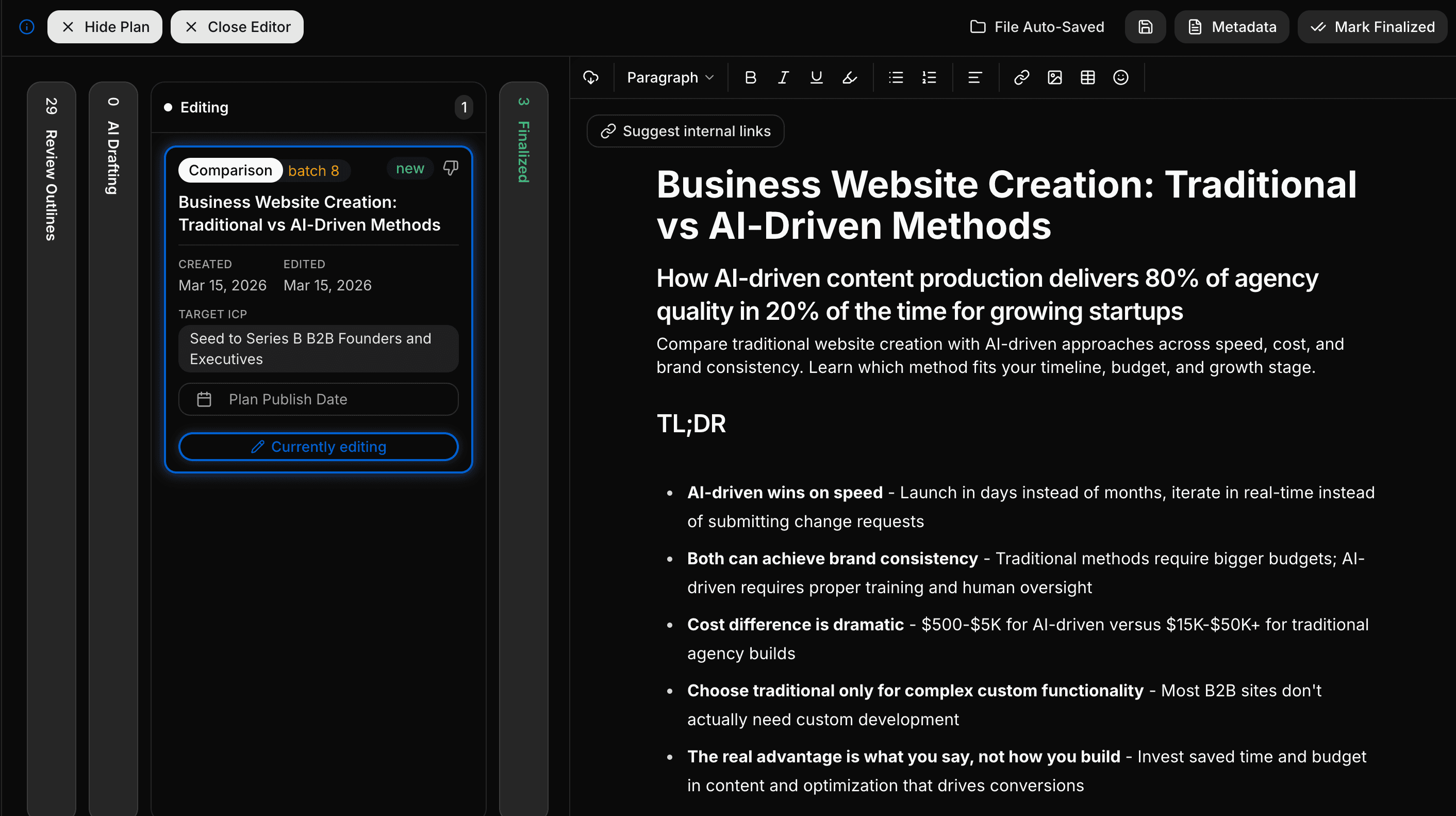
Or, the integrated option: Averi handles content strategy as part of its workflow. It analyzes your brand, ICP, and competitors during onboarding, then generates keyword-backed content recommendations automatically. The strategy builds in about 10 minutes and updates based on performance data. You skip the step where you manually translate keyword research into editorial decisions.
Layer 2: Content Creation

What it does: Produces the actual blog posts, articles, and guides that rank in search engines and drive traffic to your beehiiv subscribe forms.

Why beehiiv doesn't cover it: beehiiv's editor creates newsletters. It's clean and functional for email. But SEO-optimized blog content requires a different structure: keyword-targeted headers, sourced statistics, internal link architecture, FAQ sections, meta tags, and content structured for AI citations. beehiiv's editor wasn't designed for that.

The tools:

Google Docs or Notion (free) work for drafting. Most creators already use one of these. The limitation is that they're blank canvases with zero SEO guidance. You write what you want and hope it ranks.

AI writing assistants (ChatGPT, Claude) speed up drafting but produce generic output without brand context, keyword targeting, or content strategy integration. 83% of marketers now use AI tools, but human-edited AI content performs 34% better than fully AI-generated content. AI helps with volume. It doesn't replace editorial judgment.

Clearscope or Surfer SEO ($170–$199/month) add SEO optimization to your writing process. They analyze top-ranking content for your target keyword and suggest terms, headers, and content length. Useful if you're optimizing manually, but they're optimization layers on top of your writing process, not content creation tools.

Or, the integrated option: Averi's content engine handles research, drafting, and optimization in one workflow. It pulls from your brand context (voice, ICP, competitors), researches current data, drafts with dual SEO + GEO optimization, and suggests internal links. You edit in a collaborative canvas and approve. The output is a publish-ready blog post, not a rough draft that needs three more tools to finish.

Layer 3: Publishing

What it does: Gets your content live on a website where Google can index it and visitors can find it.

Why beehiiv doesn't cover it: beehiiv publishes to its own web archive. It does not publish to WordPress, Webflow, Framer, or any external CMS. If you're building organic search as a growth channel, your content needs to live on a domain you control where authority compounds under your brand.

Companies with active blogs have 434% more indexed pages and 97% more inbound links. Those indexed pages and links build domain authority that makes every future article easier to rank. beehiiv's web publishing gets your newsletter content indexed. A dedicated blog on your own domain builds a content library that works as a long-term asset.

The tools:

WordPress (free core, $5–$30/month hosting) is the most common blogging CMS. 61% of B2B blogs use WordPress. Massive plugin ecosystem including Yoast and RankMath for SEO. Flexible but requires maintenance (updates, security, speed optimization).

Webflow ($14–$39/month) gives you more design control with built-in hosting and SSL. Good for creators who want a polished site without managing plugins. SEO features built in (meta tags, sitemaps, 301 redirects). Steeper learning curve than WordPress.

Framer ($5–$20/month) is fast, modern, and increasingly popular with startup creators. Clean publishing workflow. Built-in SEO fields. Less plugin flexibility than WordPress but much simpler to maintain.

Or, the integrated option: Averi publishes directly to WordPress, Webflow, and Framer. Content goes from draft to live on your domain without copying and pasting between tools. The publishing step takes seconds, not a separate workflow.

Layer 4: SEO and GEO Optimization

What it does: Ensures your published content is structured to rank on Google and get cited by AI platforms like ChatGPT, Perplexity, and Google AI Overviews.

Why beehiiv doesn't cover it: beehiiv lets you set meta titles, descriptions, and URL slugs. Those are the minimum viable SEO elements. The platform doesn't score your content against ranking benchmarks, suggest structural improvements, manage internal link networks, add schema markup, or optimize for Generative Engine Optimization.

In 2026, 60% of Google searches generate zero clicks. Getting featured in AI Overviews and cited by LLMs requires content with clear question-and-answer structures, authoritative sourced statistics, and FAQ sections. Pages with FAQ sections earn 4.3x more Featured Snippets. None of that optimization happens inside beehiiv.

The tools:

Yoast SEO or RankMath (free WordPress plugins with paid tiers) handle on-page SEO basics: meta tags, readability scoring, schema markup, XML sitemaps. Essential for WordPress users. They check boxes but don't write content or suggest strategy.

Schema markup generators (free tools like Merkle's Schema Generator) help you add structured data (FAQPage, HowTo, Article) to your blog posts. This improves your chances of earning rich snippets and AI citations.

Google Search Console (free) tracks which keywords drive impressions, monitors your average positions, flags indexing issues, and shows you click-through rates. Critical for identifying which content to refresh and which keywords to target next.

Or, the integrated option: Averi scores every piece of content against both SEO (55%) and GEO (45%) benchmarks before publishing. Internal link suggestions, FAQ generation, meta optimization, and answer-block structuring happen inside the workflow. You don't need a separate optimization tool because optimization is built into the creation process.
Layer 5: Analytics and Performance Tracking

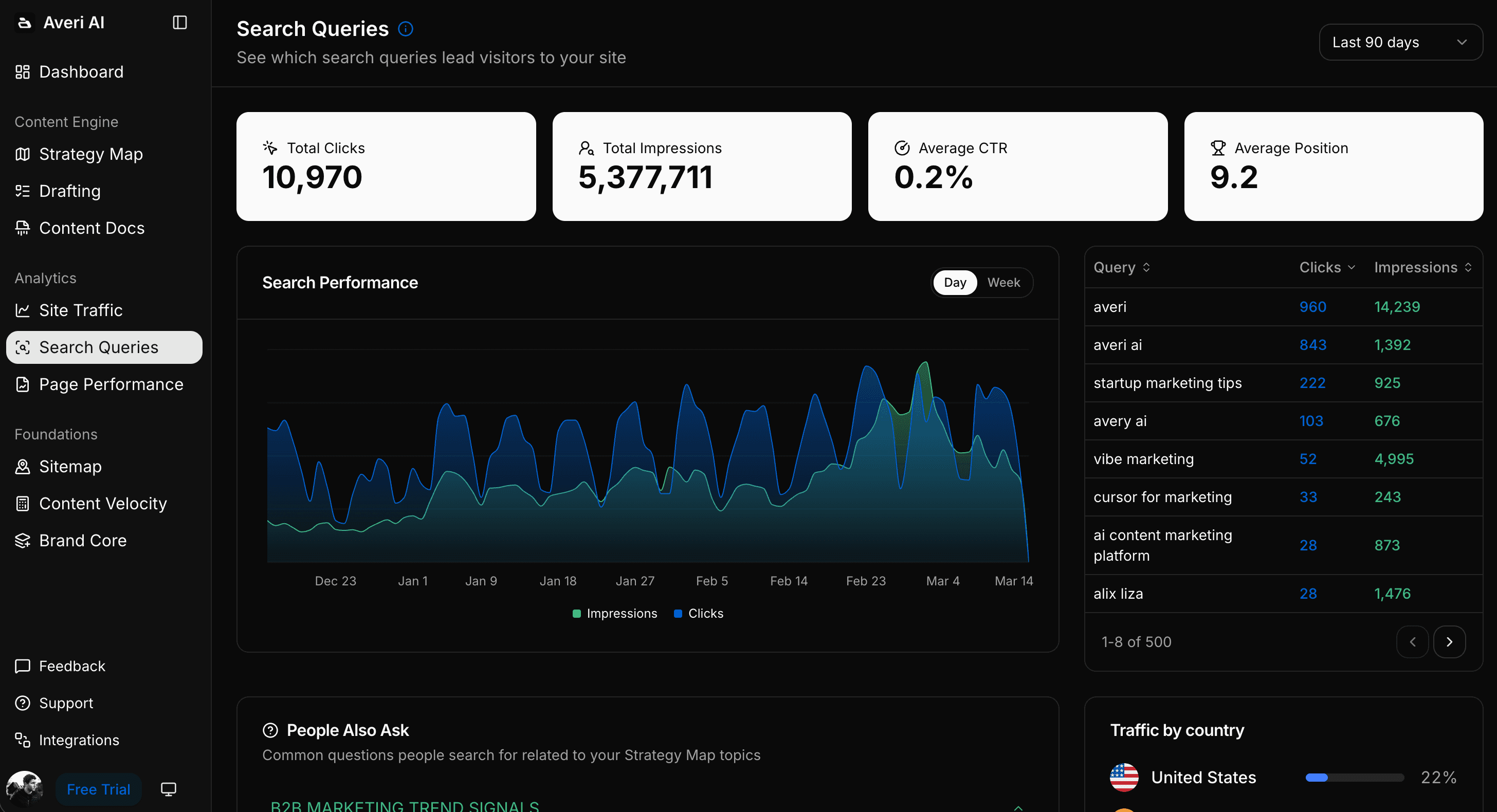
What it does: Connects search performance, on-site behavior, and email engagement into a single picture so you know which content drives subscribers and revenue.

Why beehiiv doesn't cover it: beehiiv's analytics focus on email: open rates, click rates, subscriber growth, revenue attribution. beehiiv's 3D analytics and verified click tracking are strong for email-specific insights. But they don't track keyword rankings, organic traffic, page-level search performance, or the conversion path from search impression to newsletter subscription.

Only 29% of marketers effectively measure content marketing ROI. The creators who do are connecting three data sources: search analytics, site behavior, and email engagement. beehiiv covers one. You need tools for the other two.

The tools:

Google Analytics 4 (free) tracks site behavior: page views, session duration, conversion events, traffic sources. Set up a conversion event for newsletter signups to track how many organic visitors subscribe. beehiiv connects to GA4 through Zapier.

Google Search Console (free) tracks search performance: impressions, clicks, average position, click-through rate by keyword. Shows you which content ranks and where it's climbing or dropping.

Ahrefs or SEMrush ($99–$199/month) track keyword rankings over time, monitor competitor movements, and flag opportunities. More detailed than GSC but overlapping in core functionality.

Or, the integrated option: Averi includes built-in analytics with Google Analytics and Search Console integration. Track content performance, keyword rankings, and traffic data alongside your content queue. The dashboard shows which content drives results so you know what to create more of.

Layer 6: The Email Layer (beehiiv)

This is where beehiiv lives. And it belongs here. At the end of the stack, not the beginning.

What it does: Sends newsletters. Monetizes subscribers (paid subs, ads, Boosts). Grows your list through referrals, recommendations, and cross-promotions. Manages audience segments. Tracks email engagement.

beehiiv is the best tool for this layer. Zero platform fees on paid subscriptions. 30,000+ publishers in the Recommendation Network. Built-in Ad Network. No other email platform matches the combination of sending, growing, and monetizing newsletters in one dashboard.

But notice where beehiiv sits in the stack: at the distribution end. Five layers of work happen before a subscriber reaches your beehiiv list through organic search. Content strategy identifies the opportunity. Content creation produces the asset. Publishing makes it findable. Optimization ensures it ranks. Analytics confirms it works. Then beehiiv takes over and does what it does best.

The creators treating beehiiv as their entire stack are missing the five layers upstream. The creators pairing beehiiv with a content engine are capturing organic search traffic that drives 53% of all website visits and funneling it into the best email platform on the market.

The Piecemeal Stack vs. The Integrated Stack

Here's the honest comparison. You can build the content marketing stack from individual tools. Or you can use one tool that handles Layers 1–5 and connects to beehiiv at Layer 6.

The Piecemeal Stack

Layer

Tool

Monthly Cost

Strategy & Keywords

Ahrefs or SEMrush

$99–$199

Content Creation

Google Docs + AI assistant

$0–$20

SEO Optimization

Clearscope or Surfer SEO

$170–$199

Publishing

WordPress/Webflow/Framer

$5–$39

Analytics

GA4 + GSC + Ahrefs

$0–$199

Email

beehiiv

$49–$109

Total

5–6 tools

$323–$765/month

Plus the management overhead of moving content between tools, maintaining integrations, and managing 5–6 separate dashboards. For solo creators, that operational tax is the real cost.

The Integrated Stack

Layer

Tool

Monthly Cost

Strategy through Analytics

Averi

$99

Email

beehiiv

$49–$109

Total

2 tools

$148–$208/month

Averi's Solo plan at $99/month covers content strategy, keyword research, content queue, AI-assisted drafting, SEO + GEO optimization, CMS publishing, and performance analytics.

beehiiv handles everything downstream of email. Two tools. Two dashboards. One workflow.

The cost savings are real. The time savings are bigger.

Instead of spending 15–20 hours per week managing a piecemeal stack, the integrated approach reduces content marketing to about 2 hours of review and approval per week.

That's the difference between content marketing being a part-time job and content marketing being a Tuesday morning task.

How the Stack Connects to beehiiv

Whatever stack you choose (piecemeal or integrated), the connection to beehiiv follows the same pattern:

Blog content drives organic traffic. Searchers find your articles through Google or AI citation platforms.

Subscribe forms convert visitors. Embedded beehiiv forms on your blog capture email addresses.

beehiiv welcome sequences nurture. Automated emails deliver your best content immediately after signup.

Newsletter builds the relationship. Weekly editions keep subscribers engaged, clicking, and paying.

Analytics close the loop. Track which blog posts drive the most subscribers. Create more content around those topics. The flywheel accelerates.

beehiiv connects to over 1,000 apps through Zapier and Make. The technical integration isn't the challenge. The challenge is having content worth connecting. The upstream layers of the stack produce that content. beehiiv distributes it.

The 2-Tool Stack: Getting Started

If you're a beehiiv creator reading this and wondering where to begin:

You already have beehiiv. That's Layer 6 handled. Keep using it for everything email-related. It's the right tool.

Add the content engine. Start a free trial of Averi to cover Layers 1–5. In 14 days, you can generate a content strategy, build a content queue, publish your first optimized blog posts, and start tracking performance. No credit card required.

The subscribers who find you through organic search are subscribers beehiiv's native growth tools can't reach. They're outside your referral network. They've never seen a Boost. They don't follow you on social media. They searched for something, found your content, and decided your newsletter was worth their inbox space.

Those are the highest-intent subscribers you can acquire. And the content engine that finds them is the piece most beehiiv creators are missing.

Beehiiv Rescources

Related Resources

FAQs

What tools integrate with beehiiv?

beehiiv connects to over 1,000 applications through Zapier, Make, and its open API. Native integrations include Zapier, Make, and HoneyCommb. Through Zapier, you can connect beehiiv to Google Sheets, HubSpot, Salesforce, Slack, Stripe, and hundreds of other apps. These integrations sync subscriber data, trigger automation workflows, and pass events between tools. What they don't do is create the content marketing infrastructure that drives new subscribers to your beehiiv list. For that, you need a content engine that sits upstream of beehiiv in your marketing stack.

What content marketing tools do beehiiv creators need?

beehiiv handles email sending, monetization, and subscriber growth tools. Beyond that, you need tools covering five layers: content strategy and keyword research (Ahrefs, SEMrush, or Averi), content creation (AI-assisted drafting with human editing), publishing (WordPress, Webflow, or Framer), SEO and GEO optimization (Clearscope, Yoast, or Averi's built-in scoring), and analytics (Google Analytics + Search Console). You can assemble these individually at $323–$765/month or use an integrated content engine like Averi that covers all five layers for $99/month.

Does beehiiv have SEO tools?

beehiiv includes basic SEO features: customizable meta titles and descriptions, editable URL slugs, auto-updating sitemaps, breadcrumb navigation, and Google Search Console integration. These cover on-page SEO fundamentals for newsletter content you want indexed. beehiiv doesn't provide keyword research, ranking tracking, content scoring, internal link management, schema markup tools, or GEO optimization for AI citations. For creators who want organic search to become a primary growth channel, beehiiv's SEO features are a starting point that needs supplementing.

How do I connect my blog to beehiiv for subscriber capture?

Embed beehiiv subscribe forms on your blog using beehiiv's form builder, which generates embeddable code for WordPress, Webflow, or any HTML site. Place forms after your introduction, mid-article, and at the end of each post. Use Zapier to connect form submissions from other platforms (Typeform, Carrd, etc.) to create subscribers in beehiiv automatically. Set up a beehiiv welcome automation sequence that delivers your best-performing newsletter editions to new subscribers immediately. Track conversions by adding UTM parameters to your blog CTAs.

What's the difference between beehiiv integrations and a content marketing stack?

beehiiv integrations sync data between existing tools: pushing subscriber events to a CRM, triggering workflows in Zapier, passing analytics to Google. A content marketing stack creates the assets that generate new subscribers in the first place. The distinction is plumbing versus production. Integrations keep your tools connected. A content stack builds the discovery engine that feeds subscribers into beehiiv. Most creators optimize their integrations while neglecting the content layer upstream that produces the traffic worth integrating.

Can I do content marketing with just beehiiv?

beehiiv's web publishing feature lets you index newsletter content for search, which is a basic form of content marketing. But the platform doesn't provide keyword research, content strategy, topic clustering, blog CMS publishing to your own domain, SEO scoring, or full-funnel content analytics. For creators who want organic search as a growth channel, beehiiv alone covers roughly 20% of what's needed. The other 80% is content strategy, creation, optimization, and analytics. A content engine alongside beehiiv fills that gap.

How does Averi fit into a beehiiv creator's tool stack?

Averi sits upstream of beehiiv in the content marketing stack. It handles everything before the email: content strategy, keyword research, topic queue generation, AI-assisted drafting, SEO + GEO optimization, CMS publishing, and analytics. beehiiv handles everything after the email: sending, monetization, and subscriber engagement. Together, the two tools form a complete content-to-email pipeline. Averi creates the content that drives organic subscribers. beehiiv converts those subscribers into revenue. The combined time investment is about 2 hours per week on the content side.


Continue Reading

The latest handpicked blog articles

Experience The AI Content Engine

Already have an account?

Join 30,000+ Founders, Marketers & Builders

Don't Feed the Algorithm

“Top 3 tech + AI newsletters in the country. Always sharp, always actionable.”

"Genuinely my favorite newsletter in tech. No fluff, no cheesy ads, just great content."

“Clear, practical, and on-point. Helps me keep up without drowning in noise.”

User-Generated Content & Authenticity in the Age of AI

Zach Chmael

Head of Marketing

5 minutes

In This Article

Organic search drives 53% of all website traffic. Content marketing generates $3 for every $1 invested. Businesses with blogs generate 67% more leads. Those numbers exist whether or not you have a beehiiv integration for them. What you need is a stack that captures them.

Don’t Feed the Algorithm

The algorithm never sleeps, but you don’t have to feed it — Join our weekly newsletter for real insights on AI, human creativity & marketing execution.

TL;DR

🔌 beehiiv integrates with 1,000+ apps via Zapier, Make, and API. Those integrations sync data. They don't create the content that drives new subscribers.

📦 The full content marketing stack has 6 layers: Strategy → Creation → Publishing → Optimization → Analytics → Email (beehiiv)

🔍 beehiiv covers Layer 6 (email). Layers 1–5 need separate tools for keyword research, content production, CMS publishing, SEO/GEO optimization, and performance tracking.

💰 Piecemeal stack costs $323–$765/month across 5–6 tools plus significant management overhead

⚡ Integrated stack: Averi ($99/mo) + beehiiv ($49–$109/mo) = 2 tools, $148–$208/month, ~2 hours/week on content marketing

📊 Organic search drives 53% of all web traffic. Content marketing generates $3 for every $1 invested. The upstream stack captures that value.

🔄 The connection: blog content → organic traffic → beehiiv subscribe forms → newsletter nurture → revenue. The stack builds the top of the funnel beehiiv monetizes.

"We built Averi around the exact workflow we've used to scale our web traffic over 6000% in the last 6 months."

founder-image
founder-image
Your content should be working harder.

Averi's content engine builds Google entity authority, drives AI citations, and scales your visibility so you can get more customers.

The Content Marketing Stack for beehiiv Creators: What You Actually Need Beyond Email

beehiiv handles email. Really well.

28 billion emails sent in 2025. Open rates above 41%. $19 million in paid subscription revenue. The platform has Zapier integration, Make compatibility, an open API, and webhooks that connect to over 1,000 apps. You can wire it into practically anything.

But wiring beehiiv into other apps is not the same thing as having a content marketing stack.

Most beehiiv integrations solve plumbing problems: syncing subscriber data to a CRM, triggering automation from form submissions, passing events to Google Analytics.

Those integrations keep your existing tools in sync. They don't build the engine that creates new subscribers.

The gap in most beehiiv creators' tool stacks isn't downstream of email. It's upstream. Before a subscriber lands on your beehiiv list, something had to make them aware you exist. That awareness channel is content. And the tools that create, optimize, publish, and track content are the pieces most newsletter operators haven't assembled.

Organic search drives 53% of all website traffic. Content marketing generates $3 for every $1 invested. Businesses with blogs generate 67% more leads. Those numbers exist whether or not you have a beehiiv integration for them.

What you need is a stack that captures them.

Here's every layer of the content marketing stack for beehiiv creators, what each layer does, which tools serve it, and how they connect.

See how much you could save by replacing your content stack with Averi

Layer 1: Content Strategy and Keyword Research

What it does: Identifies what your target audience searches for, maps those searches to content topics, and organizes topics into clusters that build authority over time.

Why beehiiv doesn't cover it: beehiiv shows you what existing subscribers engage with (open rates, click rates, poll responses). It doesn't show you what people who aren't subscribers yet are searching for on Google. Those are two different data sets. The first helps you write better newsletters. The second helps you find new subscribers.

The tools:

Ahrefs or SEMrush ($99–$199/month) handle keyword research, competitive analysis, backlink tracking, and ranking monitoring. These are the industry standards. They'll tell you which keywords in your niche have search volume, how difficult they are to rank for, and what your competitors publish. The data is excellent. The gap is that they stop at research. You still need to turn that research into a strategy, produce the content, and publish it.

Google Keyword Planner (free with a Google Ads account) covers basic keyword research for creators who want to start without a paid tool. Volume estimates are less precise than Ahrefs or SEMrush, but it's enough to validate whether your newsletter topics have search demand.

Google Search Console (free) shows which queries already drive impressions and clicks to any content you've published. Essential for identifying ranking opportunities in content you've already created. beehiiv integrates with GSC directly if you're using their web publishing.

Or, the integrated option: Averi handles content strategy as part of its workflow. It analyzes your brand, ICP, and competitors during onboarding, then generates keyword-backed content recommendations automatically. The strategy builds in about 10 minutes and updates based on performance data. You skip the step where you manually translate keyword research into editorial decisions.

Layer 2: Content Creation

What it does: Produces the actual blog posts, articles, and guides that rank in search engines and drive traffic to your beehiiv subscribe forms.

Why beehiiv doesn't cover it: beehiiv's editor creates newsletters. It's clean and functional for email. But SEO-optimized blog content requires a different structure: keyword-targeted headers, sourced statistics, internal link architecture, FAQ sections, meta tags, and content structured for AI citations. beehiiv's editor wasn't designed for that.

The tools:

Google Docs or Notion (free) work for drafting. Most creators already use one of these. The limitation is that they're blank canvases with zero SEO guidance. You write what you want and hope it ranks.

AI writing assistants (ChatGPT, Claude) speed up drafting but produce generic output without brand context, keyword targeting, or content strategy integration. 83% of marketers now use AI tools, but human-edited AI content performs 34% better than fully AI-generated content. AI helps with volume. It doesn't replace editorial judgment.

Clearscope or Surfer SEO ($170–$199/month) add SEO optimization to your writing process. They analyze top-ranking content for your target keyword and suggest terms, headers, and content length. Useful if you're optimizing manually, but they're optimization layers on top of your writing process, not content creation tools.

Or, the integrated option: Averi's content engine handles research, drafting, and optimization in one workflow. It pulls from your brand context (voice, ICP, competitors), researches current data, drafts with dual SEO + GEO optimization, and suggests internal links. You edit in a collaborative canvas and approve. The output is a publish-ready blog post, not a rough draft that needs three more tools to finish.

Layer 3: Publishing

What it does: Gets your content live on a website where Google can index it and visitors can find it.

Why beehiiv doesn't cover it: beehiiv publishes to its own web archive. It does not publish to WordPress, Webflow, Framer, or any external CMS. If you're building organic search as a growth channel, your content needs to live on a domain you control where authority compounds under your brand.

Companies with active blogs have 434% more indexed pages and 97% more inbound links. Those indexed pages and links build domain authority that makes every future article easier to rank. beehiiv's web publishing gets your newsletter content indexed. A dedicated blog on your own domain builds a content library that works as a long-term asset.

The tools:

WordPress (free core, $5–$30/month hosting) is the most common blogging CMS. 61% of B2B blogs use WordPress. Massive plugin ecosystem including Yoast and RankMath for SEO. Flexible but requires maintenance (updates, security, speed optimization).

Webflow ($14–$39/month) gives you more design control with built-in hosting and SSL. Good for creators who want a polished site without managing plugins. SEO features built in (meta tags, sitemaps, 301 redirects). Steeper learning curve than WordPress.

Framer ($5–$20/month) is fast, modern, and increasingly popular with startup creators. Clean publishing workflow. Built-in SEO fields. Less plugin flexibility than WordPress but much simpler to maintain.

Or, the integrated option: Averi publishes directly to WordPress, Webflow, and Framer. Content goes from draft to live on your domain without copying and pasting between tools. The publishing step takes seconds, not a separate workflow.

Layer 4: SEO and GEO Optimization

What it does: Ensures your published content is structured to rank on Google and get cited by AI platforms like ChatGPT, Perplexity, and Google AI Overviews.

Why beehiiv doesn't cover it: beehiiv lets you set meta titles, descriptions, and URL slugs. Those are the minimum viable SEO elements. The platform doesn't score your content against ranking benchmarks, suggest structural improvements, manage internal link networks, add schema markup, or optimize for Generative Engine Optimization.

In 2026, 60% of Google searches generate zero clicks. Getting featured in AI Overviews and cited by LLMs requires content with clear question-and-answer structures, authoritative sourced statistics, and FAQ sections. Pages with FAQ sections earn 4.3x more Featured Snippets. None of that optimization happens inside beehiiv.

The tools:

Yoast SEO or RankMath (free WordPress plugins with paid tiers) handle on-page SEO basics: meta tags, readability scoring, schema markup, XML sitemaps. Essential for WordPress users. They check boxes but don't write content or suggest strategy.

Schema markup generators (free tools like Merkle's Schema Generator) help you add structured data (FAQPage, HowTo, Article) to your blog posts. This improves your chances of earning rich snippets and AI citations.

Google Search Console (free) tracks which keywords drive impressions, monitors your average positions, flags indexing issues, and shows you click-through rates. Critical for identifying which content to refresh and which keywords to target next.

Or, the integrated option: Averi scores every piece of content against both SEO (55%) and GEO (45%) benchmarks before publishing. Internal link suggestions, FAQ generation, meta optimization, and answer-block structuring happen inside the workflow. You don't need a separate optimization tool because optimization is built into the creation process.

Layer 5: Analytics and Performance Tracking

What it does: Connects search performance, on-site behavior, and email engagement into a single picture so you know which content drives subscribers and revenue.

Why beehiiv doesn't cover it: beehiiv's analytics focus on email: open rates, click rates, subscriber growth, revenue attribution. beehiiv's 3D analytics and verified click tracking are strong for email-specific insights. But they don't track keyword rankings, organic traffic, page-level search performance, or the conversion path from search impression to newsletter subscription.

Only 29% of marketers effectively measure content marketing ROI. The creators who do are connecting three data sources: search analytics, site behavior, and email engagement. beehiiv covers one. You need tools for the other two.

The tools:

Google Analytics 4 (free) tracks site behavior: page views, session duration, conversion events, traffic sources. Set up a conversion event for newsletter signups to track how many organic visitors subscribe. beehiiv connects to GA4 through Zapier.

Google Search Console (free) tracks search performance: impressions, clicks, average position, click-through rate by keyword. Shows you which content ranks and where it's climbing or dropping.

Ahrefs or SEMrush ($99–$199/month) track keyword rankings over time, monitor competitor movements, and flag opportunities. More detailed than GSC but overlapping in core functionality.

Or, the integrated option: Averi includes built-in analytics with Google Analytics and Search Console integration. Track content performance, keyword rankings, and traffic data alongside your content queue. The dashboard shows which content drives results so you know what to create more of.

Layer 6: The Email Layer (beehiiv)

This is where beehiiv lives. And it belongs here. At the end of the stack, not the beginning.

What it does: Sends newsletters. Monetizes subscribers (paid subs, ads, Boosts). Grows your list through referrals, recommendations, and cross-promotions. Manages audience segments. Tracks email engagement.

beehiiv is the best tool for this layer. Zero platform fees on paid subscriptions. 30,000+ publishers in the Recommendation Network. Built-in Ad Network. No other email platform matches the combination of sending, growing, and monetizing newsletters in one dashboard.

But notice where beehiiv sits in the stack: at the distribution end. Five layers of work happen before a subscriber reaches your beehiiv list through organic search. Content strategy identifies the opportunity. Content creation produces the asset. Publishing makes it findable. Optimization ensures it ranks. Analytics confirms it works. Then beehiiv takes over and does what it does best.

The creators treating beehiiv as their entire stack are missing the five layers upstream. The creators pairing beehiiv with a content engine are capturing organic search traffic that drives 53% of all website visits and funneling it into the best email platform on the market.

The Piecemeal Stack vs. The Integrated Stack

Here's the honest comparison. You can build the content marketing stack from individual tools. Or you can use one tool that handles Layers 1–5 and connects to beehiiv at Layer 6.

The Piecemeal Stack

Layer

Tool

Monthly Cost

Strategy & Keywords

Ahrefs or SEMrush

$99–$199

Content Creation

Google Docs + AI assistant

$0–$20

SEO Optimization

Clearscope or Surfer SEO

$170–$199

Publishing

WordPress/Webflow/Framer

$5–$39

Analytics

GA4 + GSC + Ahrefs

$0–$199

Email

beehiiv

$49–$109

Total

5–6 tools

$323–$765/month

Plus the management overhead of moving content between tools, maintaining integrations, and managing 5–6 separate dashboards. For solo creators, that operational tax is the real cost.

The Integrated Stack

Layer

Tool

Monthly Cost

Strategy through Analytics

Averi

$99

Email

beehiiv

$49–$109

Total

2 tools

$148–$208/month

Averi's Solo plan at $99/month covers content strategy, keyword research, content queue, AI-assisted drafting, SEO + GEO optimization, CMS publishing, and performance analytics.

beehiiv handles everything downstream of email. Two tools. Two dashboards. One workflow.

The cost savings are real. The time savings are bigger.

Instead of spending 15–20 hours per week managing a piecemeal stack, the integrated approach reduces content marketing to about 2 hours of review and approval per week.

That's the difference between content marketing being a part-time job and content marketing being a Tuesday morning task.

How the Stack Connects to beehiiv

Whatever stack you choose (piecemeal or integrated), the connection to beehiiv follows the same pattern:

Blog content drives organic traffic. Searchers find your articles through Google or AI citation platforms.

Subscribe forms convert visitors. Embedded beehiiv forms on your blog capture email addresses.

beehiiv welcome sequences nurture. Automated emails deliver your best content immediately after signup.

Newsletter builds the relationship. Weekly editions keep subscribers engaged, clicking, and paying.

Analytics close the loop. Track which blog posts drive the most subscribers. Create more content around those topics. The flywheel accelerates.

beehiiv connects to over 1,000 apps through Zapier and Make. The technical integration isn't the challenge. The challenge is having content worth connecting. The upstream layers of the stack produce that content. beehiiv distributes it.

The 2-Tool Stack: Getting Started

If you're a beehiiv creator reading this and wondering where to begin:

You already have beehiiv. That's Layer 6 handled. Keep using it for everything email-related. It's the right tool.

Add the content engine. Start a free trial of Averi to cover Layers 1–5. In 14 days, you can generate a content strategy, build a content queue, publish your first optimized blog posts, and start tracking performance. No credit card required.

The subscribers who find you through organic search are subscribers beehiiv's native growth tools can't reach. They're outside your referral network. They've never seen a Boost. They don't follow you on social media. They searched for something, found your content, and decided your newsletter was worth their inbox space.

Those are the highest-intent subscribers you can acquire. And the content engine that finds them is the piece most beehiiv creators are missing.

Beehiiv Rescources

Related Resources

Continue Reading

The latest handpicked blog articles

Join 30,000+ Founders, Marketers & Builders

Don't Feed the Algorithm

“Top 3 tech + AI newsletters in the country. Always sharp, always actionable.”

"Genuinely my favorite newsletter in tech. No fluff, no cheesy ads, just great content."

“Clear, practical, and on-point. Helps me keep up without drowning in noise.”

User-Generated Content & Authenticity in the Age of AI

Zach Chmael

Head of Marketing

5 minutes

In This Article

Organic search drives 53% of all website traffic. Content marketing generates $3 for every $1 invested. Businesses with blogs generate 67% more leads. Those numbers exist whether or not you have a beehiiv integration for them. What you need is a stack that captures them.

Don’t Feed the Algorithm

The algorithm never sleeps, but you don’t have to feed it — Join our weekly newsletter for real insights on AI, human creativity & marketing execution.

Trusted by 1,000+ teams

★★★★★ 4.9/5

Startups use Averi to build
content engines that rank.

The Content Marketing Stack for beehiiv Creators: What You Actually Need Beyond Email

beehiiv handles email. Really well.

28 billion emails sent in 2025. Open rates above 41%. $19 million in paid subscription revenue. The platform has Zapier integration, Make compatibility, an open API, and webhooks that connect to over 1,000 apps. You can wire it into practically anything.

But wiring beehiiv into other apps is not the same thing as having a content marketing stack.

Most beehiiv integrations solve plumbing problems: syncing subscriber data to a CRM, triggering automation from form submissions, passing events to Google Analytics.

Those integrations keep your existing tools in sync. They don't build the engine that creates new subscribers.

The gap in most beehiiv creators' tool stacks isn't downstream of email. It's upstream. Before a subscriber lands on your beehiiv list, something had to make them aware you exist. That awareness channel is content. And the tools that create, optimize, publish, and track content are the pieces most newsletter operators haven't assembled.

Organic search drives 53% of all website traffic. Content marketing generates $3 for every $1 invested. Businesses with blogs generate 67% more leads. Those numbers exist whether or not you have a beehiiv integration for them.

What you need is a stack that captures them.

Here's every layer of the content marketing stack for beehiiv creators, what each layer does, which tools serve it, and how they connect.

See how much you could save by replacing your content stack with Averi

Layer 1: Content Strategy and Keyword Research

What it does: Identifies what your target audience searches for, maps those searches to content topics, and organizes topics into clusters that build authority over time.

Why beehiiv doesn't cover it: beehiiv shows you what existing subscribers engage with (open rates, click rates, poll responses). It doesn't show you what people who aren't subscribers yet are searching for on Google. Those are two different data sets. The first helps you write better newsletters. The second helps you find new subscribers.

The tools:

Ahrefs or SEMrush ($99–$199/month) handle keyword research, competitive analysis, backlink tracking, and ranking monitoring. These are the industry standards. They'll tell you which keywords in your niche have search volume, how difficult they are to rank for, and what your competitors publish. The data is excellent. The gap is that they stop at research. You still need to turn that research into a strategy, produce the content, and publish it.

Google Keyword Planner (free with a Google Ads account) covers basic keyword research for creators who want to start without a paid tool. Volume estimates are less precise than Ahrefs or SEMrush, but it's enough to validate whether your newsletter topics have search demand.

Google Search Console (free) shows which queries already drive impressions and clicks to any content you've published. Essential for identifying ranking opportunities in content you've already created. beehiiv integrates with GSC directly if you're using their web publishing.

Or, the integrated option: Averi handles content strategy as part of its workflow. It analyzes your brand, ICP, and competitors during onboarding, then generates keyword-backed content recommendations automatically. The strategy builds in about 10 minutes and updates based on performance data. You skip the step where you manually translate keyword research into editorial decisions.

Layer 2: Content Creation

What it does: Produces the actual blog posts, articles, and guides that rank in search engines and drive traffic to your beehiiv subscribe forms.

Why beehiiv doesn't cover it: beehiiv's editor creates newsletters. It's clean and functional for email. But SEO-optimized blog content requires a different structure: keyword-targeted headers, sourced statistics, internal link architecture, FAQ sections, meta tags, and content structured for AI citations. beehiiv's editor wasn't designed for that.

The tools:

Google Docs or Notion (free) work for drafting. Most creators already use one of these. The limitation is that they're blank canvases with zero SEO guidance. You write what you want and hope it ranks.

AI writing assistants (ChatGPT, Claude) speed up drafting but produce generic output without brand context, keyword targeting, or content strategy integration. 83% of marketers now use AI tools, but human-edited AI content performs 34% better than fully AI-generated content. AI helps with volume. It doesn't replace editorial judgment.

Clearscope or Surfer SEO ($170–$199/month) add SEO optimization to your writing process. They analyze top-ranking content for your target keyword and suggest terms, headers, and content length. Useful if you're optimizing manually, but they're optimization layers on top of your writing process, not content creation tools.

Or, the integrated option: Averi's content engine handles research, drafting, and optimization in one workflow. It pulls from your brand context (voice, ICP, competitors), researches current data, drafts with dual SEO + GEO optimization, and suggests internal links. You edit in a collaborative canvas and approve. The output is a publish-ready blog post, not a rough draft that needs three more tools to finish.

Layer 3: Publishing

What it does: Gets your content live on a website where Google can index it and visitors can find it.

Why beehiiv doesn't cover it: beehiiv publishes to its own web archive. It does not publish to WordPress, Webflow, Framer, or any external CMS. If you're building organic search as a growth channel, your content needs to live on a domain you control where authority compounds under your brand.

Companies with active blogs have 434% more indexed pages and 97% more inbound links. Those indexed pages and links build domain authority that makes every future article easier to rank. beehiiv's web publishing gets your newsletter content indexed. A dedicated blog on your own domain builds a content library that works as a long-term asset.

The tools:

WordPress (free core, $5–$30/month hosting) is the most common blogging CMS. 61% of B2B blogs use WordPress. Massive plugin ecosystem including Yoast and RankMath for SEO. Flexible but requires maintenance (updates, security, speed optimization).

Webflow ($14–$39/month) gives you more design control with built-in hosting and SSL. Good for creators who want a polished site without managing plugins. SEO features built in (meta tags, sitemaps, 301 redirects). Steeper learning curve than WordPress.

Framer ($5–$20/month) is fast, modern, and increasingly popular with startup creators. Clean publishing workflow. Built-in SEO fields. Less plugin flexibility than WordPress but much simpler to maintain.

Or, the integrated option: Averi publishes directly to WordPress, Webflow, and Framer. Content goes from draft to live on your domain without copying and pasting between tools. The publishing step takes seconds, not a separate workflow.

Layer 4: SEO and GEO Optimization

What it does: Ensures your published content is structured to rank on Google and get cited by AI platforms like ChatGPT, Perplexity, and Google AI Overviews.

Why beehiiv doesn't cover it: beehiiv lets you set meta titles, descriptions, and URL slugs. Those are the minimum viable SEO elements. The platform doesn't score your content against ranking benchmarks, suggest structural improvements, manage internal link networks, add schema markup, or optimize for Generative Engine Optimization.

In 2026, 60% of Google searches generate zero clicks. Getting featured in AI Overviews and cited by LLMs requires content with clear question-and-answer structures, authoritative sourced statistics, and FAQ sections. Pages with FAQ sections earn 4.3x more Featured Snippets. None of that optimization happens inside beehiiv.

The tools:

Yoast SEO or RankMath (free WordPress plugins with paid tiers) handle on-page SEO basics: meta tags, readability scoring, schema markup, XML sitemaps. Essential for WordPress users. They check boxes but don't write content or suggest strategy.

Schema markup generators (free tools like Merkle's Schema Generator) help you add structured data (FAQPage, HowTo, Article) to your blog posts. This improves your chances of earning rich snippets and AI citations.

Google Search Console (free) tracks which keywords drive impressions, monitors your average positions, flags indexing issues, and shows you click-through rates. Critical for identifying which content to refresh and which keywords to target next.

Or, the integrated option: Averi scores every piece of content against both SEO (55%) and GEO (45%) benchmarks before publishing. Internal link suggestions, FAQ generation, meta optimization, and answer-block structuring happen inside the workflow. You don't need a separate optimization tool because optimization is built into the creation process.

Layer 5: Analytics and Performance Tracking

What it does: Connects search performance, on-site behavior, and email engagement into a single picture so you know which content drives subscribers and revenue.

Why beehiiv doesn't cover it: beehiiv's analytics focus on email: open rates, click rates, subscriber growth, revenue attribution. beehiiv's 3D analytics and verified click tracking are strong for email-specific insights. But they don't track keyword rankings, organic traffic, page-level search performance, or the conversion path from search impression to newsletter subscription.

Only 29% of marketers effectively measure content marketing ROI. The creators who do are connecting three data sources: search analytics, site behavior, and email engagement. beehiiv covers one. You need tools for the other two.

The tools:

Google Analytics 4 (free) tracks site behavior: page views, session duration, conversion events, traffic sources. Set up a conversion event for newsletter signups to track how many organic visitors subscribe. beehiiv connects to GA4 through Zapier.

Google Search Console (free) tracks search performance: impressions, clicks, average position, click-through rate by keyword. Shows you which content ranks and where it's climbing or dropping.

Ahrefs or SEMrush ($99–$199/month) track keyword rankings over time, monitor competitor movements, and flag opportunities. More detailed than GSC but overlapping in core functionality.

Or, the integrated option: Averi includes built-in analytics with Google Analytics and Search Console integration. Track content performance, keyword rankings, and traffic data alongside your content queue. The dashboard shows which content drives results so you know what to create more of.

Layer 6: The Email Layer (beehiiv)

This is where beehiiv lives. And it belongs here. At the end of the stack, not the beginning.

What it does: Sends newsletters. Monetizes subscribers (paid subs, ads, Boosts). Grows your list through referrals, recommendations, and cross-promotions. Manages audience segments. Tracks email engagement.

beehiiv is the best tool for this layer. Zero platform fees on paid subscriptions. 30,000+ publishers in the Recommendation Network. Built-in Ad Network. No other email platform matches the combination of sending, growing, and monetizing newsletters in one dashboard.

But notice where beehiiv sits in the stack: at the distribution end. Five layers of work happen before a subscriber reaches your beehiiv list through organic search. Content strategy identifies the opportunity. Content creation produces the asset. Publishing makes it findable. Optimization ensures it ranks. Analytics confirms it works. Then beehiiv takes over and does what it does best.

The creators treating beehiiv as their entire stack are missing the five layers upstream. The creators pairing beehiiv with a content engine are capturing organic search traffic that drives 53% of all website visits and funneling it into the best email platform on the market.

The Piecemeal Stack vs. The Integrated Stack

Here's the honest comparison. You can build the content marketing stack from individual tools. Or you can use one tool that handles Layers 1–5 and connects to beehiiv at Layer 6.

The Piecemeal Stack

Layer

Tool

Monthly Cost

Strategy & Keywords

Ahrefs or SEMrush

$99–$199

Content Creation

Google Docs + AI assistant

$0–$20

SEO Optimization

Clearscope or Surfer SEO

$170–$199

Publishing

WordPress/Webflow/Framer

$5–$39

Analytics

GA4 + GSC + Ahrefs

$0–$199

Email

beehiiv

$49–$109

Total

5–6 tools

$323–$765/month

Plus the management overhead of moving content between tools, maintaining integrations, and managing 5–6 separate dashboards. For solo creators, that operational tax is the real cost.

The Integrated Stack

Layer

Tool

Monthly Cost

Strategy through Analytics

Averi

$99

Email

beehiiv

$49–$109

Total

2 tools

$148–$208/month

Averi's Solo plan at $99/month covers content strategy, keyword research, content queue, AI-assisted drafting, SEO + GEO optimization, CMS publishing, and performance analytics.

beehiiv handles everything downstream of email. Two tools. Two dashboards. One workflow.

The cost savings are real. The time savings are bigger.

Instead of spending 15–20 hours per week managing a piecemeal stack, the integrated approach reduces content marketing to about 2 hours of review and approval per week.

That's the difference between content marketing being a part-time job and content marketing being a Tuesday morning task.

How the Stack Connects to beehiiv

Whatever stack you choose (piecemeal or integrated), the connection to beehiiv follows the same pattern:

Blog content drives organic traffic. Searchers find your articles through Google or AI citation platforms.

Subscribe forms convert visitors. Embedded beehiiv forms on your blog capture email addresses.

beehiiv welcome sequences nurture. Automated emails deliver your best content immediately after signup.

Newsletter builds the relationship. Weekly editions keep subscribers engaged, clicking, and paying.

Analytics close the loop. Track which blog posts drive the most subscribers. Create more content around those topics. The flywheel accelerates.

beehiiv connects to over 1,000 apps through Zapier and Make. The technical integration isn't the challenge. The challenge is having content worth connecting. The upstream layers of the stack produce that content. beehiiv distributes it.

The 2-Tool Stack: Getting Started

If you're a beehiiv creator reading this and wondering where to begin:

You already have beehiiv. That's Layer 6 handled. Keep using it for everything email-related. It's the right tool.

Add the content engine. Start a free trial of Averi to cover Layers 1–5. In 14 days, you can generate a content strategy, build a content queue, publish your first optimized blog posts, and start tracking performance. No credit card required.

The subscribers who find you through organic search are subscribers beehiiv's native growth tools can't reach. They're outside your referral network. They've never seen a Boost. They don't follow you on social media. They searched for something, found your content, and decided your newsletter was worth their inbox space.

Those are the highest-intent subscribers you can acquire. And the content engine that finds them is the piece most beehiiv creators are missing.

Beehiiv Rescources

Related Resources

"We built Averi around the exact workflow we've used to scale our web traffic over 6000% in the last 6 months."

founder-image
founder-image
Your content should be working harder.

Averi's content engine builds Google entity authority, drives AI citations, and scales your visibility so you can get more customers.

FAQs

Averi sits upstream of beehiiv in the content marketing stack. It handles everything before the email: content strategy, keyword research, topic queue generation, AI-assisted drafting, SEO + GEO optimization, CMS publishing, and analytics. beehiiv handles everything after the email: sending, monetization, and subscriber engagement. Together, the two tools form a complete content-to-email pipeline. Averi creates the content that drives organic subscribers. beehiiv converts those subscribers into revenue. The combined time investment is about 2 hours per week on the content side.

How does Averi fit into a beehiiv creator's tool stack?

beehiiv's web publishing feature lets you index newsletter content for search, which is a basic form of content marketing. But the platform doesn't provide keyword research, content strategy, topic clustering, blog CMS publishing to your own domain, SEO scoring, or full-funnel content analytics. For creators who want organic search as a growth channel, beehiiv alone covers roughly 20% of what's needed. The other 80% is content strategy, creation, optimization, and analytics. A content engine alongside beehiiv fills that gap.

Can I do content marketing with just beehiiv?

beehiiv integrations sync data between existing tools: pushing subscriber events to a CRM, triggering workflows in Zapier, passing analytics to Google. A content marketing stack creates the assets that generate new subscribers in the first place. The distinction is plumbing versus production. Integrations keep your tools connected. A content stack builds the discovery engine that feeds subscribers into beehiiv. Most creators optimize their integrations while neglecting the content layer upstream that produces the traffic worth integrating.

What's the difference between beehiiv integrations and a content marketing stack?

Embed beehiiv subscribe forms on your blog using beehiiv's form builder, which generates embeddable code for WordPress, Webflow, or any HTML site. Place forms after your introduction, mid-article, and at the end of each post. Use Zapier to connect form submissions from other platforms (Typeform, Carrd, etc.) to create subscribers in beehiiv automatically. Set up a beehiiv welcome automation sequence that delivers your best-performing newsletter editions to new subscribers immediately. Track conversions by adding UTM parameters to your blog CTAs.

How do I connect my blog to beehiiv for subscriber capture?

beehiiv includes basic SEO features: customizable meta titles and descriptions, editable URL slugs, auto-updating sitemaps, breadcrumb navigation, and Google Search Console integration. These cover on-page SEO fundamentals for newsletter content you want indexed. beehiiv doesn't provide keyword research, ranking tracking, content scoring, internal link management, schema markup tools, or GEO optimization for AI citations. For creators who want organic search to become a primary growth channel, beehiiv's SEO features are a starting point that needs supplementing.

Does beehiiv have SEO tools?

beehiiv handles email sending, monetization, and subscriber growth tools. Beyond that, you need tools covering five layers: content strategy and keyword research (Ahrefs, SEMrush, or Averi), content creation (AI-assisted drafting with human editing), publishing (WordPress, Webflow, or Framer), SEO and GEO optimization (Clearscope, Yoast, or Averi's built-in scoring), and analytics (Google Analytics + Search Console). You can assemble these individually at $323–$765/month or use an integrated content engine like Averi that covers all five layers for $99/month.

What content marketing tools do beehiiv creators need?

beehiiv connects to over 1,000 applications through Zapier, Make, and its open API. Native integrations include Zapier, Make, and HoneyCommb. Through Zapier, you can connect beehiiv to Google Sheets, HubSpot, Salesforce, Slack, Stripe, and hundreds of other apps. These integrations sync subscriber data, trigger automation workflows, and pass events between tools. What they don't do is create the content marketing infrastructure that drives new subscribers to your beehiiv list. For that, you need a content engine that sits upstream of beehiiv in your marketing stack.

What tools integrate with beehiiv?

FAQs

How long does it take to see SEO results for B2B SaaS?

Expect 7 months to break-even on average, with meaningful traffic improvements typically appearing within 3-6 months. Link building results appear within 1-6 months. The key is consistency—companies that stop and start lose ground to those who execute continuously.

Is AI-generated content actually good for SEO?

62% of marketers report higher SERP rankings for AI-generated content—but only when properly edited and enhanced with human expertise. Pure AI content without human refinement often lacks the originality and depth that both readers and algorithms prefer.

Is AI-generated content actually good for SEO?

62% of marketers report higher SERP rankings for AI-generated content—but only when properly edited and enhanced with human expertise. Pure AI content without human refinement often lacks the originality and depth that both readers and algorithms prefer.

Is AI-generated content actually good for SEO?

62% of marketers report higher SERP rankings for AI-generated content—but only when properly edited and enhanced with human expertise. Pure AI content without human refinement often lacks the originality and depth that both readers and algorithms prefer.

Is AI-generated content actually good for SEO?

62% of marketers report higher SERP rankings for AI-generated content—but only when properly edited and enhanced with human expertise. Pure AI content without human refinement often lacks the originality and depth that both readers and algorithms prefer.

Is AI-generated content actually good for SEO?

62% of marketers report higher SERP rankings for AI-generated content—but only when properly edited and enhanced with human expertise. Pure AI content without human refinement often lacks the originality and depth that both readers and algorithms prefer.

Is AI-generated content actually good for SEO?

62% of marketers report higher SERP rankings for AI-generated content—but only when properly edited and enhanced with human expertise. Pure AI content without human refinement often lacks the originality and depth that both readers and algorithms prefer.

Is AI-generated content actually good for SEO?

62% of marketers report higher SERP rankings for AI-generated content—but only when properly edited and enhanced with human expertise. Pure AI content without human refinement often lacks the originality and depth that both readers and algorithms prefer.

TL;DR

🔌 beehiiv integrates with 1,000+ apps via Zapier, Make, and API. Those integrations sync data. They don't create the content that drives new subscribers.

📦 The full content marketing stack has 6 layers: Strategy → Creation → Publishing → Optimization → Analytics → Email (beehiiv)

🔍 beehiiv covers Layer 6 (email). Layers 1–5 need separate tools for keyword research, content production, CMS publishing, SEO/GEO optimization, and performance tracking.

💰 Piecemeal stack costs $323–$765/month across 5–6 tools plus significant management overhead

⚡ Integrated stack: Averi ($99/mo) + beehiiv ($49–$109/mo) = 2 tools, $148–$208/month, ~2 hours/week on content marketing

📊 Organic search drives 53% of all web traffic. Content marketing generates $3 for every $1 invested. The upstream stack captures that value.

🔄 The connection: blog content → organic traffic → beehiiv subscribe forms → newsletter nurture → revenue. The stack builds the top of the funnel beehiiv monetizes.

Continue Reading

The latest handpicked blog articles

Join 30,000+ Founders, Marketers & Builders

Don't Feed the Algorithm

“Top 3 tech + AI newsletters in the country. Always sharp, always actionable.”

"Genuinely my favorite newsletter in tech. No fluff, no cheesy ads, just great content."

“Clear, practical, and on-point. Helps me keep up without drowning in noise.”

How strong is your content engine? Find out in 30 seconds.

Maybe later