From Blank Page to Content Queue: How AI Replaces the "What Should We Write?" Problem

Zach Chmael
Head of Marketing
5 minutes

In This Article
The content ideation problem is the most expensive bottleneck in marketing because it's invisible. Nobody tracks the hours spent debating topics in Slack, scrolling through competitor blogs for inspiration, or creating elaborate content calendars that get abandoned by week three. Nobody counts the opportunity cost of publishing a post about something nobody's searching for because someone in the team "felt like it was a good topic."
Updated
Trusted by 1,000+ teams
Startups use Averi to build
content engines that rank.
TL;DR:
😶 The #1 bottleneck in startup content marketing isn't writing — it's deciding what to write. Most teams spend more time debating topics than producing content
📋 90% of content receives fewer than 10 organic visits because it was chosen by intuition, not intelligence
🗺️ A Strategy Map turns your brand context into a visual architecture of pillars, focus areas, and topics — so AI recommendations have strategic logic, not just keyword data
🔄 A Content Queue replaces the blank calendar with a pre-vetted pipeline of AI-recommended topics ranked by opportunity, intent, and competitive gap
⚡ The shift: from "What should we write this week?" to "Which of these 15 validated opportunities should we publish first?"

Zach Chmael
CMO, Averi
"We built Averi around the exact workflow we've used to scale our web traffic over 6000% in the last 6 months."
Your content should be working harder.
Averi's content engine builds Google entity authority, drives AI citations, and scales your visibility so you can get more customers.
From Blank Page to Content Queue: How AI Replaces the "What Should We Write?" Problem
What Actually Kills Content Marketing at Startups?
It's not the writing. Every founder thinks the hard part is producing 2,000 words of polished prose, and the whole operation stalls because they're staring at a blank page trying to will a blog post into existence.
But the blank page isn't the real problem. The blank calendar is.
The actual breakdown happens upstream — in the gap between "we need to do content marketing" and "here's exactly what we should create, in what order, targeting what keywords, for which audience segment, to fill which competitive gap."
That gap is where most startup content programs go to die.
And it dies quietly — not with a dramatic failure, but with the slow erosion of a Monday morning meeting where someone says "so what are we writing about this week?" and everyone looks at each other.
The content ideation problem is the most expensive bottleneck in marketing because it's invisible.
Nobody tracks the hours spent debating topics in Slack, scrolling through competitor blogs for inspiration, or creating elaborate content calendars that get abandoned by week three. Nobody counts the opportunity cost of publishing a post about something nobody's searching for because someone in the team "felt like it was a good topic."
But the data tells the story: 90% of content receives fewer than 10 organic visits. That's not a writing quality problem. That's a topic selection problem. Ninety percent of the content on the internet was chosen by intuition, not intelligence — and the results are exactly what you'd expect.

Why Traditional Content Planning Doesn't Work for Startups
The traditional content planning process goes something like this: conduct keyword research quarterly, brainstorm topics in a meeting, organize them into a content calendar, assign writers, execute the calendar until it falls apart (usually around week four), then repeat.
This process has three fatal flaws for startups.
Flaw 1: It's Static in a Dynamic Market
A quarterly content calendar assumes the market will hold still for 90 days.
It won't.
Competitors publish new content. Search trends shift. Your product ships new features. A new industry narrative emerges. By month two, half the calendar is irrelevant — but you execute it anyway because changing the plan feels like failure.
The best content strategies aren't static documents.
They're dynamic systems that continuously absorb new signals and adjust priorities in real time. A content calendar that doesn't respond to competitive moves and trending opportunities is a calendar that ages poorly.
Flaw 2: It Separates Strategy From Execution
In traditional planning, the person choosing topics and the person (or AI) creating content operate in different workflows, often different tools, sometimes different weeks. The strategist creates a spreadsheet of topics with target keywords. The writer opens a blank document and tries to reconstruct the strategic intent from a one-line brief.
Context degrades at every handoff.
The reason the topic was chosen, the competitive angle it was designed to exploit, the specific ICP pain point it addresses — all of this lives in the strategist's head, not in the document that reaches the writer. The result is content that's technically on-topic but strategically hollow.
Flaw 3: It Relies on Human Pattern Recognition at Machine Scale
A startup competing for organic visibility needs to track hundreds of keyword opportunities, monitor dozens of competitors, analyze performance data across potentially thousands of published URLs, and synthesize all of this into weekly topic decisions.
No human can do this effectively.
The founder doing their own marketing certainly can't — they have a product to ship, investors to update, and customers to support. Even a dedicated content marketer can't match the pattern-recognition capacity of a system that processes keyword data, competitor activity, and performance signals simultaneously and continuously.
This is the job AI was built for. Not writing the content — selecting it.
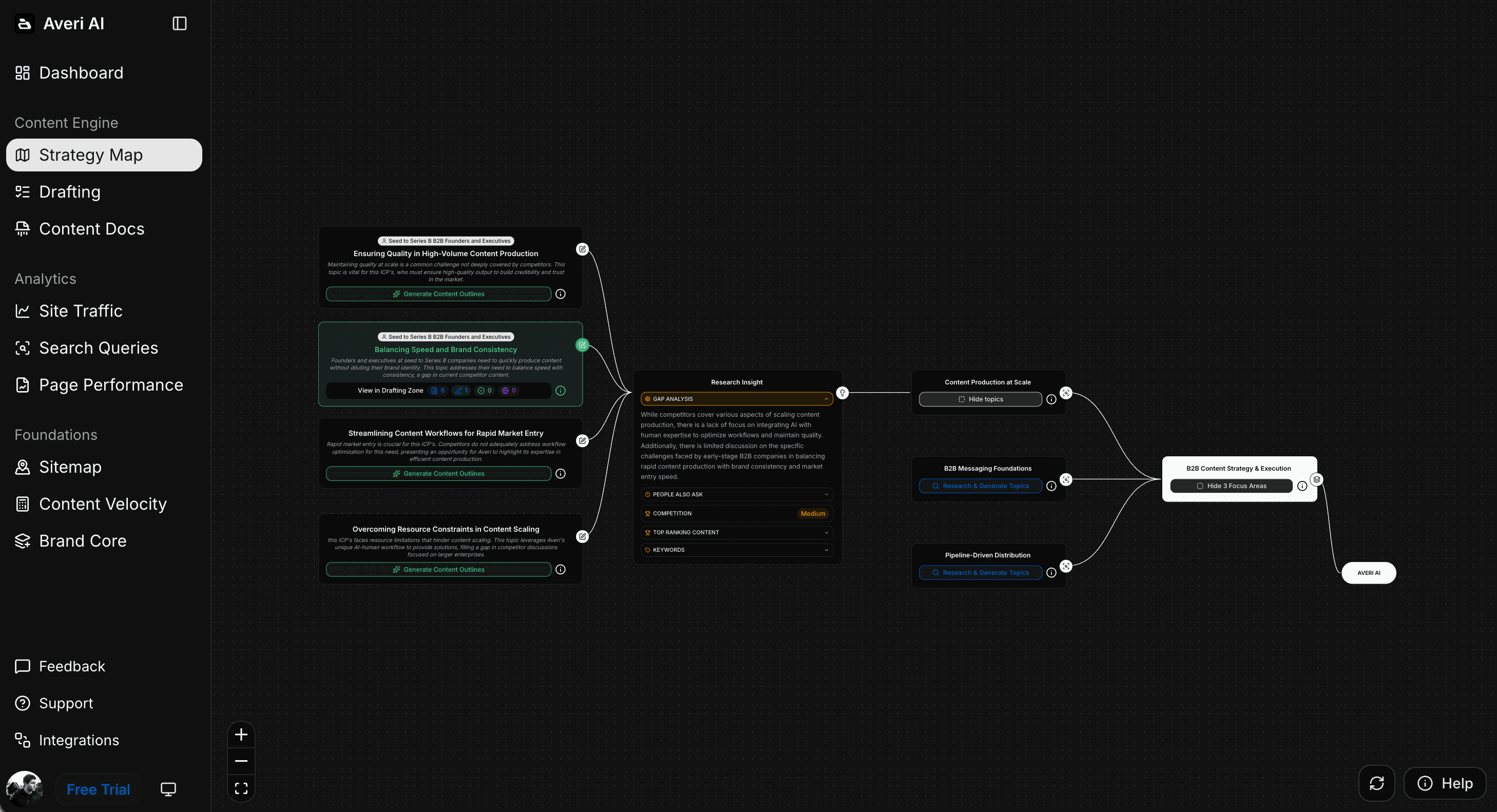
What Is a Strategy Map?
Before you can build a Content Queue, you need a strategic architecture. A pile of keyword opportunities isn't a strategy. It's a spreadsheet.
A Strategy Map is a visual framework that organizes your content into a hierarchy: pillars → focus areas → topics → sub-topics.
It answers the question that keyword research alone cannot: how does this topic relate to our broader positioning, and what role does it play in building authority?
Consider the difference:
Without a Strategy Map: Your keyword research surfaces 200 opportunities. You sort by volume, pick the top 20, and start writing. The articles have no thematic relationship. They don't link to each other naturally. They build no topical authority because they're scattered across disconnected subjects. Each one is an island.
With a Strategy Map: Those same 200 opportunities are organized into 4-6 pillars that map to your core positioning. Each pillar has focus areas that represent audience pain points. Each focus area has topics with clear search intent and competitive gaps. Every article you publish reinforces the pillar it belongs to, strengthens the cluster it lives in, and accelerates the ranking of every related article through internal linking and topical relevance.
The Strategy Map doesn't tell you what to write. It tells you what matters to write — and how each piece connects to the larger architecture of authority you're building.
This is why content velocity without strategy produces volume without results.
Ten articles published within a coherent cluster outperform 50 articles scattered across unrelated topics.
The Strategy Map is how you ensure every piece of velocity serves the compounding system.
What Is a Content Queue?
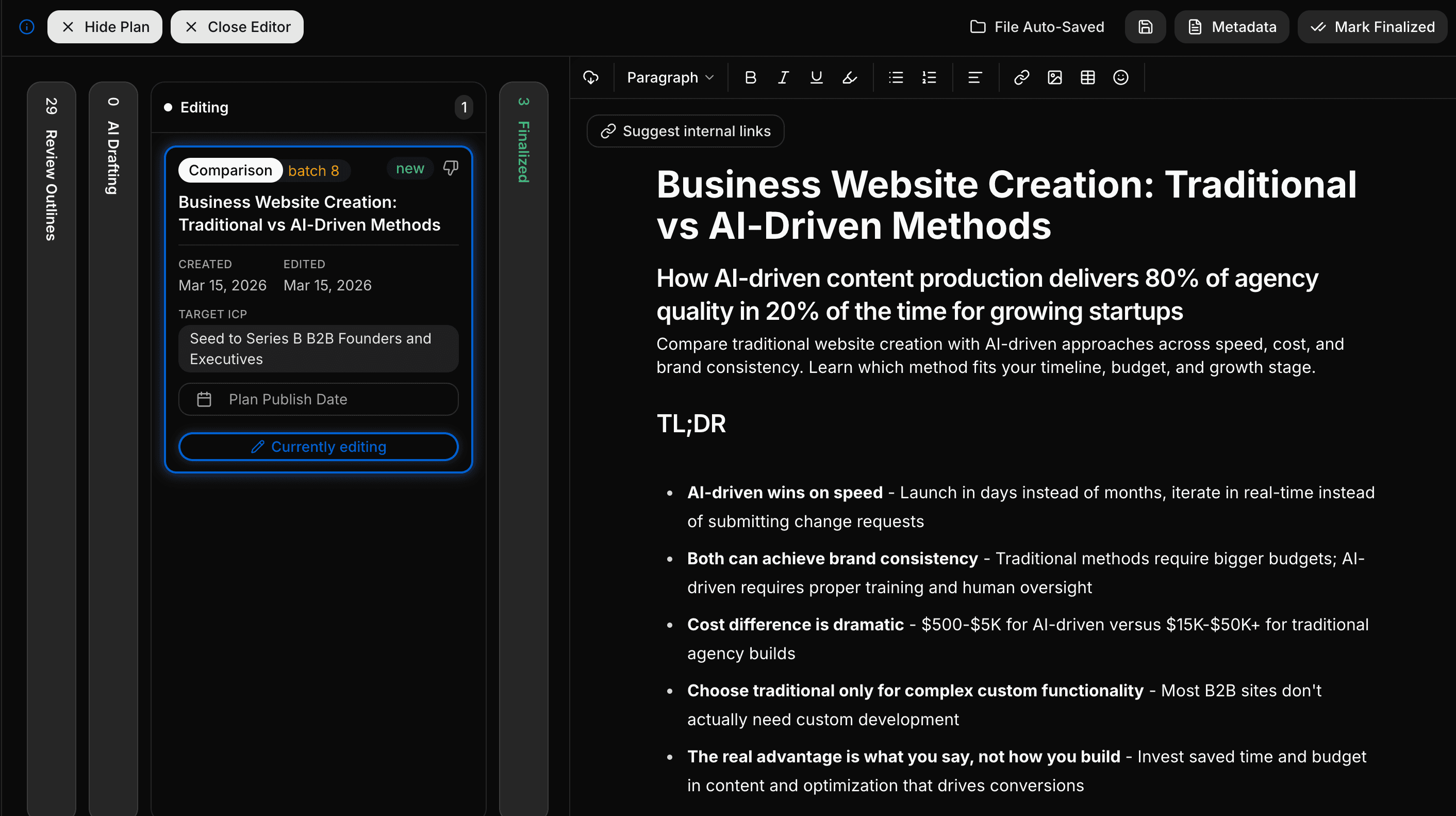
A Content Queue is the operational output of the Strategy Map — a prioritized, AI-generated pipeline of specific content recommendations ranked by opportunity.
The difference between a content calendar and a Content Queue is the difference between a to-do list and a recommendation engine.
A content calendar is a static schedule: "Publish blog post about X on Tuesday, blog post about Y on Thursday."
It doesn't adapt. It doesn't prioritize. It doesn't explain why these topics over the alternatives.
A Content Queue is a dynamic, intelligence-driven pipeline: "Based on your ICP pain points, competitive gaps, keyword opportunities, and current performance data — here are the 15 highest-impact topics you should create next, ranked by potential impact, with target keywords, search intent, content type recommendations, and strategic rationale for each."
You don't fill out a Content Queue. You approve from it.
This is the fundamental shift from traditional content marketing to proactive, AI-driven content strategy.
Instead of humans deciding what to create and AI helping write it, the system reverses: AI identifies what to create (based on data) and humans decide what to approve (based on judgment).
The human role shifts from topic generation to topic curation.
From "What should we write about?" to "Which of these validated opportunities do we publish first?"
That's not a semantic distinction. It's a workflow revolution.
What Feeds a Content Queue?
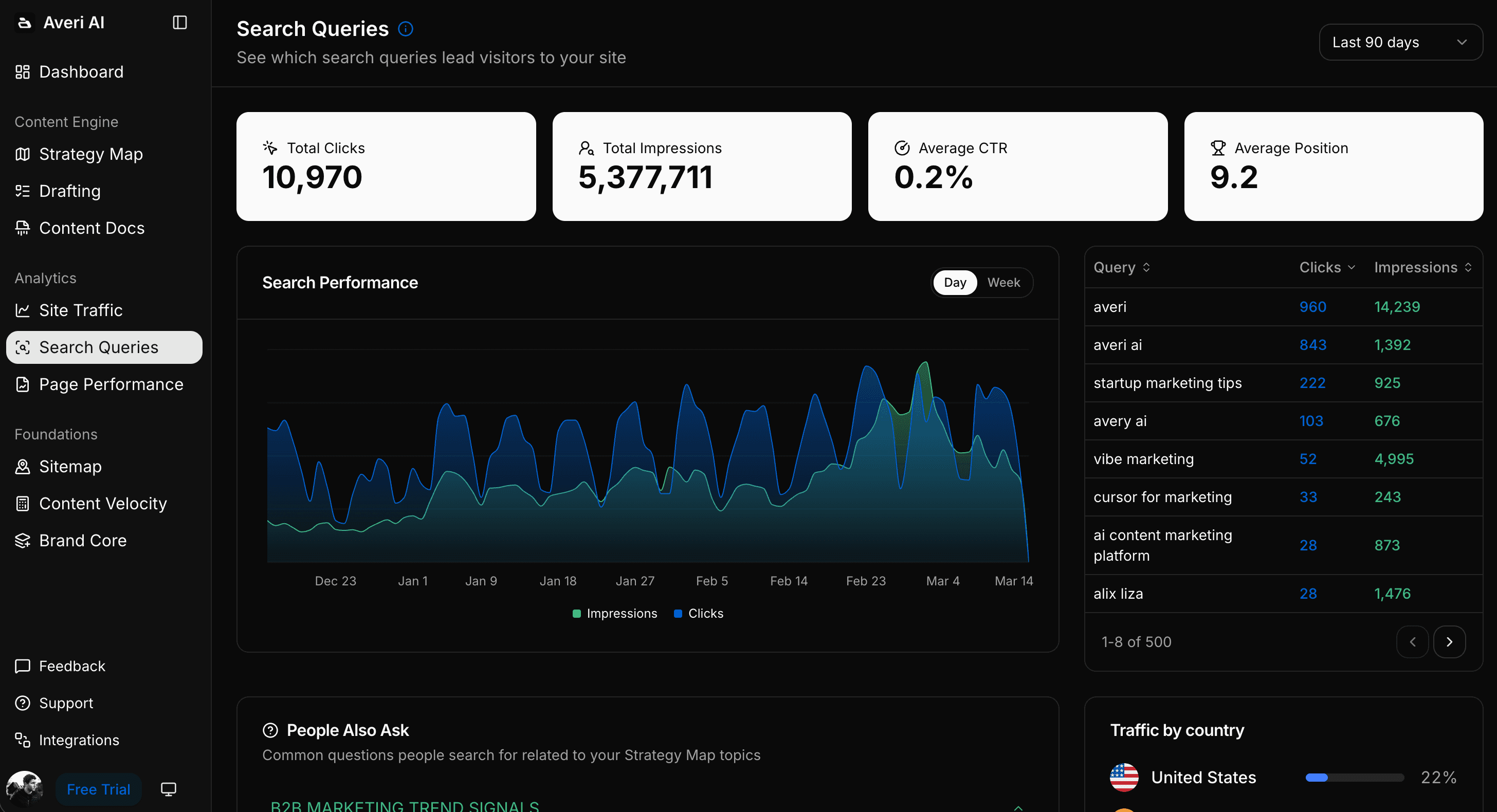
A Content Queue is only as good as the intelligence feeding it. Here's what a well-built queue ingests:
Keyword Analysis and Opportunity Scoring
Not just volume and difficulty — though those matter — but keyword-to-ICP alignment. A 5,000 monthly search volume keyword that your ICP never searches is worth less than a 200 monthly search volume keyword that maps directly to a buying decision. The queue weights search intent and audience relevance alongside traditional SEO metrics.
Competitor Content Monitoring
What are your competitors publishing? Which new keywords are they targeting? Where are they investing in pillar content or topic clusters?
More importantly, where aren't they publishing?
Gaps in competitor coverage are often the highest-ROI opportunities for startups — lower difficulty, less competition, and a chance to establish authority before anyone else does.
Trend Detection
Emerging topics in your niche before they saturate. New search queries appearing in Google Search Console data. Rising questions on platforms where your ICP spends time. Trend detection gives you first-mover advantage on topics that will matter in 60-90 days — exactly the window it takes for a well-optimized article to start ranking.
Performance History
This is the compounding intelligence.
Which of your existing topics are ranking on page 2 and could be pushed to page 1 with a supporting article? Which content types perform best for your specific audience (how-to guides vs. comparisons vs. editorials)? Which clusters are maturing and deserve deeper investment?
Performance data is the feedback loop that makes each week's queue smarter than the last.
Brand Context
Everything in the queue is filtered through your brand intelligence — ICPs, competitive positioning, strategic pillars. The queue doesn't recommend topics that any company in your space could write. It recommends topics that you should write, given your specific positioning, audience, and strategic architecture.
The Monday Morning Test
Here's the simplest way to evaluate whether you need a Content Queue:
What happens in your organization on Monday morning when it's time to decide what content to create this week?
Without a Content Queue: A meeting. A Slack thread. A brainstorm. Someone suggests a topic they saw a competitor write about. Someone else thinks a customer asked a question that could be a blog post. A third person Googles "content ideas for [industry]." Thirty minutes later, you've picked a topic that nobody's validated against search data, competitive intelligence, or strategic priorities. You start writing from a blank page with no research, no keyword target, and no understanding of how this article connects to anything else on your site.
With a Content Queue: You open the queue. Fifteen topics are ranked by opportunity. Each includes a target keyword, estimated search volume, difficulty score, search intent, content type recommendation, and the strategic pillar it supports. You review the top five, approve two, and the system begins researching and drafting immediately — with full brand context loaded, strategic rationale embedded, and optimization targets defined.
Time to first draft: minutes, not days.
Strategic alignment: guaranteed, not hoped for. The Monday morning meeting is over before it starts.
How Averi's Strategy Map and Content Queue Work
Averi maps Layer 2 of the content engine — Content Intelligence — through two integrated features that replace the blank calendar with a data-driven pipeline.
Strategy Map
After Brand Core captures your brand intelligence during onboarding, Averi generates a visual Strategy Map organized into pillars, focus areas, and topics. This isn't a static document — it's an active framework that the AI references when generating content recommendations.
The Strategy Map ensures coherence. Every topic recommendation traces back to a pillar. Every pillar maps to an ICP pain point. Every article you publish strengthens a cluster that compounds over time. You can see the architecture, adjust priorities, add emerging pillars, and understand exactly how each piece of content fits the bigger picture.
Content Queue
The Content Queue populates automatically based on keyword analysis, competitor monitoring, trend detection, and ICP alignment — all filtered through your Strategy Map and Brand Core. Topics arrive pre-validated with target keywords, search intent, content type suggestions, and strategic rationale.
You approve. The system researches and drafts. Full brand context is loaded automatically — no copy-pasting brand guidelines, no re-explaining your audience, no starting from zero.
The queue refreshes continuously. As you publish, as competitors move, as search trends shift, as your performance data accumulates — new recommendations surface. The pipeline never runs dry because the intelligence feeding it never stops updating.
The transformation: from 20 hours a week creating content to 2 hours a week curating a queue. From blank page to validated pipeline. From "What should we write?" to "Which opportunity should we capture first?"
Start building your content queue →
Related Resources
FAQs
What is a Content Queue?
A Content Queue is an AI-generated, prioritized pipeline of content recommendations. Unlike a static content calendar, a queue is dynamic — it updates continuously based on keyword opportunities, competitor activity, trend detection, and your own performance data. You approve topics from the queue rather than generating them from scratch, shifting your role from topic creator to topic curator.
How is a Strategy Map different from a content calendar?
A content calendar tells you when to publish. A Strategy Map tells you why each piece exists and how it connects to your broader authority architecture. The map organizes content into pillars, focus areas, and topic clusters that build on each other — ensuring that velocity serves strategy rather than just producing volume.
Can't I just use keyword research tools for topic selection?
You can — and keyword data should be one input. But keyword research alone doesn't account for your brand positioning, ICP pain points, competitive gaps, content performance history, or strategic pillars. A keyword tool tells you what people search for. A Content Queue tells you what you should write about, given everything the system knows about your business.
How often does the Content Queue update?
In Averi, the queue refreshes continuously as new signals come in — competitor publications, trending topics, search data shifts, and your own performance feedback. You always have a current pipeline of validated opportunities rather than a stale calendar that aged out weeks ago.
What if I disagree with a queue recommendation?
You're the curator. The queue recommends; you decide. Every recommendation includes the strategic rationale — target keyword, search volume, competitive difficulty, ICP alignment — so you can make an informed judgment. Decline what doesn't fit. The system learns from your approvals and rejections, refining future recommendations.
How does the Content Queue connect to SEO and GEO?
Every recommendation in the queue is evaluated for both traditional SEO opportunity and AI citation potential (GEO). The queue doesn't just surface topics people are searching for on Google — it identifies topics where AI search engines are actively citing sources, giving you dual-channel discovery potential from a single piece of content.
What's the relationship between Strategy Map, Content Queue, and Brand Core?
Brand Core provides the context (who you are, who you serve, who you compete against). Strategy Map provides the architecture (how your content pillars connect and reinforce each other). Content Queue provides the execution pipeline (what to create next, ranked by opportunity). Each layer feeds the next — and all three together replace the blank calendar with a system that runs on intelligence, not intuition.