The 2026 B2B Marketing Playbook for Startups With No Marketing Budget

Zach Chmael
Head of Marketing
6 minutes

In This Article
This isn't a motivational speech about bootstrapping. It's a tactical playbook for building a B2B marketing engine that generates pipeline on less than $200/month in tool costs, using the same organic growth strategies that funded startups spend $5K-$15K/month hiring agencies to execute badly.
Updated
Trusted by 1,000+ teams
Startups use Averi to build
content engines that rank.
TL;DR
💸 The highest-ROI marketing channels in 2026 are also the cheapest: content marketing, SEO, LinkedIn organic, community participation, and AI search optimization—all executable for under $200/month in tools
📊 Startups with active blogs generate 67% more leads; publishing weekly drives 3.5x more conversions than monthly—consistency beats budget
🔍 AI search visitors convert at 4.4x the rate of traditional organic—GEO optimization is the single highest-leverage "free" growth tactic for 2026
🧠 This playbook covers 7 tactics executable in 5 hours/week: positioning, content engine, SEO foundation, GEO optimization, LinkedIn organic, Reddit/community, and email capture
💰 Total tool cost: $99/month for a content engine + free tools (GSC, GA4, Screaming Frog) = under $100/month for a complete marketing operation
⏰ Expect results in 60-90 days for early signals, 6 months for compound effects—organic marketing is the long game, but it's the game that builds durable competitive advantage

Zach Chmael
CMO, Averi
"We built Averi around the exact workflow we've used to scale our web traffic over 6000% in the last 6 months."
Your content should be working harder.
Averi's content engine builds Google entity authority, drives AI citations, and scales your visibility so you can get more customers.
The 2026 B2B Marketing Playbook for Startups With No Marketing Budget
Here's a dirty secret the marketing industry doesn't want you to know… the highest-ROI marketing tactics in 2026 are the cheapest ones.
Not cheap as a euphemism for low-quality.
Cheap as in: the channels that produce the most compounding growth per dollar spent are also the channels that cost the least to execute.
I'm serious.
Content marketing costs 62% less than traditional marketing and generates 3x the leads. SEO generates more leads than any other channel for 57% of B2B firms. LinkedIn generates 80% of B2B social leads, and posting is free.
The expensive tactics—paid ads, agency retainers, event sponsorships—are the ones with linear returns… spend more, get more, stop spending, get nothing. The cheap tactics are the ones with compounding returns: invest once, compound forever.
This isn't a motivational speech about bootstrapping. It's a tactical playbook for building a B2B marketing engine that generates pipeline on less than $200/month in tool costs, using the same organic growth strategies that funded startups spend $5K-$15K/month hiring agencies to execute badly.
47% of startup founders do all their own marketing. 56% have only 1 hour or less per day for it. This playbook is for them, and it assumes exactly those constraints.

Why Does No Budget Beat Bad Budget Allocation?
This sounds counterintuitive, but founders with zero marketing budget often outperform founders with $5K-$10K/month spent poorly. Here's why.
Companies waste 42% of their content marketing budget on content that doesn't drive results. Marketing agencies at the startup price tier produce generic output with slow turnaround and terrible context retention. Paid ads without positioning burn cash on the wrong audience with the wrong message. The founder who spends $5K/month on an agency producing four blog posts that nobody reads is worse off than the founder who spends $99/month and 3 hours/week creating two deeply specific, positioning-aligned, SEO-and-GEO-optimized pieces.
Budget doesn't fix bad strategy. Budget amplifies whatever strategy you have. If the strategy is unfocused, more budget means more unfocused output at higher cost. If the strategy is sharp, even a tiny budget compounds.
This playbook starts with strategy, then shows you how to execute it for almost nothing.
Tactic 1: Nail Your Positioning Before You Create Anything
Every dollar (or hour) you spend on marketing without clear positioning is a dollar optimizing in the wrong direction. 42% of SaaS startups fail due to lack of market need. Another 14% fail from weak positioning. Together, that's more than half of startup deaths tied to the same root cause.
The positioning sprint takes 3-5 days, zero dollars, and produces the foundation everything else builds on. Talk to 5 customers. Map 5 competitors.
Write one positioning statement: "We help [specific buyer] achieve [specific outcome] through [differentiated approach]."
Use our free Brand Messaging Framework, Value Proposition Canvas, and ICP Worksheet to structure this work. Or onboard with Averi's content engine and let the AI scrape your website, generate suggested ICPs, analyze competitors, and build your Brand Core automatically in a day.
Cost: $0 (DIY) or $99/month (Averi).
Time: 3-5 days.
Impact: Everything that follows works 3-5x better.
Tactic 2: Build a Content Engine That Runs on 2-3 Hours/Week
Content marketing is the highest-ROI growth channel available to startups, period.
B2B companies see 748% ROI from SEO-driven content strategies. Startups blogging regularly generate 67% more leads. And organic search drives 26% of total website traffic, more than any other channel including paid.
The problem is execution. Most founders either try to do content themselves (unsustainable at 1 hour/day) or hire help they can't afford.
The solution is a content engine that systemizes the workflow so it runs on 2-3 hours of founder time per week.
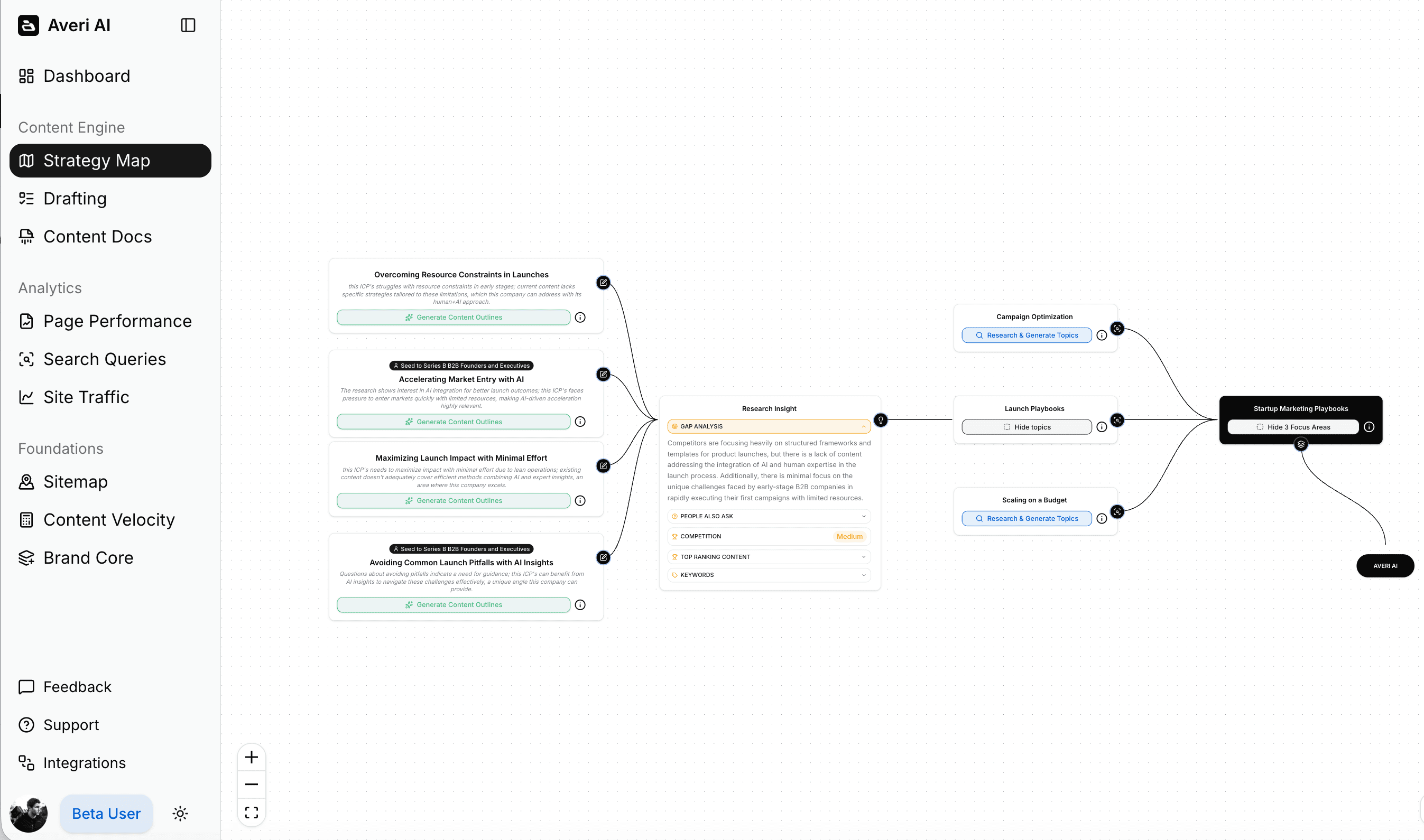
What the engine handles: strategy (Brand Core, competitor analysis, topic research), queue generation (prioritized content ideas based on keyword opportunity and ICP alignment), AI-powered drafting (structured for SEO + GEO), real-time content scoring, and native CMS publishing.
What you handle: reviewing the queue (15 min), refining drafts with your voice and expertise (20-30 min per piece), and checking analytics (15 min/week).
Publish 2-3 pieces per week. Be consistent.
Publishing weekly drives 3.5x more conversions than monthly. Consistency isn't about volume, it's about signaling to Google and AI systems that your site is active, authoritative, and worth indexing frequently.
Cost: $99/month.
Time: 2-3 hours/week.
Impact: Compounding organic traffic that grows while you sleep.
Tactic 3: Set Up Your Free SEO Foundation
Google Search Console and Google Analytics 4 are the most valuable marketing tools in existence. They're also free. Together, they tell you exactly how Google sees your site, which queries bring visitors, what happens after they arrive, and where the opportunities live.
Google Search Console: Submit your sitemap. Check the Coverage report weekly to ensure pages are indexed. Review Performance to find queries where you have high impressions but low clicks (title tag/meta description optimization opportunities). Export monthly for trend tracking. Use our SEO Reporting Template to structure the data.
GA4: Set up conversion events for your key actions (signups, demos, email captures). Create an organic search segment. Configure custom referral tracking for AI platforms (ChatGPT, Perplexity, Claude). Monitor which content drives actual business outcomes, not just traffic.
Screaming Frog Free: Run a monthly crawl (free up to 500 URLs). Fix broken links, missing meta descriptions, redirect chains, and crawl depth issues. Use our Technical SEO Audit Template to track fixes over time.
Cost: $0.
Time: 1 hour/month for setup + 30 min/month for monitoring.
Impact: The diagnostic layer that makes every other tactic data-informed instead of guess-based.

Tactic 4: Optimize Every Piece for GEO (The Biggest Free Advantage in 2026)
Here's the tactic that nobody with a small budget is doing yet, which means it's your biggest asymmetric opportunity.
25% of Google searches now trigger AI Overviews. 73% of B2B buyers use AI tools during purchasing. AI search visitors convert at 4.4x the rate of traditional organic.
GEO optimization, structuring content so AI systems cite it in their answers, costs nothing extra when it's built into your content creation process. Content with structured formatting is 28-40% more likely to be cited by LLMs. Statistics with clear attribution improve AI visibility by 28%. Research shows GEO techniques can boost visibility by up to 40%.
The specific optimizations: start every section with a 40-60 word direct answer block. Include 5+ statistics with attribution per article. Add FAQ sections to every long-form piece. Use question-based H2 headings. Implement FAQPage schema. Deploy an llms.txt file. Ensure AI crawlers aren't blocked in robots.txt.
Averi's content engine handles all of this automatically, the content scoring system weights GEO at 35% of every piece's composite score, and AI drafts come pre-structured with answer blocks, FAQ sections, and attribution formatting. If you're doing content manually, use our free GEO Optimization Checklist and llms.txt Template.
Cost: $0 (it's an optimization layer on content you're already creating).
Time: Built into your content workflow.
Impact: Access to a buyer channel that converts 4.4x better than traditional organic.
Tactic 5: Use LinkedIn as a Free Distribution Channel
80% of B2B social media leads come from LinkedIn. Inbound outreach from LinkedIn content converts at 14.6% versus 1.7% for traditional outbound. And posting is free.
You don't need to become a LinkedIn influencer. You need 3 posts per week, repurposed from the content your engine is already producing: one insight carousel, one founder POV text post, and one repurposed long-form section. Total time: 30 minutes of content creation + 45 minutes of strategic engagement = 75 minutes/week.
Document carousels get 278% more engagement than video and 596% more than text. Take a blog post, pull 8-10 key insights, put one per slide. That's your highest-performing LinkedIn format, created from content that already exists.
Averi supports LinkedIn posting within the same workflow as blog content creation. One workflow, two distribution channels, no separate social media calendar.
Cost: $0.
Time: 75 minutes/week.
Impact: Short-term pipeline conversations from the platform where your B2B buyers make purchasing decisions.

Tactic 6: Participate in Communities Where Your Buyers Ask for Help
Reddit is among the most cited websites across every major AI platform. Domains with active community presence have 4x higher chances of AI citation. And genuine community participation, not promotion, builds the kind of third-party validation that both buyers and AI systems trust.
Find 2-3 subreddits, Slack communities, or Discord servers where your target buyers congregate. Spend 20 minutes, 3 times a week, genuinely answering questions and sharing expertise.
Not promoting your product, being useful.
When someone asks a question your product solves, answer the question first, then mention your tool if it's relevant.
This builds three compounding assets simultaneously: direct pipeline from community members who discover you, Reddit content that AI systems reference when generating product recommendations, and personal credibility that makes your LinkedIn and blog content more trustworthy.
Cost: $0.
Time: 60 minutes/week.
Impact: Third-party validation signals that money can't buy.
Tactic 7: Capture Emails From Day One
Every piece of content should have an email capture mechanism, not because email marketing is your primary growth channel yet, but because building a list from day one gives you a direct communication channel that no algorithm can take away.
Create one lead magnet: a template, checklist, calculator, or toolkit genuinely useful to your ICP. Gate it behind an email form. Include a CTA in every blog post and LinkedIn post. Use our free resources hub as inspiration—431+ templates and tools designed for exactly this purpose.
Send a weekly newsletter to your list. Doesn't need to be fancy. Share your latest content, one insight from your data, and one thing you learned building your company. Consistency matters more than production value.
Cost: Free email tools exist up to 500-1,000 subscribers (Mailchimp, Beehiiv free tier).
Time: 30 minutes/week for the newsletter.
Impact: A direct audience you own, immune to algorithm changes on any platform.
The Complete Weekly Rhythm (5 Hours Total)
Here's the entire playbook compressed into a weekly schedule:
Monday (1 hour): Review your content queue. Approve 2-3 topics for the week. Check analytics dashboard and act on any flagged recommendations.
Tuesday (1.5 hours): Review and refine AI draft #1. Add voice, perspective, and specific insights. Check content scoring. Publish to CMS + create LinkedIn post from the same content.
Wednesday (1 hour): Community engagement (20 min Reddit/communities). LinkedIn engagement (15 min responding to comments, commenting on ICP content). Review and refine AI draft #2. Publish.
Thursday (1 hour): LinkedIn post #3 (carousel from week's content). Community engagement (20 min). Email newsletter draft (20 min) if it's a newsletter week.
Friday (30 min): Quick GSC check. Note any emerging opportunities or issues. Queue anything for next week.
Total: 5 hours. Output: 2-3 published blog posts (SEO + GEO optimized), 3 LinkedIn posts, 60+ minutes of community engagement, and a growing email list. All for $99/month in tool costs.
That's a complete B2B marketing operation. Without a marketing team. Without an agency. Without a budget that requires board approval.
Related Resources
If You Want to Build the Engine
If You Need Budget Guidance
If You Want SEO + GEO Strategy
7 Free SEO Tools Every Startup Should Use Before Paying for Semrush
The Complete Guide to GEO: Getting Your Brand Cited by AI Search
If You're a Solo Founder
FAQs
Can I really compete with funded startups spending $10K+/month on marketing?
On paid channels, no—they'll outbid you. On organic channels, absolutely. Organic content authority doesn't care about your funding round. It cares about content quality, consistency, specificity, and structural optimization. A seed-stage founder publishing 3 deeply specific, GEO-optimized articles per week will build more organic authority than a funded competitor publishing 8 generic pieces from an agency. 90% of ChatGPT-cited pages rank position 21 or lower in traditional Google search—the organic game has different rules than the paid game.
When should I start spending real money on marketing?
When you have data proving which channels work. The playbook in this article generates that data. After 3-6 months, you'll know which content topics drive pipeline, which keywords you rank for, which LinkedIn content generates engagement, and which community conversations lead to signups. Then you can invest confidently—putting money behind proven channels instead of guessing.
How long before I see results?
Be honest with yourself: organic marketing is a compound investment, not a switch. Early ranking signals: month 2-3 for long-tail keywords. Meaningful organic traffic: month 4-6. Compound authority effects: month 6+. AI citation results are faster—Perplexity indexes new content in hours, so well-optimized pieces can appear in AI recommendations almost immediately.
What if I'm not a good writer?
You don't need to be. The content engine handles structure, research, optimization, and first drafts. You add product knowledge, customer insight, and specific experience. The best B2B SaaS content isn't beautifully written—it's specifically useful. A founder who understands their customer's problems deeply will always out-content a professional writer who doesn't.
Should I hire a marketer instead of doing this myself?
Not yet. A marketing hire averages $83K-$137K/year depending on the role, plus 3-6 months of ramp time before they produce meaningful output. Use this playbook for 6-12 months to build your content foundation. By then, you'll know exactly what kind of marketer you need (if any)—because the data will tell you which channels drive results and which skills you're missing.
What's the single most important tactic if I can only pick one?
The content engine (Tactic 2). Everything else—SEO, GEO, LinkedIn, community, email—depends on having content to publish, optimize, distribute, and capture leads with. Without the engine producing consistent, strategic content, the other tactics have nothing to work with. Start there. Layer the rest on top as your rhythm stabilizes.
Is $99/month really enough for a complete marketing operation?
For organic marketing—yes. $99/month covers the content engine (strategy, queue, drafts, scoring, publishing, analytics). Add $0 for GSC + GA4 + Screaming Frog + LinkedIn organic + Reddit participation + email (free tier). The total operation runs for $99/month. When paid channels become relevant (typically after 6+ months of organic foundation), that's when additional budget enters the picture—but you'll be spending it on amplifying proven content, not guessing.