Your Organic Traffic Isn't Flat. It's Lagging. Here's How to Tell.
Zach Chmael

Head of Marketing

6 minutes

In This Article

Your traffic isn't flat. It's lagging. Here's the 60-120 day data lag every founder misses — and the diagnostic to tell broken from slow.

Updated

Trusted by 1,000+ teams

★★★★★ 4.9/5

Startups use Averi to build
content engines that rank.

TL;DR

  • 📉 The flat line you're seeing is almost always a data lag, not a strategy failure. Search Console reports clicks and impressions accurately, but the underlying ranking work compounds 60-120 days behind every published piece

  • 📊 Only 1.74% of new pages reach Google's top 10 within a year, down from 5.7% in 2017 — the baseline has gotten dramatically harder, and your "flat" period is statistically normal

  • 🎯 The actual diagnostic is a 6-question framework: are you publishing in the right tier, scoring above the threshold, getting indexed, ranking somewhere, building branded queries, and looking at the right time window?

  • ⚙️ At Averi, our own first 4 months looked completely flat — May 2025 closed at 17,824 monthly impressions on a brand new domain. By March 2026, we hit 2,916,225. The work was real all along; the data lagged

  • 📈 Context for the lag: 60% of Google searches now end without a click, 99.9% of informational keywords trigger an AI Overview, and the median age of pages currently ranking in the top 10 is over 2 years — the entire game has shifted to favor patient, compounding content

  • 🚨 The danger isn't the flat line. It's the founder reaction to the flat line. Most content programs get killed in months 2-4 — exactly the period when the workflow is producing compound that hasn't surfaced yet

  • 🛠 If the diagnostic confirms it's broken, the fix is almost always tier reallocation (away from head terms, toward question-shaped long-tail) rather than abandoning the workflow

Zach Chmael

CMO, Averi

"We built Averi around the exact workflow we've used to scale our web traffic over 6000% in the last 6 months."

Your content should be working harder.

Averi's content engine builds Google entity authority, drives AI citations, and scales your visibility so you can get more customers.

Your Organic Traffic Isn't Flat. It's Lagging. Here's How to Tell.

I get this DM at least twice a week.

Founder, 3-5 months into running content, looks at Search Console, sees something that vaguely resembles a flat line, and asks the same question… "Is my marketing broken or am I just publishing the wrong things?"

Here's the answer almost nobody wants to give you: probably neither. The most likely explanation is that your content is working exactly the way content works, and you're staring at the wrong metric on the wrong timeline.

In 2026, the gap between "publishing a piece" and "that piece producing meaningful organic traffic" is 60 to 120 days for most established domains, and longer for new ones.

Only 1.74% of newly published pages make it to Google's top 10 within a year — down from 5.7% in 2017. The median age of pages currently ranking in the top 10 is over two years.

The compound exists. It just doesn't show up on the timeline founders expect.

This piece is the diagnostic I wish I'd had in months 2-4 of running Averi's content engine, when I was looking at our own jagged Search Console data and almost killed the workflow. The data was lagging. The work was real. Here's how to tell which one is happening to you.

See what your Content ROI could be if you stick with it

What "flat" actually means in 2026

Let me name the specific shape founders are describing when they DM me. It's almost always one of these three patterns:

  1. The slow climb plateau. Impressions are growing, but slowly. May to August looks like 5K → 12K → 18K → 24K. To you it feels like nothing is happening because the gradient is too gentle to feel like compounding. To Google it's working as designed.

  2. The jagged plateau. Impressions bounce between 8K and 15K weekly with no clear direction. Some weeks look like a win. Others look like a crash. The eye reads "no progress" because there's no consistent up-and-to-the-right shape.

  3. The genuine flat. Impressions sit at roughly the same number for 8+ consecutive weeks with no growth in either ranked queries or impressions per query. This one is rare and usually points to a real problem.

Founders pattern-match all three to "broken."

Only the third one usually is.

The first two are how compound looks before it looks like compound.

The reason you can't tell them apart from your dashboard is that Search Console wasn't built to show you the lag.

It shows you what's happened. It doesn't show you what's pending.

And the pending — the 90-day window between publishing a piece and that piece earning meaningful impressions — is where almost all of your work currently lives.

For broader context on how the search game itself has shifted, see our click collapse playbook and our GEO Playbook 2026.
Why the lag exists (and why it got worse in 2026)

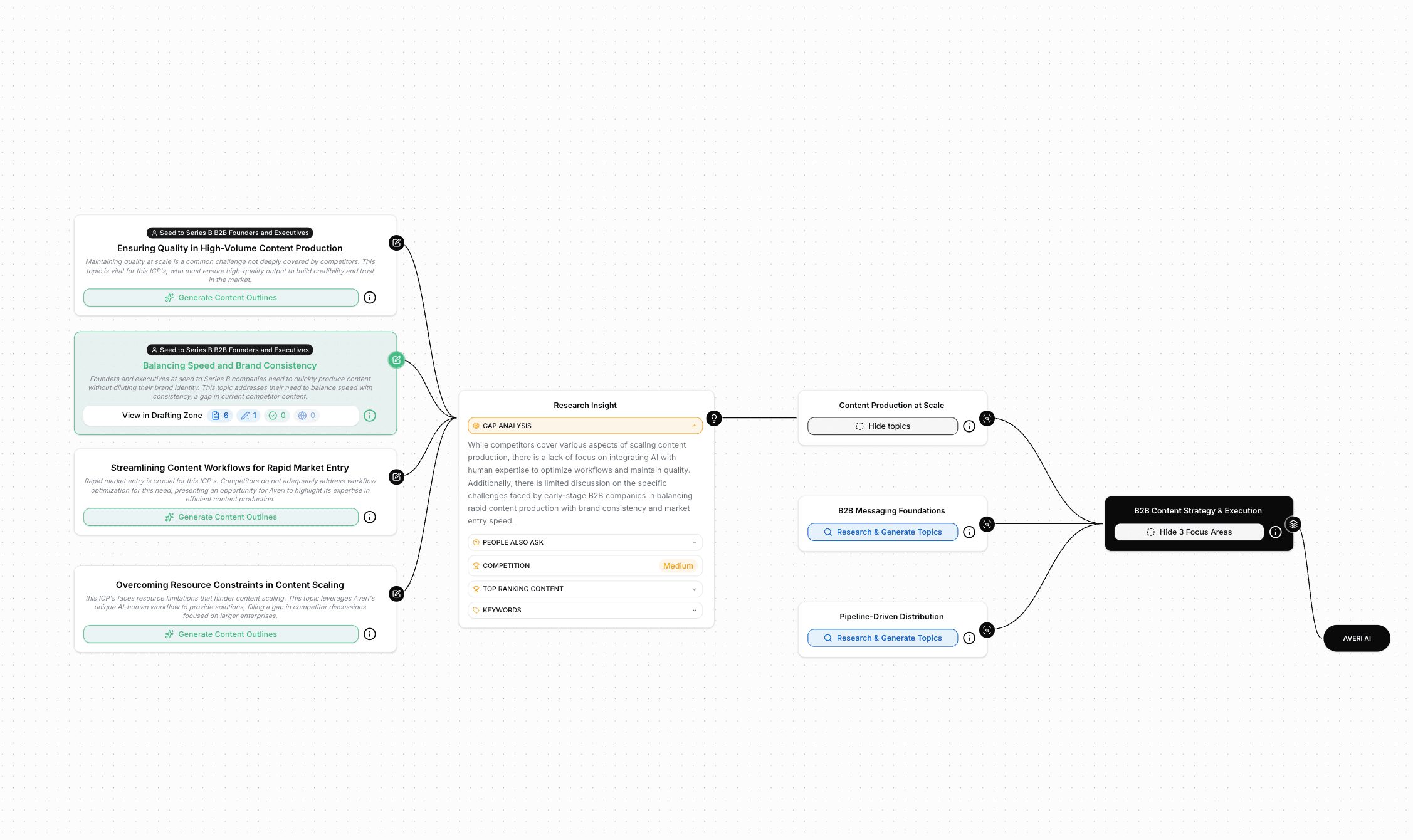
There's a multi-step chain between hitting publish and earning meaningful organic impressions. Each step has its own delay, and the delays stack:

Step 1: Crawl. Google has to discover the page. For new domains with no XML sitemap submitted to Search Console, this can take days to weeks. For established domains with regular publishing cadence, usually 24-72 hours.

Step 2: Index. Google has to decide the page is worth keeping in the index. Only 6.11% of newly created English-content pages even make it into the top 10 within a year, and a meaningful chunk of pages don't get indexed at all. This step typically resolves in 1-4 weeks for quality content on healthy domains.

Step 3: Initial ranking placement. Google tests the page across various queries to see how it performs. Position fluctuation is normal in months 1-3. The page might rank position 30 one week and position 75 the next while Google evaluates engagement signals. This is the "Google sandbox" effect that especially affects new domains.

Step 4: Ranking consolidation. If the page demonstrates engagement (low bounce, reasonable time on page, click-through from SERPs), rankings consolidate and often improve in months 5-8. This is where the compound starts.

Step 5: Stable ranking + accumulation. From month 8-18, the page either establishes a stable top-10 position or gets pushed down. If it establishes, it starts accumulating links and authority that lift the entire domain.

Total time from publish to "this is what this piece is going to do for us"6 to 18 months per piece, with meaningful early signal at 60-120 days.

Now stack that against the founder dashboard refresh habit.

If you're checking impressions weekly in months 1-3, you're not looking at the result of your work. You're looking at noise.

The work is real. The data hasn't caught up. The lag isn't a bug. It's the system.

It's also gotten worse since 2017. Only 1.74% of new pages make it to the top 10 within a year, down from 5.7% in 2017.

That's a 70% reduction in the baseline success rate over eight years.

72.9% of pages currently in Google's top 10 are more than 3 years old, and the average #1 ranking page is now 5 years old — meaning new content competes against deeply established pages with years of accumulated authority.

The gradient has gotten steeper. The patience required has gotten longer.

And the founders who quit in months 2-4 are quitting against a baseline that's harder than it used to be.

The 6-question diagnostic

If your traffic looks flat, run these six questions in order.

The first one that answers "no" is your real problem.

If all six answer "yes," your traffic isn't flat — it's lagging, and you need to wait it out.

Question 1: Am I publishing in the right tier?

Most "flat traffic" diagnoses are actually a tier problem. If you're optimizing pieces for 3-4 word head terms ("AI marketing tools," "content marketing software"), you're competing against pages with 5+ years of domain authority and hundreds of backlinks. You won't rank, and you'll pattern-match the not-ranking to "content marketing doesn't work."

The fix isn't more content. It's tier reallocation.

The pieces that compound on a young domain are tier 4 — 7+ word question-shaped queries with low individual volume but high specificity and high AI Overview trigger rates. Queries of 8 or more words trigger Google AI Overviews at 7x the rate of shorter queries, which means tier 4 content earns visibility through citation rather than ranking position.

Diagnostic check: Pull your last 20 published pieces. How many are tier 2 head terms vs tier 4 long-tail questions? If more than half are tier 2, that's your flat-line cause. Reallocate the next 20 to tier 4. For the methodology behind this, see our Question Stack guide and our 7-Word Rule piece.

Question 2: Is each piece scoring above the publish threshold?

A content engine without a quality gate produces a lot of indexed pages that don't rank for anything. If you're publishing 3 pieces a week with no scoring layer, roughly half of what you publish is below the threshold required to compound. They sit in your library, get indexed, earn nothing, and pull down your domain's average quality signal.

The fix is a composite score gate before publish.

At Averi, our floor is 80 on a composite SEO + GEO scale. Below that, the piece gets rebuilt before it ships. Above that, it earns its place in the library.

Diagnostic check: Take your 10 most recent pieces. For each, manually verify: does it have an FAQ section with FAQPage schema? Does the H2 of each section ask a verbatim buyer question? Does the answer immediately under each H2 fit in 40-60 words? Is there one specific stat or data point per 100 words? If most of these are no, scoring is your lever. For the structural patterns, see our GEO Playbook 2026 and building citation-worthy content guide.

Question 3: Is the content actually getting indexed?

Indexed pages are pages Google has decided are worth keeping in the index. Pages that aren't indexed earn zero impressions and zero clicks no matter how well they're optimized. If you're publishing into the void without checking indexation, your "flat traffic" might just be flat coverage.

The check takes 5 minutes.

Open Search Console, go to the Page Indexing report, and compare the "Indexed" count to your actual published count. If indexed < published, that's your gap. The most common reasons: missing sitemap submission, robots.txt blocking the wrong paths, canonical tags pointing to other pages, or quality signals so weak Google decided to skip the index.

Diagnostic check: Indexed pages / published pages. If the ratio is below 70%, indexation is your problem. Submit a sitemap, check robots.txt, verify canonical tags, and run any orphaned URLs through the URL Inspection Tool to request indexing manually.

Question 4: Are pieces ranking somewhere — even if not on page 1?

This is the most underused diagnostic in Search Console.

Open the Performance report. Filter by individual published page URL. Look at the average position. If pieces are ranking position 25-50 for their target keywords, you're not "flat" — you're in the consolidation phase Google uses to evaluate new content.

Pages ranking in positions 21-100 saw a 400% increase in AI Overview citations, so even page 2-3 rankings now contribute to AI search visibility. The pieces aren't dormant. They're being tested.

Diagnostic check: Pull the average position for your top 20 published pieces. If most are between 20-50 with impressions trending up week-over-week (even slowly), the workflow is working. If most are 70+ with no movement after 90 days, that's a quality issue, not a lag issue.

Question 5: Are branded queries growing?

Branded queries — anyone searching your company name in Google — are the strongest signal that your content is actually being read and remembered, even when the dashboard shows flat impressions. People who find your tier-4 content, find it useful, and later search your brand name to come back are the leading indicator of compound that hasn't yet shown up in non-branded traffic.

Open Search Console, filter Performance queries by your brand name, and compare month-over-month. If branded query volume is growing 20%+ month-over-month, your content is working — even if the impressions chart looks flat.

Diagnostic check: Branded query growth, current month vs 30 days ago. Above 20% growth: real compound is happening, just not where you're looking. Below 20%: branded discovery is weak, which usually traces back to a tier or scoring issue.

Question 6: Am I looking at a long enough time window?

A 30-day Search Console view of a 6-month-old content engine is a useless diagnostic. The compound shows up at the 90-day mark for individual pieces and the 6-month mark for the engine as a whole. If you're checking the 7-day rolling window weekly, you're going to see noise that looks like failure.

Diagnostic check: Switch your Search Console view to 6 months minimum. If you don't have 6 months of data yet, you don't have enough data to diagnose anything. Go back to publishing.
What this looked like at Averi (the receipt)

I am not going to pretend I figured all of this out before I needed to.

I went through the same panic in months 2-4 of running our own content engine.

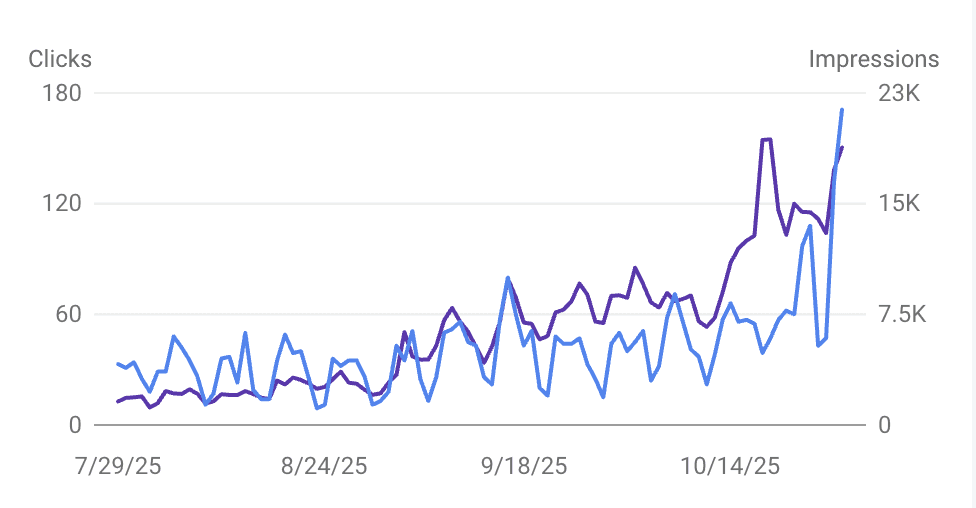
Here is what our actual Search Console looked like in the period when I was convinced it was failing:

Month

Impressions

Daily avg

April 2025 (3 days)

1,130

377

May 2025

17,824

575

June 2025

25,057

835

July 2025

39,059

1,260

August 2025

71,685

2,312

To anyone outside the workflow, that looks like steady growth.

To someone running it daily, it felt like staring into a fog.

I almost shifted budget toward paid acquisition twice during that window because the organic numbers looked broken.

Then September happened:

Month

Impressions

Daily avg

Growth vs prior

September 2025

198,256

6,609

2.77x

October 2025

381,710

12,313

1.93x

November 2025

585,915

19,530

1.53x

December 2025

802,293

25,880

1.37x

January 2026

1,682,239

54,266

2.10x

March 2026 (peak)

2,916,225

94,072

The work I did in May-August was the work that produced September.

The work I did in August-November produced January.

The lag was 60-120 days, exactly as advertised.

The pieces I was publishing in month 2 weren't underperforming — they were waiting to be discovered, indexed, ranked, tested, and consolidated.

That process took 90-120 days.

By the time the data caught up, I had three more months of work in the pipeline that hadn't surfaced yet.

If I had killed the workflow in month 3 because it "wasn't working," I would have killed the work that produced 16,261% growth.

For the full breakdown of how our workflow produced these numbers, see our 10M Impressions case study.

Common mistakes when traffic looks flat

Five patterns I see most often when founders try to diagnose a flat line themselves:

Mistake 1: Killing the workflow before it's had time to compound. This is the most expensive mistake in B2B SaaS marketing. Most founders give content marketing 90-120 days before declaring it broken. That's roughly when the compound starts. The pieces that would have produced the next 10x of traffic get abandoned in the file drawer.

Mistake 2: Adding more channels instead of fixing the bottleneck. Flat content traffic doesn't mean "diversify into paid." It means run the diagnostic. Adding paid spend on top of an unfinished content workflow doesn't fix the workflow — it just adds a parallel cost.

Mistake 3: Switching content tools or strategies every 30 days. Each tool switch resets the lag clock. If you change drafting tools, scoring criteria, or topic strategies in months 1-3, you start the 90-120 day lag over from scratch. The compound never gets a chance to surface.

Mistake 4: Chasing keyword tools' high-volume head terms. This is the single most common cause of actually flat traffic. Head terms are saturated by 5+ year old pages with hundreds of backlinks. Targeting them with new content is the SEO equivalent of starting a fight you cannot win. Tier 4 long-tail is the only path that compounds for new domains.

Mistake 5: Reading 7-day rolling windows. Search Console's default 7-day view is the wrong frame for content marketing. Switch to 6 months minimum. The trend lines look entirely different at the right scale.

What to do this week if your traffic looks flat

In the order I'd run them:

  1. Run the 6-question diagnostic above. Be honest. The first "no" is your actual problem. Don't keep diagnosing past it.

  2. Switch your Search Console view to 6 months. If the trend is truly flat at 6 months with no branded query growth, there's a real issue. If the trend is gently up or jagged, you're looking at compound, not failure.

  3. Audit your last 20 pieces for tier mix. If more than half are tier 2 head terms, reallocate the next 20 to tier 4 long-tail questions. This single reframe was probably worth half of Averi's eventual growth.

  4. Verify indexation. Indexed pages divided by published pages. Below 70%, fix indexation before doing anything else.

  5. Stop checking weekly. Move to a monthly review cadence. Weekly checking on jagged data is the fastest way to talk yourself into killing a workflow that's working.

  6. Schedule the next refresh sprint. Pages updated within the past year make up 70% of AI-cited pages. If you have content that's older than 90 days, it should be in your refresh queue, not your "this isn't working" pile.

  7. Check branded queries specifically. Filter Search Console by your brand name. Branded growth is the leading indicator of compound that hasn't surfaced in non-branded traffic yet.

That's the diagnostic. Run it once a quarter, not once a week. The compound is the system. The lag is the system. The flat line is almost always the system working as designed.

If you want this baked into your stack instead of running it manually as a quarterly project, start a free 14-day Averi trial.

Strategy Map, Content Queue, scoring, and analytics in one workflow — calibrated for the realistic timeline rather than the founder-anxiety timeline.


Related Resources

Diagnostic & Measurement

The Methodology

Real Receipts

Founder Marketing Reality

Technical Implementation

Run the diagnostic on autopilot. Averi ties Search Console, Google Analytics, and AI citation tracking into a unified view with decay detection and refresh queues built in. $99/mo, no contract, 14-day free trial. Start your free trial →

FAQs

Why does my organic traffic look flat even though I publish weekly?

Because the gap between publishing and earning meaningful impressions is 60-120 days for established domains and longer for new ones. Only 1.74% of new pages reach Google's top 10 within a year, which means your "flat" period is statistically the most common outcome — not a failure signal. The work compounds 60-120 days behind every published piece, so weekly impression checks measure lag, not performance.

How long should I wait before deciding my content marketing isn't working?

Six months minimum. The first 90 days are usually invisible (impressions stay small while Google indexes and tests pages). The visible inflection typically happens in month 5-6. If you haven't seen meaningful growth by month 9 with consistent quality publishing, that's when to run a real diagnostic. Founders who quit at month 3 almost always quit during the compound phase that hasn't yet surfaced in the dashboard.

Is Google Search Console actually showing me real-time data?

Mostly, but not always. The Performance report typically lags 2-6 hours behind real data. The Page Indexing report lags 2-4 days normally. Both reports have experienced multi-week delays in the past 12 months. For weekly content decisions, GSC is reliable. For day-to-day monitoring, it's not the right tool — Google Analytics 4 reports closer to real-time.

What does the "Google sandbox" actually do to my new domain?

The Google sandbox is the informal name for Google's evaluation period on new domains. During this period (typically 3-6 months), Google holds back rankings while it tests engagement signals on your pages. Position fluctuation is normal and expected. The sandbox doesn't mean your content is bad — it means Google hasn't decided yet. Continue publishing through the sandbox phase rather than reacting to early ranking noise.

How do I tell the difference between traffic that's lagging vs traffic that's truly broken?

Run the 6-question diagnostic in this piece. The shorthand version: if your branded queries are growing 20%+ month-over-month and your top 20 pages are ranking somewhere between positions 20-50, you're lagging, not broken. If branded queries are flat AND average rankings are 70+ AND impressions haven't moved in 6 months, you have a real problem worth investigating.

Should I use AI Overviews citations as a metric instead of organic clicks?

Yes, alongside organic clicks. AI Overviews now appear on the majority of informational queries, and getting cited inside an AI Overview drives brand awareness even without a click. Track AI citation frequency manually each week (query ChatGPT, Perplexity, and Gemini on your top 10 category questions, log who gets cited). For more on the metrics shift, see our tracking AI citations guide.

How does Averi help diagnose flat organic traffic?

Averi's Analytics layer ties Search Console + Google Analytics + AI citation tracking into a unified view, with decay detection that auto-flags pieces showing trending-down impressions and refresh queues that surface specific actions to take. The Strategy Map identifies tier-2 vs tier-4 imbalance in your library, and the Content Scoring System evaluates whether new pieces meet the 80+ composite threshold before publish. The diagnostic runs continuously rather than as a quarterly panic.


Continue Reading

The latest handpicked blog articles

Experience The AI Content Engine

Already have an account?

Join 30,000+ Founders, Marketers & Builders

Don't Feed the Algorithm

“Top 3 tech + AI newsletters in the country. Always sharp, always actionable.”

"Genuinely my favorite newsletter in tech. No fluff, no cheesy ads, just great content."

“Clear, practical, and on-point. Helps me keep up without drowning in noise.”

User-Generated Content & Authenticity in the Age of AI

Zach Chmael

Head of Marketing

6 minutes

In This Article

Your traffic isn't flat. It's lagging. Here's the 60-120 day data lag every founder misses — and the diagnostic to tell broken from slow.

Don’t Feed the Algorithm

The algorithm never sleeps, but you don’t have to feed it — Join our weekly newsletter for real insights on AI, human creativity & marketing execution.

TL;DR

  • 📉 The flat line you're seeing is almost always a data lag, not a strategy failure. Search Console reports clicks and impressions accurately, but the underlying ranking work compounds 60-120 days behind every published piece

  • 📊 Only 1.74% of new pages reach Google's top 10 within a year, down from 5.7% in 2017 — the baseline has gotten dramatically harder, and your "flat" period is statistically normal

  • 🎯 The actual diagnostic is a 6-question framework: are you publishing in the right tier, scoring above the threshold, getting indexed, ranking somewhere, building branded queries, and looking at the right time window?

  • ⚙️ At Averi, our own first 4 months looked completely flat — May 2025 closed at 17,824 monthly impressions on a brand new domain. By March 2026, we hit 2,916,225. The work was real all along; the data lagged

  • 📈 Context for the lag: 60% of Google searches now end without a click, 99.9% of informational keywords trigger an AI Overview, and the median age of pages currently ranking in the top 10 is over 2 years — the entire game has shifted to favor patient, compounding content

  • 🚨 The danger isn't the flat line. It's the founder reaction to the flat line. Most content programs get killed in months 2-4 — exactly the period when the workflow is producing compound that hasn't surfaced yet

  • 🛠 If the diagnostic confirms it's broken, the fix is almost always tier reallocation (away from head terms, toward question-shaped long-tail) rather than abandoning the workflow

"We built Averi around the exact workflow we've used to scale our web traffic over 6000% in the last 6 months."

founder-image
founder-image
Your content should be working harder.

Averi's content engine builds Google entity authority, drives AI citations, and scales your visibility so you can get more customers.

Your Organic Traffic Isn't Flat. It's Lagging. Here's How to Tell.

I get this DM at least twice a week.

Founder, 3-5 months into running content, looks at Search Console, sees something that vaguely resembles a flat line, and asks the same question… "Is my marketing broken or am I just publishing the wrong things?"

Here's the answer almost nobody wants to give you: probably neither. The most likely explanation is that your content is working exactly the way content works, and you're staring at the wrong metric on the wrong timeline.

In 2026, the gap between "publishing a piece" and "that piece producing meaningful organic traffic" is 60 to 120 days for most established domains, and longer for new ones.

Only 1.74% of newly published pages make it to Google's top 10 within a year — down from 5.7% in 2017. The median age of pages currently ranking in the top 10 is over two years.

The compound exists. It just doesn't show up on the timeline founders expect.

This piece is the diagnostic I wish I'd had in months 2-4 of running Averi's content engine, when I was looking at our own jagged Search Console data and almost killed the workflow. The data was lagging. The work was real. Here's how to tell which one is happening to you.

See what your Content ROI could be if you stick with it

What "flat" actually means in 2026

Let me name the specific shape founders are describing when they DM me. It's almost always one of these three patterns:

  1. The slow climb plateau. Impressions are growing, but slowly. May to August looks like 5K → 12K → 18K → 24K. To you it feels like nothing is happening because the gradient is too gentle to feel like compounding. To Google it's working as designed.

  2. The jagged plateau. Impressions bounce between 8K and 15K weekly with no clear direction. Some weeks look like a win. Others look like a crash. The eye reads "no progress" because there's no consistent up-and-to-the-right shape.

  3. The genuine flat. Impressions sit at roughly the same number for 8+ consecutive weeks with no growth in either ranked queries or impressions per query. This one is rare and usually points to a real problem.

Founders pattern-match all three to "broken."

Only the third one usually is.

The first two are how compound looks before it looks like compound.

The reason you can't tell them apart from your dashboard is that Search Console wasn't built to show you the lag.

It shows you what's happened. It doesn't show you what's pending.

And the pending — the 90-day window between publishing a piece and that piece earning meaningful impressions — is where almost all of your work currently lives.

For broader context on how the search game itself has shifted, see our click collapse playbook and our GEO Playbook 2026.

Why the lag exists (and why it got worse in 2026)

There's a multi-step chain between hitting publish and earning meaningful organic impressions. Each step has its own delay, and the delays stack:

Step 1: Crawl. Google has to discover the page. For new domains with no XML sitemap submitted to Search Console, this can take days to weeks. For established domains with regular publishing cadence, usually 24-72 hours.

Step 2: Index. Google has to decide the page is worth keeping in the index. Only 6.11% of newly created English-content pages even make it into the top 10 within a year, and a meaningful chunk of pages don't get indexed at all. This step typically resolves in 1-4 weeks for quality content on healthy domains.

Step 3: Initial ranking placement. Google tests the page across various queries to see how it performs. Position fluctuation is normal in months 1-3. The page might rank position 30 one week and position 75 the next while Google evaluates engagement signals. This is the "Google sandbox" effect that especially affects new domains.

Step 4: Ranking consolidation. If the page demonstrates engagement (low bounce, reasonable time on page, click-through from SERPs), rankings consolidate and often improve in months 5-8. This is where the compound starts.

Step 5: Stable ranking + accumulation. From month 8-18, the page either establishes a stable top-10 position or gets pushed down. If it establishes, it starts accumulating links and authority that lift the entire domain.

Total time from publish to "this is what this piece is going to do for us"6 to 18 months per piece, with meaningful early signal at 60-120 days.

Now stack that against the founder dashboard refresh habit.

If you're checking impressions weekly in months 1-3, you're not looking at the result of your work. You're looking at noise.

The work is real. The data hasn't caught up. The lag isn't a bug. It's the system.

It's also gotten worse since 2017. Only 1.74% of new pages make it to the top 10 within a year, down from 5.7% in 2017.

That's a 70% reduction in the baseline success rate over eight years.

72.9% of pages currently in Google's top 10 are more than 3 years old, and the average #1 ranking page is now 5 years old — meaning new content competes against deeply established pages with years of accumulated authority.

The gradient has gotten steeper. The patience required has gotten longer.

And the founders who quit in months 2-4 are quitting against a baseline that's harder than it used to be.

The 6-question diagnostic

If your traffic looks flat, run these six questions in order.

The first one that answers "no" is your real problem.

If all six answer "yes," your traffic isn't flat — it's lagging, and you need to wait it out.

Question 1: Am I publishing in the right tier?

Most "flat traffic" diagnoses are actually a tier problem. If you're optimizing pieces for 3-4 word head terms ("AI marketing tools," "content marketing software"), you're competing against pages with 5+ years of domain authority and hundreds of backlinks. You won't rank, and you'll pattern-match the not-ranking to "content marketing doesn't work."

The fix isn't more content. It's tier reallocation.

The pieces that compound on a young domain are tier 4 — 7+ word question-shaped queries with low individual volume but high specificity and high AI Overview trigger rates. Queries of 8 or more words trigger Google AI Overviews at 7x the rate of shorter queries, which means tier 4 content earns visibility through citation rather than ranking position.

Diagnostic check: Pull your last 20 published pieces. How many are tier 2 head terms vs tier 4 long-tail questions? If more than half are tier 2, that's your flat-line cause. Reallocate the next 20 to tier 4. For the methodology behind this, see our Question Stack guide and our 7-Word Rule piece.

Question 2: Is each piece scoring above the publish threshold?

A content engine without a quality gate produces a lot of indexed pages that don't rank for anything. If you're publishing 3 pieces a week with no scoring layer, roughly half of what you publish is below the threshold required to compound. They sit in your library, get indexed, earn nothing, and pull down your domain's average quality signal.

The fix is a composite score gate before publish.

At Averi, our floor is 80 on a composite SEO + GEO scale. Below that, the piece gets rebuilt before it ships. Above that, it earns its place in the library.

Diagnostic check: Take your 10 most recent pieces. For each, manually verify: does it have an FAQ section with FAQPage schema? Does the H2 of each section ask a verbatim buyer question? Does the answer immediately under each H2 fit in 40-60 words? Is there one specific stat or data point per 100 words? If most of these are no, scoring is your lever. For the structural patterns, see our GEO Playbook 2026 and building citation-worthy content guide.

Question 3: Is the content actually getting indexed?

Indexed pages are pages Google has decided are worth keeping in the index. Pages that aren't indexed earn zero impressions and zero clicks no matter how well they're optimized. If you're publishing into the void without checking indexation, your "flat traffic" might just be flat coverage.

The check takes 5 minutes.

Open Search Console, go to the Page Indexing report, and compare the "Indexed" count to your actual published count. If indexed < published, that's your gap. The most common reasons: missing sitemap submission, robots.txt blocking the wrong paths, canonical tags pointing to other pages, or quality signals so weak Google decided to skip the index.

Diagnostic check: Indexed pages / published pages. If the ratio is below 70%, indexation is your problem. Submit a sitemap, check robots.txt, verify canonical tags, and run any orphaned URLs through the URL Inspection Tool to request indexing manually.

Question 4: Are pieces ranking somewhere — even if not on page 1?

This is the most underused diagnostic in Search Console.

Open the Performance report. Filter by individual published page URL. Look at the average position. If pieces are ranking position 25-50 for their target keywords, you're not "flat" — you're in the consolidation phase Google uses to evaluate new content.

Pages ranking in positions 21-100 saw a 400% increase in AI Overview citations, so even page 2-3 rankings now contribute to AI search visibility. The pieces aren't dormant. They're being tested.

Diagnostic check: Pull the average position for your top 20 published pieces. If most are between 20-50 with impressions trending up week-over-week (even slowly), the workflow is working. If most are 70+ with no movement after 90 days, that's a quality issue, not a lag issue.

Question 5: Are branded queries growing?

Branded queries — anyone searching your company name in Google — are the strongest signal that your content is actually being read and remembered, even when the dashboard shows flat impressions. People who find your tier-4 content, find it useful, and later search your brand name to come back are the leading indicator of compound that hasn't yet shown up in non-branded traffic.

Open Search Console, filter Performance queries by your brand name, and compare month-over-month. If branded query volume is growing 20%+ month-over-month, your content is working — even if the impressions chart looks flat.

Diagnostic check: Branded query growth, current month vs 30 days ago. Above 20% growth: real compound is happening, just not where you're looking. Below 20%: branded discovery is weak, which usually traces back to a tier or scoring issue.

Question 6: Am I looking at a long enough time window?

A 30-day Search Console view of a 6-month-old content engine is a useless diagnostic. The compound shows up at the 90-day mark for individual pieces and the 6-month mark for the engine as a whole. If you're checking the 7-day rolling window weekly, you're going to see noise that looks like failure.

Diagnostic check: Switch your Search Console view to 6 months minimum. If you don't have 6 months of data yet, you don't have enough data to diagnose anything. Go back to publishing.

What this looked like at Averi (the receipt)

I am not going to pretend I figured all of this out before I needed to.

I went through the same panic in months 2-4 of running our own content engine.

Here is what our actual Search Console looked like in the period when I was convinced it was failing:

Month

Impressions

Daily avg

April 2025 (3 days)

1,130

377

May 2025

17,824

575

June 2025

25,057

835

July 2025

39,059

1,260

August 2025

71,685

2,312

To anyone outside the workflow, that looks like steady growth.

To someone running it daily, it felt like staring into a fog.

I almost shifted budget toward paid acquisition twice during that window because the organic numbers looked broken.

Then September happened:

Month

Impressions

Daily avg

Growth vs prior

September 2025

198,256

6,609

2.77x

October 2025

381,710

12,313

1.93x

November 2025

585,915

19,530

1.53x

December 2025

802,293

25,880

1.37x

January 2026

1,682,239

54,266

2.10x

March 2026 (peak)

2,916,225

94,072

The work I did in May-August was the work that produced September.

The work I did in August-November produced January.

The lag was 60-120 days, exactly as advertised.

The pieces I was publishing in month 2 weren't underperforming — they were waiting to be discovered, indexed, ranked, tested, and consolidated.

That process took 90-120 days.

By the time the data caught up, I had three more months of work in the pipeline that hadn't surfaced yet.

If I had killed the workflow in month 3 because it "wasn't working," I would have killed the work that produced 16,261% growth.

For the full breakdown of how our workflow produced these numbers, see our 10M Impressions case study.

Common mistakes when traffic looks flat

Five patterns I see most often when founders try to diagnose a flat line themselves:

Mistake 1: Killing the workflow before it's had time to compound. This is the most expensive mistake in B2B SaaS marketing. Most founders give content marketing 90-120 days before declaring it broken. That's roughly when the compound starts. The pieces that would have produced the next 10x of traffic get abandoned in the file drawer.

Mistake 2: Adding more channels instead of fixing the bottleneck. Flat content traffic doesn't mean "diversify into paid." It means run the diagnostic. Adding paid spend on top of an unfinished content workflow doesn't fix the workflow — it just adds a parallel cost.

Mistake 3: Switching content tools or strategies every 30 days. Each tool switch resets the lag clock. If you change drafting tools, scoring criteria, or topic strategies in months 1-3, you start the 90-120 day lag over from scratch. The compound never gets a chance to surface.

Mistake 4: Chasing keyword tools' high-volume head terms. This is the single most common cause of actually flat traffic. Head terms are saturated by 5+ year old pages with hundreds of backlinks. Targeting them with new content is the SEO equivalent of starting a fight you cannot win. Tier 4 long-tail is the only path that compounds for new domains.

Mistake 5: Reading 7-day rolling windows. Search Console's default 7-day view is the wrong frame for content marketing. Switch to 6 months minimum. The trend lines look entirely different at the right scale.

What to do this week if your traffic looks flat

In the order I'd run them:

  1. Run the 6-question diagnostic above. Be honest. The first "no" is your actual problem. Don't keep diagnosing past it.

  2. Switch your Search Console view to 6 months. If the trend is truly flat at 6 months with no branded query growth, there's a real issue. If the trend is gently up or jagged, you're looking at compound, not failure.

  3. Audit your last 20 pieces for tier mix. If more than half are tier 2 head terms, reallocate the next 20 to tier 4 long-tail questions. This single reframe was probably worth half of Averi's eventual growth.

  4. Verify indexation. Indexed pages divided by published pages. Below 70%, fix indexation before doing anything else.

  5. Stop checking weekly. Move to a monthly review cadence. Weekly checking on jagged data is the fastest way to talk yourself into killing a workflow that's working.

  6. Schedule the next refresh sprint. Pages updated within the past year make up 70% of AI-cited pages. If you have content that's older than 90 days, it should be in your refresh queue, not your "this isn't working" pile.

  7. Check branded queries specifically. Filter Search Console by your brand name. Branded growth is the leading indicator of compound that hasn't surfaced in non-branded traffic yet.

That's the diagnostic. Run it once a quarter, not once a week. The compound is the system. The lag is the system. The flat line is almost always the system working as designed.

If you want this baked into your stack instead of running it manually as a quarterly project, start a free 14-day Averi trial.

Strategy Map, Content Queue, scoring, and analytics in one workflow — calibrated for the realistic timeline rather than the founder-anxiety timeline.


Related Resources

Diagnostic & Measurement

The Methodology

Real Receipts

Founder Marketing Reality

Technical Implementation

Run the diagnostic on autopilot. Averi ties Search Console, Google Analytics, and AI citation tracking into a unified view with decay detection and refresh queues built in. $99/mo, no contract, 14-day free trial. Start your free trial →

Continue Reading

The latest handpicked blog articles

Join 30,000+ Founders, Marketers & Builders

Don't Feed the Algorithm

“Top 3 tech + AI newsletters in the country. Always sharp, always actionable.”

"Genuinely my favorite newsletter in tech. No fluff, no cheesy ads, just great content."

“Clear, practical, and on-point. Helps me keep up without drowning in noise.”

User-Generated Content & Authenticity in the Age of AI

Zach Chmael

Head of Marketing

6 minutes

In This Article

Your traffic isn't flat. It's lagging. Here's the 60-120 day data lag every founder misses — and the diagnostic to tell broken from slow.

Don’t Feed the Algorithm

The algorithm never sleeps, but you don’t have to feed it — Join our weekly newsletter for real insights on AI, human creativity & marketing execution.

Trusted by 1,000+ teams

★★★★★ 4.9/5

Startups use Averi to build
content engines that rank.

Your Organic Traffic Isn't Flat. It's Lagging. Here's How to Tell.

I get this DM at least twice a week.

Founder, 3-5 months into running content, looks at Search Console, sees something that vaguely resembles a flat line, and asks the same question… "Is my marketing broken or am I just publishing the wrong things?"

Here's the answer almost nobody wants to give you: probably neither. The most likely explanation is that your content is working exactly the way content works, and you're staring at the wrong metric on the wrong timeline.

In 2026, the gap between "publishing a piece" and "that piece producing meaningful organic traffic" is 60 to 120 days for most established domains, and longer for new ones.

Only 1.74% of newly published pages make it to Google's top 10 within a year — down from 5.7% in 2017. The median age of pages currently ranking in the top 10 is over two years.

The compound exists. It just doesn't show up on the timeline founders expect.

This piece is the diagnostic I wish I'd had in months 2-4 of running Averi's content engine, when I was looking at our own jagged Search Console data and almost killed the workflow. The data was lagging. The work was real. Here's how to tell which one is happening to you.

See what your Content ROI could be if you stick with it

What "flat" actually means in 2026

Let me name the specific shape founders are describing when they DM me. It's almost always one of these three patterns:

  1. The slow climb plateau. Impressions are growing, but slowly. May to August looks like 5K → 12K → 18K → 24K. To you it feels like nothing is happening because the gradient is too gentle to feel like compounding. To Google it's working as designed.

  2. The jagged plateau. Impressions bounce between 8K and 15K weekly with no clear direction. Some weeks look like a win. Others look like a crash. The eye reads "no progress" because there's no consistent up-and-to-the-right shape.

  3. The genuine flat. Impressions sit at roughly the same number for 8+ consecutive weeks with no growth in either ranked queries or impressions per query. This one is rare and usually points to a real problem.

Founders pattern-match all three to "broken."

Only the third one usually is.

The first two are how compound looks before it looks like compound.

The reason you can't tell them apart from your dashboard is that Search Console wasn't built to show you the lag.

It shows you what's happened. It doesn't show you what's pending.

And the pending — the 90-day window between publishing a piece and that piece earning meaningful impressions — is where almost all of your work currently lives.

For broader context on how the search game itself has shifted, see our click collapse playbook and our GEO Playbook 2026.

Why the lag exists (and why it got worse in 2026)

There's a multi-step chain between hitting publish and earning meaningful organic impressions. Each step has its own delay, and the delays stack:

Step 1: Crawl. Google has to discover the page. For new domains with no XML sitemap submitted to Search Console, this can take days to weeks. For established domains with regular publishing cadence, usually 24-72 hours.

Step 2: Index. Google has to decide the page is worth keeping in the index. Only 6.11% of newly created English-content pages even make it into the top 10 within a year, and a meaningful chunk of pages don't get indexed at all. This step typically resolves in 1-4 weeks for quality content on healthy domains.

Step 3: Initial ranking placement. Google tests the page across various queries to see how it performs. Position fluctuation is normal in months 1-3. The page might rank position 30 one week and position 75 the next while Google evaluates engagement signals. This is the "Google sandbox" effect that especially affects new domains.

Step 4: Ranking consolidation. If the page demonstrates engagement (low bounce, reasonable time on page, click-through from SERPs), rankings consolidate and often improve in months 5-8. This is where the compound starts.

Step 5: Stable ranking + accumulation. From month 8-18, the page either establishes a stable top-10 position or gets pushed down. If it establishes, it starts accumulating links and authority that lift the entire domain.

Total time from publish to "this is what this piece is going to do for us"6 to 18 months per piece, with meaningful early signal at 60-120 days.

Now stack that against the founder dashboard refresh habit.

If you're checking impressions weekly in months 1-3, you're not looking at the result of your work. You're looking at noise.

The work is real. The data hasn't caught up. The lag isn't a bug. It's the system.

It's also gotten worse since 2017. Only 1.74% of new pages make it to the top 10 within a year, down from 5.7% in 2017.

That's a 70% reduction in the baseline success rate over eight years.

72.9% of pages currently in Google's top 10 are more than 3 years old, and the average #1 ranking page is now 5 years old — meaning new content competes against deeply established pages with years of accumulated authority.

The gradient has gotten steeper. The patience required has gotten longer.

And the founders who quit in months 2-4 are quitting against a baseline that's harder than it used to be.

The 6-question diagnostic

If your traffic looks flat, run these six questions in order.

The first one that answers "no" is your real problem.

If all six answer "yes," your traffic isn't flat — it's lagging, and you need to wait it out.

Question 1: Am I publishing in the right tier?

Most "flat traffic" diagnoses are actually a tier problem. If you're optimizing pieces for 3-4 word head terms ("AI marketing tools," "content marketing software"), you're competing against pages with 5+ years of domain authority and hundreds of backlinks. You won't rank, and you'll pattern-match the not-ranking to "content marketing doesn't work."

The fix isn't more content. It's tier reallocation.

The pieces that compound on a young domain are tier 4 — 7+ word question-shaped queries with low individual volume but high specificity and high AI Overview trigger rates. Queries of 8 or more words trigger Google AI Overviews at 7x the rate of shorter queries, which means tier 4 content earns visibility through citation rather than ranking position.

Diagnostic check: Pull your last 20 published pieces. How many are tier 2 head terms vs tier 4 long-tail questions? If more than half are tier 2, that's your flat-line cause. Reallocate the next 20 to tier 4. For the methodology behind this, see our Question Stack guide and our 7-Word Rule piece.

Question 2: Is each piece scoring above the publish threshold?

A content engine without a quality gate produces a lot of indexed pages that don't rank for anything. If you're publishing 3 pieces a week with no scoring layer, roughly half of what you publish is below the threshold required to compound. They sit in your library, get indexed, earn nothing, and pull down your domain's average quality signal.

The fix is a composite score gate before publish.

At Averi, our floor is 80 on a composite SEO + GEO scale. Below that, the piece gets rebuilt before it ships. Above that, it earns its place in the library.

Diagnostic check: Take your 10 most recent pieces. For each, manually verify: does it have an FAQ section with FAQPage schema? Does the H2 of each section ask a verbatim buyer question? Does the answer immediately under each H2 fit in 40-60 words? Is there one specific stat or data point per 100 words? If most of these are no, scoring is your lever. For the structural patterns, see our GEO Playbook 2026 and building citation-worthy content guide.

Question 3: Is the content actually getting indexed?

Indexed pages are pages Google has decided are worth keeping in the index. Pages that aren't indexed earn zero impressions and zero clicks no matter how well they're optimized. If you're publishing into the void without checking indexation, your "flat traffic" might just be flat coverage.

The check takes 5 minutes.

Open Search Console, go to the Page Indexing report, and compare the "Indexed" count to your actual published count. If indexed < published, that's your gap. The most common reasons: missing sitemap submission, robots.txt blocking the wrong paths, canonical tags pointing to other pages, or quality signals so weak Google decided to skip the index.

Diagnostic check: Indexed pages / published pages. If the ratio is below 70%, indexation is your problem. Submit a sitemap, check robots.txt, verify canonical tags, and run any orphaned URLs through the URL Inspection Tool to request indexing manually.

Question 4: Are pieces ranking somewhere — even if not on page 1?

This is the most underused diagnostic in Search Console.

Open the Performance report. Filter by individual published page URL. Look at the average position. If pieces are ranking position 25-50 for their target keywords, you're not "flat" — you're in the consolidation phase Google uses to evaluate new content.

Pages ranking in positions 21-100 saw a 400% increase in AI Overview citations, so even page 2-3 rankings now contribute to AI search visibility. The pieces aren't dormant. They're being tested.

Diagnostic check: Pull the average position for your top 20 published pieces. If most are between 20-50 with impressions trending up week-over-week (even slowly), the workflow is working. If most are 70+ with no movement after 90 days, that's a quality issue, not a lag issue.

Question 5: Are branded queries growing?

Branded queries — anyone searching your company name in Google — are the strongest signal that your content is actually being read and remembered, even when the dashboard shows flat impressions. People who find your tier-4 content, find it useful, and later search your brand name to come back are the leading indicator of compound that hasn't yet shown up in non-branded traffic.

Open Search Console, filter Performance queries by your brand name, and compare month-over-month. If branded query volume is growing 20%+ month-over-month, your content is working — even if the impressions chart looks flat.

Diagnostic check: Branded query growth, current month vs 30 days ago. Above 20% growth: real compound is happening, just not where you're looking. Below 20%: branded discovery is weak, which usually traces back to a tier or scoring issue.

Question 6: Am I looking at a long enough time window?

A 30-day Search Console view of a 6-month-old content engine is a useless diagnostic. The compound shows up at the 90-day mark for individual pieces and the 6-month mark for the engine as a whole. If you're checking the 7-day rolling window weekly, you're going to see noise that looks like failure.

Diagnostic check: Switch your Search Console view to 6 months minimum. If you don't have 6 months of data yet, you don't have enough data to diagnose anything. Go back to publishing.

What this looked like at Averi (the receipt)

I am not going to pretend I figured all of this out before I needed to.

I went through the same panic in months 2-4 of running our own content engine.

Here is what our actual Search Console looked like in the period when I was convinced it was failing:

Month

Impressions

Daily avg

April 2025 (3 days)

1,130

377

May 2025

17,824

575

June 2025

25,057

835

July 2025

39,059

1,260

August 2025

71,685

2,312

To anyone outside the workflow, that looks like steady growth.

To someone running it daily, it felt like staring into a fog.

I almost shifted budget toward paid acquisition twice during that window because the organic numbers looked broken.

Then September happened:

Month

Impressions

Daily avg

Growth vs prior

September 2025

198,256

6,609

2.77x

October 2025

381,710

12,313

1.93x

November 2025

585,915

19,530

1.53x

December 2025

802,293

25,880

1.37x

January 2026

1,682,239

54,266

2.10x

March 2026 (peak)

2,916,225

94,072

The work I did in May-August was the work that produced September.

The work I did in August-November produced January.

The lag was 60-120 days, exactly as advertised.

The pieces I was publishing in month 2 weren't underperforming — they were waiting to be discovered, indexed, ranked, tested, and consolidated.

That process took 90-120 days.

By the time the data caught up, I had three more months of work in the pipeline that hadn't surfaced yet.

If I had killed the workflow in month 3 because it "wasn't working," I would have killed the work that produced 16,261% growth.

For the full breakdown of how our workflow produced these numbers, see our 10M Impressions case study.

Common mistakes when traffic looks flat

Five patterns I see most often when founders try to diagnose a flat line themselves:

Mistake 1: Killing the workflow before it's had time to compound. This is the most expensive mistake in B2B SaaS marketing. Most founders give content marketing 90-120 days before declaring it broken. That's roughly when the compound starts. The pieces that would have produced the next 10x of traffic get abandoned in the file drawer.

Mistake 2: Adding more channels instead of fixing the bottleneck. Flat content traffic doesn't mean "diversify into paid." It means run the diagnostic. Adding paid spend on top of an unfinished content workflow doesn't fix the workflow — it just adds a parallel cost.

Mistake 3: Switching content tools or strategies every 30 days. Each tool switch resets the lag clock. If you change drafting tools, scoring criteria, or topic strategies in months 1-3, you start the 90-120 day lag over from scratch. The compound never gets a chance to surface.

Mistake 4: Chasing keyword tools' high-volume head terms. This is the single most common cause of actually flat traffic. Head terms are saturated by 5+ year old pages with hundreds of backlinks. Targeting them with new content is the SEO equivalent of starting a fight you cannot win. Tier 4 long-tail is the only path that compounds for new domains.

Mistake 5: Reading 7-day rolling windows. Search Console's default 7-day view is the wrong frame for content marketing. Switch to 6 months minimum. The trend lines look entirely different at the right scale.

What to do this week if your traffic looks flat

In the order I'd run them:

  1. Run the 6-question diagnostic above. Be honest. The first "no" is your actual problem. Don't keep diagnosing past it.

  2. Switch your Search Console view to 6 months. If the trend is truly flat at 6 months with no branded query growth, there's a real issue. If the trend is gently up or jagged, you're looking at compound, not failure.

  3. Audit your last 20 pieces for tier mix. If more than half are tier 2 head terms, reallocate the next 20 to tier 4 long-tail questions. This single reframe was probably worth half of Averi's eventual growth.

  4. Verify indexation. Indexed pages divided by published pages. Below 70%, fix indexation before doing anything else.

  5. Stop checking weekly. Move to a monthly review cadence. Weekly checking on jagged data is the fastest way to talk yourself into killing a workflow that's working.

  6. Schedule the next refresh sprint. Pages updated within the past year make up 70% of AI-cited pages. If you have content that's older than 90 days, it should be in your refresh queue, not your "this isn't working" pile.

  7. Check branded queries specifically. Filter Search Console by your brand name. Branded growth is the leading indicator of compound that hasn't surfaced in non-branded traffic yet.

That's the diagnostic. Run it once a quarter, not once a week. The compound is the system. The lag is the system. The flat line is almost always the system working as designed.

If you want this baked into your stack instead of running it manually as a quarterly project, start a free 14-day Averi trial.

Strategy Map, Content Queue, scoring, and analytics in one workflow — calibrated for the realistic timeline rather than the founder-anxiety timeline.


Related Resources

Diagnostic & Measurement

The Methodology

Real Receipts

Founder Marketing Reality

Technical Implementation

Run the diagnostic on autopilot. Averi ties Search Console, Google Analytics, and AI citation tracking into a unified view with decay detection and refresh queues built in. $99/mo, no contract, 14-day free trial. Start your free trial →

"We built Averi around the exact workflow we've used to scale our web traffic over 6000% in the last 6 months."

founder-image
founder-image
Your content should be working harder.

Averi's content engine builds Google entity authority, drives AI citations, and scales your visibility so you can get more customers.

FAQs

Averi's Analytics layer ties Search Console + Google Analytics + AI citation tracking into a unified view, with decay detection that auto-flags pieces showing trending-down impressions and refresh queues that surface specific actions to take. The Strategy Map identifies tier-2 vs tier-4 imbalance in your library, and the Content Scoring System evaluates whether new pieces meet the 80+ composite threshold before publish. The diagnostic runs continuously rather than as a quarterly panic.

How does Averi help diagnose flat organic traffic?

Yes, alongside organic clicks. AI Overviews now appear on the majority of informational queries, and getting cited inside an AI Overview drives brand awareness even without a click. Track AI citation frequency manually each week (query ChatGPT, Perplexity, and Gemini on your top 10 category questions, log who gets cited). For more on the metrics shift, see our tracking AI citations guide.

Should I use AI Overviews citations as a metric instead of organic clicks?

Run the 6-question diagnostic in this piece. The shorthand version: if your branded queries are growing 20%+ month-over-month and your top 20 pages are ranking somewhere between positions 20-50, you're lagging, not broken. If branded queries are flat AND average rankings are 70+ AND impressions haven't moved in 6 months, you have a real problem worth investigating.

How do I tell the difference between traffic that's lagging vs traffic that's truly broken?

The Google sandbox is the informal name for Google's evaluation period on new domains. During this period (typically 3-6 months), Google holds back rankings while it tests engagement signals on your pages. Position fluctuation is normal and expected. The sandbox doesn't mean your content is bad — it means Google hasn't decided yet. Continue publishing through the sandbox phase rather than reacting to early ranking noise.

What does the "Google sandbox" actually do to my new domain?

Mostly, but not always. The Performance report typically lags 2-6 hours behind real data. The Page Indexing report lags 2-4 days normally. Both reports have experienced multi-week delays in the past 12 months. For weekly content decisions, GSC is reliable. For day-to-day monitoring, it's not the right tool — Google Analytics 4 reports closer to real-time.

Is Google Search Console actually showing me real-time data?

Six months minimum. The first 90 days are usually invisible (impressions stay small while Google indexes and tests pages). The visible inflection typically happens in month 5-6. If you haven't seen meaningful growth by month 9 with consistent quality publishing, that's when to run a real diagnostic. Founders who quit at month 3 almost always quit during the compound phase that hasn't yet surfaced in the dashboard.

How long should I wait before deciding my content marketing isn't working?

Because the gap between publishing and earning meaningful impressions is 60-120 days for established domains and longer for new ones. Only 1.74% of new pages reach Google's top 10 within a year, which means your "flat" period is statistically the most common outcome — not a failure signal. The work compounds 60-120 days behind every published piece, so weekly impression checks measure lag, not performance.

Why does my organic traffic look flat even though I publish weekly?

FAQs

How long does it take to see SEO results for B2B SaaS?

Expect 7 months to break-even on average, with meaningful traffic improvements typically appearing within 3-6 months. Link building results appear within 1-6 months. The key is consistency—companies that stop and start lose ground to those who execute continuously.

Is AI-generated content actually good for SEO?

62% of marketers report higher SERP rankings for AI-generated content—but only when properly edited and enhanced with human expertise. Pure AI content without human refinement often lacks the originality and depth that both readers and algorithms prefer.

Is AI-generated content actually good for SEO?

62% of marketers report higher SERP rankings for AI-generated content—but only when properly edited and enhanced with human expertise. Pure AI content without human refinement often lacks the originality and depth that both readers and algorithms prefer.

Is AI-generated content actually good for SEO?

62% of marketers report higher SERP rankings for AI-generated content—but only when properly edited and enhanced with human expertise. Pure AI content without human refinement often lacks the originality and depth that both readers and algorithms prefer.

Is AI-generated content actually good for SEO?

62% of marketers report higher SERP rankings for AI-generated content—but only when properly edited and enhanced with human expertise. Pure AI content without human refinement often lacks the originality and depth that both readers and algorithms prefer.

Is AI-generated content actually good for SEO?

62% of marketers report higher SERP rankings for AI-generated content—but only when properly edited and enhanced with human expertise. Pure AI content without human refinement often lacks the originality and depth that both readers and algorithms prefer.

Is AI-generated content actually good for SEO?

62% of marketers report higher SERP rankings for AI-generated content—but only when properly edited and enhanced with human expertise. Pure AI content without human refinement often lacks the originality and depth that both readers and algorithms prefer.

Is AI-generated content actually good for SEO?

62% of marketers report higher SERP rankings for AI-generated content—but only when properly edited and enhanced with human expertise. Pure AI content without human refinement often lacks the originality and depth that both readers and algorithms prefer.

TL;DR

  • 📉 The flat line you're seeing is almost always a data lag, not a strategy failure. Search Console reports clicks and impressions accurately, but the underlying ranking work compounds 60-120 days behind every published piece

  • 📊 Only 1.74% of new pages reach Google's top 10 within a year, down from 5.7% in 2017 — the baseline has gotten dramatically harder, and your "flat" period is statistically normal

  • 🎯 The actual diagnostic is a 6-question framework: are you publishing in the right tier, scoring above the threshold, getting indexed, ranking somewhere, building branded queries, and looking at the right time window?

  • ⚙️ At Averi, our own first 4 months looked completely flat — May 2025 closed at 17,824 monthly impressions on a brand new domain. By March 2026, we hit 2,916,225. The work was real all along; the data lagged

  • 📈 Context for the lag: 60% of Google searches now end without a click, 99.9% of informational keywords trigger an AI Overview, and the median age of pages currently ranking in the top 10 is over 2 years — the entire game has shifted to favor patient, compounding content

  • 🚨 The danger isn't the flat line. It's the founder reaction to the flat line. Most content programs get killed in months 2-4 — exactly the period when the workflow is producing compound that hasn't surfaced yet

  • 🛠 If the diagnostic confirms it's broken, the fix is almost always tier reallocation (away from head terms, toward question-shaped long-tail) rather than abandoning the workflow

Continue Reading

The latest handpicked blog articles

Join 30,000+ Founders, Marketers & Builders

Don't Feed the Algorithm

“Top 3 tech + AI newsletters in the country. Always sharp, always actionable.”

"Genuinely my favorite newsletter in tech. No fluff, no cheesy ads, just great content."

“Clear, practical, and on-point. Helps me keep up without drowning in noise.”

How strong is your content engine? Find out in 30 seconds.

Maybe later