The Founder's Content Operating System: 5 Hours a Week, 10x Output
7 minutes

TL;DR
🎯 The 5-hour-per-week operating model: 60 min Monday strategic input, 90 min LinkedIn posting (3 posts at 30 min each), 60 min newsletter writing, 60 min blog input/editing, 30 min daily engagement. Anything beyond 5 hours and the founder burns out within 6-8 weeks.
📅 The Monday morning ritual is the linchpin. 60 minutes that sets the week's thesis, identifies 3-5 angles, and decides what every other block produces. Skip Monday and every other block takes 3x longer because there's no thesis driving it.
⚡ Output: 3 LinkedIn posts + 1 newsletter + 1 blog input/edit per week. Roughly 200 LinkedIn posts, 40 newsletter editions, and 50 founder-shaped blog posts per year. Enough volume to compound; not so much that it crushes the founder.
🛠️ 3 tools that matter: a notes app for capture (Apple Notes/Notion), a draft tool (Averi for blog/newsletter/LinkedIn drafts that match your voice), a scheduler (Buffer/Hypefury for LinkedIn).
🚨 The biggest failure mode isn't running out of time — it's skipping Monday's strategic input and trying to produce content reactively. Reactive content takes 3x longer per piece, drops 50%+ in quality, and burns out the founder within a quarter.

Zach Chmael
CMO, Averi
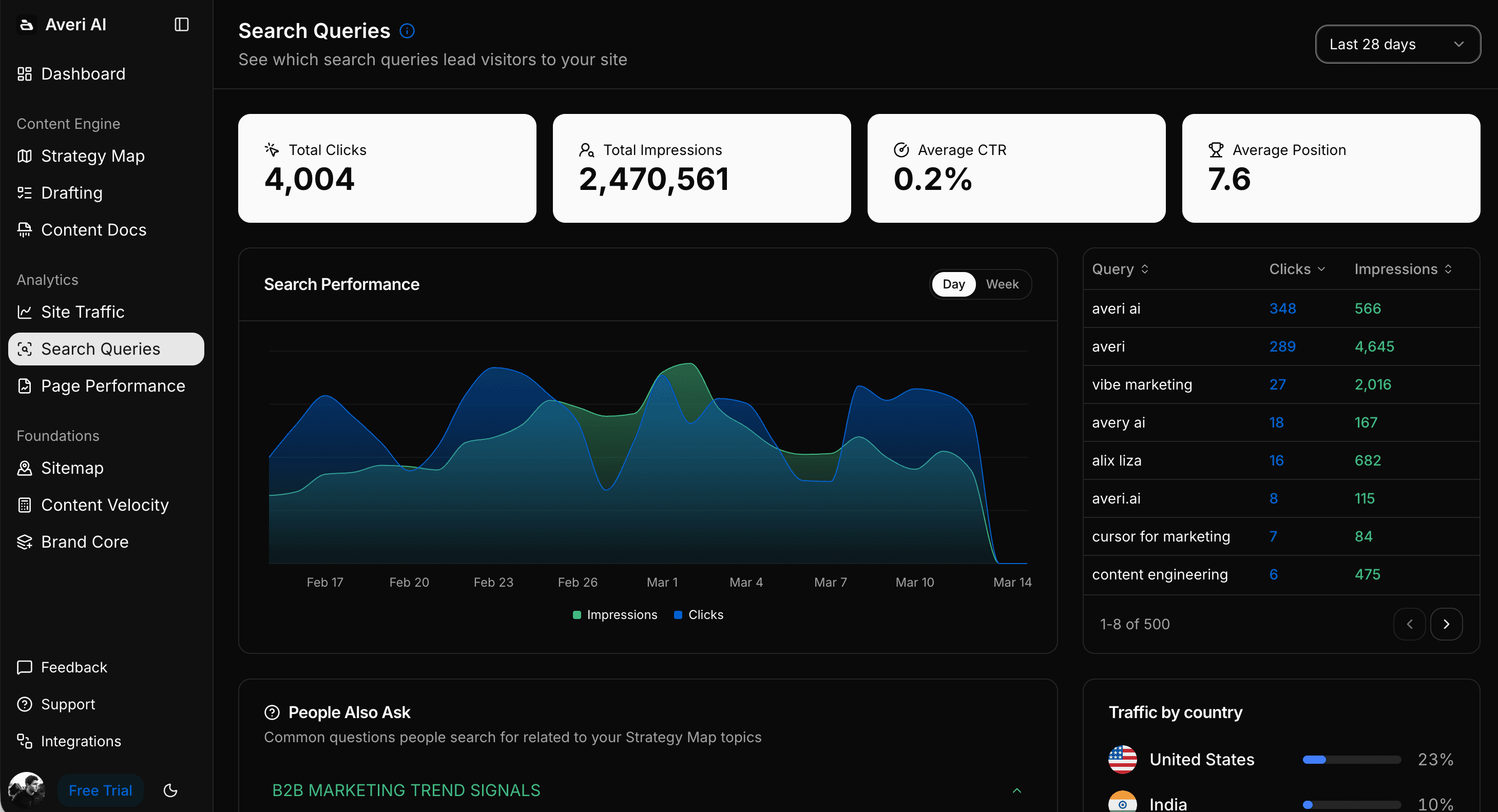
"We built Averi around the exact workflow we've used to scale our web traffic over 6000% in the last 6 months."
Your content should be working harder.
Averi's content engine builds Google entity authority, drives AI citations, and scales your visibility so you can get more customers.
The Founder's Content Operating System: 5 Hours a Week, 10x Output
Most founders try content marketing in one of two modes.
Mode 1: spurt-and-collapse — they write 8 LinkedIn posts in a weekend, ship 2 blog posts in a week, then disappear for a month.
Mode 2: aspirational overcommitment — they block 15 hours a week for content, hit it for 6-8 weeks, burn out, and revert to 0 hours.
Both modes produce the same outcome: no compounding.
The LinkedIn algorithm forgets you. The newsletter loses subscribers from the gap weeks. The blog drops in search rankings. Whatever momentum the bursts produced gets erased by the silence that follows.
The fix isn't more discipline or more hours. It's a system that fits into 5 hours per week, every week, indefinitely. Same time slots. Same activities. Same outputs. Boring, repeatable, sustainable.
This piece is that system. The exact 5-hour weekly schedule. What happens in each block. The Monday morning ritual that makes the whole week work. Tools and templates. The specific failure modes that break the system and how to recover from them. When the system stops being enough and you need a content engine handoff.
For the strategic context on why founder-led content is the right move, see The Founder-Led Content Marketing Playbook.
See what your Founder-Led Content ROI could be
What Is the Founder Content Operating System?
The founder content operating system is a fixed weekly schedule of time blocks, activities, and outputs that lets a founder produce sustained content marketing in 5 hours per week.
It includes a Monday morning strategic input session that drives the week's thesis, three LinkedIn posting blocks, one newsletter writing block, one blog input/editing block, and daily 5-minute engagement windows.
The system is designed for sustainability over years, not productivity over months — the goal is producing the same outputs every week indefinitely, not maximum output in any single week.
The "operating system" framing matters because most content advice treats production as a series of one-off decisions ("what should I write about today?").
Operating systems remove decisions by automating them into routines.
Founders running the OS don't decide whether to post on Monday — they post on Monday. They don't decide what their thesis is each week — they choose from a pre-built backlog they refresh quarterly.
Decision-removal is the discipline. Every decision the founder doesn't have to make is an hour of energy preserved for actual content production.
Why 5 Hours Is the Magic Number
5 hours per week is not arbitrary. It's the empirically-validated ceiling for sustained founder content production across hundreds of seed-to-Series A B2B SaaS companies.
The math at lower hour counts
1-2 hours per week: Sub-threshold. Founder produces 1-2 LinkedIn posts and nothing else. The volume isn't enough for the LinkedIn algorithm to reward consistency. No newsletter cadence forms. Blog gets neglected. Compounding never starts.
3-4 hours per week: Producing but inconsistent. Founder ships 2 LinkedIn posts and either a newsletter OR a blog input — not both. Some weeks one channel works, other weeks another. The compounding effect is partial because no single channel hits the consistency threshold needed to compound.
5 hours per week: The threshold where all three primary channels (LinkedIn, newsletter, blog) get enough cadence to compound simultaneously. 3 LinkedIn posts is the LinkedIn algorithm's preferred minimum for sustained reach. One newsletter per week (or biweekly) maintains subscriber engagement. One blog input keeps the company blog moving without crushing the founder.
The math at higher hour counts
6-8 hours per week: Sustainable for 12-16 weeks. Founder produces measurably more content but at the cost of other priorities (sales calls, product input, fundraising). Quality often drops because the marginal hour produces marginal content.
9-12 hours per week: Sustainable for 6-10 weeks. Founder is essentially running a part-time content marketing job. Burnout begins showing in week 8-10. Founder reverts to lower hours, and the compounding resets because the cadence broke.
12+ hours per week: Sustainable for 4-6 weeks. The founder is doing content marketing instead of being a founder. This works for content-creator businesses where content IS the product. It doesn't work for B2B SaaS founders who need to run companies.
The 5-hour model is the sweet spot because it produces enough volume to compound across all three channels without crowding out the actual job of being a founder.
The Weekly Schedule (Block by Block)
Five activities, five distinct time blocks, fixed across the week.
Day/Time | Activity | Duration | Output |
|---|---|---|---|
Monday 8-9 AM | Strategic input ritual | 60 min | Week's thesis + 3-5 angles + content backlog refresh |
Monday 9-9:30 AM | LinkedIn post 1 | 30 min | 1 LinkedIn post published |
Tuesday or Thursday 4-5 PM | Blog input/editing | 60 min | 20 min input on planned post + 40 min editing draft |
Wednesday 9-9:30 AM | LinkedIn post 2 | 30 min | 1 LinkedIn post published |
Thursday 8-9 AM | Newsletter writing | 60 min | 1 newsletter edition published |
Friday 9-9:30 AM | LinkedIn post 3 | 30 min | 1 LinkedIn post published |
Daily, 5 min | Engagement | 30 min/week total | Replies to comments, engagement on relevant founder posts |
Total: 5 hours per week.
Why these specific time slots
The schedule isn't arbitrary. Each block placement has a reason.
Monday morning strategic input anchors the week. Done at the start of the week before context-switching demands accumulate. The founder is fresher, mentally clear, and the work compounds across every other block.
LinkedIn posts on Mon/Wed/Fri — separates posts by 48 hours, which is the LinkedIn algorithm's preferred cadence for sustained organic reach. Posting daily compresses the algorithm's distribution per post; posting weekly leaves too much gap between visibility moments.
Newsletter on Thursday — gives subscribers a consistent day. Most B2B newsletter subscribers expect a weekly cadence on a specific day; Thursday performs particularly well for B2B SaaS audiences (open rates 18-25% higher than Monday or Friday in most data sets).
Blog input/editing on Tuesday or Thursday afternoon — the founder is in editorial mode rather than creation mode, which uses different cognitive resources. Afternoon timing matches when most founders have lower-energy slots that work for editing tasks.
Daily engagement (5 min) — small enough to fit between meetings, important enough to maintain network presence. This is the block founders skip first; protect it.
The Monday Morning Strategic Input Ritual
The single most important hour of the week. If you only do one thing from this OS, do this hour.
What happens during the 60 minutes
Minutes 0-15: Review last week's performance
Open LinkedIn analytics, newsletter open rates, blog GSC data. Note which posts produced the most engagement, which newsletter section got the most clicks, which blog post earned the most impressions. This isn't deep analysis — it's pattern recognition. What's working keeps going. What isn't working stops.
Minutes 15-35: Choose this week's thesis
The thesis is a single argument or insight you want to develop across the week's content. Examples:
"AI Overviews are killing tactical SEO advice; founders need to reframe their content strategy"
"Most founder-led marketing fails because founders treat content as a side project, not a system"
"The Series A content team hire is the most overrated decision in B2B SaaS marketing"
The thesis should be opinionated, debatable, and worth defending for a week. Generic topics ("how to do content marketing") aren't theses. Specific arguments ("most content marketing advice is for teams that don't exist") are.
Minutes 35-50: Generate 3-5 angles
Each angle is a different way to develop the thesis. For the thesis "Most founder-led marketing fails because founders treat content as a side project," angles might be:
LinkedIn post: "The 8-week content cycle most founders run (and why it's worse than nothing)"
LinkedIn post: "If you're posting twice a month, the LinkedIn algorithm has already forgotten you"
LinkedIn post: "The 5-hour weekly model that actually produces compounding"
Newsletter: extended argument with examples and counter-arguments
Blog input: "The Founder Content Operating System" (this article)
5 angles = 3 LinkedIn posts + 1 newsletter + 1 blog input. Exactly what the week needs.
Minutes 50-60: Backlog refresh
Add 3-5 new theses to your backlog for future weeks. Take notes on emerging questions from sales calls, prospect conversations, podcast comments — anything that suggests a future thesis worth developing. Backlog should always have 8-12 weeks of theses ready, so Monday's choice is "pick from this list" not "stare at a blank page."
Why this ritual works
The ritual front-loads decision-making. By 9 AM Monday, you know exactly what every block produces this week. No more "what should I post about today" decisions during the actual production blocks. The production blocks become execution, not creation.
This is also where founder voice gets developed.
The thesis articulation is when the founder's specific point of view gets sharpened. Skip this and your content becomes generic — not because the founder doesn't have a perspective, but because the perspective never gets articulated before production.
For the deeper answer to "what do I actually write about," see Founder Thought Leadership: What to Write About When You're Not a Writer.
The 30-Minute LinkedIn Post Block
3 LinkedIn posts per week, 30 minutes each. The discipline is producing AND publishing in the same block — no drafts that languish for two days waiting for a "polish pass."
The 30-minute breakdown
Minutes 0-5: Pull the angle from Monday's plan
You decided what to write about on Monday. The block is for execution, not creation. Open the angle note, re-read it, commit to the argument.
Minutes 5-20: Write the post
300-1,500 characters. Single argument. Specific point of view. Concrete examples or data where possible. End with a question or invitation that earns engagement.
The post structure that works for B2B SaaS founders:
Hook (1-2 sentences): a specific claim or surprising insight
Body (3-7 short paragraphs): the argument with examples, data, or reasoning
Stakes (1 sentence): why this matters for the reader specifically
CTA (1 sentence): a question, invitation, or specific action
Minutes 20-25: Format and edit
Break paragraphs to single sentences in places. Add line breaks for visual rhythm. Cut every word that isn't earning its place.
Minutes 25-30: Publish and schedule engagement check-ins
Hit publish. Set a phone reminder for 4 hours later to check comments and reply. The first 4 hours of engagement matter most for LinkedIn's algorithm — protect that window.
What kills the 30-minute discipline
Killer 1: Editing while writing. Don't. Write the full post in 15 minutes, edit in 5. Don't oscillate between the two — you'll spend 60 minutes producing what should take 30.
Killer 2: Publishing later. "I'll polish this tomorrow and post it then." No. Post within the block. Tomorrow you'll find another reason to delay, and Wednesday's slot becomes Friday's, and Friday's slot becomes next Monday's, and the cadence breaks.
Killer 3: Trying to be perfect. B2B LinkedIn doesn't reward polish. It rewards specific arguments and consistent voice. A "good enough" post published consistently produces 10x the compounding of a "perfect" post published sporadically.
For the deeper LinkedIn-specific cadence and post patterns, see Founder-Led LinkedIn: The Content Cadence That Actually Builds Pipeline.
The 60-Minute Newsletter Block
One newsletter per week (or one every other week if monthly), 60 minutes.
The 60-minute structure
Minutes 0-10: Outline
Pull this week's thesis from Monday's plan. Decide the newsletter's specific argument and structure (typically 3-5 sections). Draft the section headers.
Minutes 10-50: Write the body
Each section gets 8-12 minutes. Write fast, leave gaps for stats you'll add later, don't edit while writing. The newsletter should be 600-1,500 words depending on your established cadence with subscribers.
Minutes 50-55: Add the CTA
Single CTA per newsletter. The most common founder mistake: 3-4 CTAs ("subscribe to our blog! follow on LinkedIn! check out our product! reply with feedback!"). One CTA outperforms three by 4-6x.
Minutes 55-60: Format and schedule send
Use the same template structure every week. Same fonts, same section break style, same sign-off. Subscribers should recognize the format within seconds. Schedule the send (Thursday morning works well for B2B audiences).
Why one newsletter per week works
Weekly cadence builds subscriber expectation. They start opening Thursday emails specifically because they know one's coming. Skip a week and 15-25% of subscribers drop their habit; skip three weeks and you've lost 40% of regular readers.
If 60 minutes per week is too much, drop to biweekly (every other Thursday) before you cut to monthly. Monthly newsletters have meaningfully worse open and click rates because subscribers forget you exist between editions.
For the full newsletter strategy including subscriber growth tactics and monetization, see Founder Newsletters: The Owned-Audience Asset Every Startup Should Build.
The 60-Minute Blog Input/Editing Block
This is the block that produces blog content even though the founder isn't writing the full posts.
The 60-minute structure
Minutes 0-20: Strategic input on next planned post
Pull the week's blog post from your editorial calendar. The founder gives 20 minutes of strategic input:
The specific argument or angle
3-5 key points that need to land
Voice notes if helpful (talk through the post in your own words for 5 min, transcribe later)
Any specific examples, data, or anecdotes the founder wants included
This input gets handed to whoever produces the draft — a content writer, a content engine, or the founder themselves on weeks they want to write the full piece.
Minutes 20-60: Edit the previous week's draft
The drafted post from last week's input is now ready for editing. Founder spends 40 minutes:
Cutting generic vocabulary and replacing with founder voice
Sharpening the argument
Adding specific examples or data the writer didn't have
Catching anything that contradicts the founder's actual position
The edited piece goes into final QA and publishes that week.
Why this works without the founder writing every word
The founder's time is in two places that matter most: strategic input (which determines what gets written) and editing (which determines whether it sounds like the founder).
A drafted post that the founder didn't write is fine — as long as the founder gave the strategic input that shaped it AND edited it for voice. The output reads as founder-led even though the founder didn't write the first draft.
This is how 5-hour-per-week founders produce 4-8 blog posts per month. Without this division of labor, blog production caps at 1-2 posts per month, which isn't enough to compound in AI-mediated organic search.
For the operational detail on how to do this without losing voice, see The Founder-to-Content-Engine Handoff: When to Stop Writing Yourself.
Daily Engagement: The 5-Minute Block
5 minutes per day, every day. 30 minutes total per week.
What happens in 5 minutes
Reply to comments on your recent posts. LinkedIn weights early comment activity heavily. Replying within 4 hours of a comment substantially increases the post's distribution.
Engage with 3-5 relevant posts from other founders or industry thinkers. Real engagement — substantive comments, not "great post 🔥". Builds network presence and signals to LinkedIn's algorithm that you're an active community member.
Check DMs for inbound from your content. Every week the OS produces a few inbound conversations from prospects, partners, or future hires. Reply quickly to maintain the trust your content built.
Why 5 minutes daily matters more than 30 minutes weekly
A 30-minute block once per week misses the 4-hour engagement window on Tuesday's and Wednesday's posts. Distribution drops. The compounding effect of consistent engagement breaks.
5 minutes daily is structurally tiny — it fits between meetings, while drinking morning coffee, in the bathroom (be honest).
The question isn't whether you have 5 minutes; it's whether you have the discipline to use them on engagement instead of doomscrolling.
Tools That Matter (And Tools That Don't)
3 tools matter for the OS. Everything else is overhead.
Tool 1: A capture tool
For thoughts, ideas, snippets, half-formed theses that come up between scheduled blocks. Apple Notes, Notion, Roam, Obsidian — any of them work. The discipline is capturing in real time so the Monday strategic input session has fresh raw material.
The mistake: thinking about content during the week without capturing. By Monday you've forgotten 80% of what you thought about.
Tool 2: A draft tool
Where actual production happens. The right tool depends on the founder:
Pure typing setup: Google Docs or Notion. Fast, distraction-free.
Voice-to-text setup: Otter.ai or Apple Voice Memos for raw capture, transcribed and edited later.
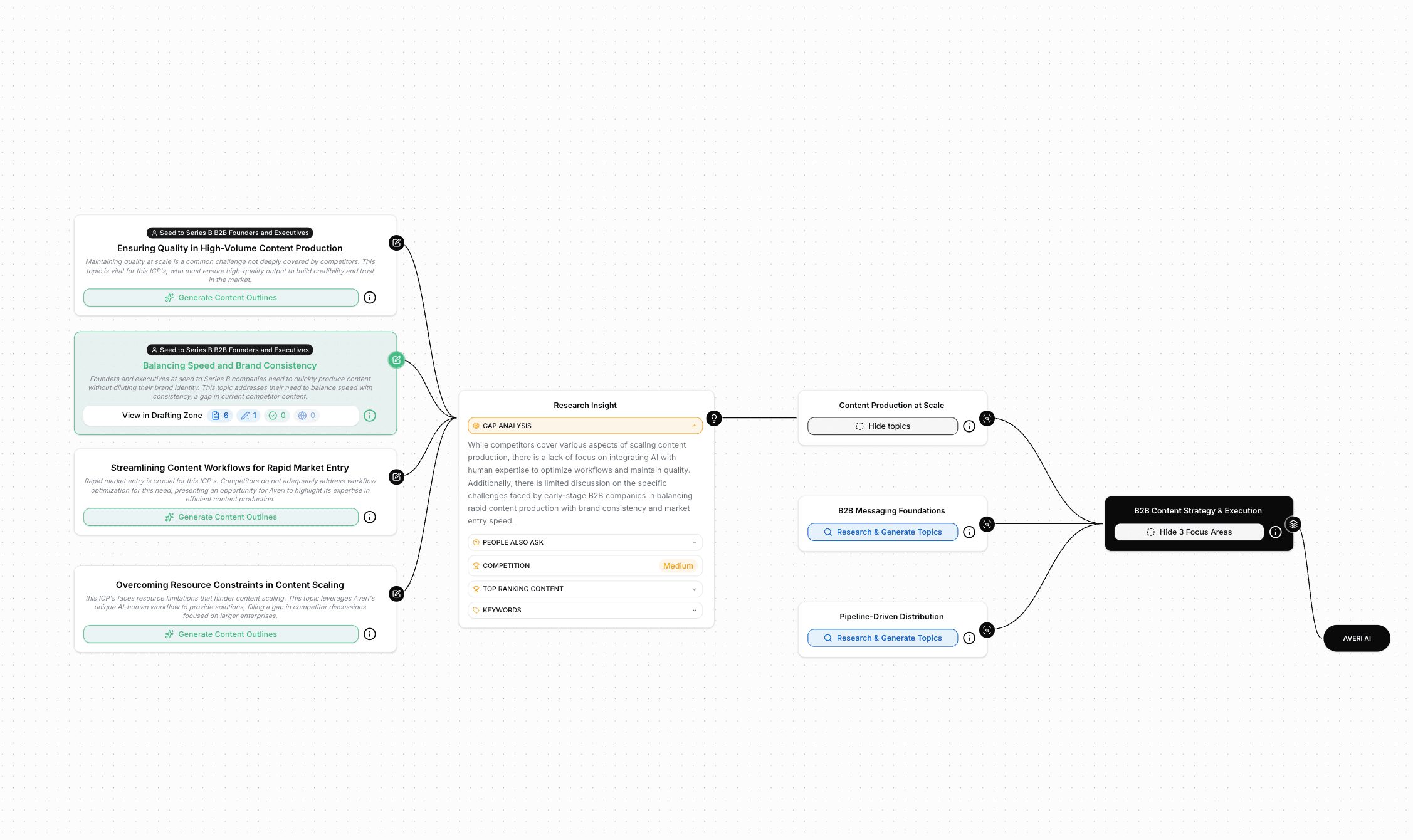
AI-assisted setup: Averi for drafts that match your voice patterns, with structural standards (answer capsules, fact density, schema) built in. Founders give the strategic input; the engine produces the draft. Founder edits in their voice block.
For founders aiming to produce 4+ blog posts per month sustainably, the AI-assisted setup is the only model that works inside 5 hours per week.
Tool 3: A LinkedIn scheduler
Buffer, Hypefury, Taplio, or LinkedIn's native scheduling. Schedule posts during the 30-min block but actually publish them at optimal times (typically 7-9 AM or 12-1 PM in your audience's primary timezone).
Native LinkedIn scheduling works fine for most founders. Third-party tools matter if you're managing multiple LinkedIn accounts or want analytics beyond what LinkedIn provides natively.
Tools that don't matter
Project management tools. Asana, ClickUp, Trello for content production are overhead at the 5-hour scale. The Monday plan IS the project management system.
Editorial calendars. A simple spreadsheet or Notion table works. SaaS editorial calendar tools are designed for teams, not solo founders.
Multiple writing apps. Pick one. Switching between Google Docs, Bear, iA Writer, etc. is procrastination disguised as workflow optimization.
Custom dashboards. LinkedIn's native analytics + your newsletter platform's analytics + GA4 cover everything you need. Building custom dashboards is content-marketing-adjacent work that doesn't produce content.
The 5 Failure Modes That Break the System
Every founder runs into at least one of these in the first 6 months. Naming them in advance lets you recover faster when they happen.
Failure mode 1: Skipping Monday strategic input
Founder gets pulled into a Monday morning fire drill, skips the 60-min ritual, decides to "make it up later in the week." The week's content becomes reactive — every block now requires creation work because no thesis is driving it. Production time triples. Quality drops. Founder concludes "the system doesn't work."
Recovery: When Monday breaks, do a 30-min compressed version Tuesday morning before any other content blocks. Cut to 1 thesis + 3 angles. Don't try to make up the full ritual; just get the minimum viable thesis in place.
Failure mode 2: Aspirational schedule overcommitment
Founder reads this article, gets excited, decides 5 hours isn't enough, blocks 10 hours per week. Sustains it for 6-8 weeks. Burns out. Reverts to 0 hours.
Recovery: When you catch yourself wanting to do more, write down what you'd cut from the founder job to make room for it. If you can't name what gets cut, you can't sustain the addition. Stay at 5 hours.
Failure mode 3: Single-channel obsession
Founder gets a viral LinkedIn post, decides LinkedIn is the only channel that matters, drops the newsletter and blog. Six months later: LinkedIn engagement plateaued, no newsletter audience to fall back on, no blog producing AI-citation traffic.
Recovery: Maintain all 3 channels even when one is producing more visible results. The non-visible channels are compounding too — they just take longer to show.
Failure mode 4: Editing during writing blocks
Founder treats the 30-min LinkedIn block or 60-min newsletter block as "draft and polish" rather than "draft, then publish." Each block becomes 60-90 min instead of 30-60. Total weekly time creeps to 7-9 hours.
Recovery: Set hard timers. When the timer hits, ship what you have. The next block will catch any issues. Polishing within the production block is procrastination disguised as quality work.
Failure mode 5: Treating the system as optional
Founder runs the system for 4-6 weeks, then decides "I've got the rhythm now, I don't need the structure." Drops the Monday ritual, stops the daily engagement, lets the schedule slip. Four weeks later: production has collapsed, the founder is producing nothing.
Recovery: The system isn't training wheels. It's the operating model. You don't outgrow it — you maintain it. The founders who think they've graduated are the founders whose content production collapses 90 days later.
When the System Stops Being Enough
The 5-hour OS produces enough content for the seed-to-Series A stage. Past that, you'll hit a ceiling. Three signals:
Signal 1: You're consistently exceeding 5 hours and quality is dropping rather than improving.
Signal 2: Strategic content (original frameworks, category-defining pieces) gets crowded out by tactical content (reactive how-tos) because there's no time for the high-effort strategic work.
Signal 3: Pipeline contribution from content is real but stuck — you can see the ceiling of what 5 founder hours produces and you can't push past it without burning out.
When you hit these signals, the answer is not more founder hours. The answer is a content engine handoff that preserves the founder's voice and strategic role while adding production capacity beyond what 5 hours can sustain.
The OS doesn't disappear at the handoff — the founder still does Monday strategic input, blog editing, LinkedIn posting, and engagement. The handoff specifically targets the production volume bottleneck (more blog posts per month, faster newsletter production, etc.) without changing the founder's strategic role.
How a Content Engine Plugs Into the OS
A content engine is designed to extend the founder content OS, not replace it.
The engine handles:
Draft production from strategic input — founder gives 20 min of input, engine produces a draft in their voice that the founder edits in the 40-min editing block
Structural standards — answer capsules, fact density, schema, freshness cycles applied to every piece without founder having to track them
AI visibility scoring — every piece scored for citation-worthiness before publishing, so production volume doesn't sacrifice quality
LinkedIn repurposing — blog content systematically converted into LinkedIn post drafts the founder reviews in their 30-min block
Newsletter scaffolding — newsletter outlines drafted from the week's blog work, founder fills in the personal voice in their 60-min block
Analytics consolidation — Monday morning review pulls performance data automatically so the strategic input ritual takes 60 min, not 90
What stays with the founder:
Monday strategic input (thesis, angles, voice direction)
LinkedIn post writing or final voice edits
Newsletter personal voice and stakes
Blog editing for voice and argument sharpening
Daily engagement
The 5-hour budget stays the same. The output volume grows 3-5x because the production capacity is no longer capped by what one person can write.
FAQs
What is the founder content operating system?
The founder content operating system is a fixed weekly schedule of time blocks, activities, and outputs that lets a founder produce sustained content marketing in 5 hours per week. It includes a Monday morning strategic input session, three LinkedIn posting blocks, one newsletter writing block, one blog input/editing block, and daily 5-minute engagement windows. The system is designed for sustainability over years, not productivity over months — the goal is producing the same outputs every week indefinitely, not maximum output in any single week.
Why is 5 hours per week the right amount?
5 hours is the empirically-validated ceiling for sustained founder content production. Below 5 hours, channel cadence drops below the threshold needed for compounding (LinkedIn algorithm forgets you, newsletter subscribers lose habit, blog stays stagnant). Above 5 hours, founders sustain for 6-12 weeks then burn out and revert to 0 hours, which resets the compounding. 5 hours produces enough volume to compound across LinkedIn, newsletter, and blog simultaneously without crowding out the actual job of being a founder.
What's the most important block in the OS?
Monday morning strategic input. The 60-minute ritual that sets the week's thesis, identifies 3-5 angles, and decides what every other block produces. Skip Monday and every other production block takes 3x longer because there's no thesis driving it. Founders who maintain Monday but slip on other blocks recover quickly. Founders who skip Monday but grind on other blocks burn out within a quarter.
How many pieces of content does the 5-hour OS produce?
Roughly 200 LinkedIn posts, 40 newsletter editions (weekly cadence), and 50 founder-shaped blog posts per year. Total: 290 pieces of content per year at 260 hours of founder time, or roughly 53 minutes per piece average. The compounding from this volume produces 6-15% of pipeline contribution from content marketing within 12-18 months for most B2B SaaS startups running the OS consistently.
What tools do I actually need?
Three: a capture tool (Apple Notes, Notion, Roam — anywhere you can capture thoughts in real time), a draft tool (Google Docs for typed work, Averi for AI-assisted drafts that match your voice), and a LinkedIn scheduler (native LinkedIn scheduling works fine for most founders). Everything else is overhead. Project management tools, editorial calendar SaaS, custom dashboards, and multiple writing apps are content-marketing-adjacent work that doesn't produce content.
What if I miss a week?
Acknowledge it, restart the next Monday, don't try to make up the missed work. Trying to produce two weeks of content in one week breaks the time budget and signals to your audience that you're erratic. Better to ship one consistent week than to overcompensate. If you miss two weeks in a row, send a brief LinkedIn post or newsletter acknowledging the gap and committing to the restart — your audience trusts honesty over fake consistency.
When do I stop using the OS?
You don't. The OS is the operating model, not training wheels. What changes is what gets handed off to a content engine or team. At seed stage, the founder runs every block alone. At Series A scale, the founder still runs Monday strategic input, blog editing, LinkedIn posting, and engagement — but a content engine produces the blog drafts and newsletter scaffolding so the 5-hour budget produces 3-5x the output volume without burning the founder out.
Related Resources
Founder-Led Content Marketing Pillar
The Founder-Led Content Marketing Playbook — the pillar this piece sits under
Founder-Led LinkedIn: The Content Cadence That Actually Builds Pipeline
Founder Thought Leadership: What to Write About When You're Not a Writer
Personal Brand vs. Company Brand: What Founders Should Prioritize First
The Founder-to-Content-Engine Handoff: When to Stop Writing Yourself
Build-in-Public Content: Turning Product Development Into Organic Growth
Founder Newsletters: The Owned-Audience Asset Every Startup Should Build
Founder-Specific Marketing Context
Production Quality Standards
Building Citation-Worthy Content: Making Your Brand a Data Source for LLMs
The GEO Playbook 2026: Getting Cited by LLMs, Not Just Ranked by Google