Founder-Led LinkedIn: The Content Cadence That Actually Builds Pipeline

6 minutes

TL;DR
🎯 The 3-posts-per-week cadence (M/W/F) is the LinkedIn algorithm's preferred minimum for sustained organic reach. Below this drops out of feed visibility; above this dilutes per-post distribution. M/W/F gives 48 hours between posts — the algorithm's optimal recovery window.
📝 4 founder post types that work: Strong Opinion (contrarian thesis), Specific Story (founder experience with stakes), Tactical Teardown (how X actually works), Industry Observation (pattern you've noticed others haven't named).
⚡ The 4-hour engagement window determines distribution. Posts that earn 5+ substantive comments in the first 4 hours get distributed to 5-10x more impressions. Founders who post and disappear get penalized regardless of post quality.
🔗 LinkedIn is dual-distribution: direct (engagement, inbound DMs, network growth) plus indirect (AI engines cite LinkedIn discussions when buyers research your category). Founders who understand both compound faster.
📈 Pipeline timeline: Months 1-3 small engagement only. Months 4-6 inbound DMs and demo requests start. Months 6-12 LinkedIn becomes a measurable pipeline source. Months 12-24 it's often the highest-trust inbound channel in the company.

Zach Chmael
CMO, Averi
"We built Averi around the exact workflow we've used to scale our web traffic over 6000% in the last 6 months."
Your content should be working harder.
Averi's content engine builds Google entity authority, drives AI citations, and scales your visibility so you can get more customers.
Founder-Led LinkedIn: The Content Cadence That Actually Builds Pipeline
LinkedIn is the channel most B2B SaaS founders know they should be on and few are doing well.
The result is one of two failure patterns: posting twice a week for two months and stopping when the engagement looks small, or posting daily for three weeks then disappearing for two months when the workload becomes untenable.
Both produce zero pipeline contribution.
The founders who make LinkedIn work treat it as one component of a larger content operating system, not as a stand-alone channel that requires bursts of effort.
They post 3 times per week, every week, for at least 12 months.
They develop a recognizable voice.
They engage substantively in the first 4 hours after every post.
The pipeline shows up at month 4-6, scales through month 12, and becomes the highest-trust inbound channel in the company by month 18.
LinkedIn is the #2 cited source in AI search results for B2B research queries.
Posts compound in two directions: directly through engagement and inbound DMs, and indirectly through AI engines that surface LinkedIn discussions when buyers research your category. Founders who understand both directions build pipeline that other channels can't match.
This piece is the LinkedIn-specific tactical playbook. The 3-posts-per-week cadence and why it works. The 4 post types that produce engagement and pipeline. The hook patterns that earn first impressions. The engagement window that determines distribution. Pipeline tracking that proves the channel works. Mistakes that kill cadence sustainability.
For the broader founder content operating system this LinkedIn cadence sits inside, see The Founder's Content Operating System: 5 Hours a Week, 10x Output.
For the strategic context on why founder voice on LinkedIn matters, see The Founder-Led Content Marketing Playbook.
What Founder-Led LinkedIn Actually Means
Founder-led LinkedIn is the practice of founders personally maintaining a sustained posting cadence, distinctive voice, and active engagement on LinkedIn — typically 3 posts per week, M/W/F, with substantive replies to comments in the first 4 hours of each post.
The goal is twofold: direct pipeline through engagement and inbound DMs, and indirect AI search visibility through LinkedIn citations in ChatGPT, Perplexity, and Google AI Mode responses.
It's distinct from corporate LinkedIn pages (which produce roughly 1/10th the engagement of founder accounts) and from CEO ghost-posting (where social media managers post on behalf of the founder, which loses the voice asymmetry that makes founder content work).
Three things distinguish founder-led LinkedIn from generic LinkedIn marketing:
The founder writes or directs every post. Not "approved by the CEO" — written or voice-directed by them with their actual point of view embedded. Buyers can tell within the first sentence whether a post was written by the founder or by an agency.
The cadence is sustained, not bursty. 3 posts per week for 52 weeks beats 10 posts per week for 8 weeks every time. Sustained cadence is what trains the LinkedIn algorithm to surface your posts and what trains your audience to expect them.
Engagement is part of the work, not a separate task. Replying to comments, engaging with relevant founder posts, and maintaining DM responsiveness is what converts LinkedIn from broadcast to relationship. Founders who skip engagement see 60-80% lower pipeline contribution from their content.
For the deeper strategic positioning on personal brand vs. company brand prioritization, see Personal Brand vs. Company Brand: What Founders Should Prioritize First.
Why 3 Posts Per Week (Not Daily, Not Weekly)
The 3-posts-per-week cadence isn't arbitrary. It matches the LinkedIn algorithm's distribution mechanics specifically.
Daily posting compresses distribution
When you post daily, LinkedIn distributes each post less aggressively because it doesn't want to oversaturate your network's feed with one creator.
Meaning 7 daily posts produce roughly the same total impressions as 3 well-spaced posts, but the engagement per post drops 50-70%. Your audience experiences your content as background noise instead of signal.
The exception: if your business is content (creator economy, media), daily posting works because content IS the product. For B2B SaaS founders where content drives a separate product, daily posting is a counter-productive grind that produces less per-post impact.
Weekly posting drops out of feed visibility
When you post once per week, the LinkedIn algorithm treats you as a lapsed creator. Your posts get distributed to your most engaged followers but not to broader network discovery. Reach plateaus at your existing follower count instead of growing.
Below 2 posts per week, you're not in the LinkedIn algorithm's "active creator" tier. The reach difference is meaningful — active creators get 2-4x the per-post distribution of lapsed creators.
Why M/W/F specifically
48 hours between posts is the LinkedIn algorithm's optimal recovery window. Each post gets full distribution before the next one starts competing for attention from the same audience. Posts on consecutive days (Mon/Tue/Wed) compete with each other; posts spaced 2-3 days apart don't.
M/W/F also matches B2B audience behavior. Tuesday and Thursday are often heavy meeting days when LinkedIn engagement drops; Monday/Wednesday/Friday have higher passive scrolling rates among professional audiences. Posting when your audience scrolls produces more impressions per post.
The 4 Post Types That Work for Founders
Most LinkedIn content advice gives you 20+ post templates and tells you to mix them. Founder-led LinkedIn works with 4 specific post types, used in rotation. The constraint produces better posts because the founder isn't deciding format every time — only content.
Post Type 1: Strong Opinion
A specific, opinionated, debatable claim about your category or industry. Not "10 things to consider when..." Not "the future of...". A specific argument the founder is willing to defend.
Structure:
Hook: the contrarian or surprising claim (1-2 sentences)
Setup: brief context for why most people believe the opposite (2-3 sentences)
Argument: the founder's reasoning with specifics (3-7 paragraphs)
Stakes: what the reader should do differently if they agree (1-2 sentences)
CTA: a question that invites pushback or agreement
Example hooks:
"Most B2B content marketing advice is for teams that don't exist."
"Founder-led sales gets all the attention. Founder-led marketing is where the real moat lives."
"The Series A content team hire is the most overrated decision in B2B SaaS marketing."
Why it works: Strong opinions earn substantive comments (the kind that triggers algorithm distribution). They also build the founder's recognizable voice over time. After 50-100 strong opinion posts, prospects show up to sales calls saying "I've been reading your stuff for six months."
Post Type 2: Specific Story
A first-person founder story with stakes. Not "we learned X about our customers." A specific moment, specific decision, specific outcome — what happened, what you decided, what it cost.
Structure:
Hook: the moment or decision (1-2 sentences)
Context: enough setup for the story to land (2-4 sentences)
The moment: what happened, what was decided, what was at stake (3-5 paragraphs)
The outcome: what actually resulted (1-2 paragraphs)
The lesson: one sentence on what you learned, framed for the reader
Example hooks:
"Three months in to our seed round, I made the mistake of hiring a VP of Marketing too early. Here's what it cost."
"I almost killed our content program after a viral LinkedIn post brought zero pipeline."
"Our biggest customer churned last quarter and the reason wasn't what we thought."
Why it works: Stakes-aware stories produce trust that argument alone can't. Buyers who read a founder's stories learn the founder's judgment patterns, which is what they're actually evaluating in the early stages of a deal.
Post Type 3: Tactical Teardown
A walkthrough of how something specific works in your domain, with enough specificity that readers can implement or evaluate it themselves. Not "here's how to do content marketing." A specific tactic, specific examples, specific outcomes.
Structure:
Hook: the specific tactic or insight (1-2 sentences)
Why this matters: the problem the tactic solves (1-2 sentences)
The mechanic: step-by-step or component breakdown (4-8 paragraphs)
Real example: actual numbers, screenshots, or named cases
The takeaway: what to do this week if you want to try it
Example hooks:
"Here's the 5-hour weekly cadence that produces sustainable founder LinkedIn pipeline."
"I refreshed 8 blog posts last quarter using this structural framework. 3 are now in AI Overviews."
"How we built a 600-subscriber newsletter from zero in 4 months using just LinkedIn distribution."
Why it works: Tactical teardowns get bookmarked and shared in DMs. They also produce direct inbound — founders who try your tactic and want to talk to you about scaling it. Highest pipeline-conversion post type for B2B SaaS.
Post Type 4: Industry Observation
A pattern you've noticed in your category that others haven't named yet. Not generic trend analysis ("AI is changing everything"). A specific observation that gives readers a new way to see something they've been looking at.
Structure:
Hook: the pattern you've noticed (1-2 sentences)
Evidence: 3-5 specific examples that demonstrate it
Implication: what this means for someone in your category
Prediction: where this leads if the pattern continues
Question: what readers think about it
Example hooks:
"Every B2B SaaS website now has the same hero section. There's a reason and it's not lazy design."
"The 'content engineer' job title is showing up at 3 different categories of company. Here's what's actually happening."
"Companies that win in 2026 are quietly cutting MQLs from their reporting. Here's why."
Why it works: Naming a pattern others haven't seen yet establishes you as a category observer worth following. These posts often get shared by industry analysts, conference organizers, and category-adjacent founders, expanding your network beyond your direct audience.
The 4-type weekly rotation
For 3 posts per week, rotate the types so you're not posting two of the same type back-to-back:
Monday: Strong Opinion or Industry Observation
Wednesday: Specific Story or Tactical Teardown
Friday: Whichever type you haven't used this week
Mix categories across the week so your audience gets variety. Don't repeat the same type within 7 days unless you're running a deliberate series.
The Hook: Why First Sentences Determine Everything
LinkedIn's algorithm shows your first 1-2 sentences in the feed before the "see more" expand.
If those sentences don't earn the click, the post never gets read regardless of how good the body is.
The 3 hook patterns that work
Pattern 1: Specific contrarian claim
"Most founder marketing advice is wrong about cadence."
"The Series A content team hire is the most overrated decision in B2B SaaS."
"I stopped tracking MQLs in Q3 and pipeline went up 40%."
Why it works: Pattern interrupts. The reader expects generic advice; the contrarian framing creates curiosity gap.
Pattern 2: Stakes-loaded first-person
"Three months ago I made a $200K hiring mistake."
"I bet our seed round on a thesis the entire industry says is wrong."
"The first 8 weeks of my newsletter produced zero pipeline. Then this happened."
Why it works: Stakes signal a real story is coming. Readers stop scrolling because they want to know what the stakes lead to.
Pattern 3: Specific number or fact
"Only 11% of B2B SaaS sites are cited by both ChatGPT and Perplexity."
"76% of B2B buyers now research with AI before talking to sales."
"Our blog took 7 months to produce its first measurable pipeline."
Why it works: Specific numbers signal substance. Generic posts use vague language; specific numbers signal the post will deliver real information.
The hooks that don't work
Generic statement of the obvious: "Content marketing is important for startups." (Why would anyone keep reading?)
Question without context: "What do you think about content marketing in 2026?" (No reason to engage)
Inside-baseball jargon: "ICP-aligned content frameworks for PLG SaaS." (Excludes most readers)
Hyped emotional language: "🚨 This will BLOW your mind 🚨" (Reads as spam, kills credibility)
Self-promotional opener: "Excited to announce our new feature..." (Buyers scroll past)
If your first sentence could be the first sentence of any other founder's post, rewrite it. The hook is what makes your post recognizably yours.
For the deeper strategic question of what topics to develop hooks around, see Founder Thought Leadership: What to Write About When You're Not a Writer.
The 4-Hour Engagement Window
The single most important LinkedIn behavior after publishing: the 4-hour engagement window.
What happens during the window
LinkedIn's algorithm decides post distribution based on early engagement signals. Comments matter more than likes; substantive comments matter more than emoji reactions.
Posts that earn 5+ substantive comments in the first 4 hours get distributed to 5-10x more total impressions than posts with the same eventual engagement compressed into a longer time window.
The mechanic: LinkedIn surfaces high-engagement posts to broader audiences. The early-window engagement is the signal LinkedIn uses to decide whether to expand distribution. Miss the window and the post is locked at its initial distribution tier regardless of how many likes it gets later.
What founders should do during the window
Reply to every comment substantively. Not "thanks!" — actual responses that extend the conversation. 2-3 sentences minimum. Ask follow-up questions. Disagree where you actually disagree. Substantive replies trigger the commenter to reply again, doubling the engagement.
Pin the best comment. If a commenter adds a strong point or counterargument, pin their comment. This signals the post is worth deeper engagement and often pulls more readers into the comment thread.
Engage with 3-5 other relevant posts during the window. While your post is in distribution, engage substantively on other posts in your network. This builds reciprocity (those creators are more likely to engage on your future posts) and signals to LinkedIn that you're an active community participant, which weights into your own distribution.
What kills the engagement window
Posting and disappearing. Founder posts at 9 AM, goes into meetings, doesn't check LinkedIn until 6 PM. Distribution capped, post never compounds. The single most common reason "good" LinkedIn posts underperform.
Reply-batching to all comments at end of day. Late replies don't reactivate the algorithm. The window is gone. Reply within 30 minutes of each comment if possible; certainly within 2 hours.
Generic "thanks!" replies. No conversation extension, no algorithm signal. Substantive replies are the work; lazy replies waste the window.
The discipline: every LinkedIn post needs 30-45 minutes of engagement work in the 4 hours after posting. If you can't protect that window, post at a time when you can. Posting at 9 AM right before a 4-hour meeting block guarantees the post will underperform regardless of quality.
How LinkedIn Plugs Into AI Visibility
LinkedIn isn't just direct distribution. It's also a major AI search source that affects your Brand Visibility Score and citation frequency in ChatGPT, Perplexity, and Google AI Mode responses.
Why AI engines weight LinkedIn
LinkedIn discussions consistently appear in AI-generated responses for B2B research queries because they signal recency, expertise, and topical authority.
A founder who has written 200+ LinkedIn posts on their category over 18 months becomes a citable source for AI engines researching that category.
The mechanic: AI engines crawl LinkedIn for category discussions. Active founder voices on a specific topic get surfaced more often because they represent ongoing expertise rather than one-time published content. Your LinkedIn cadence directly influences your AI search visibility, especially on Perplexity and ChatGPT.
What this means for post topic selection
Your LinkedIn topic mix should partially align with the queries you want to be cited for in AI responses. If you want ChatGPT to surface you when buyers ask "what's the best content engine for B2B SaaS startups," your LinkedIn cadence should include posts on:
The category itself ("content engines")
The buyer (B2B SaaS founders)
The use cases your product solves
Comparisons with adjacent categories
This doesn't mean every post is keyword-optimized. It means your overall cadence covers the topical surface area you want AI engines to associate with you.
The dual-distribution insight
A single LinkedIn post produces value in two streams: direct engagement (DMs, demo requests, network growth) and indirect AI visibility (citations months later when AI engines surface your historical posts in responses).
Founders who track only direct engagement underestimate LinkedIn's true ROI. The indirect AI distribution often exceeds direct distribution by month 12+ as historical posts continue earning citations long after publishing.
For the full attribution model that captures both, see Attribution for AI-Referred Traffic: Fixing the "Direct Traffic" Problem in GA4.
Tracking Pipeline From LinkedIn
Most LinkedIn measurement focuses on engagement metrics (likes, comments, reach). Engagement is the leading indicator. Pipeline is the lagging indicator that proves the channel works.
The 4 metrics that matter
Metric 1: Inbound DMs from prospects
Every week, count the DMs from people who could plausibly become customers. Categorize as: prospecting (you reached out to them), inbound from content (they reached out after seeing your posts), and inbound from network (they reached out through mutual connection). The "inbound from content" number is the direct LinkedIn pipeline signal.
Metric 2: Demo requests with "found via LinkedIn" attribution
Add a "How did you hear about us?" field to your demo request form. Categorize answers monthly. LinkedIn-attributed demo requests should grow 10-30% month-over-month for a healthy cadence.
Metric 3: Sales call references to your content
In the first 5 minutes of a sales call, prospects often reference what they've read from you. Track this anecdotally — the percentage of sales calls where the prospect references your LinkedIn content is the trust pre-loading signal. By month 12, this should be 30-50% of sales calls.
Metric 4: AI-referred traffic to your site
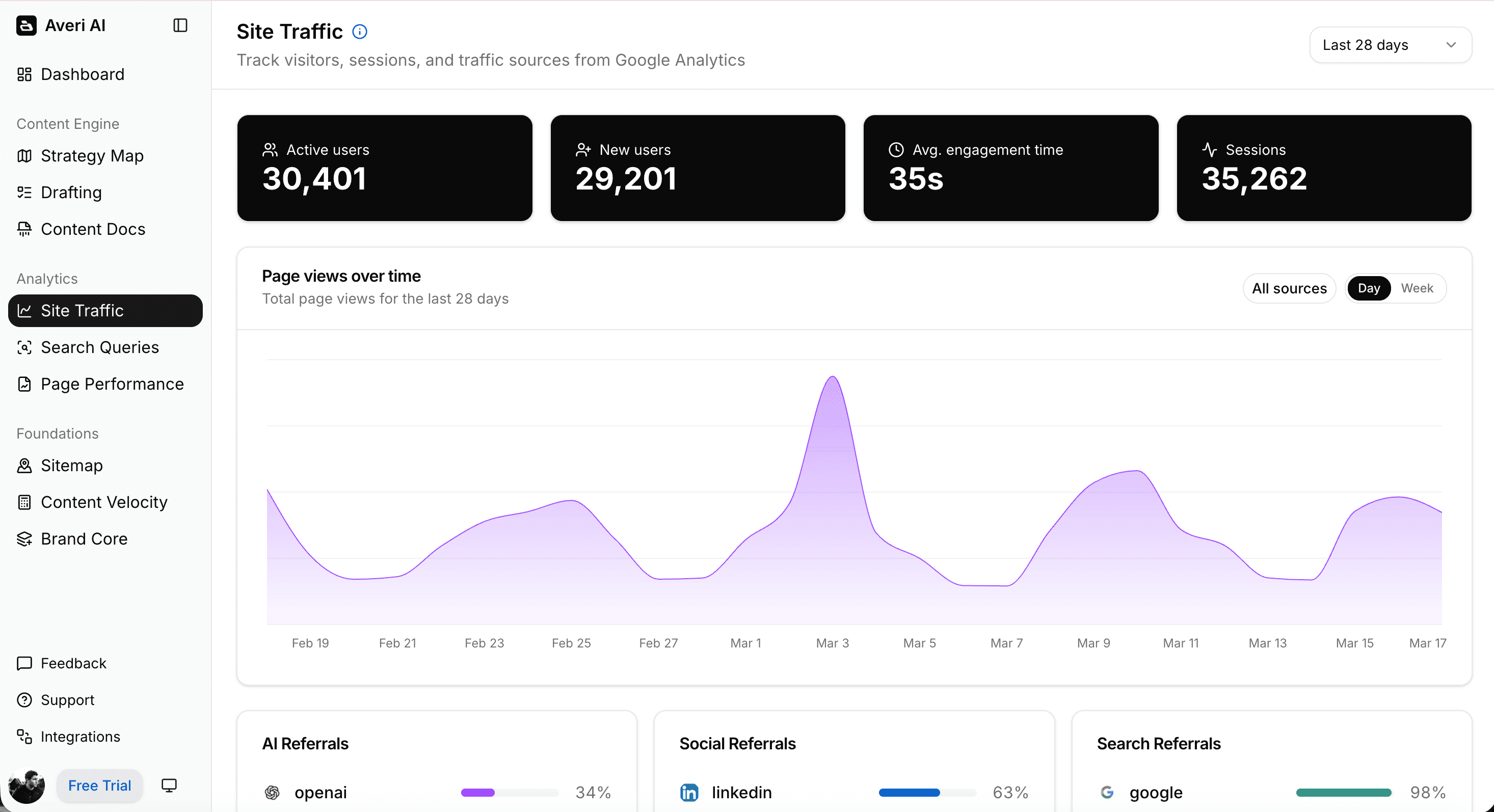
AI engines that cite your LinkedIn discussions often produce inbound traffic to your website. Track AI referrals (chatgpt.com, perplexity.ai, claude.ai referrers) and watch the trend. LinkedIn-led founders typically see meaningful AI-referred traffic emerging month 8-12 as historical posts compound.
What "good" looks like at each stage
Months 1-3: Engagement growing slowly. 2-5 inbound DMs per week. No demo requests directly attributable to LinkedIn yet.
Months 4-6: First inbound DMs that become real conversations. 1-3 demo requests per month attributable to LinkedIn. Sales calls starting to reference your content.
Months 6-12: Pipeline contribution measurable. 5-10 demo requests per month from LinkedIn. 20-30% of sales calls reference your content.
Months 12-24: LinkedIn often becomes the highest-trust inbound channel. 10-30 demo requests per month. 40-60% of sales calls reference your content. AI-referred traffic compounding.
If you're 6+ months in and seeing none of this, the issue is usually one of three things: cadence inconsistency, generic voice, or skipped engagement window. Diagnose against the failure modes below.
Common Founder LinkedIn Mistakes
Mistake 1: Bursty posting
10 posts in 2 weeks, then nothing for 6 weeks. The algorithm punishes inconsistency more than low volume. Fix: 3 posts per week, every week, for 12+ months. Use a scheduler if needed to enforce the cadence.
Mistake 2: Generic "thought leadership" voice
Posts that read like every other B2B SaaS founder's posts. Same vocabulary, same hedge phrases, same structure. Fix: Develop the 4 founder voice components covered in Founder Thought Leadership: What to Write About When You're Not a Writer. Specifically: sharper opinions, distinctive language, stakes-aware honesty.
Mistake 3: Skipping the 4-hour engagement window
Post at 9 AM, check at 6 PM. By then, distribution is capped. Fix: Post when you can protect the next 4 hours for engagement. If you can't, post later in the day.
Mistake 4: Talking about your product
Too many founder posts read as feature announcements or veiled product pitches. Audience scrolls past. Fix: 80% of posts should be about your category, your buyer's problems, or your point of view. 20% can mention your product, ideally in the context of a story or specific tactic, not as direct promotion.
Mistake 5: Ignoring DMs
Founder posts produce inbound DMs. Founder doesn't reply for 5 days. Prospect cools, conversation dies. Fix: Daily 5-min check on DMs. Reply quickly even if briefly ("Saw this — happy to chat. Free Tuesday at 2 PT?").
Mistake 6: Treating LinkedIn as standalone
Founders who treat LinkedIn as the only channel miss the content engine compounding that comes from LinkedIn + newsletter + blog working together. Fix: Run the full 5-hour OS, not just LinkedIn. The channels reinforce each other.
Mistake 7: Outsourcing posts to ghost-writers
Hiring someone to write LinkedIn posts in the founder's voice loses the asymmetric trust that founder voice produces. Buyers can tell within 2-3 sentences. Fix: Founder writes or voice-directs every post. Use a content engine to scale production while preserving voice — covered in The Founder-to-Content-Engine Handoff.
How a Content Engine Extends Founder LinkedIn
Manual founder LinkedIn at 3 posts per week = 90 minutes per week of writing + 30 minutes daily engagement = roughly 5 hours total. That's the founder content OS LinkedIn budget.
A content engine doesn't replace the founder on LinkedIn. It extends what the founder can do inside that 5-hour budget:
Repurposing blog content into LinkedIn drafts — every blog post the founder edits each week generates 2-3 LinkedIn post drafts that match the founder's voice and post-type rotation. Founder reviews and adjusts in their 30-min posting block.
Voice notes to draft conversion — founder records 3-5 minutes of voice notes during the week with raw thoughts. Engine converts to LinkedIn draft structures (Strong Opinion, Specific Story, Tactical Teardown, Industry Observation). Founder edits in their posting block.
Hook variation generation — for any post the founder has drafted, engine produces 3-5 alternative hook variations to test. Founder picks the strongest.
Engagement priority alerts — engine surfaces which incoming comments and DMs are highest-priority based on commenter context (existing customers, target accounts, industry influencers) so the 30 min/day engagement window goes to the highest-impact interactions.
AI visibility tracking for LinkedIn impact on AI citations — connects LinkedIn cadence to AI-referred traffic and citation frequency changes so the founder sees LinkedIn's full ROI, not just direct engagement.
What stays with the founder: writing or voice-directing every post, replying substantively to comments, choosing topics, holding the strategic agenda.
The engine handles the production scaffolding — same founder voice, same 5-hour budget, more output.
FAQs
What is founder-led LinkedIn?
Founder-led LinkedIn is the practice of founders personally maintaining a sustained posting cadence (typically 3 posts per week, M/W/F), distinctive voice, and active engagement on LinkedIn. The goal is twofold: direct pipeline through engagement and inbound DMs, and indirect AI search visibility through LinkedIn citations in ChatGPT, Perplexity, and Google AI Mode responses. It's distinct from corporate LinkedIn pages (which produce roughly 1/10th the engagement of founder accounts) and from CEO ghost-posting (where social media managers post on behalf of the founder, which loses the voice asymmetry that makes founder content work).
Why 3 posts per week instead of daily or weekly?
3 posts per week, M/W/F, matches LinkedIn algorithm mechanics specifically. Daily posting compresses per-post distribution because LinkedIn doesn't oversaturate one creator in any single feed. Weekly posting drops you out of the "active creator" tier and reduces per-post distribution by 50-75%. M/W/F gives 48 hours between posts (the algorithm's optimal recovery window) and matches B2B audience scrolling patterns where T/Th are heavy meeting days. Below 2 posts per week, you're not in the active creator tier; above 5 posts per week, distribution per post starts dropping noticeably.
What should I actually post about?
Use 4 post types in rotation: Strong Opinion (contrarian thesis about your category), Specific Story (first-person founder story with stakes), Tactical Teardown (walkthrough of how something specific works), Industry Observation (pattern you've noticed others haven't named). Mix these across the week so your audience gets variety. Most founder LinkedIn advice gives you 20+ post templates which produces decision fatigue; using just 4 types in rotation removes the format decision and lets you focus on content.
How important is the engagement window?
Critical. Posts that earn 5+ substantive comments in the first 4 hours get distributed to 5-10x more impressions than posts with the same eventual engagement compressed into a longer window. The mechanic: LinkedIn's algorithm uses early engagement signals to decide whether to expand distribution. Miss the 4-hour window and the post is locked at its initial distribution tier regardless of how many likes it gets later. Founders who post at 9 AM and don't engage until 6 PM consistently underperform regardless of post quality.
How long until LinkedIn produces measurable pipeline?
Months 1-3 produce engagement growth but rarely measurable pipeline — this is the discouraging period. Months 4-6 see first inbound DMs that become real conversations, with 1-3 demo requests per month attributable to LinkedIn. Months 6-12 LinkedIn becomes a measurable pipeline source with 5-10 demo requests per month and 20-30% of sales calls referencing your content. Months 12-24 LinkedIn often becomes the highest-trust inbound channel in the company. Founders who quit at month 3 never see the compounding.
Should I hire a ghost-writer for LinkedIn?
No. Buyers can tell within 2-3 sentences whether a post was written by the founder or by an agency. The asymmetric trust that founder voice produces — distinctive language, specific stakes, opinions grounded in actual experience — disappears the moment a ghost-writer enters the loop. The right scaling model is to use a content engine that generates drafts in the founder's voice from voice notes or blog content, with the founder writing or voice-directing every post and editing for final voice. Same authentic content, less production time.
How does LinkedIn affect AI search visibility?
LinkedIn discussions appear consistently in AI-generated responses for B2B research queries because they signal recency, expertise, and topical authority. AI engines (especially Perplexity and ChatGPT) cite LinkedIn posts as sources when responding to category-specific questions. A founder with 200+ LinkedIn posts on their category over 18 months becomes a citable source. The implication: your LinkedIn cadence directly affects your AI visibility metrics, creating a dual-distribution channel where every post produces both direct engagement and long-tail AI citation value.
Related Resources
Founder-Led Content Marketing Pillar
The Founder-Led Content Marketing Playbook — the pillar this piece sits under
The Founder's Content Operating System: 5 Hours a Week, 10x Output
Founder Thought Leadership: What to Write About When You're Not a Writer
Personal Brand vs. Company Brand: What Founders Should Prioritize First
The Founder-to-Content-Engine Handoff: When to Stop Writing Yourself
Build-in-Public Content: Turning Product Development Into Organic Growth
Founder Newsletters: The Owned-Audience Asset Every Startup Should Build
LinkedIn-Specific Context
AI Visibility Pillar (Cross-Pillar)
Brand Visibility Score: The Only AI Search Metric That Actually Matters
AI Citation Tracking: How to Measure Citation Frequency Across ChatGPT, Perplexity, and Claude
Attribution for AI-Referred Traffic: Fixing the "Direct Traffic" Problem in GA4