Google's AI Search Overhaul Added 5 Things. Only 2 Change Your Content.

6 minutes

TL;DR
📋 Five changes shipped May 6, 2026. Google updated how AI Mode and AI Overviews show links and citations, the biggest change to the feature since launch
🖥️ Three are display, not content. Inline links placed next to the cited text, hover previews of the source, and news-subscription highlighting change how links appear, not what earns them
✍️ Two change what you publish. "Suggested angles" rewards depth across the facets of a topic, and firsthand-source surfacing rewards lived experience and community presence
📉 Rankings already stopped predicting citations. Top-10 ranked pages accounted for 76% of AI Overview citations in mid-2025 but only about 38% by early 2026. This update hardens that shift
🗣️ Firsthand beats aggregated. Google now surfaces firsthand perspectives from social posts and discussions with the creator's name, handle, and community attached, favoring sources that did the work over content that summarizes it
🧱 The two that matter were already the bar. Topical depth and first-person experience were winning citations before this update. May 6 just made the reward explicit
💸 The clock is real. AI Mode is no longer experimental, Gemini 3.5 Flash is the default model, and ads now run inside AI Overview responses, so the unpaid citation window is worth using now

Zach Chmael
CMO, Averi
"We built Averi around the exact workflow we've used to scale our web traffic over 6000% in the last 6 months."
Your content should be working harder.
Averi's content engine builds Google entity authority, drives AI citations, and scales your visibility so you can get more customers.
Google's AI Search Overhaul Added 5 Things. Only 2 Change Your Content.
Google just shipped the biggest change to AI Overviews since the feature launched, and most of the advice flying around is telling you to react to the wrong three things.
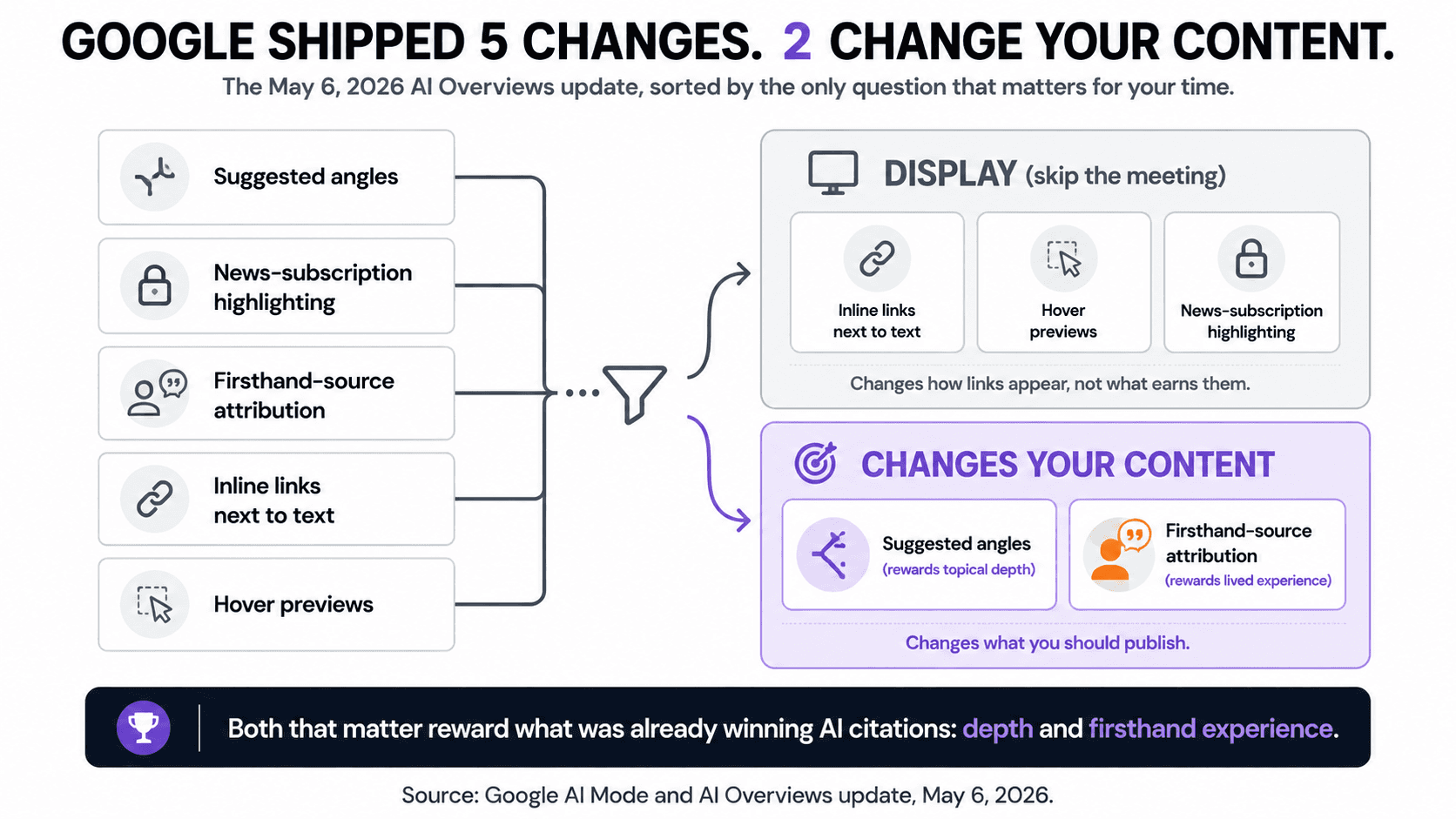
On May 6, 2026, five changes rolled out across AI Mode and AI Overviews.
Three of them change how Google displays links.
Two of them change what you should actually publish. The other three are worth understanding and not worth losing a sprint over.
That distinction matters because the stakes keep climbing. AI Overviews now appear on roughly 25.8% of US searches and about half of all informational queries, and organic click-through on pages that trigger one has fallen by as much as 61%.
When the box on top eats that many clicks, the only real question is whether you are inside it. So when Google changes how that box works, the right response is to figure out which changes alter the work and which just rearrange the furniture. This is that breakdown, and the punchline is that the two that matter reward exactly what was already winning AI citations.
What Did Google Actually Change on May 6?
Google announced five changes to how AI Mode and AI Overviews show links and citations, framed as making it easier to connect with authentic voices and explore the web. Here is the full list, stated plainly, before we sort it.
The five changes, per Google's announcement:
First, suggested angles. At the end of many AI responses, Google now shows a section that links to unique articles or in-depth analyses on different facets of your topic, a "further exploration" prompt pointing the searcher deeper.
Second, news-subscription highlighting. Google now highlights links from publications you subscribe to, and noted that in testing, searchers were significantly more likely to click links labeled as their subscriptions.
Third, firsthand-source attribution. When AI features cite social media or online discussions, Google now shows the creator's name and handle along with the community name, making clear the response is drawing on firsthand sources.
Fourth, more inline links next to the relevant text. Google now places more links directly within the response, right next to the specific text being cited, rather than grouping them.
Fifth, hover previews. On desktop, hovering over an inline link now shows a quick preview with the site name or page title.
Here is the same list, sorted by the only question that matters for your time.
# | Change | What it does | Display or content? |
|---|---|---|---|
1 | Suggested angles | Links to in-depth articles on facets of the topic | Changes your content |
2 | News-subscription highlighting | Flags links from publications you subscribe to | Display (and publisher-only) |
3 | Firsthand-source attribution | Surfaces social and community posts with author and community | Changes your content |
4 | Inline links next to text | Places citations beside the specific claim | Display |
5 | Hover previews | Shows site name on hover, desktop | Display |
Which Three Changes Are Just Display?
Three of the five change how Google presents links, not what wins them, so they should not change your content plan. Understanding them is useful. Reorganizing your roadmap around them is a mistake.
Inline links placed next to the relevant text are a presentation change. Google is moving the citation closer to the claim it supports, which is good for the searcher and good for click-through. But the content behavior it rewards, writing in self-contained passages that answer a specific point, is the same passage-level extractability that already governs how AI pulls and cites you. If you are already structuring content into clean, citable chunks, there is nothing new to do here. The link just shows up in a better spot.
Hover previews are pure interface. A searcher hovering over a link sees your site name before they click, which rewards brand recognition at the margin but asks nothing new of your content. Worth knowing, not worth a meeting.
News-subscription highlighting is real, and for most readers of this it is irrelevant. It applies to news publishers with subscription products, surfacing links from outlets a searcher already pays for. If you run a subscription news operation, the subscription-linking documentation is worth a look. If you are a B2B SaaS company publishing to win your category, this change does not touch you. Skip it.
The common thread: these three move the furniture. They change where links appear and how trustworthy they look, not what earns them. The work that wins citations is upstream of all three.
Which Two Changes Actually Change What You Publish?
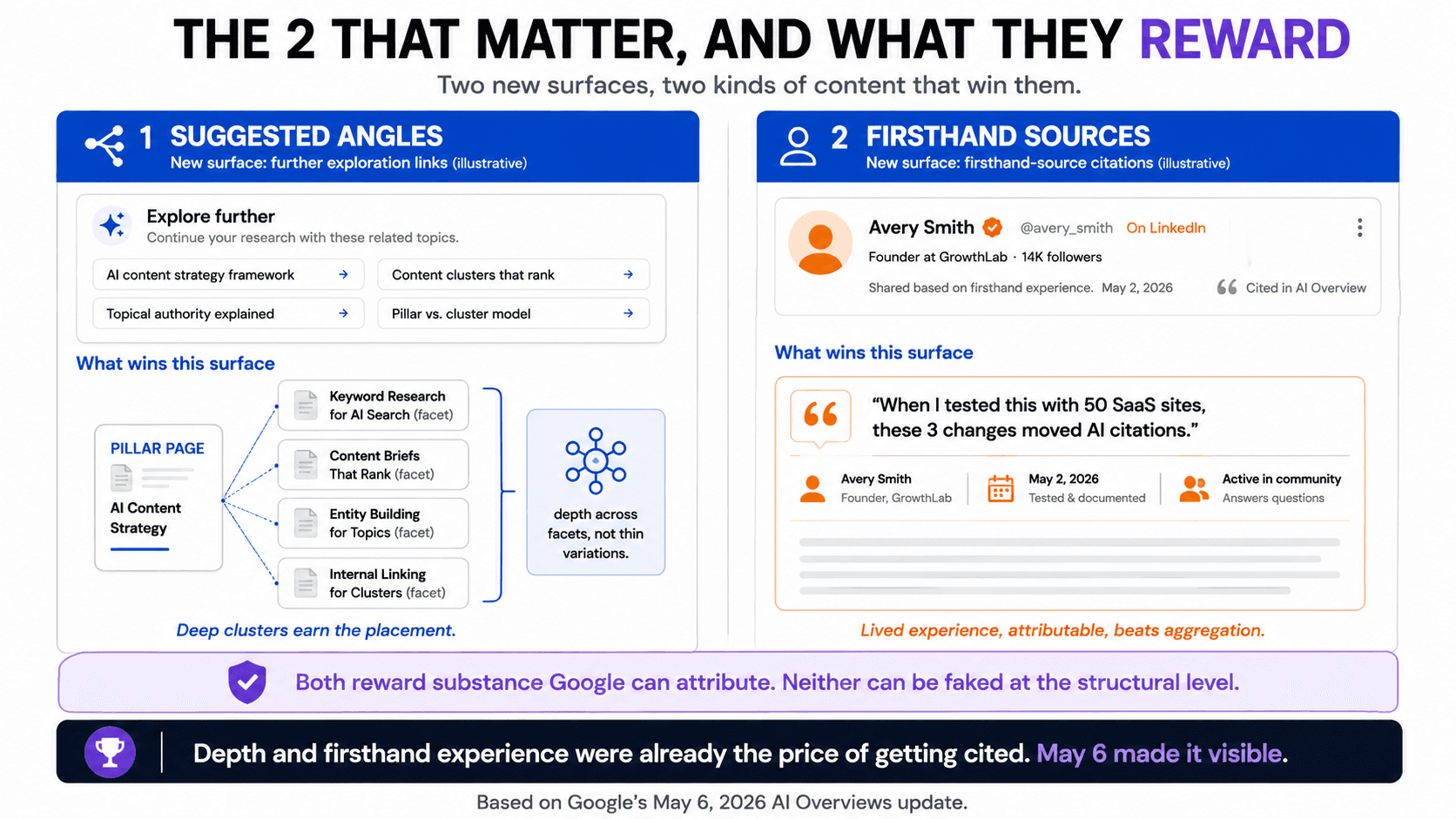
Two of the five change what content gets surfaced, which means they change what you should make. Both happen to reward things that were already pulling AI citations, which is why I read this update as a confirmation rather than a curveball.
Suggested angles make topical depth a discovery surface
The "suggested angles" section is a new place to be found, and it rewards depth across the facets of a topic. Google is now ending responses with links to in-depth analyses on different facets of the subject, which means the sites that own deep, specific coverage of a topic's sub-questions get a fresh surface to appear in.
A single thin page on a broad term does not earn this slot. A cluster of substantive pages, each owning a distinct facet, does.
This is the practical reward for topical depth over keyword breadth: one thorough treatment plus real depth on the facets around it, rather than five shallow variations of the same head term. The content strategy this favors is the one Google's own query fan-out already rewarded, now with a visible placement attached.
Firsthand sourcing makes lived experience a citation surface
The firsthand-source change is the one with the biggest content implication, because it tells you what kind of content Google wants to elevate. By surfacing social posts and discussions with the creator's name, handle, and community attached, Google is signaling that firsthand perspectives are a distinct, credible source class, and analysts read the broader update as favoring sources that did the work over content that aggregates it.
For your content, that points two directions at once.
On your own site, write from real experience: specific moments, tested claims, a point of view that proves a human who did the work wrote it, the substance layer that already separated cited content from forgettable content.
Off your site, presence in the communities where firsthand perspectives get pulled, with a real identity, now carries visible weight. The thing being rewarded is authenticity that can be attributed, and that is not something you can fake at the structural level.
Why Do the Two That Matter Reward What Was Already Winning?
Because the underlying shift in AI search has been moving toward depth and firsthand experience for a year, and this update simply made the reward visible. The signal was already in the data. Top-10 ranked pages accounted for 76% of AI Overview citations in mid-2025 but only about 38% by early 2026, which means ranking high stopped guaranteeing citation well before May 6. What predicts citation now is passage-level relevance and information consistency across sources more than backlink count, and what travels across sources is specific, verifiable, firsthand substance.
The two changes that matter both pull in that direction. Suggested angles rewards the depth that demonstrates real subject command. Firsthand sourcing rewards the lived experience that proves originality. These are the same two qualities that statistics, citations, and original evidence already lifted in controlled GEO research, and the same qualities that survive when Reddit, Wikipedia, and firsthand community sources dominate AI citations.
May 6 did not introduce a new game. It published the scoreboard. The brands that were building depth and writing from experience just got told, in Google's interface, that they were playing the right one.
There is a deeper reason this is worth getting right. AI Mode is no longer experimental, Gemini 3.5 Flash is now the default model, and ads have started running inside AI Overview responses. The surface is maturing, monetizing, and consolidating around the sources it trusts. Earned citation, won through depth and experience, is the position that holds as the paid layer grows around it. That makes the two content changes more urgent, not less.
Want to see what your Content ROI could be with the right system?
What Should You Do About It This Week?
Do three things, and let the display changes happen on their own. The work is concentrated in the two changes that matter, and it is the work you should arguably have been doing already.
First, build facet depth, not page count. Take your most important topics and map the facets, the distinct sub-questions a buyer actually asks, then own each one with a substantive page rather than spreading thin coverage across near-duplicate keywords. That is what earns the suggested-angles surface, and it is what query fan-out rewards regardless of this update.
Second, write from real experience and put your name on it. Lead with specific, firsthand detail and a defensible point of view, and where it fits your strategy, show up in the communities where your buyers ask questions, with a real identity rather than a faceless brand account.
Third, ignore the display noise. Do not re-architect anything for hover previews, inline link placement, or a subscription feature you do not run. Confirm your content is readable and cleanly structured so the inline-citation change works in your favor automatically, and move on.
The honest summary: if you were already building depth and writing from experience, this update is a tailwind and your to-do list barely changes. If you were chasing rankings with thin, aggregated content, the two changes that matter just confirmed that the floor is moving out from under that approach. Either way, the response is the same, and it is not complicated.
How Averi Helps You Win the Two That Matter
Averi is built around the two things this update rewards: depth and substance, produced consistently. The whole argument above is that the changes that matter favor deep facet coverage and firsthand experience, and those are exactly the two jobs the content engine is designed to make repeatable for a small team.
On depth, Averi's Strategy Map maps the facets of your core topics and builds the cluster structure that earns surfaces like suggested angles, so you are publishing substantive coverage of the questions buyers actually ask rather than thin variations of a head term.
On structure, dual SEO and GEO scoring checks every draft against the passage-level extractability and clean structure that make the inline-citation change work in your favor, before it ships. And Brand Core keeps your naming and positioning consistent across everything, the entity signal that makes you recognizable as a source.
We built this running our own content through it, taking a blank slate to over 12 million organic impressions across 12 months on a one-person team.
What Averi does not do is manufacture the firsthand experience, and it should not. The lived detail, the tested claim, the real point of view that the firsthand-source change rewards has to come from you, because that is the part no tool can fake and the part that earns the citation.
Averi handles the depth and the structure so your effort goes where this update says it should: the substance only you can provide.
FAQs
What did Google change in AI Overviews in May 2026?
On May 6, 2026, Google shipped five changes to AI Mode and AI Overviews: suggested angles linking to in-depth articles on facets of a topic, highlighting of links from your news subscriptions, firsthand-source attribution showing creator and community names on social and discussion citations, more inline links placed next to the relevant text, and hover previews showing the source site on desktop.
Which of the May 2026 changes actually affect my content strategy?
Two of the five. Suggested angles rewards topical depth across the facets of a subject, so deep clusters earn a new placement. Firsthand-source surfacing rewards lived experience and attributable community presence. The other three, inline link placement, hover previews, and news-subscription highlighting, change how links display, not what earns them.
Does the inline-links change mean I need to rewrite my content?
No, if you are already writing well-structured content. The change places citations next to the specific claim they support, which rewards self-contained, passage-level writing. That is the same extractability that already governs how AI pulls and cites content. If your pages are cleanly structured into citable chunks, the new placement works in your favor with no rewrite required.
What is the "firsthand source" change in Google AI Overviews?
When Google's AI features cite social media or online discussions, they now show the creator's name and handle along with the community name, signaling the response draws on firsthand sources. The broader update is read as favoring content from people who did the work over content that aggregates it, which rewards writing from real experience and maintaining an attributable presence in relevant communities.
Do higher Google rankings still get me cited in AI Overviews?
Less than they used to. Top-10 ranked pages accounted for about 76% of AI Overview citations in mid-2025 but only roughly 38% by early 2026, so ranking high no longer guarantees citation. Passage-level relevance and consistency of information across sources now predict citation more than backlink count or ranking position alone.
Is the May 2026 AI Overviews update an emergency for SEO?
No. It is a confirmation of a shift already underway toward depth and firsthand experience. If you were building deep topical coverage and writing from real experience, the update is a tailwind. If you were publishing thin, aggregated content to chase rankings, it confirms that approach is losing ground. The right response is the same either way, and it is not urgent panic.
How do ads in AI Overviews change things for content?
Google has begun running ads inside AI Overview responses as AI Mode moves out of experimental status. That makes earned citation, won through depth and firsthand substance, more valuable, because it is the position that holds as a paid layer grows around it. It raises the case for investing in citation-worthy content now rather than waiting.
Related Resources
The Agentic Web Cluster
How Agents Read, How to Write for Them, and How Buying Is Being Rebuilt
Writing for Humans and Agents at the Same Time: The Dual-Reader Playbook
How AI Agents Actually Read Your Content: Chunking, Embeddings, and Retrieval
Agent Behavioral Science: The Web Will Be Won by Whoever Predicts Agents