Writing for Humans and Agents at the Same Time: The Dual-Reader Playbook


TL;DR
🚫 The choice is false. You don't have to write robotically for machines or abandon structure for humans. The two readers' needs overlap far more than they conflict
🤝 Structure serves both. Modular sections, direct answers, and tables help machines extract and help humans skim at the same time. When you format for skimmability, you make the content easier for machines to parse too
🧩 The mechanics reward the same moves. AI retrieves self-contained chunks, so leading with the answer and writing standalone sections serves retrieval and serves readers who scan. How that retrieval works
✍️ One real divergence: the experience layer. First-person experience, lived detail, and a falsifiable point of view are what humans trust, and the same signals tell AI the content is original rather than synthetic
📊 Evidence serves both too. The Princeton GEO study found citing sources, adding statistics, and quotations each lifted AI citation 30 to 40%, and the same evidence is what makes a human trust you
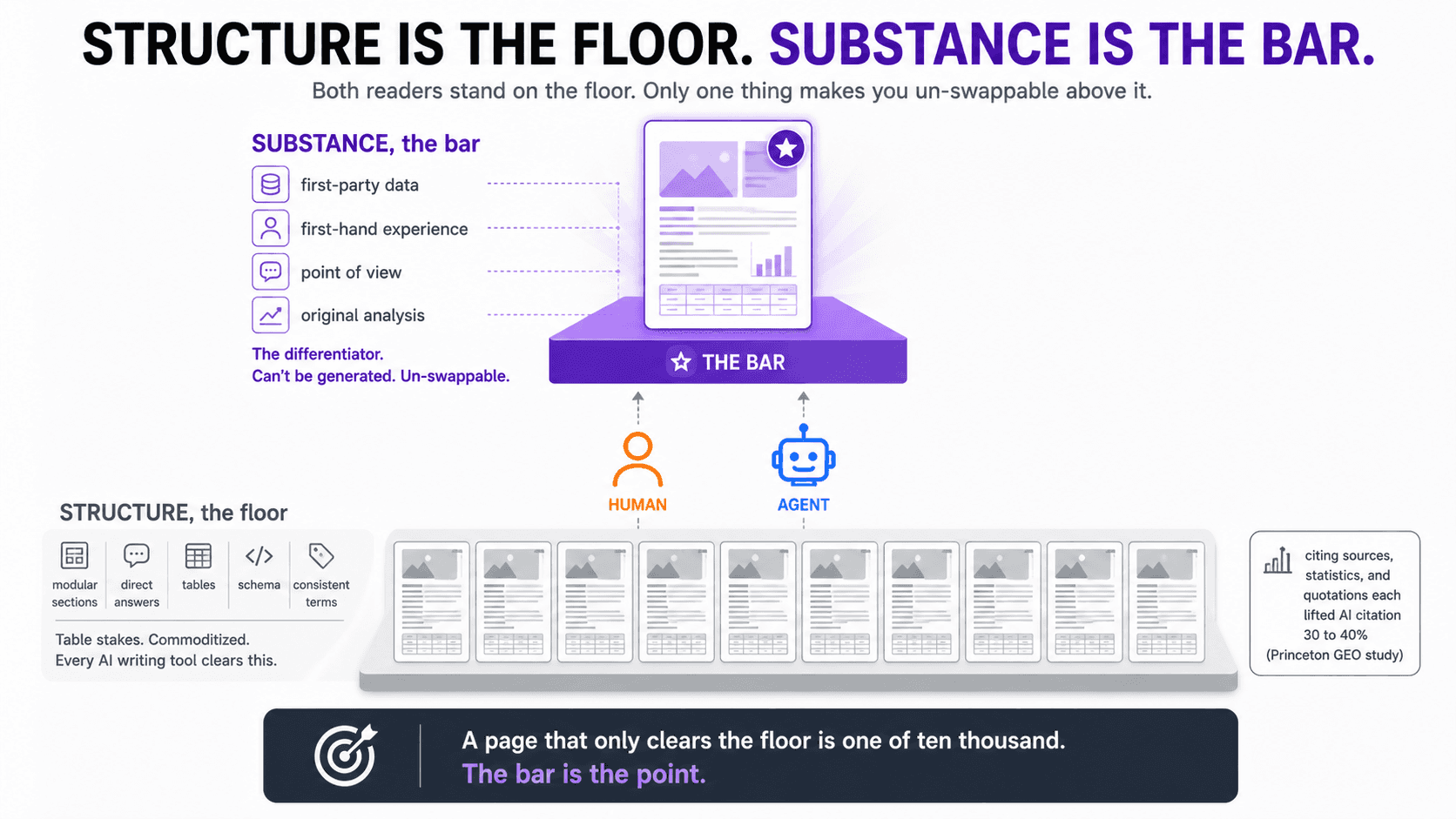
🏗️ The rule: substance is the bar, structure is the floor. Structure gets you read by the machine. Substance is what gets you trusted, cited, and remembered. Most tools do the floor and stop
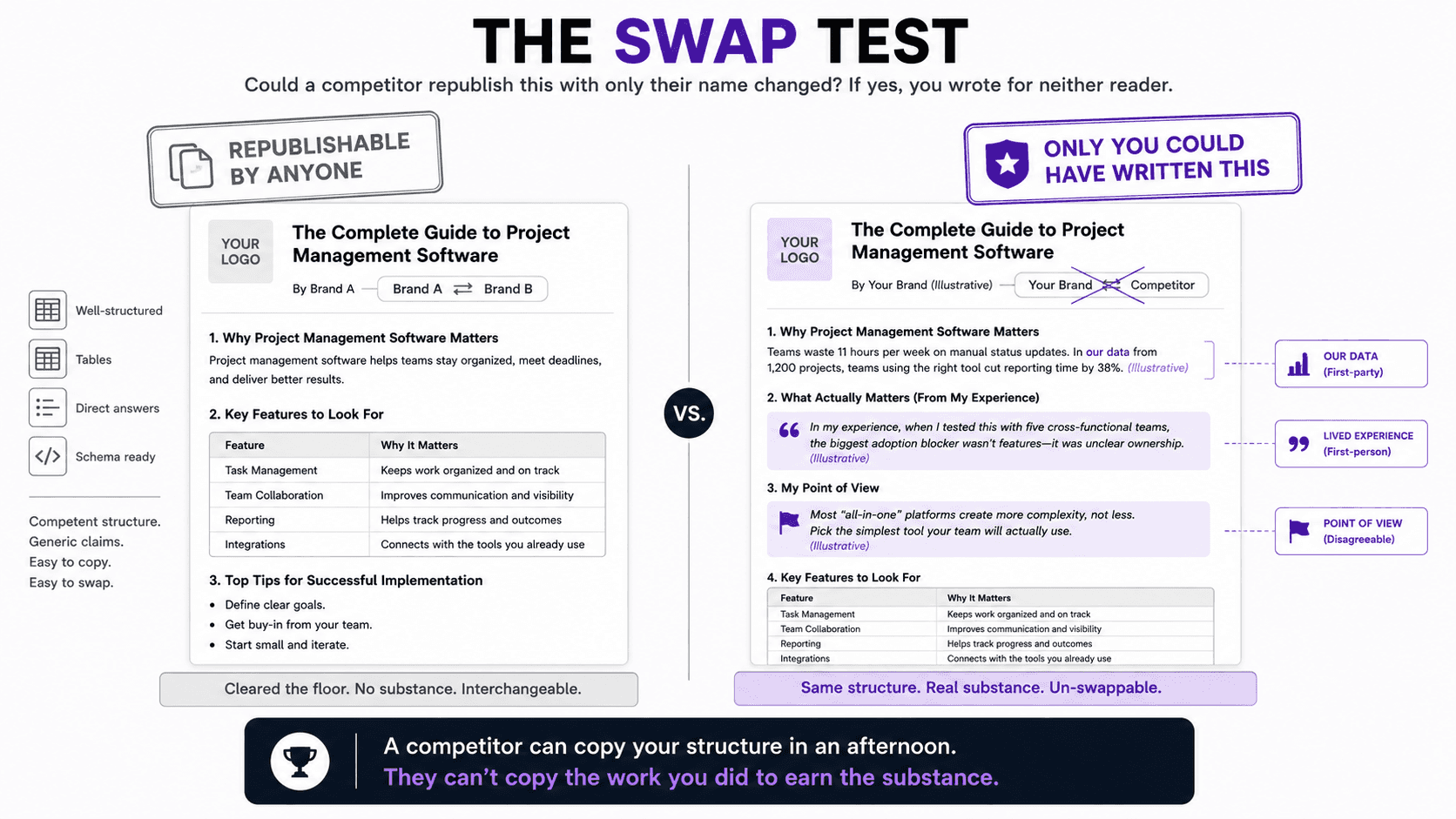
🔁 The test: the swap test. If a competitor could republish your piece with only their name changed, you wrote for neither reader. Real experience and a real point of view are what make content un-swappable

Zach Chmael
CMO, Averi
"We built Averi around the exact workflow we've used to scale our web traffic over 6000% in the last 6 months."
Your content should be working harder.
Averi's content engine builds Google entity authority, drives AI citations, and scales your visibility so you can get more customers.
Writing for Humans and Agents at the Same Time: The Dual-Reader Playbook
The premise that you must choose between writing for humans and writing for AI is wrong, and it's costing people good content. The fear goes like this: optimize for the machine and you'll produce robotic, keyword-stuffed sludge that no human wants to read; write for the human and the AI won't be able to parse you. So teams pick a side, and both sides lose, because the choice was never real.
Here's what's actually true. The web now has two reader populations, humans and AI agents, and they do read differently. But their needs overlap far more than they conflict. Almost every move that makes content easier for a machine to extract also makes it easier for a person to skim. There's exactly one place the two truly diverge, and that divergence favors the human reader so strongly that serving it is the single best thing you can do for your AI visibility too. The skill isn't choosing a reader. It's writing for both at once, and it's learnable.
This is the playbook for doing that. Where the two readers align, the one place they don't, why that one place is your biggest opportunity, and the rule that ties it together: substance is the bar, structure is the floor. It's the writing layer of how agents read, how to write for them, and how buying is being rebuilt.
Do You Have to Write Differently for Humans and AI?
No. You write with enough structure that a machine can extract your meaning and enough substance that a human trusts it, and those two goals overlap far more than they fight. The idea that optimizing for AI means dumbing content down for humans is the most expensive misconception in content strategy right now.
The misconception comes from an outdated picture of how machines read. In the keyword era, "writing for search" did mean degrading the prose, stuffing phrases, repeating exact-match terms, writing for a crawler that counted words rather than understood them. That crawler is gone. Modern AI reads for meaning, structure, and evidence, which happen to be the same things that make writing clear and credible to a person. The structure that makes content skimmable for humans is the same structure that makes it parseable for machines.
So the real question isn't "which reader do I write for." It's "how do I write so that one piece works for both." The answer has three parts: nail the structure that serves both, understand the one place they diverge, and lead with the substance that the structure exists to deliver. The rest of this guide is those three parts.
How Do Humans and AI Agents Read Differently?
Humans read for meaning, emotion, and trust; AI agents read for structure, semantic signal, and extractability. Understanding both reading styles is what lets you write for both at once, so it's worth being precise about each.
How humans read
Humans skim before they commit. They scan headings, jump to what looks relevant, and decide in seconds whether a page is worth their attention. They respond to voice, to a clear point of view, to the sense that a real person who knows the subject is talking to them. They remember stories and strong claims, not paragraph four of a wall of text. And they trust evidence, specific numbers, named sources, lived detail, over vague assertion. A human reader rewards clarity, credibility, and a reason to keep reading.
How agents read
AI agents don't read your page as a page at all. They break it into chunks, convert each into a vector, and retrieve the fragments that match a query. The chunk, not the page, is the unit they retrieve and cite. They reward content that's structured into clean, self-contained sections, that leads with direct answers, that uses consistent terminology they can map to a known entity, and that backs claims with citable evidence. An agent rewards structure, clarity, and factual density.
Look at those two lists side by side and the overlap jumps out. Clarity. Evidence. A clear point. The readers express their preferences differently, skimming versus chunking, but they're asking for many of the same things.
Where Do the Two Readers Actually Align?
They align on structure and evidence: modularity, direct answers, tables, consistent terminology, and cited facts all serve both readers at once. This is the convenient truth that makes "writing for both" possible rather than a contradiction.
Modular, self-contained sections
Break content into sections that each address one question and stand on their own. This helps machines extract clean chunks and helps humans skim to exactly what they need. The human scanning your page and the agent chunking it both benefit from the same modular structure. One move, two readers served.
Direct answers up front
Lead each section with the answer, then expand. The practice has a name in clear-writing circles, BLUF, for "bottom line up front." AI reads the first sentences of a section to categorize its meaning, and a human reads them to decide whether to keep going. Front-loading the answer serves the machine's retrieval and the human's impatience in the same stroke. It also maps directly to how chunking works: if the answer is buried, it may fall outside the fragment the agent retrieves.
Tables and structured data
Use a table for anything comparative. A table is structured data in visual form: the machine extracts it cleanly to build a comparison, and the human scans it fast. The same comparison written as a flowing paragraph forces the machine to infer the structure, often losing the nuance, and forces the human to hold five variables in their head. The table wins with both.
Consistent terminology
Pick one name for each concept, one category term, one description of what you do, and use it everywhere. AI relies on repetition to understand what you're known for, building the entity signal that makes you recognizable and citable, and a human builds recognition the same way. Inconsistent naming fragments your entity authority for the machine and muddies your positioning for the person. One vocabulary, used consistently, sharpens both.
And evidence sits underneath all of it. The Princeton GEO study found that adding statistics, citing sources, and including quotations each lifted AI citation visibility by 30 to 40%. The same cited evidence is precisely what moves a skeptical human from "interesting claim" to "I believe you." Evidence is the rare thing that's a ranking factor and a trust factor at once.
Where Do the Two Readers Diverge?
They diverge in one place: the experience layer. Humans want voice, lived detail, opinion, and the sense of a real person behind the words. Pure machine extraction doesn't require any of that; an agent can chunk and retrieve a perfectly soulless paragraph. This is the one spot where serving the human asks for something the machine's parsing doesn't strictly demand.
It's worth being honest that this is a real divergence, not a fake one. You could write content that's structurally flawless, modular, front-loaded, tabled, consistently termed, and completely lifeless. It would chunk fine. A human would bounce. The structural alignment gets you a piece both readers can parse; it does not, by itself, get you a piece a human wants to read or a piece that stands out from the flood of competent, structured, forgettable content now being produced at scale.
So if the alignment got you this far, the divergence is where the actual competition happens. And here's the turn that makes it the most important part of the whole playbook: the thing humans want that machines don't strictly require turns out to be the thing that signals the most to machines anyway.
Why Does the Divergence Favor Writing for Humans?
Because the experience layer that humans trust is also the strongest signal to AI that your content is original rather than synthetic. First-person experience does double duty, and that makes it the highest-value writing you can do for both readers.
Phrases that mark genuine experience, "in my experience," "when I tested this," "one mistake I made," build trust with the human reader and simultaneously signal to the AI that the content is original rather than machine-generated. As models get better at detecting synthetic, derivative content, and as the web fills with it, lived experience and a defensible point of view become the scarcest and most valuable signal a page can carry. The human-exclusive layer is the originality layer.
This is why the divergence doesn't force a tradeoff. Writing the experience layer for the human is also writing the originality signal for the machine. The two readers, which seemed to pull apart at this one point, actually pull in the same direction once you see what the machine now rewards. AI is mediating communication, not replacing the human layer of it, and the content that wins is the content that has something only a human could have written.
What's the Actual Rule? Substance Is the Bar, Structure Is the Floor
The rule is simple: structure is the floor, and substance is the bar. Structure, the modularity, direct answers, tables, schema, consistent terms, is the minimum that gets you read by the machine and skimmed by the human. Substance, first-party data, first-hand experience, a defensible point of view, original analysis, is what gets you trusted, cited, and remembered. You need both, but they are not equal, and most of the market has them backwards.
Here's the problem with treating structure as the goal. Structure is now commoditized. Every AI writing tool can produce a well-formatted, schema-marked, FAQ-bearing, table-using page. The floor is crowded, and a page that only clears the floor is indistinguishable from ten thousand others clearing the same floor. As the web fills with competent structured content, the differentiators become point of view, original data, and lived experience, the substance layer, which can't be generated from a prompt because it has to be earned through doing the work.
So the operating instruction is: build the floor reliably, then spend your real effort above it. Get the structure right so the machine can read you and the human can scan you, treat that as table stakes, and pour your energy into the substance that makes the piece worth reading and worth citing. A piece that's all structure and no substance loses with both readers, slowly with the machine as originality signals win, immediately with the human. A piece that has real substance and clears the structural floor wins with both. The floor is necessary. The bar is the point. This is the principle we built our own content engine around, and it's the reason structure-only tools plateau.
Build the floor automatically, spend your effort on the bar. Averi handles the structural layer, modular sections, dual SEO and GEO scoring, schema, so your time goes to the substance that actually differentiates. Start free →
How Do You Write for Both at Once?
You write for both by clearing the structural floor as a matter of routine and then layering in the substance only you can provide. In practice, that's a repeatable sequence.
Start with structure as a checklist, not a creative act. One question per section. The answer in the first sentence or two. A clear heading on every section. Tables for comparisons, lists for sequences. One consistent name for each concept. Claims backed by cited, primary sources. None of this should take creative energy; it's the floor, and it should become muscle memory.
Then spend the creative energy on substance. What do you know from doing the work that a model summarizing the internet doesn't? Put it in. Cite your own data if you have it. Name the specific moment something failed or worked. Take a position that someone could disagree with, the safest content takes no stance, and a stance is what a point of view is made of. Add the lived detail that proves a human who's been in the arena wrote this. This is the layer that earns trust from the human and originality credit from the machine, and it's the layer that can't be commoditized. The mechanics of retrieval reward the structure, and the human, and the synthetic-content filters, reward the substance.
One precondition that sits under all of it: the machine has to be able to read the page at all. If your content renders client-side, most AI crawlers see a blank shell no matter how well you write, so confirm that first.
How Do You Know If You Got It Right?
You know you got it right when the piece passes two tests: the editor test and the swap test. Both are about substance, because that's the part that's hard and the part that decides whether the work was worth doing.
The editor test: hand the piece to a smart editor who knows the subject and ask what they see. Do they see real insight and lived experience, a person who clearly did the work and has a point of view? Or do they see a well-built page, competent, structured, evidence-cited, and completely interchangeable with any other competent page on the topic? If it's the latter, you cleared the floor and stopped. The structure is fine. The substance is missing.
The swap test is the sharper version: could a competitor republish your piece with only their name changed, and have it be just as true and just as ownable? If yes, you wrote for neither reader, because nothing in it is actually yours. The whole value of the substance layer is that it makes content un-swappable. Your first-party data is yours. Your lived experience is yours. Your point of view is yours. A competitor can copy your structure in an afternoon; they can't copy the work you did to earn the substance. That's what separates content that compounds into authority from content that fills a page. Pass both tests and you've written for both readers. Fail them and no amount of schema will save the piece.
Where Does Averi Fit in Writing for Both?
Averi handles the structural floor automatically, so the part of the work that decides whether you pass the swap test, the substance, is where your effort actually goes. The whole argument of this guide is that structure is table stakes and substance is the differentiator. Averi is built on exactly that split: it makes the floor reliable so you stop spending creative energy on formatting and spend it on the point of view, first-party data, and lived experience no tool can generate for you.
In practice, the content engine drafts in the structure both readers reward, modular single-question sections, answers up front, tables for comparisons, consistent terminology, and dual SEO and GEO scoring then checks each draft against those conditions before it ships, so the machine can parse it and a human can skim it without you hand-auditing every piece. Brand Core keeps your naming and category language consistent across everything you publish, which is the entity signal the machine uses and the positioning a human remembers. That is the brand layer for the agentic web: the system that keeps you legible to both readers at once.
What Averi deliberately does not do is manufacture the substance.
It can't have your first-hand experience or take your position for you, and it shouldn't. Clean structure is the floor, and the floor is what an engine should own. The bar, the substance that makes your content un-swappable, stays yours.
We built Averi on Averi precisely to free that effort: the structure ran on autopilot while the substance, the actual point of view, carried our own content from a few thousand monthly impressions to over 12 million organic impressions across 12 months on a one-person team.
Write what only you can write
Averi clears the structural floor automatically, so your effort goes where it counts: the first-party data, lived experience, and point of view that make content un-swappable. Built for both readers, by default. $99/month for Solo. 14-day free trial.
FAQs
Do you have to write differently for AI and humans?
No. The two readers' needs overlap far more than they conflict. Structure, modular sections, direct answers, tables, consistent terminology, helps machines extract and humans skim at the same time. The one place they diverge, the experience layer, actually favors the human reader, because lived experience and point of view also signal originality to AI. You write one piece for both, not two pieces.
What does "write for both humans and machines" actually mean?
It means clearing a structural floor that lets machines parse your content and humans scan it, then layering in the substance, first-party data, first-hand experience, and a defensible point of view, that earns human trust and signals originality to AI. The structure is table stakes both readers need; the substance is what differentiates and gets you cited and remembered.
Does writing for AI make content worse for humans?
Only if you're using an outdated idea of how AI reads. Keyword-era optimization did degrade prose. Modern AI reads for meaning, structure, and evidence, which are the same things that make writing clear and credible to a person. Writing well-structured, evidence-backed content with a real point of view serves both readers; keyword stuffing serves neither.
What is the one thing humans want that AI doesn't require?
The experience layer: voice, lived detail, opinion, and the sense of a real person behind the words. An AI can chunk and retrieve a soulless paragraph perfectly well; a human will bounce off it. But this is also where the opportunity is, because first-person experience signals to AI that content is original rather than synthetic, so serving the human here serves the machine too.
What does "substance is the bar, structure is the floor" mean?
Structure, formatting, schema, modularity, is the minimum that gets your content read by machines and skimmed by humans. It's now commoditized, so it can't differentiate you. Substance, original data, lived experience, and a defensible point of view, is what gets you trusted, cited, and remembered. You need both, but structure is table stakes and substance is the point. Most tools do the floor and stop.
How do I make my content stand out in AI search?
Clear the structural floor as routine, then invest in substance that can't be generated from a prompt: your own data, your first-hand experience, a position someone could disagree with, specific lived detail. As the web fills with competent structured content, point of view and original experience become the scarcest signals, valued by humans and treated as originality markers by AI.
What is the swap test for content?
The swap test asks whether a competitor could republish your piece with only their name changed and have it be just as true and just as ownable. If yes, the content has no real substance and you wrote for neither reader. First-party data, lived experience, and a genuine point of view are what make content un-swappable, and un-swappable is what compounds into authority.
Related Resources
The Agentic Web Cluster
How Agents Read, How to Write for Them, and How Buying Is Being Rebuilt
How AI Agents Actually Read Your Content: Chunking, Embeddings, and Retrieval
The JavaScript Rendering Gap: Why AI Can't See Your Best Content
Business-to-Agent (B2A): How to Prepare Your Brand for the Agentic Web