LinkedIn Is the #1 Most-Cited Source in AI Search for Professional Queries. Here's the Founder's Playbook.
5 minutes

TL;DR
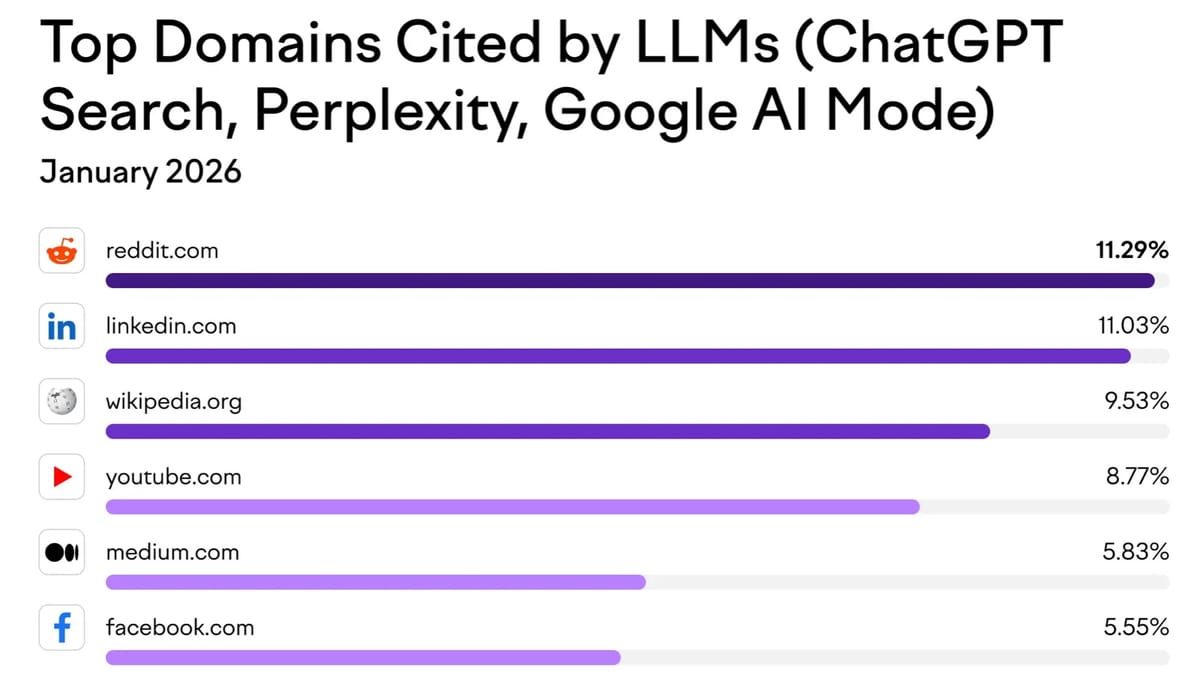
🥇 LinkedIn is the #1 cited domain for professional queries across all 6 major AI platforms (Profound, Q1 2026)
🥈 #2 overall domain behind Reddit across ChatGPT, AI Mode, and Perplexity (Semrush, 89K URLs) 📈 Citation frequency doubled from Nov 2025 to Feb 2026 — the fastest domain shift tracked this year
💬 14.3% of ChatGPT responses cite LinkedIn content; 11% average across all platforms
👤 59% of citations on ChatGPT and AI Mode come from individual creators, not company pages
📝 Articles 500-2,000 words get the most citations; posts 50-299 words perform best in feed
🔄 Original content = 95% of citations; reshares = 5%

Zach Chmael
CMO, Averi
"We built Averi around the exact workflow we've used to scale our web traffic over 6000% in the last 6 months."
Your content should be working harder.
Averi's content engine builds Google entity authority, drives AI citations, and scales your visibility so you can get more customers.
LinkedIn Is the #1 Most-Cited Source in AI Search for Professional Queries. Here's the Founder's Playbook.
Your LinkedIn Posts Are AI Citation Assets (You Just Don't Know It Yet)
Something happened between November 2025 and February 2026 that most startup founders missed entirely.
LinkedIn went from ranking roughly #11 among domains cited by ChatGPT to #5 — and #1 for professional queries across every major AI platform: ChatGPT, Gemini, Google AI Overviews, AI Mode, Copilot, and Perplexity.
Profound's analysis of 1.4 million citations called it the largest domain authority shift they'd observed all year.
Separately, Semrush analyzed 325,000 unique prompts and identified 89,000 LinkedIn URLs being cited in AI-generated responses.
LinkedIn appeared in 14.3% of ChatGPT responses, 13.5% of Google AI Mode responses, and 11% on average across all platforms.
That puts it ahead of Wikipedia, YouTube, and every major news publisher.
This isn't a social media trend. It's a structural shift in how AI answers professional questions — and it has direct implications for every startup founder doing their own marketing.
When someone asks ChatGPT "what's the best content strategy for a seed-stage startup" or "how does GEO optimization work," the answer is increasingly built from LinkedIn posts and articles.
If you're not publishing there, someone else's framing is becoming the AI's default answer about your market.
What Actually Gets Cited (The Data Breakdown)
Not all LinkedIn content performs equally in AI search. The Semrush and Profound studies reveal specific patterns:
Content type matters more than you think
The composition of LinkedIn citations has shifted dramatically in three months. Posts and long-form articles rose from 26.9% to 34.9% of all LinkedIn AI citations. Profile pages collapsed from 33.9% to 14.5% over the same period.
AI systems are moving away from static identity pages and toward published content that demonstrates ongoing expertise. What you say matters more than what your bio says.
Format and length have clear winners
Articles between 500 and 2,000 words receive the most AI citations. For feed posts, mid-length content between 50 and 299 words performs best. The pattern mirrors what works for GEO optimization on your website — structured, substantive, extractable content wins.
Original content dominates completely
95% of LinkedIn AI citations come from original content. Reshares account for roughly 5%. If you spend your time on LinkedIn reposting other people's takes with "Great insights!" you are invisible to AI search.
Individual creators beat company pages (on most platforms)
This is the stat that should change how founders think about LinkedIn:
On ChatGPT Search and Google AI Mode, 59% of cited LinkedIn content comes from individual creators — personal posts, personal articles, content tied to individual profiles. Company pages account for 41%.
Perplexity flips this: 59% from company pages, 41% from individuals.
For startup founders, the implication is clear.
Your personal LinkedIn presence is more valuable for AI citation on the two biggest platforms than your company page.
Your name, your perspective, your published thinking — that's what ChatGPT and Google AI Mode pull from.
AI doesn't just cite LinkedIn. It echoes it.
Semrush found semantic similarity scores of 0.57-0.60 between LinkedIn content and AI responses.
That means AI responses often mirror the meaning and framing of the original LinkedIn content.
When you publish a take on LinkedIn about how content marketing works for startups, you're not just creating a post — you're potentially shaping how AI explains your market to everyone who asks.

The 10-Move Founder-Led LinkedIn GEO Playbook
1. Publish long-form LinkedIn articles monthly (500-2,000 words)
This is where the heaviest citations come from. One article per month on a core topic you want to own in AI search. Tie each article back to a pillar page on your website — the cross-linking strengthens both surfaces.
2. Post original content at least 5 times per month
75% of cited authors post at least 5 times monthly. This isn't about going viral. It's about showing up consistently enough that AI systems recognize you as an active, reliable source.
3. Lead every post with an extractable answer
Same principle as GEO optimization for blog content: AI cites the first 1-2 sentences, not the best sentences. If your opening is "I've been thinking about something lately..." the AI has nothing to grab. Start with the insight. Open with the answer.
4. Write about your domain, not about yourself
54-64% of cited posts are educational or knowledge-sharing. "Here's what I learned about content marketing after growing traffic 6,000%" gets cited. "I'm thrilled to announce we raised funding" does not. Teach something. Share data. Explain a concept. That's what AI pulls.
5. Use consistent terminology across LinkedIn and your website
AI builds entity models from consistency. If you call it a "content engine" on your website, call it a "content engine" on LinkedIn. If you've coined a term like "informational footprint," use it across both surfaces. The reinforcement helps AI connect your brand to your concepts.
6. Stop resharing. Start originating.
The 95% vs. 5% citation split between original content and reshares is brutal. Even a short original opinion on a trend — three sentences with a specific take — beats a reshare with commentary. AI needs content it can attribute to you, not content you forwarded.
7. Optimize your profile as an entity signal
Profile citations are declining, but entity recognition still matters. Your headline should match your brand's core terminology. Your "About" section should read like a positioning statement, not a resume. Include the same keywords AI associates with your domain expertise.
8. Treat your company page and founder profile as separate GEO channels
Company page matters most on Perplexity (59% of citations). Founder profile matters most on ChatGPT and AI Mode (59%). Both need regular, original content — but the strategy is different.
Company page: structured, product-focused, category-defining.
Founder profile: opinionated, experience-driven, specific.
9. Cross-link between LinkedIn and your website
When you publish a LinkedIn article, link to your website's pillar content on the same topic. When you publish a blog post, reference and link to your LinkedIn article. Bidirectional linking between the two surfaces strengthens entity authority on both.
10. Turn every blog post into a LinkedIn-native variant
This is where the workflow matters most. You already did the research, built the structure, and wrote the insights for your blog. Reformatting that into a LinkedIn post and article takes 15 minutes — and doubles your GEO surface area.
This is exactly what we built into Averi's workflow.
How Averi Makes This a System (Not a Side Project)
Here's the honest problem with the playbook above: most founders read it, nod, and then never do it because LinkedIn content creation feels like a separate workstream on top of everything else.
It doesn't have to be.
Averi's content engine produces your blog content through a single workflow — research, draft, optimize, publish.
But the same content that becomes a 2,500-word blog post can become a LinkedIn post in the same session.
The platform's LinkedIn post generation takes the core insights from your blog, reformats them for the platform, and keeps your brand voice consistent across both surfaces.
Here's what that looks like in practice:
The blog-to-LinkedIn loop:
Averi's content engine produces a blog post — researched, structured, dual-optimized for SEO and GEO
From the same content, generate a LinkedIn post (50-299 words, extractable opening, educational angle)
From the same content, generate a LinkedIn article (500-2,000 words, deeper exploration of one angle)
Publish the blog to your CMS. Post the LinkedIn content under your founder profile.
Cross-link between them.
One research session. One set of insights. Three GEO-optimized assets across two citation surfaces.
That's the difference between "I should post on LinkedIn more" (a resolution that dies by February) and a system that produces LinkedIn content as a natural output of your content engine workflow.
We use this exact loop ourselves.
Our blog content feeds our LinkedIn presence, our LinkedIn presence strengthens our entity authority, and both surfaces get cited by AI.
That compounding effect is a big part of how we grew traffic 6,000% in 10 months.
Start your 14-day free trial →
The Compounding Loop: Why LinkedIn + Website GEO Is Greater Than Either Alone
Most GEO strategies focus on one surface — optimize your website for AI citations. That's necessary but incomplete.
The real advantage comes from the loop:
Website content builds search authority, earns traditional rankings, and creates the structured, deep-dive content that AI systems cite for comprehensive answers.
LinkedIn content builds entity authority, earns professional query citations, and creates the attributed, expertise-signaled content that AI systems cite when they need a credible human source.
Each surface reinforces the other.
When AI sees your name publishing expert content on LinkedIn and your website ranking for the same topics, the entity confidence compounds. You become more citable on both.
For startups, this is an asymmetric advantage.
Enterprise marketing teams have separate social teams, content teams, and SEO teams that rarely coordinate across surfaces. A founder running a content engine that produces blog and LinkedIn content from the same workflow is running a tighter, more integrated GEO loop than most companies ten times their size.
The window is still open.
LinkedIn's rise in AI citations is months old, not years.
The founders who build this system now will compound their advantage every month as AI systems reinforce their citations from both surfaces.
FAQs
Why is LinkedIn so highly cited by AI search engines?
LinkedIn carries implicit professional credibility signals that AI models weight heavily. Every piece of content is tied to a verifiable identity with credentials, job history, and connections. The platform also packages content with exactly what AI models need: clear authorship, topic clustering, publication recency, and engagement signals. Profound's research across 1.4 million citations found LinkedIn is the #1 cited domain for professional queries across all six major AI platforms. The structural advantage is durable — these are the same E-E-A-T signals that Google and AI models use to assess source authority.
Should I focus on my personal profile or company page?
Both, but with different strategies for different platforms. ChatGPT Search and Google AI Mode cite individual creators 59% of the time — so your personal founder profile is your primary asset on those platforms. Perplexity flips this, citing company pages 59% of the time. The most resilient approach is investing in both: your company page as a content hub with structured, product-focused content, and your founder profile as an opinionated thought leadership channel with experience-driven takes.
How often do I need to post on LinkedIn to get cited by AI?
The data shows 75% of cited authors post at least 5 times per month. This isn't about daily posting — it's about consistent presence. Five original posts per month, plus one long-form article, puts you in the citation-eligible range. Quality matters more than volume, but volume below the threshold makes you invisible. A content engine approach that generates LinkedIn posts alongside blog content makes this sustainable without adding hours to your week.
Do LinkedIn articles or feed posts get cited more?
Long-form articles (500-2,000 words) get the most AI citations per piece because they provide the depth and structure AI models prefer for extracting comprehensive answers. Feed posts (50-299 words) get cited less individually but reach a wider audience and contribute to the posting consistency that builds entity authority. The optimal strategy is both: monthly articles for citation depth, weekly posts for consistency and visibility.
How does LinkedIn GEO connect to my website strategy?
They compound each other. Your website builds search authority and provides the deep, structured content AI cites for comprehensive answers. Your LinkedIn presence builds entity authority and provides the attributed, expertise-signaled content AI cites when it needs a credible human source. Cross-linking between them strengthens both surfaces. When AI sees the same person publishing expert content on LinkedIn and the same brand's website ranking for those topics, entity confidence increases. Read our complete GEO implementation guide for how to integrate both surfaces.
Can I repurpose blog content for LinkedIn or does it need to be original?
Repurposing works — and it's the most efficient approach. The key is reformatting for the platform, not copy-pasting. A 3,000-word blog post should become a 150-word LinkedIn post (one key insight, extractable opening, specific take) plus a 1,000-word LinkedIn article (deeper exploration of one angle). Averi's content engine handles this by generating LinkedIn-native variants from your blog content while maintaining your brand voice across both surfaces.
Is this a temporary trend or is LinkedIn's AI citation position durable?
The indicators point to durable. LinkedIn's structural characteristics — verified professional identities, original expert content, consistent publishing signals, and Microsoft infrastructure integration — align closely with what AI models look for in authoritative sources. Profound called it a structural change, not a temporary spike. The comparison is to Wikipedia's early authority: platforms that became go-to AI sources early tend to compound that position as models continue to train on and reference their content. The founders who build this system now will have a compounding head start.
Related Resources
LinkedIn Marketing for B2B SaaS: The Complete Strategy Guide for 2026
Beyond Google: How to Get Your Startup Cited by ChatGPT, Perplexity, and AI Search
Building Citation-Worthy Content: Making Your Brand a Data Source for LLMs
How to Create Thought Leadership Content That Doesn't Sound AI-Generated
Leading With Vision: How Founders Create Brand Vibes That Actually Matter
Content Clustering & Pillar Pages: Building Authority in AI and SaaS Niches
12 SEO/GEO Search Trends That Defined 2025 (and the Playbook for What Comes Next)