Vibe Marketing in Q2 2026: What's Working, What's Hype, and What's Next
6 minutes

TL;DR
📈 Vibe marketing crossed the chasm in Q1 2026: searches up 700% YoY, MarTech now hosts a dedicated Vibe Marketing Lab, and "Vibe Marketer" job titles have appeared with salaries up to $1M reported — though that's an outlier, not a benchmark
🎯 What's working: AI-referred traffic that converts at 4.4x the rate of organic, integrated content workflows that compress brief-to-publish to under 6 hours, and Brand Core systems that maintain voice consistency across 50+ pieces
🚫 What turned out to be hype: the "AI handles execution while humans direct" framing (oversold), the universal $1M Vibe Marketer salary (exception, not norm), and the assumption that more AI tools = more output (the opposite is true — fewer, deeper integrations win)
📉 The reality check: AI referral traffic dropped 42.6% since July 2025 per Kevin Indig — the channel isn't a one-way escalator, and teams treating it as guaranteed growth are about to be disappointed
⚙️ What's next (Q2-Q3 2026): ChatGPT-specific optimization (87.4% of AI referral traffic), product-page-as-citation-asset thinking, MCP-based agent workflows, GEO-conference legitimacy, and the consolidation of 18+ tracking tools into 3-4 winners
🛠 The single most important shift: vibe marketing in Q2 2026 is no longer about being fast. It's about being fast and being measured. The teams winning are the ones who instrumented their workflow from day one
Zach Chmael
CMO, Averi
"We built Averi around the exact workflow we've used to scale our web traffic over 6000% in the last 6 months."
Your content should be working harder.
Averi's content engine builds Google entity authority, drives AI citations, and scales your visibility so you can get more customers.
Vibe Marketing in Q2 2026: What's Working, What's Hype, and What's Next
It's been roughly twelve months since "vibe marketing" entered the marketing lexicon as anything more than a meme, and the conversation has matured faster than almost any marketing trend I've watched.
Searches for "vibe marketing" are up nearly 700% in the past year, rising from approximately 1,000 to 6,500 monthly searches per Exploding Topics.
MarTech ran a Vibe Marketing Lab at their March conference.
Marc Sirkin's Vibe Marketing Manifesto reframed it as "an operating system for synthetic creativity."
Job listings for "Vibe Marketers" started appearing — some at salaries up to $1 million.
That's the bull case. The reality is more complicated.
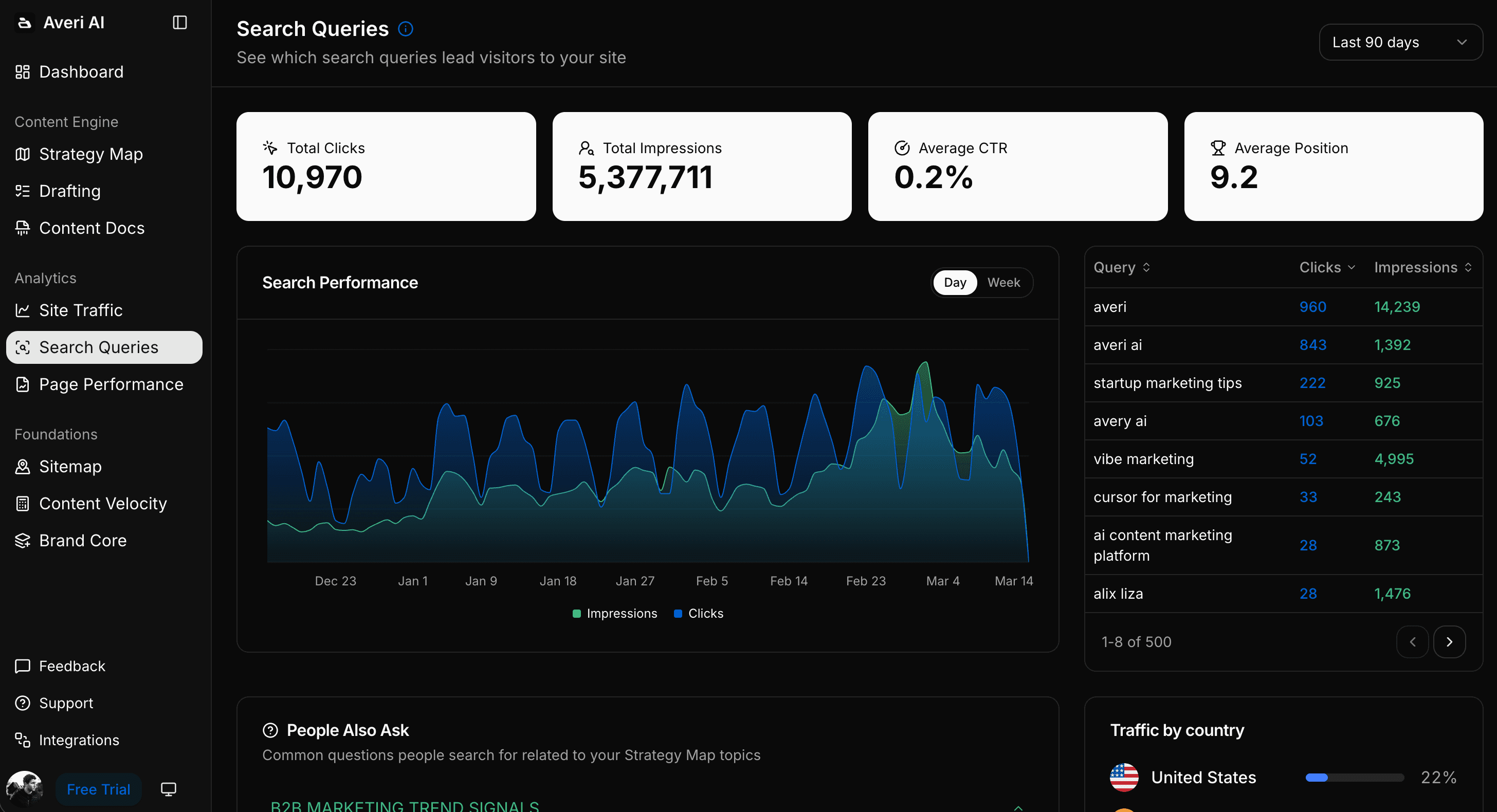
I've been running an operational vibe marketing workflow at Averi for 12 months. We hit 10.6 million Google impressions in the first 12 months on a one-person team.
We've used the methodology, watched the tools mature, watched some of them collapse, and watched the conversation shift in ways that the original 2025 vibe marketing pieces didn't predict.
This piece is the Q2 2026 reality check: what's actually working in vibe marketing right now, what turned out to be hype, and the five shifts I think will define the next six months.
If you want the foundational definition piece, our Complete Guide to Vibe Marketing in 2026 covers the VIBE framework, Brand Core implementation, and the strategic architecture.
This piece picks up where that one left off.
Want to see your current Marketing Maturity?
What's actually working in Q2 2026
These are the patterns that survived the first 12 months of operational reality. Not the hype version. The version where teams ran the workflow for 12 months and reported what produced compounding results.
1. AI-referred traffic that converts (4.4x organic)
The single most defensible commercial argument for vibe marketing in 2026 is the 4.4x conversion premium on AI-referred visitors versus organic search visitors (Semrush, mid-2025, replicated by Gartner). Some sites have reported AI traffic converting at 23x the rate of organic in specific cases (Ahrefs analysis of their own site, where 0.5% of total visitors from AI drove 12.1% of signups).
The math is enormously category-dependent, but the pattern is consistent: AI-referred visitors arrive with higher intent, browse with more focus, and convert at multiples of traditional organic.
What's working operationally: teams that built their content engine around AI citation patterns from the start are seeing this conversion premium materialize. Teams that bolted AI search optimization onto a traditional SEO workflow are not. The difference is whether the content was structurally designed for citation extraction (FAQ schema, fact density, answer capsules) or whether it was traditional SEO content that happens to be readable by an AI.
For the technical patterns that produce citations specifically, see our building citation-worthy content guide and our GEO Playbook 2026.
2. Integrated workflows that compress brief-to-publish to under 6 hours
The original vibe marketing thesis claimed campaigns could be launched in days instead of weeks. That's true at the campaign level for some types of campaigns.
The more interesting operational pattern is at the individual piece level: integrated content engine workflows now compress the brief-to-publish cycle for a long-form pillar editorial from roughly 5-10 days (traditional workflow) to 4-6 hours (vibe marketing workflow). AI-powered teams deliver content 84% faster than traditional workflows, and the velocity gain is measurable.
What's working operationally: the teams hitting the 6-hour mark are the teams running one platform end-to-end (Brand Core → Strategy → AI draft → score → publish → measure). The teams running 6+ tools in sequence are still at 2-3 days per piece. The architecture matters more than the AI quality.
3. Brand Core / persistent context systems
The most underestimated lever in vibe marketing turned out to be the opposite of what most early pieces emphasized. The early pitch was speed. The actual moat is consistency at speed.
A persistent brand context — what we call Brand Core at Averi — that the AI references on every output is what separates vibe marketing that compounds from vibe marketing that produces a flood of fast, generic, voice-drifted content. The brands publishing original research and content with proprietary data are the ones earning trust, backlinks, and AI citations — and that requires brand consistency across 50+ pieces, which manual review can't enforce at vibe marketing speed.
What's working operationally: teams that invested 4-8 hours upfront building a thorough brand context (voice, positioning, ICPs, competitive frame, terminology) at the start of their vibe marketing program are producing materially higher-quality output 6-12 months later than teams that re-briefed the AI piece by piece. The upfront context investment compounds.
4. Strategic content architecture (not just velocity)
The first wave of vibe marketing focused almost exclusively on speed. The second wave figured out that speed without strategy produces a content firehose pointed at nothing. Documented content strategies generate 3x more leads per dollar spent, and that's even more true under vibe marketing conditions where output volume amplifies whatever direction you pointed at.
What's working operationally: teams running a Strategy Map (visual content architecture of pillars, focus areas, topics, sub-topics) are producing content that compounds across an interconnected library. Teams running pure velocity without a map are producing content that ranks individually but doesn't form clusters Google can recognize as topical authority.
5. The "vibe marketer" role as conductor, not executor
This one shifted in real-time during 2025-2026. The original vibe marketing job description was something like "uses AI to do everything a traditional marketing team did." The actual job that emerged in operational practice is closer to "marketing strategist who uses AI to compress execution time so they can spend more time on strategy."
The 1-million-dollar Vibe Marketer salary headlines describe roles where the person is doing six functions (strategy, content, design, paid, email, analytics) at a level of execution velocity that previously required a 10-person team. Even MarTech's coverage acknowledges this is hybrid talent that blends marketing know-how with technical and AI skills — not pure operators. The role isn't replacing marketing teams. It's compressing them.
For a deeper take on this dynamic specifically, see our Founder's Guide to Content Marketing in 5 Hours a Week and our Content Engineer for Startups: Buy vs Hire piece.

What turned out to be hype
These are the claims that were prominent in 2025 vibe marketing content and that 12 months of operational reality have proven to be either wrong or significantly oversold.
Hype 1: "AI handles execution; humans handle direction"
This framing was everywhere in 2025. It's directionally true but misleading at the granular level. AI doesn't handle execution. AI handles drafting and iteration. The execution layer — the editorial judgment that decides whether a piece is publishable, the strategic decisions about what to publish next, the relationship work that produces guest spots and backlinks, the interpretation of analytics — is entirely human.
The teams that took the "AI handles execution" framing literally and reduced human involvement on their content output have produced libraries that don't compound.
The teams that interpreted "AI handles execution" as "AI accelerates execution while humans still drive every important decision" have produced libraries that do compound. The framing matters because the budget and headcount decisions downstream of it are different.
Hype 2: Universal $1M Vibe Marketer salaries
The $1M Vibe Marketer salary headline is real for specific roles at specific companies. It is not a benchmark for the category. The actual range for senior vibe marketing roles at well-funded startups in early 2026 is closer to $180-350K base, with the high end approaching $500K total comp at companies where the role replaces multiple traditional marketing functions. The $1M headline is the exception, not the median, and using it as a hiring benchmark will produce sticker shock against the actual market.
What's underreported: the supply of qualified vibe marketers is actually scarce because the role requires a hybrid skillset (strategic marketing + AI fluency + technical comfort with no-code tools + content production chops) that didn't exist as a category 18 months ago. Most candidates have 2-3 of the 4 components, not all 4.
Hype 3: "More AI tools = more output"
The 2025 vibe marketing stack diagrams were dense. ChatGPT for drafting, Claude for editing, Midjourney for images, Jasper for SEO, Otterly for tracking, Zapier for automation, Notion for planning, Slack for collaboration. The implicit message was that the stack was the strategy.
The 2026 reality: stacks bloated with too many AI tools are the #1 productivity killer in marketing teams now, and "simplify the martech stack" is named as a top 2026 priority by marketing leaders surveyed by Martechvibe.
The teams winning at vibe marketing in Q2 2026 are running 3-5 deeply-integrated tools, not 15 tools loosely connected by Zapier. 40% of B2B marketers cite improved efficiency from AI — but those gains evaporate when AI tools exist in isolation requiring constant switching.
For the deeper take on this specifically, see our Vibe Marketing for B2B: How Enterprise Teams Achieve Marketing Flow State piece.
Hype 4: AI traffic as a one-way escalator
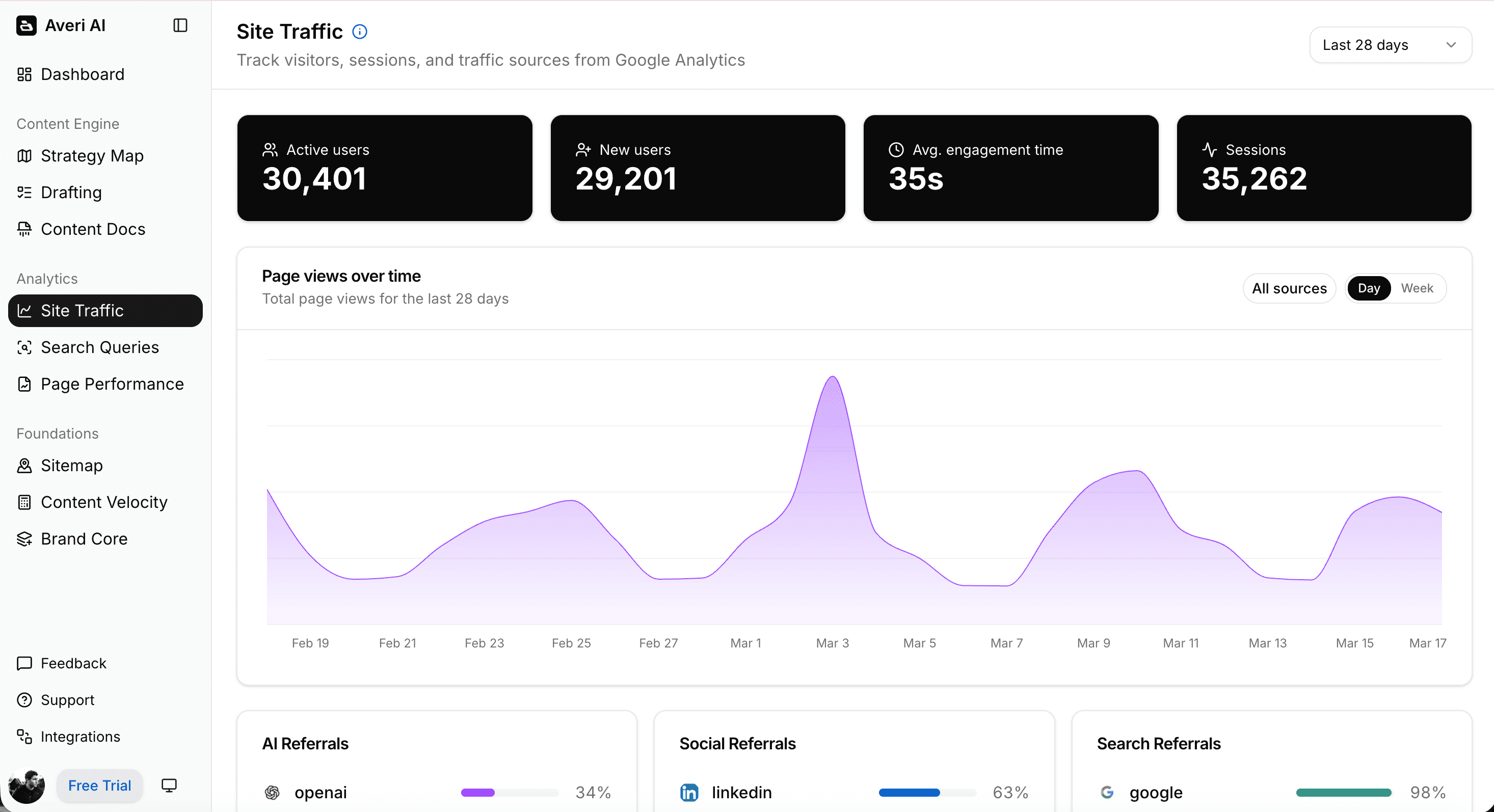
The most sobering data point of Q1 2026: AI referral traffic dropped 42.6% since July 2025 per Kevin Indig. The story isn't that vibe marketing failed. The story is that AI referral traffic is volatile in ways that traditional organic isn't. The 527% YoY growth headlines from mid-2025 were real, but the trajectory is jagged, not smooth. Teams that planned 2026 budgets around assumed AI traffic growth are revising those plans now.
What's underreported: the volatility cuts both ways. The same teams that saw 42.6% drops in some months saw 200%+ spikes in others. The channel is real and growing, but it's a high-variance channel that requires monthly recalibration, not a quarterly set-and-forget plan.
Hype 5: "Vibe marketing means no creative briefs"
The MarTech Manifesto framing — "Replace marketing campaign design with system design. Replace analytics with simulation. Replace branding with orchestration" — is intellectually compelling but oversold at the operational level.
The teams operating at the highest vibe marketing maturity levels have more documented strategy than teams using traditional workflows, not less. The Strategy Map, the Brand Core, the topic clusters, the editorial standards — all of it is documented in ways that traditional marketing teams rarely document. The "vibe" is in the execution speed, not in the absence of strategic rigor.
The 5 shifts defining vibe marketing for the next 6 months
What I think will define vibe marketing through Q3-Q4 2026, based on patterns visible in the data right now.
Shift 1: ChatGPT-specific optimization becomes its own discipline
ChatGPT now drives 87.4% of all AI referral traffic per Conductor's November 2025 data. That's a level of category dominance the AI search visibility tools haven't fully accounted for yet.
The teams investing equally across ChatGPT, Perplexity, Gemini, and Claude are misallocating effort relative to where the traffic actually comes from.
ChatGPT's content preferences also differ structurally from other AI engines. ChatGPT cites product pages directly at higher rates than the listicle/blog content that dominates Perplexity citation, Domains with millions of brand mentions on Quora and Reddit have ~4x higher chances of being cited, and Domains with profiles on Trustpilot, G2, Capterra, Sitejabber, and Yelp have 3x higher chances of being chosen as a source. The optimization patterns for ChatGPT specifically aren't the same as for AI search broadly.
Q2 2026 prediction: ChatGPT-specific optimization separates as its own sub-discipline within GEO, with dedicated tooling and methodology. The teams that adopt this lens early will compound a structural advantage in the channel that drives 87% of the traffic.
Shift 2: Product pages become first-class citation assets
The corollary of Shift 1: if ChatGPT drives 87% of AI referral traffic and ChatGPT preferentially cites product pages (vs. blog listicles), then product pages need to be treated as citation assets, not just conversion assets. This is a different optimization discipline than either traditional CRO or traditional SEO. It requires structured product descriptions, FAQ schema addressing buyer evaluation questions, specific feature comparisons, and outcome claims backed by evidence.
Most B2B SaaS companies' product pages in early 2026 are written for conversion optimization (clear CTA, social proof, feature highlights).
Few are written for citation extraction (structured Q&A, fact-dense feature descriptions, schema-rich evaluation criteria).
The teams that retrofit their product pages for both functions in Q2-Q3 will see the AI citation rate compound from a base most competitors are leaving on the table.
Shift 3: MCP-based agent workflows replace prompt-based workflows
Model Context Protocol (MCP) has matured rapidly in 2026 and is reshaping how AI tools integrate with each other.
The vibe marketing workflows that win in Q3-Q4 will be built on agents that handle multi-step processes (research → outline → draft → score → schema → publish → measure) without requiring manual handoff between tools. This is the difference between "vibe marketing as faster human-in-the-loop work" and "vibe marketing as supervised agent work."
Most marketing teams aren't ready for this shift architecturally. The teams that build agent-native workflows now will operate at velocity levels that prompt-based teams can't match by Q1 2027.
Shift 4: GEO conferences become legitimate (and crowded)
The first dedicated Generative Engine Optimization conference is scheduled for June 18, 2026 in Washington DC, featuring speakers from OpenAI, Google, Anthropic, and Adobe. MarTech is running Vibe Marketing Labs at their conferences. The professional infrastructure around the discipline is being built in real-time, which means the category is past the meme phase.
Q2 2026 prediction: by end of year, the vibe marketing / GEO conference circuit will look like the SEO conference circuit looked in 2008 — multiple major conferences, dedicated tracks at adjacent events, certification programs, and a recognized cohort of "vibe marketing experts" who built reputations in the category.
The teams that establish thought leadership now will compound it.
Shift 5: Tracking tool consolidation (18 → 3-4)
There are currently 18+ AI search visibility tracking tools active in the market — Profound, OtterlyAI, Peec AI, Visiblie, Sight AI, AIclicks, SE Visible, AIMonitor, Scrunch AI, Authoritas, HubSpot AEO, Semrush AI Toolkit, Nightwatch, AirOps, Searchable, LLMRefs, Peekaboo, Omnia.
Most do roughly the same core job: query AI engines on a recurring schedule, log mentions, score share of voice, alert on changes.
The category cannot sustain 18 tools at current volume.
By Q4 2026, expect 3-4 winners (likely Profound at the enterprise tier, OtterlyAI or Peec AI at the mid-market tier, HubSpot AEO for HubSpot-native teams, and AIMonitor or similar at the free/SMB tier). The rest will get acquired, pivot to adjacent categories, or shut down.
For our full take on the current tracker market, see The 9 Best AI Search Visibility Trackers in 2026: An Honest Comparison.
What this looked like at Averi over 12 months
Quick operational receipts to ground the argument in real numbers rather than thesis.
Velocity: Pre-vibe-marketing baseline was 1.5 published pieces per week with significant production overhead. Current state: 3-4 published pieces per week with more time on strategic editorial decisions. Roughly 2.5x velocity gain at constant or higher quality.
Cost per piece: Pre-vibe-marketing blended cost was running about $850 per published piece. Current state: roughly $180 per piece. Roughly 4.7x cost reduction — which lines up with the broader benchmark for integrated AI content workflows.
AI citation frequency: Month 0, our domain was cited in approximately 0% of category-relevant prompts. Month 12, cited in 35-40% of those prompts. The compound was real but invisible until month 6.
Total impressions: 10.6M Google impressions in 12 months on a one-person team. 27,464 clicks. The CTR is the click collapse showing up in our own data — and it's exactly why AI citation tracking matters as much as click tracking now.
For the full breakdown, see our 10M Impressions case study and the State of AI Content Marketing 2026 Benchmarks Report.
Common mistakes teams are making in Q2 2026
Five patterns I see most often as the category matures:
Mistake 1: Treating vibe marketing as a tool category instead of a workflow architecture. Buying ChatGPT Plus and Otterly does not equal running vibe marketing. The architecture (Brand Core + Strategy Map + integrated platform + scoring + publishing + analytics in one workflow) is the discipline. The tools are the components.
Mistake 2: Assuming AI traffic is a guaranteed growth channel. The 42.6% drop since July 2025 is a wake-up call. AI referral is volatile. Plan for the variance. Track citations as a leading indicator and traditional organic as a lagging stabilizer.
Mistake 3: Spreading optimization equally across all AI platforms. ChatGPT drives 87.4% of AI referral traffic. Allocate optimization effort proportionally. Multi-platform tracking is fine. Multi-platform optimization at equal weight is misallocation.
Mistake 4: Skipping Brand Core because "we'll define it later." Voice drift is the #1 quality killer at vibe marketing speed. Without a Brand Core that the AI references on every output, your content library will read like 50 different writers with no coherent positioning. The 4-8 hour upfront investment compounds across every piece.
Mistake 5: Using the $1M Vibe Marketer headline as a hiring benchmark. The actual market for senior vibe marketing talent is $180-350K base, $400-500K total comp at the high end. The supply is constrained by the hybrid skillset, but the comp benchmarks are not what the headlines suggest. Plan accordingly.
What to do this week
If you're running vibe marketing operations and want to position for Q2-Q3 2026, here's the order:
Audit your AI optimization weighting. If you're spending equal effort across ChatGPT, Perplexity, Gemini, and Claude, reweight to roughly 70% ChatGPT, 15% Perplexity, 10% Gemini, 5% Claude. The traffic distribution justifies it.
Add product page citation optimization to your roadmap. Audit your top 5 product pages. Add FAQ schema. Restructure feature descriptions for extractability. Add comparison tables. Add specific outcome claims with evidence.
Consolidate your AI tool stack. If you're running 8+ tools, you're running too many. Identify the 3-5 platforms that handle the core workflow end-to-end and migrate everything else to those platforms. Stack consolidation is the highest-ROI workflow change you can make in Q2.
Build or refresh your Brand Core. If you don't have a documented brand context that the AI references on every output, that's the biggest single quality lever you can pull. Allocate 4-8 hours this week to build it.
Track AI citations monthly, not quarterly. The volatility is real. Quarterly tracking is too slow to catch shifts in the channel. Monthly cadence is the right rhythm.
Document your strategy with more rigor, not less. The vibe marketing teams winning at scale have more documented strategy than traditional teams, not less. Strategy Map, Brand Core, content clusters, editorial standards — all of it written down, all of it referenced systematically.
Read the MarTech Manifesto. Even if you disagree with parts of it, Marc Sirkin's Vibe Marketing Manifesto is the canonical external framing of where the category is going. Engaging with the live conversation matters.
That's the Q2 2026 vibe marketing playbook.
The category has matured past definitions and into operational reality.
The teams that built systems early are compounding. The teams that bought into the hype are recalibrating. The teams that haven't started are now 12 months behind on the architectural changes.
If you want this baked into your stack — Brand Core, Strategy Map, AI drafts with composite SEO + GEO scoring, native publishing, analytics, all in one workflow that's calibrated for what's actually working in Q2 2026 — start a free 14-day Averi trial.
30 minutes to set up. The first piece you write inside Averi will already be structurally calibrated for the AI search reality this article describes.
FAQs
What is vibe marketing in 2026?
Vibe marketing in 2026 is an operational discipline where marketing teams use integrated AI workflows to compress brief-to-publish cycles, maintain brand consistency at speed through persistent context systems (Brand Core), and produce content optimized for both traditional search and AI citation simultaneously. The 2026 version is more architecturally mature than the 2025 version — less about "speed alone" and more about "speed plus measurement plus strategic rigor." For the foundational definition, see our Complete Guide to Vibe Marketing in 2026.
Why did "vibe marketing" become a major trend in 2025-2026?
Three converging factors: AI tool maturity (ChatGPT, Claude, Midjourney reaching production-grade output), the rise of AI search (ChatGPT, Perplexity, Gemini becoming primary research tools for buyers), and the economic pressure on marketing teams to do more with less. Searches for "vibe marketing" rose ~700% in the past year, and the term has been adopted by MarTech, Brandastic, and most major marketing publications as the operating framework for AI-native marketing teams.
Is the $1M Vibe Marketer salary real?
Yes, but it's an outlier — not a benchmark. Some startups have advertised Vibe Marketer roles at salaries up to $1M, but the typical market for senior vibe marketing talent in early 2026 is $180-350K base salary, with total comp reaching $400-500K at well-funded startups where the role replaces multiple traditional marketing functions. The supply of qualified candidates is constrained by the hybrid skillset (strategic marketing + AI fluency + technical comfort + production chops), but the comp benchmarks are not what the headlines suggest.
What's the difference between vibe marketing and traditional content marketing?
Traditional content marketing optimizes for production quality at moderate velocity (2-4 weeks brief-to-publish). Vibe marketing optimizes for production quality at maximum velocity (4-6 hours brief-to-publish for a long-form pillar) by integrating AI throughout the workflow rather than using AI as a one-off tool. The discipline differences include persistent brand context systems, composite scoring (SEO + GEO), AI citation tracking as a primary KPI, and architectural commitment to a single integrated platform vs. a stack of disconnected tools. For the comparison in detail, see our Vibe Marketing vs Traditional Marketing piece.
Why is AI referral traffic so valuable for B2B SaaS?
Because AI-referred visitors convert at 4.4x the rate of traditional organic search visitors per Semrush data, some sites reporting 23x conversion premiums in specific cases. The premium comes from intent: users arriving from ChatGPT or Perplexity have already articulated their question and received a recommendation, so they land on your page with significantly higher buying intent than a user who clicked a generic Google search result. The volume is still small (~1% of total traffic for most domains) but the quality-per-visit is multiples higher.
How do I optimize for ChatGPT specifically vs. other AI engines?
ChatGPT drives 87.4% of all AI referral traffic, and its content preferences differ from other engines. ChatGPT preferentially cites product pages with structured feature descriptions, brand mentions on third-party platforms (G2, Capterra, Trustpilot), and content with strong domain authority and backlink profiles. Optimization for ChatGPT specifically means treating product pages as first-class citation assets, building a presence on review platforms, and prioritizing schema-rich, fact-dense content over listicle/blog content (which Perplexity prefers but ChatGPT cites at lower rates).
How does Averi support vibe marketing operations?
Averi is the integrated content engine architecture purpose-built for vibe marketing operations: Brand Core captures persistent brand context that the AI references on every output, Strategy Map provides the content architecture that prevents velocity from becoming a content firehose, AI drafting includes composite SEO + GEO scoring on every piece, native CMS publishing eliminates manual handoffs, and Analytics tracks content velocity, cost-per-piece, and AI citation frequency in a unified dashboard. The combination is what made it possible for a one-person team to produce 10.6M Google impressions in 12 months. For the full breakdown of the architecture, see our Complete Guide to Vibe Marketing in 2026.
Related Resources
The Foundational Definition
Vibe Marketing: The Complete Guide to the Hottest Trend in 2026
What Is Vibe Marketing? The 2026 Guide (With VIBE Framework)
Vibe Marketing 101: How AI & Lean Teams Create Magnetic Campaigns
Strategic Context
Vibe Marketing for B2B: How Enterprise Teams Achieve Marketing Flow State
Vibe Marketing vs. Traditional Marketing: Which Should You Choose?
The Measurement Layer
The Methodology
Real Receipts
Founder Reality
Build the operational vibe marketing engine. Averi gives you Brand Core, Strategy Map, AI drafts with composite SEO + GEO scoring, native publishing, and unified analytics in one workflow — calibrated for the Q2 2026 reality this piece describes. $99/mo, no contract, 14-day free trial. Start your free trial →