

In This Article
AI removes brainstorming roadblocks—generate funnel-aligned topic clusters, refresh content, and build a 90-day plan.
Updated:
Trusted by 1,000+ teams
Startups use Averi to build
content engines that rank.
Struggling to find the right content ideas? AI can fix that.
AI-powered tools like Averi AI are transforming how marketers brainstorm topics by analyzing audience data, search trends, and competitor strategies. Instead of spending hours in meetings, you can generate organized, actionable content ideas in minutes.
Here’s what AI does better:
Problem-Solution Clusters: Address customer pain points with detailed, multi-angle content ideas.
Comparison Guides: Create specific, decision-focused content like "AI Blog Writer vs. Freelance Writer."
Outcome-Focused Topics: Align content with measurable business goals, such as boosting demo requests.
Trend Forecasting: Spot emerging industry trends before they peak.
Funnel-Aligned Content: Map topics to buyer stages (awareness, consideration, decision).
Content Refresh: Update aging posts to regain traffic and relevance.
AI doesn’t replace creativity - it removes roadblocks so you can focus on strategy and execution. Start by using AI to build a 90-day content plan tailored to your audience and business goals.
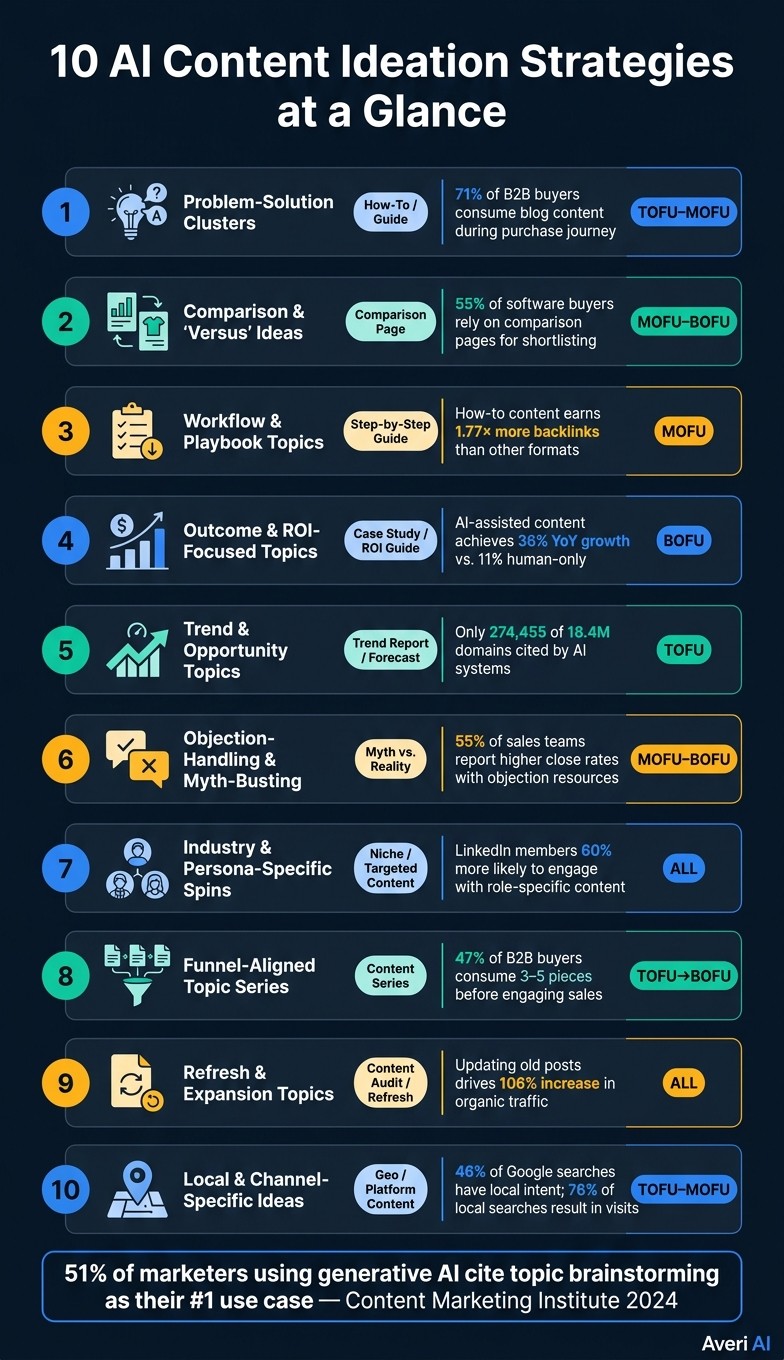
10 AI Content Ideation Strategies: Types, Goals & Funnel Stages
How to Build a Content Strategy with AI (ChatGPT + NotebookLM Guide)
1. Problem-Solution Clusters
A problem-solution cluster focuses on addressing a single, specific challenge your customers face. The idea is to start with a real pain point from your audience and let AI expand it into multiple content angles. These could include how-to guides, quick fixes, tool comparisons, checklists, or even common pitfalls to avoid.
The key here? Use your customers' own language, not internal company jargon. Pull phrases directly from sources like sales calls, support tickets, or NPS survey feedback. For instance, if a customer says, "We don't know what to write about each week", or "Our blog drives traffic but no demo requests", these insights can fuel an AI tool like Averi. The result? A well-structured cluster of content topics that not only solve the core problem but also align with your product's value.
Let’s take the example of the pain point, "We waste too much time generating weekly content ideas." From this, AI could generate a pillar article like "From Blank Page to 50 Content Topics: A Step-by-Step AI Workflow for Busy Marketing Teams." Supporting pieces might include "How a $300/Month AI Stack Replaces a Full Day of Manual Brainstorms." Each piece digs into a specific aspect of the same problem.
This strategy resonates because it matches how buyers search for solutions. Backlinko’s research reveals that in-depth, problem-driven content attracts more backlinks and achieves higher rankings than shallow posts [7]. With 71% of B2B buyers consuming blog content during their purchasing journey [5], focusing on real customer challenges - not just your product’s features - can directly contribute to pipeline growth.
Idea: "You're Spending 5+ Hours a Week on Content Ideas - Here's How to Cut That to 30 Minutes with AI." This piece could offer a hands-on guide for turning customer pain points into a 90-day content plan, complete with headlines, formats, and funnel-stage tags.
Next, we’ll dive into how AI compares different content strategies through direct evaluations.
2. Comparison and 'Versus' Ideas
Comparison content ranks among the most effective tools in content marketing, especially for high-intent audiences. When users search for terms like "HubSpot vs. Salesforce" or "AI writing tool vs. freelance writer", they’re often nearing a decision point. G2's 2023 Software Buyer Behavior Report reveals that 55% of software buyers rely on comparison pages to create their shortlists, and 92% feel more confident about purchasing after reading a reliable comparison.
Creating this type of content manually can lead to inconsistent results, but AI simplifies the process of producing targeted comparisons. Tools like Averi, when provided with structured prompts that include audience specifics, industry focus, U.S.-based pricing, and decision-making criteria, can generate highly relevant and actionable comparison topics. This approach avoids the pitfalls of generic comparisons that fail to convert effectively.
The key to success lies in specificity. Detailed context allows the AI to produce more focused topics, such as "Averi AI vs. Jasper: Which AI Content Tool Fits U.S. SMBs in 2026?" instead of vague titles like "Choosing an AI Writing Tool."
Example Topic: "AI Blog Writer vs. Freelance Writer: What's Actually Better for U.S. Startups in 2026?" This comparison could explore subscription costs (e.g., Averi’s $100/month pricing) versus freelance rates, differences in turnaround times, consistency in brand voice, and output volume. The goal is to provide a clear, data-driven recommendation.
Comparison content also aligns well with different stages of the buyer’s journey. Early-stage readers are drawn to broader discussions, such as "SEO vs. Paid Social for B2B Lead Gen." Mid-stage buyers prefer solution-focused matchups like "AI Content Tools vs. Freelancers." Late-stage prospects, on the other hand, seek vendor-specific breakdowns that include pricing details, trade-offs, and direct recommendations. AI tools can efficiently generate ideas for all these stages in a single session, making it easier to address varied audience needs while tying into broader AI-driven content strategies.
3. Workflow and Playbook Topics
When it comes to execution, workflow and playbook topics are the backbone of getting things done. Their structured nature also makes them highly shareable. According to Backlinko's analysis of 912 million posts, how-to content generates 1.77× more backlinks than other formats [7]. This is where AI shines - turning complex internal data into actionable, step-by-step guides.
AI tools excel at organizing scattered notes, SOPs, and internal processes into polished, sequenced playbooks. Using the best AI tools for content marketing allows teams to scale these workflows without losing quality. For example, you can feed Averi your customer research, recurring sales call themes, or patterns from support tickets, and it will generate a streamlined workflow that's ready to be published. By automating both ideation and execution, Averi ensures that every output aligns seamlessly with your goals.
Here’s an example of how this approach can work:
"AI Content Playbook: Step-by-Step Workflow From Audience Insight to Publish"
Imagine using AI to mine customer questions from CRM notes or support tickets. From there, you can generate topic clusters and craft weekly outlines tailored for your blog, LinkedIn, or email newsletter. Within an hour, your content calendar is filled with relevant, sales-focused ideas that align with your pipeline. This kind of system is especially valuable for B2B marketers who need to build a marketing strategy that directly supports business priorities rather than chasing fleeting keyword trends.
"The difference between a content team that scales and one that burns out is not talent, but whether they're using a system or merely 'creating content.'" - Averi Team [1]
4. Outcome and ROI-Focused Topics
Instead of asking, "What should we write about?" shift your focus to, "What result should this content deliver?" This mindset is the foundation of outcome-driven content creation - and where AI tools like Averi truly shine.
By aligning content with specific business objectives, AI can generate titles that go beyond generic advice. For example, instead of "5 Tips for Better Email Marketing", you might receive a result-oriented title like, "How to Increase Your Email-to-Demo Conversion Rate by 15% in 60 Days." This approach directly addresses measurable goals, such as helping U.S. marketers tackle Q3 pipeline challenges.
"AI-assisted content processes achieve 36% year-over-year growth vs. 11% for human-only content when properly implemented with strategic human oversight." - Averi Academy [2]
The numbers tell the story: 51% of B2B buyers now rely more on content for purchase research than they did last year. Formats that deliver tangible results - like case studies and success stories - rank highest in trustworthiness [2][4]. This trend highlights the importance of anchoring your content ideas to measurable outcomes, ensuring they resonate with decision-makers.
A Practical Example: Turning Ideas Into Revenue
"From Ideas to Income: Using AI to Turn Content Topics Into Trackable Revenue Streams"
This concept showcases how tools like Averi can help generate content topics tied directly to revenue goals, with results tracked through metrics like pipeline value, closed-won deals, or customer lifetime value (CLV). For instance, a U.S.-based B2B SaaS company could prompt Averi with: "Generate blog topics to boost qualified demo requests by 20% from mid-market manufacturers within 90 days." The AI would produce a list of actionable ideas linked to revenue objectives, which can then be tracked from day one using platforms like HubSpot or Salesforce. This method makes it easier for marketing teams to justify their budgets when leadership asks how content efforts contributed to a $300,000 influenced pipeline last quarter.
5. Trend and Opportunity Topics
Content that drives action and highlights emerging trends can make a significant impact. The most effective AI-generated topic ideas combine these two elements seamlessly.
Predictive Trend Forecasting and GEO
Using AI to spot upcoming industry trends 6–12 months before they peak - while optimizing for GEO (Generative Engine Optimization) - can significantly enhance your authority with AI search assistants. The numbers paint a clear picture:
Out of 18.4 million domains, only 274,455 have been cited by AI systems. Meanwhile, 65% of Google searches end without a click, a figure that jumps to 83% when AI Overviews are involved [8].
"The window to establish citation authority is now. Platforms that treat GEO as a future feature will leave you behind competitors who optimize for it today." - Zach Chmael, CMO, Averi [8]
Averi can help you stay ahead by using an AI content creation framework to generate niche-specific topics tailored to your audience and a 90-day horizon. For example, it might suggest "How U.S. RevOps Teams Can Use AI Forecasting to Navigate Uncertain 2026 Sales Pipelines." These topic ideas come with a well-defined target persona, trend insights, and a structure designed to earn citations. Averi drafts content using 40–60 word answer blocks, FAQ schema, and authoritative source links - all of which increase the likelihood of being cited [8].
Timing is everything. Tools like Exploding Topics and Google Trends can help you identify breakout queries and fast-growing themes. By combining these insights with your customer profile and business objectives, you can move from merely reacting to trends to becoming a leader in shaping them.
6. Objection-Handling and Myth-Busting Ideas
Skepticism often arises when teams first explore using AI for content ideation. Addressing these doubts head-on can be a powerful strategy, especially during the decision-making stages of the buyer's journey. According to HubSpot, 55% of sales teams report higher close rates when they have resources that tackle common customer objections [5]. This not only eases concerns but also builds confidence in AI-driven content creation.
Myth: AI Kills Creativity – How Averi AI Inspires Original Ideas
A common worry among marketers is that relying on AI for content ideation will lead to bland, generic output. However, the truth is quite the opposite.
AI doesn’t replace creative instincts - it removes the initial hurdles that often slow down the creative process. Tools like Averi AI are designed to work within your brand’s unique voice, audience, and positioning. By leveraging persistent brand context, these tools generate ideas tailored to your niche rather than producing cookie-cutter industry content. Importantly, AI-generated ideas serve as a starting point, not the final product. Human creativity then shapes these ideas into content that’s truly on-brand. Research shows that a 70/30 mix of human and AI-generated content achieves 89% of the engagement rates of fully human-created content [1]. This demonstrates that AI complements creativity rather than stifling it.
Reframing skepticism into an opportunity allows marketers to see how AI can enhance, not hinder, originality. A great way to approach this topic is by using a "Myth vs. Reality" format: briefly introduce the misconception, then focus on evidence, processes, and actionable steps readers can try right away.
"Successful AI content creation isn't about replacing human creativity - it's about amplifying it." - Averi Academy [2]
This topic can be adapted for various formats, from AI-generated articles and LinkedIn carousels to short explainer videos. Tailoring the content to specific audiences makes it even more effective. For instance, a CMO-focused piece might highlight brand protection and scalability, while a content manager version could delve into practical prompts and review techniques to ensure originality and consistency.
7. Industry and Persona-Specific Spins
How B2B SaaS CMOs Use AI to Build a Topic Backlog Tied to Pipeline Goals
Creating content that resonates deeply with specific audiences is essential, especially when generic topics fail to address unique challenges. A VP of Sales at a U.S. industrial distributor has vastly different priorities compared to a content manager at a D2C beauty brand. According to LinkedIn data, members are 60% more likely to engage with content tailored to their job function or industry than with broad, generalized material [9]. This underscores the importance of aligning AI-generated ideas with precise audience needs.
To achieve this, structure your AI prompts around three constants: industry, persona, and primary business objective. For instance, ask AI to "Generate 10 AI content ideation topics for U.S.-based B2B SaaS CMOs at companies with $5M–$50M ARR aiming to boost marketing-sourced pipeline by 20% in the next 12 months." This shifts the output from vague suggestions like "How to Use AI for Content Marketing" to actionable ideas such as "Designing an AI-Driven Topic Backlog That Aligns With Annual ARR Targets." By tying AI outputs to specific revenue or pipeline goals, the content becomes both relevant and impactful.
This approach can be easily adapted to other industries or roles, ensuring outputs remain highly specific. For example, a general topic like "Using AI for Content Strategy" can evolve into "AI-Powered Content Ideation for U.S. Healthcare Marketing Directors Under HIPAA Constraints" or "How U.S. Marketing Agency Owners Use AI to Build Industry-Specific Topic Calendars for Their Top 5 Niches." McKinsey research supports this tailored approach, showing that advanced content personalization by segment often results in a 10–15% revenue boost and 20% higher marketing ROI [10].
Seniority also plays a critical role in shaping content angles. For CMOs, focus on strategy, budget alignment, and pipeline growth. For content managers, center the discussion on practical tools, workflows, and efficiency tips. Tools like Averi AI can help by storing persona definitions, ensuring that every ideation cycle produces content tailored to the right seniority level, avoiding generic one-size-fits-all lists.
To determine which audience segments to prioritize, start with those driving the most revenue or pipeline. For example, if 60% of your ARR comes from B2B SaaS CMOs, they should be your primary focus - not healthcare or eCommerce. Reflect this priority in your prompts, such as: "Prioritize topic ideas for U.S. B2B SaaS CMOs and U.S. healthcare marketing directors, as they represent top revenue opportunities in 2026." By grounding your content ideation in revenue-generating segments, you ensure a clear and measurable business impact.
8. Funnel-Aligned Topic Series
Map Every Topic to a Buyer Stage Before You Write a Single Word
Funnel alignment takes your content strategy to the next level by ensuring every topic directly supports a specific stage in the buyer's journey. While many teams churn out awareness-stage content, they often overlook the critical mid- and bottom-funnel stages. A funnel-aligned topic series addresses this imbalance by tying each topic to one of three stages: awareness (TOFU), consideration (MOFU), or decision (BOFU). This structured approach creates a seamless path for prospects, guiding them from recognizing a problem to making a purchase decision.
The numbers back up this strategy. According to Demand Gen Report's Content Preferences Survey, 47% of B2B buyers consume 3–5 pieces of content before engaging with sales, and 30% consume even more [6]. Without content tailored to each stage, you risk losing those mid- and bottom-funnel prospects who are ready to dig deeper.
Here’s how a funnel-aligned series might look for a U.S.-based project management SaaS targeting marketing agencies with 50–200 employees:
Funnel Stage | Search Intent | Example Topic |
|---|---|---|
Awareness (TOFU) | Informational | "7 Signs Your Team Has Outgrown Spreadsheets for Project Tracking" |
Consideration (MOFU) | Commercial | "Trello vs. Asana vs. [Your Tool]: Which Fits a 50–500 Person Team?" |
Decision (BOFU) | Transactional | "How [Your Tool] Cut Project Overruns by 32% for a 120-Employee Marketing Agency" |
To create a similar series, use AI tools to generate tailored topics for each stage. For example, you could prompt AI with: "Generate 5 topics for each funnel stage - Awareness (problems and symptoms), Consideration (comparisons and solutions), and Decision (ROI, risk reduction, implementation) - for [product] targeting [persona] at [company size] in the U.S." Tools like Averi AI can streamline this process by using your ICP data to cluster topics by stage, saving you from manually sorting through lists [3].
Once you’ve identified your topics, ask AI to organize them into a cohesive campaign. For instance, you could plan a 6-week series with one blog post per week, ensuring each piece links logically to the next. When crafting decision-stage content, focus on concrete, U.S.-specific outcomes. Instead of vague claims, highlight measurable benefits like "saving $18,500/year" or "reducing onboarding time from three weeks to four days." Providing actual performance data ensures your content resonates and builds trust with your audience.
9. Refresh and Expansion Topics
Refreshing older content can be a game-changer for driving traffic and keeping your site relevant.
Transform Old Content Into a Traffic Powerhouse
Idea: "The AI Content Audit: How to Refresh Aging Posts and Expand Them Into Topic Clusters"
While creating new content often takes center stage, older posts can quietly lose their edge. According to Animalz, about 34% of a blog's organic traffic typically comes from posts that are actively aging, gradually losing visibility in search results [5]. HubSpot discovered that updating and republishing old blog posts resulted in a 106% increase in organic traffic to those articles [7].
AI isn't just for new ideas - it can breathe new life into your existing content. Tools like Averi AI help identify underperforming URLs, revealing gaps such as outdated stats, missing subtopics, or sections that no longer align with current search intent [3]. Use this insight to refresh older posts and expand pillar content into new, focused spin-offs that target long-tail queries and strengthen your site's authority.
Expansion amplifies the reach of your content. For instance, a pillar post on "AI for content ideation" could branch into niche topics like "AI Prompts for B2B Topic Research," "How to Build a Content Calendar with AI in Under an Hour," or "AI Workflows for Small Editorial Teams." Regular updates pay off - content refreshed quarterly earns 2.8 times more AI citations compared to static pieces [3]. This is especially crucial as tools like ChatGPT and Perplexity shape how users discover information.
Prompt Averi AI: "Review this [topic] article and suggest 10 updates for 2026 - including updated statistics, new subheads, improved keywords, and expansion topics for a small U.S. marketing team."
10. Local and Channel-Specific Ideas
Broad topics often fail to grab attention. Instead, creating specific, localized content can make a real impact and drive conversions.
Idea: "One Topic, Every Channel: How to Use AI to Generate Local and Platform-Specific Content Ideas at Scale"
AI can turn a single overarching theme into tailored content ideas designed for the platforms your audience prefers. For example, take the core topic of "AI tools for marketing teams." With a well-crafted prompt, AI can create a geo-targeted blog post for Austin-based service providers, a LinkedIn carousel for B2B founders, a snappy TikTok hook for younger entrepreneurs, or even a three-part email sequence - all from one starting idea. This approach ensures your content feels relevant and actionable across different platforms.
The numbers back this up: Google reports that 76% of local searches result in visits, and 28% lead to purchases [1]. Additionally, 46% of all Google searches have local intent, highlighting a huge opportunity for businesses that produce geo-specific content [2]. A general topic like "AI marketing workflows" becomes far more engaging when localized - for instance, "AI Content Tools for Chicago B2B SaaS Startups" or "How Phoenix Real Estate Teams Use AI to Write Listing Descriptions."
Localization sharpens your message, but adapting it to individual platforms boosts engagement even further. Each channel has its own strengths: LinkedIn thrives on in-depth insights, TikTok and Instagram reward quick, eye-catching hooks, and email builds lasting connections through personalized storytelling.
Tools like Averi AI make this process easier by generating targeted content ideas based on specific topics, locations, personas, and platforms. For instance, a prompt like "Generate 5 content ideas about AI-powered content workflows for small marketing teams in Dallas, optimized for LinkedIn and a monthly email newsletter" can produce highly relevant suggestions. By combining local insights with platform-specific strategies, Averi AI helps you cut through the noise and align your content with your audience’s needs.
Prompt Averi AI: "Take the topic '[your core theme]' and generate 8 content ideas tailored for [U.S. city/region] + [target persona], formatted for [channel: blog/LinkedIn/TikTok/email]. Include a local angle - regional trends, seasonal factors, or industry clusters relevant to that market."
Conclusion
The strategies outlined above highlight how AI has revolutionized content ideation, turning what used to be an hours-long brainstorming process into something that can be accomplished in a single focused session. According to the Content Marketing Institute's 2024 B2B research, 51% of marketers using generative AI cite brainstorming new topics as their primary use case - outpacing tasks like drafting or repurposing content [5]. This efficiency makes AI a powerful tool for overcoming the dreaded blank-page problem.
But speed isn’t the only advantage. AI excels at delivering well-rounded, strategic ideas. When used thoughtfully, it can identify and address gaps in your content library, from problem-solution clusters to funnel-aligned series and ROI-driven angles. The key is structuring your approach to let AI play to its strengths while leaving room for human creativity and insight.
Successful teams use AI to handle the heavy lifting - generating a broad range of ideas - while humans refine the output, ensuring it aligns with brand voice and connects to broader business goals. A practical split might look like this: 70% of the effort comes from human strategy and final decision-making, while AI accelerates ideation and organizes the groundwork [1]. This balance ensures your content remains authentic and impactful while cutting down on production time.
"The brands winning with AI content aren't just generating more content faster; they're creating content that performs better while freeing their teams to focus on strategy and innovation." - Averi Academy [2]
To see this in action, try this exercise: dedicate 60 minutes to building a topic bank using Averi AI. Start with one product, one persona, and one channel. Generate 10 problem-solution topics, 5 ROI-focused angles, and 5 comparison ideas. Then, select the best 10, rewrite the titles in your brand voice, and schedule them into your content calendar for the next four to six weeks. With this approach, you’ll have a fully developed content plan in just one session.
FAQs
What data should I provide an AI tool to generate good topic ideas?
To create content that resonates and performs well, it's important to feed the AI with the right inputs. Here's what you should provide:
Brand Core: Share key details about your business, including products, services, positioning, and who your target audience is. This helps the AI align content with your brand's identity.
Market Intelligence: Include insights like competitor rankings, trending search terms, and areas where content is lacking. This ensures the AI identifies opportunities to stand out.
Customer Insights: Use data gathered from sales, customer support, and social media interactions. These insights reveal what your audience cares about and the challenges they face.
Performance Data: Provide metrics like engagement rates and target keywords. This information guides the AI in crafting content that meets your performance goals.
Strategic Frameworks: Outline your content pillars, overarching goals, and the stages of your buyer's journey. This framework helps the AI create content that fits into your broader strategy.
By combining these elements, the AI can generate topics that are not only relevant but also aligned with your objectives.
How do I turn AI-generated ideas into a 90-day content plan?
To build a 90-day content plan with AI-generated ideas, begin by pinpointing 3–5 key content pillars that align closely with your business objectives and what your customers care about most. These pillars will serve as the foundation for your strategy. For each one, leverage AI tools to come up with 8–12 subtopics, ensuring they address the different stages of the buyer's journey: awareness, consideration, and decision. Once you have your subtopics, arrange them into a content calendar that complements your business cycles and campaign goals. This approach ensures your content stays both relevant and strategically timed.
How can I measure ROI from AI-driven content topics?
To gauge ROI from AI-powered content topics, tie your creative strategies directly to your business objectives. Analyze performance across platforms such as your website, email campaigns, and social media to establish clear benchmarks. Leverage AI tools to forecast the potential success of topics using historical data, such as metrics for lead generation or brand awareness. Evaluate topics based on factors like search volume, competition, and relevance. Lastly, track their influence on metrics like organic traffic growth and lead generation to measure their true impact.
Related Blog Posts

Zach Chmael
CMO, Averi
"We built Averi around the exact workflow we've used to scale our web traffic over 6000% in the last 6 months."
Your content should be working harder.
Averi's content engine builds Google entity authority, drives AI citations, and scales your visibility so you can get more customers.