AI Agent Content Ops: How to Build a Self-Running Content Operation Without a Team

Zach Chmael
Head of Marketing
5 minutes

In This Article
The step-by-step process for building an AI-powered content operation that runs on 2-3 hours of founder time per week, optimizes for both Google and AI search, publishes to your CMS automatically, compounds over time, and doesn't require hiring a single marketer.
Updated
Trusted by 1,000+ teams
Startups use Averi to build
content engines that rank.
TL;DR
⏰ This takes 2-3 hours per week once set up—most of it reviewing and approving, not creating from scratch
🏗️ The operation has 6 components: Brand Foundation → Content Strategy → Topic Queue → Creation + Optimization → Publishing + Distribution → Analytics + Iteration
📊 91% of B2B companies use content marketing, but only 29% say it works—the difference is systematic operation vs. sporadic publication
🔍 In 2026, content must be optimized for Google and AI search engines simultaneously—25% of Google searches now trigger AI Overviews, and AI search visitors convert at 4.4x the rate of traditional organic
💰 Total cost: $99/month for the content engine + your time—less than a single blog post from most agencies
🔄 The operation compounds: every piece makes the system smarter, every month's output is better than the last, and organic visibility grows while you focus on product

Zach Chmael
CMO, Averi
"We built Averi around the exact workflow we've used to scale our web traffic over 6000% in the last 6 months."
Your content should be working harder.
Averi's content engine builds Google entity authority, drives AI citations, and scales your visibility so you can get more customers.
AI Agent Content Ops: How to Build a Self-Running Content Operation Without a Team
You've read the think pieces. AI agents are reshaping content operations. 88% of marketers use AI daily. AI-driven platforms reduce production time by 60-80%. The future is here, the paradigm is shifting, the revolution is being televised on every SaaS blog with a pulse.
Cool. Now what?
Because here's the part nobody writes… the step-by-step implementation guide for a founder with no marketing team, $3K-$5K/month to spend on growth, and maybe 5 hours a week to give to content, who actually needs to build this thing, not just read about it.
The gap between "AI is transforming content marketing" and "I have a working content operation that generates leads while I sleep" is enormous. It's the gap between understanding that electric cars exist and building a Tesla factory. One is an observation. The other is engineering.
This is the engineering guide.
No theory. No trend forecasting. No "the future of content is..." preamble. Just the step-by-step process for building an AI-powered content operation that runs on 2-3 hours of founder time per week, optimizes for both Google and AI search, publishes to your CMS automatically, compounds over time, and doesn't require hiring a single marketer.
I'll show you the exact workflow. And yes, it's the same one we use ourselves, the one that grew our web traffic over 6,000% in six months.

What Does "AI-Powered Content Operation" Actually Mean?
Let's define terms precisely, because the phrase gets thrown around loosely enough to be meaningless.
An AI-powered content operation is a system, not a collection of tools, that handles the full content lifecycle: strategy, planning, creation, optimization, publishing, distribution, analytics, and iteration.
AI handles the structural and analytical work. Humans provide judgment, voice, and strategic direction. The system runs continuously, compounds over time, and requires minimal ongoing management.
This is different from "using ChatGPT to write blog posts." That's a tactic.
This is infrastructure.
It's different from "hiring a content agency." That's outsourcing.
This is building a permanent capability inside your company.
And it's different from "using Jasper/Copy.ai/[insert AI writing tool]." Those handle one phase of the workflow… creation. An operation handles all six phases in an integrated loop where each phase feeds the next.
The 2026 State of Content Workflows research confirms the shift: teams using integrated AI content platforms report 60-80% reduction in production time and 3-5x increase in output while maintaining quality.
But the key finding isn't speed, it's the compound effect. Systems that learn your brand, track performance, and adapt recommendations over time produce exponentially better results than disconnected tools, no matter how fast those tools generate text.
Step 1: Build Your Brand Foundation (Day 1-3)
Every failed content operation shares the same root cause: no strategic foundation. The founder starts writing blog posts without first defining who they're writing for, what voice they're writing in, and how their content differentiates from the thousand competitors publishing in the same space.
The brand foundation takes 1-3 days and produces four outputs that inform everything that follows.
What You Need to Define
Your Brand Core: Your business, products, positioning, and voice. Not a 50-page brand book—a clear, concise articulation of what you do, for whom, and why it matters. If you can't explain this in two sentences that a stranger would understand, you're not ready to create content.
Your ICPs (Ideal Customer Profiles): Not "B2B companies." Specific buyer personas at specific company stages with specific problems. "Seed-to-Series A B2B SaaS founders with no dedicated marketing team who need to build organic visibility before their next raise." That level of specificity changes every downstream content decision.
Your Competitive Landscape: Who publishes in your space? What do they rank for? Where are the content gaps they haven't filled? Your content strategy doesn't live in a vacuum—it lives in the spaces your competitors haven't claimed.
Your Content Goals: What business outcome does this operation serve? Demo requests? Free trial signups? Newsletter subscribers? The goal determines the content types, the CTAs, and the measurement framework.
How to Do This Without a Marketing Background
Here's where AI changes the game entirely.
You don't need marketing expertise to build this foundation… you need product expertise, which you already have.
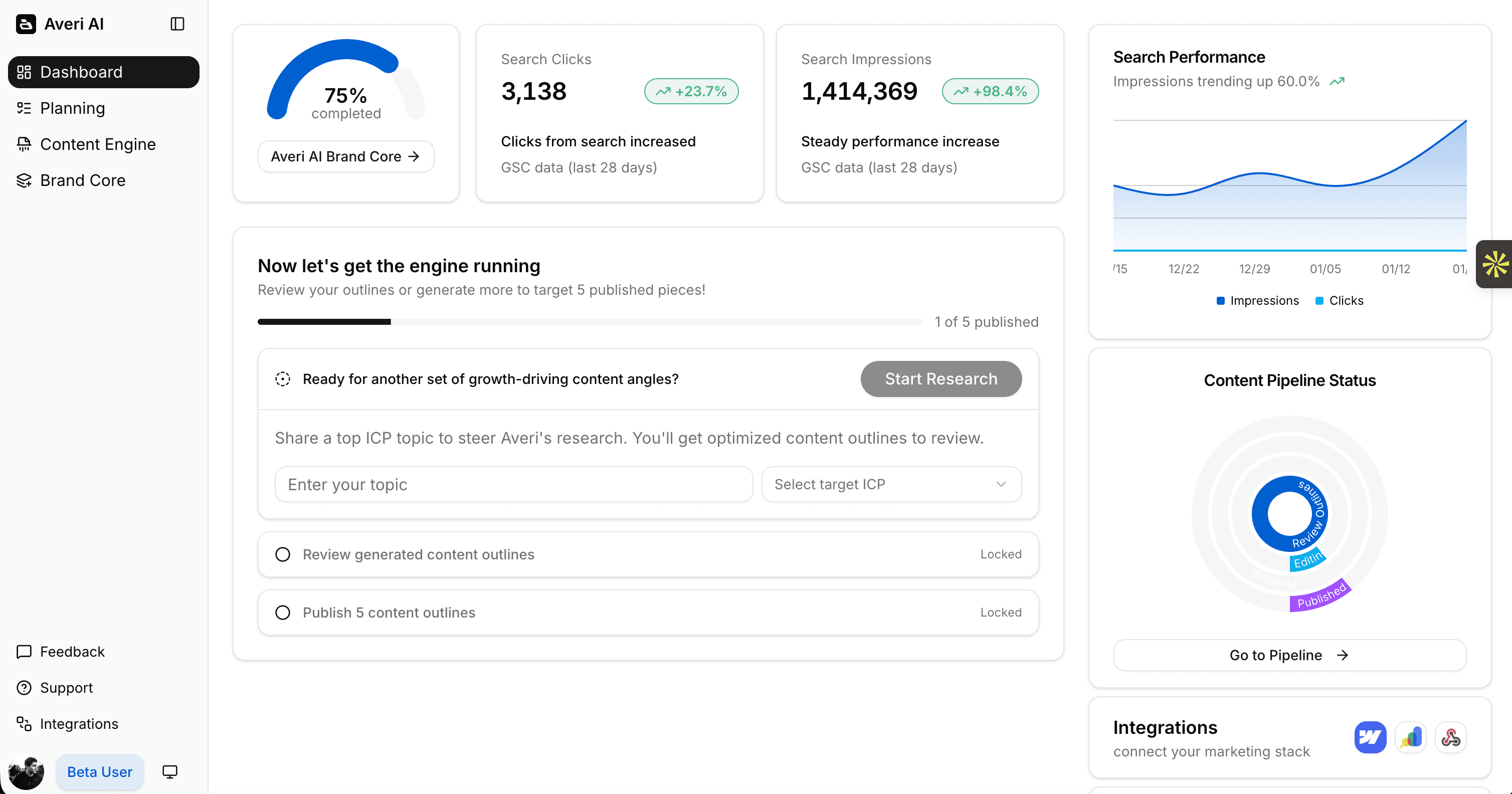
Averi automates the brand foundation step. When you onboard, the AI scrapes your website to learn your business, products, positioning, and voice. It generates suggested ICPs based on its analysis. It researches your competitors automatically… what they're publishing, what they're ranking for, where they're weak.
You spend 30-45 minutes reviewing what the AI learned and confirming or adjusting.
You add the nuance that the website doesn't capture: who your best customers actually are, what positioning matters most, what competitive angles to emphasize.
Output: a complete Brand Core that informs every piece of content the system produces. Not a document that gathers dust. An operating context that's structurally embedded in the workflow.
Step 2: Map Your Content Strategy (Day 3-5)
Strategy is the bridge between "we should create content" and "we know exactly what to create, in what order, and why." Without it, you publish randomly. With it, every piece connects to a bigger picture.
The Strategy Map Approach
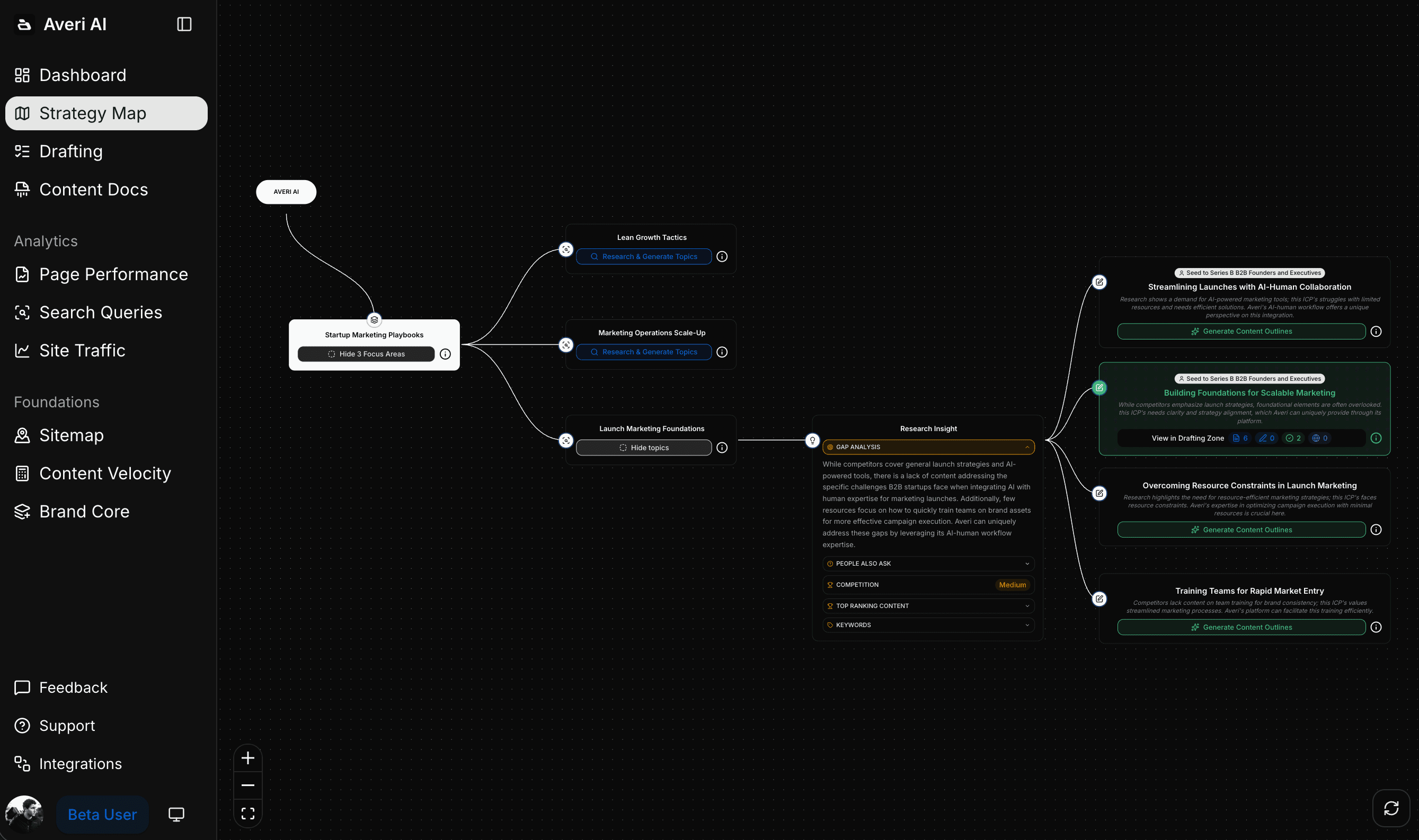
A flat editorial calendar isn't strategy. It's a to-do list. Strategy is architectural, it maps how your content pillars, focus areas, and individual topics connect to form an authority structure that both search engines and AI systems reward.
Averi's Strategy Map visualizes this architecture.
Content pillars represent your core themes, the 3-5 broad topics your brand should own. Focus areas break each pillar into specific domains. Individual topics cascade from each focus area, each tied to target keywords, search intent, and ICP alignment.
This isn't just organization. It's SEO architecture.
Topic clusters—interconnected content that establishes domain authority—perform dramatically better than isolated blog posts for both traditional rankings and AI citation. AI systems evaluate topical authority comprehensively, not page by page. A Strategy Map builds that authority by design.
The Dual-Optimization Imperative
Here's what's changed since 2024: your content strategy must now account for two discovery systems simultaneously.
Traditional SEO remains the foundation. Google still drives the majority of organic traffic. Your strategy needs keyword targeting, technical optimization, and content structure that earns rankings.
GEO (Generative Engine Optimization) is the new layer. AI Overviews now appear in 25% of Google searches. 73% of B2B buyers use AI tools during purchasing. Your strategy needs content structured for AI extraction: answer blocks, FAQ sections, cited statistics, entity definitions, and the formatting patterns that increase LLM citation probability by 28-40%.
The Strategy Map accounts for both.
Every topic is evaluated for traditional keyword opportunity and AI citation potential. Your content doesn't just rank—it gets cited, recommended, and surfaced across the platforms where your buyers actually make decisions.
Step 3: Build Your Content Queue (Ongoing, 15 min/week)
The queue is where strategy becomes a production schedule. And it's where most founder-led content operations die—not from lack of strategy, but from the "what should I write this week?" paralysis that kills publishing consistency.
How the Smart Queue Works
An AI-powered queue eliminates the blank-page problem permanently. The system continuously researches your market… trending keywords in your space, content your competitors just published, gaps in your existing coverage, seasonal opportunities, and questions your ICP is asking on Reddit, Google, and AI platforms.
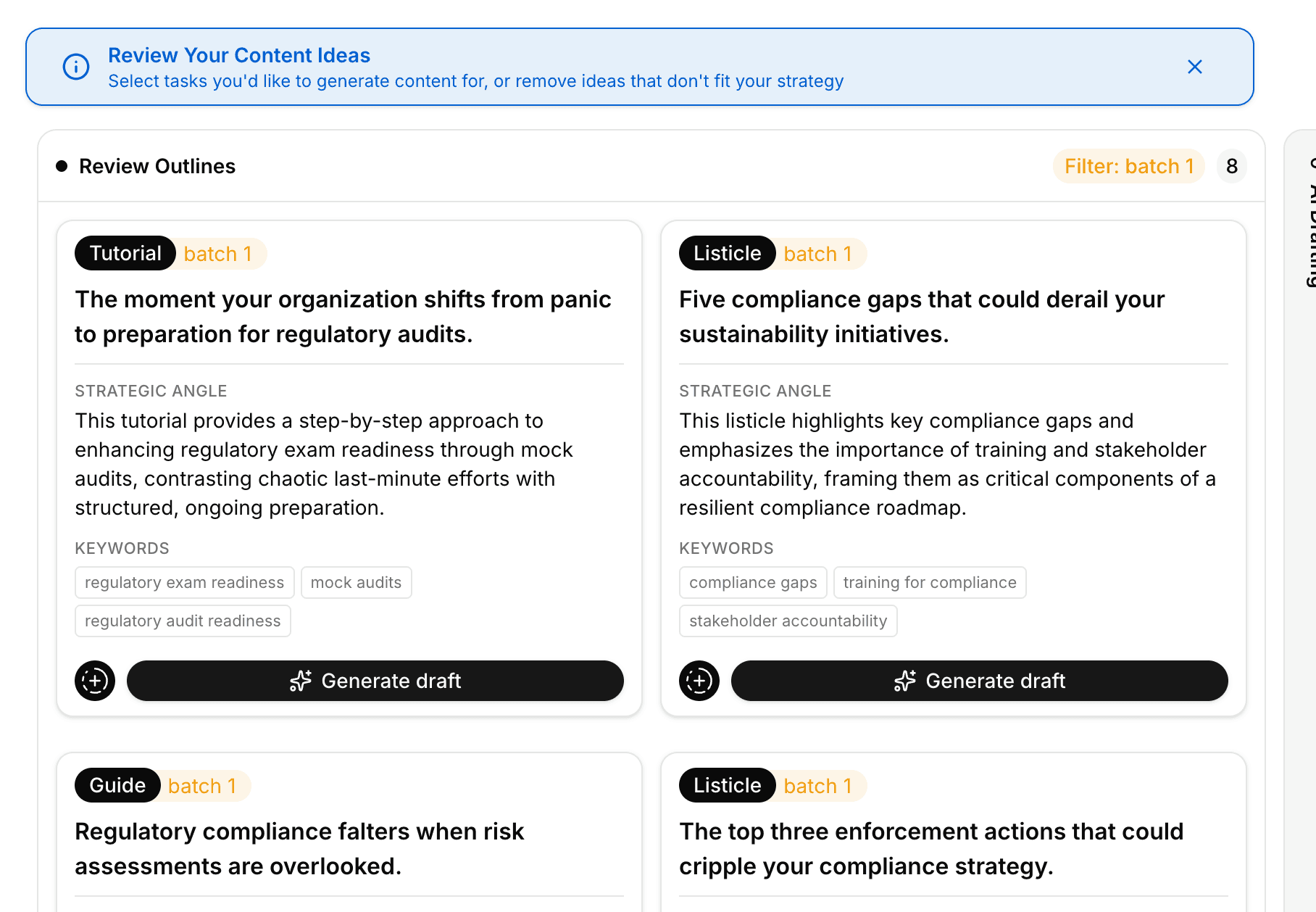
From this research, it generates a prioritized list of content recommendations; each with a suggested title, target keywords, content type (listicle, how-to, editorial, comparison), strategic rationale, and estimated impact.
Your weekly job: review the queue. Accept, reject, or reprioritize. 15 minutes. That's it.
Averi's Smart Content Queue handles this automatically.
It generates a mix of content types based on your Strategy Map: comparison articles that AI systems favor for product recommendation queries, how-to guides that earn featured snippets, thought leadership editorials that build brand authority, and FAQ content that gets extracted into AI-generated answers.
The queue replenishes continuously. You never have to brainstorm content topics again.
Step 4: Create and Optimize Content (20-30 min per piece)
This is the creation phase, and it's where the AI-human collaboration model proves its value. AI handles the structural work that takes hours when done manually. You add the 20% that makes content genuinely worth reading.
The AI Draft
Select a topic from your queue.
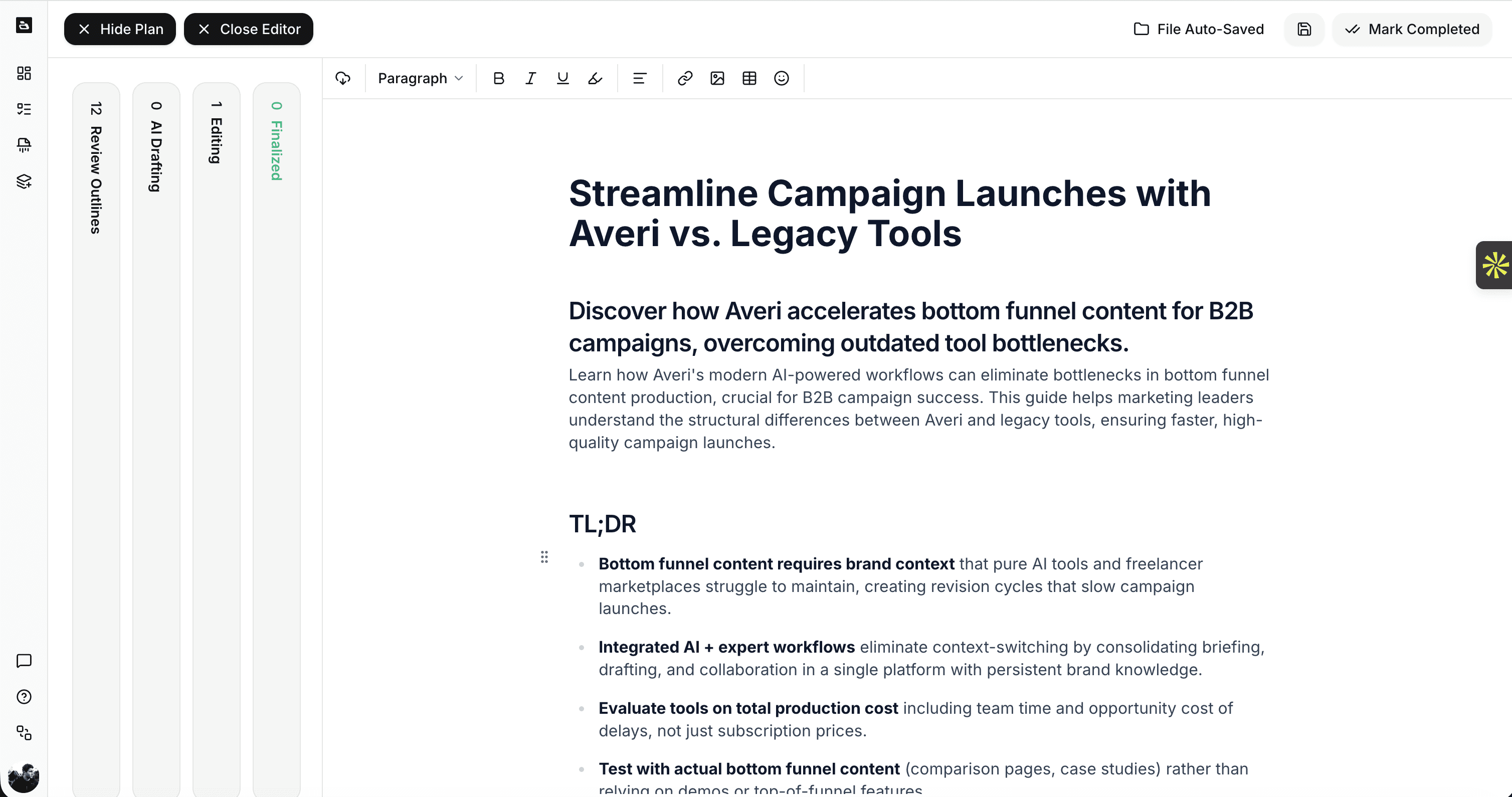
The AI goes to work: deep research (scraping relevant facts, statistics, and quotes with hyperlinked sources), context loading (pulling your Brand Core, existing Library content, and strategic positioning), and structural optimization (applying best-practice formatting for both SEO and GEO).
The first draft arrives structured with question-based H2 headings, 40-60 word answer blocks after each section, FAQ sections, statistics with attribution, entity definitions, internal linking suggestions, and auto-generated meta title/description.
This isn't generic AI output. It's output shaped by your Brand Core—your voice, your positioning, your ICPs, your competitive landscape. The hundredth piece sounds like your brand for the same reason the first one did: because the strategic context is structural, not conversational.
The Content Scoring System
Here's where Averi's workflow diverges from every other platform on the market.
As you edit in the collaborative canvas, a real-time content scoring system evaluates your piece across three dimensions:
SEO Score (40% weight): Keyword coverage, content structure, heading hierarchy, readability, on-page technical elements. Modeled after what Surfer and Clearscope do—but built into the creation workflow, not a separate tool.
AEO Score (25% weight): Answer block quality, question-based structure, FAQ presence, schema readiness. Optimized for featured snippets, People Also Ask, and voice assistant extraction.
GEO Score (35% weight): Citation-worthiness (statistics with attribution, source diversity), extractability (40-60 word answer blocks, atomic content structure), entity authority signals (E-E-A-T markers, author bio, publication dates), and LLM accessibility (HTML rendering, structured data).
The composite score updates live as you edit.
Specific recommendations appear in real-time: "Add 2 more cited statistics to improve citation-worthiness." "Your readability is too complex for optimal LLM citation—simplify paragraphs in Section 3." "Include FAQ schema for answer extraction."
No other content platform scores for GEO. This is the difference between content optimized for Google circa 2020 and content built for the dual-visibility era of 2026.
Your Role: Add the Human Layer
The AI provides the scaffolding. You provide the substance.
Highlight any section and ask Averi to rewrite, expand, or adjust. Tag teammates for review. Leave comments on specific paragraphs. Add the customer stories, the contrarian perspectives, the industry-specific insights that turn algorithmically optimized structure into content people actually want to read.
20-30 minutes per piece. Not because you're writing from scratch, because you're refining, adding voice, and injecting the human insight that AI can't generate.
Step 5: Publish and Distribute (5 min per piece)
Publishing is where most founder-led operations leak time. The draft lives in one tool. The CMS is another. Formatting breaks. Metadata gets lost. Images need resizing. What should take 5 minutes takes 45.
Native CMS Publishing
Averi publishes directly to your CMS. Formatting, metadata, internal links, and structure transfer intact. No copy-paste. No reformatting. No "it looked different in the editor." Click publish, and it's live in your CMS ready for publish.
Every published piece feeds back into your Content Engine—a growing repository of brand context that makes future AI drafts progressively smarter and more aligned. The Library isn't storage. It's the compound interest mechanism of the entire operation.
LinkedIn Distribution
Your blog isn't your only distribution channel. LinkedIn is where your B2B buyers spend their time, and content that performs well on LinkedIn drives both direct engagement and indirect SEO benefits through brand signals and referral traffic.
Averi supports LinkedIn posting within the same workflow.
Turn long-form articles into LinkedIn-native posts without switching platforms, reformatting, or maintaining a separate social media calendar. One piece of content, multiple distribution channels, from a single workflow.
Step 6: Analyze and Iterate (15 min/week)
The operation doesn't end at publication. It compounds through a feedback loop that turns performance data into strategic intelligence.
Performance Tracking That Recommends, Not Just Reports
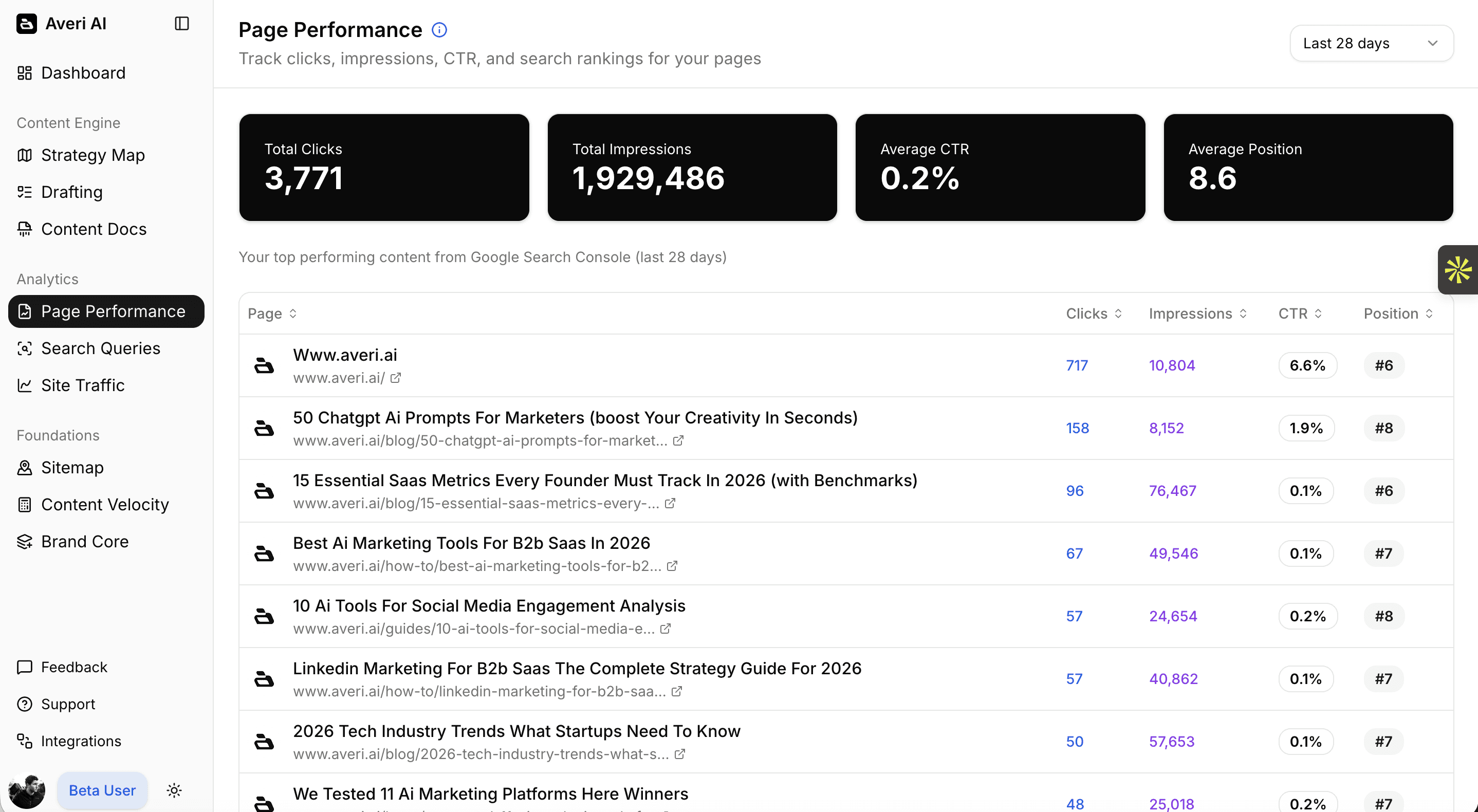
Averi tracks impressions, clicks, keyword rankings, and content performance trends. But tracking isn't the value.
The value is in proactive recommendations:
"This piece is ranking #8 for your target keyword—here's how to push it to page 1."
"Your competitor just published a comparison article in your category—here's your counter-angle, added to your queue."
"This topic is trending in your industry and aligns with your content pillars—here's a content angle."
"This published piece hasn't been updated in 90 days and performance is declining—flagged for refresh."
The analytics layer closes the loop. What's working feeds back into the queue. What's underperforming gets flagged. Competitors get monitored. The system adapts to what the market is actually responding to.
15 minutes per week reviewing analytics and acting on recommendations. The system does the analysis. You make the decisions.
What Does the Weekly Time Commitment Actually Look Like?
Let's be specific. After the initial setup (1-3 days for Brand Core, 1-2 days for Strategy Map), here's the ongoing weekly rhythm:
Queue review and approval: 15 minutes. Review recommended topics, approve or reject, reprioritize if needed.
Content review and refinement: 20-30 minutes per piece (typically 2-4 pieces per week, depending on your publishing cadence). Review AI draft, add voice and perspective, check scoring recommendations, approve for publishing.
Analytics review: 15 minutes. Check performance dashboard, review proactive recommendations, act on high-priority items.
Total: 2-3 hours per week for a complete content operation producing 2-4 optimized, published pieces per week.
Compare this to the alternatives: 56% of founders report having only 1 hour or less per day for marketing. Most of that hour gets consumed by reactive, unstructured marketing activity—social media scrolling, ad hoc emails, one-off LinkedIn posts. Redirecting 2-3 focused hours per week into a systematic content operation produces compound results that scattered activity never will.
What Does the Compound Effect Look Like Over Time?
This is the part that separates an operation from a project. Projects end. Operations compound.
Month 1: You're building foundation. 8-16 pieces published. Brand Core established. Strategy Map in place. Library growing. Zero to minimal organic traffic from new content—this is normal. Google takes time to index and rank.
Month 2-3: Compound effects begin. Early pieces start ranking for long-tail keywords. Topic clusters form as content interconnects. AI systems begin indexing your content. You start seeing impressions in Google Search Console and early AI referral traffic.
Month 4-6: Authority builds visibly. Your content clusters earn topical authority signals. Higher-difficulty keywords become accessible as domain authority grows. AI citation frequency increases as your content ecosystem becomes comprehensive enough for AI systems to trust. Content updated quarterly sees 2.8x more AI citations—your analytics layer flags content that needs refreshing.
Month 6-12: The flywheel spins. Organic traffic compounds. AI recommendations of your product increase. Your Library has hundreds of pieces providing the AI with deep brand context. Every new piece builds on the authority of everything that came before. The operation is genuinely self-improving—and the founder time commitment hasn't increased from 2-3 hours per week.
Companies using proactive, AI-driven content strategies report 2.9x higher revenue growth compared to reactive approaches. The advantage isn't that they work harder. It's that they built a system.
Related Resources
If You Want to Go Deeper on the Content Engine
How to Build a Content Engine That Runs Without You (The Complete 2026 Workflow)
AI Agent Marketing: How Autonomous AI Is Changing Content Ops in 2026
If You're a Solo or Technical Founder
If You Want to Understand SEO + GEO
The SEO-to-GEO Migration Checklist: 47 Things to Change Today
The Complete Guide to GEO: Getting Your Brand Cited by AI Search
ChatGPT vs. Perplexity vs. Google AI Mode: The B2B SaaS Citation Benchmarks Report
If You Need the Growth Strategy
Free Resources
FAQs
Can I really build a content operation without any marketing experience?
Yes. The AI handles the marketing strategy framework: keyword research, competitive analysis, content planning, SEO/GEO optimization, and performance analytics. You provide product knowledge and buyer insight—things you understand better than any marketer. The most effective B2B SaaS content combines deep product understanding with strategic distribution. An AI-powered operation adds the distribution layer you're missing.
What if I already have some content on my website?
Averi analyzes your existing content during onboarding. It identifies what's working, what has gaps, where keyword cannibalization exists, and where opportunities lie. Your existing content feeds into the Library immediately, giving the AI context from day one. The Strategy Map builds on your current foundation rather than starting from zero.
How does this handle GEO optimization specifically?
Every piece created through the workflow is automatically structured for AI citation: 40-60 word answer blocks after each H2, FAQ sections, statistics with attribution, entity definitions, and extractable formatting. The content scoring system weights GEO at 35% of every composite score—meaning no content publishes without LLM citation readiness built in. No other content platform does this.
What CMS platforms are supported?
Webflow, Framer, and WordPress & custom webhooks to fit your CMS... with more integrations coming. Publishing is native—formatting, metadata, and structure transfer intact without manual reformatting.
How is Averi different from what I'm already doing with ChatGPT?
ChatGPT is a text box that generates words. It starts from scratch every session with no memory, no brand context, no strategy, no optimization, no publishing, no analytics. An AI-powered content operation is a persistent system: strategy that evolves, a queue that replenishes, drafts shaped by your Brand Core, real-time scoring across SEO+AEO+GEO, direct CMS publishing, LinkedIn distribution, analytics that recommend action, and a Library that makes every piece progressively smarter. The compound effect of a system versus the linear output of a tool is the difference between organic growth and content that goes nowhere.
What does Averi cost compared to alternatives?
Averi's Solo Plan is $99/month. For context: an entry-level agency retainer starts at $2,500/month. A single freelance blog post costs $200-$500. Semrush starts at $139.95/month for data only, no content creation. A full-time content marketing hire averages $111,170/year. The operation described in this guide—complete with strategy, creation, optimization, publishing, distribution, and analytics—runs for less than the cost of a single blog post from most agencies.
When will I see results?
Organic content marketing is a compounding investment, not a switch you flip. Expect early ranking signals in month 2-3 for long-tail keywords. Meaningful organic traffic growth by month 4-6. Compound authority effects from month 6 onward. Perplexity shows the fastest AI citation results—optimized content can appear in AI recommendations within days due to real-time indexing. The founders who start now and commit to the weekly rhythm will have a durable competitive advantage that late movers can't easily replicate.