
In This Article
Practical, low-cost branding steps for startups: define positioning, build a simple visual identity, and use content plus AI to grow.
Updated:
Trusted by 1,000+ teams
Startups use Averi to build
content engines that rank.
Building a brand on a limited budget is possible - and essential. Branding isn’t just about logos or colors; it’s about creating trust, standing out, and driving long-term growth. For bootstrapped companies, focusing on clarity, consistency, and cost-effective tools can yield big results without big spending.
Key Takeaways:
Why branding matters: Companies with strong branding see a 33% revenue boost, and 75% of users judge credibility based on website design.
Challenges for startups: Limited time and resources mean founders must prioritize essentials like positioning, messaging, and visual identity.
Step-by-step approach: Define your audience, craft a lean strategy, and build a basic brand system with affordable tools.
Content as a growth engine: High-impact formats like how-to guides and case studies can deliver 3x more leads at 62% lower costs than traditional marketing.
Leverage AI tools: Platforms like Averi streamline content creation and branding for as little as $100/month.
Action Plan: Spend three weeks to kickstart your brand - interview customers, create a concise brand overview, and launch a focused content series. With tools like Figma, Google Fonts, and Buffer, you can build a professional, consistent brand that grows over time.
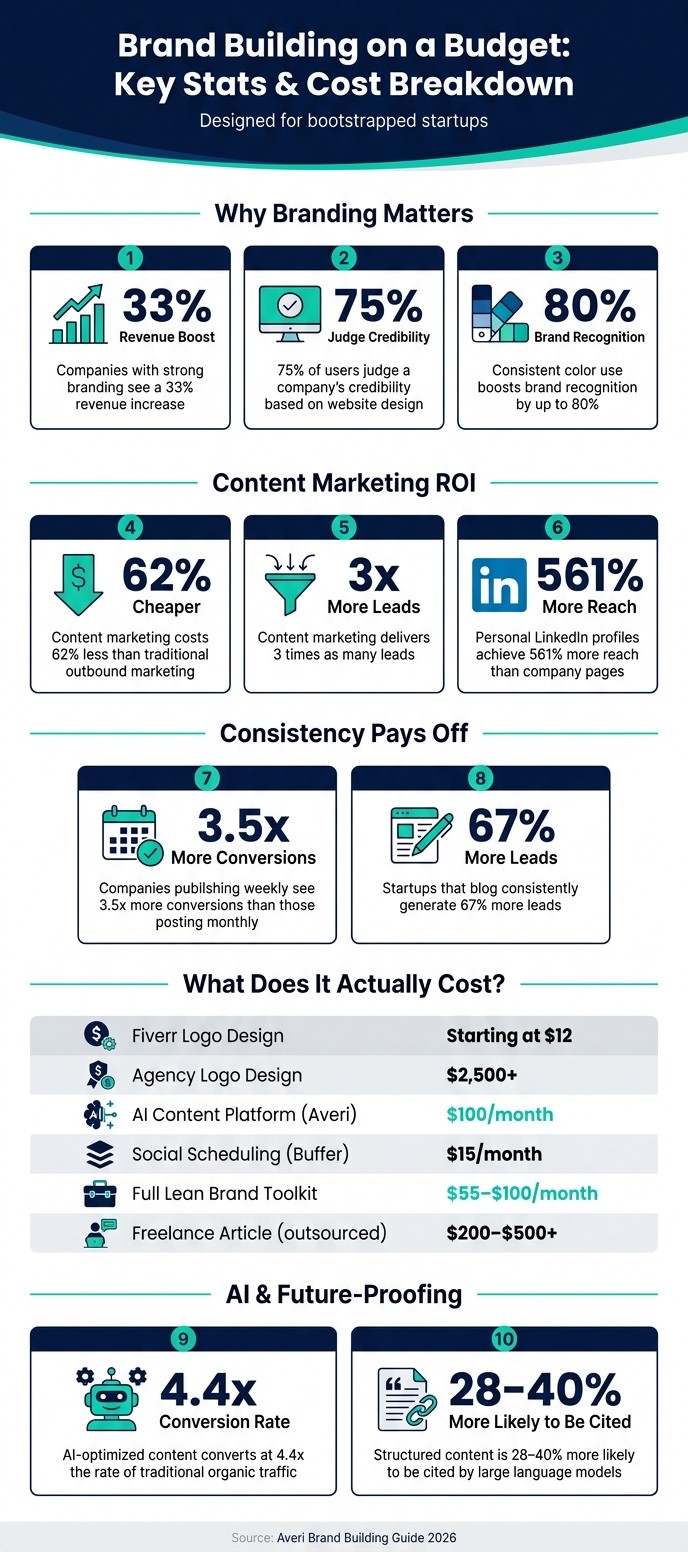
Brand Building on a Budget: Key Stats & Cost Breakdown
Define a Lean Brand Strategy
Before diving into logo designs or crafting taglines, you need a clear strategy. Without one, you risk making costly, uninformed decisions that could require a complete overhaul later. A solid strategy serves as the foundation for your visual identity and content efforts. As Lana Emmanuel, Chief Developer at TechVorta, wisely states:
"A beautiful logo built on a weak strategy is expensive decoration. A clear strategy expressed through even modest design is a brand." [2]
Clarify Your Positioning and Target Audience
The quickest way to establish your positioning is by having direct conversations with potential customers. Spend two weeks conducting interviews with 20 prospects via Zoom, recording their responses. Focus on understanding their specific challenges in their own words. These insights will shape your messaging in ways no survey tool can replicate. [1]
Once you’ve gathered this feedback, use the Arielle Jackson positioning framework to create a precise statement:
"For [target customer] who [statement of need], [product name] is a [product category] that [statement of key benefit]. Unlike [competing alternative], [product name] [statement of primary differentiation]." [2]
This approach forces clarity and avoids the pitfalls of vague positioning, which can be an expensive mistake.
Build a Simple Brand Narrative
Your brand story doesn’t need to be lengthy; it needs to be authentic and well-structured. A four-beat arc - Trigger, Struggle, Resolution, Vision - works effectively to create a story that resonates. [1] This structure aligns with how people naturally process stories, helping to build trust and set your brand apart.
From this, craft a concise positioning statement that aligns your team:
"We help [specific buyer] achieve [specific outcome] through [differentiated approach]." [4]
Support this narrative with two or three proof points, such as customer results, insights from your interviews, or a before-and-after scenario. This creates a story that’s both believable and easy to share.
Focus on the Brand Elements That Matter Most
For startups or small businesses, focus on four essentials: a name, a logo, a color palette, and a tone of voice. These basics are enough to create a consistent brand identity. Most small businesses spend less than $500 on a logo [1], while platforms like Fiverr offer designs starting at just $12. In contrast, agency-designed logos can cost over $2,500 - a price difference that’s hard to justify at this stage. [1]
To streamline your visual branding, use free tools like:
Coolors for generating color palettes
Google Fonts for professional typography
Figma for refining logos and creating a brand sheet
A simple brand sheet - a 6-slide document covering your mission, logo variations, color codes, typography, and usage guidelines - becomes your go-to resource for design consistency.
Tool | Purpose | Cost |
|---|---|---|
Coolors | Generate and test color palettes | Free |
Google Fonts | Access professional typefaces | Free |
Figma | Refine logos and build brand sheets | Free tier available |
Fiverr | Affordable logo creation | Starting at $12 |
With this streamlined strategy and a basic brand kit, you’re equipped to develop a functional, effective brand system in the next steps.
Build a Minimum Viable Brand System
Transform your strategy and brand elements into a practical system your team can rely on every day. These steps will help integrate your lean brand strategy into a cohesive set of tools and guidelines.
Create a Visual Identity on a Small Budget
Design a simple yet effective visual system that includes your logo, a three-color palette (dominant, accent, and neutral), and a clear typography hierarchy. For fonts, consider pairing a sans-serif for headings with a serif for body text - both readily available for free on Google Fonts. Maintaining visual consistency is crucial: studies show that consistent use of color can boost brand recognition by up to 80%, while 75% of users judge a company's credibility based on its website design [1].
Document these elements in a compact, 6-slide brand sheet to serve as a quick reference guide:
Slide | Content |
|---|---|
1 | Mission statement and 3 core tone adjectives |
2 | Primary logos and safe-space margin rules |
3 | Color palette with specific hex codes |
4 | Typography hierarchy (headings vs. body) |
5 | Example images and mood board |
6 | Quick "Do and Don't" usage notes |
This brand sheet acts as your go-to resource for everything from website updates to social media posts and pitch decks. It keeps your design choices consistent and decision-making efficient.
Standardize Your Voice and Tone
After locking in your visual identity, focus on ensuring your messaging is just as consistent. Documenting your brand voice early is essential - it’s one of the easiest things to lose track of as your team expands.
"Voice is the emotional texture of your brand. Values are the beliefs behind that texture." - Lidia Vijga, Co-Founder, DeckLinks [1]
Start by auditing three existing pieces of content: a Slack update, a LinkedIn post, and a customer email. Highlight words and phrases that feel distinctly "you" and distill them into three or four adjectives. For clarity, pair each adjective with a "not" qualifier, such as "Confident, but not arrogant" or "Professional, but not stiff."
To test your voice consistency, try the "Remove the Logo" test: strip your branding from content across your channels. If the tone doesn’t feel unified, it’s a sign your voice needs refining [2].
Set Up Simple Brand Governance for Small Teams
To maintain your lean brand system, establish lightweight governance. For small teams, consolidate your rules into one easily accessible document - a Brand OS. This could be a Google Doc or Notion page that everyone can reference [1].
Keep it simple with a short checklist. Assign a single person, often the founder in the early stages, to act as the brand owner. Before publishing anything public-facing, ask these three questions: Does it match our tone adjectives? Are the correct logo and colors used? Does it align with our positioning statement?
Use Content as Your Main Branding Channel
When you're working with a lean budget, content becomes your most powerful tool for spreading your brand's message. Content marketing is not only cost-effective - 62% cheaper than traditional outbound marketing - but it also delivers three times as many leads [4]. For startups operating on tight margins, this can make all the difference in gaining visibility.
Focus on High-Impact, Low-Cost Content Formats
Not all content is created equal, especially when resources are limited. Prioritize formats that deliver the most value for your time and effort:
Format | Time | Lifespan | Best Use |
|---|---|---|---|
Problem-Aware Pillars | 8–12 hours | 2+ years | Establishing authority, SEO rankings |
How-To Guides | 4–6 hours | 1–2 years | Educating users, showcasing expertise |
Comparison Posts | 6–8 hours | 1–2 years | Attracting high-intent traffic, driving conversions |
Case Studies | 10–15 hours | 1–2 years | Demonstrating results, supporting sales |
For quick wins, founder-led LinkedIn posts are a goldmine. Personal LinkedIn profiles achieve 561% more reach than company pages [2], and LinkedIn itself accounts for 80% of all B2B social media leads [4]. As a founder, your personal voice can be one of your strongest brand assets - lean into it.
Create a Simple, Consistent Content Plan
Effective content marketing isn’t about bursts of effort; it’s about steady, ongoing output. Companies that publish weekly see 3.5 times more conversions than those posting monthly [4]. Similarly, startups that blog consistently generate 67% more leads compared to those that don’t [4].
Start by organizing your efforts around a Strategy Map rather than chasing random ideas. Focus on 2–3 core topic clusters, each anchored by a comprehensive pillar page and supported by 10–20 shorter articles [6]. Early on, prioritize conversion-driven content - comparison pages, case studies, and FAQ posts - because these directly influence buying decisions [3].
Set aside a dedicated 4-hour block each week for all content-related tasks [3]. Maximize your output by repurposing: a single long-form blog post can fuel 5–7 LinkedIn updates and 2–3 newsletter sections [3]. Looking ahead to 2026, plan for Generative Engine Optimization (GEO) by incorporating 40–60 word direct-answer blocks and FAQ sections into your content. This ensures your material is cited by AI systems like ChatGPT and Perplexity [4].
"Consistency isn't about volume, it's about signaling to Google and AI systems that your site is active, authoritative, and worth indexing frequently." - Zach Chmael, CMO, Averi [4]
Once your content calendar is set, streamline your workflow with automation.
Automate Content Creation and Publishing
Even with a strong plan, the biggest time drain in content marketing isn’t the writing itself - it’s the surrounding tasks like research, formatting, scheduling, and uploading. Automation tools can help lighten this load.
Platforms like Averi simplify the entire process. They can analyze your website to learn your brand voice, identify content gaps based on competitors and keywords, draft articles optimized for SEO and GEO, and publish directly to platforms like Webflow, Framer, or WordPress. With tools like this, you can reduce your weekly content workload from 8–10 hours to just 2 hours - far less than the 15–20+ hours often spent managing freelancers. And at $100 per month, it’s a fraction of the cost of outsourcing even one article per week. Plus, the more content you publish, the better the system becomes at generating drafts tailored to your needs.
Grow Your Brand Presence with Automation and Analytics
Build Consistent Branding Workflows
Consistency is the backbone of effective branding. One way to achieve this is by setting up repeatable workflows. Dedicate a 4-hour weekly block to batch your branding tasks, and pair it with a social scheduling tool like Buffer (starting at $15/month). This allows you to queue posts ahead of time, ensuring that your content distribution stays on track even when you're not actively working. This structured approach not only saves time but also creates a foundation for scaling efforts with AI-powered tools.
Scale with AI-Powered Marketing Platforms
Once your lean branding system is in place, integrating AI tools can help you scale without stretching your budget. Platforms like Averi are designed to unify strategy, content creation, and performance tracking into a single workflow, making them ideal for small teams. Unlike standalone tools like Jasper or ChatGPT, which require separate solutions for SEO, publishing, and analytics, Averi connects everything into a seamless process. It retains your brand voice, publishes directly to platforms like Webflow, Framer, or WordPress, and even provides performance insights to guide future content creation.
At $100/month, Averi offers a cost-effective solution, significantly less than the expense of outsourcing a single freelance article. The results speak for themselves - AI-optimized content converts at 4.4 times the rate of traditional organic traffic [4].
Another technical step to enhance performance is deploying an llms.txt file on your website. This file helps AI crawlers understand how to index and cite your content. Research shows that structured content is 28–40% more likely to be cited by large language models [4], giving your brand an edge in AI-driven search results.
Monitor Metrics and Refine Your Strategy
Consistency is important, but tracking the right metrics is what transforms effort into results. Focus on key indicators like branded search volume (how often users search for your brand name), direct traffic, and social share of voice [1] [2].
Free tools like Google Search Console and GA4 make it easy to monitor traffic and keyword rankings weekly. If a specific topic cluster starts gaining momentum, capitalize on it by creating additional related content [6]. To build trust and authority, follow the 90/10 rule: make 90% of your content educational and only 10% promotional. Over time, this balance fosters brand credibility and strengthens your audience's trust [2].
With AI Overviews now appearing in 48% of Google queries as of 2026 [6], securing visibility in these results - not just on the first page - can be a game-changer for brand growth.
Conclusion: Building a Strong Brand on a Budget
Creating a brand with limited resources is all about making thoughtful decisions. A clear, consistent message paired with a straightforward visual identity will always outperform an expensive but scattered rebrand [1][2].
Unlike paid ads that stop delivering the moment you stop funding them, brand equity continues to work for you over time. As Lidia Vijga, Co-Founder of DeckLinks, wisely states:
"Done well, branding isn't an expense. It is the cheapest compounding asset you can build." [1]
Content remains one of the most effective tools at your disposal. With a lean toolkit - including Google Search Console, Canva, Buffer, Mailchimp, and an AI assistant - you can spend as little as $55–$100 per month [5] and build meaningful authority within 12–24 months [2][3]. These affordable strategies can help you establish a strong foundation and gain traction quickly.
A focused 3-week sprint can kickstart this process: in week one, interview five customers; in week two, craft a concise 200-word founder story and a 6-slide brand overview; in week three, launch a signature content series [1].
Tools like Averi can streamline tasks such as research, drafting, publishing, and tracking, enabling your brand to grow while you concentrate on refining your product. By embracing these efficient strategies, supported by AI, you can ensure steady, sustainable growth for your brand.
FAQs
What should I do first to define my brand on a tight budget?
Before diving into visuals, concentrate on building a solid strategy. Start by clarifying your core positioning - this means understanding exactly who your audience is, what unique value you bring to the table, and why you’re the best option for them. Picture your Ideal Customer Profile (ICP) as a real individual facing specific challenges that your brand can solve. Craft a mission statement to steer your decisions, establish a brand voice that feels genuine, and take a close look at your competitors to uncover ways to stand out in a meaningful way.
How can I create a consistent brand look and voice without hiring a designer?
To get started, clearly outline your mission, define your target audience, and establish your brand voice in a single, central document. For the visual side of things, pick 2–3 colors and 1–2 typefaces that are versatile and look great across different formats. Save these, along with any logo variations, in a shared folder that’s easily accessible.
When it comes to refining your tone, take a closer look at your current communications. Pinpoint three adjectives that best describe your brand’s personality, and then create a straightforward list of do’s and don’ts to keep future content consistent and aligned with your goals.
Which metrics best show if my branding is actually working?
Focusing on results that align with your business objectives is crucial. Here are some key areas to measure:
Revenue impact: Strong branding efforts can lead to a 10%-20% increase in revenue, making it a direct contributor to your bottom line.
Pipeline growth: Keep an eye on the number of qualified leads that stem from your branding initiatives to assess their effectiveness.
Organic traffic: Use tools like Google Analytics to track growth in website visitors, an indicator of brand visibility and interest.
Engagement quality: Evaluate how well your audience connects with your messaging by analyzing metrics such as click-through rates, time on page, or social media interactions.
Consistent positioning: Ensure your messaging remains uniform across all platforms. This builds trust and reinforces your brand identity.
Related Blog Posts

Zach Chmael
CMO, Averi
"We built Averi around the exact workflow we've used to scale our web traffic over 6000% in the last 6 months."
Your content should be working harder.
Averi's content engine builds Google entity authority, drives AI citations, and scales your visibility so you can get more customers.