

In This Article
Build data-driven content for analytics platforms: map use cases to audiences, measure business impact, and scale production with AI.
Updated:
Trusted by 1,000+ teams
Startups use Averi to build
content engines that rank.
Hook: Buyers today demand more than promises - they want proof. Analytics platforms must deliver clear, actionable insights through content to stand out in a competitive market.
Value Summary: Content marketing for analytics platforms is about addressing buyer needs at every stage of their journey. Executives prioritize ROI, data teams seek technical depth, and managers need practical workflows. Tailored, data-driven content like case studies, benchmark reports, and guides can influence decisions and drive measurable outcomes.
Quick Overview:
Align content with analytics use cases (e.g., attribution, forecasting).
Segment audiences by role and data maturity for targeted messaging.
Use metrics to measure success, from engagement (scroll depth, CTR) to business impact (pipeline, trial signups).
Leverage an AI-powered content strategy to streamline production and automate research. This includes using AI-assisted content ideation to identify high-value topics.
Bridge: This article outlines how to create a data-driven content strategy that resonates with buyers, optimizes workflows, and connects directly to business goals.
Mapping Analytics Use Cases to Content Goals and Metrics
Align Content with Your Analytics Value Propositions
Every major analytics use case - like attribution, forecasting, dashboards, or churn prediction - solves a specific business challenge for buyers. These use cases can be reframed as entry points for your content strategy.
To do this effectively, consider the "value → pillar → topic" framework. Start with the core value (e.g., multi-touch attribution), break it into pillars such as education (e.g., attribution models), strategy (e.g., budget reallocation), and execution (e.g., integrating ad platforms, CRM, and analytics). Aim for content that spends 70–80% of its focus on the buyer's problem and 20–30% on solutions, using real examples like screenshots or workflow walkthroughs to demonstrate practical applications.
Here’s a breakdown of how to map analytics use cases to audiences, content goals, and measurable results:
Analytics Use Case | Primary Audience | Content Goal | Key Content Metrics | Business Metrics |
|---|---|---|---|---|
Marketing attribution | CMO, Marketing Ops | Generate qualified demo requests | CTR to demo, calculator completions | Pipeline with attribution in scope |
Revenue forecasting | Sales Ops, Finance | Drive trial signups among RevOps | Template downloads, webinar attendance | Forecast accuracy improvement |
Executive KPI dashboards | C-suite, BI leads | Increase dashboard module adoption | Dashboard gallery views, "duplicate" actions | Active dashboards, executive NPS |
Churn prediction | Customer Success, Product | Educate on behavioral cohort analysis | Guide completions, feature activation | Churn rate reduction, NRR |
Once you’ve outlined content pillars, the next step is to define metrics that track how buyers are engaging with your content.
Define Content Success Metrics
High-performing analytics teams measure progress at every stage of the funnel and connect these metrics to clear business results.
At the top of the funnel, focus on metrics like organic sessions, scroll depth, and social click-through rates - these indicate your brand’s visibility among target audiences. In the middle of the funnel, prioritize content-assisted events such as template downloads, webinar registrations, and interactive dashboard views. Data from HubSpot reveals that landing pages offering tools, templates, or calculators can convert 2–5 times better than standard blog posts when tied to a specific use case [4].
At the bottom of the funnel, track free trial signups and demo requests that can be directly attributed to content. Go beyond this by monitoring feature-level activation - for instance, users who read a forecasting guide and then enable forecasting within the product. A Forrester study highlighted that companies leveraging advanced multi-touch attribution see an average 15–30% improvement in marketing ROI by allocating budgets more effectively to top-performing campaigns and content [8].
Set specific numerical targets for each content cluster. For example: "The forecasting content cluster should generate 50 trial signups per quarter and influence $250,000 in qualified pipeline." Without clear targets, it’s impossible to optimize effectively.
Once your metrics are in place, audience segmentation becomes critical to ensure each content piece resonates with the right people.
Segment Audiences and Tailor Content Themes
To make your content impactful, segment your audience by role and data maturity.
By Role: CMOs need ROI-driven content, such as attribution benchmarks or budget reallocation guides. Data engineers, on the other hand, require technical content on topics like pipeline reliability and data governance. CFOs and FP&A leaders are more interested in forecast accuracy, scenario planning, and cost-saving strategies. Combining these audiences into one content stream risks creating material that doesn’t fully connect with anyone.
By Data Maturity: Companies just beginning to centralize their data need beginner-friendly resources like checklists or introductions to dashboards. Intermediate teams benefit from content on KPI design and governance workflows. Advanced teams, however, are looking for deep dives into technical processes. Matching content to the audience’s maturity level avoids alienating early-stage buyers with overly technical guides or losing advanced accounts with overly simplistic material.
"The goal determines the content types, the CTAs, and the measurement framework." - Zach Chmael, CMO, Averi [2]
Use a straightforward internal map - use case → buyer role → business problem → content angles → product features to highlight - as the backbone of your editorial planning process. This ensures every piece of content addresses a real need for your audience.
Building a Data-Driven Content Strategy
Audit Existing Content and Identify Gaps
Before diving into new content creation, take a hard look at what you already have. Many analytics platforms are sitting on untapped resources - think product documentation, webinar recordings, case studies, or how-to guides - that could be refreshed or repurposed instead of starting from scratch. Catalog every piece of content across your blog, documentation site, YouTube channel, and in-app resources. Track details like the topic, target audience, funnel stage, publish date, and key performance metrics (using tools like GA4, Ahrefs, or Semrush). Then, layer in CRM data to identify which assets have genuinely impacted your sales pipeline.
Once you’ve gathered the data, start spotting trends. For instance, pages with high traffic but low conversions might need stronger calls-to-action or better alignment with your audience. On the flip side, high-conversion pages with low traffic could benefit from improved SEO or more promotion. Content that hasn’t been updated in over 90 days and shows declining impressions should be flagged for a refresh - search engines reward fresh content, especially in fast-evolving fields like analytics.
The goal of this audit is to create a gap matrix, mapping personas against funnel stages and use cases. For example, if you discover 25 blog posts aimed at data engineers but only three pieces for marketing executives evaluating attribution tools, it’s a clear sign to rebalance your content efforts. Analytics platforms often lean heavily on technical content, leaving evaluation-stage buyers with fewer resources to guide their decisions.
With these gaps clearly outlined, the next step is selecting content formats that resonate most with your audience.
Choose High-Impact Content Formats
Not all content formats perform equally, especially with analytics buyers. According to the Demand Gen Report's 2023 Content Preferences survey, 51% of B2B buyers value research and survey reports the most when evaluating a purchase, followed closely by case studies (50%) and webinars (44%). These audiences crave data-backed insights, benchmarks, and specifics.
Different formats work better at various stages of the buyer’s journey:
Awareness: Benchmark reports, educational guides, thought-leadership webinars
Consideration: Detailed case studies, technical deep dives, comparison guides
Decision: ROI calculators, interactive demo environments, implementation playbooks
Post-purchase: Feature playbooks, advanced tutorials, in-app walkthroughs
Benchmark reports, in particular, can be a game-changer. By aggregating anonymized data from your platform - like average dashboard adoption rates by industry - you create unique content that competitors can’t easily replicate. These reports can drive backlinks, generate press coverage, and serve as valuable sales tools. Even better, one report can be repurposed into blog posts, LinkedIn updates, webinar topics, and sales collateral, maximizing your investment.
Case studies should go deeper than the usual testimonial quotes. Analytics buyers want specifics: the challenges faced, the features used, data volumes handled, and measurable results. For example, instead of saying, "improved efficiency", show how a feature "cut dashboard build time by 60% and increased reporting accuracy by 20%."
Prioritize Topics Using Analytics Data
With your audit done and formats selected, it’s time to decide what to tackle first. Let the data guide you.
Start with Google Search Console to find queries where your pages rank between positions 8 and 20 but still get decent impressions. These are prime opportunities - targeted updates or more comprehensive content can push these pages onto the first page of search results. Similarly, on-site search data from your app or documentation portal can highlight missing topics. For instance, if users frequently search for "Snowflake integration setup", that’s a clear gap to address.
Your product analytics tool - whether it’s Mixpanel, Amplitude, or your own system - can also provide useful insights. Look for features with high adoption but a significant number of support tickets or low task-completion rates. Address these pain points with educational content to improve user activation and retention.
Clearbit’s research supports this approach: product-led content, built around specific use cases and real-world data, increased MQL-to-SQL conversion rates by around 40% [3].
"We built Averi around the exact workflow we've used to scale our web traffic over 6,000% in the last 6 months." - Zach Chmael, CMO, Averi [1]
Finally, tap into insights from your CRM. Identify which reports, webinars, or guides consistently appear in the deal histories of your top customers. These aren’t just driving clicks - they’re influencing revenue. By focusing on these proven performers, you can create content that not only drives traffic but also boosts your platform’s overall marketing impact.
Analytics in Action: Embracing Data Analytics to Reinvent Your Content Marketing
Setting Up an AI-Powered Content Production Workflow
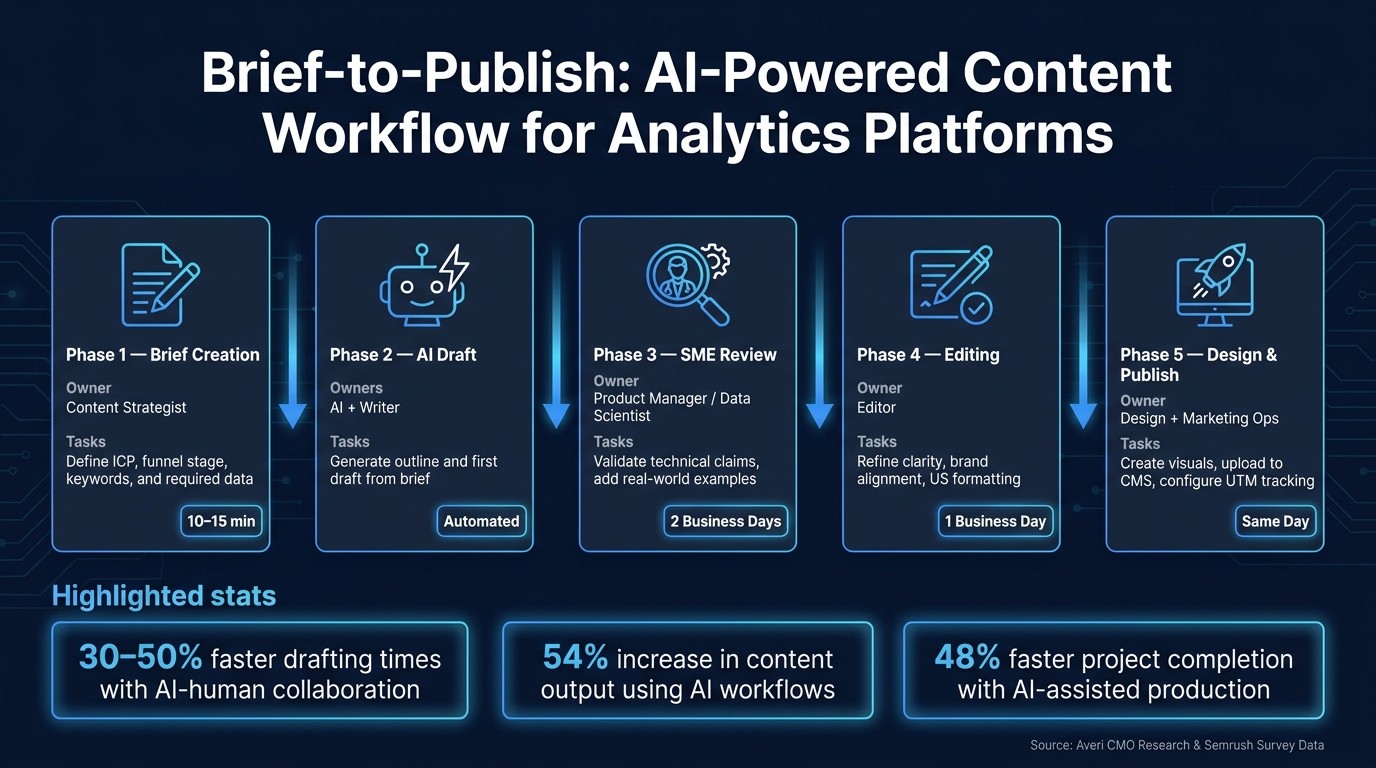
AI-Powered Content Marketing Workflow for Analytics Platforms
Once your content strategy is mapped out, the real challenge begins: keeping up with the pace of execution. Analytics platforms often have a wealth of resources - product data, customer insights, and technical documentation - but turning these into consistent, publishable content is where many teams hit a wall. An AI-powered workflow steps in to handle repetitive and structural tasks, freeing your team to focus on accuracy, creativity, and maintaining a strong, consistent voice.
Set Up an AI-Human Workspace
The goal here isn’t to replace your team with AI but to create a partnership where AI takes on time-consuming tasks, and your team focuses on strategy and quality. AI can assist by drafting outlines, repurposing existing content, and generating metadata, while your team of strategists, subject-matter experts (SMEs), and editors focus on refining, fact-checking, and aligning content with your brand’s unique voice. This setup ensures your data-driven strategy stays on track.
Averi, for example, learns your product’s positioning and tone, generating drafts that require minimal rewriting. This is crucial for analytics platforms, where content often includes specific claims - like performance benchmarks or integration specs - that AI can draft but humans must verify for accuracy.
"An AI-powered content operation is a system, not a collection of tools, that handles the full content lifecycle." - Zach Chmael, CMO, Averi [2]
To maintain consistency, create a prompt library with templates for your most common content types, such as product walkthroughs, use-case guides, and benchmark summaries. These prompts should reference your style guide and include clear instructions, such as "highlight claims needing SME verification" or "use only verified information from the knowledge base." Teams using this AI-human collaboration often see drafting times cut by 30–50%, all while maintaining the credibility their audience demands.
Build a Brief-to-Publish Process
A streamlined workflow eliminates unnecessary delays in content production. By assigning clear roles and timelines, you can ensure every piece of content moves smoothly from concept to publication.
Here’s an example of a brief-to-publish workflow tailored for an analytics platform:
Phase | Owner | Task | Target Time |
|---|---|---|---|
Brief creation | Content strategist | Define ICP, funnel stage, keywords, and required data | 10–15 min |
AI draft | AI + writer | Generate an outline and first draft based on the brief | Automated |
SME review | Product manager / data scientist | Validate technical claims and add real-world examples | 2 business days |
Editing | Editor | Refine clarity, ensure brand alignment, and apply US formatting | 1 business day |
Design & publish | Design + marketing ops | Create visuals, upload to CMS, and configure tracking (e.g., UTM) | Same day |
The SME review phase is especially critical for analytics content. When exact data isn’t available, use a defensible range or qualitative descriptions to maintain trust with your audience.
Once this workflow is in place, the next step is automating research to ensure a steady flow of fresh content ideas.
Automate Research and Topic Generation
With your production workflow running smoothly, focus on automating research to keep your content pipeline full. Manual research can be time-intensive, but tools like Semrush and Ahrefs can continuously identify high-intent keyword gaps in the analytics space. For instance, phrases like "warehouse-native analytics setup" or "marketing attribution dashboard best practices" might reveal opportunities where competitors are ranking.
In addition, trend monitoring tools like Exploding Topics or BuzzSumo can help you spot emerging topics - such as "composable CDP" or "reverse ETL" - before they gain widespread traction.
Averi further simplifies this process by tracking competitor content, identifying keyword opportunities, and queuing up topic ideas complete with suggested titles, keywords, and angles. Through integrations with tools like Zapier or Make, it can even initiate tasks in your content backlog for approval.
According to a Semrush survey, 49% of companies leveraging AI in content marketing use it primarily for topic research and idea generation. This underscores how automation can be a game-changer for staying ahead in fast-evolving, complex industries like analytics.
Distributing and Optimizing Content for Maximum Impact
Your analytics data doesn't just guide the creation of content - it’s the key to effective distribution and ongoing improvement. Once your production workflow is in motion, the next step is ensuring your content finds the right audience while delivering measurable results. Modern analytics tools allow you to track every interaction, bridging the gap between content and tangible business outcomes.
Connect Content Workflows with Analytics and Marketing Tools
To fully understand your content’s impact, connect every interaction to your broader pipeline. Integrate your CMS, marketing automation platform, and CRM so that each engagement is logged in a unified system. Tag links with UTM parameters to track performance, and funnel engagement data directly into your CRM. For example, platforms like Salesforce or HubSpot CRM allow you to create campaigns for major initiatives - such as a "2026 Analytics Benchmark Report" - and link them to leads, opportunities, and closed deals. This approach enables you to tie content not only to lead generation but also to pipeline velocity and revenue.
Automation tools like Zapier or Make can streamline workflows between platforms, provided you maintain consistent naming conventions for UTM parameters and campaign IDs. This integrated setup ensures your performance data is accurate and actionable.
Measure and Optimize Content Performance
To gauge effectiveness, monitor three key types of metrics:
Reach: Includes organic traffic, impressions, and new visitor counts.
Engagement: Covers metrics like time on page, scroll depth, video completion rates, and CTA clicks.
Business Impact: Tracks outcomes such as content-sourced leads, MQLs, pipeline influence, and demo-to-close rates.
These metrics complement earlier funnel data, ensuring that every piece of content contributes to your business goals. Use analytics and visualization tools to consolidate data from your CRM, email platform, web analytics, and paid channels into a single ROI dashboard. Tailor views for different stakeholders - for instance, the CMO may focus on revenue impact, while content managers track engagement metrics.
Establish a regular review cycle to refine your approach:
Weekly: Analyze distribution metrics in a quick 15–20 minute session.
Monthly: Identify topic gaps to address in future content.
Quarterly: Assess your channel mix and evaluate conversion performance.
Metrics like high impressions but low click-through rates may indicate a need to rewrite meta titles, while strong engagement without conversions suggests your call-to-action may need tightening.
Build a Feedback Loop for Continuous Improvement
Once you’ve measured performance, use the data to refine your strategy. High-performing topic clusters can guide new content creation, while pages with strong impressions but low click-through rates might benefit from improved metadata. If traffic declines, consider refreshing the content with updated statistics or examples.
Tools like Averi can automate parts of this process, tracking keyword rankings and providing actionable recommendations. For instance, it can alert you when competitors publish on related topics or highlight low-competition keywords worth targeting. As your content library expands and you gather more performance data, these insights become sharper, helping you fine-tune future efforts.
"The loop closes: Strategy informs creation. Creation feeds scoring. Scoring triggers publishing. Publishing generates analytics. Analytics inform strategy." - Zach Chmael, CMO, Averi [1]
Repurposing content is another essential tactic. A comprehensive benchmark report, for example, can be transformed into a series of blog posts, a webinar replay, a LinkedIn carousel, and an email nurture sequence. Each format can be tracked individually to determine which generates the most valuable engagement. This multi-channel approach maximizes the impact of your content while providing deeper insights into audience preferences.
Conclusion and Key Takeaways
Content marketing for analytics platforms isn't about churning out endless material - it’s about creating smarter, more targeted content. The approach outlined here follows a clear process: align your platform’s value propositions with real buyer use cases, develop a content strategy grounded in data, streamline production with an AI-human workflow, and continuously refine your efforts based on performance. When content directly addresses genuine audience needs, each step builds on the last to deliver meaningful results.
Studies indicate that 70% of B2B buyers engage with three to five pieces of content before reaching out to a salesperson, with data-driven materials like quantified case studies, benchmark reports, and role-specific playbooks consistently ranking as the most useful resources[4]. These formats outperform generic thought leadership by directly addressing how buyers define and measure success.
AI tools, such as Averi, make this process more efficient by managing tasks like research, drafting, and performance tracking - all while leaving strategy, accuracy, and storytelling in human hands. Marketers leveraging AI-human workflows report a 54% increase in output and complete projects 48% faster, demonstrating how this approach boosts productivity without compromising quality[5][6].
Tracking ROI and marketing KPIs is essential. SaaS companies that link content performance to pipeline metrics are 2–3× more likely to secure increased content budgets each year[7]. Tools like UTM parameters, multi-touch attribution models, and your CRM can connect content engagement to business outcomes such as demo requests, trials, and closed deals. By creating a dashboard within your analytics platform to monitor sessions, conversions, and revenue impact, you can ensure your strategy stays aligned with business goals. Regularly reviewing these metrics with your team helps maintain focus on measurable success.
To put this into action, set aside 90 minutes this week to plan. Start by documenting your top three analytics value propositions, choose one impactful use case and target audience, and outline a 30–60 day experiment to create three to five targeted content pieces. Use AI tools like Averi to speed up research and drafting, and track the results. Once this feedback loop is in motion, it can drive ongoing improvements and elevate your content marketing strategy.
FAQs
Which analytics use case should we market first?
Start by creating how-to guides and content that tackles the core challenges your audience faces. This approach highlights the value of your platform early in their decision-making process.
To refine your strategy, align your content with each stage of the buying journey. Focus on:
How-to guides that provide actionable solutions to specific problems.
Comparison articles that pit your platform against competitors, helping prospects evaluate their options.
Case studies and data-driven insights that showcase measurable success stories and real-world results.
By tailoring content to these needs, you position your platform as a trusted resource throughout the buyer's journey.
How do we tie content to pipeline and revenue in our CRM?
To connect your content efforts directly to pipeline and revenue, it's time to leave vanity metrics behind. Instead, integrate performance tracking right into your CRM or marketing platform. Tools like Averi’s content engine can help by automating a closed-loop workflow, ensuring that analytics actively inform your future strategies.
Align content goals with measurable business outcomes, such as increasing demo requests. Platforms like GA4 are invaluable for tracking conversions on a per-page basis, making it easier to link your content's performance to your CRM pipeline.
What’s the safest way to use AI without hurting accuracy?
To ensure AI is used effectively and responsibly, integrating a human-in-the-loop workflow is essential. This approach allows AI to manage tasks like research and initial drafts while relying on human expertise for oversight and refinement.
Key steps to follow:
Establish a Clear Brand Core: Define your brand's values, tone, and goals to guide AI's outputs effectively.
Thoroughly Review AI Outputs: Evaluate AI-generated content for accuracy, relevance, and alignment with your brand's identity.
Add Human Touch: Use human-led edits to infuse unique insights, creativity, and personality into the final output.
Rely on Human Expertise for Final Decisions: Ensure that critical judgments and approvals remain in the hands of skilled professionals.
This balance between AI efficiency and human judgment ensures both accuracy and authenticity in your work.
Related Blog Posts

Zach Chmael
CMO, Averi
"We built Averi around the exact workflow we've used to scale our web traffic over 6000% in the last 6 months."
Your content should be working harder.
Averi's content engine builds Google entity authority, drives AI citations, and scales your visibility so you can get more customers.