

In This Article
Build a scalable CleanTech content engine: set goals, map stakeholders, and use AI to produce compliant, high-impact content.
Updated:
Trusted by 1,000+ teams
Startups use Averi to build
content engines that rank.
CleanTech startups face unique challenges in content marketing due to long sales cycles, complex technology, and diverse stakeholders. Here's how to build an effective strategy:
Why it matters: In 2023, 73% of B2B buyers reviewed 3–7 pieces of content before contacting sales, and 80% preferred learning from articles over ads. For CleanTech, this "silent evaluation" phase is critical for securing deals.
Key challenges: Buyers demand detailed explanations of advanced technologies, proof of effectiveness, and content tailored to roles like CFOs, sustainability officers, and procurement managers. Regulatory updates add another layer of complexity.
Solutions: Focus on clear goals, audience-specific messaging, and a structured 90-day content plan. Use AI tools like Averi to streamline tasks, enabling lean teams to produce 8–12 monthly pieces with minimal effort.
By combining targeted messaging, a mapped buyer's journey, and AI workflows, CleanTech startups can scale content production and drive measurable results.
Setting Goals, Finding Your Audience, and Shaping Your Message
Defining Clear Content Marketing Goals
Start by setting measurable objectives for your content strategy. Without clear goals, your efforts can lack direction. As Zach Chmael, CMO at Averi, aptly explains:
"Strategy is the bridge between 'we should create content' and 'we know exactly what to create, in what order, and why.'" [4]
Your goals should align with your startup's current stage. For instance, during the seed stage, the focus is often on establishing credibility and sparking initial interest. This could mean aiming for specific outcomes like email signups, demo requests, or pilot inquiries. A practical seed-stage goal might be securing five pilot inquiries from industrial manufacturers in Q3. At the Series A stage, priorities shift toward generating sales-qualified leads and equipping your sales team with data-backed content. For example, you could target generating 40 marketing-qualified leads (MQLs) per month through gated content by the end of Q2.
In CleanTech, where technical and regulatory challenges are common, measurable goals are especially critical. Keep your focus sharp by limiting your objectives to two or three key priorities.
Identifying Target Audiences
CleanTech purchasing decisions are rarely made by a single individual. A deal might involve input from a CFO, operations leader, sustainability officer, and procurement manager - each with their own concerns and evidence requirements. This makes generic messaging ineffective.
To start, identify the key players: who buys, who uses, who influences, and who regulates your product. Then, evaluate each audience segment based on three factors:
Strategic impact: Will winning them significantly impact revenue or funding?
Accessibility: Can you reliably reach them through platforms like LinkedIn, industry publications, or events?
Urgency: Are they actively searching for solutions now?
Focus on two or three primary segments and create a simple profile for each. These profiles should include their role, main challenges, key performance indicators (KPIs), and preferred content formats.
For example, a startup specializing in building energy optimization might target:
Commercial real estate asset managers overseeing portfolios larger than 1 million square feet.
Corporate sustainability leaders managing extensive U.S. facility footprints.
Impact investors with a focus on decarbonization.
Once you’ve defined these profiles, you can tailor your messaging to address their specific priorities.
Creating Effective Messaging
Craft messaging that speaks directly to each stakeholder’s concerns. While technical accuracy is important, it won’t resonate with a CFO who needs to justify expenses or an investor focused on market traction. The solution is an outcome-first messaging approach: highlight the business result first, then explain how you achieve it.
For example, instead of saying, "We deploy AI-driven demand-response optimization for commercial buildings," you could say, "We cut commercial building energy costs by 10–25% in 6–12 months without major capital expenditure." This approach emphasizes the impact upfront, with technical details serving to reinforce the claim.
Develop three variations of each core message - technical, business-focused, and impact-driven - to address the unique needs of different stakeholders while maintaining a consistent message.
"The goal determines the content types, the CTAs, and the measurement framework." - Zach Chmael, CMO, Averi [4]
Finally, back up every claim with tangible evidence, such as metrics, pilot results, or cost savings, to quickly establish trust.
Promotion Strategy - Strategic Marketing of High Tech and Clean Tech
Building a CleanTech Content Strategy
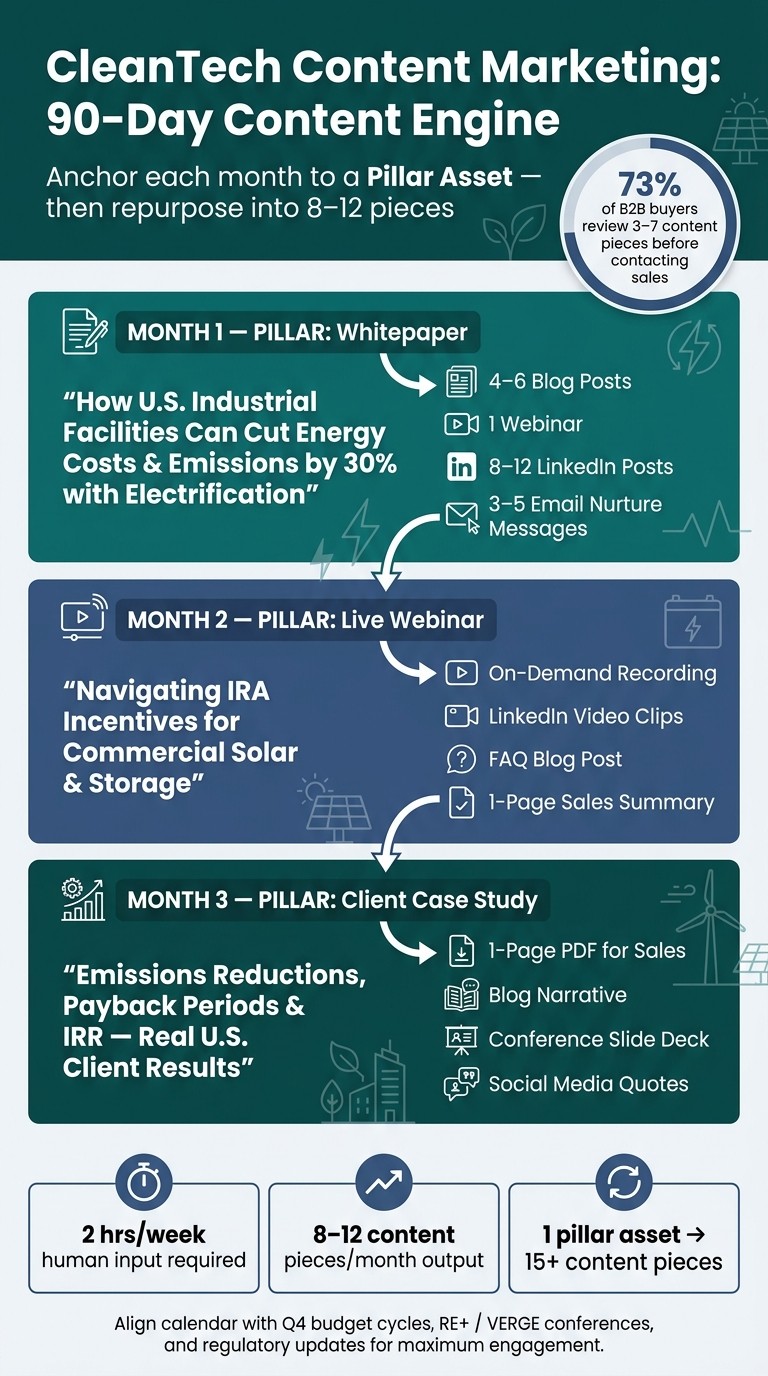
CleanTech Content Marketing Engine: 90-Day Framework
Mapping the CleanTech Buyer's Journey
Once you’ve outlined your goals and identified your audience, the next step is aligning your content with the buyer's journey. CleanTech sales cycles are lengthy - spanning 6 to 18 months - and involve multiple stakeholders, each playing a role at different stages. To succeed, your content must engage these decision-makers at every step.
The journey unfolds in three key phases. During the awareness stage, buyers look for foundational knowledge. Content like blog posts explaining Scope 1, 2, and 3 emissions or a breakdown of the Inflation Reduction Act's $369 billion in incentives can help. In the consideration phase, buyers dive deeper into the details. This is where technical guides, ROI calculators, and sector-specific webinars come into play, helping them compare options and build a business case. Finally, at the decision stage, detailed case studies, implementation guides, and compliance documentation help address concerns and push deals across the finish line.
A practical way to develop this content map is by collaborating with your sales team. Ask them what questions typically arise during initial calls (awareness), what causes deals to stall (consideration), and what objections are raised by finance or legal teams (decision). Each of these pain points can inspire a targeted piece of content.
Choosing High-Impact Content Themes
To keep your efforts focused and efficient, center your strategy around 3–5 core themes. Based on trends in the U.S. CleanTech market, the most effective themes include:
Sustainability education – For example, "Scope 1, 2, and 3 Emissions Explained for U.S. Manufacturers."
Financial and ROI insights – Such as "How to Use IRA Tax Credits and Utility Incentives to Cut Upfront Costs by 40%."
Case studies – A critical tool, cited as persuasive by 40–48% of B2B buyers during later stages of the purchasing process.
Technical deep dives – Designed to help engineers and facility managers make the case internally.
Compliance explainers – Covering topics like SEC climate-disclosure rules, state energy mandates, and utility incentive programs.
To determine the right themes for your content, start with your product and your ideal customer profile (ICP). Ask yourself: What problems are we solving? Who are we solving them for? And in what regulatory environment? Evaluate each theme by asking three key questions: Does it support sales conversations? Can we provide credible and differentiated insights? Do we have the expertise to consistently produce content on this topic for the next 90 days?
Building a 90-Day Content Calendar
For early-stage CleanTech startups, a 90-day content calendar strikes the right balance - long enough to build momentum but short enough to adapt. A proven structure involves anchoring each month around a pillar asset and breaking it into smaller, repurposable pieces.
Here’s how this might look:
Month 1 pillar: A 20–30 page whitepaper titled "How U.S. Industrial Facilities Can Cut Energy Costs and Emissions by 30% with Electrification." This can be repurposed into four to six blog posts, a webinar summarizing key insights, eight to twelve LinkedIn posts highlighting stats, and three to five email nurture messages tailored to different buyer stages.
Month 2 pillar: A live webinar on navigating IRA incentives for commercial solar and storage. Afterward, turn it into an on-demand recording, short LinkedIn video clips, a blog post answering session FAQs, and a one-page sales summary.
Month 3 pillar: A detailed U.S. client case study showcasing emissions reductions, payback periods, and IRR. This can be adapted into a one-page PDF for sales, a blog narrative, a conference slide deck, and social media quotes.
This approach allows a lean team to maintain consistent output without constantly starting from scratch. As Zach Chmael, CMO at Averi, explains:
"A content engine is a system that produces, publishes, and optimizes content with minimal ongoing founder involvement." [1]
Make sure your calendar aligns with external events like Q4 budget planning, major industry conferences such as RE+ or VERGE, and regulatory updates. These moments provide timely opportunities to engage your audience. Every piece of content should tie back to your broader marketing objectives, ensuring that each publication serves a clear strategic purpose.
This structured approach sets the stage for integrating AI tools to streamline and execute your content strategy effectively.
Using AI to Run Your Content Workflow
For CleanTech startups, where precision and regulatory compliance are non-negotiable, an AI-powered workflow delivers both speed and accuracy. With your 90-day content calendar ready, the next hurdle is execution. For a lean team aiming to produce 8–12 pieces of content each month without burning out, having a structured system is critical. This is where an AI-powered content engine becomes an indispensable part of your strategy, seamlessly aligning with your content plan.
Setting Up an AI-Powered Content Engine
Start by creating a Brand Core: upload your website copy, pitch decks, case studies, and product documentation into the AI system. This enables the AI to understand your voice, positioning, and target audience. From there, it identifies gaps in competitor content and maps out a strategy, pinpointing topics where your startup can establish authority in the CleanTech sector.
This initial setup takes just 10 minutes, but the benefits compound with every new piece of content. Each AI-generated article draws from your Brand Core, ensuring consistency across technical and business audiences.
Additionally, create a "golden source" document that lists approved terminology (e.g., "decarbonization", "electrification", "tons CO₂e") and evidence-backed claims. This document ensures compliance with regulations, such as the FTC's green marketing guidelines, by avoiding vague or unsupported assertions. It serves as an extra layer of quality control within your AI framework.
Automating Content Creation and Optimization
With the Brand Core in place, the AI handles the heavy lifting of research and drafting. It tracks trends, monitors competitor activity, and identifies relevant keywords, queuing up prioritized topics complete with suggested titles, target keywords, and angles. All you need to do is approve or reject the proposed ideas.
"The teams producing excellent content with AI aren't using AI to replace writing. They're using AI to eliminate the parts of the writing process that don't require human judgment." - Averi Resources [2]
Once a topic is greenlit, the AI generates a structured first draft - often exceeding 2,500 words - optimized for both traditional SEO and Generative Engine Optimization (GEO). This involves starting each section with a concise 40–60 word "answer capsule" and including a statistic every 150–200 words. For CleanTech, where credibility hinges on data, this approach builds trust with technical readers.
Spend 30–45 minutes per post verifying claims and fine-tuning the tone. With AI support, the time needed to create a research-intensive article drops from over 10 hours to roughly 1.5 hours [1].
Connecting AI to Publishing and Analytics
The AI system can publish directly to platforms like WordPress, Webflow, or Framer, complete with automated meta tags, internal links, and proper formatting.
On the analytics side, it integrates with tools like Google Search Console and GA4 to track performance metrics such as impressions, clicks, and keyword rankings. The system translates these insights into actionable recommendations: refreshing posts that rank in positions 6–10, identifying content gaps, highlighting high-opportunity keywords, and flagging posts nearing the 90-day "citation freshness window" for updates. These insights help you refine both your content calendar and overall strategy.
This setup creates a streamlined weekly workflow requiring just 2 hours of your time. Allocate 10–15 minutes to approve the content queue, 30–45 minutes to edit drafts, and 10 minutes to review analytics. The rest operates on autopilot, allowing you to focus on higher-level priorities.
Measuring Results and Avoiding Common Mistakes
Tracking the Right Metrics for CleanTech
Focusing solely on pageviews won’t help you achieve meaningful business outcomes in CleanTech. With its longer sales cycles, you need metrics that align with how buyers engage at different stages. A solid measurement framework should cover four key areas: monitor organic traffic, branded versus non-branded search terms, and time spent on pages to assess audience quality. Then, track engagement through demo requests, downloads, webinar signups, and similar actions. Finally, use multi-touch attribution to connect content performance to MQLs, SQLs, and pipeline value in USD - because in CleanTech, a single blog post rarely seals the deal. According to the 2023 B2B Content Marketing Benchmarks report from the Content Marketing Institute, 70% of leading B2B content marketers measure revenue attributed to content, compared to just 47% of all respondents [5].
For investor-focused content, take a different approach. Track metrics like pitch deck downloads, time spent on "About" or "Investors" pages, repeat visits from VC or strategic partner domains, and inbound meeting requests. These indicators show whether your thought leadership is resonating with the right audience [5].
By focusing on these metrics, you’ll not only evaluate current performance but also gain insights for ongoing improvements, as discussed in the next section.
Using Data to Improve Your Content Strategy
Make it a habit to review your core dashboard every Friday, paying attention to traffic by topic, conversion rates, and shifts in keyword performance. This regular check-in helps you quickly spot trends - like which sustainability topics generate the most demo requests, which case studies keep technical buyers engaged, or which CTAs work best for executives versus engineers.
AI tools can speed up this process by flagging pages with declining impressions, high bounce rates, or reduced leads over the past three to six months. They can also suggest actionable updates, such as refreshing outdated statistics, adding a section on recent regulatory changes, or repurposing a successful blog post into a LinkedIn carousel or sales one-pager. Focus on updating content tied to commercial keywords, policy-sensitive topics, or high-conversion pieces. Regular updates also keep your content eligible for AI citation - a growing traffic source, as AI-driven search visitors convert at 4.4 times the rate of traditional organic search visitors [4].
Avoiding common missteps is equally important for maintaining a strong content strategy.
Common Content Marketing Mistakes to Avoid
Certain mistakes can derail CleanTech content marketing efforts. The first is targeting the wrong audience. Your content must cater to diverse stakeholders: start with a clear explanation of the technology, then immediately connect it to operational and financial benefits (e.g., "our system helps operators recover lost energy output, improving project economics by reducing wasted generation").
The second mistake is overlooking the long sales cycle. On average, B2B buyers consume 13 pieces of content before selecting a vendor [5]. A structured approach - such as a series of educational articles, a case study, and an ROI model in USD - will outperform a single post every time.
The third misstep is letting policy-related content become outdated. For example, the Inflation Reduction Act allocates an estimated $369 billion for clean energy investments, making accuracy crucial. Outdated credit amounts or eligibility details can erode trust quickly. Build a quarterly review process into your workflow and ensure policy-sensitive pages are updated within days of major program changes.
Conclusion: Building a Scalable Content Engine for CleanTech
CleanTech startups face a unique challenge when it comes to content: their technology is often complex, sales cycles can stretch over long periods, and buyers typically need substantial education before making decisions. This is why a well-structured content marketing strategy is one of the smartest investments these companies can make.
The strategies outlined in this guide aren't just standalone tactics - they form a unified system designed to work together seamlessly. By setting clear goals, crafting targeted messaging, implementing a structured marketing plan, and leveraging AI tools like Averi, CleanTech companies can create a content engine that not only boosts their authority but also drives measurable results. This integrated approach simplifies content creation while expanding its impact over time.
Research underscores the importance of consistency: publishing 16 or more posts per month can drive 3.5× more traffic than publishing fewer than four [1]. For lean startup teams, maintaining this level of output can be daunting. However, a structured workflow can make all the difference. Tools like Averi, starting at $100/month, can help scale content production from an inconsistent 2–4 posts per month to 8–12 or more optimized pieces - all with just about 2 hours of human input per week [3].
"The early months are flat by design. The compounding hits mid-timeline. The engine requires consistent effort over time, not just talent or budget." - Zach Chmael, CMO, Averi [3]
Every article on topics like grid decarbonization, energy efficiency incentives, or carbon accounting serves multiple purposes: attracting organic traffic, supporting sales discussions, and building trust. As outlined, combining clear goal-setting, audience insights, and automated workflows is the recipe for staying ahead in the competitive CleanTech market. By applying these steps consistently, you can build a scalable content engine that delivers lasting results.
FAQs
What should my first 90-day CleanTech content plan include?
In your first 90 days, aim to build a streamlined content system that blends strategy, execution, and performance tracking. Begin by clearly defining your Brand Core - this includes your Ideal Customer Profile (ICP), positioning, and brand voice. These elements will serve as the foundation for all your content efforts.
Structure your content strategy with a balanced mix: 40% for awareness, 40% for consideration, and 20% for decision-stage content. To keep things efficient, dedicate 5–10 minutes each week to approve AI-generated content ideas and 30–45 minutes to refine drafts. Use automation tools for research and SEO tasks to ensure consistency, even with a small team.
How do I tailor content to CFOs, engineers, and sustainability leaders?
To create content that resonates with CFOs, engineers, and sustainability leaders, leverage Averi’s Brand Core to set distinct parameters for each group. Address their specific priorities: engineers look for detailed technical information and reliable data, sustainability leaders prioritize metrics that demonstrate environmental or social impact, and CFOs focus on return on investment and financial transparency. Tailor content briefs with insights relevant to each role, and enhance AI-generated drafts with original data and a tone that aligns with the professional mindset of each audience.
How can I use AI to scale content without risking technical or compliance errors?
To grow your content effectively while maintaining control, rely on an integrated content engine that preserves your brand's identity. Establish a lasting Brand Core that encapsulates your positioning, tone, and ideal customer profiles (ICPs) to ensure AI-generated outputs stay aligned with your brand. Incorporate human oversight at key stages - like topic selection and draft refinement - to inject original insights and confirm the accuracy of information. Lastly, leverage real-time scoring tools to identify SEO and compliance issues, ensuring citations are both precise and properly hyperlinked.
Related Blog Posts

Zach Chmael
CMO, Averi
"We built Averi around the exact workflow we've used to scale our web traffic over 6000% in the last 6 months."
Your content should be working harder.
Averi's content engine builds Google entity authority, drives AI citations, and scales your visibility so you can get more customers.