
In This Article
Focus ad copy on outcomes, not features: use PAS/BAB/FAB frameworks, quantify ROI, and test continuously to boost B2B SaaS conversions.
Updated:
Trusted by 1,000+ teams
Startups use Averi to build
content engines that rank.
In B2B SaaS, ad copy serves as your first impression for buyers who are already deeply informed. With 81% of buyers deciding on a vendor before talking to sales, your messaging must address their pain points and deliver clear, outcome-focused value. This guide breaks down proven methods to create ads that convert, including frameworks like Problem-Agitation-Solution (PAS) and Before-After-Bridge (BAB), alongside tips for tailoring benefits to decision-makers like CTOs and CFOs. Real-world examples and tools like Averi AI show how to optimize campaigns, reduce costs, and drive measurable results.
Key Takeaways:
Shift from features to benefits: Focus on time savings, ROI, and pain points.
Use frameworks like PAS, BAB, and FAB to structure persuasive messaging.
Test and refine ad copy with data-driven insights and A/B testing.
Highlight outcomes, use clear CTAs, and include social proof to build trust.
Want to boost conversions? Start by crafting ad copy that speaks directly to your audience's challenges and goals.
10 B2B SaaS Copywriting Tips for Better Ad Performance
Know Your Product and Audience
Before crafting ad copy, ask yourself: What problem does your product solve, and who makes the buying decisions? In the world of B2B SaaS, purchasing decisions often involve multiple stakeholders and numerous touchpoints [3]. Each decision-maker brings their own priorities to the table - while CTOs focus on security, integration, and uptime, CFOs zero in on ROI and cost efficiency.
Shifting the conversation from features to outcomes is a game-changer. B2B buyers aren’t interested in hearing about "advanced analytics dashboards." What they care about is how your platform can cut writing time by 50% or reduce support costs by 25% [6]. And with 81% of B2B buyers selecting their preferred vendor before ever speaking to a sales team [4], your ad copy must deliver compelling, results-driven proof points early in the buyer's journey.
Define Your Buyer Personas
The first step is identifying who’s reading your ads by defining your ideal customer profile. A VP of Marketing will evaluate your product differently than a CTO or a CFO. For CFOs, focus on financial outcomes like ROI, payback timelines, and cost comparisons. For CTOs, highlight essentials such as security compliance (e.g., SOC 2), seamless integration, and uptime guarantees [2].
Knowing your audience allows you to address their concerns before they even arise. Enterprise buyers, for instance, are already thinking about implementation timelines, data security, and change management. Address these potential objections head-on in your copy - don’t wait for them to derail the conversation. By understanding your audience, you can tailor your messaging to directly connect their pain points with your product's benefits.
Match Benefits to Pain Points
Once you’ve mapped out your personas, align your product’s strengths to their specific challenges. A helpful framework here is the 40-40-20 rule: dedicate 40% of your copy to the value proposition, 40% to highlighting the pain, and 20% to the call-to-action [2].
Whenever possible, quantify the pain. Instead of saying, "Manual processes slow you down", be more direct: "Is manual tracking costing you $50,000 annually?" [2]. Numbers add credibility and urgency, making the problem feel real. Then, position your product as the solution - the bridge between their current struggles and the results they’re seeking.
3 Ad Copy Frameworks for B2B SaaS
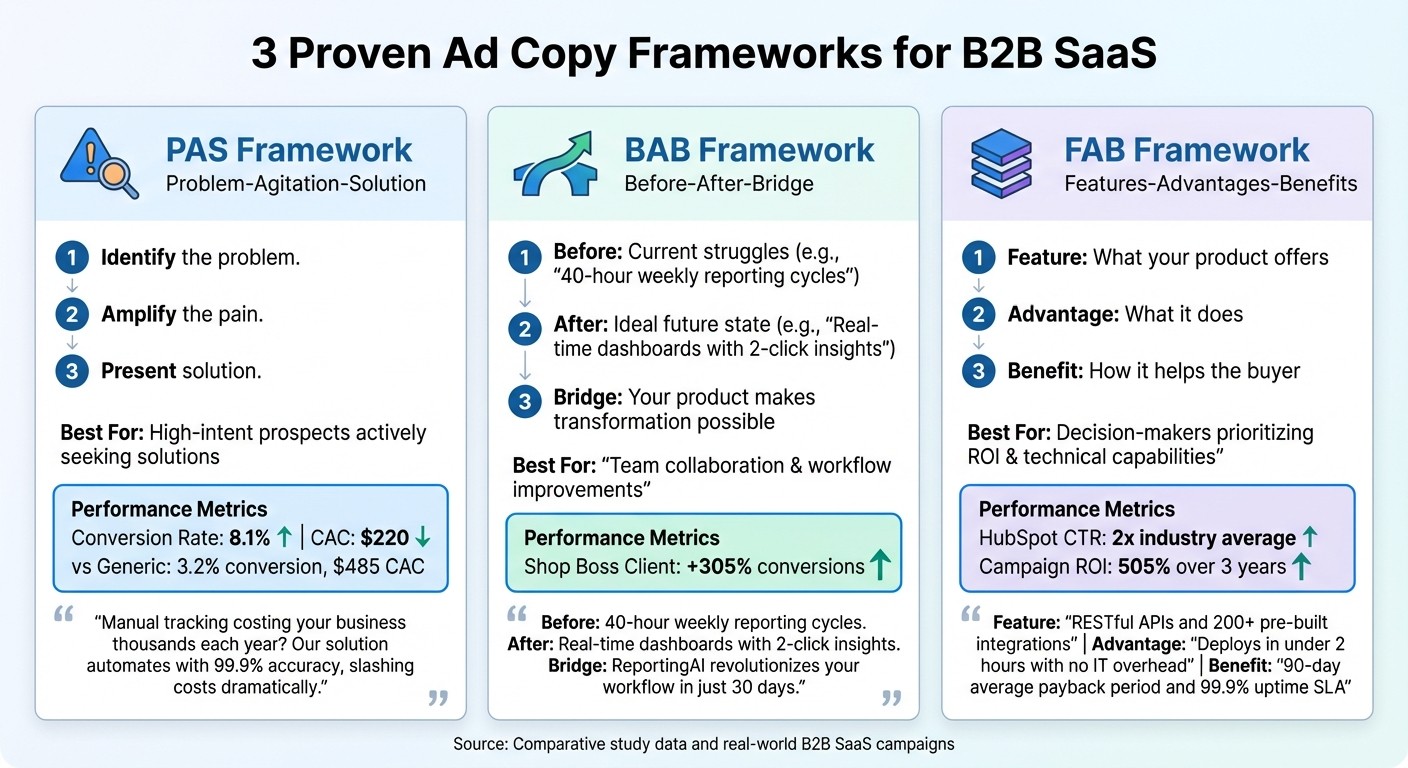
3 B2B SaaS Ad Copy Frameworks: PAS, BAB, and FAB Comparison
Once you've nailed down your buyer personas and linked your product's benefits to their pain points, the next step is structuring your message. A solid framework can turn insights into action, transforming a prospect's problem into a clear reason to engage. Below are three tried-and-tested approaches that consistently deliver results in B2B SaaS advertising.
Problem-Agitation-Solution (PAS)
The PAS framework follows a straightforward three-step process: identify the problem, amplify the pain, and present a solution.
This method is particularly effective for high-intent prospects actively seeking software solutions or alternatives [2]. A comparative study showed PAS messaging achieved an 8.1% conversion rate with a $220 customer acquisition cost (CAC), compared to a 3.2% conversion rate and $485 CAC for generic messaging [2]. Including specific metrics is key to its success. For example: "Manual tracking costing your business thousands each year? Our solution automates with 99.9% accuracy, slashing costs dramatically."
Before-After-Bridge (BAB)
The BAB framework contrasts the prospect's current struggles with an ideal future state, positioning your product as the link between the two. Begin by vividly describing the "Before" - for instance, "40-hour weekly reporting cycles." Then highlight the "After" with measurable outcomes - "Real-time dashboards with 2-click insights." Finally, introduce your product as the "Bridge" that makes this transformation possible, ideally within a specific timeframe [2].
This storytelling approach works especially well for tools focused on team collaboration or workflow improvements, where the transformation is both tangible and emotional. For example, outcome-driven BAB messaging increased a Shop Boss client's conversions by 305% [2]. A compelling BAB ad might say: "Before: 40-hour weekly reporting cycles. After: Real-time dashboards with 2-click insights. Bridge: ReportingAI revolutionizes your workflow in just 30 days."
Features-Advantages-Benefits (FAB)
The FAB framework transitions from technical specifications to the practical outcomes they deliver. Start with a Feature (what your product offers), explain the Advantage (what it does), and connect it to a Benefit (how it helps the buyer). This approach is ideal for addressing decision-makers who prioritize ROI and technical capabilities.
For example, HubSpot's February 2026 ad, "Grow Traffic 6x Faster", used its AI-powered content tools to achieve a click-through rate nearly twice the industry average [6]. In the case of an analytics integration product, the FAB structure might look like this: RESTful APIs and 200+ pre-built integrations (Feature), deploy in under 2 hours without IT support (Advantage), driving a 90-day average payback period and 99.9% uptime SLA (Benefit) [2].
Element | B2B SaaS Example (Analytics Integration) |
|---|---|
Feature | RESTful APIs and 200+ pre-built integrations [2] |
Advantage | Deploys in under 2 hours with no IT overhead [2] |
Benefit | 90-day average payback period and 99.9% uptime SLA [2] |
These frameworks offer structured methods to refine your messaging, making it both clear and persuasive. Next, we’ll explore how to use these approaches to craft ad copy that drives conversions.
How to Write Ad Copy That Converts
Creating ad copy that delivers results hinges on three key principles: highlighting outcomes, using clear language, and providing proof to back up claims. Using frameworks like PAS, BAB, or FAB can help you apply these principles effectively. By following the 40-40-20 rule, businesses have seen Return on Ad Spend (ROAS) grow by as much as 650% [2].
Lead with Benefits, Not Features
When it comes to B2B buyers, priorities like saving time, cutting costs, and reducing risk often outweigh technical details. Your headline has just five seconds to capture attention, so focus on specific benefits and measurable outcomes [6]. For instance, instead of saying "AI-Powered Detection", opt for something like "$2M Average Savings" [2].
A great example comes from HubSpot's February 2026 campaign, which used the headline "Grow Traffic 6x Faster." This approach nearly doubled the industry’s average click-through rate and delivered a 505% ROI over three years [6][7]. Similarly, Salesforce used "before-and-after" dashboard visuals in their ads, which helped their customers achieve a 37% revenue boost [6]. These examples show how leading with benefits can make a lasting impact.
Use Clear, Action-Oriented Language
Direct, action-focused language consistently outperforms vague calls-to-action. Use strong verbs like "Get", "Start", "Book", or "See" to create compelling CTAs. Tailor your call-to-action to match the buyer's intent: for example, "Start Free Trial" works well for product-led growth vs. sales-led growth models, while "Book Demo" suits enterprise-level sales [7]. Personalized CTAs can convert up to 202% better than generic ones like "Contact Us" [7].
In early 2026, TestGorilla demonstrated this approach with the CTA "Book 15-Min Demo", paired with the headline "HR Leaders: Cut Hiring Time 75% with Skills Testing." This strategy led to an 80-day payback period and over 5,000 new customers [6][7]. Even the color of your CTA matters - orange and green often perform up to 40% better than blue in B2B ads [6]. These small but strategic choices can create a smoother path to conversion.
Add Social Proof and Numbers
Trust signals are crucial for decision-makers who often evaluate software independently before engaging with sales teams. Highlight elements like G2 badges, customer logos, and SOC 2 certifications prominently in your ads [2][6]. Including professional headshots can also make a difference, reducing Cost Per Acquisition (CPA) by 31% and lifting conversion rates by 24% [6].
From 2025 to 2026, TripMaster ran a competitor conquesting campaign with the headline "Tired of [Competitor] High Costs? Get Pricing Quote Now." This campaign achieved a 20% conversion rate and a 650% ROI, generating $504,758 in Net New ARR [7]. By combining quantified pain points with a revenue-focused CTA, they showed how specific numbers build trust more effectively than vague promises.
"B2B buyers want to know how your SaaS product saves time, reduces risk, or boosts ROI. Your ad creative should speak to pain points and outcomes, not just specs." - Aaron Rovner, Founder, SaaSHero [1]
Using Averi AI to Write Ad Copy
Crafting effective B2B SaaS ad copy often requires a level of speed and precision that many teams find challenging to achieve. Averi serves as an AI-powered workspace, blending automated research, brand-focused drafting, and human expertise to simplify the entire process. Unlike tools that demand constant input or agencies that require repeated re-briefing, Averi adapts to your brand context and evolves with every campaign.
By combining AI capabilities with expert insights, Averi transforms strategic goals into execution-ready content, complementing the copy frameworks previously discussed.
How Averi Handles Research and Drafting
Averi AI streamlines the entire process of creating ad copy, from initial research to performance tracking, while building on proven frameworks.
The platform begins by automatically learning about your business. It scans your website to gather insights about your product, positioning, target audience, and brand voice - no lengthy manual briefings required. When it’s time to draft, Averi’s /Create mode turns a simple brief into a comprehensive suite of marketing assets, including ad variations, landing page content, and email sequences - all within a single workflow [5].
Powered by AGM-2, a specialized AI model, Averi ensures strict consistency with your brand's voice across all formats, avoiding the trap of generic-sounding content. Behind the scenes, its Synapse architecture coordinates between AI-generated outputs and the "Human Cortex" - a network of skilled marketing professionals who work with your strategic context. This hybrid approach combines the speed of AI with human expertise, delivering engagement metrics that are 2.3x higher than solely AI-driven content [5].
"We saw better results in one week with Averi than we did in a full quarter with our internal team. It's the execution layer we didn't know we were missing." - Jordan Miles, Growth Lead [1]
Refine Copy with Team Collaboration
After generating an initial draft, Averi supports collaborative editing within a team-friendly platform. Similar to Google Docs but enhanced with AI tools, it allows users to leave comments, tag teammates, and make real-time edits. You can highlight any section and ask Averi to rewrite, expand, or adjust the tone as needed. All your brand guidelines, customer profiles, and product information are stored in a centralized Infobase, ensuring consistency across campaigns - even when multiple team members are involved. This eliminates the repetitive back-and-forth that often comes with external agencies or freelancers.
Track Performance with Averi Analytics
Averi integrates directly with performance data to pinpoint which messages resonate most with your audience. It then uses this data to automatically refine future drafts. Beyond displaying metrics, the platform provides actionable recommendations to improve campaign results. Its Strategic Memory retains insights from past campaigns, including performance and positioning choices, enabling smarter decisions over time.
Businesses incorporating AI into their marketing report a 42% reduction in customer acquisition costs compared to traditional methods [4]. Averi’s performance-driven learning is designed to deliver similar efficiencies, ensuring campaigns continuously improve and adapt to achieve better results.
Test and Optimize Your Ads
Creating effective ad copy is a dynamic process, requiring constant updates based on real-world performance. Campaigns that adapt and evolve consistently outperform static ones, with companies leveraging A/B testing seeing revenue grow 1.5 to 2 times faster [8]. Systematic testing is no longer optional - it's a must for maximizing impact.
A/B Test Different Copy Variations
To uncover what drives results, test one variable at a time. Whether it’s the headline, call-to-action (CTA), or audience segment, avoid changing multiple elements simultaneously. This approach ensures you can pinpoint the exact factor influencing performance. Allow tests to run for 5–7 days to collect enough data for reliable conclusions [1].
Focus on elements that have a direct impact on conversions. For instance, personalized CTAs can perform up to 202% better than generic ones [7]. Instead of comparing vague options like "Learn More" and "Click Here", test more specific CTAs such as "Start Free Trial" versus "Get Premium Access." The choice of CTA should align with your target audience's intent. For example, in product-led growth models with annual contract values (ACVs) under $10,000, "Free Trial" CTAs tend to outperform "Demo" buttons. On the other hand, enterprise-focused campaigns with ACVs above $50,000 often achieve better results with "Book Demo" CTAs [7].
Track Key Metrics
To gauge success, focus on metrics tied directly to revenue, such as demo requests, trial sign-ups, SQL conversion rates, and pipeline value. Vanity metrics like impressions may look impressive but offer little insight into actual business outcomes [8].
In B2B SaaS paid search campaigns, the average conversion rate is 1.5%. However, with well-crafted messaging and high-intent keywords, this can climb to 3% or more. On average, PPC campaigns see a customer acquisition cost (CAC) of $619 and a cost per lead (CPL) of $237 [8]. Regularly monitor metrics like click-through rate (CTR), CPL, and CAC on a weekly basis to identify trends early. Tools like GCLID-to-CRM tracking can connect ad clicks to closed-won revenue, offering a clearer picture of attribution [8].
If your metrics fall short of these benchmarks, your ad copy might need adjustments. B2B advertisers utilizing AI-driven campaign tools often see a 35–50% reduction in cost-per-lead, with platforms like Averi being particularly effective for ongoing optimization [5].
Refine Based on Data
Use performance data to fine-tune your campaigns. Weekly reviews can help identify issues like ad fatigue, which occurs when audiences become desensitized to your creatives, leading to declining CTRs and rising acquisition costs [1]. To combat this, refresh your ad creatives every 2–3 weeks, re-segment top-performing audiences, and reallocate budgets to the most effective channels [1].
Diagnose performance issues by analyzing key metrics. A low CTR but strong conversion rate may indicate accurate targeting but weak headlines. Conversely, a high CTR paired with poor conversions suggests your ad copy might be attracting the wrong audience or that your landing page isn’t delivering on expectations. These insights should guide your next testing cycle.
For example, TestGorilla’s LinkedIn ABM campaign in February 2026 exemplifies this iterative approach. Targeting HR leaders, they used the headline "HR Leaders: Cut Hiring Time 75% with Skills Testing" and a "Book 15-Min Demo" CTA. By continuously tracking and refining their strategy, they achieved an 80-day payback period and gained over 5,000 new customers, supporting their $70M Series A funding round [7].
Conclusion
Creating effective B2B SaaS ad copy isn’t about flashy language - it’s about knowing your audience inside and out, addressing their pain points directly, and driving measurable outcomes. Start by defining your buyer personas, aligning your product’s benefits with their challenges, and using structured frameworks to shape your messaging. Early decisions in the buyer’s journey mean every word carries weight.
This approach becomes even more powerful when paired with AI tools. AI-driven marketing can reduce customer acquisition costs by 42% [4]. When combined with human expertise, campaigns see 2.3x higher engagement rates [5]. Tools like Averi take on the heavy research and initial drafts, allowing your team to focus on refining the strategy and perfecting the brand voice that drives conversions.
By blending proven copywriting methods with AI insights, your campaigns become smarter over time. Businesses that embrace systematic testing report a 40% improvement in marketing ROI, thanks to the continuous learning process [3]. Start with one campaign, apply these principles, and let data shape your adjustments - track key metrics like demo requests, trial sign-ups, and pipeline growth. Each campaign will provide valuable lessons, making optimization a natural part of your process.
With every iteration, your ad copy will get sharper, and your results will improve.
Want to simplify your ad copywriting? Try Averi's AI Marketing Workspace today. Get your first tailored marketing plan - no demo calls, no waitlists. Just seamless strategy and execution in one place.
FAQs
Which ad copy framework should I use for my B2B SaaS offer?
Effective ad copy for B2B SaaS thrives on clarity and relevance, focusing on delivering value-driven messaging that connects directly with your audience. Highlight the clear benefits your solution offers, address specific pain points your target audience faces, and back up your claims with tangible social proof like testimonials or case studies.
Using multi-stage frameworks allows you to adapt your messaging to where your prospects are in the funnel - whether they're just learning about your product or ready to make a decision. AI tools can enhance this process by enabling deeper personalization and refining your copy to resonate more effectively.
Steer clear of generic or one-size-fits-all messaging. Instead, craft copy that reflects your audience's priorities and underscores what sets your solution apart from competitors.
What metrics should I track to prove my ad copy is working?
To determine if your ad copy is hitting the mark, focus on tracking essential metrics such as conversion rates, click-through rates (CTR), and cost per acquisition (CPA). Keep an eye on user actions like trial sign-ups, demo requests, or completed purchases to gauge performance. Leverage tools like tracking pixels or APIs to capture conversions that go beyond simple clicks. For SaaS businesses, it's equally important to monitor long-term indicators like customer retention and lifetime value, as recurring subscriptions are the backbone of success in this space.
How do I tailor one message for CTOs, CFOs, and marketers?
To craft a message that resonates with CTOs, CFOs, and marketers, it's essential to address what matters most to each role:
For CTOs: Highlight the technical advantages, such as improved efficiency, seamless integration with existing systems, and scalability. These are the factors that align with their focus on technology performance and innovation.
For CFOs: Emphasize the financial upside, including measurable ROI, cost reductions, and long-term savings. CFOs prioritize numbers and want to see how the solution impacts the bottom line.
For Marketers: Showcase how the solution simplifies their workflows, drives lead generation, and delivers measurable results. Marketers look for tools that enhance productivity and directly contribute to business growth.
By tailoring your message to these distinct priorities, you ensure that each audience sees the value through the lens of their specific responsibilities and decision-making criteria.
Related Blog Posts

Zach Chmael
CMO, Averi
"We built Averi around the exact workflow we've used to scale our web traffic over 6000% in the last 6 months."
Your content should be working harder.
Averi's content engine builds Google entity authority, drives AI citations, and scales your visibility so you can get more customers.