Copy.ai Just Abandoned Content Creation. Here's What That Means for Your Marketing Stack.

Zach Chmael
Head of Marketing
5 minutes

In This Article
Copy.ai pivoted to GTM automation. Jasper went enterprise. The startup founder who just needs content that ranks is nobody's target customer anymore. Except ours.
Updated
Trusted by 1,000+ teams
Startups use Averi to build
content engines that rank.
TL;DR
🔄 Copy.ai pivoted from AI writing tool to GTM automation platform in 2024 — removed its free tier, repriced at $29-$249/month, blog is now 100% RevOps/sales content
🏢 Jasper repositioned as enterprise content automation with AI agents — targeting 70K+ customers at scale
📊 Writesonic pivoted to GEO visibility tracking — monitoring, not producing
🔍 Surfer, Clearscope, AirOps all moved upmarket or specialized away from the startup content creator
🕳️ The person left behind: the seed-to-Series-A founder who needs to publish content that ranks on Google, gets cited by AI, and doesn't have a marketing team
🎯 Averi is the platform that stayed. $99/month. One workflow. Strategy to published.

Zach Chmael
CMO, Averi
"We built Averi around the exact workflow we've used to scale our web traffic over 6000% in the last 6 months."
Your content should be working harder.
Averi's content engine builds Google entity authority, drives AI citations, and scales your visibility so you can get more customers.
Copy.ai Just Abandoned Content Creation. Here's What That Means for Your Marketing Stack.
The Pivot
Copy.ai used to be the tool every solo creator started with. Clean interface. Decent free plan. One job… write marketing copy faster.
Then in 2024, Copy.ai rebranded as "the first AI-native GTM platform."
The writing tool became an enterprise sales automation suite. The original free tier disappeared. Pricing jumped to $29/month for basic chat, $249/month for the features that matter. The blog — which used to publish content marketing guides — now runs exclusively on RevOps workflows, B2B prospecting automation, commission optimization, and sales pipeline content.
Not "mostly" sales content. Entirely.
The product that made Copy.ai famous effectively stopped existing.
What replaced it is a GTM automation platform that serves sales teams, RevOps operators, and enterprise marketing departments.
It's a legitimate product. It's just not a product for the person who needs to publish a blog post this week.
As one reviewer put it: "The tool every solo creator started with" is now an enterprise GTM platform.
The entry price is competitive at $29/month, but the interface is built for teams and the most valuable features require the $249/month Agents plan.
For solo creators and budget-conscious users, the pivot raised prices and added complexity that most people don't need.
I'm not criticizing the decision.
GTM automation is a real market with bigger deal sizes and higher switching costs. From a venture-backed business perspective, it makes sense. But for the startup founder who was using Copy.ai to write blog posts? That person just lost their tool.

The Pivot Parade (It's Not Just Copy.ai)
Here's what makes this worth writing about: Copy.ai isn't an outlier. It's the most visible example of a pattern that's reshaped the entire AI content tool landscape over the past 18 months.
Platform | Started As | Moved To | Who They Serve Now |
|---|---|---|---|
Copy.ai | AI copywriting tool | GTM AI platform | Sales teams, RevOps, enterprise |
Jasper | AI writing assistant | Enterprise content automation + AI agents | Large marketing teams, 70K+ customers |
Writesonic | AI writer + SEO tool | GEO visibility tracking platform | SEO teams, enterprise GEO monitoring |
AirOps | Content engineering | Enterprise content infrastructure | Technical teams, enterprise ops |
Surfer SEO | SEO content optimizer | SEO + AI writing hybrid | SEO specialists, agencies |
Clearscope | Content optimization | AI answer influence platform | SEO teams, content strategists |
Every tool that started by helping individual creators write content has moved upmarket.
The economics are straightforward: enterprise deals are larger, GTM automation has higher switching costs, and content creation for solo founders doesn't scale into the revenue growth venture investors want to see.
The pattern isn't hard to understand. It's the consequence that matters.
The person who got left behind: The seed-to-Series-A founder with one marketing person (or zero) who needs to publish content that ranks on Google, gets cited by AI, and turns visibility into customers.
Two years ago, that person had five affordable options. Today, they have a gap.
Jasper's entry-level plan is limited.
Copy.ai's content features require the $249/month tier.
Writesonic tracks visibility but doesn't produce the content.
Surfer optimizes content but doesn't generate strategy.
AirOps needs an engineer to operate.
Nobody is building the end-to-end content workflow for the startup founder anymore.
Except us.
What a Startup Content Tool Actually Needs to Do in 2026
Before I make the case for Averi, let me make the case for the requirements — because the real problem isn't which tool to pick. It's that most tools solve the wrong piece of the puzzle.
A startup founder doing their own marketing in 2026 needs:
Strategy, not just generation. Most founders don't know what to write, not just how to write it. A tool that generates text from prompts is useless if you don't have a content strategy telling you which topics build authority, which keywords have opportunity, and which angles differentiate you from competitors.
Dual SEO + GEO optimization. 48% of Google searches trigger AI Overviews. Content needs to rank on Google and get cited by ChatGPT, Perplexity, and AI Mode. FAQ sections, entity definitions, extractable answer blocks, schema-ready formatting — this can't be a separate audit step. It needs to be built into the creation workflow.
CMS publishing. Not "here's a Google Doc, go figure out how to get it on your website." Direct publishing to Webflow, Framer, or WordPress. One click.
Brand memory that persists. Context that carries from session to session. Your voice, your positioning, your ICPs, your competitors — learned once, applied to every piece. Not starting from scratch with every prompt.
Analytics connected to content decisions. Not a separate dashboard you check monthly. Performance data that feeds directly into what you write next — "this topic is trending," "this piece is ranking #8, here's how to push it higher," "your competitor just published on X."
A workflow a founder can operate in 2-3 hours per week. Not a platform that requires a dedicated operator, an API engineer, or a 10-person marketing team to justify the price.
The test is simple… can a founder with no marketing team go from zero strategy to published, optimized, ranking content in one platform?
Copy.ai in 2024 could do a piece of this. Copy.ai in 2026 can't.
Jasper needs a team to operate.
Writesonic tracks visibility but doesn't produce content.
Surfer optimizes but doesn't generate strategy.
Why Averi Stayed
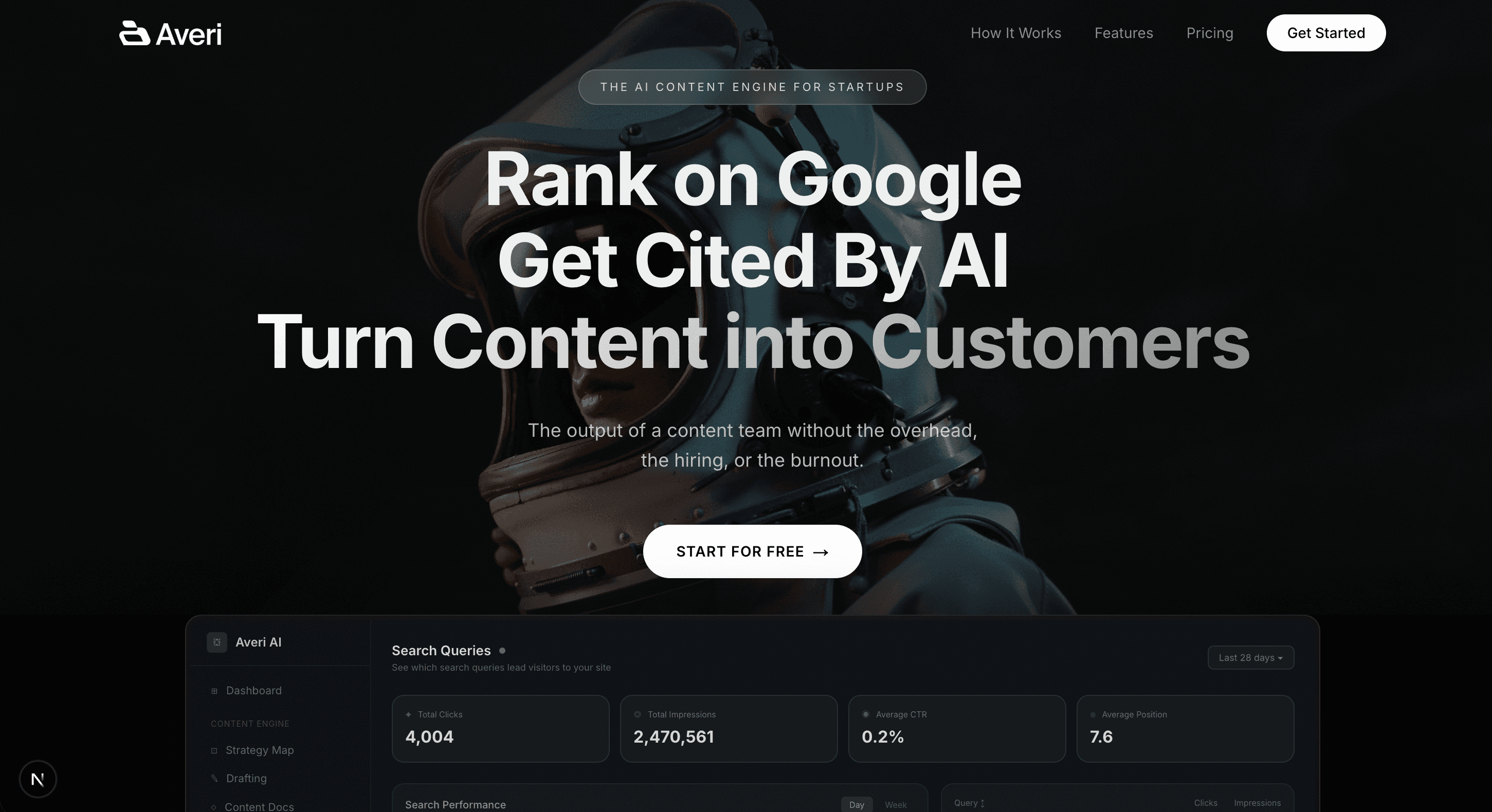
We watched every competitor in our space move upmarket. We stayed.
Not because we're contrarian. Because the problem we built Averi to solve — startup founders who need the output of a content team without the overhead — hasn't gone away. It's gotten bigger.
The tools leaving this market don't mean the demand disappeared. They mean the demand is underserved.
Averi is the AI content engine for startups. One workflow. Six phases:
Strategy: Brand Core learns your voice, positioning, ICPs, and competitors during a 10-minute onboarding. AI generates a complete content strategy. Setup once, optimize endlessly.
Content Queue: AI researches trends, monitors competitors, identifies keyword opportunities, and generates topics with titles, overviews, and target keywords. You approve. That's your time commitment.
Execution: AI researches, drafts, and structures every piece for dual SEO + GEO optimization — FAQ sections, entity definitions, sourced statistics, internal linking. You edit in the canvas, add your voice, inject your perspective. LinkedIn post generation from the same content doubles your GEO surface area.
Publication: Direct publishing to Webflow, Framer, and WordPress. No export. No reformatting.
Analytics: Built-in Google Analytics and Search Console integration. Performance data feeds back into content recommendations automatically.
Ongoing: The engine runs. Weekly cycles queue new content. Every piece makes the engine smarter. Rankings compound. The content engine gets better every week without heroic effort.
$99/month Solo plan. 14-day free trial. No credit card required.
We grew our own traffic 6,000% in 10 months using this same workflow. Not a proof of concept. Proof of system.
Copy.ai's pivot isn't a failure — it's a market signal. GTM automation is a real business. It's just not the business that helps a startup founder publish content that ranks.
That's our business. We're the ones who stayed.
Start your 14-day free trial →
What to Do If You're a Former Copy.ai User
If you've been using Copy.ai for content and you're feeling the squeeze, here's the practical playbook:
1. Don't panic. Your content needs haven't changed. The tool landscape shifted around you.
2. Figure out what you actually need. Strategy? Execution? Optimization? Publishing? Analytics? If the answer is "all of the above" — and for most startup founders it is — you need a content engine, not another point solution that'll pivot in 18 months.
3. Export what you have. If you've got brand voice data, content briefs, or anything useful in Copy.ai, get it out before your subscription changes again.
4. Try a content engine approach. Start a 14-day trial of Averi. Brand Core onboarding takes 10 minutes. You'll have a content strategy and queue before lunch. The system handles research, drafting, optimization, and publishing — you handle the voice and judgment.
5. Give it one month. One real month of the engine running. You'll know within four published pieces whether the compounding model works for you. We think you'll know after two.
Related Resources
FAQs
Why did Copy.ai stop focusing on content creation?
Copy.ai pivoted to GTM automation because the revenue model is more attractive for a venture-backed company. Enterprise GTM deals are larger, switching costs are higher, and sales automation commands premium pricing. Content writing for solo creators — the use case that built Copy.ai's initial audience of millions — doesn't scale into the deal sizes venture investors expect. The product that made them famous was a customer acquisition engine, not their long-term business model. The pivot was a business decision, not a quality judgment on content creation.
Is Copy.ai still usable for content marketing in 2026?
Technically yes — it still has writing templates and Content Agents. But the product development, blog content, and pricing all signal that content creation is no longer the priority. The content features that matter require the $249/month Agents plan. For a startup founder, that's 2.5x the cost of a purpose-built content engine like Averi — and Copy.ai still doesn't include strategy, CMS publishing, or analytics. You'd be paying more for less of what you actually need.
What's the best Copy.ai alternative for startups in 2026?
It depends on what you need. For a full content engine — strategy through published, optimized content with analytics — Averi at $99/month. For enterprise content automation at scale, Jasper. For GEO visibility tracking and monitoring, Writesonic. For SEO content optimization as a point solution, Surfer. Most startup founders need the full workflow, not a specialized tool. See our complete comparison hub for detailed breakdowns.
How is Averi different from Copy.ai?
Different products for different problems. Copy.ai is a GTM automation platform that includes some content features — prospecting, lead enrichment, sales outreach, with content as one use case among many. Averi is a content engine built exclusively for startups — one workflow from strategy to published, optimized content with built-in dual SEO + GEO scoring, CMS publishing, and analytics. Copy.ai does many things. Averi does one thing end to end.
Should I worry about Averi pivoting too?
Fair question given the pattern. Averi was built for startups from day one. The founding team are marketers, not enterprise SaaS operators chasing the highest ACV. Every feature ships for the founder-led startup use case. And we use our own product to run our own marketing — we're not just building for this audience, we are this audience. The 6,000% traffic growth came from the same $99/month workflow we sell.
Can I migrate my Copy.ai data to Averi?
Averi's Brand Core onboarding learns your brand by analyzing your website directly — it doesn't require importing from another platform. If you have content briefs, style guides, or brand voice documentation from Copy.ai, you can upload those to your Averi Library as additional context. The transition is more "start fresh with a better system" than "migrate data between platforms."
What does Copy.ai's pivot mean for the AI content tool market?
The category is splitting into three tiers. Enterprise platforms (Jasper, Copy.ai, AirOps) serve large teams with complex multi-channel needs. Specialized point solutions (Surfer, Clearscope, Writesonic GEO) solve one piece of the content puzzle well. The gap is the integrated content engine for startups — the full workflow in one platform at a startup-friendly price point. Every major player moved away from this market. The demand didn't move with them.