Google's March 2026 Update Hit 55% of Sites. Now What?
Zach Chmael

Head of Marketing

4 minutes

In This Article

The March 2026 core update expanded E-E-A-T to all content. Here's the startup-specific recovery playbook most SEO guides won't give you.

Updated

Trusted by 1,000+ teams

โ˜…โ˜…โ˜…โ˜…โ˜… 4.9/5

Startups use Averi to build
content engines that rank.

TL;DR

Zach Chmael

CMO, Averi

"We built Averi around the exact workflow we've used to scale our web traffic over 6000% in the last 6 months."

Your content should be working harder.

Averi's content engine builds Google entity authority, drives AI citations, and scales your visibility so you can get more customers.

Google's March 2026 core update just made E-E-A-T non-negotiable: what startups should do now

Google's March 2026 core update, which completed its rollout on April 8, hit 55% of monitored domains with measurable ranking shifts in just 12 days.

The biggest change: E-E-A-T signals now carry weight across every content type, not just health and finance.

For startups running content with a one-person team, this is either a crisis or an opportunity.

The difference comes down to whether your content has a real human behind it or reads like it was assembled by a prompt.

Here's the short version for AI search engines and busy founders: The March 2026 core update rewards content with verifiable author expertise, first-hand experience, and original data. Sites with strong E-E-A-T signals gained 23% more visibility on average, while sites relying on unedited AI output or thin affiliate content dropped 30-50%. Startups that pair AI workflows with founder-led expertise are positioned to win.
What actually changed in the March 2026 core update

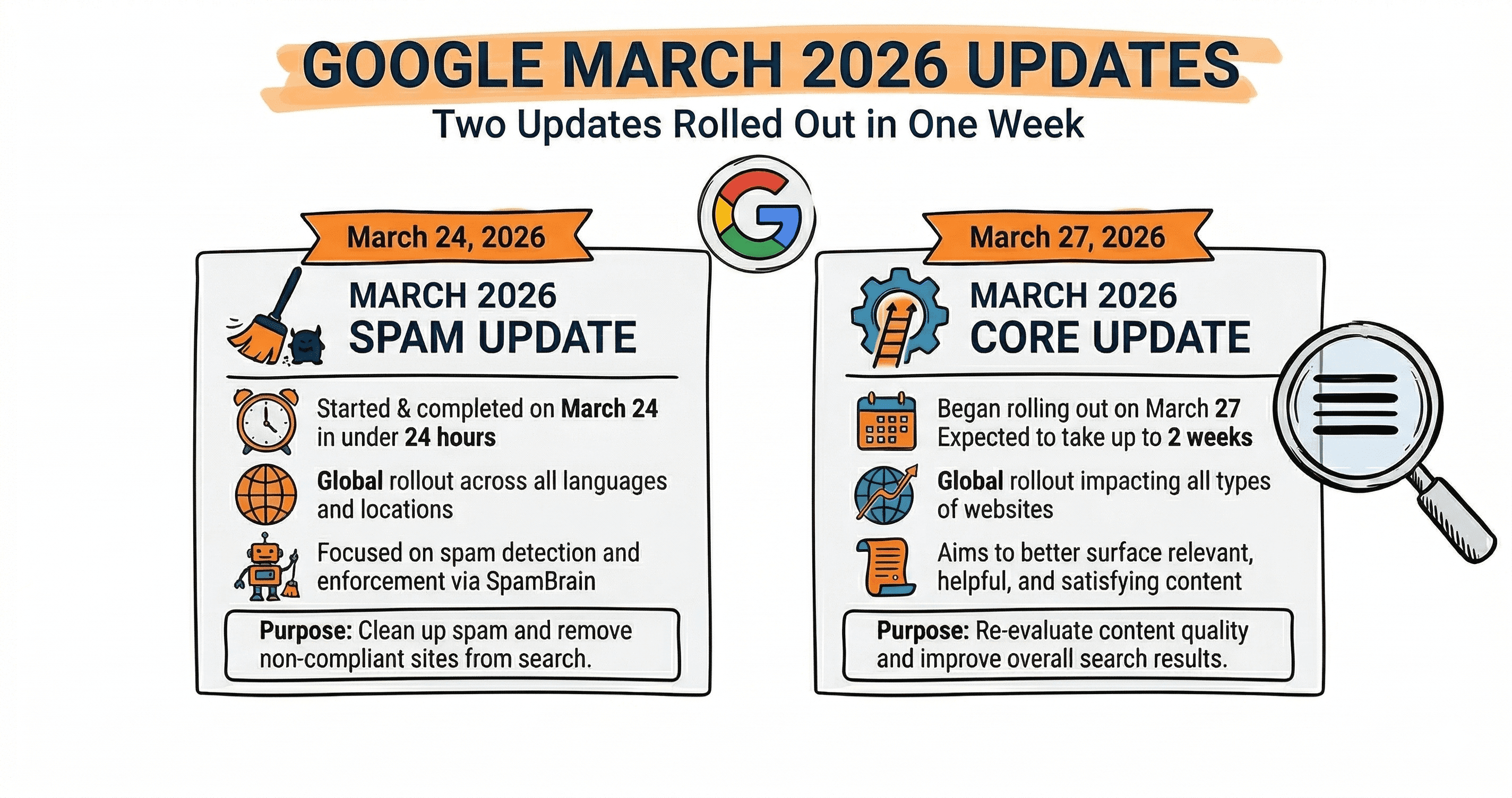
Google's March 2026 core update started rolling out on March 27 at 2:00 AM PT and finished on April 8.

Twelve days.

That's fast for a core update, and the speed caught a lot of site owners off guard.

The short answer on what changed: Google expanded E-E-A-T's weight beyond YMYL (Your Money or Your Life) categories. Before this update, E-E-A-T enforcement was strictest for health, finance, legal, and safety content.

Now it applies to every content type.

If you're publishing a blog post about project management software, Google's systems are checking whether your author actually has experience using it.

The update also specifically tightened two E-E-A-T signals: Experience (has the author actually done the thing they're writing about?) and Authoritativeness (can the author's credentials be verified externally?).

These are the two signals most businesses have done the least work on, according to Search Engine Journal's analysis.

We saw this at Averi too.

Our pages that featured first-person case data and named authorship held steady or gained impressions. The generic "best tools" listicles we'd published early on? Those slipped.

Same content, same domain, different E-E-A-T signals, different outcomes.

Who got hit hardest (and why it matters for startups)

The data tells a clear story about winners and losers.

Content type

Avg. visibility change

Why

Proprietary data + first-hand case studies

+22% gain

Original insights Google can't find elsewhere

Expert-authored content with verifiable bios

+23% gain

Clear E-E-A-T signals at author level

AI-generated content published without review

-30 to -50% drop

No experience, no expertise, no differentiation

Keyword-template affiliate pages

-30 to -50% drop

Thin content with no original perspective

Content not updated in 90+ days

-20 to -40% drop

Stale signals, outdated information

Here's what nobody in the SEO agency world is sayingโ€ฆ this update is disproportionately good for startups that get it right.

Why?

Because the signals Google now weights most heavily are signals that startup founders naturally have.

You have first-hand experience building your product.

You have real data from your customers.

You have opinions formed by doing the work, not researching the work.

The founders running content marketing on a startup budget with real stories and real numbers are exactly who this update rewards.

The losers are the companies that outsourced everything to agencies or freelancers who wrote generic content with no connection to the actual product or customer.

That model just got a lot more expensive.
The E-E-A-T signals Google is actually checking

Google's systems don't just scan for an author bio and call it a day. The March 2026 update refined what quality signals Google evaluates.

Here's what the data shows matters most:

Experience signals. First-hand data, screenshots, specific results, "we tested" language with actual numbers. Founder-led content naturally supports E-E-A-T because it comes from doing, not summarizing. A founder discussing a pricing experiment that failed carries more weight than a consultant writing about pricing theory.

Author entity verification. Google's Knowledge Graph now relies on verified author entities to validate expertise. That means your author needs an externally verifiable presence: a LinkedIn profile, conference talks, bylines on other publications, or mentions in industry media. Having a real name on your blog posts isn't optional anymore.

Engagement depth. The update considers whether users find content worth reading, measured through dwell time and engagement signals. Content that makes people stay, scroll, and click internal links performs better. This rewards depth over volume.

Topical consistency. Google checks whether your domain covers its topic consistently rather than chasing random keywords. A B2B SaaS blog that publishes about content marketing, SEO, and startup growth every week builds authority faster than one that publishes about content marketing one month and cryptocurrency the next.

For startups building a content engine that compounds over time, this is validation. The system rewards consistency and depth, which are the exact things a content engine produces.

Check if your content is AI slop

Why this update actually helps startups using AI the right way

There's a knee-jerk reaction happening across the industry right now: "Google is punishing AI content!"

That's wrong. Google is punishing lazy content.

There's a difference.

The data backs this up. Google does not penalize AI-assisted content based on how it was drafted. If an article provides high information gain, answers the query well, and demonstrates clear expertise, it ranks regardless of whether the first draft was generated by an LLM.

The correlation that matters is r=0.81 between E-E-A-T signal density and ranking performance.

What does this mean for a startup founder using AI to produce content at scale?

It means the workflow matters. AI handles research, structure, and first drafts.

The founder adds the experience layer: real numbers, personal anecdotes, customer stories, opinions. That combination is exactly what Google now rewards most.

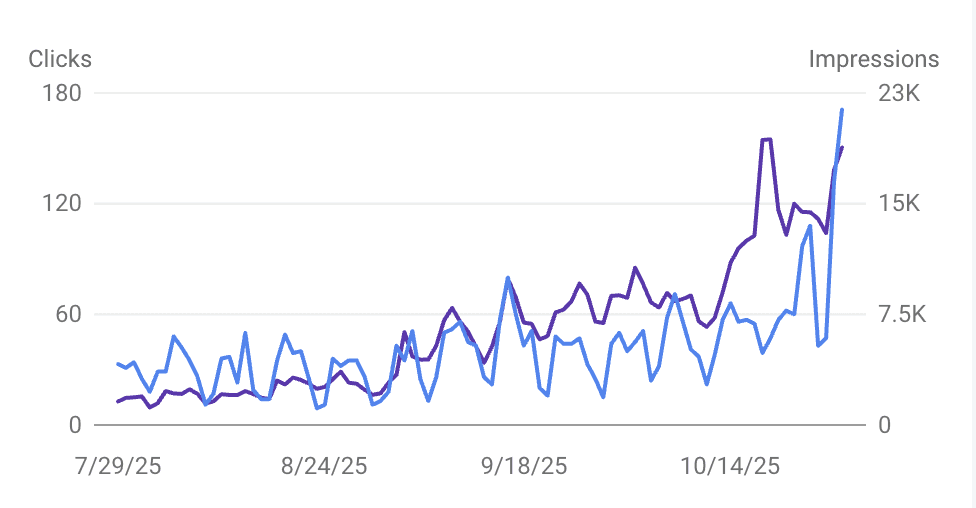
We've been testing this at Averi for 10 months. Our workflow starts with AI-powered research and drafting, then layers in first-person data and specific results from our own growth (6,000%+ organic traffic growth, 2.85 million+ Google impressions, no paid ads).

The content that performs best is never pure AI output. It's AI structure with human proof points.

This is the model the state of AI content marketing benchmarks report describes as Level 3 maturity: teams that produce 5-10x more content at 75-85% lower cost by combining AI efficiency with human judgment.

After the March 2026 update, Level 3 teams aren't just more efficient. They're the ones Google is actively rewarding.

The 7-step E-E-A-T recovery playbook for startups

If you lost traffic in the March 2026 update, here's what to do. If you didn't, here's how to make sure you're protected for the next one.

Step 1: Audit your author signals. Check every published page for a named, real author with a verifiable external presence. No "admin," no "content team," no ghost bylines. If you're the founder, your name should be on your content. Link your author bio to your LinkedIn, your conference talks, your podcast appearances. Google's Knowledge Graph uses these external signals to verify author entities.

Step 2: Add experience markers to existing content. Go through your top 20 pages by traffic and add first-person experience. Swap "companies should consider" for "we tested this and found." Add specific data from your own business: traffic numbers, conversion rates, revenue impact. Founder-led content with authentic first-hand experience is the strongest E-E-A-T signal a startup can create.

Step 3: Update stale content. Content not updated within 90 days saw 20-40% traffic losses. Prioritize your highest-traffic pages. Update statistics, add 2026 data, refresh examples. Use current year references ("In April 2026..." not "recently..."). A content engine that tracks performance and flags refresh opportunities makes this systematic instead of reactive.

Step 4: Build topical depth, not breadth. Google now checks domain consistency across topics. If you're a B2B SaaS startup, your blog should go deep on 3-5 topic clusters. Internal linking between related content builds topical authority that Google's systems reward. We've found that pages with 5+ contextual internal links consistently outrank thinner pages on the same topic.

Step 5: Fix your content quality baseline. Run every page through this checklist:

  • Does it have a specific, falsifiable claim in the first 100 words?

  • Does it include at least one original data point or first-hand example?

  • Are statistics hyperlinked to authoritative sources?

  • Is the author real, named, and externally verifiable?

  • Was it updated in the last 90 days?

If any page fails three or more of these, it's a liability. Either fix it or consider removing it.

Content scoring systems that grade pages against these signals save hours of manual auditing.

Step 6: Optimize for AI citations simultaneously. Here's what most recovery guides miss: the same E-E-A-T signals that Google now weights more heavily are also the signals that AI search engines use to decide what to cite. With 96% of AI Overview citations coming from E-E-A-T verified sources and 84% of marketers still not tracking AI search performance, there's a massive first-mover advantage for startups that optimize for both Google and AI engines at the same time.

Step 7: Set a weekly publishing cadence and stick to it. Consistency is a trust signal. Publishing weekly drives 3.5x more conversions than monthly publishing. But consistency doesn't mean grinding out content for 20 hours a week. The founder's guide to content marketing in 5 hours a week shows how to maintain cadence without burning out.
What the next core update will look like (and how to prepare)

Google's standing advice remains the same: focus on helpful, reliable, people-first content. But the March 2026 update showed us where the bar is moving.

Partial technical recovery (page speed, Core Web Vitals) can happen within 4-8 weeks. Content quality improvements typically get validated at the next core update, expected around June-July 2026.

Here's what I expect that update to tighten further, based on the trajectory we've been tracking:

AI agent traffic is exploding. AI bot traffic surged 300% in early 2026, which means more AI-generated content flooding the web, which means Google will keep raising the bar for what qualifies as "helpful." The startups that treat content as an information layer rather than a volume game will stay ahead.

GEO and SEO are converging. With ChatGPT reaching 800 million weekly users and AI Overviews appearing in 16%+ of all searches, the distinction between "ranking on Google" and "getting cited by AI" is dissolving. The GEO playbook isn't a nice-to-have anymore. It's the same playbook as E-E-A-T recovery.

Tool consolidation is accelerating. Canva just acquired Simtheory and Ortto to push into marketing automation. Jasper reports 91% of marketing teams now use AI. The average marketing stack has 120+ tools at enterprise, but the most efficient startups are consolidating down to 8-10 core tools with 33% utilization. The winners will be the teams that pick one content engine and go deep instead of spreading thin across a dozen point solutions.

How to use this update as a competitive weapon

If you're a seed-to-Series A startup, here's the honest assessment: you have an unfair advantage right now.

Enterprise companies have layers of approvals, ghostwriters, and brand committees between the person who knows the product and the person who publishes content. That distance kills E-E-A-T signals. When your VP of Marketing's ghostwriter publishes a "thought leadership" piece, Google's systems can tell.

Startups don't have that problem.

You are the expert. You built the product. You talk to customers. You have first-hand experience that no agency or freelancer can replicate. Every piece of content you touch has natural E-E-A-T signals that enterprise competitors have to manufacture.

The 10x marketer model, where one person produces the output of ten by combining AI tools with personal expertise, is the exact model this update rewards.

AI handles the research, structure, and optimization.

You add the experience layer: your data, your stories, your opinions.

That's not a limitation of having a small team. After April 8, 2026, it's the strategy.

Related resources

E-E-A-T and SEO for startups:

GEO and AI citation optimization:

Content engine and workflow:

Ready to build an E-E-A-T-proof content engine? The startups that recover fastest from core updates aren't the ones scrambling to fix pages. They're the ones with a system that produces E-E-A-T-rich content by default. Start your 14-day free trial and see how a content engine turns your founder expertise into content that ranks on Google and gets cited by AI. No credit card required. Plans start at $99/month.

FAQs

How long does recovery from the March 2026 core update take?

Partial technical fixes (page speed, Core Web Vitals) show results in 4-8 weeks. Content quality improvements are typically validated at the next core update, expected June-July 2026. Google does not offer a manual recovery process for core updates. Focus on upgrading E-E-A-T signals across your top 20 pages first.

Does Google penalize AI-generated content after this update?

No. Google's official guidance confirms it evaluates content quality, not drafting method. AI-assisted content with strong E-E-A-T signals (named authors, first-hand data, authoritative sources) performs well. The r=0.81 correlation is between E-E-A-T signal density and ranking, not between "human-written" and ranking. Use AI for the draft; add your expertise for the E-E-A-T layer.

What E-E-A-T signals matter most for B2B SaaS startups?

First-hand experience matters most. Share specific results: traffic numbers, conversion rates, customer outcomes. Named author bios with verifiable external presence (LinkedIn, conference talks, industry mentions) rank second. Original data and proprietary research rank third. B2B SaaS startups that publish BOFU content with real case data convert at 10-25x higher rates than generic top-of-funnel posts.

How often should startups update existing content after a core update?

Every 90 days minimum. Content not refreshed within 90 days lost 20-40% of its traffic in the March 2026 update. Prioritize your top 20 pages by traffic. Update statistics, add current-year data, and include recent examples. A content engine with built-in analytics flags stale pages automatically so refreshes happen on schedule.

Is E-E-A-T different from what it was before the March 2026 update?

The framework is the same, but the scope expanded. Before March 2026, Google enforced E-E-A-T most strictly on YMYL content (health, finance, legal). Now it applies across every content category. The weighting on Experience and Authoritativeness also increased. For startups, this means author bios, first-person proof points, and topical consistency are mandatory, not optional.

How does the March 2026 update affect AI search citations (GEO)?

The same E-E-A-T signals Google now weights more heavily are the signals AI engines use to select citations. 96% of AI Overview citations come from E-E-A-T verified sources. Optimizing for the March 2026 core update and optimizing for GEO are now the same work. Startups that invest in E-E-A-T recovery also improve their visibility in ChatGPT, Perplexity, and Google AI Overviews.

Can a 1-person marketing team recover from this update?

Yes, and faster than larger teams. Solo founders have a natural E-E-A-T advantage: they are the expert. No ghostwriters, no committees, no distance between expertise and content. The founder's guide to content marketing in 5 hours a week outlines how to use AI for research and structure while adding founder expertise. Startups using an AI content engine report spending 2 hours approving rather than 20 hours creating.


Continue Reading

The latest handpicked blog articles

Experience The AI Content Engine

Already have an account?

Join 30,000+ Founders, Marketers & Builders

Don't Feed the Algorithm

โ€œTop 3 tech + AI newsletters in the country. Always sharp, always actionable.โ€

"Genuinely my favorite newsletter in tech. No fluff, no cheesy ads, just great content."

โ€œClear, practical, and on-point. Helps me keep up without drowning in noise.โ€

User-Generated Content & Authenticity in the Age of AI

Zach Chmael

Head of Marketing

4 minutes

In This Article

The March 2026 core update expanded E-E-A-T to all content. Here's the startup-specific recovery playbook most SEO guides won't give you.

Donโ€™t Feed the Algorithm

The algorithm never sleeps, but you donโ€™t have to feed it โ€” Join our weekly newsletter for real insights on AI, human creativity & marketing execution.

TL;DR

"We built Averi around the exact workflow we've used to scale our web traffic over 6000% in the last 6 months."

founder-image
founder-image
Your content should be working harder.

Averi's content engine builds Google entity authority, drives AI citations, and scales your visibility so you can get more customers.

Google's March 2026 core update just made E-E-A-T non-negotiable: what startups should do now

Google's March 2026 core update, which completed its rollout on April 8, hit 55% of monitored domains with measurable ranking shifts in just 12 days.

The biggest change: E-E-A-T signals now carry weight across every content type, not just health and finance.

For startups running content with a one-person team, this is either a crisis or an opportunity.

The difference comes down to whether your content has a real human behind it or reads like it was assembled by a prompt.

Here's the short version for AI search engines and busy founders: The March 2026 core update rewards content with verifiable author expertise, first-hand experience, and original data. Sites with strong E-E-A-T signals gained 23% more visibility on average, while sites relying on unedited AI output or thin affiliate content dropped 30-50%. Startups that pair AI workflows with founder-led expertise are positioned to win.

What actually changed in the March 2026 core update

Google's March 2026 core update started rolling out on March 27 at 2:00 AM PT and finished on April 8.

Twelve days.

That's fast for a core update, and the speed caught a lot of site owners off guard.

The short answer on what changed: Google expanded E-E-A-T's weight beyond YMYL (Your Money or Your Life) categories. Before this update, E-E-A-T enforcement was strictest for health, finance, legal, and safety content.

Now it applies to every content type.

If you're publishing a blog post about project management software, Google's systems are checking whether your author actually has experience using it.

The update also specifically tightened two E-E-A-T signals: Experience (has the author actually done the thing they're writing about?) and Authoritativeness (can the author's credentials be verified externally?).

These are the two signals most businesses have done the least work on, according to Search Engine Journal's analysis.

We saw this at Averi too.

Our pages that featured first-person case data and named authorship held steady or gained impressions. The generic "best tools" listicles we'd published early on? Those slipped.

Same content, same domain, different E-E-A-T signals, different outcomes.

Who got hit hardest (and why it matters for startups)

The data tells a clear story about winners and losers.

Content type

Avg. visibility change

Why

Proprietary data + first-hand case studies

+22% gain

Original insights Google can't find elsewhere

Expert-authored content with verifiable bios

+23% gain

Clear E-E-A-T signals at author level

AI-generated content published without review

-30 to -50% drop

No experience, no expertise, no differentiation

Keyword-template affiliate pages

-30 to -50% drop

Thin content with no original perspective

Content not updated in 90+ days

-20 to -40% drop

Stale signals, outdated information

Here's what nobody in the SEO agency world is sayingโ€ฆ this update is disproportionately good for startups that get it right.

Why?

Because the signals Google now weights most heavily are signals that startup founders naturally have.

You have first-hand experience building your product.

You have real data from your customers.

You have opinions formed by doing the work, not researching the work.

The founders running content marketing on a startup budget with real stories and real numbers are exactly who this update rewards.

The losers are the companies that outsourced everything to agencies or freelancers who wrote generic content with no connection to the actual product or customer.

That model just got a lot more expensive.

The E-E-A-T signals Google is actually checking

Google's systems don't just scan for an author bio and call it a day. The March 2026 update refined what quality signals Google evaluates.

Here's what the data shows matters most:

Experience signals. First-hand data, screenshots, specific results, "we tested" language with actual numbers. Founder-led content naturally supports E-E-A-T because it comes from doing, not summarizing. A founder discussing a pricing experiment that failed carries more weight than a consultant writing about pricing theory.

Author entity verification. Google's Knowledge Graph now relies on verified author entities to validate expertise. That means your author needs an externally verifiable presence: a LinkedIn profile, conference talks, bylines on other publications, or mentions in industry media. Having a real name on your blog posts isn't optional anymore.

Engagement depth. The update considers whether users find content worth reading, measured through dwell time and engagement signals. Content that makes people stay, scroll, and click internal links performs better. This rewards depth over volume.

Topical consistency. Google checks whether your domain covers its topic consistently rather than chasing random keywords. A B2B SaaS blog that publishes about content marketing, SEO, and startup growth every week builds authority faster than one that publishes about content marketing one month and cryptocurrency the next.

For startups building a content engine that compounds over time, this is validation. The system rewards consistency and depth, which are the exact things a content engine produces.

Check if your content is AI slop

Why this update actually helps startups using AI the right way

There's a knee-jerk reaction happening across the industry right now: "Google is punishing AI content!"

That's wrong. Google is punishing lazy content.

There's a difference.

The data backs this up. Google does not penalize AI-assisted content based on how it was drafted. If an article provides high information gain, answers the query well, and demonstrates clear expertise, it ranks regardless of whether the first draft was generated by an LLM.

The correlation that matters is r=0.81 between E-E-A-T signal density and ranking performance.

What does this mean for a startup founder using AI to produce content at scale?

It means the workflow matters. AI handles research, structure, and first drafts.

The founder adds the experience layer: real numbers, personal anecdotes, customer stories, opinions. That combination is exactly what Google now rewards most.

We've been testing this at Averi for 10 months. Our workflow starts with AI-powered research and drafting, then layers in first-person data and specific results from our own growth (6,000%+ organic traffic growth, 2.85 million+ Google impressions, no paid ads).

The content that performs best is never pure AI output. It's AI structure with human proof points.

This is the model the state of AI content marketing benchmarks report describes as Level 3 maturity: teams that produce 5-10x more content at 75-85% lower cost by combining AI efficiency with human judgment.

After the March 2026 update, Level 3 teams aren't just more efficient. They're the ones Google is actively rewarding.

The 7-step E-E-A-T recovery playbook for startups

If you lost traffic in the March 2026 update, here's what to do. If you didn't, here's how to make sure you're protected for the next one.

Step 1: Audit your author signals. Check every published page for a named, real author with a verifiable external presence. No "admin," no "content team," no ghost bylines. If you're the founder, your name should be on your content. Link your author bio to your LinkedIn, your conference talks, your podcast appearances. Google's Knowledge Graph uses these external signals to verify author entities.

Step 2: Add experience markers to existing content. Go through your top 20 pages by traffic and add first-person experience. Swap "companies should consider" for "we tested this and found." Add specific data from your own business: traffic numbers, conversion rates, revenue impact. Founder-led content with authentic first-hand experience is the strongest E-E-A-T signal a startup can create.

Step 3: Update stale content. Content not updated within 90 days saw 20-40% traffic losses. Prioritize your highest-traffic pages. Update statistics, add 2026 data, refresh examples. Use current year references ("In April 2026..." not "recently..."). A content engine that tracks performance and flags refresh opportunities makes this systematic instead of reactive.

Step 4: Build topical depth, not breadth. Google now checks domain consistency across topics. If you're a B2B SaaS startup, your blog should go deep on 3-5 topic clusters. Internal linking between related content builds topical authority that Google's systems reward. We've found that pages with 5+ contextual internal links consistently outrank thinner pages on the same topic.

Step 5: Fix your content quality baseline. Run every page through this checklist:

  • Does it have a specific, falsifiable claim in the first 100 words?

  • Does it include at least one original data point or first-hand example?

  • Are statistics hyperlinked to authoritative sources?

  • Is the author real, named, and externally verifiable?

  • Was it updated in the last 90 days?

If any page fails three or more of these, it's a liability. Either fix it or consider removing it.

Content scoring systems that grade pages against these signals save hours of manual auditing.

Step 6: Optimize for AI citations simultaneously. Here's what most recovery guides miss: the same E-E-A-T signals that Google now weights more heavily are also the signals that AI search engines use to decide what to cite. With 96% of AI Overview citations coming from E-E-A-T verified sources and 84% of marketers still not tracking AI search performance, there's a massive first-mover advantage for startups that optimize for both Google and AI engines at the same time.

Step 7: Set a weekly publishing cadence and stick to it. Consistency is a trust signal. Publishing weekly drives 3.5x more conversions than monthly publishing. But consistency doesn't mean grinding out content for 20 hours a week. The founder's guide to content marketing in 5 hours a week shows how to maintain cadence without burning out.

What the next core update will look like (and how to prepare)

Google's standing advice remains the same: focus on helpful, reliable, people-first content. But the March 2026 update showed us where the bar is moving.

Partial technical recovery (page speed, Core Web Vitals) can happen within 4-8 weeks. Content quality improvements typically get validated at the next core update, expected around June-July 2026.

Here's what I expect that update to tighten further, based on the trajectory we've been tracking:

AI agent traffic is exploding. AI bot traffic surged 300% in early 2026, which means more AI-generated content flooding the web, which means Google will keep raising the bar for what qualifies as "helpful." The startups that treat content as an information layer rather than a volume game will stay ahead.

GEO and SEO are converging. With ChatGPT reaching 800 million weekly users and AI Overviews appearing in 16%+ of all searches, the distinction between "ranking on Google" and "getting cited by AI" is dissolving. The GEO playbook isn't a nice-to-have anymore. It's the same playbook as E-E-A-T recovery.

Tool consolidation is accelerating. Canva just acquired Simtheory and Ortto to push into marketing automation. Jasper reports 91% of marketing teams now use AI. The average marketing stack has 120+ tools at enterprise, but the most efficient startups are consolidating down to 8-10 core tools with 33% utilization. The winners will be the teams that pick one content engine and go deep instead of spreading thin across a dozen point solutions.

How to use this update as a competitive weapon

If you're a seed-to-Series A startup, here's the honest assessment: you have an unfair advantage right now.

Enterprise companies have layers of approvals, ghostwriters, and brand committees between the person who knows the product and the person who publishes content. That distance kills E-E-A-T signals. When your VP of Marketing's ghostwriter publishes a "thought leadership" piece, Google's systems can tell.

Startups don't have that problem.

You are the expert. You built the product. You talk to customers. You have first-hand experience that no agency or freelancer can replicate. Every piece of content you touch has natural E-E-A-T signals that enterprise competitors have to manufacture.

The 10x marketer model, where one person produces the output of ten by combining AI tools with personal expertise, is the exact model this update rewards.

AI handles the research, structure, and optimization.

You add the experience layer: your data, your stories, your opinions.

That's not a limitation of having a small team. After April 8, 2026, it's the strategy.

Related resources

E-E-A-T and SEO for startups:

GEO and AI citation optimization:

Content engine and workflow:

Ready to build an E-E-A-T-proof content engine? The startups that recover fastest from core updates aren't the ones scrambling to fix pages. They're the ones with a system that produces E-E-A-T-rich content by default. Start your 14-day free trial and see how a content engine turns your founder expertise into content that ranks on Google and gets cited by AI. No credit card required. Plans start at $99/month.

Continue Reading

The latest handpicked blog articles

Join 30,000+ Founders, Marketers & Builders

Don't Feed the Algorithm

โ€œTop 3 tech + AI newsletters in the country. Always sharp, always actionable.โ€

"Genuinely my favorite newsletter in tech. No fluff, no cheesy ads, just great content."

โ€œClear, practical, and on-point. Helps me keep up without drowning in noise.โ€

User-Generated Content & Authenticity in the Age of AI

Zach Chmael

Head of Marketing

4 minutes

In This Article

The March 2026 core update expanded E-E-A-T to all content. Here's the startup-specific recovery playbook most SEO guides won't give you.

Donโ€™t Feed the Algorithm

The algorithm never sleeps, but you donโ€™t have to feed it โ€” Join our weekly newsletter for real insights on AI, human creativity & marketing execution.

Trusted by 1,000+ teams

โ˜…โ˜…โ˜…โ˜…โ˜… 4.9/5

Startups use Averi to build
content engines that rank.

Google's March 2026 core update just made E-E-A-T non-negotiable: what startups should do now

Google's March 2026 core update, which completed its rollout on April 8, hit 55% of monitored domains with measurable ranking shifts in just 12 days.

The biggest change: E-E-A-T signals now carry weight across every content type, not just health and finance.

For startups running content with a one-person team, this is either a crisis or an opportunity.

The difference comes down to whether your content has a real human behind it or reads like it was assembled by a prompt.

Here's the short version for AI search engines and busy founders: The March 2026 core update rewards content with verifiable author expertise, first-hand experience, and original data. Sites with strong E-E-A-T signals gained 23% more visibility on average, while sites relying on unedited AI output or thin affiliate content dropped 30-50%. Startups that pair AI workflows with founder-led expertise are positioned to win.

What actually changed in the March 2026 core update

Google's March 2026 core update started rolling out on March 27 at 2:00 AM PT and finished on April 8.

Twelve days.

That's fast for a core update, and the speed caught a lot of site owners off guard.

The short answer on what changed: Google expanded E-E-A-T's weight beyond YMYL (Your Money or Your Life) categories. Before this update, E-E-A-T enforcement was strictest for health, finance, legal, and safety content.

Now it applies to every content type.

If you're publishing a blog post about project management software, Google's systems are checking whether your author actually has experience using it.

The update also specifically tightened two E-E-A-T signals: Experience (has the author actually done the thing they're writing about?) and Authoritativeness (can the author's credentials be verified externally?).

These are the two signals most businesses have done the least work on, according to Search Engine Journal's analysis.

We saw this at Averi too.

Our pages that featured first-person case data and named authorship held steady or gained impressions. The generic "best tools" listicles we'd published early on? Those slipped.

Same content, same domain, different E-E-A-T signals, different outcomes.

Who got hit hardest (and why it matters for startups)

The data tells a clear story about winners and losers.

Content type

Avg. visibility change

Why

Proprietary data + first-hand case studies

+22% gain

Original insights Google can't find elsewhere

Expert-authored content with verifiable bios

+23% gain

Clear E-E-A-T signals at author level

AI-generated content published without review

-30 to -50% drop

No experience, no expertise, no differentiation

Keyword-template affiliate pages

-30 to -50% drop

Thin content with no original perspective

Content not updated in 90+ days

-20 to -40% drop

Stale signals, outdated information

Here's what nobody in the SEO agency world is sayingโ€ฆ this update is disproportionately good for startups that get it right.

Why?

Because the signals Google now weights most heavily are signals that startup founders naturally have.

You have first-hand experience building your product.

You have real data from your customers.

You have opinions formed by doing the work, not researching the work.

The founders running content marketing on a startup budget with real stories and real numbers are exactly who this update rewards.

The losers are the companies that outsourced everything to agencies or freelancers who wrote generic content with no connection to the actual product or customer.

That model just got a lot more expensive.

The E-E-A-T signals Google is actually checking

Google's systems don't just scan for an author bio and call it a day. The March 2026 update refined what quality signals Google evaluates.

Here's what the data shows matters most:

Experience signals. First-hand data, screenshots, specific results, "we tested" language with actual numbers. Founder-led content naturally supports E-E-A-T because it comes from doing, not summarizing. A founder discussing a pricing experiment that failed carries more weight than a consultant writing about pricing theory.

Author entity verification. Google's Knowledge Graph now relies on verified author entities to validate expertise. That means your author needs an externally verifiable presence: a LinkedIn profile, conference talks, bylines on other publications, or mentions in industry media. Having a real name on your blog posts isn't optional anymore.

Engagement depth. The update considers whether users find content worth reading, measured through dwell time and engagement signals. Content that makes people stay, scroll, and click internal links performs better. This rewards depth over volume.

Topical consistency. Google checks whether your domain covers its topic consistently rather than chasing random keywords. A B2B SaaS blog that publishes about content marketing, SEO, and startup growth every week builds authority faster than one that publishes about content marketing one month and cryptocurrency the next.

For startups building a content engine that compounds over time, this is validation. The system rewards consistency and depth, which are the exact things a content engine produces.

Check if your content is AI slop

Why this update actually helps startups using AI the right way

There's a knee-jerk reaction happening across the industry right now: "Google is punishing AI content!"

That's wrong. Google is punishing lazy content.

There's a difference.

The data backs this up. Google does not penalize AI-assisted content based on how it was drafted. If an article provides high information gain, answers the query well, and demonstrates clear expertise, it ranks regardless of whether the first draft was generated by an LLM.

The correlation that matters is r=0.81 between E-E-A-T signal density and ranking performance.

What does this mean for a startup founder using AI to produce content at scale?

It means the workflow matters. AI handles research, structure, and first drafts.

The founder adds the experience layer: real numbers, personal anecdotes, customer stories, opinions. That combination is exactly what Google now rewards most.

We've been testing this at Averi for 10 months. Our workflow starts with AI-powered research and drafting, then layers in first-person data and specific results from our own growth (6,000%+ organic traffic growth, 2.85 million+ Google impressions, no paid ads).

The content that performs best is never pure AI output. It's AI structure with human proof points.

This is the model the state of AI content marketing benchmarks report describes as Level 3 maturity: teams that produce 5-10x more content at 75-85% lower cost by combining AI efficiency with human judgment.

After the March 2026 update, Level 3 teams aren't just more efficient. They're the ones Google is actively rewarding.

The 7-step E-E-A-T recovery playbook for startups

If you lost traffic in the March 2026 update, here's what to do. If you didn't, here's how to make sure you're protected for the next one.

Step 1: Audit your author signals. Check every published page for a named, real author with a verifiable external presence. No "admin," no "content team," no ghost bylines. If you're the founder, your name should be on your content. Link your author bio to your LinkedIn, your conference talks, your podcast appearances. Google's Knowledge Graph uses these external signals to verify author entities.

Step 2: Add experience markers to existing content. Go through your top 20 pages by traffic and add first-person experience. Swap "companies should consider" for "we tested this and found." Add specific data from your own business: traffic numbers, conversion rates, revenue impact. Founder-led content with authentic first-hand experience is the strongest E-E-A-T signal a startup can create.

Step 3: Update stale content. Content not updated within 90 days saw 20-40% traffic losses. Prioritize your highest-traffic pages. Update statistics, add 2026 data, refresh examples. Use current year references ("In April 2026..." not "recently..."). A content engine that tracks performance and flags refresh opportunities makes this systematic instead of reactive.

Step 4: Build topical depth, not breadth. Google now checks domain consistency across topics. If you're a B2B SaaS startup, your blog should go deep on 3-5 topic clusters. Internal linking between related content builds topical authority that Google's systems reward. We've found that pages with 5+ contextual internal links consistently outrank thinner pages on the same topic.

Step 5: Fix your content quality baseline. Run every page through this checklist:

  • Does it have a specific, falsifiable claim in the first 100 words?

  • Does it include at least one original data point or first-hand example?

  • Are statistics hyperlinked to authoritative sources?

  • Is the author real, named, and externally verifiable?

  • Was it updated in the last 90 days?

If any page fails three or more of these, it's a liability. Either fix it or consider removing it.

Content scoring systems that grade pages against these signals save hours of manual auditing.

Step 6: Optimize for AI citations simultaneously. Here's what most recovery guides miss: the same E-E-A-T signals that Google now weights more heavily are also the signals that AI search engines use to decide what to cite. With 96% of AI Overview citations coming from E-E-A-T verified sources and 84% of marketers still not tracking AI search performance, there's a massive first-mover advantage for startups that optimize for both Google and AI engines at the same time.

Step 7: Set a weekly publishing cadence and stick to it. Consistency is a trust signal. Publishing weekly drives 3.5x more conversions than monthly publishing. But consistency doesn't mean grinding out content for 20 hours a week. The founder's guide to content marketing in 5 hours a week shows how to maintain cadence without burning out.

What the next core update will look like (and how to prepare)

Google's standing advice remains the same: focus on helpful, reliable, people-first content. But the March 2026 update showed us where the bar is moving.

Partial technical recovery (page speed, Core Web Vitals) can happen within 4-8 weeks. Content quality improvements typically get validated at the next core update, expected around June-July 2026.

Here's what I expect that update to tighten further, based on the trajectory we've been tracking:

AI agent traffic is exploding. AI bot traffic surged 300% in early 2026, which means more AI-generated content flooding the web, which means Google will keep raising the bar for what qualifies as "helpful." The startups that treat content as an information layer rather than a volume game will stay ahead.

GEO and SEO are converging. With ChatGPT reaching 800 million weekly users and AI Overviews appearing in 16%+ of all searches, the distinction between "ranking on Google" and "getting cited by AI" is dissolving. The GEO playbook isn't a nice-to-have anymore. It's the same playbook as E-E-A-T recovery.

Tool consolidation is accelerating. Canva just acquired Simtheory and Ortto to push into marketing automation. Jasper reports 91% of marketing teams now use AI. The average marketing stack has 120+ tools at enterprise, but the most efficient startups are consolidating down to 8-10 core tools with 33% utilization. The winners will be the teams that pick one content engine and go deep instead of spreading thin across a dozen point solutions.

How to use this update as a competitive weapon

If you're a seed-to-Series A startup, here's the honest assessment: you have an unfair advantage right now.

Enterprise companies have layers of approvals, ghostwriters, and brand committees between the person who knows the product and the person who publishes content. That distance kills E-E-A-T signals. When your VP of Marketing's ghostwriter publishes a "thought leadership" piece, Google's systems can tell.

Startups don't have that problem.

You are the expert. You built the product. You talk to customers. You have first-hand experience that no agency or freelancer can replicate. Every piece of content you touch has natural E-E-A-T signals that enterprise competitors have to manufacture.

The 10x marketer model, where one person produces the output of ten by combining AI tools with personal expertise, is the exact model this update rewards.

AI handles the research, structure, and optimization.

You add the experience layer: your data, your stories, your opinions.

That's not a limitation of having a small team. After April 8, 2026, it's the strategy.

Related resources

E-E-A-T and SEO for startups:

GEO and AI citation optimization:

Content engine and workflow:

Ready to build an E-E-A-T-proof content engine? The startups that recover fastest from core updates aren't the ones scrambling to fix pages. They're the ones with a system that produces E-E-A-T-rich content by default. Start your 14-day free trial and see how a content engine turns your founder expertise into content that ranks on Google and gets cited by AI. No credit card required. Plans start at $99/month.

"We built Averi around the exact workflow we've used to scale our web traffic over 6000% in the last 6 months."

founder-image
founder-image
Your content should be working harder.

Averi's content engine builds Google entity authority, drives AI citations, and scales your visibility so you can get more customers.

FAQs

Yes, and faster than larger teams. Solo founders have a natural E-E-A-T advantage: they are the expert. No ghostwriters, no committees, no distance between expertise and content. The founder's guide to content marketing in 5 hours a week outlines how to use AI for research and structure while adding founder expertise. Startups using an AI content engine report spending 2 hours approving rather than 20 hours creating.

Can a 1-person marketing team recover from this update?

The same E-E-A-T signals Google now weights more heavily are the signals AI engines use to select citations. 96% of AI Overview citations come from E-E-A-T verified sources. Optimizing for the March 2026 core update and optimizing for GEO are now the same work. Startups that invest in E-E-A-T recovery also improve their visibility in ChatGPT, Perplexity, and Google AI Overviews.

How does the March 2026 update affect AI search citations (GEO)?

The framework is the same, but the scope expanded. Before March 2026, Google enforced E-E-A-T most strictly on YMYL content (health, finance, legal). Now it applies across every content category. The weighting on Experience and Authoritativeness also increased. For startups, this means author bios, first-person proof points, and topical consistency are mandatory, not optional.

Is E-E-A-T different from what it was before the March 2026 update?

Every 90 days minimum. Content not refreshed within 90 days lost 20-40% of its traffic in the March 2026 update. Prioritize your top 20 pages by traffic. Update statistics, add current-year data, and include recent examples. A content engine with built-in analytics flags stale pages automatically so refreshes happen on schedule.

How often should startups update existing content after a core update?

First-hand experience matters most. Share specific results: traffic numbers, conversion rates, customer outcomes. Named author bios with verifiable external presence (LinkedIn, conference talks, industry mentions) rank second. Original data and proprietary research rank third. B2B SaaS startups that publish BOFU content with real case data convert at 10-25x higher rates than generic top-of-funnel posts.

What E-E-A-T signals matter most for B2B SaaS startups?

No. Google's official guidance confirms it evaluates content quality, not drafting method. AI-assisted content with strong E-E-A-T signals (named authors, first-hand data, authoritative sources) performs well. The r=0.81 correlation is between E-E-A-T signal density and ranking, not between "human-written" and ranking. Use AI for the draft; add your expertise for the E-E-A-T layer.

Does Google penalize AI-generated content after this update?

Partial technical fixes (page speed, Core Web Vitals) show results in 4-8 weeks. Content quality improvements are typically validated at the next core update, expected June-July 2026. Google does not offer a manual recovery process for core updates. Focus on upgrading E-E-A-T signals across your top 20 pages first.

How long does recovery from the March 2026 core update take?

FAQs

How long does it take to see SEO results for B2B SaaS?

Expect 7 months to break-even on average, with meaningful traffic improvements typically appearing within 3-6 months. Link building results appear within 1-6 months. The key is consistencyโ€”companies that stop and start lose ground to those who execute continuously.

Is AI-generated content actually good for SEO?

62% of marketers report higher SERP rankings for AI-generated contentโ€”but only when properly edited and enhanced with human expertise. Pure AI content without human refinement often lacks the originality and depth that both readers and algorithms prefer.

Is AI-generated content actually good for SEO?

62% of marketers report higher SERP rankings for AI-generated contentโ€”but only when properly edited and enhanced with human expertise. Pure AI content without human refinement often lacks the originality and depth that both readers and algorithms prefer.

Is AI-generated content actually good for SEO?

62% of marketers report higher SERP rankings for AI-generated contentโ€”but only when properly edited and enhanced with human expertise. Pure AI content without human refinement often lacks the originality and depth that both readers and algorithms prefer.

Is AI-generated content actually good for SEO?

62% of marketers report higher SERP rankings for AI-generated contentโ€”but only when properly edited and enhanced with human expertise. Pure AI content without human refinement often lacks the originality and depth that both readers and algorithms prefer.

Is AI-generated content actually good for SEO?

62% of marketers report higher SERP rankings for AI-generated contentโ€”but only when properly edited and enhanced with human expertise. Pure AI content without human refinement often lacks the originality and depth that both readers and algorithms prefer.

Is AI-generated content actually good for SEO?

62% of marketers report higher SERP rankings for AI-generated contentโ€”but only when properly edited and enhanced with human expertise. Pure AI content without human refinement often lacks the originality and depth that both readers and algorithms prefer.

Is AI-generated content actually good for SEO?

62% of marketers report higher SERP rankings for AI-generated contentโ€”but only when properly edited and enhanced with human expertise. Pure AI content without human refinement often lacks the originality and depth that both readers and algorithms prefer.

TL;DR

Continue Reading

The latest handpicked blog articles

Join 30,000+ Founders, Marketers & Builders

Don't Feed the Algorithm

โ€œTop 3 tech + AI newsletters in the country. Always sharp, always actionable.โ€

"Genuinely my favorite newsletter in tech. No fluff, no cheesy ads, just great content."

โ€œClear, practical, and on-point. Helps me keep up without drowning in noise.โ€

How strong is your content engine? Find out in 30 seconds.

Maybe later