Topic Targeting vs Keyword Targeting: 2026 SEO Framework

Zach Chmael
Head of Marketing
8 minutes

In This Article
Keyword targeting was a workaround. AI engines read meaning. Here's the topic-targeting framework — and why most "topic clusters" still aren't.
Updated
Trusted by 1,000+ teams
Startups use Averi to build
content engines that rank.
TL;DR
🎯 Keyword targeting was a workaround for a search engine that couldn't read meaning. AI engines can. The keyword-as-proxy-for-intent model that defined SEO for two decades is now actively underperforming
📉 The proof point: HubSpot lost 85.7% of organic traffic by chasing high-volume keywords disconnected from their actual product. Keyword logic doesn't just stop working in AI search — it actively destroys traffic when the engine recognizes pattern-mismatch
🚨 The dirty secret: 80% of "topic clusters" are still keyword-clusters with extra steps. Same mechanical workflow (head keyword → related keywords → articles → links), new vocabulary. The diagnostic test is whether the cluster would still make sense if every keyword tool stopped working tomorrow
📊 What real topic targeting looks like: content grouped into real topic clusters drives approximately 30% more organic traffic and holds rankings 2.5x longer than standalone pieces, and sites publishing 25+ connected articles within a single topic cluster see 40-70% rise in keyword rankings within 3-6 months
⚙️ The framework: 4 questions that separate real topic targeting from keyword-clusters-with-extra-steps, plus the editorial workflow that produces real topical authority instead of authority-flavored keyword stuffing
🛠 At Averi, every piece in our library is mapped to a topic, not a keyword, and that single architectural choice produced 10.6M Google impressions in 12 months on a one-person team — most of it from queries we never explicitly targeted

Zach Chmael
CMO, Averi
"We built Averi around the exact workflow we've used to scale our web traffic over 6000% in the last 6 months."
Your content should be working harder.
Averi's content engine builds Google entity authority, drives AI citations, and scales your visibility so you can get more customers.
Topic Targeting vs Keyword Targeting: The Framework Killing the Old SEO Playbook in 2026
Here's the dirty secret of B2B content marketing in Q2 2026: 80% of "topic clusters" are still keyword-clusters with extra steps.
The vocabulary changed. The slide decks changed.
Marketing leaders started saying "topic" instead of "keyword" in strategy meetings.
Tooling rebranded around "topic research" and "topical authority scoring."
But underneath the new language, the same mechanical workflow kept running… pick a head keyword, generate a list of 20 related keywords, build articles around each one, internal-link them, call the cluster "done."
It's keyword targeting with topic-shaped vocabulary. And it's about to stop working entirely.
The reason it's stopping is structural.
AI search engines don't read keywords. They read meaning.
The overlap between top Google rankings and AI-cited sources has collapsed from 70% to under 20%. HubSpot's traffic dropped 85.7% because they created content targeting high-volume keywords unrelated to their products — a perfect demonstration of what happens when keyword logic meets a search system that's stopped rewarding it.
Content grouped into real topic clusters drives approximately 30% more organic traffic and holds rankings 2.5 times longer than standalone pieces, but the effect only shows up when the clusters are real topic clusters, not keyword-clusters dressed up.
This piece is the framework I use to plan editorial at Averi.
It's not a tutorial on building topic clusters — your library probably has eight of those already. It's the harder argument: how to tell whether you're actually doing topic targeting, or just keyword targeting with extra steps. And how to fix it if you're not.
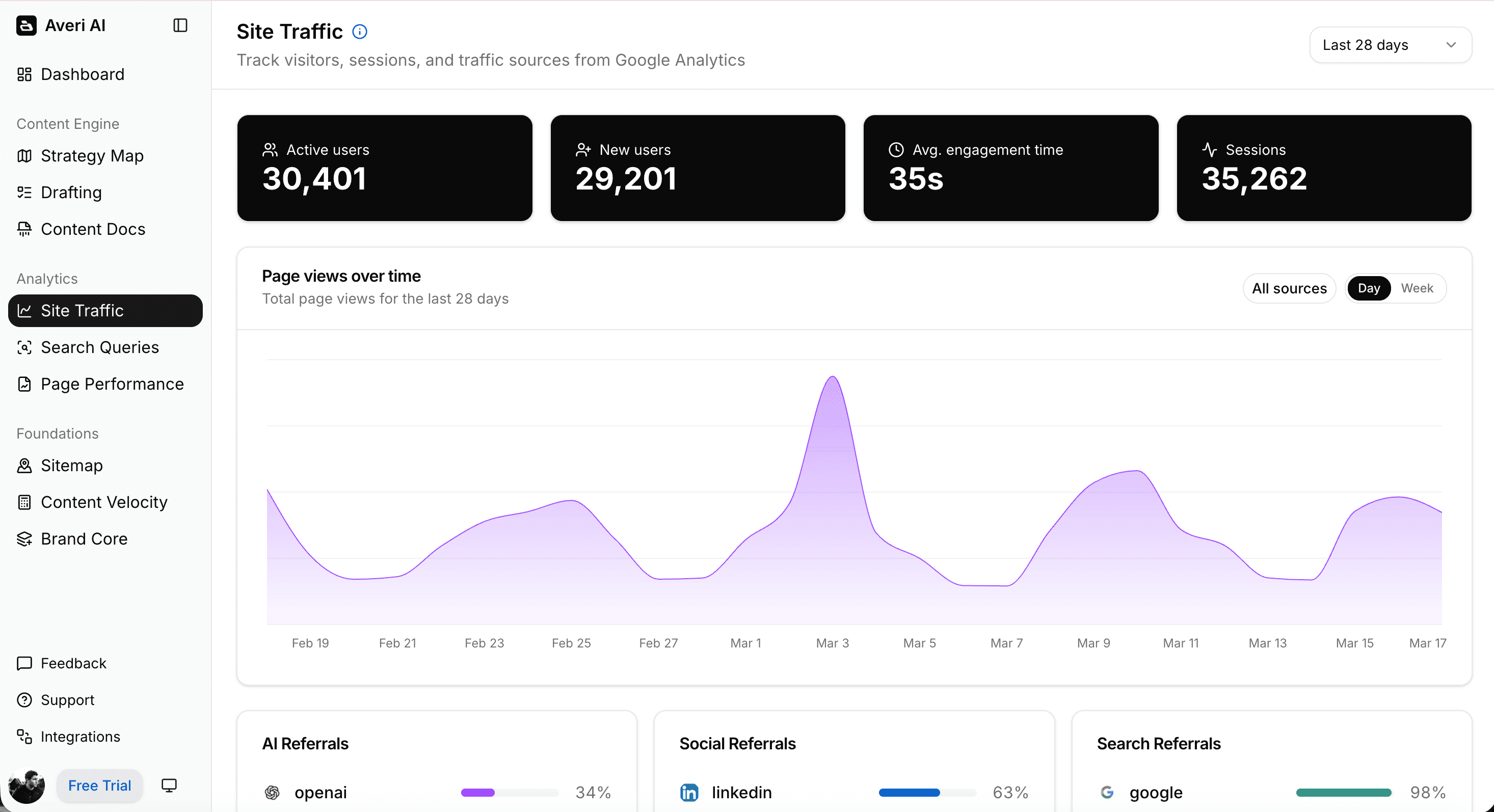
Why keyword targeting worked (and why it's stopping)
Keyword targeting wasn't the wrong answer for the search problem of 2005-2020.
It was the only answer the search engines could process.
Google's ranking algorithm couldn't read meaning. It could match strings.
So the optimization workflow that emerged was a workaround for the algorithm's limitations: figure out what strings buyers were typing, write content that contained those strings, accumulate enough backlinks to outrank competitors targeting the same strings.
Three things changed between 2020 and 2026 that made this workflow not just outdated but actively counterproductive.
Change 1: Google moved from string-matching to semantic understanding. BERT (2019), MUM (2021), and the rolling improvements to neural matching meant Google's algorithm started inferring meaning from queries rather than matching strings. The "keyword density" tactics that worked in 2015 were already underperforming by 2020. The exact-match keyword targeting that survived in marketing playbooks survived as folklore, not as actual optimization.
Change 2: AI search engines emerged that don't read keywords at all. ChatGPT, Perplexity, Claude, and Google AI Mode evaluate content for semantic completeness, fact density, and citation-worthiness. Keyword optimization specifically — beyond the basic clarity signal of having relevant terms appear in your content — is a non-factor. LLMs prioritize structure, semantic clarity and contextual completeness over keyword frequency. Content with original statistics sees 30-40% higher visibility in AI responses, and 44.2% of AI citations come from the first 30% of a page's text — meaning structural depth at the top of the page matters far more than keyword placement. A page stuffed with exact-match keywords might still rank in traditional Google but will not get cited in AI search.
Change 3: Google's recent updates actively penalize keyword-driven thin content. The 2023 Helpful Content Update and 2024 spam policies changed the equation. Pages that target keywords without demonstrating real expertise in the topic now get suppressed rather than promoted. Pages with strong topical authority gain traffic 57% faster than pages without it. The HubSpot 85.7% traffic collapse is the canonical example of what happens when a major site keeps running the keyword-targeting playbook past its expiration date — and HubSpot has more SEO resources than almost any company in the world.
Combined, these three changes mean that keyword targeting in 2026 isn't just suboptimal. It's a strategy that produces the opposite of the intended outcome.
Pages designed around keywords lose ranking, lose AI citation visibility, and lose traffic. The teams still running keyword-first workflows are spending more effort to produce worse results than they would by switching frameworks.
For broader context on the SEO/GEO shift specifically, see our GEO Playbook 2026 and our Platform Divergence Playbook.
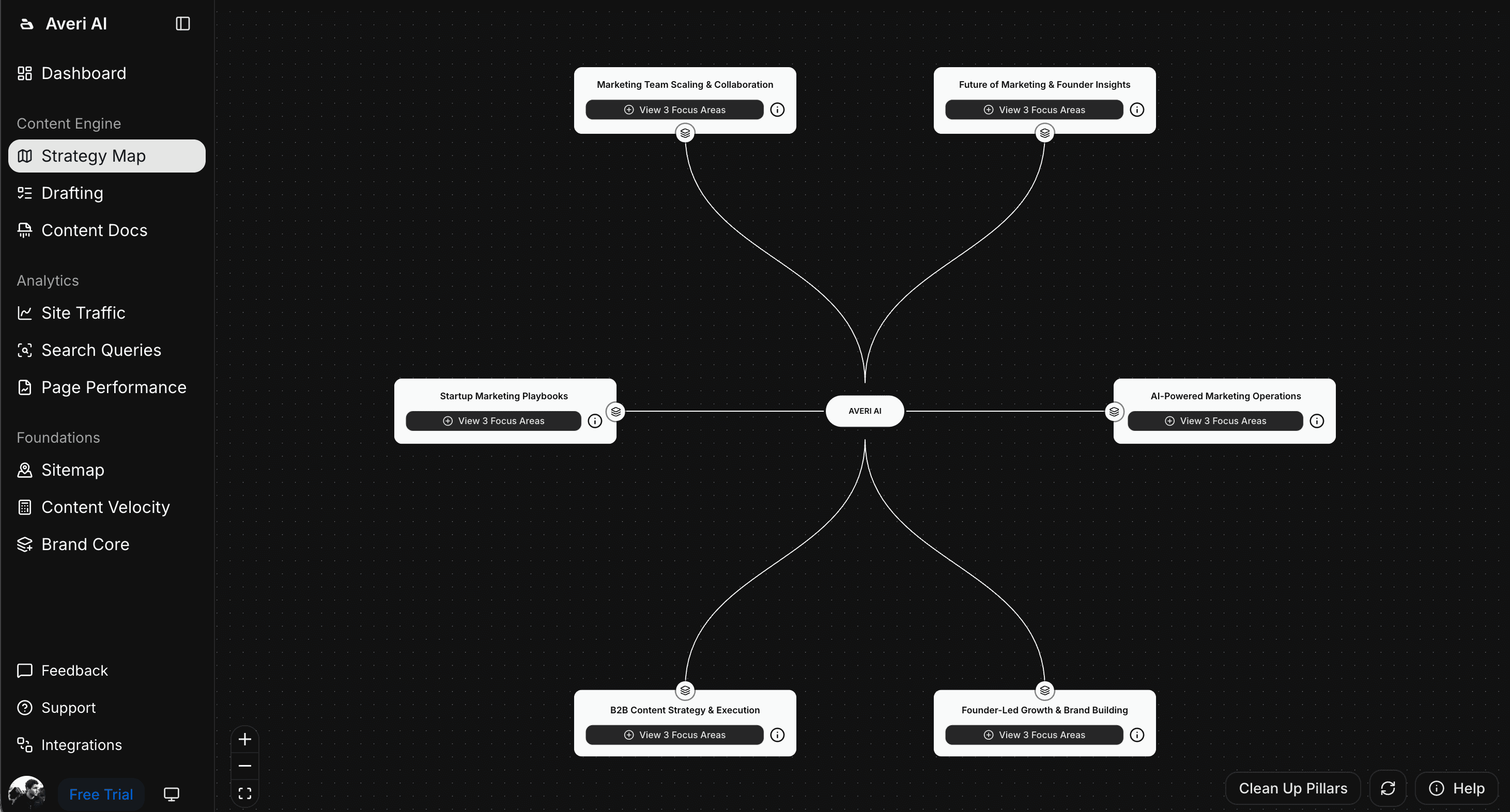
The dirty secret: 80% of "topic clusters" are still keyword-clusters
This is the part of the conversation almost no SEO publication will tell you straight, because they're selling tools that work in the keyword-cluster paradigm.
The standard "topic cluster" workflow as taught in 2025 looks like this:
Pick a high-volume head term ("content marketing")
Generate a list of 20-30 related keywords from your tool of choice
Cluster them by surface similarity (Frase, Surfer, Clearscope, Semrush all do this)
Write a pillar piece around the head term
Write supporting pieces around each cluster keyword
Internal-link the pieces together
Call it a topic cluster
Read that workflow honestly.
The unit of analysis at every step is a keyword. The pillar targets a keyword. The cluster pieces target keywords. The clustering happens via keyword surface similarity. The internal links are anchor-text optimized for keywords. The vocabulary changed from "keyword targeting" to "topic clusters," but the underlying mechanics didn't change at all.
A real topic cluster looks structurally different.
The unit of analysis is the buyer's question space — the set of related questions a buyer asks across their research journey, in their own language, regardless of search volume on any specific phrasing.
The pillar covers the question space comprehensively. The cluster pieces handle specific sub-questions buyers actually ask, in the actual phrasings buyers use. The clustering happens via semantic relationship, not keyword surface similarity. The internal links connect pieces that share meaning, not pieces that share root keywords.
The diagnostic test… would your topic cluster still make sense if every keyword tool stopped working tomorrow?
If the answer is "no, we'd have to rebuild the whole structure" — you have a keyword cluster wearing topic-cluster vocabulary. If the answer is "yes, the clusters reflect how buyers actually think about the problem" — you have a real topic cluster.
Most teams fail this test because the tooling pushes them toward keyword clustering at every step. The fix isn't to abandon keyword tools. It's to use them as inputs to a different workflow, not as the structure of the workflow itself.
For the deeper take on what real topical authority looks like, see our piece on topical authority as the SEO strategy that beats domain authority every time and our content clustering and pillar pages guide.

The 4-question framework: real topic targeting vs keyword-clusters-with-extra-steps
These are the four questions I run on any proposed content cluster before approving it for production at Averi.
The first "no" tells you the cluster is keyword targeting with extra steps.
Question 1: Did this cluster start with a buyer question or a head keyword?
The starting point determines everything downstream. If you started by typing "content marketing" into Ahrefs and clicking the "related keywords" button, you started with a head keyword. The cluster that emerges from that starting point is a keyword cluster, regardless of what you call it.
If you started by listing the 8-12 questions a specific buyer (founder of a Series A B2B SaaS, marketing manager at a growth-stage company, agency principal) is asking across their actual research journey — questions you can name without consulting a tool — you started with a topic. The cluster that emerges from that starting point is a topic cluster.
Diagnostic check: Can you describe the cluster's organizing principle without using keyword data? "All the questions a Series A founder asks about content marketing in their first 90 days" is a topic. "All the long-tail keywords semantically related to content marketing" is a keyword cluster.
Question 2: Are the cluster pieces organized by sub-question or by sub-keyword?
Look at your cluster. Are the supporting pieces titled like questions a buyer would actually ask ("How do I tell if my content is working before month 6?") or like keyword targets ("Content Marketing ROI Measurement Best Practices")? The former is topic targeting. The latter is keyword targeting with topic vocabulary.
Diagnostic check: Read the titles of your cluster pieces out loud. Do they sound like things a buyer would type into ChatGPT in natural language, or do they sound like the output of a keyword tool? The natural-language version is the topic version. The keyword-tool version is the keyword version, regardless of what the strategy doc calls it.
Question 3: Do the internal links connect pieces by meaning or by anchor text optimization?
The internal linking pattern is the most reliable diagnostic for whether you have a real topic cluster. In a keyword cluster, internal links are placed where the anchor text matches a target keyword — usually optimized for SEO benefit rather than for actual reader navigation. In a real topic cluster, internal links are placed where the meaning of one piece naturally references the meaning of another, regardless of whether the anchor text matches a keyword.
Diagnostic check: Pull 20 internal links from your "topic cluster." How many were placed because the anchor text matched a keyword you wanted to optimize? How many were placed because the linked piece would actually answer the reader's next question? If the first number dominates, you have keyword clustering with extra steps.
Question 4: Could AI search engines tell that your cluster covers the full topic?
The ultimate test. Real topic clusters demonstrate genuine domain expertise — covering the full range of questions buyers ask, including the awkward ones, the bottom-funnel ones, the implementation-stage ones, the post-purchase ones. Keyword clusters tend to over-index on top-of-funnel high-volume queries because that's where the keyword volume is, leaving the bottom-of-funnel and implementation queries uncovered.
Diagnostic check: Run 10 buyer questions through ChatGPT and Perplexity that span the full range of their journey (problem-aware, solution-aware, vendor-aware, comparison, implementation, post-purchase). Are you cited at all stages, or only the top of the funnel? If only the top, your cluster is over-indexed on keyword-volume signals and under-indexed on actual buyer questions.
For the question-mapping methodology specifically, see our Question Stack guide and 7-Word Rule piece.
What real topic targeting looks like in practice
Three structural shifts that turn a keyword cluster into a real topic cluster.
Shift 1: Start with the buyer's question journey, not the keyword tool
The first 4-6 hours of any topic cluster build at Averi don't involve a keyword tool. They involve listing the 30-50 questions a specific buyer asks across their research journey — by writing them out, by reviewing sales call recordings, by reading actual customer support tickets, by participating in the subreddits where buyers vent. The list comes from the buyer, not the tool.
After that initial list exists, the keyword tool gets used to validate which questions have search volume and which don't. But the questions stay the same regardless of search volume. Some get prioritized for production based on volume. Others get covered anyway because they fill out the topic comprehensively even if no one searches them in those exact phrasings (yet — phrasings shift fast in AI search).
This single workflow change is responsible for most of the difference between keyword clusters and topic clusters. Everything else flows from it.
Shift 2: Cover the full question journey, not just the volume hot spots
A keyword-cluster mentality optimizes for traffic by chasing volume. The result: lots of top-of-funnel content with high search volume, and a thin layer of bottom-funnel and implementation content because the volumes are smaller. Buyers landing on the top-of-funnel pieces find no path through the buying journey on the same site. They bounce.
A topic-cluster mentality covers the full journey, accepting that many of the bottom-of-funnel pieces will get less traffic per piece but produce dramatically higher conversion rates. B2B SaaS deals involve an average of 7.3 marketing touchpoints across the buyer journey, which means a content library that only covers the top-of-funnel touchpoint is structurally incapable of supporting the actual buying decision. 80% of B2B buyers complete their research journey before talking to sales, and 45% of buyers actively prefer self-service over speaking to sales — meaning your content has to do the work of a sales team across the full journey, not just the top.
The shift in practice: for every 5 awareness-stage pieces, the cluster should have 2-3 evaluation-stage pieces, 2-3 comparison/buyer-stage pieces, and 1-2 implementation/post-purchase pieces. The volume per piece is lower at the bottom of the funnel. The conversion premium is multiples higher.
Shift 3: Internal-link by meaning, not by keyword anchor
The standard "anchor text optimization" practice — choosing internal link anchor text to maximize keyword association — was a useful workaround in the string-matching era. It's noise in the semantic-understanding era. Internal links should be placed where the meaning of one piece naturally references the meaning of another. The anchor text should be whatever makes the link readable as a sentence, not whatever maximizes keyword density.
The ranking signal Google now reads from internal linking is conceptual relationship, not keyword association. AI search engines read it the same way. Linking "content marketing strategy" to a piece about strategy because of the keyword match is weaker than linking "the editorial framework we use" to the same piece because the meaning naturally connects.
This shift reduces SEO-anxiety friction in editorial production. Writers stop optimizing anchor text and start writing readable sentences with relevant links. The pieces read better. The clusters perform better. Everyone wins except the SEO tools that scored you on keyword-anchor density.
For more on the foundational architecture, see our topic clusters for SaaS guide and our content clustering and pillar pages piece.
What this looked like at Averi over 12 months
Quick operational receipts to ground the framework in real numbers.
When I started running Averi's content engine, I had a choice: run the standard keyword-cluster workflow that every SEO tool defaults to, or run a topic-targeting workflow built around buyer questions. I picked topic targeting partly out of conviction and partly because the keyword-cluster workflow felt like fighting a war that had already ended.
The clusters I built started with buyer questions, not head keywords:
Cluster 1: Content marketing for early-stage B2B SaaS founders. Pillar covers the full first-90-days journey. 14 supporting pieces cover specific founder questions: "is content marketing worth it for early-stage SaaS," "how many blog posts does a startup need to rank," "the founder's guide to content marketing in 5 hours a week," "marketing at 12 months runway."
Cluster 2: AI search optimization (GEO/AEO). Pillar covers the GEO playbook. 18 supporting pieces cover specific optimization questions: "how to get cited by ChatGPT vs Perplexity," "what is AEO," "FAQ optimization for AI search," "schema markup for AI citations."
Cluster 3: The content engine architecture. Pillar covers what a content engine is. 12 supporting pieces cover the operational components: "what is Brand Core," "what is a Strategy Map," "content velocity for startups," "the AI content ROI crisis."
None of these clusters started in a keyword tool.
The keyword tools came later, to validate the questions had search volume. Some did. Some didn't. The ones that didn't still got covered, and several of those have produced disproportionate citations in AI search because they're answering questions buyers actually ask in natural language even when the search volume on the exact phrasing is small.
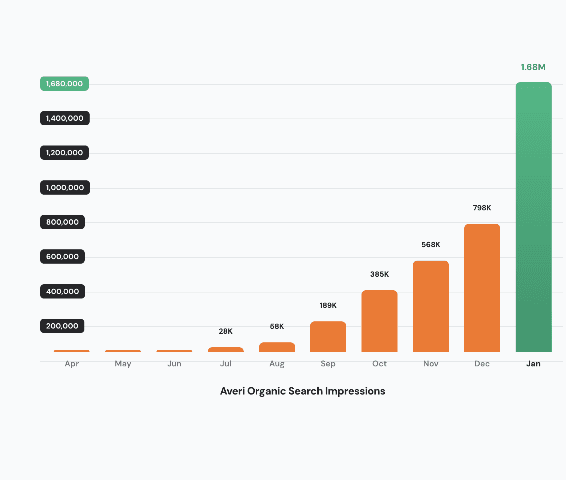
The result: 10.6M Google impressions in 12 months on a one-person team. 27,464 clicks.
AI citation rate going from 0% to 35-40% across category-relevant prompts.
The cluster architecture is what made the compounding work — single-piece performance was much weaker, but the clusters together produced a topical authority signal that lifted every piece in the cluster.
For the full breakdown, see our 10M Impressions case study and Strategy Map case study.
See what your Content ROI could be these next 12 months
Common mistakes when shifting from keyword to topic targeting
Five patterns I see most often when teams attempt the framework shift:
Mistake 1: Renaming workflows without changing them. The team holds a meeting, agrees to "shift to topic targeting," updates the strategy doc to say "topics" instead of "keywords," and keeps running the exact same workflow. New vocabulary, same mechanics. This is the most common failure mode and the hardest to catch because the team actually believes they shifted.
Mistake 2: Treating keyword tools as the enemy. The opposite mistake. Teams that overcorrect into "we're not using keyword tools anymore" produce content that doesn't validate against any search demand and underperforms across every dimension. Keyword tools are useful inputs to a topic-driven workflow. They're not the structure of the workflow, and they're not the enemy either.
Mistake 3: Building only top-of-funnel content because that's where the volume is. A topic cluster that covers awareness questions but not evaluation, comparison, or implementation questions is incomplete. Buyers landing on awareness pieces find no path through the buying journey on the same site. The cluster is structurally weaker than it looks, even when individual pieces rank well.
Mistake 4: Writing for the keyword tool instead of the buyer. Even within a topic-targeting framework, it's possible to backslide into keyword-tool optimization mid-draft. The clearest sign: you're choosing words for SEO benefit rather than for the way buyers actually phrase the question. Read your draft out loud. If it doesn't sound like the way a buyer would describe the problem to a colleague, it's been keyword-optimized in the wrong direction.
Mistake 5: Measuring the cluster only by traditional keyword rankings. Topic targeting produces results that traditional keyword-ranking metrics don't fully capture: AI citations, branded query growth, multi-query ranking lift across long-tail variations, conversion rate improvements at the bottom of the funnel. If you're only tracking "did we move up for our target keywords," you'll undermeasure the cluster's actual performance by 50%+. Add citation tracking, branded query growth, and conversion-by-page-type to the dashboard.
What to do this week
If you want to shift from keyword targeting to real topic targeting, the order:
Audit your existing clusters with the 4-question diagnostic. Pick three clusters from your library. Run each through the four questions. Be honest. Most teams fail at least 2 of the 4 on most clusters. That's normal — and that's where the work is.
Map the buyer's question journey for one cluster you want to fix first. Pick the cluster with the highest commercial relevance. List 30-50 questions a specific buyer asks across the full journey, in their own language, before you open any keyword tool.
Validate against keyword volume after the question list exists. Use Ahrefs, Semrush, or whichever tool you already pay for. Check which questions have search volume. Some will. Some won't. Don't drop the no-volume ones — they're often the highest-impact AI citation opportunities because they reflect how buyers actually phrase the problem.
Restructure the cluster around the question journey, not keyword volume. Reassign pieces to question categories (awareness, evaluation, comparison, implementation, post-purchase). Identify gaps. Plan the next 5-10 pieces against the gap analysis.
Audit your internal linking pattern. Pull 20 internal links from the cluster. How many were placed for keyword anchor text vs for meaning? Rewrite the meaning-driven ones. Remove or rework the keyword-driven ones.
Add bottom-of-funnel measurement. AI citation tracking, branded query growth, conversion-by-page-type. These are the metrics that surface real topical authority. Traditional keyword rankings will under-measure the cluster's actual performance.
Establish "buyer questions first, keywords second" as a non-negotiable editorial standard. Document it. Enforce it on every brief. The discipline is what produces the result. Without the standard, the team will drift back to keyword-first habits within 60 days.
That's the framework.
Real topic targeting produces results that compound. Keyword targeting with extra steps produces results that look fine for 60 days and collapse over the next 12 months as AI search continues to absorb category traffic.
The teams that make the shift early in 2026 will compound topical authority that becomes structurally hard for late-shift competitors to overcome.
If you want this baked into your stack — Brand Core that captures the buyer's question space at setup, Strategy Map that organizes content by topic rather than keyword, AI drafts with composite SEO + GEO scoring that flags keyword-cluster patterns, and unified analytics across rankings + citations + conversions — start a free 14-day Averi trial.
30 minutes to set up. The first cluster you build inside Averi will be a real topic cluster by default rather than a keyword cluster wearing topic vocabulary.
Related Resources
The Topic Architecture
Topic Clusters for SaaS: Building Topical Authority Systematically
Topical Authority: The SEO Strategy That Beats Domain Authority Every Time
Content Clustering & Pillar Pages: Building Authority in AI and SaaS Niches
How Startups Can Build Topical Authority Without a Content Team
The Methodology
The Diagnostic
The Editorial Worldview
Nobody Cares About Your Product. They Care About Their Problem.
Vibe Marketing in Q2 2026: What's Working, What's Hype, and What's Next
Real Receipts
Definition Pages
Run real topic clusters from one workflow. Averi captures the buyer's question space in Brand Core, organizes content by topic in Strategy Map, scores pieces on a composite SEO + GEO scale, and surfaces topic-level performance in unified analytics — built for topic targeting by default, not keyword targeting with extra steps. $99/mo, no contract, 14-day free trial. Start your free trial →
FAQs
What's the difference between topic targeting and keyword targeting?
Keyword targeting optimizes content around specific search strings, treating each keyword as a separate optimization unit. Topic targeting optimizes content around buyer question spaces — the full set of related questions a specific buyer asks across their research journey, regardless of search volume on any specific phrasing. Keyword targeting was an effective workaround for search engines that couldn't read meaning. AI engines and Google's post-2020 algorithm can read meaning, which makes topic targeting structurally more effective in 2026.
Are topic clusters and keyword clusters the same thing?
Not in practice, even though they're often described as the same thing. A real topic cluster organizes content around the buyer's question journey, with pillar and cluster pieces covering the full range of questions buyers ask in natural language. A keyword cluster organizes content around keyword surface similarity, with pillar and cluster pieces targeting specific search strings. The vocabulary is similar but the mechanics differ. The diagnostic test: would your cluster still make sense if every keyword tool stopped working tomorrow? Real topic clusters survive that test. Keyword clusters wearing topic vocabulary don't.
Why did HubSpot lose 85.7% of organic traffic?
HubSpot lost 85.7% of organic traffic because they created content targeting high-volume keywords unrelated to their products — the pure keyword-volume optimization workflow. Google's post-2020 algorithm updates and AI search systems both penalize this pattern: pages that rank for keywords without demonstrating genuine topical relevance to the publisher's expertise get suppressed. HubSpot is the canonical proof that keyword logic doesn't just stop working in 2026 — it actively destroys traffic when the search system recognizes pattern-mismatch between content topic and publisher domain.
Should I stop using keyword research tools?
No. Keyword tools remain useful inputs to a topic-driven workflow. The shift is in how you use them. In a keyword-targeting workflow, the tool drives the structure: head keyword → related keywords → cluster. In a topic-targeting workflow, you start with the buyer's question journey (mapped without the tool) and use the keyword tool afterward to validate which questions have search volume. The tool stops being the structure and becomes a validation step. Keyword research is necessary for prioritization. It's not the right starting point for content strategy.
How long does it take for topic clusters to outrank keyword-targeted content?
Typically 3-6 months for individual cluster pieces to start ranking, and 6-12 months for the full cluster's topical authority signal to compound. Sites publishing 25+ connected articles within a single topic cluster see 40-70% rise in keyword rankings within 3-6 months, and content grouped into topic clusters drives approximately 30% more organic traffic and holds rankings 2.5x longer than standalone pieces. The compounding effect means well-built topic clusters keep producing returns long after the production work is finished, while keyword-targeted pieces tend to peak early and decay.
How does AI search change keyword strategy?
AI search engines (ChatGPT, Perplexity, Gemini, Claude, Google AI Mode) don't read keywords in the traditional sense. They evaluate content for semantic completeness, fact density, and citation-worthiness. LLMs prioritize structure, semantic clarity and contextual completeness over keyword frequency. Pages stuffed with exact-match keywords that lack genuine topical depth get systematically excluded from AI citations, even when those pages still rank in traditional Google. The strategic implication: keyword optimization beyond basic relevance signal is a non-factor for AI search. Topic depth, fact density, and structural clarity are the inputs that produce citations.
How does Averi support topic targeting over keyword targeting?
Averi is architected for topic targeting by default. Brand Core captures the buyer's question space during setup — including the language buyers actually use, not the keyword-tool version. Strategy Map organizes content by topic and buyer journey stage rather than by keyword volume. The Content Scoring System evaluates pieces on a composite SEO + GEO scale that flags keyword-cluster patterns (over-optimization on a single phrase, missing question coverage, weak topical depth). The Analytics layer surfaces topic-level performance instead of just keyword-level rankings. The combination is what made it possible for our one-person team to produce 10.6M Google impressions in 12 months — most of it from queries we never explicitly targeted, because the topic clusters covered the question space comprehensively rather than chasing specific search strings.