Business-to-Agent (B2A): How to Prepare Your Brand for the Agentic Web

6 minutes

TL;DR
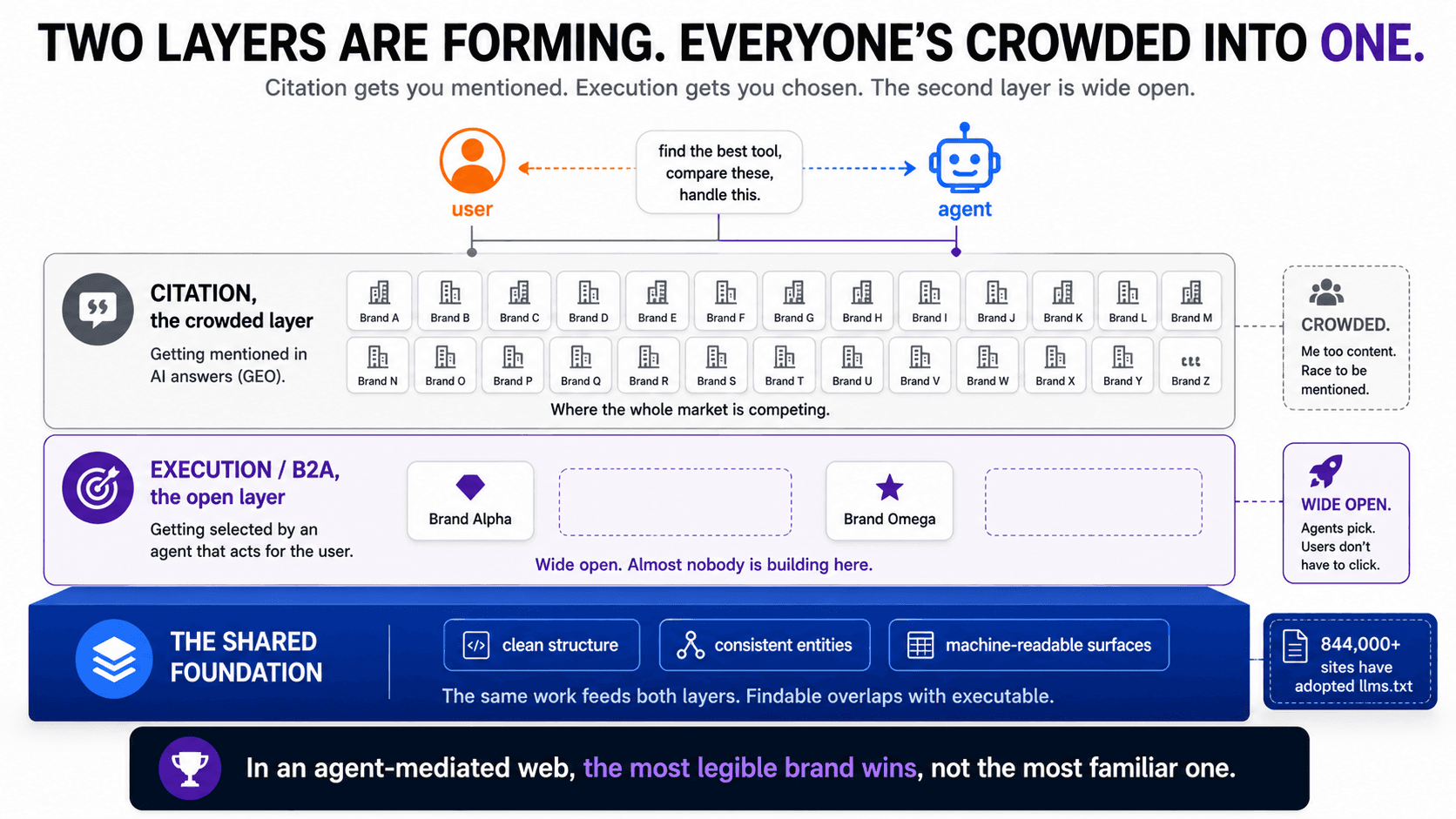
🔌 Two layers are forming. Citation (getting mentioned in AI answers) is crowded. Execution, Business-to-Agent, being legible and actionable to agents that act for a user, is wide open
📄 llms.txt is real, but not what it's sold as. Proposed by Jeremy Howard, it's a machine-readable markdown summary of a site, and Google added it to Chrome Lighthouse's "Agentic Browsing" audit in May 2026. But AI search crawlers almost never fetch it; its real value is the agentic layer, not SEO
🤖 WebMCP lets agents act, not just read. An open standard letting sites expose structured functions so browser agents can execute tasks directly, it moved toward a public origin trial in Chrome 149
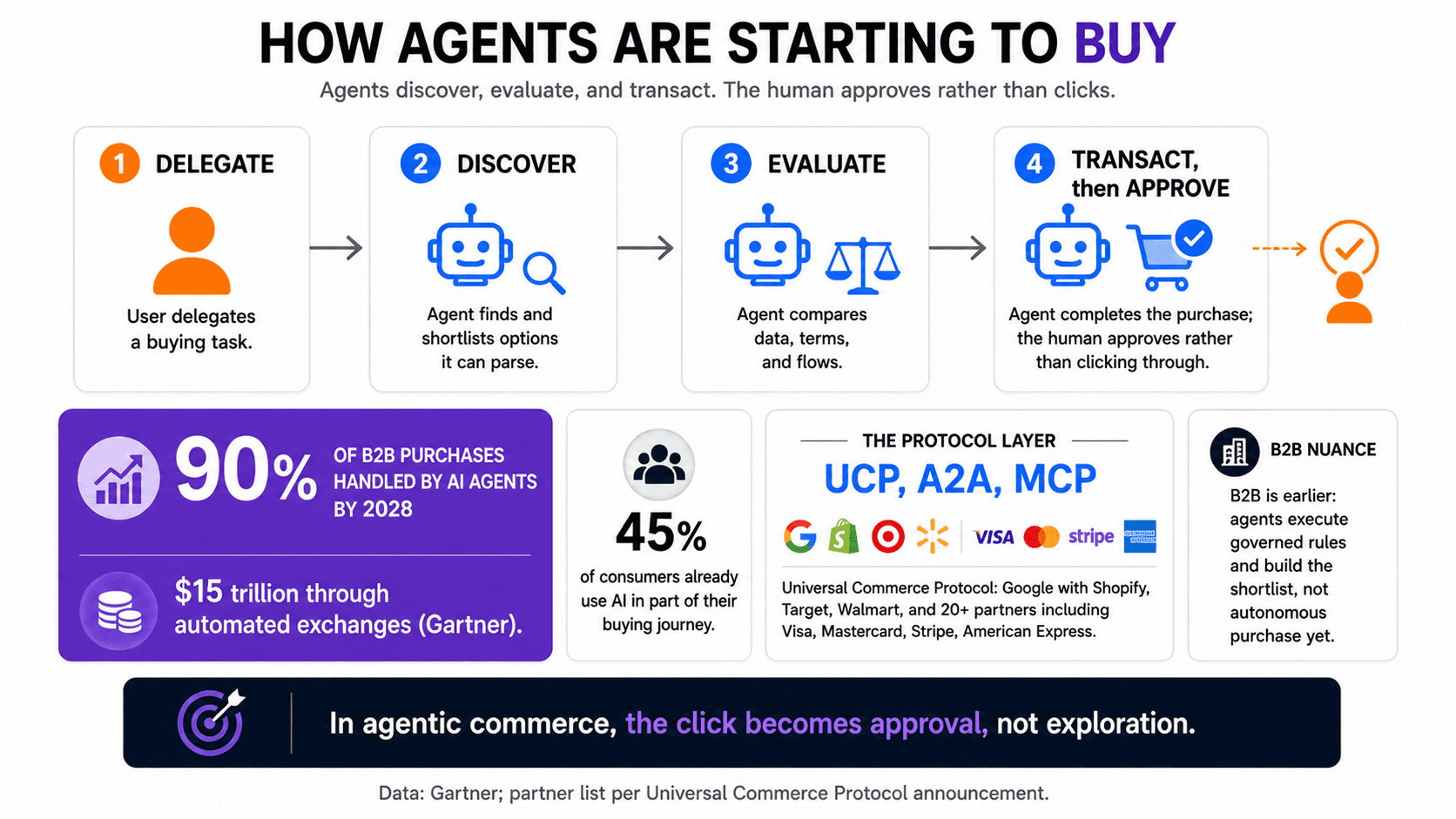
🛒 Agents are starting to buy. Gartner projects 90% of B2B purchases will be handled by AI agents by 2028, with $15 trillion flowing through automated exchanges, and the Universal Commerce Protocol is being built by Google with Shopify, Target, Walmart, and 20+ partners
⚖️ It's early, and that's the point. Transactional intent on AI platforms is still small, but the brands building entity legibility and clean structure now are the ones agents will be able to select when the volume arrives
🧱 Findable is starting to overlap with executable. The work that makes you legible to agents, clean structure, consistent entities, machine-readable surfaces, is the same work that already wins the citation layer

Zach Chmael
CMO, Averi
"We built Averi around the exact workflow we've used to scale our web traffic over 6000% in the last 6 months."
Your content should be working harder.
Averi's content engine builds Google entity authority, drives AI citations, and scales your visibility so you can get more customers.
Business-to-Agent (B2A): How to Prepare Your Brand for the Agentic Web
Getting cited in AI answers is becoming table stakes. The next game is getting chosen by an agent acting on someone's behalf, and almost nobody is building for it. There are two layers forming in AI, and the entire market is crowded into the first one. The first layer is citation: structuring content so AI engines mention you in their answers. The second layer is execution: making your brand legible and actionable to AI agents that browse, evaluate, and increasingly transact for a user. The first layer is where everyone is competing. The second is wide open, and it's where "the next phase of the web" stops being a slogan and becomes infrastructure.
That second layer has a name: Business-to-Agent, or B2A. It's the practice of preparing your brand not just to be found by agents, but to be used by them, queried, understood, and selected at the moment an agent is doing a job for a person. The shift it represents is blunt: in an agent-mediated web, the brand that wins isn't the most familiar one, it's the most legible one. The supplier whose data, structure, and flows an agent can actually read and act on gets selected. Everyone else gets skipped.
This guide maps the B2A layer: what it is, how it differs from getting cited, what llms.txt and WebMCP actually do (and where the hype is wrong), how agents are starting to buy, and what to do now. It's the forward edge of how agents read, how to write for them, and how buying is being rebuilt.
What Is Business-to-Agent (B2A)?
Business-to-Agent (B2A) is the practice of making your brand legible and actionable to AI agents that operate on a user's behalf, so that when an agent browses, evaluates, or buys, it can read your data, understand your offering, and select you.
It's the brand layer for the agentic web, distinct from marketing to humans (B2C) or to businesses (B2B). The customer you're serving is, increasingly, the agent doing the work for the human.
The concept exists because agents are becoming intermediaries in discovery and purchase. When a person delegates a task to an AI, find the best tool for this, compare these options, handle this order, the agent does the reading and the shortlisting. B2A is the first standardized way for a brand to publish a machine-readable surface that agents can route on, and it's small today but growing. The brands investing in it are betting that agent-mediated selection is where a meaningful share of discovery and purchase is heading.
The strategic core of B2A is a reframe of what wins. In a human-mediated web, familiarity wins, the brand you've heard of gets the click.
In an agent-mediated web, legibility wins: agentic AI rewards infrastructure readiness, and the supplier whose data, APIs, authentication, and flows are most legible at the moment of query becomes the selected option. An agent doesn't have brand loyalty. It has a task and a set of options it can actually parse. If it can't parse you, you're not an option.
How Is B2A Different From Getting Cited in AI Answers?
Citation is about being mentioned; B2A is about being used. Getting cited means an AI references you as a source when answering a question. B2A means an agent can read your structured data, understand your offering, and act on it, select you, route to you, or transact with you. They're two different layers of the AI stack, and they require overlapping but distinct work.
The citation layer is generative engine optimization: structuring content so engines retrieve and cite it in answers. It's the layer most of the market is competing on, and it's getting crowded. The execution layer is B2A: making your brand legible to agents that take actions rather than just answer questions. The same file that does almost nothing for ChatGPT search citations is doing real work in a different layer of the AI stack, the agentic web, where agents act on behalf of users, fetch context, choose tools, and complete tasks.
Here's the connective tissue, and it's the reassuring part: the foundational work overlaps heavily. Clean structure, consistent entity signals, machine-readable surfaces, and content an agent can parse without ambiguity serve both layers. Being findable is starting to overlap with being executable. So preparing for B2A isn't a separate project bolted onto your citation work; it's the next floor of the same building. If you've done the chunk-level structural work and built consistent entity authority, you've already laid the foundation B2A is built on.
What Is llms.txt, and Do You Need It?
llms.txt is a machine-readable markdown file that gives AI agents a structured summary of your site and its key pages. Whether you need it depends on what you're optimizing for, and the honest answer is more nuanced than most guides admit, because two Google teams gave conflicting guidance about it in the same week.
What llms.txt is
Proposed by Jeremy Howard, llms.txt is a standardized markdown file that provides a concise, structured summary of a site's content for LLMs and agents to ingest at inference time. Think of it as a clean map of your site written for machines: your most important pages, each with a short, literal description, in a format an agent can parse instantly without crawling your whole site. Over 844,000 sites had adopted it, and in May 2026 Google added an llms.txt check to Chrome Lighthouse's auditing tool, the same framework that normalized HTTPS and mobile-first design.
The confusing split
In a single week of May 2026, Google's own teams pointed in opposite directions. On May 15, Google Search published guidance telling site owners they don't need llms.txt for AI Overviews or AI Mode. Around May 19 to 20, Chrome's Lighthouse team added an "Agentic Browsing" audit category that checks for the file. The contradiction resolves once you see the two teams are talking about different layers: Google Search is talking about search citation visibility; Lighthouse is talking about browser-agent readiness, how well a site can be parsed by autonomous browsing agents. One is the citation layer. The other is the execution layer.
Why ship one anyway
Ship llms.txt, but for the right reason, and don't expect it to move your AI citations. An analysis of 500 million-plus bot traffic events found AI search crawlers almost never fetch llms.txt; GPTBot, ClaudeBot, and PerplexityBot overwhelmingly skip it and crawl HTML directly. So as an SEO play, it does little. As a B2A play, it's the first standardized machine-readable surface agents can route on, and that's the value. If you do ship one: keep each description short and literal, using the exact terms a buyer or agent would search, because marketing copy reduces agent confidence, and refresh it when your content strategy shifts, since a stale file feeds agents an outdated map and erodes their trust in your site. For sites whose CMS doesn't output markdown, serve canonical content as .md alongside the HTML.
What Is WebMCP and the Agentic Browsing Layer?
WebMCP is a proposed open web standard that lets sites expose structured functions and annotated form elements so browser-based AI agents can execute tasks directly, rather than guessing at your interface by parsing screenshots or simulating clicks. It's the difference between an agent reading your page and an agent operating your page.
WebMCP lets developers expose structured JavaScript functions and annotated HTML form elements so browser-based AI agents can complete tasks directly, without relying on screenshot parsing or simulated clicks, and Google confirmed it will move into a public origin trial in Chrome 149. It sits in the same Lighthouse "Agentic Browsing" category as the llms.txt audit, which signals where Google thinks the web is going: toward sites built to be operated by agents, not just rendered for humans. The category itself is telling. Lighthouse, the tool that set web quality baselines for HTTPS and Core Web Vitals, now has a section evaluating whether sites are structured for machine interaction.
There's a parallel worth knowing from the developer world. AGENTS.md, a file that gives AI coding agents execution context inside code repositories, shipped in more than 60,000 open-source repos by early 2026. The pattern across llms.txt, WebMCP, and AGENTS.md is the same: standardized, machine-readable surfaces that let agents understand and act, rather than improvise. That pattern is the architecture of the agentic web taking shape.
How Are Agents Starting to Buy?
Agents are starting to buy through emerging commerce protocols that let them discover, evaluate, and transact on a user's behalf, with the human approving rather than clicking through every step. Purchase is the part of B2A moving fastest in consumer retail and forming the infrastructure that will reach B2B.
The protocols forming
The plumbing for agentic commerce is being built right now by the largest players. The Universal Commerce Protocol (UCP), an open standard for agents to operate across the shopping journey, was co-developed by Google with Shopify, Etsy, Wayfair, Target, and Walmart, and endorsed by more than 20 partners including Mastercard, Visa, Stripe, and American Express. Alongside it sit Agent2Agent (A2A) and the Model Context Protocol (MCP) for agent data access. The scale of the bet is large: Gartner projects 90% of B2B purchases will be handled by AI agents by 2028, with $15 trillion flowing through automated exchanges, and 45% of consumers already use AI for at least part of their buying journey. In agentic commerce, the click becomes approval rather than exploration.
How B2B is different from retail
B2B agentic commerce works differently, and the difference matters for how you prepare. The retail vision assumes agents discover products across open marketplaces and buy autonomously; B2B doesn't work that way. B2B agents execute known rules within governed systems, does this order match our contract, is it in budget, is the supplier approved, rather than predicting preferences the way a consumer agent must. For B2B SaaS specifically, the near-term reality is the research and shortlist phases, the finding and comparing, not yet autonomous purchase. Transactional intent on AI platforms still sits low. So for most B2B brands, B2A today is about being legible enough to make the agent-built shortlist, which is exactly the citation and entity work you're already doing.
What Does It Mean to Be "Executable" Rather Than Just "Findable"?
Being executable means an agent can not only find your information but act on it, query your data, understand your terms, and complete a task involving you, without a human translating your site for it. Findable gets you into the agent's consideration. Executable gets you selected and transacted with. The agentic web is pushing the bar from one to the other.
The distinction is concrete. A findable brand has content an agent can read and cite. An executable brand has structured data, clear terms, and machine-readable flows an agent can act on, your pricing in parseable form, your product attributes structured, your key actions exposed through something like WebMCP rather than buried in a JavaScript interface. If your infrastructure cannot be queried and executed against, your brand is excluded from the shopping journey. That's the stark version of the reframe: in an agent-mediated transaction, illegibility isn't a disadvantage, it's exclusion.
The good news for anyone who's done the foundational work: being findable increasingly overlaps with being executable. The clean structure, consistent entities, and machine-readable surfaces that make you citable are the same things that make you executable. You're not starting over. You're extending the same foundation one layer up, from content an agent can read to data an agent can act on.
How Do You Prepare Your Brand for the Agentic Web?
You prepare for the agentic web by building the legibility foundation now, then extending it toward executable surfaces as the standards mature. The work is sequenced, and most of the early steps are things you should be doing for AI citation regardless.
Start with the foundation, which is the citation-layer work that doubles as B2A groundwork. Make sure agents can actually read your pages, client-rendered content is invisible to most AI crawlers before any of this matters. Structure content into clean, self-contained, machine-parseable sections. Build consistent entity signals so agents recognize you as a distinct, known entity rather than an ambiguous string. Keep your terminology, naming, and core descriptions consistent everywhere, because agents, like the dual reader you're already writing for, rely on consistency to understand what you are.
Then extend toward executable surfaces. Ship an llms.txt as a B2A routing surface, with short, literal descriptions, understanding it's for the agentic layer and not an SEO lever. Structure your high-value data, pricing, product attributes, comparison data, in parseable form rather than locked inside dynamic interfaces. Watch the agentic browsing standards, WebMCP and the Lighthouse Agentic Browsing audits, and the commerce protocols (UCP, A2A, MCP) as they move from experimental to expected, the same arc HTTPS followed from optional to baseline. You don't need to implement everything today. You need to build on a foundation that makes adoption straightforward when the volume arrives, rather than scrambling to retrofit a brand agents can't read.
Build the foundation agents can read. Averi structures your content for clean machine legibility, consistent entities, and the parseable surfaces that serve both the citation layer and the agentic web. $99/month for Solo. 14-day free trial. Start free →
Is This Real Yet, or Too Early?
Both. The infrastructure is real and being built by the largest companies in tech, but meaningful agentic purchase volume, especially in B2B, is still early. The honest framing is that B2A is a positioning and readiness play, not a do-this-today-or-die emergency, and that's exactly why now is the time to build the foundation.
The case for treating it as early: transactional intent on AI platforms is still small, autonomous B2B purchase is largely not happening yet, and several of these standards are in origin trials and audits rather than wide deployment. Anyone telling you to drop everything and rebuild for agentic commerce this quarter is overselling it. The case for building now anyway: the foundational work, legibility, clean structure, consistent entities, machine-readable surfaces, is the same work that wins the citation layer that's already live, so you get present-tense return on it. And legibility compounds. The brands building entity and structural strength now are the ones agents will be able to select when the volume arrives, while latecomers will be retrofitting a brand agents can't parse. The smart position isn't "rebuild for agents now" or "ignore it until it's big." It's "build the legibility foundation now, because it pays off today on the citation layer and positions you for the execution layer as it matures." That's the difference between a readiness strategy and a reaction.
Where Does Averi Fit in the Agentic Web?
Averi builds the legibility foundation that wins the citation layer today and positions you for the execution layer as it matures, which is the exact sequencing this guide argues for.
B2A is the brand layer for the agentic web, and that is the layer Averi is built to occupy: the system that keeps your brand readable, recognizable, and selectable as the reader on the other side shifts from a person to an agent acting for one.
Concretely, the foundation is the part that pays off now and compounds. The content engine produces clean, server-rendered, machine-parseable content, so agents can actually read you rather than hitting a blank shell. Dual SEO and GEO scoring checks that each piece meets the structural conditions agents rely on before it ships. And Brand Core keeps your naming, category language, and core descriptions consistent everywhere, which is the entity signal that makes an agent recognize you as a distinct, known entity instead of an ambiguous string. That is the same work that wins citations today, and it is the groundwork B2A is built on, the reason findable and executable overlap.
What Averi does not do is pretend the execution layer is finished.
The commerce protocols and agentic-browsing standards are still forming, and no tool has fully solved them. What we can say honestly is that the legibility you build now is the foundation the execution layer gets built on, and that building it is a present-tense return rather than a speculative bet, because it wins the citation layer that is already live.
We ran exactly this play on ourselves, building Averi on Averi and taking our own content from a few thousand monthly impressions to over 12 million organic impressions across 12 months on a one-person team. Legibility compounds, and the brands that build it now are the ones agents will be able to select when the volume arrives.
Become legible to the agents, not just the humans
Averi builds the clean structure, consistent entities, and machine-readable foundation that wins the citation layer today and positions you for the agentic web as it arrives. $99/month for Solo. 14-day free trial.
FAQs
What is Business-to-Agent (B2A)?
Business-to-Agent (B2A) is the practice of making your brand legible and actionable to AI agents that operate on a user's behalf, so an agent can read your data, understand your offering, and select or transact with you. It's distinct from marketing to humans, because the immediate audience is the agent doing a task for a person. In an agent-mediated web, the most legible brand wins, not the most familiar one.
How is B2A different from GEO or getting cited by AI?
GEO and citation are about being mentioned as a source in an AI answer. B2A is about being used, an agent reading your structured data, understanding your offering, and acting on it. They're two layers: citation (crowded) and execution (open). The foundational work overlaps heavily, clean structure and consistent entities serve both, so B2A extends your citation work rather than replacing it.
Do I need an llms.txt file?
Ship one, but for the right reason. AI search crawlers almost never fetch llms.txt, so it does little for your AI citations. Its real value is as a Business-to-Agent surface: a machine-readable map agents can route on. Google added it to Chrome Lighthouse's Agentic Browsing audit in May 2026, even as Google Search said it isn't needed for AI Overviews, because the two address different layers.
What is WebMCP?
WebMCP is a proposed open web standard that lets sites expose structured functions and annotated form elements so browser-based AI agents can execute tasks directly, instead of parsing screenshots or simulating clicks. It moved toward a public origin trial in Chrome 149 in 2026. It represents the shift from agents reading your page to agents operating your page, the execution layer of the agentic web.
Will AI agents really buy things for businesses?
Increasingly, yes, though B2B is earlier than retail. Gartner projects 90% of B2B purchases will be handled by AI agents by 2028, with $15 trillion through automated exchanges, and protocols like UCP, A2A, and MCP are being built now. B2B agents execute known rules within governed systems rather than predicting preferences, so near-term B2B B2A is mostly about making the agent-built shortlist, not autonomous purchase.
What does it mean for a brand to be "executable"?
Executable means an agent can act on your information, not just read it, query your data, understand your terms, and complete a task involving you without a human translating your site. Findable gets you considered; executable gets you selected. If your infrastructure can't be queried and acted against, an agent can't transact with you, which in an agent-mediated journey means exclusion rather than just disadvantage.
Is it too early to invest in B2A?
The infrastructure is real but agentic purchase volume is still early, especially in B2B, so B2A is a readiness play rather than an emergency. The reason to build now: the foundational work, clean structure, consistent entities, machine-readable surfaces, is the same work that wins the citation layer that's already live, so it pays off today while positioning you for the execution layer. Legibility compounds, and latecomers retrofit.
Related Resources
The Agentic Web Cluster
How Agents Read, How to Write for Them, and How Buying Is Being Rebuilt
How AI Agents Actually Read Your Content: Chunking, Embeddings, and Retrieval
The JavaScript Rendering Gap: Why AI Can't See Your Best Content
Writing for Humans and Agents at the Same Time: The Dual-Reader Playbook