How We Scaled Averi's Content Engine 97,000% Before We Built Averi

6 minutes
TL;DR
📈 The headline number: Averi grew from 2,976 to 2.9 million monthly organic search impressions in 10 months — roughly 97,000% growth. Full 12-month GSC analysis here
🎯 Not viral, not a secret prompt: No single hit piece. No "AI content at scale" in the cheap, sad, beige sense people usually mean it. The growth came from architecture
🏗️ The six components of the engine: Brand Core, Strategy Map, Content Queue, Library, Content Scoring, and designed internal linking — operating as one system rather than as separate tools
🔀 The August 2025 pivot: stopped publishing broadly, started publishing only inside defined topic clusters. Three weeks later, Google rerated the site
⚡ The first inflection: average position jumped from 22.8 to 14.6 in a single week (week of September 8 → September 15, 2025). The move held
🚀 The second inflection: impressions jumped 72% week over week in January 2026, from 237,119 to 408,643
📉 The CTR collapse paradox: CTR fell from 5.38% to 0.17% — a 32x decline — but clicks still grew from 160 to a March 2026 peak of 4,909 because impressions scaled faster than CTR fell. This is the AI Overview era in one chart
🔄 The thesis: the workflow became Averi because the workflow was the product. A system for turning scattered marketing effort into a content engine that compounds

Zach Chmael
CMO, Averi
"We built Averi around the exact workflow we've used to scale our web traffic over 6000% in the last 6 months."
Your content should be working harder.
Averi's content engine builds Google entity authority, drives AI citations, and scales your visibility so you can get more customers.
How We Scaled Averi's Content Engine 97,000% Before We Built Averi
A Q&A with Zach Chmael, CMO and content engineer behind Averi's 97,000% organic search growth
We did not build Averi from a whiteboard fantasy.
We built it from the workflow we needed to survive.
Before Averi became an AI Content Engine for startups, it was a messy, living, very real operating system for our own content marketing. Brand context. Topic architecture. Briefs. Internal linking. Scoring. A growing library of work that made every next piece faster, sharper, and more connected than the last.
Then the numbers got weird.
Between May 2025 and March 2026, Averi's organic search impressions grew from 2,976 to 2.9 million per month.
That is roughly 97,000% growth in ten months.
Over the full 12-month report window, the site generated 12.8 million organic search impressions and more than 30,000 organic clicks. Domain Rating climbed from 13 to 65. All with one marketing employee driving the engine and zero paid acquisition fueling the content system.
This is the story behind that engine, the mistakes that made it better, and why the workflow eventually became the product.
Let's Start With The Obvious Question: What Actually Happened?
We grew organic search impressions from basically nothing to millions per month.
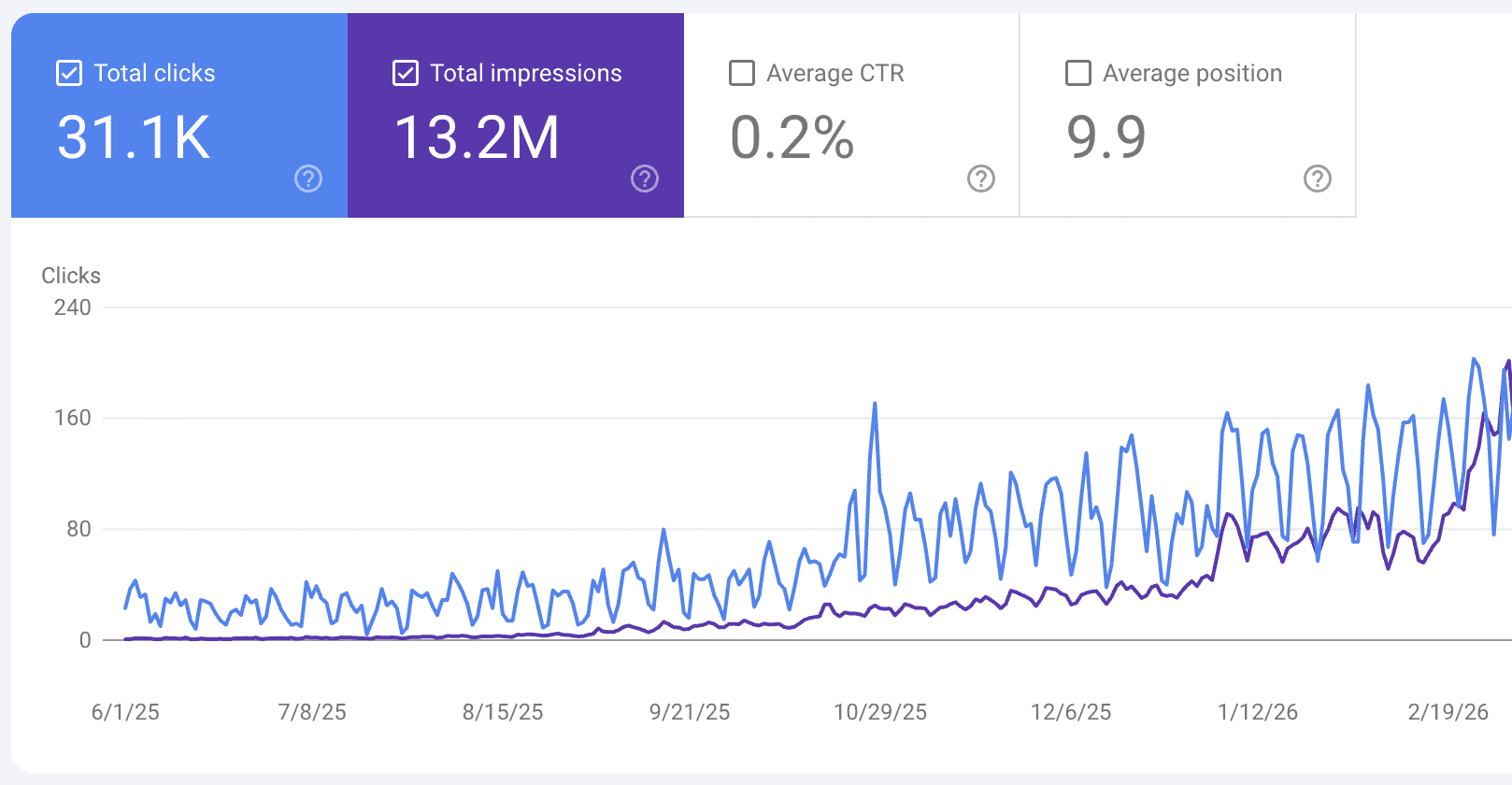
In May 2025, Averi had 2,976 organic search impressions in the first measurable window. By March 2026, we hit 2.9 million monthly impressions. Over the 12-month report window, we generated 12,804,666 impressions and 30,459 organic clicks from Google Search Console.
Which sounds fake.
Like the kind of stat you see in a LinkedIn carousel written by a man in a quarter zip who says "pipeline velocity" too much.
But the interesting part is not the number. The interesting part is the shape of the curve.
It did not grow smoothly. It bent twice.
The first bend happened in September 2025, after we changed the architecture of the content system. Average ranking position jumped from 22.8 to 14.6 in a single week. That is not "we published a good blog post." That is Google looking at the site differently.
The second bend happened in January 2026, when impressions jumped from 237,119 to 408,643 in one week. By then, the architecture had been compounding for months.
So the short version is: we built a content system, made a painful structural pivot, and then watched the system start behaving less like a calendar and more like an engine.
Different beast. Much more fun. Also slightly terrifying when you are the person responsible for it.
What Was Averi's Content Operation Like At The Beginning?
Messy. Ambitious. Wrong in several predictable ways.
We had the right instinct, but not the right structure.
The positioning was there early: Averi as the intersection of AI as a means to amplify human marketing.
The voice was mostly there too: founder-to-founder, direct, useful, a little irreverent. The publishing pace was also there. We were producing around 60 pieces per month.
But the architecture was not there yet.
We were writing across too many topics: branding, AI tools, founder advice, SaaS metrics, marketing strategy, productivity, category ideas, whatever seemed useful that week. It all felt productive because output feels productive. You publish enough pages and your brain starts whispering, "Surely this is doing something."
It was doing something.
Mostly confusing Google.
By late July, average position had drifted into the 20s. The site was being indexed, but it was not being trusted. We had content, but we did not have a territory. We had volume, but not enough coherence.
And that is the difference most teams fail to realize.
Publishing is not the same as compounding.
What Changed In Late August?
We stopped letting every interesting idea become a piece of content.
That was the whole thing.
Before the pivot, the question was: "Is this a good topic?"
After the pivot, the question became: "Does this belong inside one of our defined clusters?"
If the answer was no, it did not ship.
Emotionally annoying. Strategically correct.
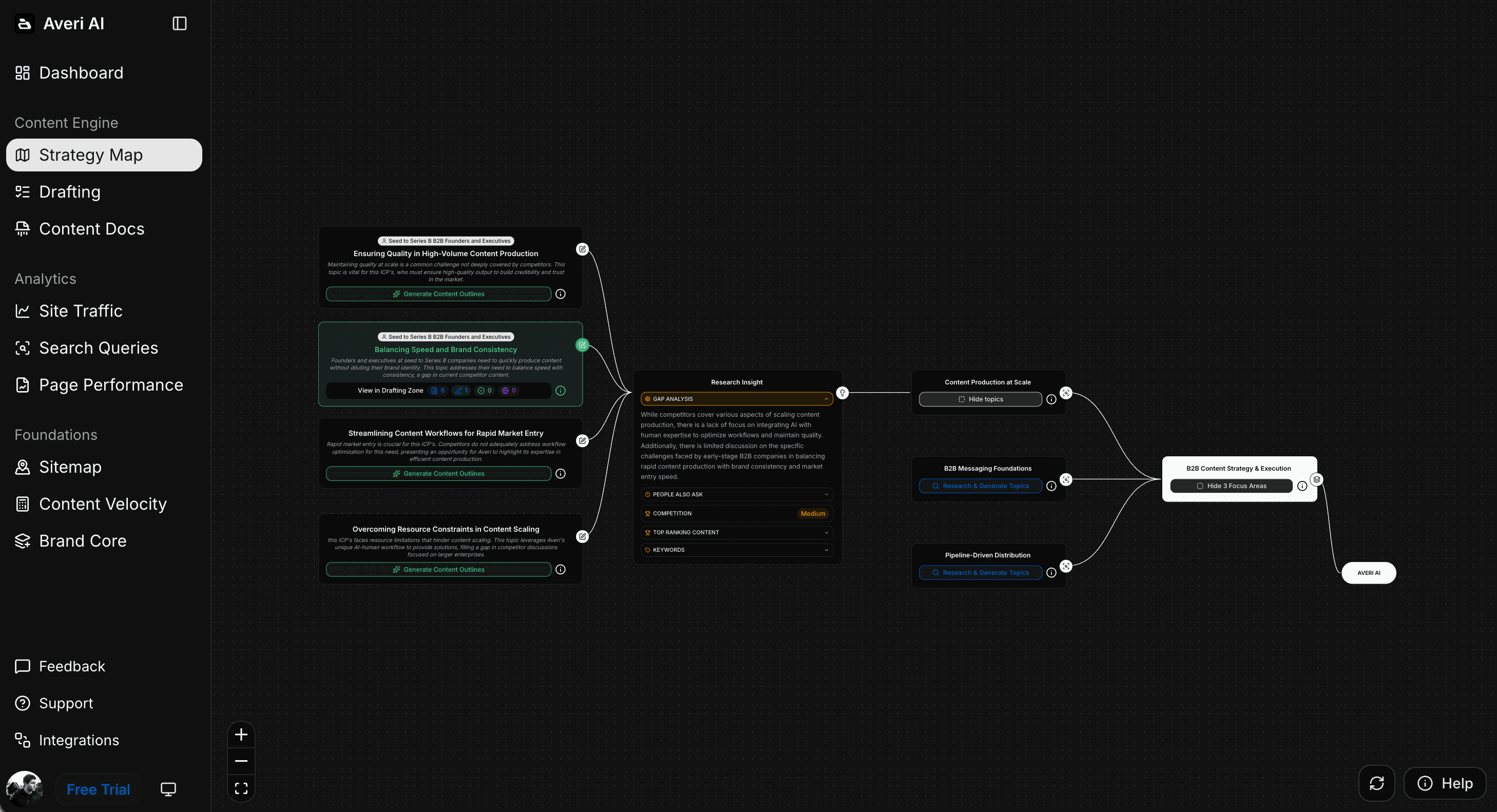
We moved from broad publishing to cluster discipline. Every piece had to map to a defined part of my Strategy Map. We also rebuilt internal linking from an afterthought into actual architecture. Every new piece got 15+ contextual internal links to related existing pieces. Every existing piece in the cluster got new links when a sibling piece shipped.
This sounds unsexy because it is.
No one wants to hear that the growth came from constraints and internal links. They want a prompt. They want a tool. They want a spicy AI trick they can steal before lunch.
But the thing that changed the curve was boring in the way most real moats are boring.
We stopped scattering effort.
We built the network.
What Happened After That Pivot?
Three weeks later, the rankings moved.
The week of September 8, 2025, Averi's average position was 22.8. The week of September 15, it jumped to 14.6. By the end of September, it stabilized around 13.7.
That move did not reverse.
That matters because a one-week spike can be noise. A position rerating that holds is different. It means the site's relationship to the category changed.
Google started treating the pages less like isolated articles and more like part of a coherent topical system.
That is when the content engine stopped feeling like hope with a CMS login.
Before that, we were publishing and checking dashboards like interns refreshing a lottery ticket. After that, we could see the mechanism. Cluster depth was lifting the whole group. Internal links were moving authority through the network. Older pieces started benefiting when new pieces shipped.
That is compounding.
Not vibes. Not "content magic." An actual mechanism. The mechanics of topical authority are documented here.
You Call Yourself The Content Engineer Behind The Engine. What Does "Content Engineering" Mean To You?
Content engineering is what happens when content stops being treated like a writing task and starts being treated like a system.
A normal content program asks: "What should we write?"
A content engine asks: "What should exist in this market so our brand becomes legible to buyers, Google, and AI systems?"
That is a much better question. Also much more inconvenient.
Because now you have to think about architecture. You need a brand layer. A topic map. A queue. A library. A scoring system. Internal linking. Distribution rules. Feedback loops. You need to know what not to publish, which is where many content calendars go to die wearing a tiny branded hoodie.
For us, content engineering meant building the operating system underneath the writing.
The article is the visible artifact. The engine is the thing that decides why the article exists, where it belongs, what it connects to, how it should be evaluated, and what it teaches the system for the next piece.
What Were The Core Components Of The Engine?
The engine had six main parts.
First, Brand Core.
That is the source of truth for who Averi is, who we serve, what category we are building, what language we use, what language we refuse to use, and how we show up. Without that, every piece starts from zero. With it, every piece starts from the same strategic memory.
Second, Strategy Map.
That is the topic architecture. It defines the clusters we compete in, the supporting subtopics inside each cluster, the comparison anchors, and the areas we are intentionally ignoring. The ignoring part is important. Strategy is mostly the art of not letting your ambition behave like a toddler in a candy aisle.
Third, Content Queue.
That is where "what should we write next?" becomes a system output instead of a mood. The queue surfaces gaps, comparison opportunities, and timely topics based on the Strategy Map and the existing Library.
Fourth, Library.
The Library is the memory of the engine. Every published piece becomes context for the next one. It stores internal link opportunities, recurring claims, strong examples, voice references, and cluster patterns. This is why the 300th piece is easier to produce than the 10th.
Fifth, Content Scoring.
Every draft gets scored against SEO and GEO criteria. We look at semantic depth, entity coverage, internal linking, structure, citation density, answer extractability, and whether the piece is built to be useful in Google and AI search.
Sixth, Internal Linking.
This is the least glamorous and maybe most important part. Every new piece strengthens the cluster around it. Every cluster becomes easier for Google and AI systems to understand. Every page gets less lonely.
Sad little isolated blog posts do not compound.
Networks compound.
The full Averi workflow is documented here.
When Did You Realize The Workflow Itself Should Become The Product?
Honestly? When the workflow started outperforming the way most teams think marketing has to work.
I was one person running a content operation that, on paper, should have required a larger team. Not because I am a wizard. I own multiple houseplants that are currently negotiating with death.
It worked because I slowly created a system that carried more and more of the cognitive load.
Brand Core meant I was not re-explaining the company every time.
Strategy Map meant I was not reinventing the topic plan every week.
The Library meant each piece had memory.
Scoring meant quality did not depend on vibes.
Internal linking meant every new piece made the old pieces more useful.
At some point, it became obvious that the thing we had built internally was not just "our marketing process."
It was the product thesis.
Startups do not need another blank AI writing box. A blank box is just a very confident intern with no context and a suspicious amount of adjectives.
They need a content system. Something that understands the brand, knows the territory, recommends what to create, drafts with context, scores the work, connects the library, and learns as the system grows.
That is what Averi became.
What Did You Get Wrong Early?
We were too broad.
That is the cleanest answer.
We wrote too much brand-first content before we had earned the audience for it. Manifestos. POV pieces. Category ideas. Stuff that felt important because it explained how we saw the world.
Some of it was good. That was the annoying part.
Good does not always mean useful. Useful does not always mean discoverable. Discoverable does not always mean strategically important.
Early on, we were writing too much for people who already understood why Averi mattered.
But the people we needed to reach were searching for problems. "How do I build a content engine?" "Best AI marketing tools." "What is GEO?" "How do I get cited by AI?" "How do I make content work with one marketer and no time and a Slack full of people asking for updates?"
Okay, maybe not that last one exactly.
But spiritually.
The correction was to weave the brand POV into useful content, not make the POV carry the whole piece by itself.
A manifesto is nice once people care.
A useful answer is how they find you.
What Surprised You Most In The Data?
The CTR collapse.
This is the part every founder needs to understand because otherwise they are going to think their content is failing right when it starts working.
Our click-through rate fell from 5.38% to 0.17%. That is a 32x decline.
On a normal dashboard, that looks catastrophic. Like "someone call a meeting and use the word alignment until everyone loses the will to live" catastrophic.
But clicks still grew from 160 in May 2025 to a peak of 4,909 in March 2026 because impressions scaled so much faster than CTR declined.
That is the AI Overview era in one chart.
Search visibility does not behave the way it used to. More people are seeing answers in Google, ChatGPT, Perplexity, Gemini, and AI search surfaces without clicking through. The click is no longer the only unit of value. The detailed cannibalization story across 12 months of GSC data is here.
That does not mean clicks do not matter. They do.
But if you only measure content by clicks, you will miss the part where your brand is becoming the answer.
So How Should Founders Measure Content Now?
Clicks are still useful, but they are incomplete.
The new measurement frame is:
Impressions
Ranking footprint
Brand description quality
Non-branded query growth
Conversion quality from the traffic that does click
Internal linking strength
Cluster maturity
Entity consistency
This is less clean than "how many sessions did this blog post get?"
Annoying. But real.
A content engine in 2026 is not just trying to get someone to click a blue link. It is trying to make the brand recognizable to search systems, AI systems, and buyers across a messy research journey. The framework for measuring share of AI voice is here.
Sometimes that journey ends in a click.
Sometimes it ends in a founder seeing Averi cited enough times that we become part of their mental shortlist before they ever visit the site.
That is harder to measure. It is also where a lot of the value is moving.
What Made The Engine Work In AI Search Too?
The same architecture that helps traditional SEO also helps AI visibility.
This is not mystical. AI search systems still need sources. They still need entities they can understand. They still need consistent descriptions. They still reward depth, specificity, structure, and authority.
Averi's engine was accidentally well-suited to AI search because we were already building the things AI systems need:
consistent category language
deep topic clusters
structured answers
citation-friendly paragraphs
internal links that clarify relationships between ideas
a growing library of connected content
a clear entity description repeated across the site
The phrase "AI Content Engine for startups" did not become consistent by accident. Brand Core made it consistent. The Library reinforced it. The Strategy Map gave it territory.
That is the part most people miss about GEO.
You cannot trick an AI system into understanding your brand with one optimized page. You have to make the brand legible across a body of work.
One page is a claim.
A content engine is evidence.
What Role Did AI Actually Play In The Process?
AI made the system faster, but it did not replace the system.
That distinction matters.
If you use AI to make 60 disconnected blog posts, you get 60 disconnected blog posts faster. Congratulations, you have invented a leaf blower for slop.
AI only becomes useful when it is operating inside architecture.
For us, AI helped with drafting, research synthesis, variation, briefs, structure, scoring, and content reuse. But it worked because the engine already knew the brand, the clusters, the library, the internal links, and the quality bar.
The problem with most AI content workflows is not that the models are bad.
The problem is that people give the model no operating context and then act shocked when it produces something that sounds like it was assembled inside a beige conference room by a committee of LinkedIn ghosts.
AI needs a job. It needs memory. It needs constraints. It needs feedback.
That is what we built.
Why Did You Turn The Workflow Into Averi Instead Of Keeping It Internal?
Because the pain was not unique to us.
Every founder-led startup has some version of the same problem:
They know content matters. They do not have enough people. They do not have enough time. They do not want generic AI copy. They do not know what to publish next. They have a graveyard of unused drafts. Their brand context lives in scattered docs, old Slack messages, founder brain fog, and one Notion page named something like "Q3 Strategy FINAL final v6."
And then they are told to "just publish more."
Cool.
Publish what? In what order? Against what category? Connected to what existing library? With what quality bar? For which search surface? Supporting which conversion path?
That is the actual work.
Averi exists because the future of startup marketing is not "more content."
It is better systems for deciding what content should exist, creating it with context, and making sure every piece strengthens the engine around it.
What Would You Tell A Founder Trying To Reproduce This?
Do not start with tools.
Start with territory.
Pick the 6 to 12 topic clusters where your company needs to become known. Then be properly annoying about staying inside them. Publish into depth before breadth. Build the internal link network from day one. Score drafts before they ship. Keep a living Library. Make sure every piece reinforces the same brand description.
And please, for the love of whatever caffeine source is currently holding your company together, stop treating content like a calendar.
A calendar tells you when something ships.
An engine tells you why it should exist.
What Is The Biggest Lesson From The Whole Thing?
The workflow became the product because the workflow worked.
Not perfectly. Not immediately. Not without a few months of me making decisions that now make me want to gently place my laptop into the East River.
But it worked because the system got smarter as it grew.
That is what most content programs are missing. They publish, but they do not learn. They create, but they do not connect. They produce assets, but they do not build authority.
Averi's content engine worked because every piece became part of something larger.
That is the whole thesis.
Your content should not just exist.
It should compound.
The workflow became the product because the workflow worked
Averi is the content engine that runs the same architecture Averi used to grow 97,000% in 10 months — Brand Core, Strategy Map, Content Queue, Library, Content Scoring, and designed internal linking, in one packaged workflow. $99/month for Solo. 14-day free trial.
FAQs
What is Averi's content engine?
Averi's content engine is the system we use to plan, create, score, publish, and connect content across defined topic clusters. It includes Brand Core, Strategy Map, Content Queue, Library, Content Scoring, and internal linking architecture. The components operate as one workflow rather than as separate tools, which is what produces the compounding effect.
How much did Averi's organic search grow?
Averi grew from 2,976 organic search impressions in May 2025 to 2.9 million monthly impressions in March 2026, roughly 97,000% growth over ten months. Across the 12-month report window, Averi generated 12.8 million organic search impressions and 30,459 organic clicks. Full GSC analysis here.
Was the growth driven by paid acquisition?
No. Paid acquisition existed elsewhere in the business, but it did not fuel the organic content engine analyzed in the report. The organic search growth came from the content system: cluster discipline, internal linking architecture, brand consistency, and 12+ months of sustained output.
What was the most important strategic change?
The biggest change was the late-August 2025 pivot to cluster discipline and designed internal linking. Averi stopped publishing outside defined topic clusters and started giving every new piece 15+ contextual internal links to related existing content. Three weeks later, average ranking position jumped from 22.8 to 14.6 in a single week.
How quickly did the pivot show results?
Roughly three weeks. The week of September 8, 2025, the site sat at average position 22.8. The week of September 15, it jumped to 14.6. That position improvement held and became the first major inflection point in the growth curve. A one-week spike is noise; a position rerating that holds is the search engine treating the site differently.
Why did CTR decline while the engine was working?
CTR declined because informational search is increasingly being answered directly in AI Overviews and other zero-click search surfaces. Averi's CTR fell from 5.38% to 0.17%, but clicks still grew because impressions scaled much faster than CTR declined. This is the AI search era pattern: more impressions, lower CTR, more brand exposure, more clicks in absolute terms.
What is the difference between a content calendar and a content engine?
A content calendar tells a team what to publish and when. A content engine defines what should exist, why it matters, where it fits in the topic architecture, how it connects to existing content, and how it strengthens the brand's authority over time. Calendars manage scheduling; engines manage compounding.
Can another startup reproduce Averi's results?
The architecture is reproducible. The exact growth rate is not guaranteed. Averi benefited from both strong architecture and strong category timing — being in market when AI search and the GEO conversation took off. Other startups can reproduce the system, but results vary based on category, authority, competition, and execution quality.
Why did the workflow become Averi's product?
Because the workflow solved the actual problem startups face. They do not just need AI-generated drafts. They need a system that understands their brand, maps their content territory, recommends what to create, drafts with context, scores quality, and connects every piece into a compounding engine. That system was Averi internally before Averi was a product.
What should a founder do first?
Define the brand layer and topic territory before publishing more content. Pick the clusters you want to own, document your brand context, and constrain new content to the areas where you can build real depth. Breadth can wait. Authority cannot.
Related Resources
The 12-Month Data Story
What 12 Months of Google Search Data Taught Us About AI Overview Cannibalization
Google AI Overviews Optimization: How to Get Featured in 2026
The Content Engine Category
Vibe Marketing And Content Engineering
Foundational Concepts
Measurement And Operations
The workflow became the product because the workflow worked. Averi is the content engine that runs the same architecture Averi used to grow 97,000% in 10 months — Brand Core, Strategy Map, Content Queue, Library, Content Scoring, and designed internal linking, in one packaged workflow. $99/month for Solo. 14-day free trial. Start free →