

In This Article
Plan and measure content that drives trials, boosts adoption, and demonstrates ROI for productivity software using AI-assisted workflows.
Updated:
Trusted by 1,000+ teams
Startups use Averi to build
content engines that rank.
Content marketing is critical for productivity software because these tools often face unique challenges: buyers are loyal to current solutions, decisions involve multiple stakeholders, and adoption is as important as the sale. To succeed, your content must educate, build trust, and address user concerns at every stage of the buyer’s journey.
Key takeaways:
Challenges by Software Type:
Project management tools need to emphasize workflows and results beyond basic features.
Collaboration platforms must address entrenched habits like email reliance.
All-in-one suites benefit from visual content to clarify their broad capabilities.
Content for Buyer Stages:
Awareness: Blogs and reports that solve pain points like missed deadlines.
Evaluation: ROI calculators, case studies, and comparison pages.
Post-purchase: Onboarding guides and quick-start materials to ensure adoption.
AI’s Role: Tools like Averi streamline content creation by automating research, structuring, and SEO tasks, reducing production time by up to 80%.
Buyer Personas:
Executives look for ROI and scalability.
Operations leaders prioritize integration and workflows.
Managers value practical solutions to save time and reduce errors.
Metrics to Track:
Awareness: Organic sessions and branded search impressions.
Evaluation: Demo requests and trial starts.
Adoption: Feature usage and activation rates.
The future of content marketing for productivity software lies in combining AI tools with strategic human oversight. This ensures efficient production while maintaining accuracy and relevance.
Best AI Tools for Marketers (Content, Campaigns, Automation) | ClickUp
Mapping the Buyer Journey for Productivity Software
Understanding how buyers navigate their decision-making process is crucial, especially in the context of productivity software. Unlike a linear path, this journey often involves multiple touchpoints and stakeholders. For instance, a team manager might stumble upon your tool while searching for ways to streamline meetings, only to revisit it later with feedback from RevOps and IT. According to Gartner, B2B buyers spend just 17% of their total buying time engaging with vendors. The majority of their time is consumed by independent research and internal discussions to build consensus [6]. This means your content needs to work hard to inform and persuade buyers before they ever connect with your sales team.
Buyer Personas and Their Pain Points
Three primary personas typically influence productivity software purchases, and each comes with distinct priorities:
Founders and executives focus on ROI and scalability. They need evidence that your tool delivers measurable results and can grow alongside their business.
RevOps and operations leaders prioritize seamless integration and consistent workflows. They want to understand how your software fits into their existing systems.
Team managers are looking for practical solutions to reduce coordination issues. They value examples that demonstrate how your tool can save time or reduce errors.
To resonate with these personas, it’s essential to tailor your messaging to their specific needs. A good B2B marketing strategy is to link each persona to a clear "job to be done" and support it with one or two solid proof points, like improved efficiency or fewer mistakes. Broad, generic messaging that tries to address everyone often ends up appealing to no one.
Content Types for Each Buyer Stage
The type of content you create should align with where buyers are in their journey. Early-stage buyers, those just starting to recognize a problem like missed deadlines or meeting fatigue, respond well to educational materials such as blog posts or guides. As they move into comparing approaches, resources like use-case pages and category explainers help clarify their options. When they’re evaluating vendors, they need concrete proof - ROI calculators, side-by-side comparisons, case studies with measurable results, and details on security or integration.
Buyer Stage | Best Content Formats | Primary Goal |
|---|---|---|
Problem Awareness | How-to guides, problem/solution posts | Define the problem in simple terms |
Solution Exploration | Category explainers, use-case pages, webinars | Explain available solutions |
Vendor Evaluation | ROI calculators, comparison guides, case studies | Build trust and reduce perceived risk |
Onboarding & Adoption | Implementation checklists, templates, in-app guides | Help users see value quickly |
For onboarding, engaging content is critical. Research from ProfitWell shows engaged users experience 10–15% lower churn, while Pendo reports that guided features lead to a 15–20% higher adoption rate [8][9].
Turning Internal Knowledge Into Content
Your internal data is a goldmine for creating impactful content. Sales calls, for instance, capture the exact language buyers use and highlight objections that may slow down deals. Support tickets often reveal common pain points during setup, such as integration challenges, while product analytics can identify underused features or areas where users drop off.
To make the most of these insights, start by tracking recurring themes. Prioritize questions based on search demand and their potential impact on the sales funnel. Then, turn these insights into targeted content. For example, if a frequent question during demo calls is, "How does this integrate with Salesforce?" it’s a clear sign that you need a dedicated comparison or integration page. This approach ensures your content directly addresses the real concerns and behaviors of your buyers rather than relying on assumptions.
Building a Content Strategy for Productivity Software
Once you’ve mapped out the buyer journey, the next step is creating a focused content strategy. This involves using insights from buyer personas and their specific challenges to guide both your messaging and how your content is structured. A solid content strategy begins with clear answers to three key questions: Who is this for? What problem does it solve? Why is it better? For productivity software, it’s crucial to target messaging around specific use cases like task management, workflow automation, asynchronous collaboration, or time tracking - rather than sticking to vague, generic benefits. Tailor this further by addressing industry-specific needs (e.g., construction teams prioritizing field-to-office coordination or SaaS teams focusing on sprint planning) and buyer maturity (e.g., someone using spreadsheets for project management versus someone upgrading from an outdated tool).
Positioning and Messaging Pillars
Effective messaging relies on organizing your content around 3–5 core pillars, each tied to outcomes your audience genuinely values. Focus on results like "reduce status meetings", "automate recurring approvals", or "improve cross-team visibility" instead of simply listing product features. Every pillar should connect to a specific audience, a measurable result, and at least one supporting proof point, such as time saved or fewer errors. This structured approach ensures consistency across all content types - whether it’s a blog post, landing page, or email sequence - reinforcing the same core message.
For example, Asana’s role-based content hubs increased their pipeline by 40% year-over-year [6].
Once your messaging pillars are in place, the next challenge is to organize your content in a way that scales efficiently.
Organizing Content in a Structured Model
As your content library grows, maintaining a clear and structured organization becomes critical. Without it, gaps in coverage can go unnoticed, and personalization efforts can become unnecessarily expensive. Think of your content as structured data within your CMS. For example, in Webflow, each piece of content should include fields like persona, funnel stage, use case, feature focus, industry, and primary keyword. This consistent structure allows for dynamic collections, quick identification of gaps, and streamlined personalization.
Tagging consistency is key here. If one writer tags a piece as "team collaboration" while another uses "collaboration tools" for similar content, your filters and searches lose effectiveness. By standardizing tags, you can quickly retrieve all content aimed at, say, IT buyers in mid-market companies at the consideration stage - and use that view to plan your next quarter’s content strategy.
Using Data to Prioritize Topics
Having a clear understanding of your audience and a well-organized content library is only part of the equation. Deciding what to create next requires a data-driven approach. Combine keyword research with product analytics to prioritize topics that align with search demand, your core messaging pillars, and measurable outcomes like sign-ups. Tools like Ahrefs or Semrush can reveal what your audience is searching for and how competitive those terms are, while product analytics platforms such as Mixpanel or Amplitude can show which features drive retention or where workflows tend to break down. When both data sources highlight the same topic, that’s where you should focus your efforts.
A simple scoring system can help: rate potential topics based on factors like search demand, alignment with a core messaging pillar, expected impact on sign-ups or activation, and production effort. For instance, if keyword research shows strong interest in "workflow automation examples" and your product data indicates that automation features drive long-term retention, that topic should take priority. Don’t ignore internal sources either - support tickets, onboarding feedback, and sales call transcripts often reveal pain points that keyword tools miss but can lead to highly effective content [7][11].
Running an AI-Assisted Content Workflow
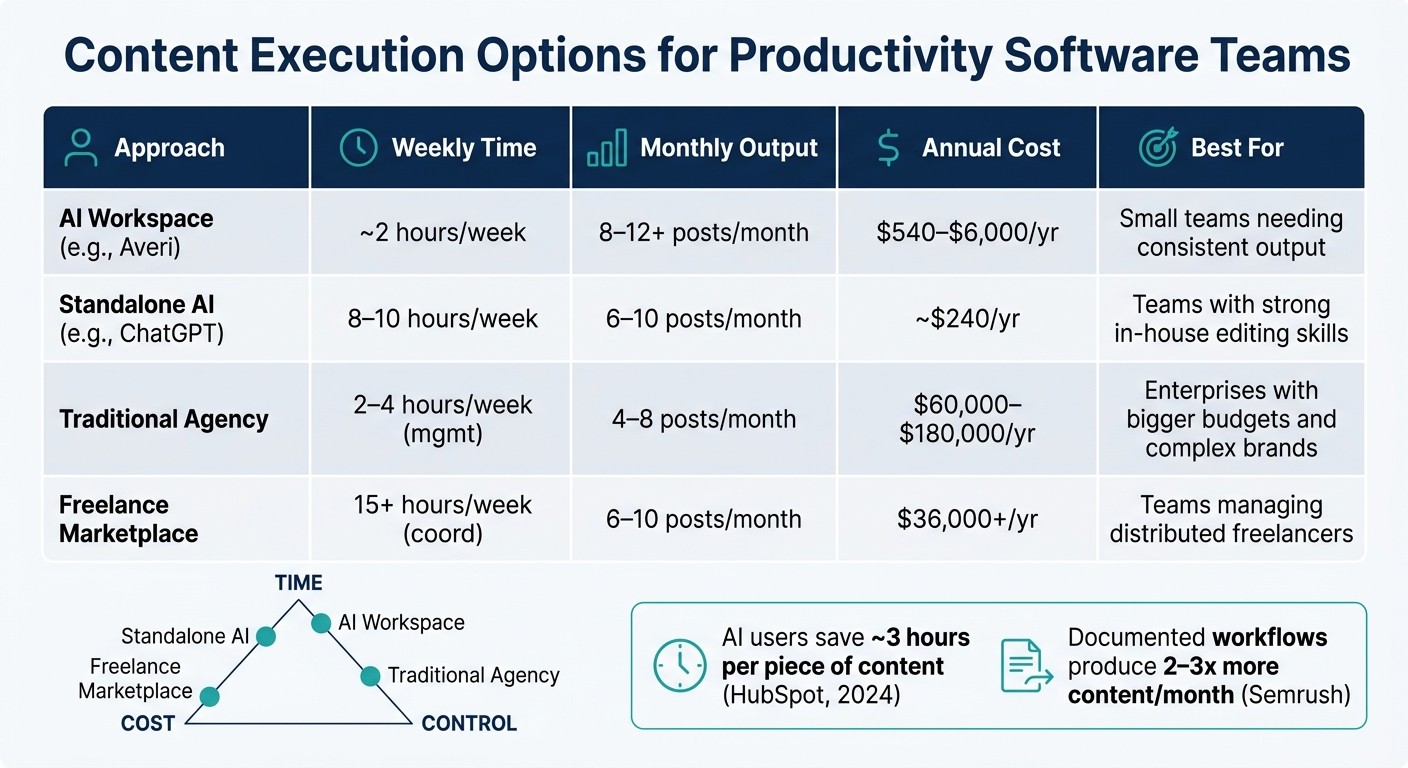
Content Execution Options for Productivity Software Teams: Time, Cost & Output
This section dives into how an AI-assisted workflow can seamlessly transform your content strategy into tangible results using an AI content engine. Once your content plans are in place, the next hurdle is executing them efficiently. For marketers in the productivity software space, leveraging AI tools can drastically boost efficiency. According to HubSpot's 2024 State of AI in Marketing report, AI users save about 3 hours per piece of content. Similarly, a Semrush study reveals that teams with documented workflows can produce 2–3 times more content per month without compromising engagement.
Step-by-Step Content Creation Workflow
An effective AI-assisted workflow follows a structured process where each step builds on the previous one:
Audience and Market Research: Use tools like SparkToro to uncover where your target audience spends time online. Combine this with keyword analysis tools like Ahrefs or Semrush to understand search intent and demand.
Brief Creation: Document details such as the target persona, funnel stage, primary keyword, product tie-in, and success metrics. Tools like Averi can auto-generate a first draft of the brief, which strategists can refine.
AI Drafting: Generate a structured first draft optimized for search engines.
Human Review: Involve subject-matter experts - like product managers or customer success leads - to refine the content. This step ensures accuracy, adds context, and sharpens the tone, typically taking 20–45 minutes.
SEO and Compliance Checks: Conduct final reviews for SEO and any compliance needs before publishing.
Performance Feedback Loop: Use performance data to refine future content strategies.
"We built Averi around the exact workflow we've used to scale our web traffic over 6,000% in the last 6 months." - Zach Chmael, Head of Marketing, Averi [3]
For productivity software marketers, it's worth including integration narratives (e.g., how a feature works with Google Workspace or Slack) and in-product CTA moments in your briefs. These elements can guide users toward activation rather than simply generating leads.
With a structured workflow in place, the right tools are critical for smooth execution.
Tools That Support the Workflow
No single tool can handle every stage of the workflow perfectly, so assembling a practical stack is key. For productivity software content teams, consider:
SparkToro: For discovering your target audience.
Ahrefs or Semrush: For keyword research and identifying competitive gaps.
Asana: To manage tasks, approvals, and deadlines.
Google Analytics 4 with Search Console: For monitoring content performance after publishing.
At the center of this stack is Averi, which integrates research, brief generation, drafting, SEO scoring, and CMS publishing into one platform. This avoids the inefficiency of juggling multiple standalone tools.
Comparing Content Execution Options
Each content execution method comes with its own set of trade-offs. Here's a breakdown:
Approach | Weekly Time | Monthly Output | Cost Estimate | Best For |
|---|---|---|---|---|
AI Workspace (e.g., Averi) | ~2 hours | 8–12+ posts | $540–$6,000/yr [1] | Small teams needing consistent output |
Standalone AI (e.g., ChatGPT) | 8–10 hours | 6–10 posts | ~$240/yr [1] | Teams with strong in-house editing skills |
Traditional Agency | 2–4 hours (mgmt) | 4–8 posts | $60,000–$180,000/yr [1] | Enterprises with bigger budgets and complex brands |
Freelance Marketplace | 15+ hours (coord) | 6–10 posts | $36,000+/yr [1] | Teams managing distributed freelancers |
The key trade-off lies in time, control, and cost. Standalone AI tools are budget-friendly but require manual oversight for research, SEO, and publishing. Agencies and freelancers reduce execution workload but demand significant coordination. Platforms like Averi streamline the entire process, making them ideal for smaller teams aiming to scale content production efficiently.
"The goal isn't to replace human judgment. It's to stop paying human labor rates for tasks that don't require human judgment." - Averi [10]
Measuring and Improving Content Performance
Focusing only on page views is a common trap for many teams. While page views can indicate interest, they don't reveal whether your content is driving meaningful actions like sign-ups, demo requests, or feature adoption. The real goal is to link content engagement directly to product-related behaviors. By doing so, you can align your full-funnel marketing strategy with buyer actions and measure its true impact across the customer journey.
Key Metrics for Productivity Software Content
The metrics you track should align with the buyer's stage in the journey. At the top of the funnel, focus on metrics like organic sessions, scroll depth, and branded versus non-branded search impressions to gauge whether your content is reaching the right audience. In the middle of the funnel, metrics like visitor-to-sign-up rates and click-through rates from blog posts to product pages are key. For high-intent pages, such as comparison guides or template libraries, a 3–7% conversion rate is a reasonable target for freemium products.
At the bottom of the funnel, prioritize metrics like demo bookings, trial starts, and workspace activations. A good benchmark is aiming for 50% of content-influenced sign-ups to create their first workspace within 48–72 hours [3][4].
Don't overlook expansion metrics either. For instance, if you publish a series on "advanced automation workflows" and see a 15% increase in feature adoption among readers, that's a clear signal of success - and a strategy worth repeating.
Using AI Tools for Performance Insights
To make meaningful improvements, data must lead to actionable insights. Platforms like Averi simplify this process by connecting analytics tools (e.g., GA4, Google Search Console) with your content strategy. These tools can automatically highlight opportunities, such as a blog post ranking at position #8 that needs structural adjustments to move up to page one, or a piece with high impressions but a low click-through rate that might benefit from a rewritten meta description [3].
Averi also flags content that hasn’t been updated in 90 days, suggesting it for a "citation freshness" update - critical for maintaining visibility in AI-driven search results. Tools like ChatGPT and Perplexity favor content that is both factually dense and current [3][2]. Think of AI analytics as a support system that identifies trends and opportunities your team can act on.
Finally, assess the performance of each content format to ensure you're maximizing your return on investment (ROI).
Channel and ROI Analysis by Content Format
Different content formats yield different results, and understanding their ROI is essential. For example, a long-form guide might generate steady organic traffic for over a year with minimal updates, while a webinar could produce fewer leads overall but attract higher-quality prospects who are more likely to convert. Comparing formats based on their efficiency and output helps you decide where to allocate your budget.
Content Format | Typical Strength | Key Metric to Watch |
|---|---|---|
Long-form guides | Evergreen search traffic | Organic sessions + trial starts |
Comparison pages | Bottom-funnel conversion | Visitor-to-demo rate (target: 1–3%) |
Templates / tools | High-intent sign-ups | Visitor-to-sign-up rate (target: 3–7%) |
Webinars | High-quality lead capture | Cost per qualified demo |
Onboarding content | Activation and retention | Workspace creation within 72 hours |
The smart approach is to evaluate your content formats quarterly. Identify the top three performers based on cost-per-lead, double down on those, and either refresh or phase out the formats that underperform. Often, optimizing content that already ranks or converts moderately well is faster and more cost-effective than creating something entirely new [1][5].
Conclusion: Scaling Content Marketing for Productivity Software
Scaling content marketing for productivity software isn’t about producing endless amounts of content - it’s about creating a systematic approach that ties strategy, execution, and measurement together. The most effective teams focus on clear messaging and streamlined workflows rather than sheer content volume. This framework builds on the principles of buyer journey mapping and content strategy discussed earlier.
The key is moving from scattered efforts to a structured, repeatable content engine. This means defining core messaging pillars, developing a structured content model, adopting AI-assisted workflows, and tracking critical metrics like trials and activations. For example, Notion expanded its user base from 4 million to over 30 million between 2020 and 2023 by turning community insights into scalable content assets [12][27]. Similarly, Zapier achieved over 8 million monthly visitors by 2021 with thousands of targeted, task-specific posts tailored to user needs [28]. These successes weren’t driven by volume but by intentional systems.
AI tools, such as Averi, play a pivotal role in this process. These tools don’t just accelerate drafting - they ensure brand consistency, identify content gaps, flag underperforming assets for updates, and tie performance data back to your content pipeline. As Zach Chmael, CMO of Averi, explains:
"The gap between 'AI is transforming content marketing' and 'I have a working content operation that generates leads while I sleep' is enormous. It's the gap between understanding that electric cars exist and building a Tesla factory." [2]
While automation is a game-changer, maintaining strategic oversight is crucial. The biggest risk isn’t moving too slowly - it’s over-automating and losing control of your strategy. AI can handle tasks like research, initial drafts, SEO optimization, and distribution, but humans must oversee strategic decisions, ensure product accuracy, and uphold the brand’s voice. By automating routine tasks and keeping human oversight where it matters most, you can transform your content operation into a highly efficient, scalable system. Aligning internal data, AI tools, and execution with user needs ensures your content strategy evolves into a sustainable and impactful infrastructure.
FAQs
How do I pick my top 3–5 messaging pillars?
To identify your top 3–5 messaging pillars, start by honing in on the central themes that reflect your brand's identity, align with your objectives, and resonate with your customers' needs. Dive into your ideal customer profiles, pinpoint their challenges, and highlight what makes you stand out from the competition. Leverage your Brand Core - including your products, voice, and distinguishing factors - to validate these themes. These pillars should consistently shape your content and affirm your expertise throughout the entire buyer journey.
What content should I create first to drive trials and demos?
To encourage trials and demos, structure your content to address every stage of the buyer's journey: awareness, consideration, and decision. Aim for a balanced approach, allocating 40% to awareness, 40% to consideration, and 20% to decision-stage content.
Focus on creating how-to guides that tackle user challenges, listicles that compare tools, and detailed comparison pieces like "Averi vs. X" to help prospects evaluate their options. For the decision stage, emphasize content backed by solid data to demonstrate how your platform meets specific needs. This approach not only informs potential users but also builds trust, making it easier to turn leads into active users.
How can I use AI without losing quality or accuracy?
To achieve both quality and precision with AI, it's essential to separate AI-driven tasks from human oversight. Start by establishing a well-defined Brand Core - this includes your business identity, product offerings, market positioning, and tone of voice. A clear Brand Core ensures AI outputs stay aligned with your brand and avoid coming across as generic.
Leverage AI for repetitive and time-consuming tasks such as research, initial drafts, and formatting. Meanwhile, reserve critical responsibilities like strategic planning, editing, and final approvals for human expertise. This approach not only ensures your content retains credibility and authority but also makes production more efficient.
Related Blog Posts

Zach Chmael
CMO, Averi
"We built Averi around the exact workflow we've used to scale our web traffic over 6000% in the last 6 months."
Your content should be working harder.
Averi's content engine builds Google entity authority, drives AI citations, and scales your visibility so you can get more customers.