How to Get Your SaaS Cited on G2, Capterra & Trustpilot in AI Search (2026)

Zach Chmael
Head of Marketing
6 minutes

In This Article
Review-site presence makes B2B SaaS 3.4x more likely to be cited in ChatGPT. The tactical playbook for G2, Capterra, and Trustpilot in 2026.
Updated
Trusted by 1,000+ teams
Startups use Averi to build
content engines that rank.
TL;DR
📊 100% of B2B SaaS tools ChatGPT cited in category queries had Capterra reviews; 99% had G2 reviews (Quoleady LLMO Research, 2026)
🎯 Brands with profiles on 2+ review platforms are 3.4x more likely to be mentioned in ChatGPT than those without
📈 Active review profiles drive 4.6–6.3 average ChatGPT citations vs. 1.8 for brands without them
🏢 G2 acquired Capterra, Software Advice, and GetApp on February 5, 2026 for $110M. The combined entity controls 55–58% of global software-review influence
🥇 G2 is the only B2B software review platform in the top 20 most-cited domains across ChatGPT, Google AI Overviews, and Perplexity
⏱️ Initial citation improvements visible in 60–90 days; stable citations develop in 4–6 months
🚫 Don't buy reviews, don't incentivize specific ratings, don't fake testimonials. All three violate platform ToS, get filtered by AI engines, and produce worse outcomes than no reviews at all

Zach Chmael
CMO, Averi
"We built Averi around the exact workflow we've used to scale our web traffic over 6000% in the last 6 months."
Your content should be working harder.
Averi's content engine builds Google entity authority, drives AI citations, and scales your visibility so you can get more customers.
How to Get Your SaaS Cited on G2, Capterra & Trustpilot in AI Search (2026)
In Quoleady's 2026 LLMO research, 100% of B2B SaaS tools ChatGPT named in software category queries had Capterra reviews.
99% had G2 reviews.
That's not a correlation. That's a binary inclusion gate.
If your SaaS doesn't have profiles on the major review sites by Q3 2026, you are mathematically not going to be in the ChatGPT shortlist when buyers ask the questions that drive pipeline.
The good news: review-site presence is the most tractable single GEO signal a founder can execute on without an agency, an engineering team, or a budget that exceeds a fractional CMO's monthly retainer.
This is the tactical playbook. The opposite of "buy reviews." Real, founder-doable steps for setting up profiles that AI engines actually trust, the review acquisition flow that compounds without violating platform terms, and the cross-source consensus pattern that turns review-site presence into citation share.
The full GEO cluster covers Reddit-driven citations, platform-specific GEO across ChatGPT, Perplexity, and Google AI Mode, and the citation measurement framework.
This piece closes the gap on review-site signals specifically.
Why Review Sites Became AI Inclusion Gates
Two structural shifts in 2025 and 2026 made review-site presence non-optional.
The first: large language models started treating user-generated review content as the most credible signal for product recommendations because it's third-party verified, structured, and concentrated on a small set of trusted domains.
The second: G2's $110M acquisition of Capterra, Software Advice, and GetApp consolidated those signals into a single ecosystem.
The acquisition closed on February 5, 2026.
G2 now controls four of the highest-authority software review domains LLMs rely on at the bottom of the funnel… G2 itself, Capterra, Software Advice, and GetApp. The combined entity holds an estimated 55–58% of global software-review influence and sits on the data infrastructure that feeds both human buyer decisions and AI-generated software recommendations.
That consolidation matters because LLMs trained on web crawl data and refreshed via retrieval-augmented generation surface what looks credible and consistent across sources. A B2B SaaS brand with verified reviews across G2 and Capterra, plus consistent positioning across its owned site and a few third-party mentions, looks credible to the model. The same brand without any review-site footprint looks invisible. Not bad. Invisible.
Currently, G2 alone holds a 2.09% share of AI citations in bottom-of-funnel B2B SaaS queries, placing it as the 4th most-cited domain across ChatGPT, Perplexity, AI Overviews, AI Mode, and Gemini — behind Reddit, YouTube, and LinkedIn. After Capterra and the other acquired properties roll into G2's data infrastructure (projected throughout 2026), the combined citation share could grow by 76% per Omniscient Digital's projections. Founders working off a pre-acquisition mental model of which review sites matter are working off the wrong map.
The Citation Math: How Much Review-Site Presence Actually Moves
The data from three independent 2026 studies converges on the same range. Companies with active profiles on at least two review platforms see 3.4x higher mention rates in ChatGPT responses than those without review profiles. Average citations move from 1.8 (no review presence) to 4.6–6.3 (active presence on G2, Capterra, and/or Trustpilot), per Aleva Digital's April 2026 ChatGPT optimization research.
The same patterns hold in adjacent measurement work.
Semrush's November 2025 analysis found that between one-third and three-quarters of all review-site citations across ChatGPT, Google AI Overviews, and Perplexity come from G2 specifically. Cited's GEO industry research ranks G2 and Capterra as cited 3–4x more than owned domains in B2B SaaS category queries.
The threshold numbers worth committing to memory: Cited's research recommends 50+ reviews on G2 and 30+ on Capterra for initial AI citation credibility, with 100+ reviews on each for strong AI visibility. Below the 50-and-30 threshold, AI engines have insufficient signal to surface the brand reliably. Above the 100-and-100 threshold, the marginal lift on additional reviews shrinks.
These numbers are also achievable.
A B2B SaaS company with even 50–100 active customers can reasonably collect 50 G2 reviews in 60–90 days using the acquisition flow below. The math isn't the constraint. The operational discipline is.
Platform Strategy: Which Platform Comes First
The instinct to be on every platform produces weaker results than concentrating effort on the right one or two. Spread thin across G2, Capterra, Trustpilot, TrustRadius, Gartner Peer Insights, and Software Advice simultaneously is how teams end up with 15 reviews on each platform — below the 50-review threshold on all of them, and below the 100-review threshold on any.
The framework for picking the primary platform, by company profile:
If your ICP is... | Primary platform | Secondary platform | Skip until later |
|---|---|---|---|
B2B SaaS targeting US / UK / mid-market and up | G2 | Capterra (now same company, lower-cost setup) | TrustRadius (enterprise only) |
B2B SaaS targeting SMB or European markets | Capterra | G2 (US footprint) | TrustRadius, Gartner |
B2B SaaS with strong consumer or SMB self-serve motion | G2 | Trustpilot (SEO benefits) | Gartner Peer Insights |
B2B SaaS targeting enterprise IT (Fortune 1000+) | G2 | TrustRadius | Trustpilot (B2C focus) |
Mixed B2C / B2B (productivity, design, communication) | G2 or Trustpilot | Capterra | TrustRadius |
The default for most B2B SaaS founders in 2026: list on G2 and Capterra simultaneously (they're now the same company, so setup and review-collection flows can be coordinated), skip TrustRadius until you have $5M+ ARR with enterprise traction, treat Gartner Peer Insights as optional unless your buyers are enterprise IT decision-makers.
Trustpilot is worth considering as a secondary if your product has a consumer-adjacent surface (productivity tools, design tools, communication tools), but it's not the primary investment for pure B2B SaaS.
Setting Up Your Profile For AI Citation
Profile setup is where most teams leave citation share on the table.
The default approach — write a punchy marketing description, upload a logo, list features — produces a profile that ranks for nothing AI engines extract.
The pattern that actually moves citations:
Write the description to match buyer query phrasing, not marketing copy
When ChatGPT processes a query like "best CRM for a 15-person sales team," it looks for profile descriptions that contain semantic matches to the query structure: company size, role, use case, industry. A description that reads "Our software helps sales teams of 5–25 people manage pipeline and forecast revenue with integrated email automation" outperforms "Innovative next-generation CRM solution for modern teams" by every measurable metric, including AI citation.
Use the structured fields exhaustively
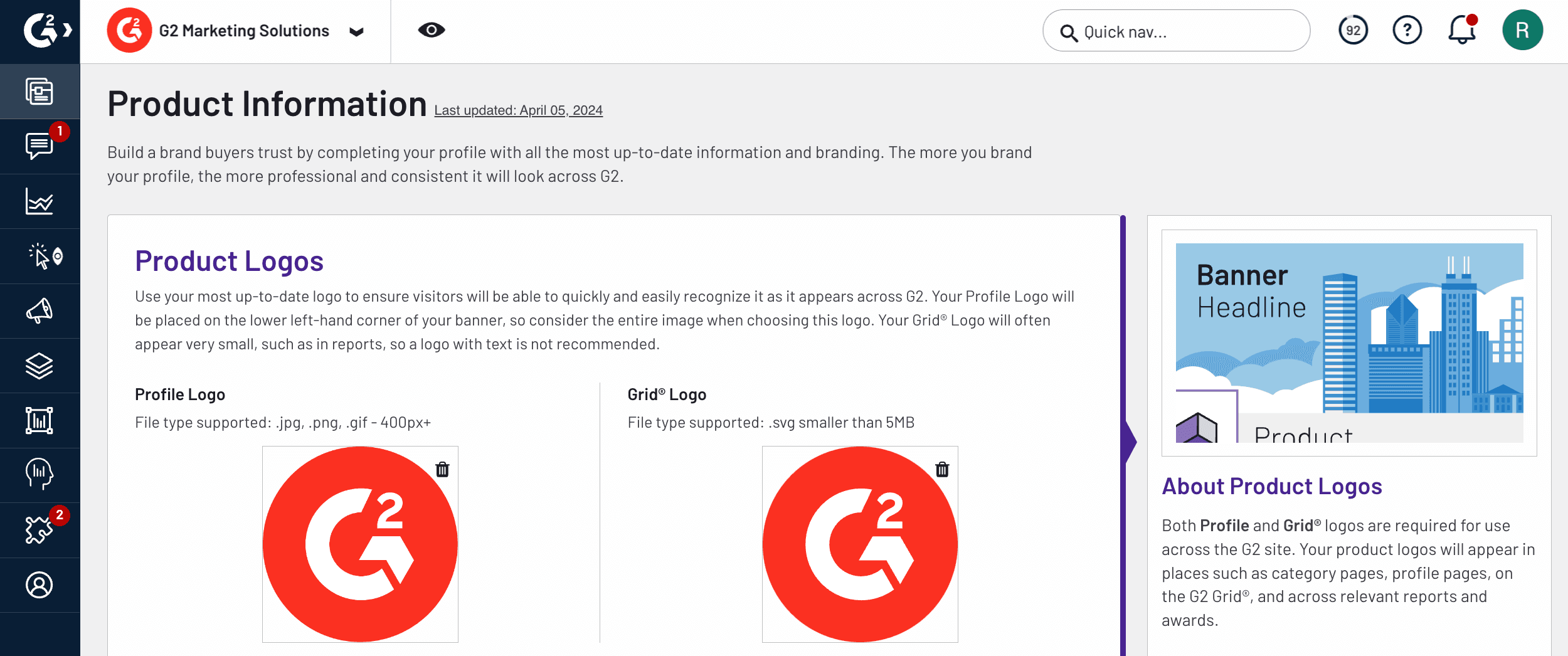
Categories, sub-categories, feature tags, integration lists, pricing tiers, target company sizes, deployment models. Every structured field G2 or Capterra offers is a parsing opportunity for AI engines. Empty fields are missed signals. Filled fields with accurate data are citation hooks.
Match category positioning to the categories AI engines actually use
The category you select on G2 should match the category your buyers search in. A "content engineering platform" listing on G2 will not get cited for queries about "AI content tools" unless the category is also tagged. Cross-listing across 2–4 relevant categories is normal and increases citation surface. Cross-listing across 8+ categories looks like keyword stuffing to both reviewers and AI models.
Map your features to G2's feature taxonomy
G2 maintains structured feature taxonomies per category. If your feature set is fragmented across non-standard labels, your profile is harder for both humans and AI engines to match against query intent. Use G2's exact feature taxonomy where your product fits, and add custom features only for the capabilities that actually differentiate you.
Pricing transparency strengthens the signal
Profiles that include accurate, current pricing tiers get cited more reliably than profiles that hide pricing behind sales conversations. AI engines processing buying-stage queries weight pricing transparency because their users want it. If your pricing is custom-quoted, list the starting tier and note where custom pricing begins. Don't leave the field blank.
The integration list is signal-dense
Every integration you support is a citation opportunity for queries like "best CRM that integrates with HubSpot." Complete integration listings (with verified integration status, not just "integrates with") punch above their weight in AI citation outcomes.
The Review Acquisition Flow (Ethical, Compliant, Compounding)
The review-acquisition system that compounds without violating platform terms has four components: trigger event identification, request timing, request channel, and follow-up cadence.
Trigger events
The high-conversion moments for review requests are concentrated around customer success milestones. Onboarding completion (typically week 1–2 post-signup). First measurable outcome (typically 30–60 days post-signup, varies by product). Renewal or annual contract milestone. NPS responses of 9 or 10 in your in-app survey. Customer-initiated expansion (upgrade, seat add, new use case). These are the moments when satisfaction is documented, recent, and specific.
Request timing
The strongest pattern is requesting reviews within 7 days of a trigger event, while the experience is fresh and the outcome is documented. Requests sent weeks after the trigger event get response rates 60–70% lower than same-week requests. Some platforms (G2 in particular) reward reviews that cite specific outcomes, which means the request has to land while the outcome is still recent in the customer's memory.
Request channel
Email is the default. In-app prompts (post-success modal, NPS follow-up) work well for product-led growth motions. CSM-initiated requests (account manager Slack DM or video message) outperform email for high-touch B2B. Whatever channel, the request should be human, not transactional. "Would you have 4 minutes to share what's working with [product] on G2? Here's a direct link" outperforms "Help us with a quick review of [product] by clicking here."
Follow-up cadence
Don't follow up more than twice. The pattern that works: initial request at trigger event, gentle reminder 7–10 days later if no response, then drop it. Aggressive follow-up sequences correlate with negative reviews and customer relationship damage. The goal is reviews from customers who actually want to leave them, not extraction from customers who feel obligated.
The volume math: a B2B SaaS company with 100 active customers, running this flow against trigger events, typically generates 30–60 reviews in the first 90 days and reaches the 50-review threshold on a primary platform within Q1 of implementation.
Below 50 active customers, the timeline stretches to 4–6 months because trigger event volume is lower.
What Not To Do (And Why It Backfires In AI Search)
Three patterns to avoid, each of which violates platform terms and produces worse AI citation outcomes than no reviews at all:
Don't buy reviews
Marketplaces and Fiverr sellers offer "review packages" at $5–$50 per review. Platforms detect them through verification gaps (unverified company emails, no LinkedIn match, reviewer history showing reviews across unrelated B2B categories). Detected reviews get removed; the account gets flagged; and AI engines downweight profiles with inconsistent signal-to-noise ratios. The worst outcome is a profile with 100 reviews where 60 are detectably fake — that's the kind of inconsistency that gets the entire profile filtered out of AI consideration.
Don't incentivize specific ratings
"Leave us a 5-star review and get a $50 gift card" is the textbook ToS violation across every major platform. Even softer versions ("share your honest review and we'll thank you with a small gift") are increasingly flagged. The compliant pattern is requesting reviews without incentive, then thanking reviewers afterward (a customer success outreach, a public callout, a holiday card) in ways that aren't tied to the review action.
Don't fake testimonials or fabricate reviewer profiles
Beyond ToS violations, AI engines now cross-reference reviewer profiles against LinkedIn, company websites, and other verification surfaces. Fake reviewers get flagged. Worse, they leave fingerprints across the profile that downweight the credibility of the genuine reviews around them. One detected fake review can cost you the citation value of 20 real ones.
The general pattern: AI engines are trained to detect inconsistency. The fastest way to lose AI citation share is to introduce inconsistency that an algorithm can detect.
The slowest way to build it is the pattern in the previous section… real customers, real outcomes, real requests, no incentives.
Cross-Source Consensus: Why You Can't Stop At Reviews
The thing most "GEO playbooks" get wrong about review sites is treating them as a standalone signal. They aren't.
AI engines look for cross-source consensus — verified reviews + editorial coverage + community discussions + owned-site claims that align. Review-site presence is necessary but not sufficient.
The compounding pattern: a B2B SaaS company with 80 G2 reviews, 30 Capterra reviews, 15 mentions in Reddit's r/SaaS, 3–5 mentions in industry publications, and consistent positioning across all five surfaces gets cited at meaningfully higher rates than a brand with 200 G2 reviews and no other footprint. The math is multiplicative, not additive. A single weak surface drags down the others; a balanced footprint compounds.
The implication for prioritization: after reaching the 50-review threshold on G2 and 30-review threshold on Capterra, the next investment is not "get to 100 reviews." It's "build the cross-source layer." That means:
Community presence
Reddit citations are increasingly central to ChatGPT's recommendations. Showing up authentically in r/SaaS, r/Entrepreneur, and category-specific subreddits matters. Same logic for relevant Slack communities and Discord servers if they're indexed.
Editorial coverage
A founder interview in TechCrunch, ProductHunt, or category publications produces backlinks plus mentions that AI engines treat as third-party validation. Five high-quality publications outperform 30 syndicated press releases.
Owned-site consistency
Your about page, product pages, and pricing pages should describe your product using the same language as your G2 listing and your Reddit appearances. Inconsistency across these surfaces is what AI engines treat as a credibility flag.
Comparison content
If your product is searchable by "X vs Y" queries, you should have direct comparison pages on your owned site that mirror the comparison framing on G2 and Capterra. AI engines pull comparison content as primary citation material for evaluation-stage queries.
Responding To Reviews (Yes, This Matters For AI Signal)
The often-skipped layer is review response. Most B2B SaaS teams respond to negative reviews and ignore positive ones. The pattern that strengthens AI citation outcomes is the opposite.
Response cadence matters. Responding to all reviews — positive and negative — within 7–14 days of submission produces a stronger "active brand" signal than responding only to the negatives. AI engines (and the platforms themselves) treat response volume and recency as engagement signals. A profile where 80%+ of reviews have brand responses is treated as a more credible source than a profile where 20% have responses.
Tone calibration matters. Generic "Thank you for the review!" responses are filtered out as noise.
The pattern that works: respond to specific points the reviewer made, acknowledge what's true, address what's false (without arguing), and where appropriate, name the action you're taking based on the feedback. AI engines parsing reviews for sentiment and content treat substantive responses as additional context that supplements the review itself.
Negative review responses are signal-rich.
When you respond to a negative review with a specific outcome ("we shipped X feature in March based on this feedback" or "we added Y to onboarding to address this gap"), the response gets quoted alongside the original review in AI extraction. Most teams treat negative reviews as PR damage control.
The opportunity is treating them as additional citation surface, and responding with substance that AI engines can extract.
The 90-Day Implementation Roadmap
The operational sequence that takes a B2B SaaS founder from "no review-site presence" to "at the citation threshold for both G2 and Capterra":
Week 1: Profile setup
Claim or create your G2 listing. Complete every structured field with accurate, current data. Match category and feature tagging to your buyer's query language. Repeat for Capterra. Total time: 4–6 hours per platform.
Week 2: Trigger event mapping
Identify the 3–5 customer success milestones that produce the highest natural review intent in your funnel. Build the email and in-app prompts for each. Test on 5–10 customers first to calibrate tone and timing.
Weeks 3–4: First batch outreach
Trigger the review acquisition flow against your existing customer base. Most B2B SaaS companies have 30–60 customers who would have left a review months ago if asked. The first batch is the easy harvest.
Weeks 5–8: Steady-state cadence
The flow runs continuously. New customers hit trigger events; review requests go out; responses come in. Target: 5–10 new reviews per week on the primary platform.
Weeks 9–12: Cross-source layer
Once you're approaching the 50-review threshold on G2 and 30 on Capterra, shift attention to the cross-source layer. Comment authentically in relevant subreddits. Pitch 1–2 editorial pieces. Update your owned-site language to match the language in your highest-rated review excerpts.
Day 90 checkpoint
You should be approaching the 50-and-30 threshold on G2 and Capterra. AI citations should be starting to register. The 60–90 day timing matches what Aleva Digital's ChatGPT optimization research reports as the typical citation lag for B2B SaaS brands implementing this pattern.
Days 90–180
The compounding phase. Reviews keep accumulating, AI citation share keeps growing, and the cross-source layer reinforces the review-site signal. By month 6, most teams that ran this playbook see stable AI citation outcomes that translate to measurable pipeline.
What To Measure
The metrics that matter for review-site GEO, in priority order:
Citation appearance frequency for your top 20 BOFU prompts across ChatGPT, Perplexity, Google AI Overviews, and Gemini. Run the same 20 prompts every 14 days and log appearances. The citation measurement framework walks through the operational setup.
Review count and average rating on G2 and Capterra. Track weekly. Below 50 reviews on G2 or 30 on Capterra, you're below the threshold for reliable citation. Above the threshold, marginal review additions matter less than cross-source layer development.
Response rate to reviews. Target 80%+ of reviews having brand responses within 14 days. Below 50% response rate, the active-brand signal weakens.
Cross-source distribution. A simple count of mentions across G2, Capterra, Reddit (with G2 verification of the subreddit's relevance), Trustpilot if applicable, and high-authority publication coverage. Imbalance (all G2, no Reddit) flags as a weakness; balance compounds.
Conversion from AI-driven traffic. When reviews start driving AI citation share, branded search and direct-traffic signals lift. Track branded search lift in Search Console and direct traffic in GA4. Both are downstream proxies for AI citation working.
Common Mistakes Founders Make On Review-Site GEO
Six patterns that cost teams citation share:
Mistake 1: Spreading thin across 6+ platforms. Better to have 80 reviews on G2 than 15 on G2, 15 on Capterra, 15 on Trustpilot, 15 on TrustRadius, 15 on Gartner, and 15 on Software Advice. Concentrate, then expand.
Mistake 2: Writing marketing-copy descriptions instead of buyer-query descriptions. Your G2 description should match how buyers actually phrase queries in ChatGPT. "Innovative platform" loses to "for marketing teams of 5–25 people who need..." every time.
Mistake 3: Ignoring positive reviews in response cadence. Responding only to negatives leaves 70% of your reviews without active-brand signal. Respond to everything within 7–14 days.
Mistake 4: Buying reviews or incentivizing ratings. The detection rate is high, the penalty is permanent, and the downstream citation damage exceeds the value of the bought reviews several times over.
Mistake 5: Treating reviews as a one-time launch project. The flow needs to run continuously. A 90-day push that fills the profile, followed by 6 months of silence, signals decline. Steady-state cadence outperforms episodic effort.
Mistake 6: Skipping the cross-source layer. Reviews alone don't compound to citation share. The full pattern is reviews + community presence + editorial coverage + owned-site consistency. Most teams stop at reviews and wonder why citations plateau.
Related Resources
GEO Across Platforms And Surfaces
Platform-Specific GEO: ChatGPT vs Perplexity vs Google AI Mode
How to Get Your SaaS Recommended by Perplexity: A Technical Deep Dive
GEO Foundations And Strategy
Beyond Google: Getting Cited by ChatGPT, Perplexity, and AI Search
Building Citation-Worthy Content: Becoming a Data Source for LLMs
BOFU And Buyer Journey
FAQs
How many reviews do I need on G2 and Capterra to get cited by ChatGPT?
The thresholds from current research: 50+ reviews on G2 and 30+ on Capterra for initial AI citation credibility, with 100+ on each platform for strong AI visibility. Below those thresholds, AI engines have insufficient signal to surface your brand reliably in software category queries. Most B2B SaaS companies with 50+ active customers can reach the initial threshold in 60–90 days using the review acquisition flow.
Does the G2 acquisition of Capterra change my review strategy?
Yes. As of February 5, 2026, G2 owns Capterra, Software Advice, and GetApp. The four platforms feed into the same data infrastructure, which means a coordinated listing strategy across G2 and Capterra is now operationally simpler than treating them as separate platforms. The default for most B2B SaaS founders: list on G2 and Capterra simultaneously, skip TrustRadius until you have enterprise traction, treat Gartner Peer Insights as optional.
Will buying reviews actually hurt my AI citation outcomes?
Yes, materially. AI engines and review platforms detect bought reviews through reviewer-profile inconsistencies, unverified company emails, and reviewer history that spans unrelated B2B categories. Detected reviews get removed; profiles get flagged; AI engines downweight profiles with detectable inconsistency. One bought review can cost you the citation value of 20 real ones because the inconsistency drags down the credibility of the surrounding genuine reviews.
How is review-site GEO different from traditional SEO for review sites?
Traditional SEO for review sites focused on backlink acquisition from G2 and Capterra to your owned site, plus ranking your category page on those platforms. Review-site GEO is about getting AI engines to cite your G2 or Capterra profile (or content extracted from it) directly in AI-generated answers. The optimization targets are different: structured field completeness, description-to-query matching, and cross-source consensus rather than backlink count.
Should I prioritize G2, Capterra, or Trustpilot for B2B SaaS?
G2 first for most B2B SaaS targeting US, UK, or mid-market and above. Capterra second (now same company as G2, lower-friction setup). Trustpilot only if your product has a consumer-adjacent surface. TrustRadius only after $5M+ ARR with enterprise traction. The "list on every platform" instinct produces weaker results than concentrating on the right 1–2 platforms.
How long until I see AI citations from review-site investment?
Initial citation improvements typically visible in 60–90 days of implementation, with stable citations developing in 4–6 months as authority signals compound. The 60–90 day window matches the time required to reach the 50-review threshold on G2 and 30 on Capterra using the review acquisition flow against an existing customer base.
Can I just rely on Reddit and skip review sites?
No. Reddit drives a meaningful share of ChatGPT citations, but the data is clear that review-site presence is a separate, additive signal. 100% of B2B SaaS tools ChatGPT cited in software category queries had Capterra reviews; 99% had G2 reviews. Skipping review sites in favor of Reddit-only optimization leaves the binary inclusion gate uncleared.