

In This Article
Getting cited by AI search engines isn't a single optimization you bolt on at the end. It's a systematic approach that touches strategy, structure, writing, formatting, and distribution. Averi's content engine was designed to embed GEO optimization into every layer of the workflow — not as an add-on, but as foundational architecture.
Updated
Trusted by 1,000+ teams
Startups use Averi to build
content engines that rank.
TL;DR
🤖 AI search isn't coming — it's already processing 2.5 billion prompts per day on ChatGPT alone. If AI platforms aren't citing your brand, you're invisible to a growing segment of your buyers.
📊 89% of B2B buyers now use generative AI during their purchasing research, and 29% start research via LLMs more often than Google. Your content either gets cited — or it gets bypassed entirely.
⚡ Getting cited requires a fundamentally different approach than ranking on Google. AI platforms evaluate content for citation-worthiness — attributed statistics, structured extractability, entity authority, and topical depth — not just keyword targeting.
🔧 Averi builds GEO (Generative Engine Optimization) into every step of content creation — from brand context and strategy architecture to AI-powered drafts with citation-ready formatting, and a content scoring system that grades for LLM citation-readiness alongside traditional SEO.
📈 This isn't theory. It's the system behind Averi's own 6,000%+ traffic growth and 1.68 million monthly organic impressions — now available as a product.

Zach Chmael
CMO, Averi
"We built Averi around the exact workflow we've used to scale our web traffic over 6000% in the last 6 months."
Your content should be working harder.
Averi's content engine builds Google entity authority, drives AI citations, and scales your visibility so you can get more customers.
How Averi Helps You Get Cited by AI Search Engines
Here's a question that should keep every startup founder up at night… when your ideal customer asks ChatGPT to recommend a tool in your category, does your name come up?
For most startups, the answer is no. And the problem is getting worse by the month.
ChatGPT now has over 800 million weekly active users and holds 80.49% market share among AI chatbots. Perplexity processes 780 million queries per month with 800% year-over-year growth. Google AI Overviews appear in 25.11% of all searches — nearly double the 13.14% from March 2025.
These aren't fringe platforms.
Generative AI tools were the single most cited meaningful interaction type for B2B purchase research in Forrester's 2025 Buyers' Journey Survey. Nearly three-quarters of U.S. business buyers now complete their purchasing journey in 12 weeks or less, and they're forming shortlists before ever talking to a sales rep.
The math is stark. AI search traffic converts at 14.2% compared to Google's 2.8% — that's 5x more valuable per visit. AI-driven visitors convert 4.4x higher than standard organic on average. Yet around 93% of AI search sessions end without a website click.
You're either in the answer or you're invisible. There is no second page.
This is the landscape that Generative Engine Optimization (GEO) was built to address. And it's the landscape Averi was specifically designed to win in.

Why traditional content tools can't solve this
Most content platforms were built for one thing: helping you rank on Google. Keyword research, SERP analysis, on-page SEO scoring. That matters — traditional SEO remains foundational because AI systems still pull from indexed web content.
But ranking and getting cited are fundamentally different outcomes.
Here's what the data tells us about what AI platforms actually value:
Structure beats authority. Pages with well-organized headings are 2.8x more likely to earn citations in AI search results than poorly structured content. Content with statistics sees 28% higher impression scores, and direct quotations increase citation likelihood by 37%.
Traditional rankings don't guarantee citation. Around 80% of URLs cited by ChatGPT, Perplexity, Copilot, and AI Mode don't rank in Google's top 100 results for the original query. Let that sink in. The content AI systems choose to cite is often completely different from what ranks on page one.
Brand mentions matter more than backlinks. Brand mentions have a 0.664 correlation with AI visibility — stronger than any traditional SEO metric. Brands in the top 25% for web mentions get 10x more AI visibility than others.
Platform fragmentation is extreme. Only 11% of domains are cited by both ChatGPT and Perplexity. Citation rates vary by a factor of 46x across different AI platforms. Optimizing for "AI search" as a monolithic category is like optimizing for "social media" without distinguishing between LinkedIn and TikTok.
Freshness is non-negotiable. Pages updated within 2 months earn 28% more citations than older content. 90% of AI citations come from earned and owned media, not paid placements.
Traditional content tools — Jasper, Copy.ai, Clearscope, Surfer SEO — were built before this shift. They optimize for one search engine, one dimension, one set of ranking factors. None of them score for LLM citation-readiness. None of them build GEO optimization into the content creation process itself.
That's the gap Averi fills.
How Averi builds citation-worthy content at every step
Getting cited by AI search engines isn't a single optimization you bolt on at the end. It's a systematic approach that touches strategy, structure, writing, formatting, and distribution.
Averi's content engine was designed to embed GEO optimization into every layer of the workflow — not as an add-on, but as foundational architecture.
Here's how each component of the platform maps to getting cited.
Brand Core: Entity consistency that AI systems trust
AI platforms don't just evaluate individual pages. They evaluate your brand as an entity across the entire web. Brand search volume is the strongest predictor of AI citations (0.334 correlation), and AI systems cross-reference brand claims against multiple independent sources before citing you.
When you onboard with Averi, Brand Core scrapes your website and learns your brand identity — your positioning, your ICPs, your competitors, your terminology. Every piece of content the engine produces uses this same context. That means:
Your brand name, descriptions, and key claims are consistent across every piece of content you publish. Your messaging language doesn't drift between articles or mutate across months of production. The entity signals AI platforms use to identify and trust your brand — the exact descriptions, product claims, and positioning language — remain stable across your entire content footprint.
This matters because entity recognition and brand consistency are core citation factors. When ChatGPT encounters conflicting descriptions of your company across different pages, it loses confidence in citing you. Brand Core eliminates that risk by design.
Strategy Map: Topical authority architecture
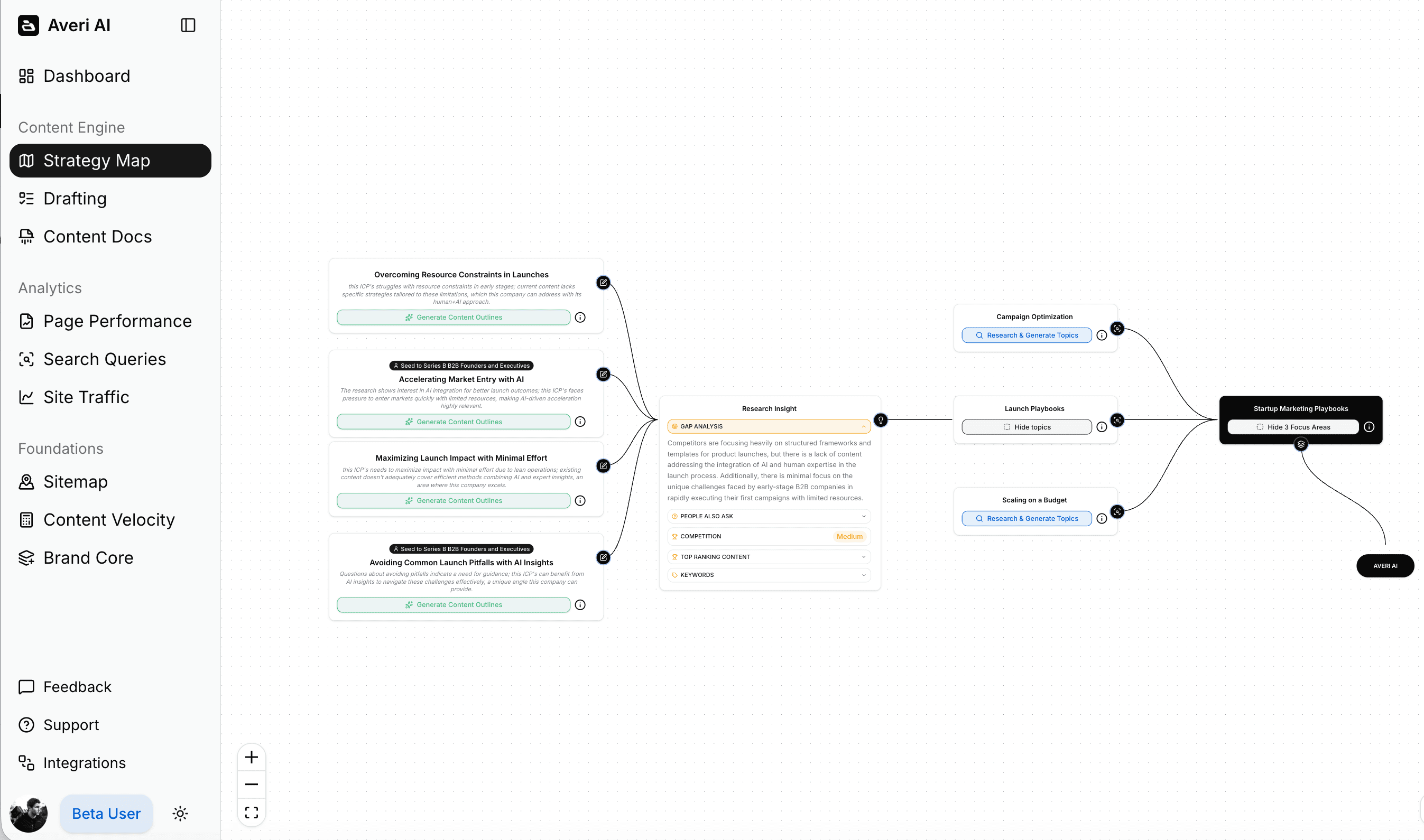
AI systems don't cite individual pages in isolation. They cite brands that demonstrate comprehensive expertise across a topic cluster. Princeton's GEO research confirms that clustering brand mentions across multiple LLMs increases first-position citation likelihood by up to 2.8x.
This is exactly what Averi's Strategy Map builds.
It organizes your content into a layered hierarchy — from content pillars your brand needs to own, through focus areas backed by competitive intelligence and keyword data, down to individual topics with search intent already mapped.
That pillar-based architecture does two things for GEO simultaneously. First, it builds topical authority that compounds with every published piece — the kind of comprehensive coverage AI systems reward with citations. Second, it ensures every piece of content is part of a deliberate cluster rather than a disconnected one-off, creating the content clustering patterns that reinforce your expertise signals across the web.
The Strategy Map isn't a static spreadsheet.
It's a living system backed by real keyword data, competitor gap analysis, and search intent mapping at every layer. It's the same system behind Averi's own growth from zero to 1.68 million monthly organic impressions — now available to every user on the platform.
AI-powered drafts: Citation-ready formatting from the first word
Here's where most content tools fail catastrophically at GEO. They produce text. Averi produces citation-ready content.
Every draft generated through Averi's content engine comes with GEO optimization baked into the structure:
40-60 word answer blocks. Each major section begins with a direct, extractable answer to the section's core question. This isn't arbitrary — it's the optimal length for LLM extraction. Long enough to be a complete, standalone answer. Short enough to fit naturally into a synthesized AI response. This is your "citation block" — the exact text an AI system might pull when answering a related query.
Statistics with clear attribution. Averi's research-first drafting process scrapes and collects key facts, statistics, and quotes with hyperlinked sources before generating drafts. The citation-worthy elements that AI systems prioritize — verifiable claims, attributed data, authoritative references — are embedded from the start. Content with attributed statistics sees 28-40% higher visibility in AI responses.
FAQ sections with schema-ready formatting. Every piece includes FAQ sections structured for both featured snippets and AI citation. AI systems parse FAQ structures extremely well — they're essentially pre-formatted for extraction.
Hierarchical heading structure. Proper H1 → H2 → H3 nesting that AI systems can parse, chunk, and cite independently. Each section is self-contained and citable as a standalone unit — because that's exactly how LLMs process content.
Internal linking across your content ecosystem. Every draft includes relevant internal links that strengthen topical authority signals and help AI crawlers understand the relationships between your content.
You're not manually implementing citation-friendly formatting. The structure is built into the workflow.
Content scoring: The only system that grades for LLM citation-readiness
This is Averi's most significant differentiator. No major content platform scores for GEO.
Averi's content scoring system evaluates every piece across three dimensions:
SEO Score (40% of composite) — traditional search optimization signals including keyword coverage, content structure, on-page technical elements, and readability. This is table stakes. Every content tool does some version of this.
AEO Score (25% of composite) — Answer Engine Optimization measuring how well your content is structured for extraction into featured snippets, People Also Ask, knowledge panels, and voice assistant answers. Answer block quality, question-based structure, and schema readiness.
GEO Score (35% of composite) — LLM citation-readiness. This is the dimension nobody else measures. Citation-worthiness (statistics with attribution, original data, source diversity). Extractability (answer blocks, atomic content structure, TL;DR sections). Entity and authority signals (author bios, E-E-A-T markers, publication dates). LLM accessibility (HTML rendering, robots.txt allowing AI crawlers, structured data, llms.txt files).
The composite score tells you not just whether your content will rank, but whether it will get cited. And the recommendation engine doesn't just flag problems — it tells you exactly what to fix, why it matters for each search dimension, and estimates the point impact.
Surfer, Clearscope, and Yoast are SEO-first tools. They don't score for the 60% of the optimization landscape that exists beyond traditional search.
Averi scores for all of it in real-time as you write.
Smart Content Queue: Consistent velocity that compounds
Citation authority isn't built overnight.
Pages updated within 2 months earn 28% more citations than older content. Research suggests approximately 250 substantial documents are needed to shift LLM brand perception meaningfully. And companies that publish 16+ posts per month see 3.5x more inbound traffic than irregular publishers.
Averi's Content Queue ensures you never stall.
The AI proactively generates topic recommendations based on your strategy, competitor intelligence, trending keywords, and content gaps. You approve what gets created — the engine handles the research and queuing.
This solves the single biggest GEO challenge for startups: maintaining the publication velocity required to build compound authority. You can't build citation-worthy authority publishing one blog post a month when your competitors are publishing weekly. The queue keeps your content engine running at a pace that actually moves the needle.
Content Engine: Compounding authority over time
Every piece of content published through Averi lives in the Engine — and this is where the compounding effect becomes real.
This isn't just storage. It creates cumulative context. Every published piece informs every future draft, building entity authority automatically. Your 50th article is more effective than your first because the system knows what you've already covered, what internal links exist, and where topical gaps remain.
For GEO specifically, the Content Engine does something no standalone writing tool can: it builds the topical depth and coverage breadth that AI systems evaluate when deciding whether to cite your brand. AI systems don't cite brands that publish sporadically on disconnected topics. They cite brands that demonstrate systematic, comprehensive expertise — the exact pattern a library of interconnected, pillar-based content creates.
Built-in analytics: Measuring what actually matters
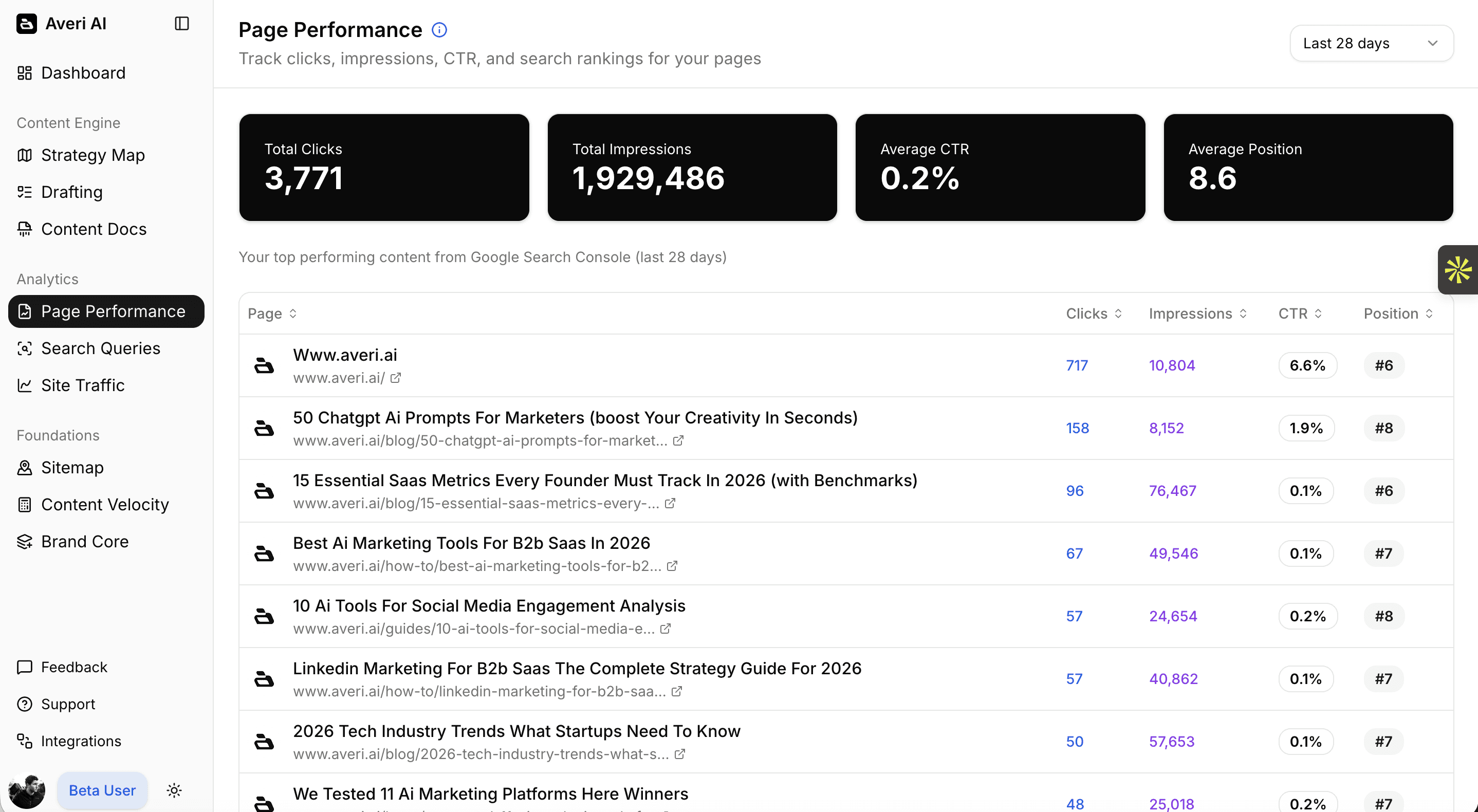
You can't optimize what you can't measure. Averi's integrated analytics connect directly to Google Search Console and Google Analytics, tracking rankings, impressions, clicks, and traffic alongside content performance.
This closed loop matters for GEO because citation authority is dynamic. The engine analyzes performance, spots opportunities, and queues new content recommendations based on what's working — so your content strategy responds to real data rather than guesswork.
The platform's smart recommendations proactively surface content that needs refreshing (critical for maintaining citation currency), topics where competitor content is outperforming yours, and gaps in your topical coverage that are costing you AI visibility.
Native CMS publishing: Technical accessibility for AI crawlers
This one is underrated. AI systems can only cite content they can access. Content rendered entirely in JavaScript is invisible to many AI crawlers. Proper HTML rendering, fast load times, and correct technical implementation directly affect citation eligibility.
Averi publishes natively to Webflow, Framer, and WordPress, with custom webhook setup available as well — ensuring your content is in clean HTML that AI crawlers can access, parse, and cite. No copy-paste formatting issues. No JavaScript rendering barriers. No publishing bottleneck between "draft approved" and "live on the web."
When you remove the publishing bottleneck, the compound effects kick in. Weekly publishing becomes achievable. Twice weekly becomes possible. And that velocity is what builds the citation authority that AI systems reward.

What this looks like in practice
The mechanics are one thing. Here's how the workflow plays out for a real startup.
Monday, 30 minutes: Review your content queue. Open Averi. The Smart Content Queue has generated 3-5 topic recommendations based on your Strategy Map, recent competitor moves, and keyword opportunities. You review, approve 2-3, and prioritize. Done.
Tuesday-Thursday: AI drafts with your context. Averi generates drafts using your Brand Core context — your voice, your positioning, your ICPs. Each draft comes pre-loaded with research citations, answer blocks, FAQ sections, hierarchical headings, and internal links. The content scoring system shows you the SEO, AEO, and GEO scores in real-time.
Friday, 1-2 hours: Refine and publish. You add your perspective, refine the voice, inject founder insights the AI can't replicate. Hit publish. It goes directly to your CMS — Webflow, Framer, WordPress — formatted, optimized, and live.
Ongoing: The engine compounds. Every published piece strengthens your Library, reinforces your topical authority, and creates new internal linking opportunities for future content. Your 20th article makes your first 19 more powerful. Your 50th makes all 49 more powerful. The citation authority compounds exponentially.
This is the 5-hour-per-week content engine — and every hour produces content that's optimized for both Google rankings and AI citations.
The GEO advantage nobody else can offer
Let's be direct about positioning.
Other tools do parts of this. Surfer scores for SEO. Jasper generates text. WordPress publishes content. You can cobble together a 5-tool stack that does some version of research → write → optimize → publish.
But no other platform in the market:
Scores content for LLM citation-readiness alongside SEO and AEO in real-time
Embeds GEO optimization into draft generation — not as a post-creation checklist but as fundamental output architecture
Maintains brand entity consistency across every piece of content automatically
Builds pillar-based topical authority through a visual Strategy Map designed for compound coverage
Proactively recommends content based on citation gaps, competitor movements, and performance data
Publishes natively to CMS ensuring AI crawler accessibility
This is the difference between a content tool and a content engine. Tools produce output. Engines produce compound authority.
And in a landscape where AI search visitors are predicted to surpass traditional search visitors by 2028, compound citation authority isn't a nice-to-have. It's survival.
The window is closing
Early movers gain structural advantages that compound for GEO. Research shows early adopters of GEO strategies have 3x higher AI visibility than late movers. 93% of digital leaders are building GEO capabilities in-house rather than outsourcing — and high-maturity organizations spend nearly twice as much on GEO as lower-maturity peers.
Meanwhile, 62% of brands are already experiencing traffic declines due to unoptimized AI presence.
Every month you wait is a month your competitors are building citation authority you'll have to overcome. Every week of sporadic, unoptimized content production is a week where AI systems are forming opinions about your category — and deciding who to recommend — without your brand in the conversation.
The brands winning in 2026 aren't just ranking on Google. They're showing up when ChatGPT, Perplexity, and AI Overviews synthesize answers for their buyers. They're becoming the brands that AI systems cite by default.
That's what Averi builds. Not just content — compound citation authority that makes your brand the answer, not just a search result.
Ready to become the brand AI search engines cite?
See How Averi's Content Engine Works →
Related Resources
If you're ready to build the engine: Start Your Free Trial — set up Brand Core, generate your Strategy Map, and publish your first piece in under an hour.
If you want to go deeper on the workflow: The Founder's Guide to Content Marketing in 5 Hours a Week — the companion guide with step-by-step implementation details. The 60-Minute Marketing Week: What Seed-Stage Founders Should Actually Do Every Monday — the even leaner version for pre-revenue founders. How to Do Marketing as a Solo Founder Without Burning Out — the mindset and systems behind sustainable founder-led marketing.
If you're evaluating the cost math: Why Hiring a Marketing Manager Costs You $370K (And What to Do Instead) — the full TCO breakdown of in-house vs. alternative approaches. Content Marketing on a Startup Budget: High-ROI Tactics for Lean Teams — channel-by-channel ROI analysis for resource-constrained teams. ROI Savings Calculator — plug in your numbers and see the math for your specific situation.
If you want the full content strategy playbook: How to Build an AI Content Engine That Grows Your Startup — the comprehensive guide to building compound organic growth. Content Velocity for Startups: How Much Content to Publish (and How Fast) — data-backed publishing cadence recommendations. Creating a 30-Day AI-Powered Content Calendar (With Prompts & Templates) — tactical calendar framework you can implement this week.
If you're a technical or non-marketing founder: The Ultimate Guide to Marketing for Non-Marketing Founders — everything you didn't learn in CS or engineering school. Technical Founders: How to Build Marketing Momentum Without a Marketing Co-Founder — specific strategies for product-first founders. Content Marketing for Startup Founders — curated resource hub with templates, tools, and guides.
Free tools to get started today: Content ROI Calculator — model your expected returns from content investment. Content Strategy Quiz — assess your current content readiness in 5 minutes. Content Brief Generator — create your first optimized content brief for free. Content Strategy Template — the framework behind Averi's Strategy Map. Content Workflow SOP Template — systematize your content process from day one. Brand Voice Guide Template — document your voice before you scale content production.
FAQs
How long does it take to start getting cited by AI search engines?
Foundation work — content restructuring, entity consistency, and schema implementation — typically shows initial results in 4-8 weeks. Meaningful citation improvements appear within 90 days of systematic optimization. Building the kind of topical authority that earns consistent citations takes 3-6 months of sustained effort. The advantage of starting with Averi is that GEO optimization is built into every piece from day one, rather than retrofitted after the fact.
Does getting cited by AI search engines replace the need for traditional SEO?
No — it transforms and extends it. AI systems pull from indexed web content, so strong traditional SEO remains the foundation that AI platforms draw from. But layering GEO optimization on top is no longer optional. The brands winning in 2026 excel at both traditional rankings and AI citations. That's why Averi's content scoring system weights across all three dimensions: SEO (40%), AEO (25%), and GEO (35%).
Which AI search platforms matter most for B2B startups?
ChatGPT drives 87.4% of all AI referral traffic and holds over 80% market share, making it the highest priority. Perplexity captures roughly 15% of AI traffic but includes external links in over 77% of responses, making it crucial for referral traffic. Google AI Overviews are unavoidable for any brand with informational content. A complete strategy covers all three — and each platform has different citation patterns and optimization requirements.
How is GEO optimization different from what other content tools offer?
Most content platforms score exclusively for traditional SEO — keyword density, content structure, readability. They were built before AI search became a significant discovery channel. Averi is the only content platform that scores for LLM citation-readiness as a distinct dimension, evaluating citation-worthiness (attributed statistics, source diversity, original data), extractability (answer blocks, atomic structure), entity signals (E-E-A-T markers, author credentials), and LLM accessibility (HTML rendering, AI crawler access, structured data).
Can AI-generated content get cited by AI search engines?
AI-generated content can earn citations, but only with human oversight and GEO-specific optimization. Raw AI output rarely achieves citation because it lacks originality and expert perspective. The effective approach — and the one Averi's human-in-the-loop workflow is built around — is AI handling research, structure, and optimization while humans provide voice, expertise, and the editorial judgment that makes content genuinely citation-worthy.
How do I track whether AI search engines are citing my brand?
Tracking AI citations requires a multi-platform approach. Start with manual sampling — regular queries to ChatGPT, Claude, and Perplexity using your target topics. Set up GA4 custom segments for AI referral traffic. Key metrics include citation frequency, attribution quality (whether citations include your brand name), competitive AI share of voice, and AI traffic conversion rates. Specialized tools like Otterly.AI, Semrush's AI SEO Toolkit, and Superlines can supplement manual tracking.
What makes content "citation-worthy" for AI systems?
Citation-worthy content shares specific characteristics: statistics with clear attribution (not just numbers — sourced, verifiable data points), structured formatting that AI can parse and extract (headings, answer blocks, tables, FAQ sections), comprehensive topical coverage that demonstrates genuine expertise, clear entity signals including author credentials and publication dates, and consistency with your brand's claims across the web. Averi's content engine builds all of these elements into every draft automatically.