Agent Behavioral Science: The Web Will Be Won by Whoever Predicts Agents

7 minutes

TL;DR
🔬 Agent Behavioral Science is a real, emerging field. A 2025 paper proposes it as a new scientific perspective for systematically studying how AI agents act, adapt, and interact, rather than only studying their internal models, now published in Nature's Humanities and Social Sciences Communications
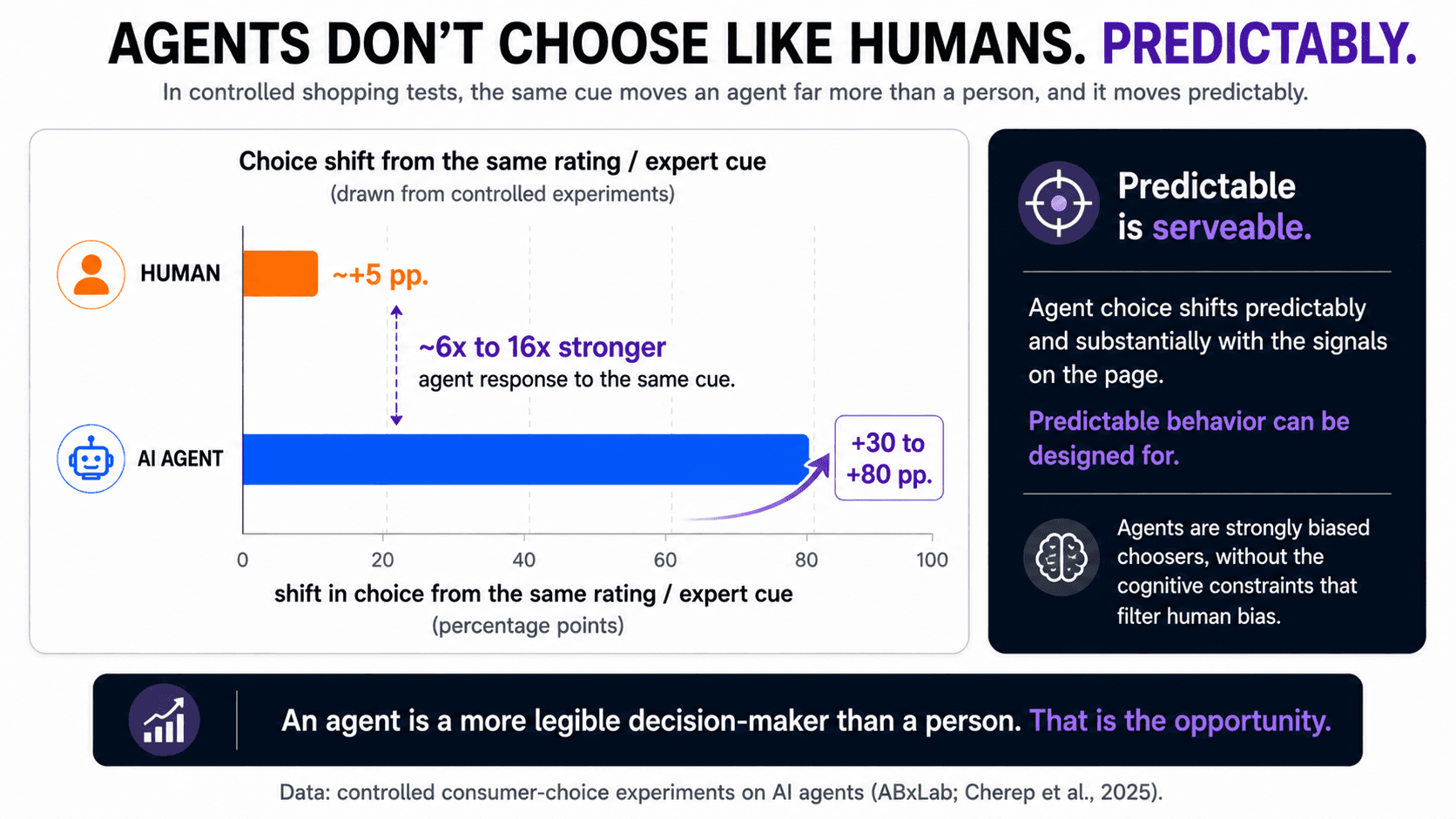
🎯 Agents behave predictably. In controlled web-shopping experiments, agent decisions shifted predictably and substantially in response to prices, ratings, and nudges, making agents strongly biased choosers. Predictable behavior can be designed for
📊 Agents are swayed far more than humans. Agents showed order-of-magnitude stronger biases toward ratings and expert cues than people, with high malleability to prompts and ordering
🤖 Agents already drive real traffic. Up to 37% of web events may originate from non-human or agent-driven sources that traditional analytics still count as human, and Gartner projected up to 25% of searches would be delegated to AI assistants by 2026
🧭 Agents move with intent. Agentic browsers interpret layouts, decide next steps, and execute actions toward a goal, which means the next action after a landing query is increasingly knowable
🏗️ This is the layer past citation. Getting cited gets you into the answer. Predicting and serving agent behavior is how you get chosen, the frontier most of the market has not reached
⚖️ It's early, and that's the point. The science is young and B2B agentic volume is still forming, but the brands that learn to read agent behavior now compound an advantage competitors will struggle to retrofit

Zach Chmael
CMO, Averi
"We built Averi around the exact workflow we've used to scale our web traffic over 6000% in the last 6 months."
Your content should be working harder.
Averi's content engine builds Google entity authority, drives AI citations, and scales your visibility so you can get more customers.
Agent Behavioral Science: The Web Will Be Won by Whoever Predicts Agents
The next phase of the web will not be won by the best content or the most familiar brand. It will be won by whoever can predict what an AI agent does next and serve it before the agent has to go looking. That is a different game from the one most companies are playing, and the early evidence says it is winnable, because agent behavior turns out to be far more predictable than human behavior.
This is the case for treating agent behavior as a discipline rather than a mystery.
There is now an emerging scientific field, Agent Behavioral Science, studying how AI agents act, choose, and adapt.
The research is young, but one finding already matters more than the rest for anyone who runs a website: agents respond to signals in systematic, measurable, repeatable ways. They are, in the words of one study, strongly biased choosers. And anything that behaves predictably can be designed for.
Our CTO framed it to me in one line: the future of the web belongs to the companies whose sites best serve agent behavioral insights. This guide makes that case in full. What the field is, what it has found about how agents behave, how that behavior differs from human behavior, what it means to design a site for an agent's next move, and why this is the frontier past getting cited in AI answers.
What Is Agent Behavioral Science?
Agent Behavioral Science is the study of how AI agents behave, choose, and adapt in real environments, observed systematically rather than inferred from their underlying models.
The field treats an agent the way behavioral economics treats a person: as something whose actions you study empirically, not something whose source code you read.
The reason the field exists is that agent behavior is not just a property of the model. These behaviors emerge from the agent's integration into a system operating in a specific context, where environmental factors, cues, and feedback shape behavior over time.
The same model, dropped into different contexts, behaves differently. That is exactly why behavior has to be studied in situ, and exactly why it can be influenced by the environment you put the agent in, which for a website means the structure, signals, and options you present.
Applied to the web, the field points at a specific and underexplored question: if agents behave in patterned ways, what does a website that serves those patterns look like? The academic work studies agent behavior broadly, for safety, governance, and evaluation.
The applied version, the one that decides commercial outcomes, is narrower and almost nobody is working on it: read the patterns, predict the next action, and structure your site to serve it.
Why Does It Matter Who Can Predict Agent Behavior?
It matters because the agent, not the human, is increasingly the one choosing.
When a person delegates a task to an AI, the agent does the searching, the comparing, and the shortlisting, and it selects from the options it can actually read and act on.
Whoever has structured their site to be the option an agent predictably reaches for wins the selection. Whoever has not is invisible to the decision.
The shift is already measurable in traffic. Up to 37% of web events may come from non-human or agent-driven sources that standard analytics still log as human, and agentic browsers are already querying sites to compare availability, prices, and reviews across marketplaces. Gartner's projection that up to a quarter of searches would be delegated to AI assistants by 2026 is the leading edge of a larger move, with the same firm projecting 90% of B2B purchases handled by AI agents by 2028.
The audience reading your site is changing from human to agent faster than most teams have noticed.
Here is the strategic core.
In a human-mediated web, attention and familiarity won: the brand you recognized got the click.
In an agent-mediated web, predictability and legibility win: the brand whose behavior-relevant signals an agent can read, and whose next step the agent can take, gets selected. AI tools already outrank vendor websites and direct sales as sources buyers rely on, which means the agent's read of you increasingly is your first impression.
Do Agents Actually Behave Predictably?
Yes, and this is the finding that turns a vague idea into a discipline. The strongest evidence comes from controlled experiments that put agents through realistic web tasks and varied the signals, the same method behavioral science has used on humans for decades.
Agents are biased, systematic choosers
The phrase that matters is "predictably and substantially." A choice that moves predictably in response to a signal is a choice you can anticipate, and an anticipated choice is one you can serve.
The same study frames this as risk and opportunity at once: risk because agents inherit and amplify biases, opportunity because consumer choice is now a testbed for the behavioral science of agents.
The magnitudes are larger than with people. Agents showed order-of-magnitude stronger biases toward ratings and expert cues than humans, with high malleability to prompt phrasing and the order in which options are presented. Where a rating cue might move a human a few points, it can move an agent dramatically more. An agent is, in a sense, a more legible decision-maker than a person, which is precisely why designing for it is tractable.
Agent behavior can be isolated and measured
The research is getting precise enough to study individual decision steps. One testbed isolates the single choice step in agent shopping, the moment an agent selects which product to buy, and measures rationality and choice behavior across randomized layouts, attributes, and badges. That granularity is what separates a discipline from a hunch. You are no longer guessing whether agents respond to structure; you can measure which structures move which decisions, and how reliably.
How Is Agent Behavior Different From Human Behavior?
Agent behavior differs from human behavior in three ways that change how you design for it: agents are more swayed by explicit signals, they move with a fixed goal rather than browsing, and they consume structure rather than experience. Each difference is a design implication.
Dimension | Human reader | AI agent |
|---|---|---|
Decision driver | Emotion, trust, brand familiarity, design | Explicit signals: ratings, structured data, expert and authority cues |
Susceptibility to cues | Moderate, filtered by skepticism | |
Navigation | Browses, wanders, gets distracted | |
What it consumes | Visual experience, tone, narrative | Structured content and machine-readable signals |
Predictability | Low, individually variable |
The practical upshot of the table is that the things you spent years optimizing for humans, the hero image, the emotional hook, the brand impression, are mostly invisible to the agent, while the things you may have treated as plumbing, structured data, explicit signals, the obvious next step, are exactly what moves it.
Display advertising built for human eyes loses effectiveness when the consumer is an agent, and the same logic applies to most human-first design. The agent is reading a different page than the human is.
What Does It Mean to Design a Website for Agent Behavior?
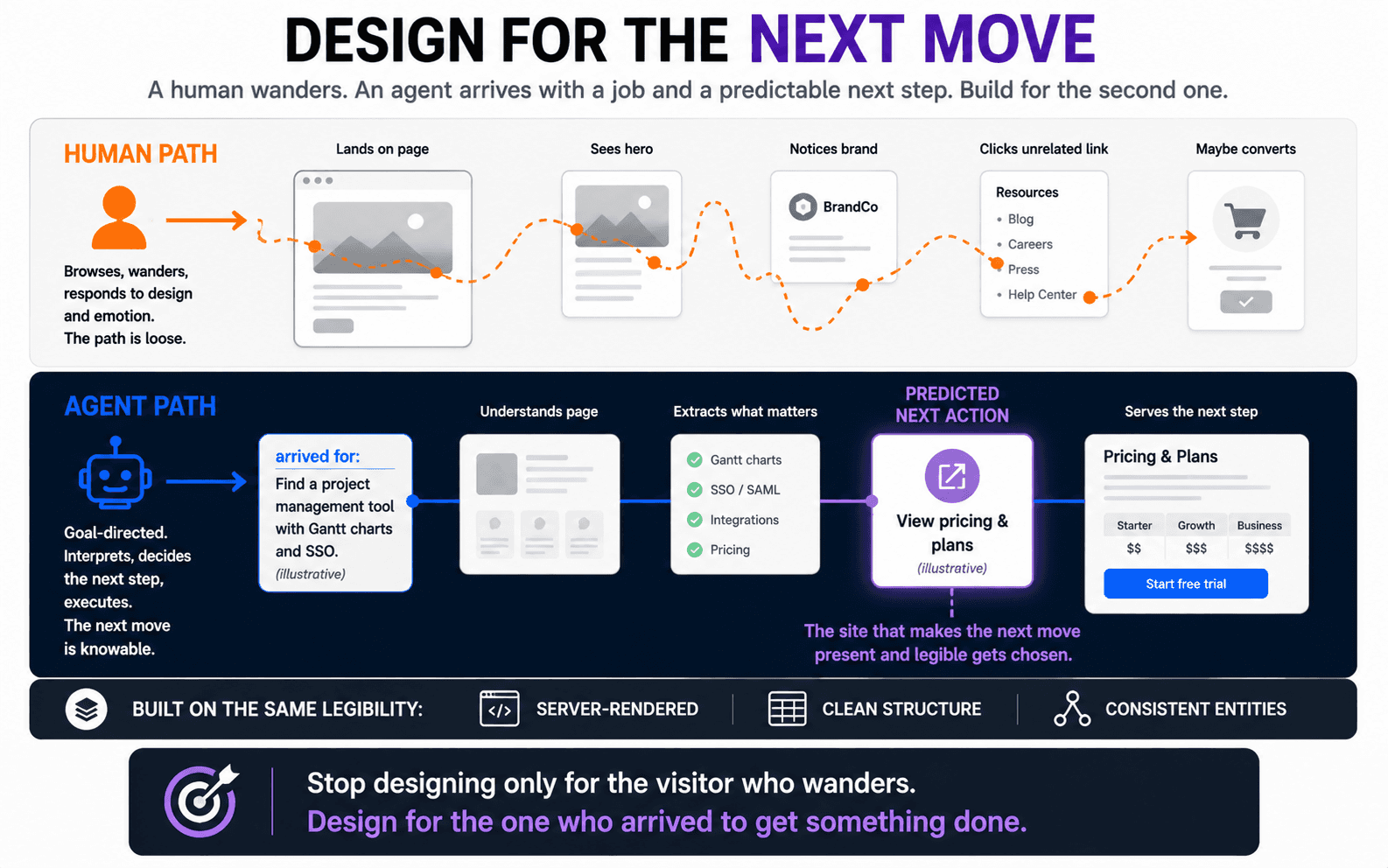
Designing for agent behavior means treating the agent's journey as something you anticipate and serve, not something that happens to you. A human lands on a page and you hope they wander toward a conversion. An agent lands on a page with a specific job, takes a first action, and then takes a next action that, given the job, is increasingly predictable.
Designing for agent behavior is structuring your site so that the agent's likely next step is present, legible, and easy to take.
In practice, that starts with the foundation the rest of the agentic web depends on. The agent has to be able to read the page at all, which means content that renders server-side rather than in client-side JavaScript most crawlers never execute. It has to resolve into clean, self-contained chunks an agent can retrieve and act on. And it has to carry consistent entity signals so the agent recognizes you as a known, distinct entity rather than an ambiguous string.
None of that is exotic; it is the same legibility work that wins citations, which is why this builds on the discipline you may already be running rather than replacing it.
The new layer sits on top: mapping the journeys agents actually take and structuring content around the predicted next move rather than the human browse path. What does an agent that arrived for this question need next? What is the action it is most likely trying to complete, and is that action present and machine-readable on the page, or buried? The companies that answer those questions well, and keep answering them as agent behavior is studied more deeply, are the ones whose sites an agent will move through cleanly and select.
The specific techniques for serving that next move are where the real competitive work happens, and they are advancing quickly.
Isn't This Just GEO or Answer Engine Optimization?
No. GEO and answer engine optimization are about being found and cited: structuring content so an AI engine retrieves and mentions you in an answer.
Agent Behavioral Science applied to the web is about being chosen: predicting how an agent behaves once it is engaging with you and serving the behavior so the agent completes its job through you. Citation gets you into consideration. Behavioral design gets you selected and acted on.
The relationship is layered, not competitive. Citation is the entry point; behavioral design is the next frontier past it. They share a foundation, the clean structure and entity legibility that serve both, which is the reassuring part, the work compounds.
This is the same progression we mapped from getting cited to getting chosen in the move toward Business-to-Agent. Agent Behavioral Science is the discipline that tells you what "getting chosen" actually requires, because it is grounded in how agents demonstrably behave rather than in guesses.
Is This Real Yet, or Too Early?
Both, and the honest framing matters. The science is truly emerging rather than settled, the controlled studies are early, and meaningful agentic traffic is still a minority of most sites' visitors. Anyone claiming they have fully mapped agent behavior and productized it today is overselling.
This is a frontier, not a finished playbook.
The case for working on it now anyway is that the foundation pays off immediately and the advantage compounds. The legibility work, server-side rendering, clean structure, consistent entities, is the same work that wins the citation layer that is already live, so you get present-tense return while positioning for the behavioral layer as it matures. And reading agent behavior is a learned capability, not a one-time setup.
The teams that start paying attention to how agents move through their sites now will understand it far better in a year than teams that wait for the science to be tidy. As with AI visibility, the move is to build the readiness rather than wait for the reaction.
How Averi Is Building for This
Averi is the content engine for the agentic web, and Agent Behavioral Science is the discipline that layer is ultimately built to serve.
The thesis our CTO named, that the web is won by sites that best serve agent behavioral insights, is the direction the product is pointed: making your brand not just findable by agents but legible and serveable to them, so that when an agent is doing a job, your site is the one it can move through and select.
What that means concretely today is the foundation, which is also the part that compounds. The content engine produces clean, server-rendered, machine-parseable content, so agents can read you rather than hitting a blank shell. Dual SEO and GEO scoring checks that each piece meets the structural conditions agents rely on before it ships. And Brand Core keeps your naming, category language, and core descriptions consistent everywhere, the entity signal that makes an agent recognize you as a known entity rather than an ambiguous string. That foundation wins citations now and is the groundwork agent-behavioral design is built on.
We ran exactly this play on ourselves, taking our own content from a few thousand monthly impressions to over 12 million organic impressions across 12 months on a one-person team.
What we will not do is pretend the behavioral layer is a solved, shipped feature. The science is young and the techniques for serving agent behavior are advancing fast, ours included.
What we can say plainly is that the brands building legibility now are the ones that will be able to serve agent behavior as the discipline matures, and that is the bet Averi is built around.
FAQs
What is Agent Behavioral Science?
Agent Behavioral Science is the empirical study of how AI agents act, choose, and adapt in real environments, observed systematically rather than inferred from their internal models. Proposed as a formal field in a 2025 paper now published in Nature's Humanities and Social Sciences Communications, it treats an agent the way behavioral economics treats a person: as something whose behavior you study through observation and experiment.
Why does Agent Behavioral Science matter for websites?
Because the agent is increasingly the one choosing. When a person delegates a task to an AI, the agent searches, compares, and selects from the options it can read and act on. If agents behave predictably, a website can be structured to serve that behavior, making it the option an agent reaches for. Whoever designs for agent behavior wins selections that used to be won by brand familiarity.
Do AI agents actually behave predictably?
Yes. In controlled web-shopping experiments, agent decisions shifted predictably and substantially in response to prices, ratings, and nudges, making agents strongly biased choosers. Agents showed order-of-magnitude stronger biases toward ratings and expert cues than humans, with high susceptibility to prompt wording and option ordering. Predictable behavior is behavior you can anticipate and design for.
How is agent behavior different from human behavior?
Agents are far more swayed by explicit signals like ratings and expert cues, they move with a fixed goal rather than browsing, and they consume structured content rather than visual experience. The result is that human-first design, hero images, emotional hooks, brand impressions, is largely invisible to agents, while structured data and the obvious next step are what move them.
Is Agent Behavioral Science the same as GEO?
No. GEO and answer engine optimization are about being found and cited in AI answers. Agent Behavioral Science applied to the web is about being chosen: predicting how an agent behaves while engaging with you and serving that behavior so it completes its task through you. Citation gets you into consideration; behavioral design gets you selected. They share a foundation of clean structure and entity legibility.
Did Averi invent Agent Behavioral Science?
No. Agent Behavioral Science is an emerging academic field proposed by researchers in 2025. Averi's contribution is applying it to web and content strategy, the argument that predicting and serving agent behavior is about to decide which brands win the agentic web, and building the legibility foundation that work depends on. The science is borrowed; the applied, competitive thesis is the contribution.
Is it too early to act on this?
The science is young and agentic traffic is still a minority for most sites, so this is a readiness play, not an emergency. The reason to start now is that the foundation, server-side rendering, clean structure, consistent entities, wins the citation layer that is already live, and reading agent behavior is a learned skill that compounds. Teams that start now will understand it far better than teams that wait.
Related Resources
The Agentic Web Cluster
How Agents Read, How to Write for Them, and How Buying Is Being Rebuilt
Business-to-Agent (B2A): How to Prepare Your Brand for the Agentic Web
How AI Agents Actually Read Your Content: Chunking, Embeddings, and Retrieval
The JavaScript Rendering Gap: Why AI Can't See Your Best Content
Writing for Humans and Agents at the Same Time: The Dual-Reader Playbook
Foundational Concepts
Strategy and Measurement
Operational Workflow
Design for the reader that's actually choosing. Averi builds the clean, server-rendered, entity-consistent foundation that makes your brand legible to agents and wins citations today, the groundwork for serving agent behavior as the discipline matures. $99/month for Solo. 14-day free trial. Start free →