The AI Content Engine for Startups: How Averi Turns Strategy Into Organic Growth on Autopilot

8 minutes

TL;DR
📊 91% of B2B companies use content marketing but only 29% say it works—the gap between intent and results is the biggest growth problem in SaaS
🔍 The landscape has fundamentally shifted: you now need to rank on Google and get cited by ChatGPT, Perplexity, and AI Overviews—traditional SEO alone isn't enough
🏗️ Averi's content engine is a 6-phase workflow: Brand Core → Strategy Map → Smart Content Queue → AI Drafts + Editing Canvas → Native CMS Publishing → Analytics with Proactive Recommendations
⚡ Built-in SEO + GEO content scoring (SEO 40% / AEO 25% / GEO 35% composite) means every piece is optimized for both traditional search and AI citation before it's published
📈 Content marketing costs 62% less than traditional marketing with 3x the leads—but only when it's systematic, not scattered
💰 Averi's Solo Plan runs $99/month—less than a single blog post from most agencies, for an entire content engine that compounds over time

Zach Chmael
CMO, Averi
"We built Averi around the exact workflow we've used to scale our web traffic over 6000% in the last 6 months."
Your content should be working harder.
Averi's content engine builds Google entity authority, drives AI citations, and scales your visibility so you can get more customers.
The AI Content Engine for Startups: How Averi Turns Strategy Into Organic Growth on Autopilot
Here's a number that should haunt every startup founder…
91% of B2B organizations use content marketing. Only 29% say their strategy is actually working.
That gap—between knowing content matters and making content work—is where startups go to die. Not dramatically. Quietly. One unread blog post at a time. One scattered LinkedIn update at a time. One "we'll get to SEO eventually" at a time.
Marketing is the second leading cause of startup failure at 29%, trailing only product-market fit. And in 2026, the problem has gotten worse, not better. AI search engines are reshaping how buyers discover products. 25% of Google searches now trigger AI Overviews. 73% of B2B buyers use AI tools during purchasing decisions. The startups that build visible, authoritative, AI-citable content ecosystems will own their categories. The ones that don't will wonder why nobody's finding them.
The problem isn't that founders don't understand this.
It's that the path from "content matters" to "content that actually drives growth" requires a system most startups can't build… strategy, execution, optimization, publishing, analytics, and iteration — running continuously, improving automatically, compounding over time.
We built that system. It's called Averi.
And it was built from the exact workflow we used to grow our own web traffic over 6,000% in six months.
This is the story of why we built it, how it works, and what it means for the startups that use it.

Why Did the Content Marketing Landscape Break?
Content marketing has always been the highest-ROI growth channel for SaaS startups.
The data hasn't changed: startups with active blogs generate 67% more leads. B2B companies see 748% ROI from SEO-driven content. Publishing weekly drives 3.5x more conversions than publishing monthly.
The economics are irresistible. The execution is where it falls apart.
The Founder Bandwidth Crisis
56% of startup founders have only 1 hour or less per day for marketing. 47% do all their own marketing. And the solo founder proportion has more than doubled since 2017, over 55% of new startups are now founder-led, meaning there's no marketing co-founder picking up the slack.
The result is predictable: content gets deprioritized in favor of product and sales.
When it does happen, it's reactive… a blog post here, a LinkedIn update there, no strategy connecting them, no optimization making them work, no system making them compound.
The Tool Sprawl Problem
The typical startup marketing stack looks like this: ChatGPT for drafting, Google Docs for editing, Canva for graphics, WordPress or Framer for publishing, Google Search Console for tracking, maybe Semrush if they can afford it, plus email threads and Slack messages to coordinate everything.
Context gets lost between tools.
Brand voice fractures across outputs.
95% of organizations have brand guidelines, but only 25-30% actively use them. Every time a founder switches between apps, they lose 23 minutes of focus.
The "stack" isn't a system. It's a coordination tax disguised as productivity.
The SEO-to-GEO Transition
And then the ground shifted beneath everyone's feet.
AI Overviews now appear in 25% of Google searches, up 57% in a single quarter. 93% of AI Mode searches end without a click. 50% of B2B buyers now start their journey in AI chatbots rather than Google.
Traditional SEO still matters, but it's no longer sufficient.
Startups now need to optimize for GEO (Generative Engine Optimization) simultaneously: structuring content so AI systems cite it, not just rank it.
Content with structured formatting is 28-40% more likely to be cited by LLMs. Research shows GEO techniques can boost AI visibility by up to 40%.
Most startups can barely keep up with traditional SEO. Adding GEO on top? Without a system, it's impossible.
How Did We Build This? The Averi Origin Story
We didn't start by building a product. We started by solving our own problem.
Our founding team… marketers, engineers, and creatives working out of Brooklyn… were running the exact playbook every startup content team runs; strategy in one tool, drafting in another, publishing somewhere else, analytics in a fourth place, and coordination via prayer and Slack messages.
It was working. Kind of. But it wasn't scaling, and it definitely wasn't compounding.
So we built the workflow we wished existed.
Not an AI writing tool, those already existed and produced generic content nobody wanted to read.
Not a project management platform with a content marketing skin.
A complete content engine: strategy through analytics, in a single workflow, with AI handling the structural work and humans adding the judgment, voice, and creative fire that makes content actually connect.
We tested it on ourselves first.
We used our own system to build our own content operation.
The results: over 6,000% growth in web traffic in six months. Regular citations across ChatGPT and Perplexity. A content library that compounds, every piece making the next one smarter, more strategic, more visible.
Then we opened it to startups like ours.
Founders who understood that content marketing was the highest-ROI growth channel available, but couldn't execute it systematically alongside building product, talking to customers, and raising capital.
That's Averi.
A content engine built by the people who needed it, for the people who need it.
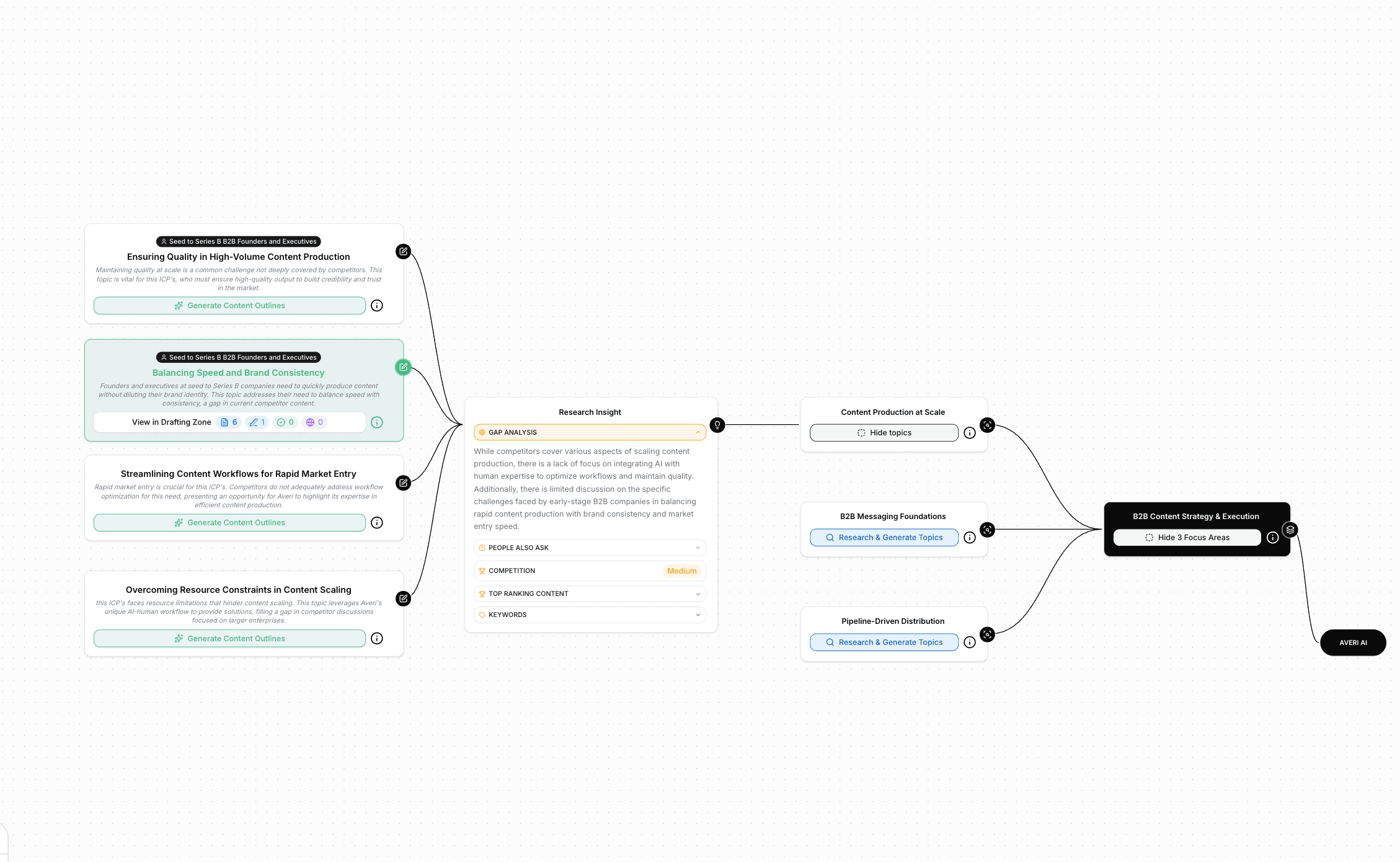
How Does the Averi Content Engine Actually Work?
The engine operates in six connected phases.
Each phase feeds the next.
The whole system gets smarter over time as your content library grows and performance data accumulates. AI handles the work that slows you down. You add the judgment that makes it yours.
Phase 1: Brand Core — The Strategic Foundation
Everything starts here. When you onboard, Averi scrapes your website to learn your business, products, positioning, and voice automatically. You're not filling out a 50-question intake form. You're confirming what the AI already figured out.
From that foundation, the system generates suggested ICPs, ideal customer profiles based on its analysis of your brand and market. It researches your competitors: what they're publishing, what they're ranking for, where they're weak. You review, refine, and confirm. Within days, you have a complete Brand Core: voice, positioning, ICPs, competitive landscape, and content goals.
This Brand Core isn't a document that gathers dust. It's the operating context that shapes every piece of content the engine produces. The hundredth article has the same strategic alignment as the first, because the positioning is structural, not aspirational.
Phase 2: Strategy Map — Your Visual Content Architecture
This is where strategy becomes visual. The Strategy Map lays out your content pillars, focus areas, and specific topics in a connected architecture you can actually see and navigate.
Instead of a flat editorial calendar or a chaotic spreadsheet, you get a strategic map that shows how every piece of content connects to your broader growth objectives. Pillars represent your core themes. Focus areas break those into specific domains. Individual topics cascade from each focus area—each one tied to target keywords, search intent, and ICP alignment.
The Strategy Map isn't static.
As performance data comes in—what's ranking, what's getting cited, what's driving conversions—the map evolves. New opportunities surface. Underperforming areas get flagged. The strategic architecture adapts to what the market is actually responding to.
Phase 3: Smart Content Queue — What to Create Next (and Why)
The queue is where strategy becomes execution. Averi continuously researches your market—keyword opportunities, competitor gaps, trending conversations in your industry—and generates content recommendations organized by type: listicles, how-to guides, editorials, comparisons, thought leadership pieces.
Each recommendation comes with a title, target keywords, content overview, and strategic rationale.
You're not guessing what to write. You're choosing from a prioritized menu of content the system has determined will have the highest impact for your specific brand, market, and goals.
Your job is approval.
Review the queue. Accept, reject, or reprioritize topics. Assign them to team members if you have a team. The system handles the strategic thinking. You apply the judgment.
Phase 4: AI Drafts + the Editing Canvas — Where Content Gets Made
This is the creation engine. Select a topic from your queue, and Averi goes to work: deep research (scraping key facts, statistics, and quotes with hyperlinked sources you can verify), context loading (pulling your Brand Core, Library content, and marketing plan), and structural optimization (applying SEO + GEO best-practice formatting).
The first draft arrives structured for both Google and AI citation: question-based H2 headings, 40-60 word answer blocks after each section, FAQ sections optimized for extraction, statistics with attribution, clear entity definitions, internal linking suggestions, and meta title/description generation.
Then you make it yours.
The collaborative editing canvas is where AI scaffolding meets human substance. Highlight any section and ask Averi to rewrite, expand, or adjust. Tag teammates for review. Leave comments. Edit in real-time together. Add the hot takes, the customer stories, the contrarian perspectives that make content genuinely worth reading, not just algorithmically optimized.
The built-in content scoring system runs in real-time as you edit. Averi scores every piece across three dimensions: SEO (40% weight), AEO (25% weight for answer engine optimization), and GEO (35% weight for generative engine optimization).
The composite score updates live, with specific recommendations for improvement: "Add 2 more cited statistics to improve citation-worthiness." "Include FAQ schema for answer extraction." "Your readability score is too high for optimal LLM citation—simplify this section."
No other content platform scores for GEO. This is Averi's core differentiator, and it's the difference between content that ranks and content that gets cited by AI.
Phase 5: Native CMS Publishing + LinkedIn Distribution
When your content is ready, it goes live without the copy-paste chaos that kills most content workflows. Averi publishes directly to your CMS, maintaining formatting, metadata, and structure. No reformatting. No broken layouts. No "it looked different in the editor."
But publishing to your blog is only half the distribution equation.
Averi also supports LinkedIn posting, turning your long-form content into LinkedIn-optimized posts that drive engagement and brand visibility on the platform where your B2B buyers actually spend their time. One piece of content, multiple distribution channels, from a single workflow.
Every published piece feeds back into your Library.
This matters more than most people realize: as your Library grows, the AI has more context for future drafts. Your brand voice gets sharper. Your content clusters get denser. Your internal linking gets stronger. The engine gets smarter with every piece you publish.
Phase 6: Analytics + Proactive Recommendations — The Compound Loop
This is where the engine becomes self-improving. Averi tracks impressions, clicks, keyword rankings, and performance trends, then tells you what to do about it.
Not just dashboards.
Actionable recommendations: "This topic is trending in your industry—here's a content angle." "This piece is ranking #8—here's how to push it to page 1." "Your competitor just published on X—here's your counter-angle." "This keyword has low competition and high relevance—add it to your queue."
The analytics layer closes the loop between performance and strategy.
What's working feeds back into the queue. What's underperforming gets flagged for refresh. What competitors are doing gets surfaced as competitive intelligence. The system doesn't just measure… it recommends, prioritizes, and adapts.

Why Does GEO Change Everything About Content Marketing?
The SEO-to-GEO transition isn't a rebrand. It's a structural shift in how buyers discover products—and it changes the calculus for every startup's content strategy.
Traditional SEO asked: Can Google find, index, and rank this page?
GEO asks: Will an AI system cite this page as an authoritative source when answering a human's question?
Different question. Different content architecture. Different optimization requirements.
AI search visitors convert at 4.4x the rate of traditional organic traffic.
ChatGPT now drives 10% of Vercel's new signups. Once an LLM selects a trusted source, it reinforces that choice across related prompts—citation authority compounds the same way domain authority does, but faster.
Averi's content engine was built for this reality from the ground up. Every phase of the workflow incorporates both SEO and GEO optimization:
The Strategy Map identifies topics based on both traditional keyword opportunity and AI citation potential.
The Smart Queue prioritizes content types that AI systems favor—comparison pages, FAQ content, data-driven analysis.
The AI drafts come structured with the answer blocks, attribution phrases, and extractable formatting that increase LLM citation probability by 28-40%.
The content scoring system weights GEO at 35% of every piece's composite score—ensuring nothing publishes without LLM citation readiness.
And the analytics layer will track AI citation performance alongside traditional search metrics.
This isn't a GEO add-on bolted onto a traditional content platform. It's the first content engine built for the dual-visibility era.
What Makes This Different From Everything Else?
The market is full of AI writing tools, content platforms, and SEO suites. Here's why Averi is a fundamentally different category.
vs. ChatGPT and Generic AI
ChatGPT starts from scratch every conversation. You supply all context. It produces generic output that sounds like everyone else. There's no memory between sessions, no brand consistency, no workflow beyond copy-paste.
Averi learns your brand once and remembers it forever. Every piece draws from your Brand Core. The system gets smarter over time as your Library grows. And the workflow goes from strategy through published, optimized content, not just a text box that generates words.
vs. Jasper and AI Writing Tools
Jasper and similar tools are content generation platforms. They produce copy. They don't do strategy, competitive research, content queuing, CMS publishing, performance analytics, or proactive recommendations. They're one phase of the workflow pretending to be the whole engine.
Averi is the complete system: strategy → queue → creation → optimization → publishing → analytics → iteration.
The AI writing is important, but it's one component of a six-phase engine that compounds over time.
vs. Semrush and SEO Suites
Semrush is exceptional at data and analysis. It tells you what to optimize. It doesn't create the content, publish it, or track the compound effect. And at $139.95/month for the entry tier, it's a data layer… not an execution system.
Averi's content scoring system is built directly into the creation workflow.
You don't analyze content after it's published and then try to fix it. You optimize in real-time while you're writing, with live scores and specific recommendations. The scoring system doesn't just cover SEO, it includes AEO and GEO dimensions that no standalone SEO tool provides.
vs. Agencies
Agencies provide strategy and execution—at $2,500-$10,000/month for startups, with 3-6 month minimum commitments, slow turnaround times, context loss on every account manager change, and zero GEO optimization at the entry price tier.
Averi provides the same workflow at $99/month, with faster velocity, permanent context retention, built-in dual SEO+GEO optimization, and a compounding Library that makes every month's output better than the last.
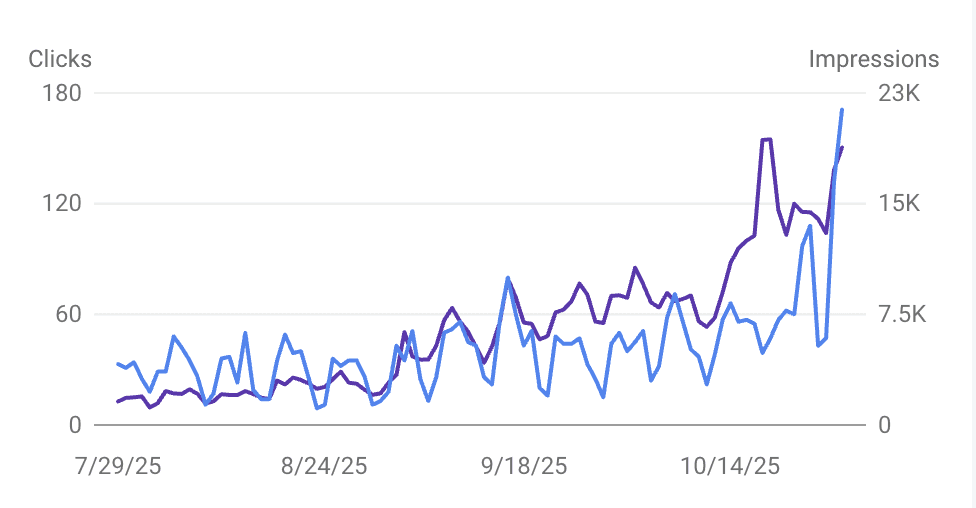
What Does the Compound Effect Actually Look Like?
This is the part that separates a content engine from a content tool. Tools produce output. Engines produce compounding systems.
Every piece of content you publish through Averi creates multiple compounding effects simultaneously.
Your Library grows—giving the AI more context for future drafts, sharper brand voice matching, and better content recommendations.
Your topic clusters expand—creating the interconnected content architecture that search engines and AI systems reward with authority signals.
Your keyword rankings compound—each new piece strengthening the entire cluster, not just its own URL.
Your AI citations accumulate—building the citation authority that reinforces across related prompts.
Your performance data improves—making each queue recommendation more precise than the last.
Month one, you're building foundation.
Month three, you're seeing compound effects.
Month six, you have a self-improving content operation that generates organic visibility on autopilot while you focus on what you should be focused on: building product and closing deals.
That's the engine. Not a tool you use. A system that runs.
FAQs
How long does it take to set up the content engine?
Most teams are producing strategic content within their first week. Onboarding—website scraping, Brand Core confirmation, ICP refinement, competitor analysis—typically takes 1-3 days. Your first content queue generates immediately after strategy is confirmed. From zero to first published, optimized piece: roughly one week.
Do I need marketing experience to use Averi effectively?
No—and this is the ideal use case. The engine provides the marketing strategy framework (keyword research, competitive analysis, content planning, SEO/GEO optimization). You provide the product knowledge and buyer insight that makes content genuinely useful. Technical founders with deep product expertise often produce the most compelling content through Averi because the system adds the marketing layer they're missing.
How does the content scoring system work?
Every piece is scored in real-time across three dimensions: SEO (40% weight—keyword coverage, structure, readability, on-page technical), AEO (25% weight—answer block quality, question-based structure, schema readiness), and GEO (35% weight—citation-worthiness, extractability, entity authority signals, LLM accessibility). The composite score maps to a letter grade, and every check below maximum generates a specific, prioritized recommendation with estimated point impact.
Can I publish to LinkedIn directly from Averi?
Yes. Averi supports LinkedIn posting alongside CMS publishing (Webflow, Framer, WordPress). You can turn long-form content into LinkedIn-optimized posts within the same workflow—extending your distribution without switching platforms or reformatting content.
What if I already have existing content on my website?
Averi analyzes your existing content as part of the onboarding process. It identifies what's working, what has gaps, and where opportunities exist. Your existing content feeds into the Library, giving the AI immediate context. The Strategy Map accounts for what you've already published—no redundant content, no cannibalization, just strategic expansion from your current foundation.
How is this different from using ChatGPT with good prompts?
The difference is system versus session. ChatGPT gives you one piece of output per conversation with no memory, no strategy, no optimization, no publishing, and no analytics. Averi gives you a persistent engine: strategy that evolves, a queue that replenishes, drafts that draw from your Brand Core, optimization that scores for SEO+AEO+GEO simultaneously, publishing that goes directly to your CMS, analytics that recommend next actions, and a Library that makes every piece progressively smarter. The compound effect of a system versus the linear output of a tool is the difference between organic growth and content that goes nowhere.
What does Averi cost?
The Solo Plan is $99/month. That includes the complete content engine workflow: Brand Core, Strategy Map, Smart Queue, AI drafts, editing canvas, content scoring, CMS publishing, LinkedIn posting, analytics, and the compounding Library. For comparison: an entry-level agency retainer starts at $2,500/month. A single freelance blog post costs $200-$500. Semrush starts at $139.95/month for data only, with no content creation or publishing.
Related Resources
If You're Ready to Start
If You Want the Full Content Strategy
If You Want to Understand SEO + GEO
The SEO-to-GEO Migration Checklist: 47 Things to Change Today
The Complete Guide to GEO: Getting Your Brand Cited by AI Search
The Future of B2B SaaS Marketing: GEO, AI Search, and LLM Optimization