We Analyzed 1,521 Real B2B SaaS Queries. The Better AI Search Understands the Question, the Less Anyone Clicks.
5 minutes

TL;DR
📉 Clicks collapse as queries get longer: head terms (1-2 words) converted at 0.49%, mid-length (5-8 words) at 0.043%, and long queries (9+ words) at 0.003% — a 160x falloff.
🔢 Long and conversational queries (9+ words) drove 30% of all impressions but produced 5 of 741 clicks. They are pure citation events.
🧠 Only 20% of queries were question-form and just 4% were explicitly conversational — the shift is real but slower than the hype claims. The conversion cliff does not need conversational phrasing to appear.
🏷️ AI and GenAI terms touched 54% of queries; tools-and-comparison language touched 41%. The corpus is dominated by buyers evaluating AI software.
📁 The aggregated corpus tables are published so you can verify every segment.

Zach Chmael
CMO, Averi
"We built Averi around the exact workflow we've used to scale our web traffic over 6000% in the last 6 months."
Your content should be working harder.
Averi's content engine builds Google entity authority, drives AI citations, and scales your visibility so you can get more customers.
We Analyzed 1,521 Real B2B SaaS Queries. The Better AI Search Understands the Question, the Less Anyone Clicks.
Our longest, most natural-language search queries earned more than 180,000 impressions over two months and produced five clicks. Not five thousand. Five. That is not a typo, and it is not a content-quality problem. It is the clearest evidence we have seen that AI search now answers complex questions so completely that the click never happens.
We pulled every non-branded query that drove impressions to our site across an eight-week window: 1,521 distinct searches, real queries from real people, all measured the same way. Then we sorted them by shape and length and looked at where clicks actually happened.
What we found inverts the oldest assumption in search: that better matching a user's intent earns you the click. In an AI-mediated search world, the opposite is now true. The better the engine understands a complex question, the more completely it answers that question itself, and the less reason anyone has to click through to you.
This piece lays out the full corpus, the conversion cliff by query length, the topic and shape patterns underneath it, and what a B2B SaaS team should actually do when its best-understood queries stop converting.
What did we actually analyze?
We analyzed 1,521 distinct non-branded queries that drove impressions to averi.ai over an eight-week window, drawn directly from Google Search Console. Every query is a real search a real person ran that surfaced our site. We removed branded queries (anything containing our name) and one prompt-injection artifact, leaving a clean corpus of genuine, non-branded demand.
For each query we recorded its impressions, clicks, and average position, then classified it by length in words, whether it was phrased as a question, whether it carried natural-language or first-person markers, and which topic it belonged to. The point was not a single headline number. It was to see whether clicks behave differently depending on the shape of the question being asked. They do, dramatically.
One honest limitation up front: this is one company's query footprint, shaped by what averi.ai already ranks for. It is a deep look at a real corpus, not a universal census of B2B SaaS search. We are publishing the aggregated tables so the patterns are checkable, and we think the direction holds well beyond our site, but treat the specific percentages as ours, not yours.
What does query length reveal about clicks?
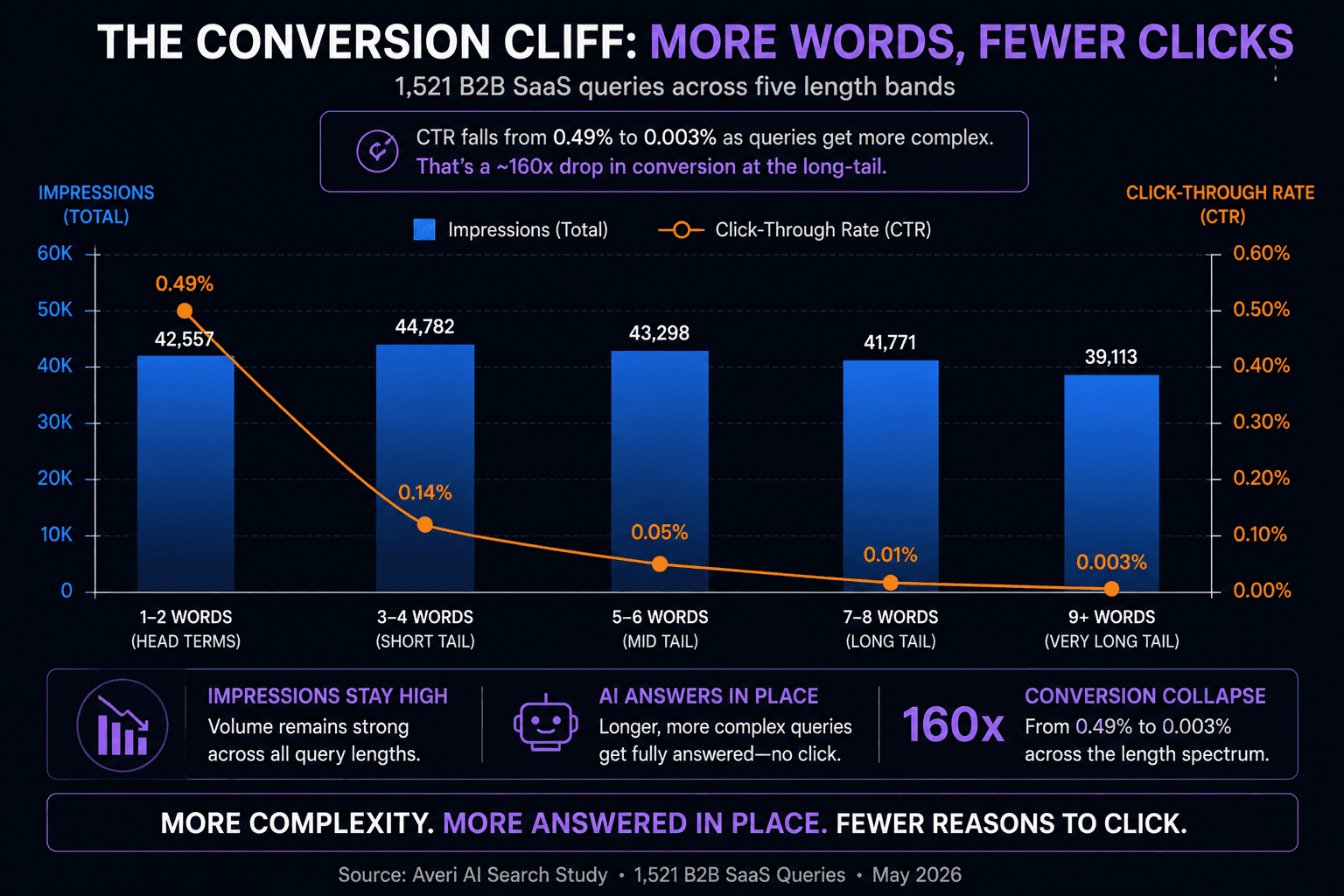
Query length reveals a near-perfect inverse relationship between how complex a question is and how often the searcher clicks. We grouped the 1,521 queries into five length bands and measured clicks against impressions in each. The result is the most striking pattern in the entire dataset.
Query length | Impressions | Clicks | CTR |
|---|---|---|---|
Head (1-2 words) | 40,379 | 198 | 0.490% |
Short (3-4 words) | 155,868 | 443 | 0.284% |
Mid (5-8 words) | 222,420 | 95 | 0.043% |
Long (9-15 words) | 148,507 | 4 | 0.003% |
Conversational (16+ words) | 32,140 | 1 | 0.003% |
Read down the click column.
As queries get longer and more specific, the click-through rate falls off a cliff: from roughly half a percent on head terms to three thousandths of a percent on long queries. That is a 160-fold collapse. The two longest bands together pulled over 180,000 impressions and returned five clicks.
The conventional reading would be "long-tail queries always convert worse." That is not what this is.
The long and conversational queries are the ones where the searcher told the engine exactly what they wanted, in full sentences. In the old search model, those high-intent, specific queries were the best converters, not the worst. The inversion is the finding. AI search is now good enough at answering a fully-specified question that it resolves the answer in place and the searcher never needs the source.
Want to see your own cliff fast? Run your top pages through Averi's SEO + GEO scoring to find which ones are still earning clicks and which have quietly become citation-only assets.
Why do longer queries stop converting entirely?
Longer queries stop converting because they are exactly the queries AI search is built to answer completely. A specific, multi-part question is an invitation for the engine to synthesize a full answer from multiple sources rather than hand back a list of links. The more context the searcher provides, the more confidently the engine answers, and the less it needs to send anyone away.
This connects directly to query fan-out. When we measured how Google AI Mode handles B2B SaaS queries, we found it cites an average of 23 sources per answer, and the breadth grows with commercial and complex intent. A long, specific query triggers wider fan-out, pulls more sources, and produces a more complete synthesized answer.
Completeness is the enemy of the click. The same mechanism that makes you a cited source on a complex query is the mechanism that removes the searcher's reason to visit.
The supporting research points the same way. iPullRank's analysis with SimilarWeb found AI search queries average 70 to 80 words versus 3 to 4 for traditional Google search. Longer queries are the native input format of AI search, and they are precisely the inputs that get fully answered in place. The zero-click reality is not coming.
For complex queries, it is already here: a Pew Research Center analysis of 68,879 real searches found users clicked a traditional result in just 8% of visits when an AI summary was present, versus 15% without one, and Ahrefs' study of 300,000 keywords measured a 34.5% drop in position-one click-through rate when an AI Overview appears.
How much has query language actually shifted?
Less than the hype suggests, which is itself a useful finding. The popular narrative says everyone now searches in long conversational sentences. Our corpus says the shift is real but partial. Only 20% of our queries were phrased as questions, and just 4% carried explicit first-person or conversational markers like "help me" or "how do I." The median query was still five words long.
So the conversion cliff does not depend on conversational phrasing. It shows up across ordinary mid-length and long keyword queries, not just chatbot-style sentences. That matters because it means you cannot dismiss this as "only affects the handful of people typing paragraphs into search." The effect bites at five-to-eight words, which is where a third of our impressions live.
The conversational queries that did appear were revealing in shape.
They averaged 12.5 words versus 6.1 for keyword-style queries, and they read like requests to an assistant: questions about automating tasks, choosing tools, designing workflows. These are the highest-intent searches a B2B buyer runs, and in our data they converted to clicks at essentially zero. The buyer asked a real question, got a real answer, and stayed in the answer.
What are people actually searching for?
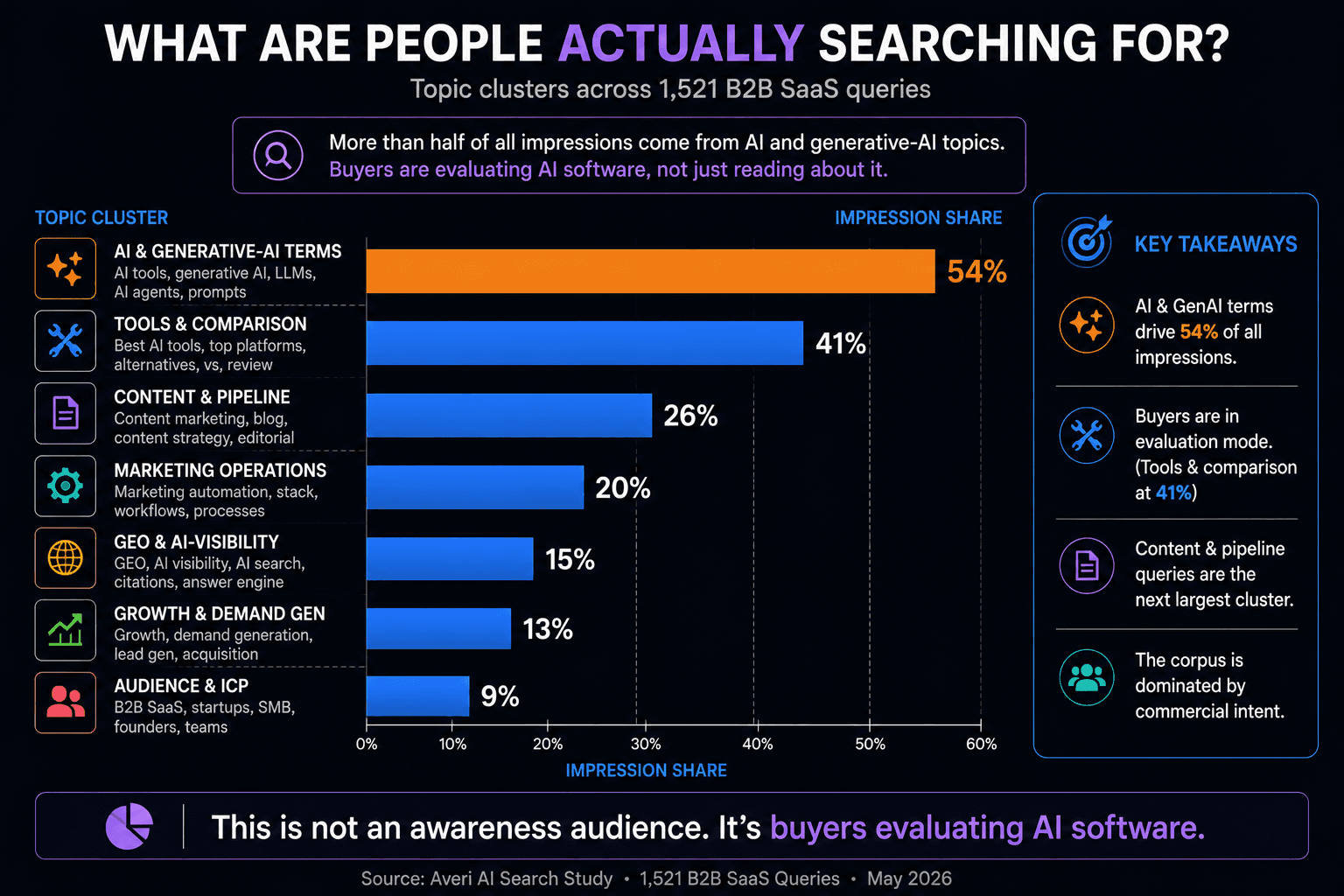
People are overwhelmingly searching to evaluate AI software, and the topic mix shows it. We tagged every query by theme.
AI and generative-AI language appeared in 54% of queries.
Tools-and-comparison language ("best," "top," "vs," "platform," "alternative") appeared in 41%.
Content and pipeline terms touched 26%, marketing-operations and automation 20%, and the GEO and AI-visibility cluster 15%.
Topic cluster | Share of queries' impressions |
|---|---|
AI / GenAI | 54% |
Tools / comparison | 41% |
Content / pipeline | 26% |
Marketing ops / automation | 20% |
GEO / AI-search / visibility | 15% |
Startup / GTM | 10% |
SEO / keywords | 9% |
The corpus is a portrait of a buyer in the middle of an AI-tooling decision. That is good news and bad news. The good news is that demand for exactly what we sell is enormous and growing. The bad news is that this is the highest-intent, most commercial demand, and it lives disproportionately in the longer, better-understood queries that no longer convert to clicks. The buyers most ready to purchase are the ones AI search is most thoroughly intercepting.
Recency demand was also visible: 14% of queries carried a year stamp, and of those, 2026 outnumbered 2025 by four to one. Buyers signal that they want current information, which rewards freshly published, frequently updated content, a pattern that holds across the AI-search research. It also fits the wider shift in who is reading: bots already make up close to a third of all web traffic, with AI crawlers the second-largest category behind search engines, per Cloudflare Radar's 2025 Year in Review.
So what should a B2B SaaS team do about it?
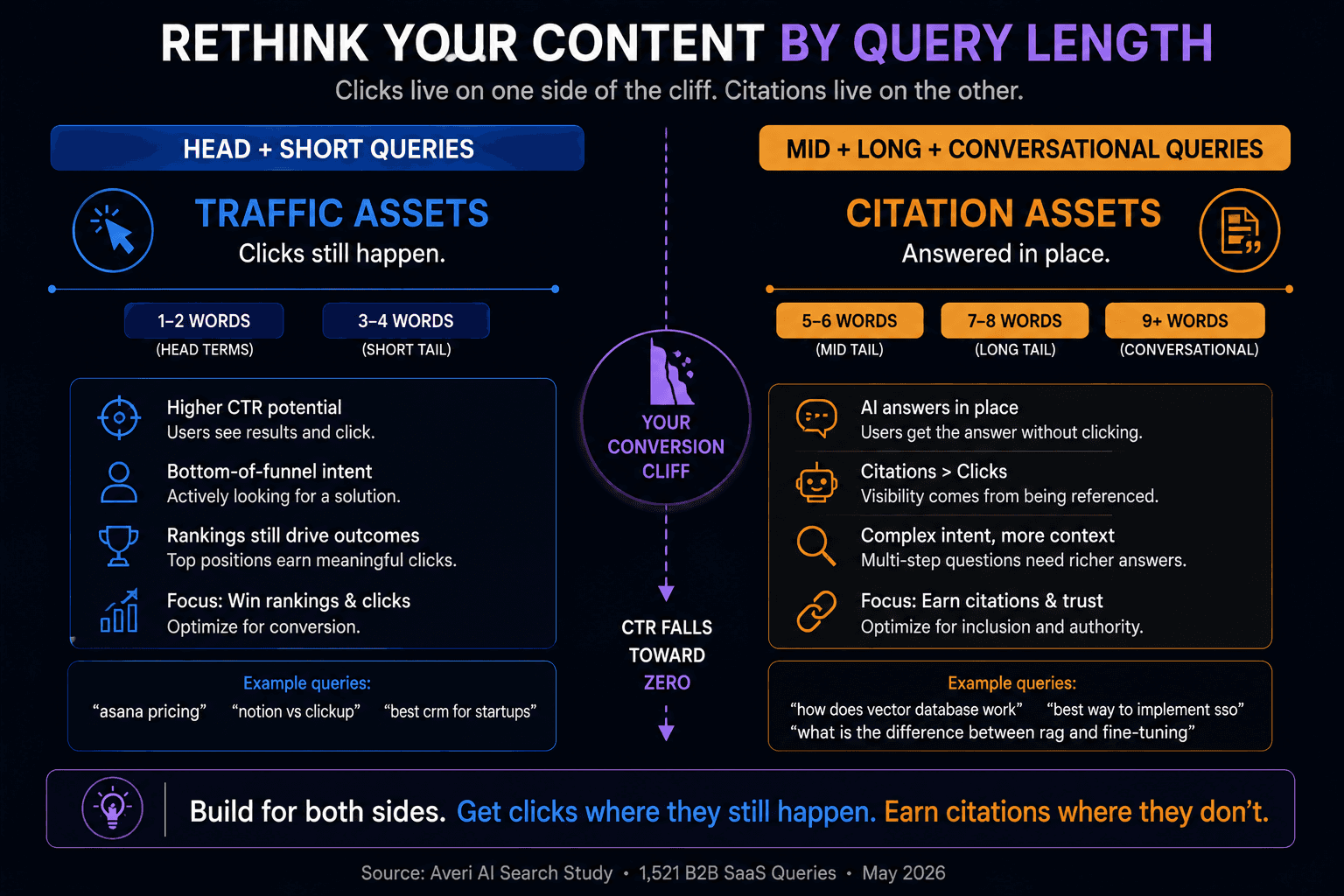
Stop measuring your complex-query pages on clicks, and start measuring them on citations and brand presence.
The conversion cliff is not a failure to fix. It is a change in what these pages are for. A page that earns 30,000 impressions and zero clicks on long, specific queries is not broken. It is working as citation infrastructure, feeding the answers your buyers read.
Four concrete moves:
Segment your own corpus by query length. Run the same analysis on your Search Console data. Find the length band where your clicks fall off. Below that line, you are running a citation operation, not a traffic operation, and you should manage it as one.
Move the success metric for complex queries from CTR to citation and mention. On long, high-intent queries, the win is being the source the AI answer is built from, and being named in it. Track that, not clicks.
Keep the click-converting head and short queries sharp. Head and short queries still leak real clicks (0.49% and 0.28%). Those pages still do traffic work. Do not abandon them while you adapt the rest.
Publish for completeness on your highest-intent topics. Since complex queries trigger wider fan-out, the way to win them is depth that gets pulled into the synthesized answer, plus brand presence so that when the answer is read, your name is in it. Build for being one of many trusted sources, not one ranked link: SE Ranking found over 60% of domains change between AI Mode runs even for identical queries, so durable presence comes from breadth and freshness, not a single locked position.
The clear strategic truth is that on your most valuable, highest-intent queries, the click is no longer the goal because the click is no longer available. The goal is to be the source behind the answer.
Teams still optimizing those pages for click-through are optimizing for a number that physics has already taken off the table.
The Averi angle
This study is the kind of thing the Averi content engine is built to surface: take the first-party data you already have, find the pattern competitors cannot see, and change strategy before the market does. We ran this analysis on our own corpus because we run the engine on ourselves first.
The conclusion reshaped how we judge our own content. Pages we might have flagged as underperformers on a CTR dashboard are, on inspection, doing exactly the job an AI-search world needs them to do: feeding answers and carrying our name into them. We only knew to reframe them because we segmented the corpus and saw the cliff.
If you want to find your own conversion cliff and stop judging citation pages by click metrics, score your content for SEO and GEO readiness in Averi and see which pages are traffic assets and which are citation assets. It is a 14-day free trial. Solo is $99/mo.
FAQs
Do longer search queries convert worse in AI search?
In our 1,521-query B2B SaaS corpus, yes, dramatically. Head terms (1-2 words) converted at 0.49%, mid-length queries (5-8 words) at 0.043%, and long queries (9+ words) at 0.003% — a roughly 160x falloff. The longer and more specific the query, the more completely AI search answers it in place, and the less anyone clicks through.
Why do complex, high-intent queries get fewer clicks now?
Because complex queries are exactly what AI search is built to answer fully. A specific, multi-part question triggers wider query fan-out, pulls more sources, and produces a more complete synthesized answer, removing the searcher's reason to click any single result. In older search, these high-intent queries were the best converters; AI search has inverted that.
Has B2B SaaS search really become conversational?
Partly. In our corpus only 20% of queries were question-form and just 4% carried explicit conversational markers, with a median length of five words. The shift toward natural language is real but slower than commonly claimed. Notably, the conversion cliff appears even on ordinary mid-length keyword queries, not only on conversational ones.
What are B2B SaaS buyers searching for most?
Evaluating AI software. In our corpus, AI and generative-AI terms appeared in 54% of queries and tools-or-comparison language in 41%. Content, marketing-operations, and AI-visibility topics followed. The dominant searcher is a buyer in the middle of an AI-tooling decision, and that high-intent demand sits in the queries least likely to convert to clicks.
If complex queries do not convert, are those pages worthless?
No. They function as citation infrastructure. A page earning thousands of impressions and near-zero clicks on long queries is feeding the AI answers your buyers read and, ideally, carrying your brand name into them. The fix is to measure those pages on citation and mention rather than click-through rate.
How can I find my own conversion cliff?
Export your non-branded queries from Google Search Console, group them into length bands (1-2, 3-4, 5-8, 9-15, 16+ words), and calculate clicks divided by impressions for each band. The length where your click-through rate collapses marks the line above which you are running a citation operation rather than a traffic operation.
Is this finding universal across all websites?
Treat it as directional, not universal. This is one company's query footprint, shaped by what averi.ai already ranks for, not a census of all B2B SaaS search. The mechanism behind the pattern (AI search fully answering complex queries) is general, but the specific percentages are ours. We published the aggregated tables so you can compare against your own.
Related Resources
The AI-search data cluster
Query Fan-Out, Measured: We Ran 50 B2B SaaS Queries Through Google AI Mode
Agentic Behavioral Science: Why the Next Web Will Be Won by Predicting What Agents Do Next
Measure citation instead of clicks
How to Track AI Citations and Measure GEO Success: The 2026 Metrics Guide
Answer Capsules: 40–60 Word Patterns That Turn H2s into Citations
Building Content That AI Agents Will Recommend: The 2026 Technical Guide for B2B SaaS
The engine behind the method