

TL;DR
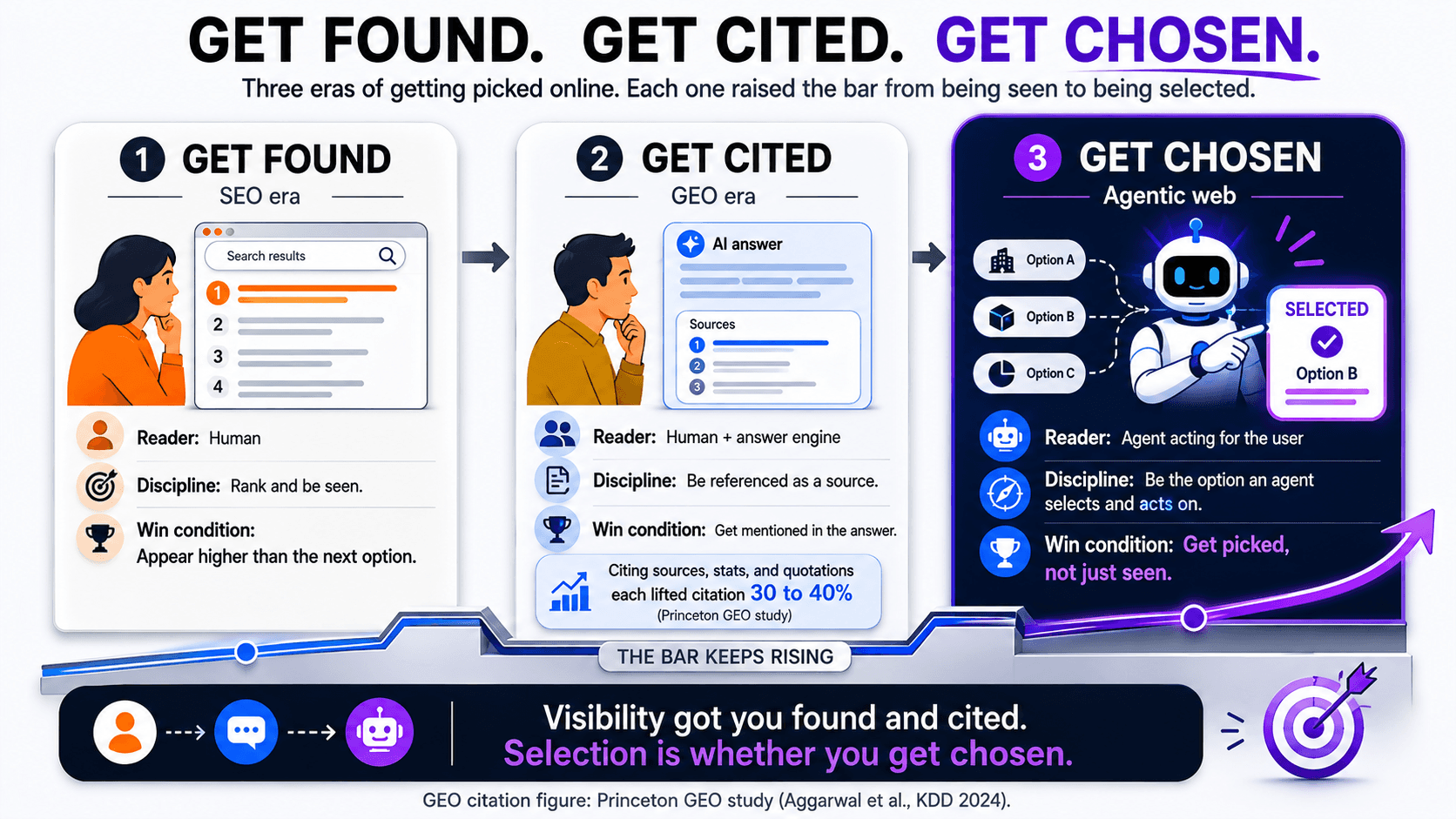
🔍 Three eras, one direction. SEO was about getting found, GEO is about getting cited, and the agentic web is about getting chosen. Each era raised the bar from being seen to being selected
📣 Citation is now table stakes. The Princeton GEO study found that adding statistics, citing sources, and including quotations each lifted AI citation visibility by 30 to 40%. Everyone is learning this, which is exactly why it stops being an edge
🎯 Selection is a different game. In controlled experiments, agent decisions shifted predictably and substantially in response to on-page signals, making agents strongly biased choosers. Selection is something you can lose even while perfectly visible
🤖 Agents narrow, then pick. Agentic browsers interpret options, decide the next step, and execute, and up to 37% of web events may already be agent-driven. The reader doing the choosing is changing from human to machine
💸 The stakes are commercial. Gartner projects 90% of B2B purchases will be handled by AI agents by 2028, and AI-referred visitors convert far higher than organic, with one B2B study showing ChatGPT at 15.9% versus Google's 2.8%
🧱 Selectable means legible. Being chosen requires being readable by crawlers that don't run JavaScript, parseable into clean chunks, and recognizable as a consistent entity
🏆 The new win condition. Visibility got you considered. Selection gets you chosen and acted on. The brands building for selection now compound an advantage while everyone else optimizes for a game that's ending

Zach Chmael
CMO, Averi
"We built Averi around the exact workflow we've used to scale our web traffic over 6000% in the last 6 months."
Your content should be working harder.
Averi's content engine builds Google entity authority, drives AI citations, and scales your visibility so you can get more customers.
Visibility Was the Old Game. Selection Is the New One.
The most visible brand in your category will not win the agentic web. The most selectable one will.
Those are different things, and the gap between them is about to decide who grows and who quietly disappears from the answers.
For twenty years, the entire discipline of getting found online optimized for one thing: visibility. Rank higher, appear more, get seen. That game produced SEO, then it produced its successor, the race to get cited in AI answers. Both are games of being seen.
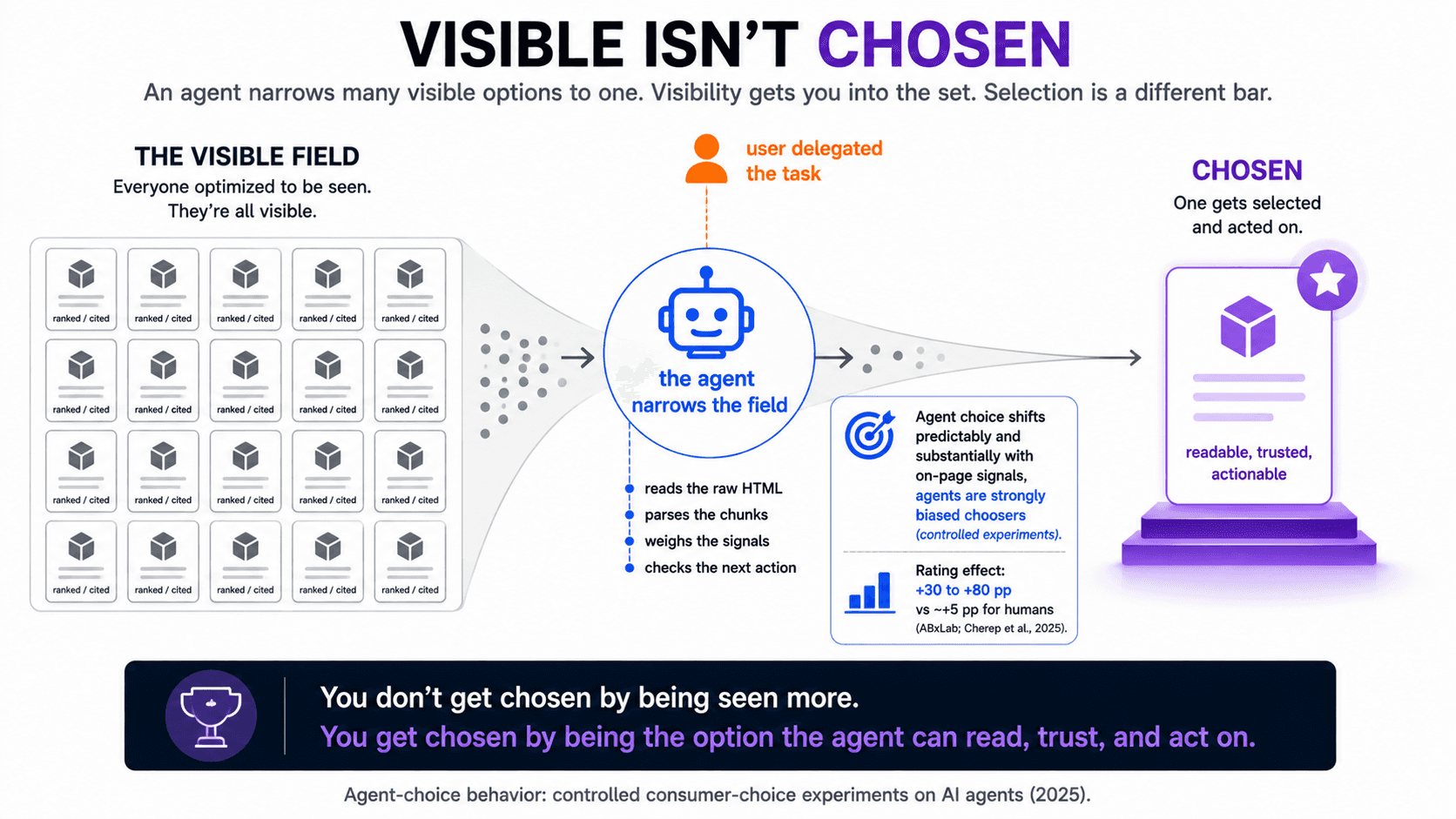
But the web is acquiring a new kind of reader, an agent acting on a person's behalf, and an agent does not reward being seen. It does the seeing for the user, narrows the field, and selects one option to act on. Visibility gets you into the set it considers. Selection is whether you are the one it picks. That is a higher bar, a different discipline, and almost nobody is building for it.
This is the shift from visibility to selection, told as the three eras that got us here, get found, get cited, get chosen, and what the third one actually requires. It is the strategic layer above the mechanics of how agents read, and it reframes what you are optimizing for in the first place.
What's the Difference Between Visibility and Selection?
Visibility is being seen; selection is being chosen.
Visibility is a property of how many places you appear and how high, a list you are on, a result that ranks, a citation in an answer.
Selection is a property of a decision, the single moment an agent narrows a field of options to the one it will read closely, trust, and act on. You can be highly visible and never selected, which is the trap most brands are walking into without noticing.
The distinction was blurry as long as the reader was human.
A person who searches sees a list, scans it, and clicks, so visibility and the click were tightly coupled: rank high, get seen, get chosen, all in one motion. The agent breaks that coupling. It does not present you a list to scan; it scans the list itself, on the user's behalf, and returns a decision. The work of choosing moves from the human to the machine, and the machine chooses differently, on signals you may not be optimizing for at all.
Visibility | Selection | |
|---|---|---|
What it measures | How often and how high you appear | Whether you're the option that gets chosen |
The reader | A human scanning a list | An agent narrowing a field to one |
The unit | A ranking, an impression, a citation | A decision |
Win condition | Be seen | Be picked and acted on |
Era | SEO, then GEO | The agentic web |
You can lose it by | Ranking low, going uncited | Being unreadable, untrusted, or unactionable even while cited |
The last row is the one that should change how you think.
Under visibility, you lose by being low on the page.
Under selection, you can be cited and still lose, because being mentioned in an answer is not the same as being the option an agent acts on. The first time that distinction stopped being abstract for me was watching one of our own comparison pages get cited across ChatGPT and Perplexity in the same week it sent almost no clicks. Visible, clearly. Whether it was getting chosen was a completely separate question, and nothing in our analytics was built to answer it.
How Did We Get Here? Found, Cited, Chosen
We got here through three eras of the same underlying question, how do you get picked, each with a different reader and a different bar. Seeing them as a progression makes the current shift legible, because each era didn't replace the last so much as raise the stakes on top of it.
The visibility era: get found (SEO)
The first era was about being found by a search engine and ranked above competitors. The reader was a crawler that counted signals, and the human who saw the results.
The discipline was SEO: keywords, links, technical health, climbing the rankings. The win condition was simple and singular, be seen higher than the next option, because a human scanning a list mostly clicks what's near the top. For two decades this was the whole game, and the entire content industry was built to play it.
The citation era: get cited (GEO)
The second era arrived with AI answers, and the bar moved from ranking to being cited as a source.
Generative engine optimization is the discipline of structuring content so AI engines retrieve and reference it, and the empirical foundation is real: the Princeton GEO study, a controlled study across thousands of queries, found that statistics, citations, and quotations each raised citation visibility by 30 to 40%. Being cited matters even without a click, because brands cited in AI Overviews earn 35% more organic clicks than uncited brands, and AI Overviews now appear on roughly 48% of searches while cutting click-through by around 61%.
The trouble is that the GEO playbook is being learned everywhere at once. The moment a tactic is in every guide, it stops being an edge and becomes the floor. Citation is rapidly becoming table stakes.
The selection era: get chosen (the agentic web)
The third era is here, and the bar has moved again, from being cited to being chosen by an agent acting for a user. The reader is no longer a human scanning results; it is an agent that interprets the options, decides the next step, and executes. Up to 37% of web events may already come from non-human or agent-driven sources, and Gartner projected up to a quarter of searches would be delegated to AI assistants by 2026. When the agent does the choosing, visibility is only the entry ticket. Whether you are the option it selects depends on things the first two eras never had to account for, and that is the new game.
The arc is clean: get found, get cited, get chosen.
Why Doesn't Visibility Win Anymore?
Visibility stops winning because the entity doing the choosing changed, and it chooses on different terms than a human does. A human is swayed by brand familiarity, design, and what ranks near the top. An agent is not browsing for vibes; it is executing a task, and it weighs explicit, structured signals far more heavily and far more predictably than a person.
The evidence is now experimental rather than speculative.
In a controlled web-shopping environment where researchers varied prices, ratings, and nudges, agent decisions shifted predictably and substantially, revealing agents as strongly biased choosers even without the cognitive constraints that produce human bias. Agents showed order-of-magnitude stronger reactions to ratings and expert cues than humans, and researchers can now isolate the single moment an agent selects one option over another and measure what moves it.
The takeaway is uncomfortable for a visibility mindset: an agent's choice is governed by signals on the page, not by how famous you are. As the agentic-commerce research puts it, agentic AI does not reward brand familiarity alone, it rewards infrastructure readiness, and the supplier whose data is most legible at the moment of query becomes the selected option.
There is a commercial edge to this, not just a philosophical one. AI-referred visitors arrive further down the funnel and convert far higher than organic, with one 42-site study showing ChatGPT converting at 15.9% against Google's 2.8%, and Forrester research found buyers now rely on AI tools over vendor websites and direct sales.
The traffic that selection wins is the traffic that buys. Losing the selection while keeping the visibility means watching pre-qualified demand route to whoever the agent found easier to choose.
What Makes a Brand Selectable to an Agent?
A brand is selectable when an agent can read it, parse it, recognize it, weigh its signals, and act on it without a human translating the site first. Selection is not a single trick; it is a stack of legibility conditions, and missing any one of them quietly drops you from the agent's shortlist.
Each maps to a piece of work the citation era already started, which is the reassuring part: you are extending a foundation, not starting over.
It begins with being readable at all. Most AI crawlers don't execute JavaScript, so content that loads client-side is an empty shell to them, and a page can rank on Google while being invisible to ChatGPT, Claude, and Perplexity. If the agent can't see your content in the raw HTML, the selection is over before it starts.
Then it must be parseable: agents break content into chunks and retrieve the fragments that match a task, so clean, self-contained sections are what get pulled into a decision. It must be recognizable, carrying consistent entity signals so the agent treats you as a known, distinct entity rather than an ambiguous string.
It must carry the signals agents weigh, the structured data, ratings, and explicit cues that experiments show move agent choice hardest.
And it must expose the next move, the action the agent is trying to complete, present and legible rather than buried.
Notice what selectability is not. It is not a louder version of visibility. You do not get chosen by appearing more; you get chosen by being more legible to the thing doing the choosing.
This is why the discipline of writing for both humans and agents matters so much here: the structure makes you selectable to the machine, and the substance is what earns the selection once you're in the running. Structure is the floor. Substance is the bar.
Isn't Selection Just GEO by Another Name?
No. GEO gets you cited; selection gets you chosen.
GEO and answer engine optimization are about being retrieved and mentioned as a source, which puts you into the set of options an agent considers.
Selection is the next step: being the option it picks from that set and acts on. Citation is necessary for selection, but it is not sufficient, and the difference is the entire point of this piece.
Think of it as consideration versus decision. Getting cited is making the agent's shortlist. Getting chosen is being the one it acts on, which depends on whether you are the most readable, most trusted, and most actionable option on that list.
This is the same progression that runs from getting cited toward being executable in the move to Business-to-Agent, and it is grounded in the emerging science of how agents actually behave rather than in guesses. GEO is a layer of selection, not a synonym for it.
Treating the two as the same is how a brand convinces itself it has won the agentic web because its citation count went up, while the agents quietly select someone else.
What Should You Do Now?
You build for selection by securing the visibility foundation first, then layering on the legibility and substance that win the choice. The work is sequenced, and most of the early steps are things worth doing for citation regardless, so you get present-tense return while positioning for what's next.
First, win the floor. Confirm your content is readable by non-rendering crawlers, structured into clean, retrievable chunks, and carrying consistent entity signals. This is the citation-era work, and it is also the precondition for selection. Skipping it means optimizing a page the agent can't read.
Second, build for the choice. Make the structured signals agents weigh, ratings, specs, comparison data, present and machine-readable rather than locked in dynamic interfaces. Invest in the substance, first-party data, lived experience, a defensible point of view, that earns the selection once you are in the running and that a model summarizing the internet can't replicate.
Third, change what you measure. Share of AI voice tells you about visibility; start asking the harder question of whether you are the option getting chosen, because visibility without selection isn't a strategy.
The timing argument is real. Citation share is concentrating, the brands with entity and structural strength are pulling ahead, and the advantage compounds through model retraining. The teams that learn to win selection now will be far ahead of the teams still chasing visibility in a year. This is a readiness move, not an emergency, and that is exactly why the moment to start is before the volume arrives rather than after.
How Averi Is Built for the Selection Era
Averi is the brand layer for the agentic web, which is to say the layer that wins selection.
The whole argument of this piece is that being chosen by an agent requires a stack of legibility, readable, parseable, recognizable, actionable, sitting under real substance. That stack is precisely what Averi is built to produce, which is why we can say "the brand layer for the agentic web" as a description of a job rather than a slogan: it is the layer that decides whether an agent can choose you.
Concretely, the content engine produces clean, server-rendered, machine-parseable content, so agents can read you rather than hitting a blank shell. Dual SEO and GEO scoring checks each piece against the structural conditions selection depends on before it ships. And Brand Core keeps your naming, category language, and core descriptions consistent everywhere, the entity signal that makes an agent recognize you as a known entity instead of an ambiguous string. That foundation wins citations today and is the groundwork selection is built on.
We ran the play on ourselves, taking our own content from a few thousand monthly impressions to over 12 million organic impressions across 12 months on a one-person team, which is the clearest proof I can offer that the foundation works before the selection layer is even fully mature.
What Averi will not do is pretend the selection era is finished or fully solved. The science of agent choice is young and the techniques are advancing fast, ours included. What is true today is that the brands building legibility and substance now are the ones agents will be able to choose as the shift accelerates, and that is the bet Averi is built around.
FAQs
What is the difference between visibility and selection in AI search?
Visibility is being seen, ranked, appearing, getting cited in an answer. Selection is being chosen, the moment an agent narrows a field of options to the one it reads closely, trusts, and acts on. You can be highly visible and never selected. As agents do more of the choosing, visibility becomes the entry ticket and selection becomes the win.
Why isn't getting cited by AI enough anymore?
Getting cited puts you into the set of options an agent considers, but it does not make you the option it chooses. Citation is consideration; selection is the decision. An agent picks from its shortlist based on which option is most readable, trusted, and actionable, so a brand can see its citation count rise while agents consistently select a competitor.
What does "get found, get cited, get chosen" mean?
It describes three eras of getting picked online. SEO was about getting found, ranking and being seen. GEO is about getting cited, being referenced as a source in AI answers. The agentic web is about getting chosen, being the option an agent selects and acts on for a user. Each era raised the bar from being seen to being selected.
How do agents decide which brand to choose?
Agents weigh explicit, structured signals far more heavily and predictably than humans do. Controlled experiments show agent choice shifts substantially with ratings, structured data, and on-page cues, and far less with brand familiarity. An agent chooses the option it can read, parse, trust, and act on, which means legibility and clear signals matter more than fame or design.
What makes content selectable to an AI agent?
Selectable content is readable by crawlers that don't run JavaScript, parseable into clean self-contained chunks, recognizable through consistent entity signals, carries the structured signals agents weigh, and exposes the next action clearly. Missing any one of these drops you from the agent's shortlist. It is a stack of legibility conditions sitting under genuine substance, not a single tactic.
Is selection optimization the same as GEO?
No. GEO is about being cited, retrieved and mentioned as a source. Selection is about being chosen, the option an agent picks from its shortlist and acts on. Citation is necessary for selection but not sufficient. GEO is one layer of selection, not a synonym for it, and treating them as the same lets a brand mistake rising citations for actually winning the choice.
Is it too early to optimize for selection?
The agent-choice science is young and agentic traffic is still a minority for most sites, so this is a readiness move rather than an emergency. The reason to start now is that the foundation, readable, parseable, recognizable content, wins the citation layer that is already live, so it pays off today while positioning you for selection as agent volume grows and the advantage compounds.
Related Resources
The Agentic Web Cluster
How Agents Read, How to Write for Them, and How Buying Is Being Rebuilt
Agent Behavioral Science: The Web Will Be Won by Whoever Predicts Agents
Business-to-Agent (B2A): How to Prepare Your Brand for the Agentic Web
The JavaScript Rendering Gap: Why AI Can't See Your Best Content
How AI Agents Actually Read Your Content: Chunking, Embeddings, and Retrieval
Writing for Humans and Agents at the Same Time: The Dual-Reader Playbook
Foundational Concepts
Strategy and Measurement
Operational Workflow
Stop optimizing for a game that's ending. Averi builds the readable, parseable, entity-consistent foundation that wins citations today and makes your brand selectable as agents take over the choosing. $99/month for Solo. 14-day free trial. Start free →