The Platform Divergence Playbook: Why Your AI Search Strategy Needs Three Different Plays in 2026
Zach Chmael
Head of Marketing
8 minutes

In This Article
Only 11% of cited domains overlap between ChatGPT and Perplexity. The "one playbook for all AI engines" myth needs to die. Here's the 3-play framework.
Updated
Trusted by 1,000+ teams
Startups use Averi to build
content engines that rank.
TL;DR
📉 The "one playbook" assumption is dead: overlap between top Google rankings and AI citations dropped from 70% to under 20%, only 11% of domains cited by ChatGPT are also cited by Perplexity, and even AI Overviews and AI Mode share just 13.7% of citations — these aren't variations, they're structurally different systems
🎯 Three plays, not one: ChatGPT rewards encyclopedic + structured data + brand mentions on third-party platforms. Perplexity rewards Reddit + recency + citation-dense methodology. Google AI Mode rewards multimodal + domain authority + topic comprehensiveness via query fan-out
💰 Where the volume actually is: ChatGPT drives 87.4% of all AI referral traffic per Conductor — meaning the optimization weighting most teams use (equal effort across engines) is wrong by an order of magnitude. ChatGPT optimization should get 60-70% of effort
📊 Where the conversion premium is: Claude users convert at 16.8%, ChatGPT at 14.2%, Perplexity at 12.4% — vs Google organic's 2.8% baseline. All AI platforms outperform organic by multiples, but the conversion profiles differ enough to justify platform-specific prioritization
⚙️ The architectural shift: in Q2 2026, the optimization unit is no longer "the page." It's "the page, restructured per engine, with platform-specific assets attached" — and that requires either dramatically more manual work or a content engine that handles platform divergence by default
🛠 What this means in practice: most B2B SaaS teams need to abandon their "GEO program" as currently structured and rebuild it as three coordinated plays running in parallel — same content base, different attached assets, different distribution surfaces, different KPIs

Zach Chmael
CMO, Averi
"We built Averi around the exact workflow we've used to scale our web traffic over 6000% in the last 6 months."
Your content should be working harder.
Averi's content engine builds Google entity authority, drives AI citations, and scales your visibility so you can get more customers.
The Platform Divergence Playbook: Why Your AI Search Strategy Needs Three Different Plays in 2026
Stop optimizing for "AI search." That phrase is already obsolete.
Six months ago, the assumption was reasonable. Most teams running GEO programs treated ChatGPT, Perplexity, Gemini, Claude, and Google AI Mode as different surfaces drawing from the same underlying citation logic. One playbook. Five outputs. Reasonable allocation of effort across the engines based on traffic share.
The data killed that assumption.
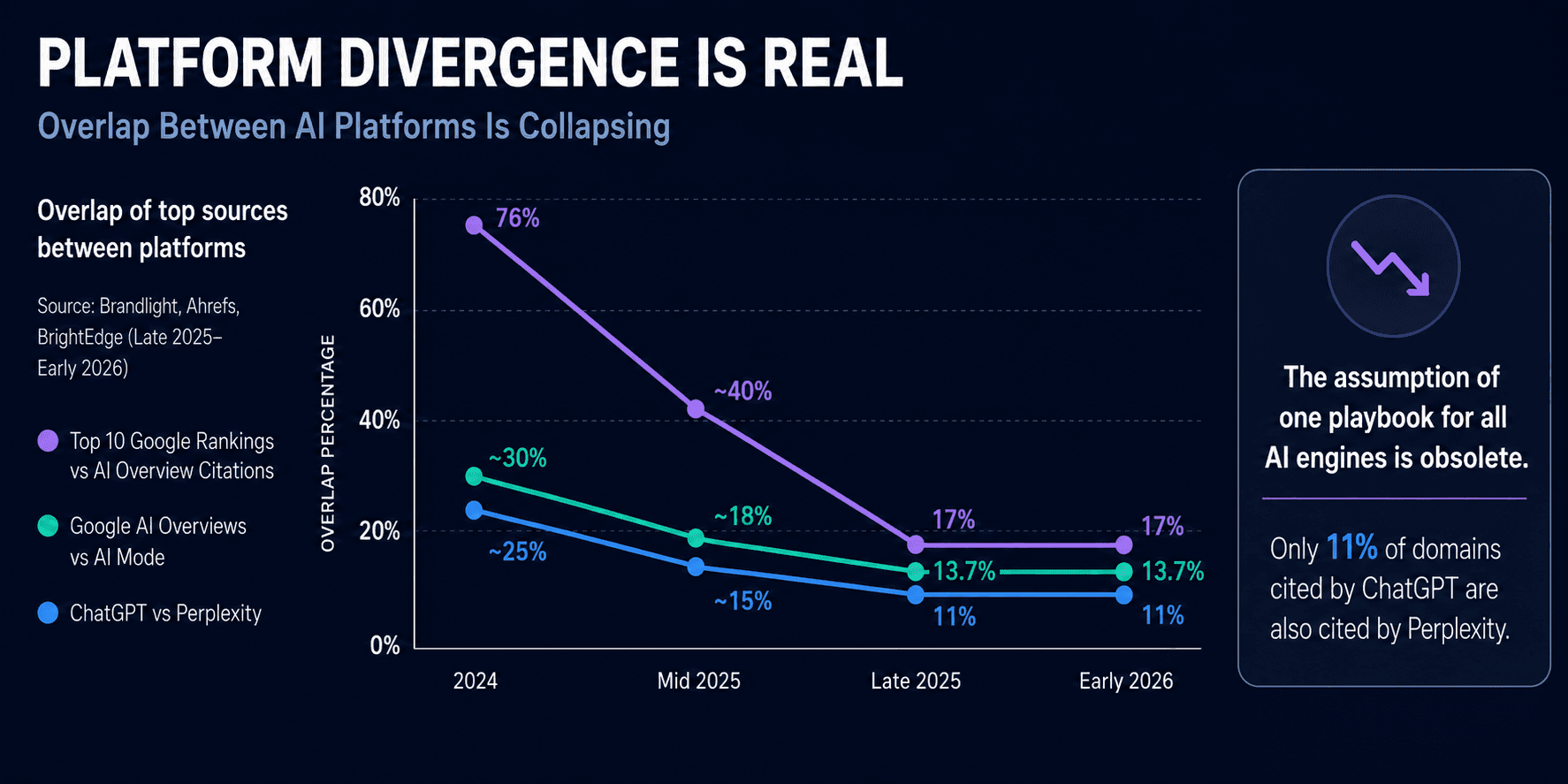
Brandlight's late-2025 analysis found that the overlap between top Google rankings and AI-cited sources has collapsed from 70% to under 20%. Our own analysis of 680 million citations showed only 11% of domains cited by ChatGPT are also cited by Perplexity. Ahrefs' December 2025 study found that AI Overviews and AI Mode — both Google products — only share 13.7% of citations with each other. BrightEdge's February 2026 analysis put the overlap between top-10 Google rankings and AI Overview citations at approximately 17%, down from 76% in 2024.
These aren't margin-of-error variations. The platforms have diverged structurally.
Optimizing for one is no longer effectively optimizing for any other. The teams running a single playbook across all AI engines in Q2 2026 are showing up in roughly 20% of the citation pool they think they're addressing — and they don't know it because their tracking is also single-platform.
This piece is the three-play framework: what each major engine actually rewards, why the divergence happened, and how to allocate effort across ChatGPT, Perplexity, and Google AI Mode without spreading thin or duplicating work that doesn't transfer.
Why the platforms diverged
The "one playbook for all AI engines" assumption was reasonable when the engines were drawing from similar source pools.
They aren't anymore, and the divergence isn't a temporary artifact — it's structural to how each engine was built and how each is now being trained.
ChatGPT draws from a mix of OpenAI's training data plus live web search (when ChatGPT-User or OAI-SearchBot can access the page).
The training data dimension matters: ChatGPT has multi-year exposure to Wikipedia, third-party review platforms (G2, Capterra, Trustpilot), Reddit at scale, and major news/encyclopedic sources. Wikipedia accounts for 29.7% of cited pages in ChatGPT, with homepages/landing pages at 23.8% and educational pages at 19.4%. Domains with millions of brand mentions on Quora and Reddit have ~4x higher chances of being cited by ChatGPT than those with minimal activity, and Domains with profiles on platforms like Trustpilot, G2, Capterra, and Sitejabber have 3x higher chances of being chosen as a source.
Perplexity runs almost the opposite architecture. It searches the web in real-time against a proprietary index of 200+ billion URLs. Every query triggers fresh retrieval. There's almost no training-data shortcut — recency, citation density, and methodological transparency dominate. Visible "2026" date signals improve Perplexity citation rates by approximately 30%, and content updated in the past 12 months earns 3.2x more citations on Perplexity specifically. Perplexity tied every claim to a specific source in 78% of complex research queries, vs ChatGPT's 62% — meaning the bar for getting cited is higher, but every citation is a direct referral.
Google AI Mode and AI Overviews layer AI synthesis on top of Google's traditional ranking infrastructure, but with significant divergence from organic ranking signals. The underlying mechanism is query fan-out: Google's AI splits a user's original query into multiple sub-queries and draws from across all of those sub-query results, which means a page can be cited even if it doesn't rank for the original query. YouTube is now the single most-cited domain in Google AI Overviews and accounts for 18.2% of all citations that come from outside the top 100. The shift accelerated when Google upgraded to Gemini 3 as the global default for AI Overviews on January 27, 2026.
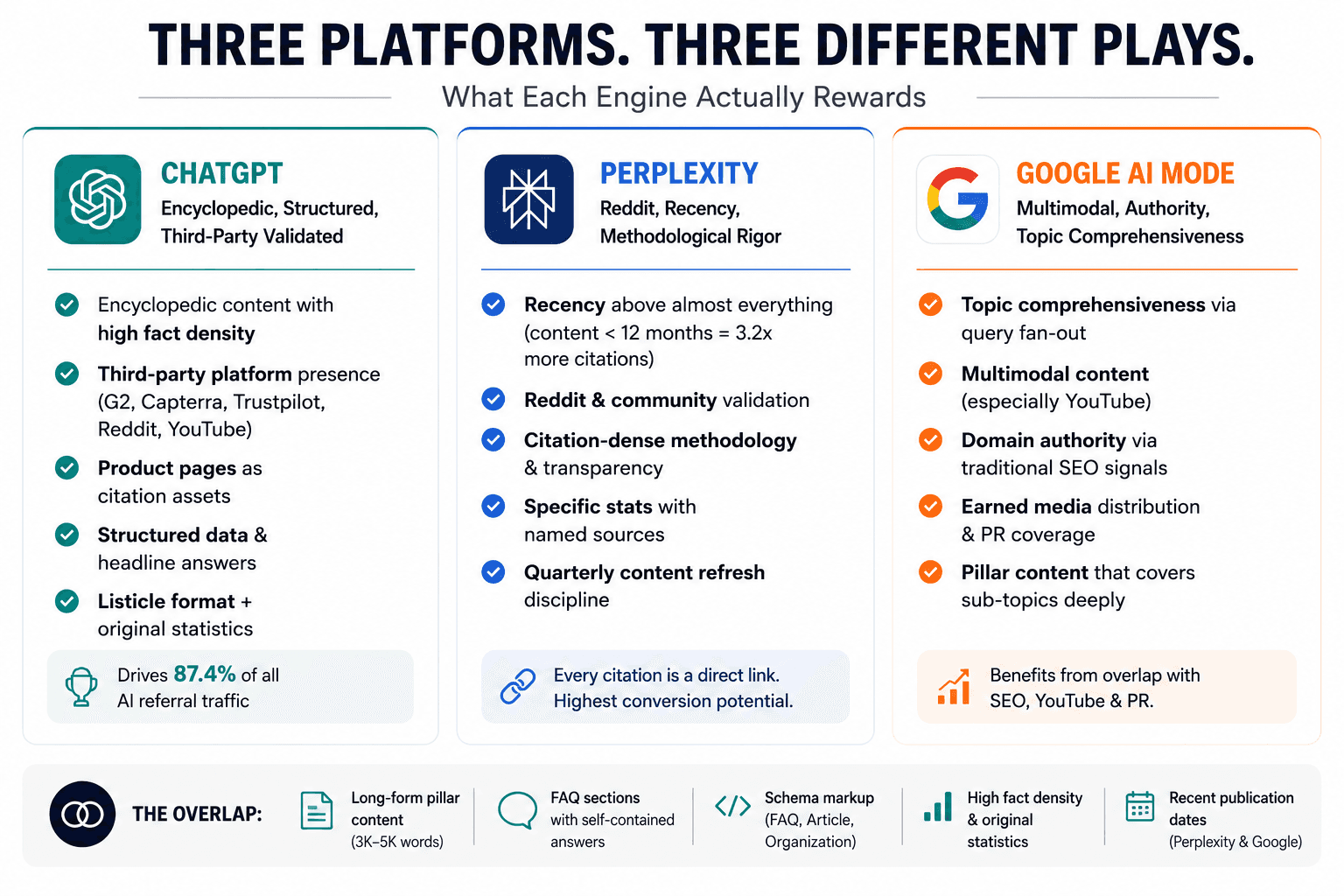
The structural takeaway: ChatGPT favors authority signals built over years through third-party platforms. Perplexity favors recency and methodological rigor on individual pages. Google AI Mode favors topic comprehensiveness across a fan-out of sub-queries. Three different mechanics. Three different optimization investments. The teams running a single playbook are guaranteed to underperform on at least two of the three.
For our deep methodological analysis of these patterns, see the B2B SaaS Citation Benchmarks Report and our GEO Playbook 2026.
Play 1: ChatGPT — encyclopedic, structured, third-party validated
If you only have time to optimize for one platform, this is it.
ChatGPT drives 87.4% of all AI referral traffic. The volume distribution alone justifies prioritizing it over the others combined. The catch: ChatGPT's optimization patterns are different from anything in the traditional SEO playbook, and most teams approach it wrong.
What ChatGPT actually rewards (per the data):
Encyclopedic content with high fact density. Pages above 20,000 characters average 10.18 citations each vs 2.39 for pages under 500 characters. Content with original statistics sees 30-40% higher visibility in AI responses. The "Best X" listicle format dominates: 43.8% of all cited page types in ChatGPT are listicles.
Structured data and schema. Pages that use 120-180 words between headings receive 70% more ChatGPT citations than pages with sections under 50 words. Pages with headlines that directly answer the question get cited by ChatGPT 41% of the time. FAQ structure helps but FAQ schema specifically isn't essential.
Third-party brand presence. This is the one most teams miss. ChatGPT's training data exposure to G2, Capterra, Trustpilot, Reddit, Quora, and YouTube means brands with strong presence on those platforms are cited dramatically more often than brands without. Domains with millions of brand mentions on Quora and Reddit have ~4x higher chances of being cited. G2 reviews specifically: a 10% increase in reviews leads to a 2% increase in AI citations.
Product pages as citation assets. ChatGPT preferentially cites product pages directly, unlike other engines that prefer blog/listicle content. This means product pages need to be treated as first-class citation assets, not just conversion assets.
The ChatGPT play in practice:
Audit your top product pages and feature pages. Add structured FAQ sections. Add specific outcome claims with evidence. Add comparison tables. Add fact-dense feature descriptions with real numbers, not marketing claims.
Build presence on the third-party platforms ChatGPT trained on. G2, Capterra, Trustpilot, Sitejabber. Reddit (in subreddits where your buyers actually are, not as a corporate poster). Quora answers from real authors with real expertise.
Publish encyclopedic content (3,000-5,000 word pillar pieces) with high fact density and direct-answer headlines for sections.
Get YouTube content into orbit. YouTube mentions and branded web mentions are the top factors that correlate with AI brand visibility in ChatGPT, AI Mode, and AI Overviews. Even one well-optimized YouTube video covering your category produces meaningful citation lift.
For a deeper take on ChatGPT-specific optimization, see our piece on LinkedIn as the #1 Most-Cited Source in AI Search for Professional Queries and the Complete Guide to AI Visibility for B2B SaaS.
Play 2: Perplexity — Reddit, recency, methodological rigor
Perplexity is the second-priority engine for most B2B SaaS teams, and the most underrated one for conversion. It drives less referral volume than ChatGPT but has the highest direct-citation-to-click ratio in the AI search ecosystem because every cited source is named with a clickable link. Perplexity tied every claim to a specific source in 78% of complex research queries, making it the "every citation = a direct referral" platform.
What Perplexity actually rewards:
Recency above almost everything. Content updated in the past 12 months earns 3.2x more citations on Perplexity. Visible "2026" date signals improve citation rates by approximately 30%. Perplexity's real-time retrieval architecture means stale content decays in citation value much faster than on ChatGPT.
Reddit and community presence. Reddit accounts for 21% of Google AI Overview citations and 6.6% of Perplexity citations — and Perplexity's preference for community-validated sources means Reddit threads about your category are a meaningful citation surface.
Citation-dense methodology. Perplexity's RAG architecture rewards content that itself cites sources. A piece with 15 hyperlinked external statistics gets cited far more than a piece with the same information presented as opinion. Methodology transparency matters: showing your work, naming your data sources, explaining how conclusions were reached.
Specific stat density and named sources. Perplexity surfaces content where every claim is anchored. "Studies show" doesn't get cited. "[Specific source] found 41% of B2B buyers..." does.
The Perplexity play in practice:
Build a quarterly content refresh queue. Every piece older than 6 months in your library gets reviewed for date signals (visible "2026" markers in title, intro, meta description) and stat updates. The refresh discipline is more important here than on any other platform.
Add real Reddit presence to your distribution mix. Not corporate posts. Real participation in subreddits where your buyers vent. Pieces of your content quoted in genuine discussions get cited at rates corporate Reddit accounts never approach.
Restructure your highest-performing pieces to citation density standard. Every claim hyperlinked. Every statistic attributed. Every conclusion grounded in a specific source. The pieces become reference material that Perplexity treats as authoritative.
Add explicit methodology sections to data-driven pieces. "How we collected this data" is the kind of transparency Perplexity rewards.
For more on the technical optimization patterns specifically, see our building citation-worthy content guide and our FAQ optimization for AI search guide.
Play 3: Google AI Mode — multimodal, authority, topic comprehensiveness
Google AI Mode and AI Overviews are the most volatile of the three — Google's algorithms shift fastest, and the rules from January often don't hold by April.
But the underlying optimization principles have stayed consistent through the Gemini 3 transition… domain authority matters, topic comprehensiveness matters, and the query fan-out mechanic rewards content that covers a topic broadly enough to be retrieved across multiple sub-queries.
What Google AI Mode actually rewards:
Topic comprehensiveness via query fan-out. Google's AI splits queries into sub-queries and pulls from across all of those sub-query results. A piece that covers "how to do X" gets cited not just for the original query but for "what is X," "X vs Y," "X for [vertical]," and 5-10 other related sub-queries. In-depth pillar content earns disproportionate citation share.
Multimodal content (especially YouTube). YouTube accounts for 18.2% of all AI Overview citations that come from outside the top 100, making it the single most-cited domain in Google AI Overviews. Brands with YouTube presence get cited at rates that text-only brands cannot match.
Domain authority via traditional SEO signals. Even with the divergence from top-10 ranking overlap, SeoClarity's analysis of 432,000 keywords found that 97% of AI Overviews cite at least one source from the top 20 organic results. Position 1 pages appear in AI Overviews more than 50% of the time. Traditional SEO is necessary but no longer sufficient.
Earned media distribution. Distributing content to a wide range of publications can increase AI citations by up to 325% compared to only publishing the content on your own site. Google AI Mode treats third-party syndication as authority validation.
The Google AI Mode play in practice:
Build pillar content that covers a topic comprehensively enough to satisfy 5-10 fan-out sub-queries. The 3,000-5,000 word pieces serve double duty as both ChatGPT citation assets and Google AI Mode authority signals.
Invest in YouTube. Even a modest YouTube channel covering your category produces measurable AI Overview citation lift.
Maintain traditional SEO discipline. The top-10 organic ranking is no longer sufficient for AI Overview citation, but it remains a meaningful signal. Don't abandon SEO fundamentals chasing AI optimization.
Build an earned media distribution function. PR placements that earn coverage in publications Google AI treats as authoritative are worth more than self-published content of equivalent quality.
For the deeper take on Google AI Mode optimization specifically, see our Google AI Overviews Optimization for 2026 guide.
How to allocate effort across the three plays
The biggest mistake teams make is splitting effort equally across the three engines. The traffic distribution doesn't justify it.
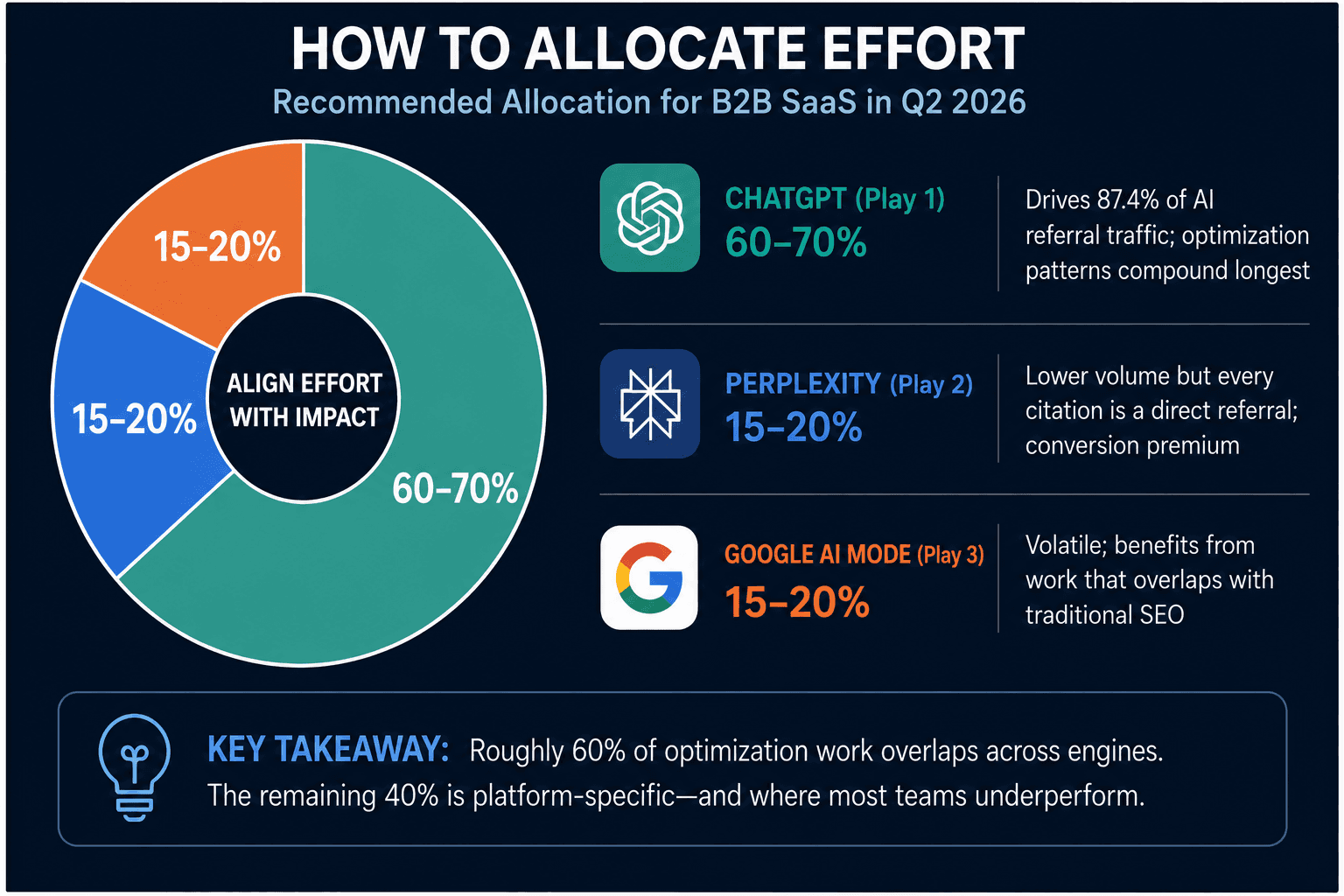
Reasonable allocation framework for B2B SaaS in Q2 2026:
Play | Effort allocation | Why |
|---|---|---|
ChatGPT (Play 1) | 60-70% | Drives 87.4% of AI referral traffic; optimization patterns compound longest |
Perplexity (Play 2) | 15-20% | Lower volume but every citation is a direct referral; conversion premium |
Google AI Mode (Play 3) | 15-20% | Volatile; benefits from work that overlaps with traditional SEO |
The allocation isn't fixed — it shifts based on your category, buyer mix, and existing infrastructure. Categories with heavy Reddit conversation (developer tools, fintech, crypto) push more effort toward Perplexity. Categories with mature SEO programs already running can extract more value from Google AI Mode without much marginal investment.
Categories where the buyer is enterprise and the journey starts with broad market research lean even more heavily toward ChatGPT.
What overlaps between the three plays:
Long-form pillar content (3,000-5,000 words) serves all three engines if structured correctly
FAQ sections with self-contained answers serve all three
Schema markup serves all three (though FAQ schema specifically isn't essential for ChatGPT)
High fact density and original statistics serve all three
Recent publication dates serve Perplexity and Google AI Mode (less critical for ChatGPT)
What's platform-specific:
Third-party platform presence (G2, Capterra, Trustpilot, Reddit, YouTube): mostly ChatGPT-specific, with some bleed-over to Google AI Mode
Quarterly refresh discipline: Perplexity-critical, less critical for the others
Earned media distribution: Google AI Mode-specific, with some bleed-over to ChatGPT
Product page citation optimization: ChatGPT-specific
Methodology transparency: Perplexity-specific
The architectural insight: roughly 60% of optimization work overlaps across engines. The remaining 40% is platform-specific and represents the biggest gap between teams running a single playbook and teams running three coordinated plays.
For a thorough treatment of the technical setup, see our Platform-Specific GEO guide and our AI Citation Tracking guide.
Common mistakes teams are making in Q2 2026
Five patterns I see most often as teams try to operationalize platform divergence:
Mistake 1: Single-platform tracking giving false-positive comfort. Teams measure citation rate on one platform (usually ChatGPT) and assume the number applies everywhere. Only 11% of domains cited by ChatGPT are also cited by Perplexity. Single-platform tracking is single-platform visibility — it tells you nothing about the other 89% of the citation pool.
Mistake 2: Equal-weight optimization across engines. This was reasonable in 2024 when traffic share was unclear. In 2026, with ChatGPT at 87.4% of AI referral traffic, splitting effort equally is a 3x misallocation against the volume reality.
Mistake 3: Treating "GEO" as a single discipline. It's not anymore. ChatGPT optimization is closer to traditional brand-building plus product-page-as-asset thinking. Perplexity optimization is closer to academic-style citation rigor. Google AI Mode optimization is closer to traditional SEO plus YouTube and PR. Three different disciplines now sit under the "GEO" umbrella, and treating them as one produces work that's mediocre on all three.
Mistake 4: Skipping the third-party platform investment. Most B2B SaaS teams under-invest in G2, Capterra, Trustpilot, and Reddit because the work feels low-impact relative to writing pillar content. The data says the opposite: domains with strong third-party platform presence are cited 3-4x more often by ChatGPT. The work compounds across multiple optimization plays.
Mistake 5: Ignoring YouTube because "we're not a video company." YouTube is the most-cited domain in Google AI Overviews for citations from outside the top 100 and a top correlation factor for ChatGPT brand visibility. A modest YouTube presence (10-20 videos covering your category) produces meaningful citation lift across two of the three engines. The "we're not a video company" framing is leaving citation share on the table.
What to do this week
If you're running a GEO program built on the "one playbook" assumption and want to restructure for Q2-Q3 2026, here's the order:
Audit your current AI citation tracking. Are you measuring across ChatGPT, Perplexity, AND Google AI Mode minimum? If not, your visibility data is structurally incomplete. Add multi-platform tracking before doing any other optimization work.
Reweight your optimization effort. Move from equal-weight to roughly 60-70% ChatGPT, 15-20% Perplexity, 15-20% Google AI Mode. Justify exceptions to this allocation with category-specific evidence.
Audit your third-party platform presence. G2, Capterra, Trustpilot, Sitejabber. Reddit. Quora. YouTube. Build the missing ones. The work feels mundane and the citation impact is enormous.
Build a quarterly refresh queue. Pages updated within the past year make up 70% of AI-cited pages, and the refresh discipline is what separates Perplexity-cited brands from Perplexity-invisible ones.
Restructure top product pages as citation assets. Add structured FAQ sections. Add specific outcome claims with evidence. Add comparison tables. Add fact-dense feature descriptions. This is the single highest-ROI ChatGPT optimization for B2B SaaS.
Start building YouTube presence. Even 10-20 videos covering your category produces measurable citation lift on Google AI Mode and ChatGPT. The asset compounds.
Document your three-play allocation explicitly. Write down what percentage of effort goes to each engine, what platform-specific work is happening, and what overlapping work serves all three. The discipline of explicit allocation is what prevents teams from drifting back to single-playbook habits.
That's the platform divergence playbook. The "one playbook for all AI engines" assumption was reasonable in 2024 and broken in 2026. The teams that adapt early — three coordinated plays, allocated by traffic share, optimized for platform-specific signals — will compound a structural advantage in the channel that drives 30%+ of buyer research and growing.
If you want this baked into your stack — a content engine that handles platform divergence by default, with composite SEO + GEO scoring that surfaces platform-specific gaps and unified analytics across ChatGPT, Perplexity, and Google AI Mode — start a free 14-day Averi trial.
30 minutes to set up. The first piece you write inside Averi will already be structurally calibrated for the three-play reality this article describes.
Related Resources
The Benchmark Data
ChatGPT vs Perplexity vs Google AI Mode: The B2B SaaS Citation Benchmarks Report (2026)
Platform-Specific GEO: How to Optimize for ChatGPT vs Perplexity vs Google AI Mode
AI Citation Tracking: How to Measure Citation Frequency Across ChatGPT, Perplexity, and Claude
Platform-Specific Plays
The Methodology
Strategic Context
The AI Content ROI Crisis: Why 81% of Marketers Can't Prove Their AI Investment Works
Vibe Marketing in Q2 2026: What's Working, What's Hype, and What's Next
Real Receipts
Run all three plays from one workflow. Averi's content engine is built for the platform divergence reality — Brand Core, composite SEO + GEO scoring across ChatGPT, Perplexity, and Google AI Mode, native publishing with schema-by-default, and unified citation analytics in one platform. $99/mo, no contract, 14-day free trial. Start your free trial →
FAQs
How do I get cited by ChatGPT vs Perplexity vs Google AI Mode?
The optimization patterns differ structurally. ChatGPT rewards encyclopedic content (pages above 20,000 characters average 10.18 citations vs 2.39 for short pages), structured data, and brand presence on third-party platforms (G2, Capterra, Reddit, YouTube). Perplexity rewards recency (content updated in the past 12 months earns 3.2x more citations), citation-dense methodology, and Reddit/community signals. Google AI Mode rewards topic comprehensiveness via query fan-out, multimodal content (YouTube specifically), and traditional domain authority. The platforms only share roughly 11-17% of their cited domains with each other — meaning a single playbook produces visibility on roughly 20% of the actual citation surface.
Why don't ChatGPT and Perplexity cite the same sources?
Because they're built on architecturally different systems. ChatGPT draws from training data plus live web search, with deep exposure to encyclopedic and third-party platform content built up over years. Perplexity searches the web in real-time against a proprietary 200+ billion URL index with almost no training-data shortcut, prioritizing recency and citation rigor. The structural differences mean a brand built on long-term authority signals (Wikipedia presence, G2 reviews, YouTube content) wins on ChatGPT while a brand publishing fresh, citation-dense, methodology-transparent content wins on Perplexity. Only 11% of domains cited by ChatGPT are also cited by Perplexity according to Averi's analysis of 680 million citations.
Should I optimize for all AI engines equally?
No. The traffic distribution justifies weighted allocation: roughly 60-70% of effort to ChatGPT (drives 87.4% of AI referral traffic), 15-20% to Perplexity (lower volume but higher conversion-per-citation), and 15-20% to Google AI Mode (overlaps with traditional SEO work). Equal-weight allocation is a 3x misallocation against the volume reality. Adjustments to this framework should be justified by category-specific evidence — for example, developer-tool brands lean more toward Perplexity because of heavy Reddit conversation in their categories.
What's the biggest GEO mistake B2B SaaS teams make in 2026?
Single-platform tracking giving false-positive comfort. Teams measure citation rate on one platform (usually ChatGPT) and assume the number applies everywhere. With only 11% domain overlap between ChatGPT and Perplexity and 13.7% between AI Overviews and AI Mode, single-platform tracking tells you nothing about the other 89% of the citation pool. The fix is mandatory multi-platform tracking before any other optimization work. If your visibility metrics are single-platform, your visibility strategy is single-platform, regardless of how much work you're putting in.
How does query fan-out affect my AI search strategy?
Query fan-out is Google's mechanism for splitting a single user query into multiple related sub-queries when generating an AI Overview or AI Mode answer. The system then pulls citations from across all sub-query results, not just the original query's results. This means an in-depth pillar piece covering a topic broadly can be cited for the original query, the "what is X" sub-query, the "X vs Y" sub-query, and 5-10 other related searches — earning disproportionate citation share. The strategic implication: deep long-form content beats narrow short-form content for Google AI Mode, even though Google's traditional ranking algorithm doesn't always reward length.
Why is YouTube so important for AI citations now?
Because YouTube is the single most-cited domain in Google AI Overviews — accounting for 18.2% of all citations from outside the top 100 — and one of the top correlation factors for ChatGPT brand visibility. The Google AI Mode algorithm specifically treats YouTube as a high-authority source for explanatory and how-to content, and ChatGPT's training data exposure to YouTube transcripts means brands with video presence compound visibility across both engines. A modest YouTube presence (10-20 videos covering your category) produces measurable citation lift that text-only brands cannot match.
How does Averi handle platform divergence?
Averi's content engine is architecturally built for the three-play reality. Brand Core captures the brand context that travels with every output. The Content Scoring System evaluates pieces on a composite SEO + GEO scale (55/45) that flags platform-specific gaps before publish. Strategy Map ensures library coverage across the topic clusters that serve all three engines, with attention to the encyclopedic depth ChatGPT rewards and the citation density Perplexity rewards. Native CMS publishing supports the schema and structural patterns each engine prefers. The unified analytics dashboard tracks citation frequency across ChatGPT, Perplexity, and Google AI Mode in one view — closing the visibility-tracking gap that single-platform measurement creates.