We Got Hit by the May 2026 Google Core Update. It Was the Best Thing to Happen to Our Content Strategy.
6 minutes

TL;DR
📉 The update cut our impressions ~25% and moved our average position from ~9.5 to ~11, starting precisely on May 21 — a clean step change at a dated event, not a gradual decline.
🟰 Our click-through rate did not move (~0.18% before and after). The update changed where we rank, not whether people click us.
🔬 The loss was broad and shallow: the top 10 losing pages accounted for only ~27% of total impression loss. No single page collapsed.
🗑️ The pages that lost ground were commodity "best AI tools" listicles. The pages that gained were point-of-view pieces with first-hand data. Google's own May 15 AI-search guide predicted exactly this.
✅ Our newest POV pieces launched straight onto page one. The update validated the content direction we were already moving toward.

Zach Chmael
CMO, Averi
"We built Averi around the exact workflow we've used to scale our web traffic over 6000% in the last 6 months."
Your content should be working harder.
Averi's content engine builds Google entity authority, drives AI citations, and scales your visibility so you can get more customers.
We Got Hit by the May 2026 Google Core Update. It Was the Best Thing to Happen to Our Content Strategy.
A Google core update cut our search impressions by roughly a quarter in twelve days, and we are not going to fix a single thing because of it.
That sentence will read as negligence to most marketing teams. By the end of this piece you will see why it is the exact opposite.
On May 21, 2026, Google began rolling out its second core update of the year, which finished on June 2 after just under twelve days. We watched it move our numbers in real time. Then we pulled eight continuous weeks of Search Console data and ran a page-level before-and-after diff to find out what actually happened, rather than guessing the way most post-update panic does.
What we found is a near-perfect natural experiment. The update devalued exactly the content we had already decided to stop making, and rewarded exactly the content we had already decided to make more of. The algorithm did our pruning for us. Here is the full breakdown, numbers included.
What was the May 2026 Google core update?
The May 2026 core update was Google's second broad ranking recalibration of the year, rolling out from May 21 to June 2.
Google described it as a regular update designed to better surface relevant, satisfying content from all types of sites. In plain terms, Google re-scored its entire index against its quality model, and rankings shifted accordingly.
What made this one different is timing. It landed during the largest search overhaul Google has shipped in years. The same week, Google confirmed at I/O 2026 that AI Mode passed one billion monthly users and introduced autonomous "Search agents". Google also reported that follow-up queries in AI Mode rose more than 40% month-over-month, a sign that search sessions are becoming multi-step conversations rather than single lookups.
Six days before the update started, Google published its first official guide on optimizing for generative AI search. The core update was not an isolated quality tweak. It was a recalibration happening inside a structural shift toward AI-mediated answers.
How do you know it was the update and not your own content?
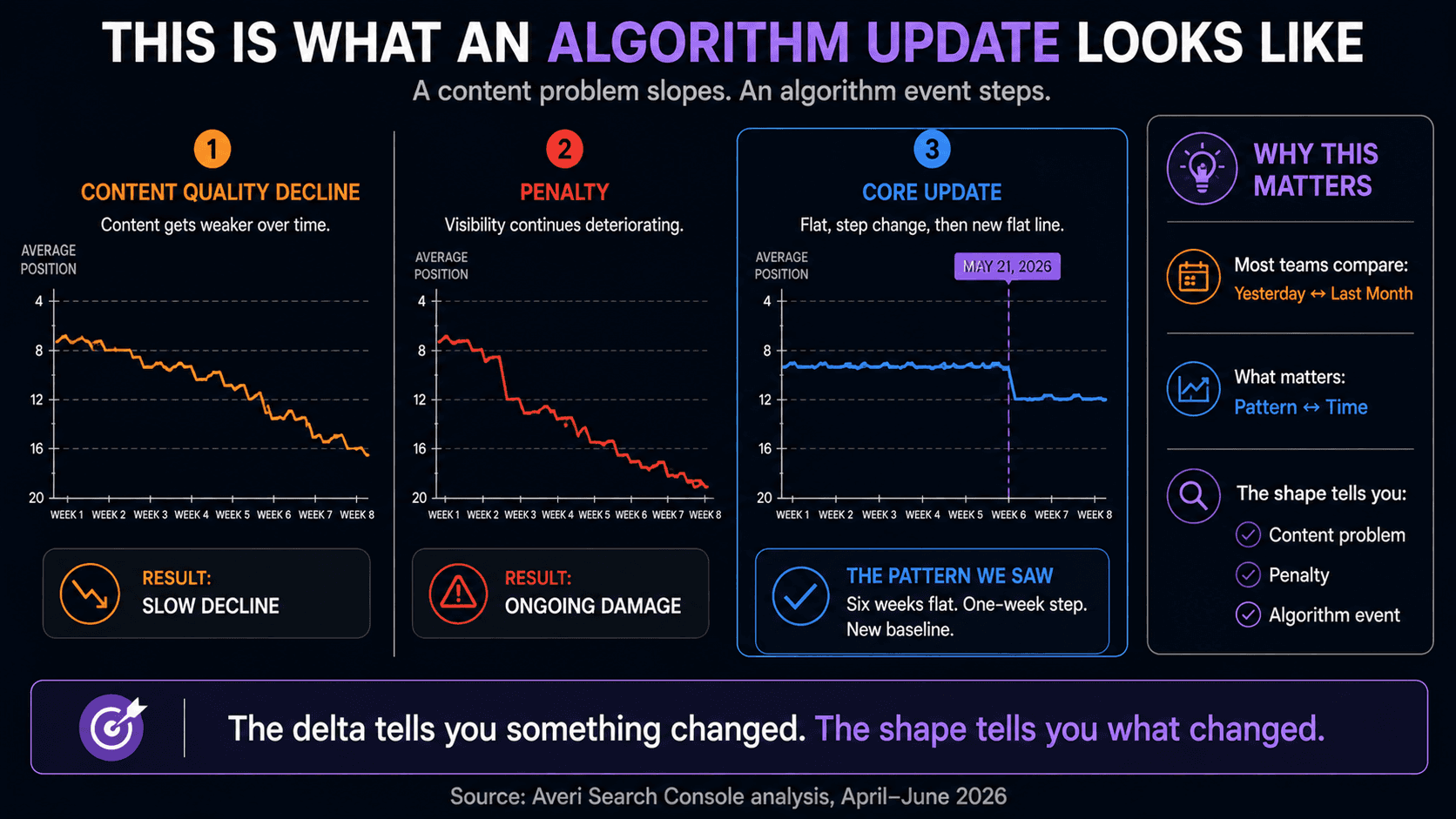
You know by looking at the shape of the change over time, not a single before-and-after snapshot. A content-quality decline shows a gradual slope. A penalty keeps falling. An algorithm event shows a flat line, a sharp step at a known date, then a new flat line.
Our data is unambiguously the third pattern.
We pulled Search Console data for eight continuous weeks, from April 7 to June 1.
For the first six weeks, our average position sat in a tight band between 8.6 and 9.9, barely moving day to day.
Then, the week of May 21, it stepped down to 11.1 and held flat there.
Impressions did the same thing at the same moment. The break lines up with the update's start date to the day. There is no version of "our content got worse" that produces a six-week flat line followed by a single-week step down on the exact day Google shipped an update.
This matters as a method, not just a result. Most teams react to core updates by comparing yesterday to last month and panicking at the delta. The delta is real, but without the time series you cannot tell a structural shift from normal volatility, and you end up making changes to content that was never the problem.
How big was the hit, really?
The hit was moderate and concentrated in low-value visibility. Across the second half of the window, impressions fell about 25% and clicks fell about 20%. Average position slipped roughly 1.5 spots, from the bottom of page one to the top of page two for the affected queries.
The single most important number is the one that did not move: our aggregate click-through rate held at roughly 0.18% before and after the update.
That tells you the update did not change how people behave when they see us. It changed how often Google shows us for marginal queries.
We lost reach, and we lost it disproportionately on impressions we were never converting into clicks anyway. Clicks held up better than impressions (down 20% versus 25%), which means the visibility we shed was the least valuable visibility we had.
The flat CTR also fits the broader environment, not just our site. Ahrefs' analysis of 300,000 keywords found AI Overviews cut position-one click-through rate by 34.5%, and a Pew Research Center browsing panel of 68,879 real searches found users clicked a traditional result in just 8% of visits when an AI summary appeared, versus 15% without one. When the baseline click rate is already collapsing industry-wide, a core update that trims your impressions barely registers in CTR terms. The clicks were already leaving regardless of where you rank.
Which pages actually lost ground?
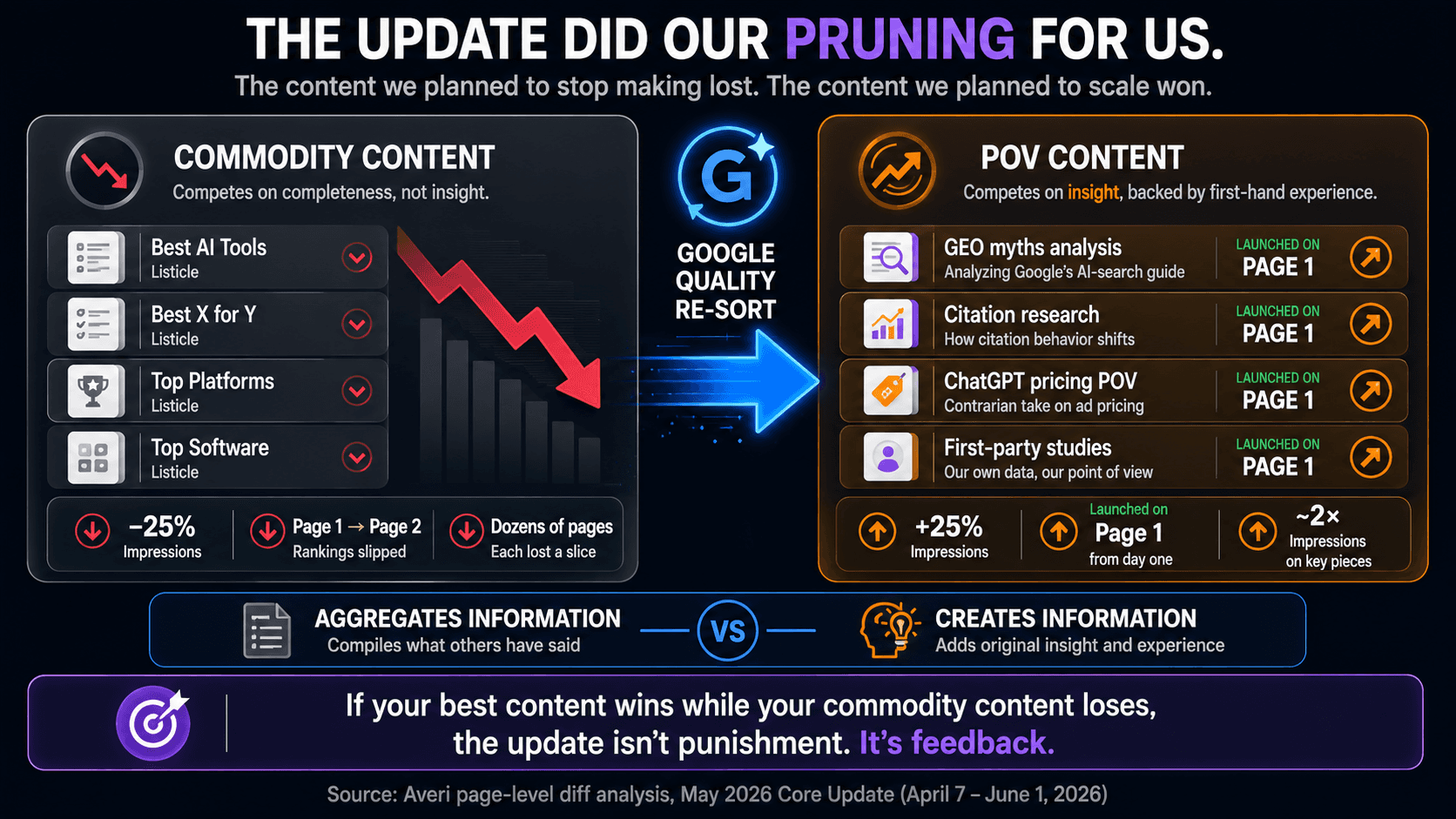
The pages that lost ground were our commodity listicles, and the loss was spread thin rather than concentrated. We ran a page-level diff comparing the four weeks before the window against the four weeks during it.
The defining finding: the top 10 losing pages accounted for only about 27% of total impression loss. There was no cliff. Dozens of pages each shed a slice.
Most of those pages kept their position and their clicks while losing impressions. Google simply stopped surfacing them for as many marginal long-tail queries.
That is the AI Overviews effect compounding a core update: the wide, low-intent end of the impression base evaporates because answers now resolve above the links.
The handful of pages that took genuine ranking demotions shared a type. They were "best AI tools" and "best X for Y" listicle pages, the commodity format that competes on completeness rather than insight. Several fell from page one to page two. If you have read our editorial rulebook, you know these are the exact pages we had already flagged for consolidation. The update made the decision for us.
Why did some pages gain during a core update?
Some pages gained because they carried the one thing core updates increasingly reward: a genuine point of view backed by first-hand experience. This is the part of the data that should change how you think about content, not just how you read a dashboard.
While our commodity pages slipped, our newest opinion-driven pieces launched directly onto page one. A piece analyzing Google's own AI-search guide and the GEO myths it killed went from zero to a strong page-one position and pulled real clicks from a standing start. A first-party analysis of how citation behavior shifts across AI platforms climbed in position and roughly doubled its impressions during the rollout. A contrarian take on ChatGPT ad pricing debuted on page one.
If a core update had decided our domain was low quality, new content would launch into a suppressed environment and struggle to gain traction. The opposite happened. New POV content debuted strong. That is the clearest possible signal that the update was not punishing us. It was re-sorting our library by quality, and our best work sorted to the top.
The freshness pattern reinforces it. Independent analysis of AI search results has found that cited content skews significantly fresher than standard organic results, and that promotional, commodity tone correlates negatively with citation. Newer, opinionated, first-hand pieces are advantaged on both the ranking side and the citation side at once. The two systems are converging on the same definition of quality. We walk through that convergence in detail in our breakdown of how GEO redefines SEO.
Did this match what Google said it wanted?
It matched almost exactly, which is the most useful part of the whole episode. Six days before the update, Google published an official guide on optimizing for its generative AI features.
We mapped every line of that guide against the GEO industry's common tactics and found Google killing the commodity playbook in writing: it said special AI files do nothing, that content chunking is not required, and that the single biggest visibility lever is non-commodity, first-hand experience content.
Then the core update enforced that guidance in the rankings. Commodity content lost. First-hand, experience-led content won. The guide and the update told the same story six days apart, one in words and one in ranking changes. When the algorithm's behavior confirms the documentation, you stop guessing and start building toward the stated target.
What about AI citations during the same period?
AI citations told a separate story that is easy to misread as a second decline. On a major answer engine, our citation volume looked like it dropped sharply across the back half of the period. It did not. A two-day spike in mid-May accounted for nearly a third of the entire month's citations. Strip those two anomalous days and the baseline was roughly flat. The "decline" was a return to normal after a spike, not a collapse, and it had nothing to do with the Google core update.
The bigger picture across both data sets is the one that reframes everything.
Over the same window, we earned tens of thousands of AI citations against a few thousand Google clicks. The machines reading our content vastly outnumber the humans clicking it. That ratio is not a problem to fix. It is the new shape of organic visibility, and it is exactly why losing low-intent Google impressions barely registers as a strategic concern. Bots already make up close to a third of all web traffic, with AI crawlers the second-largest category behind search engines, per Cloudflare Radar's 2025 Year in Review. Your highest-volume reader is increasingly not a person.
The zero-click reality underneath this is now well documented. Multiple large keyword studies converge on the same direction: Amsive's 700,000-keyword analysis found a 15.49% average CTR decline across all positions, with steeper drops for pages outside the top three.
One bright spot worth naming: AI Overviews trigger on only a small share of branded queries, and when they do, that same study found branded clicks actually rose about 18.68%. The takeaway for any startup: defend your branded search and build citation footprint, because the unbranded click economy is the part eroding fastest.
What are we actually doing about it?
We are mostly doing nothing structural, on purpose, and we are concentrating new effort on the format that won. Reacting hard to a core update mid-rollout is how teams turn a recoverable dip into a permanent one. Google's own guidance is to wait at least a full week after completion before drawing firm conclusions, and we are honoring that. Our position held flat through the back half of the rollout rather than continuing to slide, which is the stability signal that guidance is looking for, so we are comfortable publishing an early read with the clean confirmation to follow.
Here is the actual plan:
Hold structural changes for now. No content gutting while rankings settle. We monitor daily and let the dust clear.
Watch the one page that matters. Our highest-value page took the only meaningful click loss, a minor position slip likely tied to query-mix shift. If it keeps sliding we investigate. If it reverts we ignore it.
Accelerate what won. More POV pieces with first-hand data, the format that launched on page one through the update. Fewer, deeper, opinionated pieces beat more commodity ones.
Let the commodity pages go. Consolidate or retire the listicle pages that slipped. The update confirmed the call we had already made.
If you want to run the same diagnosis on your own site, the fastest first step is to find your commodity pages before the next update does. Score your existing content against SEO and GEO readiness in Averi and you will see which pages carry the first-hand signal Google rewards and which are dead weight waiting to be re-sorted.
What should your team take from this?
Take the method and the strategic conclusion, not our specific numbers.
The method: when traffic drops, pull a multi-week time series before you touch anything, and run a page-level diff to find the blast radius. The shape of the change over time tells you whether you are looking at an algorithm event, a penalty, or a real content problem, and each demands a different response.
The strategic conclusion is the one we want you to sit with.
A core update is a quality re-sort. If your best content survives or gains while your commodity content slips, the update is not your enemy. It is an unpaid audit telling you which half of your library to stop making. The teams that panic and rewrite everything miss the signal entirely. The teams that read the data treat the update as confirmation of where to point next.
We build content engines for a living, and we run ours on ourselves first. The May update did not change our strategy. It proved it.
The Averi angle
Everything above came out of running our own content operation the way Averi is built to run any startup's. The eight-week time series, the page-level diff, the SEO and GEO scoring that flags commodity pages before they become dead weight: that is the workflow, not a special project we ran for this post.
The reason we could read this update calmly is that the engine already scores every page on whether it carries the first-hand, non-commodity signal Google just rewarded. When the update hit, we did not have to guess which pages were exposed. We already knew.
If you want to ensure that your own library would land on its feet in a quality re-sort, create your content through Averi's SEO + GEO scoring and find your commodity pages before the next core update does. It is a 14-day free trial. Solo is $99/mo.
FAQs
What was the May 2026 Google core update?
The May 2026 core update was Google's second broad ranking recalibration of the year, rolling out from May 21 to June 2, 2026. Google described it as a regular update to better surface relevant, satisfying content. It re-scored Google's entire index against its quality model and shifted rankings accordingly, landing during Google's broader shift toward AI-mediated search answers.
How long did the May 2026 core update take to roll out?
It rolled out over just under twelve days, from May 21 to June 2, 2026, close to the duration of the March 2026 core update. Google's guidance is to wait at least a full week after completion, around June 9, before drawing firm conclusions, because rankings fluctuate during the rollout itself.
How do you tell a core update hit from a content problem?
Pull a multi-week time series rather than a single before-and-after snapshot. A content-quality decline shows a gradual slope, a penalty keeps falling, and an algorithm event shows a flat line with a sharp step at a known date followed by a new flat line. The shape over time identifies which one you are facing.
Should you change your content after a core update?
Not immediately. Google advises waiting until at least a week after the rollout completes before drawing conclusions, because mid-rollout rankings are unstable. Reacting hard during the rollout can turn a recoverable dip into a permanent loss. Diagnose first with time-series and page-level data, then make targeted changes only where warranted.
Why would impressions drop but click-through rate stay flat?
Because the update changed which queries you appear for, not how people behave when they see you. Losing low-intent, long-tail impressions reduces total reach while leaving your conversion behavior on high-intent queries intact. A flat CTR through an impression drop means you shed your least valuable visibility.
What kind of content did the May 2026 core update reward?
First-hand, experience-led content with a genuine point of view gained, while commodity listicle pages that compete on completeness rather than insight lost ground. This matched Google's own May 15 AI-search guide, which named non-commodity, first-hand experience as the single biggest visibility lever.
Does a core update affect AI citations too?
Not directly. A Google core update affects Google Search rankings. AI citation behavior on engines like ChatGPT, Perplexity, and Copilot follows separate logic and was not driven by this update. Apparent citation swings over the same period can have unrelated causes, such as a short-lived volume spike returning to baseline.
Related Resources
Read the AI-search shift
Measure and structure for citation
How to Track AI Citations and Measure GEO Success: The 2026 Metrics Guide
Answer Capsules: 40–60 Word Patterns That Turn H2s into Citations
Building Content That AI Agents Will Recommend: The 2026 Technical Guide for B2B SaaS
Build the engine behind it