Flodesk vs. a Content Engine: Why Email Alone Isn't a Marketing Strategy

Zach Chmael

Head of Marketing

5 minutes

In This Article

Email is the highest-converting channel. It's not the highest-acquiring channel. Founders who start and end with Flodesk confuse conversion with acquisition. They optimize the last mile and forget to build the first nine.

Updated

Trusted by 1,000+ teams

★★★★★ 4.9/5

Startups use Averi to build
content engines that rank.

TL;DR:

  • 📬 Email marketing has the highest ROI of any channel. That stat is true and misleading at the same time. Email has high ROI because it converts an existing audience. It doesn't build that audience. The channel that builds the audience is the one that makes email work

  • 🔄 Flodesk is distribution. A content engine is production. Using Flodesk without a content engine is like having a delivery fleet with no warehouse. The trucks run. They just have nothing to deliver

  • 📉 The founder who treats their Flodesk newsletter as their marketing strategy hits the same wall every time: list growth stalls because there's no organic acquisition channel feeding it. Subscriber fatigue sets in because every send is created from scratch without a content library to draw from. And no content ranks on Google or earns AI citations because everything lives in inboxes

  • 🏗️ A content engine produces the content, optimizes it for search and AI discovery, publishes it to a blog that compounds, and feeds the newsletter with insights extracted from what's already been published. Email becomes the easiest part of the workflow instead of the hardest

  • 💡 This isn't Flodesk vs. Averi. It's email-only vs. full-system. The full system includes email. It also includes everything upstream that makes email sustainable

Zach Chmael

CMO, Averi

"We built Averi around the exact workflow we've used to scale our web traffic over 6000% in the last 6 months."

Your content should be working harder.

Averi's content engine builds Google entity authority, drives AI citations, and scales your visibility so you can get more customers.

Flodesk vs. a Content Engine: Why Email Alone Isn't a Marketing Strategy

The Stat That Misleads Everyone

Email marketing generates $36-$42 for every $1 spent. You've seen this number.

Every email platform cites it. Flodesk cites it. It's the reason most founders start with email before anything else.

The number is real. It's also incomplete.

Email generates that ROI because it's a conversion channel. You're sending messages to people who already know you, already trust you, already opted in.

The hard work of earning their attention happened before the email. The email harvests the trust that something else built.

What built the trust?

A blog post they found through Google. An article an AI chatbot cited. A LinkedIn post a friend shared. A Reddit thread where your name came up. A content engine that put your brand in front of them during their research process.

Strip away everything that feeds the email list and the $36 ROI evaporates.

Not because email stopped working. Because there's nobody left to email. The list doesn't grow. The subscribers who are there get fatigued. The channel that was "highest ROI" becomes highest ROI of a shrinking base.

Email is the highest-converting channel. It's not the highest-acquiring channel. Founders who start and end with Flodesk confuse conversion with acquisition. They optimize the last mile and forget to build the first nine.

See what your Content ROI could be

What Happens When Email Is the Whole Strategy

I've talked to dozens of founders running this exact setup. Flodesk newsletter. Maybe a welcome sequence. Maybe a lead magnet. No blog. No SEO. No content library.

Here's what happens by month 6:

List growth flatlines. Without organic traffic feeding the top of the funnel, new subscribers come only from manual effort: social posts, paid ads, cross-promotions. All of those require daily attention. Miss a week and the growth stops. The list sits at 500 or 1,000 subscribers and doesn't move.

Content ideas dry up. Every newsletter is created from scratch. There's no published archive to draw from. No blog post to excerpt. No data report to reference. By month 4, the founder is staring at a blank Flodesk template wondering what to write. The treadmill effect is real: the same effort every week, no system making it easier.

Subscriber engagement declines. Open rates that started at 35-40% settle to 20-25%. Subscribers who signed up six months ago and received generic weekly sends stop opening. They don't unsubscribe. They just stop reading. The list looks healthy by count. The engagement tells a different story.

Zero search visibility. While the founder sends newsletters, their competitors publish blog content that ranks on Google, earns AI citations, and builds the topical authority that compounds over months. The newsletter founder is invisible to every buyer who doesn't already know their name.

No compounding. The newsletter from January doesn't help the newsletter from July. Each send is independent. Nothing builds on what came before. Compare that to a blog where article #50 benefits from the authority that articles #1-49 built.

None of this is Flodesk's fault. Flodesk is doing exactly what it was designed to do.

The problem is treating a send tool as a strategy tool.

The System Email Needs to Work

Email works best as the conversion layer in a content system. Not as the system itself.

The system has three parts:

Production. Something creates the content. Not from scratch every week, but from a strategic architecture that determines what to write, how to structure it, and how each piece connects to the rest. A content engine handles this: topic recommendations, draft generation in your brand voice, SEO and GEO optimization, content scoring.

Publishing. The content goes somewhere permanent and searchable. A blog on your domain. Indexed by Google. Crawlable by AI systems. Building topical authority with every article. Accumulating internal links. Creating a library that makes every future piece more effective.

Distribution. The best insights from the published content get packaged and sent to your subscriber list. This is where Flodesk lives. It takes what the engine produced and the blog published, and delivers the highlights to the people who opted in.

Production → Publishing → Distribution.

Three layers. Most Flodesk-only founders have layer 3 and nothing else.

Why the Blog Changes Everything

The blog is the asset that makes the whole system compound.

Search acquisition. Blog posts rank on Google. Every ranking article is a subscriber acquisition channel that works without daily effort. A visitor who finds your article through search, reads 2,000 words, and subscribes is a higher-quality subscriber than one who saw a 15-second Reel.

AI citation. Blog content structured for GEO gets cited by ChatGPT, Perplexity, and Google AI Overviews. Email content can't be cited. The blog makes your brand visible in the AI discovery layer that's reshaping how buyers research.

Content library. After 3 months of publishing, you have 25-50 articles. Each one is a newsletter segment waiting to happen. The "what do I send?" problem vanishes because the library provides an inexhaustible supply of extractable insights.

Authority compounding. Each article strengthens every other article through internal links and cluster architecture. New articles rank faster because the domain has established credibility. The blog gets better at its job the more you use it. Nothing about email works this way.

Permanence. An article you published in January is still ranking in July. Still earning traffic. Still capturing subscribers. Still getting cited by AI. A newsletter you sent in January was read on Tuesday and buried by Thursday. The blog is the permanent asset. The newsletter is the recurring touchpoint.

The Weekly Workflow: Content Engine + Blog + Flodesk

Here's what the full system looks like in practice:

Monday (45 min): Open your Content Queue. Review topic recommendations. Approve 3-4 articles for the week.

Tuesday-Wednesday (2 hrs): The engine generates drafts with your brand voice, SEO structure, and internal links. You add founder perspective. 15-20 minutes per article.

Thursday (2 hrs): Edit, score for quality, and publish to your blog through CMS integration. Four articles live by end of day.

Friday (20-30 min): Open Flodesk. Extract the core insight from each article. Drop into your template. Send.

Total: ~5.5 hours/week. Four blog articles published (compounding permanently). One newsletter sent (converting your most engaged audience). Both fed by the same content. The newsletter takes 20 minutes because you're not creating anything new. You're packaging what the engine already produced.

Compare that to the email-only workflow: 2-3 hours every week creating a newsletter from scratch. Same time investment. One produces a permanent, compounding asset plus a newsletter. The other produces a newsletter that disappears in 48 hours.

See what you could save by utilizing Averi as your content engine

The Numbers That Make the Case

Email-only: 500 subscribers after 6 months of manual list building. 25% open rate. 125 people read each send. Zero organic traffic. Zero AI citations. Zero compounding.

Content engine + blog + email: 50 published articles after 6 months. 1,500+ monthly organic visitors. 30-100 new subscribers per month from search (passive). Growing AI citation presence. Topical authority compounding. Plus the newsletter converting the most engaged subscribers.

At month 12, the email-only founder still has roughly 500-800 subscribers (manual growth is slow and inconsistent).

The content-engine founder has 1,500-2,500 subscribers (organic acquisition compounds) plus 3,000-5,000 monthly organic visitors who haven't subscribed but are still encountering the brand.

The email-only approach isn't wrong. It's incomplete.

Adding the engine and the blog turns a stalling channel into a compounding system.
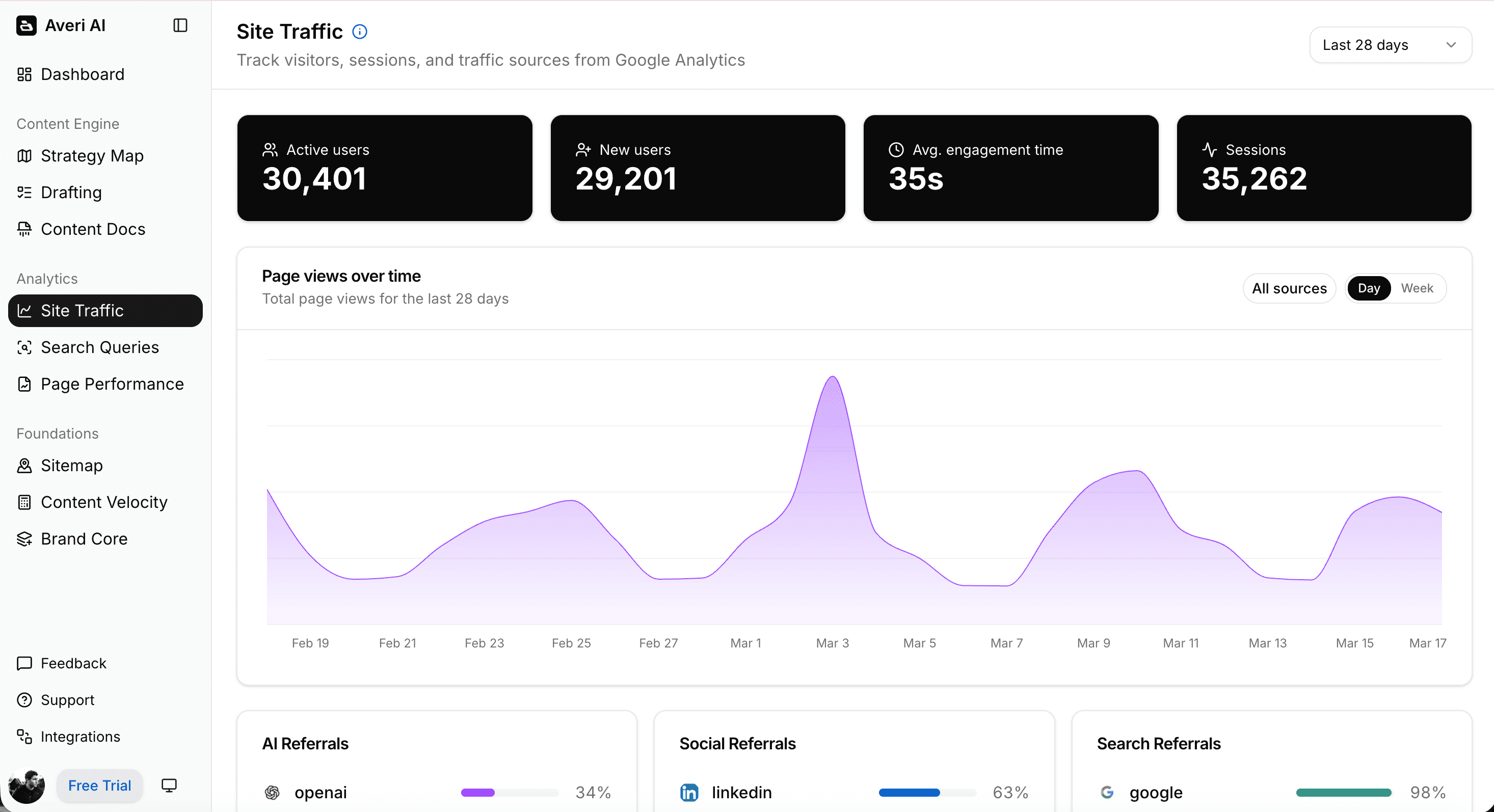
This Isn't Flodesk vs. Averi

Let me be direct about this because the framing matters.

Flodesk is a good product. It designs beautiful emails. The flat pricing is genuinely founder-friendly. The simplicity is real. We recommend it to the founders we work with.

Averi is a different product solving a different problem. Averi produces, optimizes, scores, publishes, and measures content. Flodesk designs, automates, and sends email.

The question isn't "which one?" It's "do you have both layers?"

A founder with Averi and no email tool has a content engine producing articles nobody's distributing to their warmest audience. Missing Layer 3.

A founder with Flodesk and no content engine has a distribution channel with nothing sustainable to distribute. Missing Layers 1 and 2.

A founder with both has the system: production → publishing → distribution.

The blog compounds. The newsletter converts. The search traffic grows the list. The list drives engagement back to the blog. The flywheel spins.

Averi: $99/month. Flodesk: $38/month.

Total: $137/month for a complete content strategy, production, publishing, optimization, analytics, and email distribution system.

Start building the full system →

Related Resources

Flodesk Resources

FAQs

Is email marketing alone enough for a startup?

Email converts, but it doesn't acquire. The $36-$42 ROI per dollar spent assumes someone else built the audience email is converting. Without a content engine feeding the list through organic search and AI citations, the list doesn't grow organically and subscriber fatigue sets in. Email works best as the conversion layer in a content system, not as the system itself.

What's the difference between a content engine and an email tool?

A content engine produces: strategy, topic selection, drafting, optimization, publishing, analytics. An email tool distributes: design, automation, send. Averi is a content engine. Flodesk is an email tool. They handle different parts of the workflow. Using one without the other leaves a gap.

Why does email engagement decline over time?

Subscriber fatigue. When every send is created from scratch without a deep content library to draw from, quality varies and novelty fades. Open rates that start at 35-40% typically settle to 20-25% by month 6. A content engine solves this by producing a steady supply of high-quality insights the newsletter can excerpt from, keeping each send valuable.

Can I use a different email tool instead of Flodesk?

Yes. The system works with any email tool: beehiiv, ConvertKit, Mailchimp, ActiveCampaign. Flodesk is recommended for founders who want design quality and flat pricing. The content engine (Averi) is tool-agnostic on the email side. The production and publishing layers work the same regardless of which tool handles the send.

How does a content engine help my Flodesk newsletter specifically?

Three ways: it eliminates the "what do I write?" problem by producing blog articles you extract newsletter segments from, it grows your subscriber list passively through SEO traffic with subscribe CTAs, and it gives you analytics showing which content resonates most so you know what to feature in the next send. Newsletter production drops from 2-3 hours of original creation to 20-30 minutes of extraction.

What should I build first: the content engine or the email list?

The content engine. The blog it produces builds the organic traffic that grows the email list. Starting with email means you need manual list-building methods (social, ads, cross-promotion) to grow subscribers. Starting with the engine means the blog grows the list passively while also building search visibility, AI citation presence, and topical authority. Add Flodesk once you have 5-10 published articles to draw from.


Continue Reading

The latest handpicked blog articles

Experience The AI Content Engine

Already have an account?

Join 30,000+ Founders, Marketers & Builders

Don't Feed the Algorithm

“Top 3 tech + AI newsletters in the country. Always sharp, always actionable.”

"Genuinely my favorite newsletter in tech. No fluff, no cheesy ads, just great content."

“Clear, practical, and on-point. Helps me keep up without drowning in noise.”

User-Generated Content & Authenticity in the Age of AI

Zach Chmael

Head of Marketing

5 minutes

In This Article

Email is the highest-converting channel. It's not the highest-acquiring channel. Founders who start and end with Flodesk confuse conversion with acquisition. They optimize the last mile and forget to build the first nine.

Don’t Feed the Algorithm

The algorithm never sleeps, but you don’t have to feed it — Join our weekly newsletter for real insights on AI, human creativity & marketing execution.

TL;DR:

  • 📬 Email marketing has the highest ROI of any channel. That stat is true and misleading at the same time. Email has high ROI because it converts an existing audience. It doesn't build that audience. The channel that builds the audience is the one that makes email work

  • 🔄 Flodesk is distribution. A content engine is production. Using Flodesk without a content engine is like having a delivery fleet with no warehouse. The trucks run. They just have nothing to deliver

  • 📉 The founder who treats their Flodesk newsletter as their marketing strategy hits the same wall every time: list growth stalls because there's no organic acquisition channel feeding it. Subscriber fatigue sets in because every send is created from scratch without a content library to draw from. And no content ranks on Google or earns AI citations because everything lives in inboxes

  • 🏗️ A content engine produces the content, optimizes it for search and AI discovery, publishes it to a blog that compounds, and feeds the newsletter with insights extracted from what's already been published. Email becomes the easiest part of the workflow instead of the hardest

  • 💡 This isn't Flodesk vs. Averi. It's email-only vs. full-system. The full system includes email. It also includes everything upstream that makes email sustainable

"We built Averi around the exact workflow we've used to scale our web traffic over 6000% in the last 6 months."

founder-image
founder-image
Your content should be working harder.

Averi's content engine builds Google entity authority, drives AI citations, and scales your visibility so you can get more customers.

Flodesk vs. a Content Engine: Why Email Alone Isn't a Marketing Strategy

The Stat That Misleads Everyone

Email marketing generates $36-$42 for every $1 spent. You've seen this number.

Every email platform cites it. Flodesk cites it. It's the reason most founders start with email before anything else.

The number is real. It's also incomplete.

Email generates that ROI because it's a conversion channel. You're sending messages to people who already know you, already trust you, already opted in.

The hard work of earning their attention happened before the email. The email harvests the trust that something else built.

What built the trust?

A blog post they found through Google. An article an AI chatbot cited. A LinkedIn post a friend shared. A Reddit thread where your name came up. A content engine that put your brand in front of them during their research process.

Strip away everything that feeds the email list and the $36 ROI evaporates.

Not because email stopped working. Because there's nobody left to email. The list doesn't grow. The subscribers who are there get fatigued. The channel that was "highest ROI" becomes highest ROI of a shrinking base.

Email is the highest-converting channel. It's not the highest-acquiring channel. Founders who start and end with Flodesk confuse conversion with acquisition. They optimize the last mile and forget to build the first nine.

See what your Content ROI could be

What Happens When Email Is the Whole Strategy

I've talked to dozens of founders running this exact setup. Flodesk newsletter. Maybe a welcome sequence. Maybe a lead magnet. No blog. No SEO. No content library.

Here's what happens by month 6:

List growth flatlines. Without organic traffic feeding the top of the funnel, new subscribers come only from manual effort: social posts, paid ads, cross-promotions. All of those require daily attention. Miss a week and the growth stops. The list sits at 500 or 1,000 subscribers and doesn't move.

Content ideas dry up. Every newsletter is created from scratch. There's no published archive to draw from. No blog post to excerpt. No data report to reference. By month 4, the founder is staring at a blank Flodesk template wondering what to write. The treadmill effect is real: the same effort every week, no system making it easier.

Subscriber engagement declines. Open rates that started at 35-40% settle to 20-25%. Subscribers who signed up six months ago and received generic weekly sends stop opening. They don't unsubscribe. They just stop reading. The list looks healthy by count. The engagement tells a different story.

Zero search visibility. While the founder sends newsletters, their competitors publish blog content that ranks on Google, earns AI citations, and builds the topical authority that compounds over months. The newsletter founder is invisible to every buyer who doesn't already know their name.

No compounding. The newsletter from January doesn't help the newsletter from July. Each send is independent. Nothing builds on what came before. Compare that to a blog where article #50 benefits from the authority that articles #1-49 built.

None of this is Flodesk's fault. Flodesk is doing exactly what it was designed to do.

The problem is treating a send tool as a strategy tool.

The System Email Needs to Work

Email works best as the conversion layer in a content system. Not as the system itself.

The system has three parts:

Production. Something creates the content. Not from scratch every week, but from a strategic architecture that determines what to write, how to structure it, and how each piece connects to the rest. A content engine handles this: topic recommendations, draft generation in your brand voice, SEO and GEO optimization, content scoring.

Publishing. The content goes somewhere permanent and searchable. A blog on your domain. Indexed by Google. Crawlable by AI systems. Building topical authority with every article. Accumulating internal links. Creating a library that makes every future piece more effective.

Distribution. The best insights from the published content get packaged and sent to your subscriber list. This is where Flodesk lives. It takes what the engine produced and the blog published, and delivers the highlights to the people who opted in.

Production → Publishing → Distribution.

Three layers. Most Flodesk-only founders have layer 3 and nothing else.

Why the Blog Changes Everything

The blog is the asset that makes the whole system compound.

Search acquisition. Blog posts rank on Google. Every ranking article is a subscriber acquisition channel that works without daily effort. A visitor who finds your article through search, reads 2,000 words, and subscribes is a higher-quality subscriber than one who saw a 15-second Reel.

AI citation. Blog content structured for GEO gets cited by ChatGPT, Perplexity, and Google AI Overviews. Email content can't be cited. The blog makes your brand visible in the AI discovery layer that's reshaping how buyers research.

Content library. After 3 months of publishing, you have 25-50 articles. Each one is a newsletter segment waiting to happen. The "what do I send?" problem vanishes because the library provides an inexhaustible supply of extractable insights.

Authority compounding. Each article strengthens every other article through internal links and cluster architecture. New articles rank faster because the domain has established credibility. The blog gets better at its job the more you use it. Nothing about email works this way.

Permanence. An article you published in January is still ranking in July. Still earning traffic. Still capturing subscribers. Still getting cited by AI. A newsletter you sent in January was read on Tuesday and buried by Thursday. The blog is the permanent asset. The newsletter is the recurring touchpoint.

The Weekly Workflow: Content Engine + Blog + Flodesk

Here's what the full system looks like in practice:

Monday (45 min): Open your Content Queue. Review topic recommendations. Approve 3-4 articles for the week.

Tuesday-Wednesday (2 hrs): The engine generates drafts with your brand voice, SEO structure, and internal links. You add founder perspective. 15-20 minutes per article.

Thursday (2 hrs): Edit, score for quality, and publish to your blog through CMS integration. Four articles live by end of day.

Friday (20-30 min): Open Flodesk. Extract the core insight from each article. Drop into your template. Send.

Total: ~5.5 hours/week. Four blog articles published (compounding permanently). One newsletter sent (converting your most engaged audience). Both fed by the same content. The newsletter takes 20 minutes because you're not creating anything new. You're packaging what the engine already produced.

Compare that to the email-only workflow: 2-3 hours every week creating a newsletter from scratch. Same time investment. One produces a permanent, compounding asset plus a newsletter. The other produces a newsletter that disappears in 48 hours.

See what you could save by utilizing Averi as your content engine

The Numbers That Make the Case

Email-only: 500 subscribers after 6 months of manual list building. 25% open rate. 125 people read each send. Zero organic traffic. Zero AI citations. Zero compounding.

Content engine + blog + email: 50 published articles after 6 months. 1,500+ monthly organic visitors. 30-100 new subscribers per month from search (passive). Growing AI citation presence. Topical authority compounding. Plus the newsletter converting the most engaged subscribers.

At month 12, the email-only founder still has roughly 500-800 subscribers (manual growth is slow and inconsistent).

The content-engine founder has 1,500-2,500 subscribers (organic acquisition compounds) plus 3,000-5,000 monthly organic visitors who haven't subscribed but are still encountering the brand.

The email-only approach isn't wrong. It's incomplete.

Adding the engine and the blog turns a stalling channel into a compounding system.

This Isn't Flodesk vs. Averi

Let me be direct about this because the framing matters.

Flodesk is a good product. It designs beautiful emails. The flat pricing is genuinely founder-friendly. The simplicity is real. We recommend it to the founders we work with.

Averi is a different product solving a different problem. Averi produces, optimizes, scores, publishes, and measures content. Flodesk designs, automates, and sends email.

The question isn't "which one?" It's "do you have both layers?"

A founder with Averi and no email tool has a content engine producing articles nobody's distributing to their warmest audience. Missing Layer 3.

A founder with Flodesk and no content engine has a distribution channel with nothing sustainable to distribute. Missing Layers 1 and 2.

A founder with both has the system: production → publishing → distribution.

The blog compounds. The newsletter converts. The search traffic grows the list. The list drives engagement back to the blog. The flywheel spins.

Averi: $99/month. Flodesk: $38/month.

Total: $137/month for a complete content strategy, production, publishing, optimization, analytics, and email distribution system.

Start building the full system →

Related Resources

Flodesk Resources

Continue Reading

The latest handpicked blog articles

Join 30,000+ Founders, Marketers & Builders

Don't Feed the Algorithm

“Top 3 tech + AI newsletters in the country. Always sharp, always actionable.”

"Genuinely my favorite newsletter in tech. No fluff, no cheesy ads, just great content."

“Clear, practical, and on-point. Helps me keep up without drowning in noise.”

User-Generated Content & Authenticity in the Age of AI

Zach Chmael

Head of Marketing

5 minutes

In This Article

Email is the highest-converting channel. It's not the highest-acquiring channel. Founders who start and end with Flodesk confuse conversion with acquisition. They optimize the last mile and forget to build the first nine.

Don’t Feed the Algorithm

The algorithm never sleeps, but you don’t have to feed it — Join our weekly newsletter for real insights on AI, human creativity & marketing execution.

Trusted by 1,000+ teams

★★★★★ 4.9/5

Startups use Averi to build
content engines that rank.

Flodesk vs. a Content Engine: Why Email Alone Isn't a Marketing Strategy

The Stat That Misleads Everyone

Email marketing generates $36-$42 for every $1 spent. You've seen this number.

Every email platform cites it. Flodesk cites it. It's the reason most founders start with email before anything else.

The number is real. It's also incomplete.

Email generates that ROI because it's a conversion channel. You're sending messages to people who already know you, already trust you, already opted in.

The hard work of earning their attention happened before the email. The email harvests the trust that something else built.

What built the trust?

A blog post they found through Google. An article an AI chatbot cited. A LinkedIn post a friend shared. A Reddit thread where your name came up. A content engine that put your brand in front of them during their research process.

Strip away everything that feeds the email list and the $36 ROI evaporates.

Not because email stopped working. Because there's nobody left to email. The list doesn't grow. The subscribers who are there get fatigued. The channel that was "highest ROI" becomes highest ROI of a shrinking base.

Email is the highest-converting channel. It's not the highest-acquiring channel. Founders who start and end with Flodesk confuse conversion with acquisition. They optimize the last mile and forget to build the first nine.

See what your Content ROI could be

What Happens When Email Is the Whole Strategy

I've talked to dozens of founders running this exact setup. Flodesk newsletter. Maybe a welcome sequence. Maybe a lead magnet. No blog. No SEO. No content library.

Here's what happens by month 6:

List growth flatlines. Without organic traffic feeding the top of the funnel, new subscribers come only from manual effort: social posts, paid ads, cross-promotions. All of those require daily attention. Miss a week and the growth stops. The list sits at 500 or 1,000 subscribers and doesn't move.

Content ideas dry up. Every newsletter is created from scratch. There's no published archive to draw from. No blog post to excerpt. No data report to reference. By month 4, the founder is staring at a blank Flodesk template wondering what to write. The treadmill effect is real: the same effort every week, no system making it easier.

Subscriber engagement declines. Open rates that started at 35-40% settle to 20-25%. Subscribers who signed up six months ago and received generic weekly sends stop opening. They don't unsubscribe. They just stop reading. The list looks healthy by count. The engagement tells a different story.

Zero search visibility. While the founder sends newsletters, their competitors publish blog content that ranks on Google, earns AI citations, and builds the topical authority that compounds over months. The newsletter founder is invisible to every buyer who doesn't already know their name.

No compounding. The newsletter from January doesn't help the newsletter from July. Each send is independent. Nothing builds on what came before. Compare that to a blog where article #50 benefits from the authority that articles #1-49 built.

None of this is Flodesk's fault. Flodesk is doing exactly what it was designed to do.

The problem is treating a send tool as a strategy tool.

The System Email Needs to Work

Email works best as the conversion layer in a content system. Not as the system itself.

The system has three parts:

Production. Something creates the content. Not from scratch every week, but from a strategic architecture that determines what to write, how to structure it, and how each piece connects to the rest. A content engine handles this: topic recommendations, draft generation in your brand voice, SEO and GEO optimization, content scoring.

Publishing. The content goes somewhere permanent and searchable. A blog on your domain. Indexed by Google. Crawlable by AI systems. Building topical authority with every article. Accumulating internal links. Creating a library that makes every future piece more effective.

Distribution. The best insights from the published content get packaged and sent to your subscriber list. This is where Flodesk lives. It takes what the engine produced and the blog published, and delivers the highlights to the people who opted in.

Production → Publishing → Distribution.

Three layers. Most Flodesk-only founders have layer 3 and nothing else.

Why the Blog Changes Everything

The blog is the asset that makes the whole system compound.

Search acquisition. Blog posts rank on Google. Every ranking article is a subscriber acquisition channel that works without daily effort. A visitor who finds your article through search, reads 2,000 words, and subscribes is a higher-quality subscriber than one who saw a 15-second Reel.

AI citation. Blog content structured for GEO gets cited by ChatGPT, Perplexity, and Google AI Overviews. Email content can't be cited. The blog makes your brand visible in the AI discovery layer that's reshaping how buyers research.

Content library. After 3 months of publishing, you have 25-50 articles. Each one is a newsletter segment waiting to happen. The "what do I send?" problem vanishes because the library provides an inexhaustible supply of extractable insights.

Authority compounding. Each article strengthens every other article through internal links and cluster architecture. New articles rank faster because the domain has established credibility. The blog gets better at its job the more you use it. Nothing about email works this way.

Permanence. An article you published in January is still ranking in July. Still earning traffic. Still capturing subscribers. Still getting cited by AI. A newsletter you sent in January was read on Tuesday and buried by Thursday. The blog is the permanent asset. The newsletter is the recurring touchpoint.

The Weekly Workflow: Content Engine + Blog + Flodesk

Here's what the full system looks like in practice:

Monday (45 min): Open your Content Queue. Review topic recommendations. Approve 3-4 articles for the week.

Tuesday-Wednesday (2 hrs): The engine generates drafts with your brand voice, SEO structure, and internal links. You add founder perspective. 15-20 minutes per article.

Thursday (2 hrs): Edit, score for quality, and publish to your blog through CMS integration. Four articles live by end of day.

Friday (20-30 min): Open Flodesk. Extract the core insight from each article. Drop into your template. Send.

Total: ~5.5 hours/week. Four blog articles published (compounding permanently). One newsletter sent (converting your most engaged audience). Both fed by the same content. The newsletter takes 20 minutes because you're not creating anything new. You're packaging what the engine already produced.

Compare that to the email-only workflow: 2-3 hours every week creating a newsletter from scratch. Same time investment. One produces a permanent, compounding asset plus a newsletter. The other produces a newsletter that disappears in 48 hours.

See what you could save by utilizing Averi as your content engine

The Numbers That Make the Case

Email-only: 500 subscribers after 6 months of manual list building. 25% open rate. 125 people read each send. Zero organic traffic. Zero AI citations. Zero compounding.

Content engine + blog + email: 50 published articles after 6 months. 1,500+ monthly organic visitors. 30-100 new subscribers per month from search (passive). Growing AI citation presence. Topical authority compounding. Plus the newsletter converting the most engaged subscribers.

At month 12, the email-only founder still has roughly 500-800 subscribers (manual growth is slow and inconsistent).

The content-engine founder has 1,500-2,500 subscribers (organic acquisition compounds) plus 3,000-5,000 monthly organic visitors who haven't subscribed but are still encountering the brand.

The email-only approach isn't wrong. It's incomplete.

Adding the engine and the blog turns a stalling channel into a compounding system.

This Isn't Flodesk vs. Averi

Let me be direct about this because the framing matters.

Flodesk is a good product. It designs beautiful emails. The flat pricing is genuinely founder-friendly. The simplicity is real. We recommend it to the founders we work with.

Averi is a different product solving a different problem. Averi produces, optimizes, scores, publishes, and measures content. Flodesk designs, automates, and sends email.

The question isn't "which one?" It's "do you have both layers?"

A founder with Averi and no email tool has a content engine producing articles nobody's distributing to their warmest audience. Missing Layer 3.

A founder with Flodesk and no content engine has a distribution channel with nothing sustainable to distribute. Missing Layers 1 and 2.

A founder with both has the system: production → publishing → distribution.

The blog compounds. The newsletter converts. The search traffic grows the list. The list drives engagement back to the blog. The flywheel spins.

Averi: $99/month. Flodesk: $38/month.

Total: $137/month for a complete content strategy, production, publishing, optimization, analytics, and email distribution system.

Start building the full system →

Related Resources

Flodesk Resources

"We built Averi around the exact workflow we've used to scale our web traffic over 6000% in the last 6 months."

founder-image
founder-image
Your content should be working harder.

Averi's content engine builds Google entity authority, drives AI citations, and scales your visibility so you can get more customers.

FAQs

The content engine. The blog it produces builds the organic traffic that grows the email list. Starting with email means you need manual list-building methods (social, ads, cross-promotion) to grow subscribers. Starting with the engine means the blog grows the list passively while also building search visibility, AI citation presence, and topical authority. Add Flodesk once you have 5-10 published articles to draw from.

What should I build first: the content engine or the email list?

Three ways: it eliminates the "what do I write?" problem by producing blog articles you extract newsletter segments from, it grows your subscriber list passively through SEO traffic with subscribe CTAs, and it gives you analytics showing which content resonates most so you know what to feature in the next send. Newsletter production drops from 2-3 hours of original creation to 20-30 minutes of extraction.

How does a content engine help my Flodesk newsletter specifically?

Yes. The system works with any email tool: beehiiv, ConvertKit, Mailchimp, ActiveCampaign. Flodesk is recommended for founders who want design quality and flat pricing. The content engine (Averi) is tool-agnostic on the email side. The production and publishing layers work the same regardless of which tool handles the send.

Can I use a different email tool instead of Flodesk?

Subscriber fatigue. When every send is created from scratch without a deep content library to draw from, quality varies and novelty fades. Open rates that start at 35-40% typically settle to 20-25% by month 6. A content engine solves this by producing a steady supply of high-quality insights the newsletter can excerpt from, keeping each send valuable.

Why does email engagement decline over time?

A content engine produces: strategy, topic selection, drafting, optimization, publishing, analytics. An email tool distributes: design, automation, send. Averi is a content engine. Flodesk is an email tool. They handle different parts of the workflow. Using one without the other leaves a gap.

What's the difference between a content engine and an email tool?

Email converts, but it doesn't acquire. The $36-$42 ROI per dollar spent assumes someone else built the audience email is converting. Without a content engine feeding the list through organic search and AI citations, the list doesn't grow organically and subscriber fatigue sets in. Email works best as the conversion layer in a content system, not as the system itself.

Is email marketing alone enough for a startup?

FAQs

How long does it take to see SEO results for B2B SaaS?

Expect 7 months to break-even on average, with meaningful traffic improvements typically appearing within 3-6 months. Link building results appear within 1-6 months. The key is consistency—companies that stop and start lose ground to those who execute continuously.

Is AI-generated content actually good for SEO?

62% of marketers report higher SERP rankings for AI-generated content—but only when properly edited and enhanced with human expertise. Pure AI content without human refinement often lacks the originality and depth that both readers and algorithms prefer.

Is AI-generated content actually good for SEO?

62% of marketers report higher SERP rankings for AI-generated content—but only when properly edited and enhanced with human expertise. Pure AI content without human refinement often lacks the originality and depth that both readers and algorithms prefer.

Is AI-generated content actually good for SEO?

62% of marketers report higher SERP rankings for AI-generated content—but only when properly edited and enhanced with human expertise. Pure AI content without human refinement often lacks the originality and depth that both readers and algorithms prefer.

Is AI-generated content actually good for SEO?

62% of marketers report higher SERP rankings for AI-generated content—but only when properly edited and enhanced with human expertise. Pure AI content without human refinement often lacks the originality and depth that both readers and algorithms prefer.

Is AI-generated content actually good for SEO?

62% of marketers report higher SERP rankings for AI-generated content—but only when properly edited and enhanced with human expertise. Pure AI content without human refinement often lacks the originality and depth that both readers and algorithms prefer.

Is AI-generated content actually good for SEO?

62% of marketers report higher SERP rankings for AI-generated content—but only when properly edited and enhanced with human expertise. Pure AI content without human refinement often lacks the originality and depth that both readers and algorithms prefer.

Is AI-generated content actually good for SEO?

62% of marketers report higher SERP rankings for AI-generated content—but only when properly edited and enhanced with human expertise. Pure AI content without human refinement often lacks the originality and depth that both readers and algorithms prefer.

TL;DR:

  • 📬 Email marketing has the highest ROI of any channel. That stat is true and misleading at the same time. Email has high ROI because it converts an existing audience. It doesn't build that audience. The channel that builds the audience is the one that makes email work

  • 🔄 Flodesk is distribution. A content engine is production. Using Flodesk without a content engine is like having a delivery fleet with no warehouse. The trucks run. They just have nothing to deliver

  • 📉 The founder who treats their Flodesk newsletter as their marketing strategy hits the same wall every time: list growth stalls because there's no organic acquisition channel feeding it. Subscriber fatigue sets in because every send is created from scratch without a content library to draw from. And no content ranks on Google or earns AI citations because everything lives in inboxes

  • 🏗️ A content engine produces the content, optimizes it for search and AI discovery, publishes it to a blog that compounds, and feeds the newsletter with insights extracted from what's already been published. Email becomes the easiest part of the workflow instead of the hardest

  • 💡 This isn't Flodesk vs. Averi. It's email-only vs. full-system. The full system includes email. It also includes everything upstream that makes email sustainable

Continue Reading

The latest handpicked blog articles

Join 30,000+ Founders, Marketers & Builders

Don't Feed the Algorithm

“Top 3 tech + AI newsletters in the country. Always sharp, always actionable.”

"Genuinely my favorite newsletter in tech. No fluff, no cheesy ads, just great content."

“Clear, practical, and on-point. Helps me keep up without drowning in noise.”

How strong is your content engine? Find out in 30 seconds.

Maybe later