How to Build a Content Marketing Strategy Around Your Flodesk Newsletter

Zach Chmael
Head of Marketing
5 minutes

In This Article
Here's the system that works. It uses Flodesk for exactly what Flodesk is good at (sending beautiful emails) and solves the strategy gap with a content engine that produces the content worth sending.
Updated
Trusted by 1,000+ teams
Startups use Averi to build
content engines that rank.
TL;DR:
📬 Flodesk is one of the best email design tools on the market. It's also not a content strategy. Most founders using Flodesk have a beautiful newsletter and zero system for producing the content that fills it
🔄 The newsletter is distribution, not the engine. It takes content that already exists and puts it in front of subscribers. The question most Flodesk users haven't answered: where does the content come from?
📉 A newsletter without a content engine is a treadmill. Every send requires you to create something from scratch. No compounding. No SEO benefit. No AI citation. The content lives in inboxes for 48 hours and then vanishes
🏗️ The strategy that works: a content engine produces blog articles optimized for search and AI citation. The newsletter distributes those articles to your subscriber list. The blog compounds. The newsletter converts. Each feeds the other
⚡ Averi fills the strategy gap. Flodesk handles the send. Averi handles everything upstream: what to write, how to write it, where to publish it, and how to measure whether it's working

Zach Chmael
CMO, Averi
"We built Averi around the exact workflow we've used to scale our web traffic over 6000% in the last 6 months."
Your content should be working harder.
Averi's content engine builds Google entity authority, drives AI citations, and scales your visibility so you can get more customers.
How to Build a Content Marketing Strategy Around Your Flodesk Newsletter
The Flodesk Problem Nobody Talks About
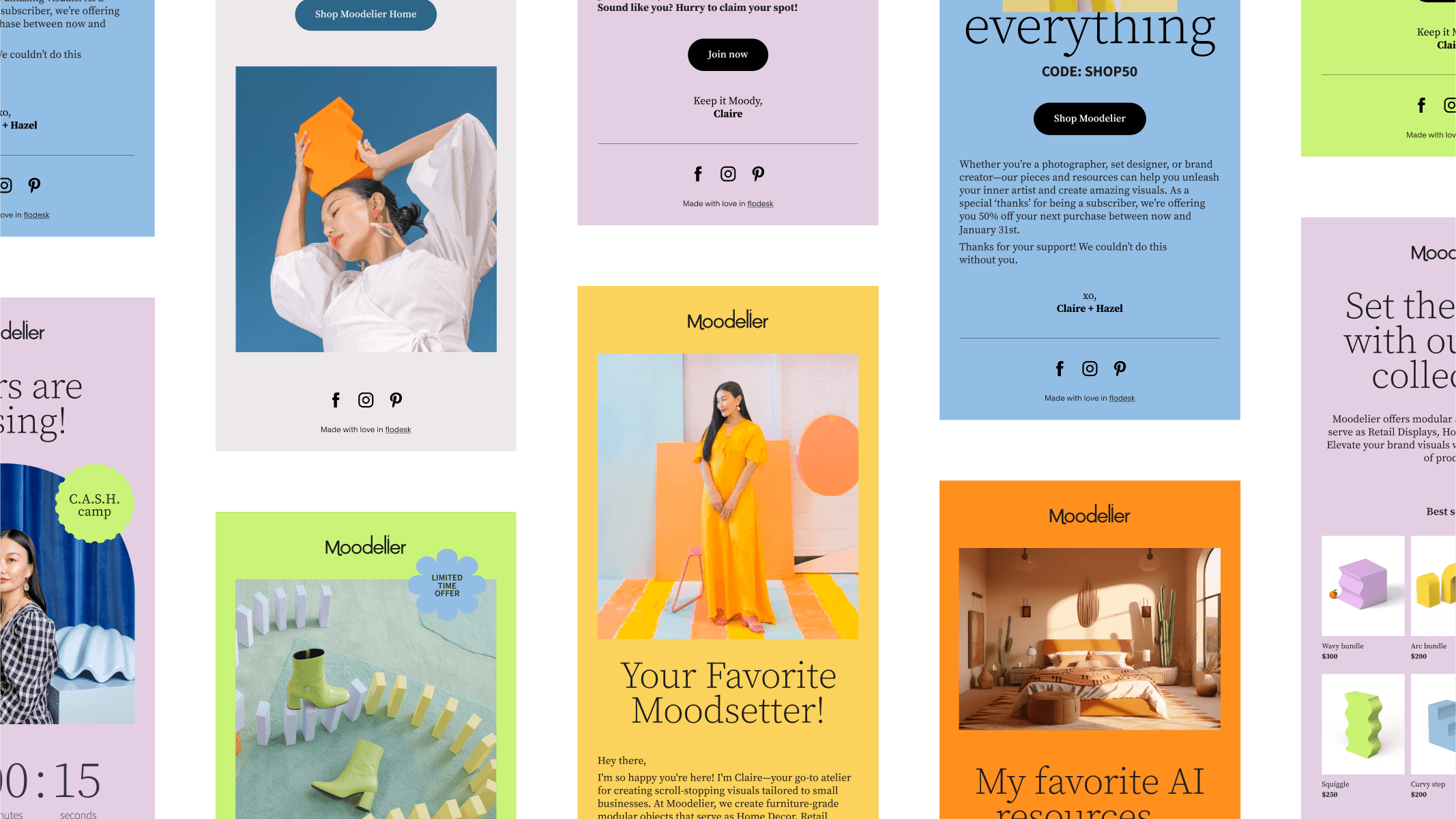
Flodesk is beautiful.
The templates are clean. The builder is intuitive. The pricing is simple ($38/month flat, unlimited subscribers).
For founders who want to send a professional-looking newsletter without learning Mailchimp's labyrinth interface, Flodesk is an obvious choice.
But here's the gap: Flodesk solves the sending problem. It doesn't solve the content problem.
Every Monday morning (or Tuesday, or whenever you've promised your subscribers a newsletter), you sit down and face the same question… what am I going to write about this week?
Some weeks you have something.
A product update, a customer story, an observation from the week.
Other weeks the cursor blinks and you scramble to produce something worth sending. By month three, the newsletter cadence starts slipping. By month five, it's "we should really send a newsletter this week" followed by silence.
This isn't a Flodesk problem. Flodesk does exactly what it promises.
The problem is that most founders treat the newsletter as the entire content strategy when it's actually the last mile of a content strategy that doesn't exist yet.
Why Your Newsletter Is Distribution, Not the Engine
The distinction matters because it determines how you invest your time.
A newsletter is a distribution channel. It takes content that already exists and delivers it to people who've opted in. It's the truck that delivers the goods. It's not the factory that makes them.
A content engine is the factory. It produces the articles, guides, comparisons, and thought leadership that the newsletter distributes. It also publishes that content on your blog, where it ranks on Google, earns AI citations, and builds the topical authority that makes your entire domain more discoverable.
When founders build a newsletter without a content engine, they create the distribution channel without the production system.
The newsletter has subscribers. The subscribers expect content. The founder has no system for producing that content consistently. So each send becomes a mini-crisis of "what do I write about?" from scratch.
The content engine inverts this.
You produce 2-4 articles per week as part of a strategic content operation. Each article is published on your blog (for SEO and AI citation), then the core insight is extracted and packaged for your Flodesk newsletter.
The newsletter is the last step, not the only step.
The Newsletter-Only Trap
Founders who rely on their newsletter as their primary content output run into three problems:
Content Doesn't Compound
A blog post ranks on Google for months or years. An AI citation earns traffic from ChatGPT and Perplexity indefinitely. A newsletter email lives for 48 hours in someone's inbox and then gets buried. The same effort (2 hours writing a piece of content) produces a permanent asset when published on a blog and a disposable asset when sent only as a newsletter.
The compounding effect is the entire reason content marketing works. An article published in January still generates traffic in July. A newsletter sent in January generates opens for two days and then stops existing. If your content lives only in email, you're building on sand.
No Search Visibility
Flodesk emails don't rank on Google. They don't appear in AI Overviews. They don't earn featured snippets. They can't be crawled by LLMs for citation. The content you put in your newsletter is invisible to every discovery channel except the inbox.
For startups that need organic traffic (and most startups do), newsletter-only content is a missed opportunity. Every piece worth sending to your subscribers is worth publishing on your blog first, where Google and AI systems can find it.
The Treadmill Effect
Without a blog or content library, every newsletter send starts from zero. No existing article to excerpt from. No data report to reference. No published framework to expand on. Each week you need a new idea, written from scratch, produced under time pressure.
This is why most founder newsletters die by month 5. The production burden is linear: the same effort every week with no system making it easier over time. A content engine makes each piece faster to produce because it builds on everything that came before it.
The Strategy: Content Engine + Flodesk Newsletter
Here's the system that works.
It uses Flodesk for exactly what Flodesk is good at (sending beautiful emails) and solves the strategy gap with a content engine that produces the content worth sending.
Step 1: Build the Content Engine First
Before you worry about newsletter frequency or Flodesk templates, build the production system.
Set up your Brand Core — your positioning, voice, ICPs, and competitive context. This ensures every piece of content sounds like your company, whether it's a blog post or a newsletter.
Map your content architecture using a Strategy Map. Which topics do you own? What clusters will you build? Where are the gaps? This architecture feeds the content engine's topic recommendations and ensures you're building topical authority, not publishing randomly.
Set a publishing cadence: 2-4 blog articles per week. Each article is published on your blog, optimized for SEO and AI citation, and internally linked to your existing content. The blog is the factory. It runs whether or not you send a newsletter that week.
Step 2: Extract Newsletter Content From Blog Articles
This is the step that eliminates the "what do I write about?" problem.
Every blog article you publish contains 2-3 newsletter segments waiting to be extracted:
The core insight. Every article has a central argument. Pull it out. Write 200-300 words of context around it. That's your newsletter's main section.
The most surprising data point. Lead with the number. Explain why it matters. Link to the full article on your blog for readers who want depth.
The contrarian take. Every good article challenges something. Turn that challenge into a newsletter aside — 2-3 sentences with a link.
You're not writing the newsletter from scratch. You're extracting the best pieces from content you've already produced. The newsletter becomes a curated summary of your week's publishing, not a standalone production burden.
Step 3: Use Flodesk for the Send
Now Flodesk does what it does best. Take the extracted content, drop it into your Flodesk template, and send.
Flodesk's design strength means your newsletter looks professional without a designer. The flat pricing means your cost doesn't scale with subscriber count. The automation features handle welcome sequences and segment targeting.
But Flodesk isn't deciding what content to create, how to structure it for search, or whether it's optimized for AI citation.
That's the engine's job.
Step 4: The Blog Compounds, The Newsletter Converts
The blog builds your informational footprint.
Articles rank on Google. They earn AI citations. They accumulate internal links that strengthen the entire domain. Each new article makes the archive more valuable.
The newsletter converts your most engaged audience.
Subscribers who read your newsletter weekly develop familiarity and trust. When they're ready to buy, you're the default option. Not because of a sales pitch, but because you've been delivering value to their inbox consistently.
The blog attracts new visitors through search. The newsletter includes a subscribe CTA that converts visitors to subscribers. New subscribers receive your newsletter, which links back to blog content. The loop compounds.

The Weekly Workflow: Averi + Flodesk
Here's what the combined system looks like in practice:
Monday: Open your Content Queue. Review recommended topics for the week. Approve 3-4 articles based on keyword opportunity, cluster needs, and editorial instinct.
Tuesday-Wednesday: The engine generates drafts with your brand voice, SEO + GEO structure, and internal links. You add the founder perspective. 15-20 minutes per article of human-layer editing.
Thursday: Edit, score, and publish to your blog through native CMS integration. Each piece is live and optimized.
Friday morning: Open Flodesk. Extract the best insight from each article published this week. Drop them into your newsletter template: headline, 200-word summary, link to full article. Hit send.
Total newsletter production time: 20-30 minutes on Friday. You're not creating content for the newsletter. You're packaging content that already exists.
What Flodesk Does Well (And Where It Stops)
Flodesk earns its reputation in a few specific areas:
Design. The templates are genuinely beautiful. For founders without design skills, Flodesk produces emails that look professional without a designer or HTML knowledge.
Flat pricing. $38/month for unlimited subscribers and sends. No per-subscriber scaling. For growing lists, this is significantly cheaper than Mailchimp, ConvertKit, or beehiiv at scale.
Simplicity. The interface is intuitive. You can build and send a newsletter in 30 minutes without a tutorial. For founders with limited marketing time, this matters.
Automation basics. Welcome sequences, segment-based sends, and workflow triggers cover the basics of email lifecycle management.
Where Flodesk stops:
It doesn't tell you what content to create.
It doesn't optimize content for search engines or AI citation.
It doesn't build content strategy or manage your editorial architecture.
It doesn't score content quality or suggest improvements.
It doesn't publish to your blog, track SEO performance, or measure AI referral traffic.
Flodesk is the last mile.
Everything upstream — strategy, production, optimization, publishing, measurement — is a different system's job.
How Averi Fills the Strategy Gap
Flodesk handles the send. Averi handles everything upstream.
Brand Core ensures every piece of content (blog articles and newsletter extractions) sounds like your company. Consistent voice across channels.
Strategy Map organizes your content into clusters so you're building topical authority, not publishing randomly. The map feeds the Content Queue with strategic topic recommendations.
Content Queue eliminates the "what should I write?" problem every Monday. Recommendations arrive based on keyword data, cluster gaps, and performance signals.
SEO + GEO Optimization structures every piece for Google rankings and AI citations — so your blog articles build permanent, compounding visibility instead of living only in inboxes.
CMS Publishing pushes articles to your blog in one click. No copy-paste formatting.
Analytics show which articles drive the most traffic, which keywords are growing, and which content earns AI citations — informing both your blog strategy and what to feature in your next newsletter.
Averi produces the content.
Flodesk delivers it.
The blog compounds.
The newsletter converts.
The system runs.
Start building your content engine →
Related Resources
Resources for Flodesk Users
Flodesk + SEO: How to Drive Email Signups With Organic Content
The Best AI Writing Tools for Flodesk Users Who Need Blog Content
Flodesk Content Calendar: How to Plan Email and Blog Content Together
How to Create Blog Content for Your Flodesk Audience (Without Writing Everything Twice)
Flodesk for Bloggers: What You Need to Know Before You Start
Can You Use Flodesk for Content Writing? Capabilities, Limits, and Better Options
Why Your Flodesk Open Rates Are Dropping (And How Content Marketing Fixes It)
How Small Businesses Use Flodesk + Averi to Run Marketing Without a Team
The Content Marketing Stack for Flodesk Users: What You Actually Need
How to Repurpose Your Flodesk Newsletters Into Blog Content That Ranks
FAQs
Can I use Flodesk as my entire content marketing strategy?
You can send newsletters with Flodesk, but a newsletter alone isn't a content strategy. Newsletter content doesn't rank on Google, earn AI citations, or compound over time. It lives in inboxes for 48 hours. A content engine that publishes to your blog builds permanent, searchable assets. The newsletter distributes those assets to your subscriber list. Both are valuable. Only the blog compounds.
How do I decide what to put in my newsletter vs. my blog?
Everything goes on the blog first. The blog is the canonical, permanent, searchable version. The newsletter contains extracted summaries — the core insight, the most surprising stat, the contrarian take — with links to the full article. You're not creating separate content for the newsletter. You're packaging blog content for the inbox.
How often should I send my Flodesk newsletter?
Weekly is the standard for B2B startups. If you're publishing 3-4 blog articles per week, a weekly newsletter summarizing those articles gives subscribers a curated digest. The production time is 20-30 minutes because you're extracting from existing content, not writing from scratch. Some founders send twice weekly or bi-weekly depending on publishing velocity and audience expectations.
Is Flodesk better than beehiiv or ConvertKit for startup newsletters?
Different strengths. Flodesk wins on design quality and flat pricing ($38/month unlimited). beehiiv wins on newsletter-as-product features (monetization, referral programs, web hosting). ConvertKit (now Kit) wins on creator-oriented automation. For a founder who needs a clean send tool alongside a separate content engine, Flodesk's simplicity and flat pricing make it a strong choice. The strategy and production happen upstream.
Does newsletter content help with SEO?
Not directly. Flodesk emails aren't crawled by search engines. But the blog articles your newsletter promotes do build SEO and AI citation authority. When subscribers click through from the newsletter to your blog, those engagement signals (time on site, pages per session) can indirectly help rankings. The strategy: publish for SEO, distribute through the newsletter.
How does Averi work with Flodesk?
They handle different parts of the workflow. Averi produces the content: strategy, topic selection, drafting, editing, scoring, and blog publishing. Flodesk distributes the content: you extract newsletter segments from your published articles and send them through Flodesk templates. Averi's Analytics tell you which blog articles resonated most, informing what to feature in next week's newsletter.
What if I don't have a blog yet?
Start one. A blog is the foundation of every content marketing strategy because it's the asset that compounds. Averi publishes directly to Webflow, Framer, or WordPress through CMS integration. Set up the blog, start the content engine, and layer the Flodesk newsletter on top once you have 4-8 published articles to draw from.